Why I’m There On Pure Virtual Events

January 28, 2011

Introduction

Over on the INXPO blog, I wrote a posting on Why I’m There on Pure Virtual Events.  The posting was a counterpoint to an article written by Dave Lutz (@VelChain) of Velvet Chainsaw Consulting.

Dave’s Points

Dave made the following points on “pure” virtual events:

  1. Attendees value the content not the commerce.
  2. They tend to attract an entry- or mid-level professional that lacks enough buying authority or influence to deliver ROI to exhibitors and sponsors.
  3. Networking feels limited if it occurs at all.
  4. It’s difficult to build trust that leads to purchase through a virtual booth.
  5. When education is offered for free and archived, it’s easy to find something more pressing to do. Archived views are less valuable than live ones.
  6. And finally, most webinars stink. I can count the good ones I’ve experienced on one hand.

Point, Counterpoint

I provided some counterpoints to the points.  Here’s a link to the full posting:

http://inxpo.wordpress.com/2011/01/27/why-im-there-on-pure-virtual-events/

I’d be interested in your thoughts – questions include:

  1. What your thoughts on hybrid events?
  2. What are your thoughts on pure virtual events?
  3. How can webinars be more engaging?

Leave a comment below with your thoughts – thanks!


Book Supplement: Virtual Event Lead Management (#leadmanagement)

January 22, 2011

Introduction

In “Generate Sales Leads With Virtual Events,” Chapter 6 is titled “Score and Follow Up with Leads”.  This really could have been Chapter 7 – and instead, Chapter 6 could have focused on important steps to consider before scoring.  Before you import your virtual event leads into your CRM system, consider these important steps first.

Step #1: Beware of the “Drive-By Viewing”

Someone visited your virtual booth – congratulations! Not so fast.  Make sure the booth visit was not a “drive-by viewing”.  I define a drive-by viewing as:

  1. One (and only one) visit to your booth
  2. “Visit time” of 5 minutes or less
  3. No engagement with others while in the booth (e.g. group chat, private chat)
  4. No interaction with booth content (e.g. booth tabs, documents, links, etc.)

I see plenty of drive-by viewings from booth visitors. Some visitors simply want to see which companies are exhibiting at the virtual event.  And, some virtual platforms have “previous” and “next” buttons in the virtual booths, which means that drive-by visitors may simply be doing a quick tour of all booths.

Drive-by visitors are not leads – they’re NAMES!  My recommendation for drive-by visitors:

  1. Go ahead and import them into your CRM system
  2. Schedule a “thanks for visiting” email
  3. Using simple text links, provide them with a few options (e.g. receive more content, schedule an appointment, etc.)
  4. Respond accordingly – and, if they do not open the email or respond to the offers, cease communications [for now] and nurture them over the long term

Step #2: Beware of Existing Leads and Business Partners

Your virtual event leads can look like a pile of dominoes.  You may not be aware that within that pile of dominoes are existing sales prospects, along with current customers and business partners.  When you exhibit at a virtual event, your sales team is inclined to invite current prospects to come visit – and, your existing customers and partners are inclined to stop in to see what’s new.

Warning: LEAD IMPORT CAN BE DANGEROUS TO YOUR HEALTH.

If you don’t manage your leads well, you may import “hot prospects” (who are already in your CRM system) and trigger a follow-up email to them.  The result is a turning back of the clock with those prospects – imagine finalizing your purchase decision, only to have one of the potential vendors call on you and ask if you’re in the market for their product!

Personal Story: I attended a virtual trade show and did a “drive-by viewing” through an exhibitor’s booth.  I’ve been a long-time subscriber to this exhibitor’s email newsletter and know some of the employees there.  My drive-by viewing was done simply to see who was staffing the booth.

A few days later, I received an email from the exhibitor, asking if I’d like more information.  This exhibitor probably should have known that I was a long-time subscriber – and, routinely click on the links in their newsletter.  Given this, the follow-up should have been more tailored, or skipped entirely.  If I was contemplating a purchase  decision with this exhibitor, that follow-up email could have cost them my business.

Step #3: Build and Import Engagement Profiles

Virtual event platforms have built-in RFID, which means that all interactions from sales prospects (with your content) are tracked and recorded.  The platforms assemble a detailed “engagement profile” for you – the worst thing you can do is throw away that profile when the lead is imported into your CRM system.  My guess is that the majority of marketers today do just that.

Instead, create custom fields in your CRM system to capture this data (e.g. number of visits, documents downloaded, transcripts of chats, etc.).  The more data, the more informed your sales team.  Just like an auto insurer reviews your past driving record and a loan officer reviews your past credit history, your sales team should have the benefit of a prospect’s past engagement data.

Step #4: Curate Leads as You Would Fine Art

You can automate portions of lead management, but you can’t automate the entire process.  It’s easy to automate the de-duping process, which ensures that new records are not created in your CRM system when there’s an existing lead record.

However, it’s not as easy to automate the business intelligence that needs to be applied to your leads (e.g. you can’t do AI on your BI). Examples of business intelligence rules:

  1. Knowing (and spotting) competitors
  2. Knowing (and spotting) existing business partners
  3. Knowing (and spotting) industry experts, analysts, media [who should not be followed up with]
  4. Spotting “creatively submitted” leads, such as “Mick E. Mouse” or “Barack Obama”

Sure, you can automate part of this by filtering on a list of company names, but there are bound to be some leads that slip through the cracks.

For instance, users may have a typo in their company name – or, may list their company differently that what you’ve entered in your filter list.  Your leads are the lifeblood of your business, so you should curate them as if they were fine art.  This means that manual review will always be a part of the lead management process.

Conclusion

Lead Management is not easy.  However, perform these steps before your first virtual event lead hits your CRM system – and you’ll be better off.  Your sales team will receive a far higher percentage of qualified leads – and they’ll thank you for that.


The Virtual Book Tour

January 21, 2011

Introduction

I recently read the excellent book “The On-Demand Brand: 10 Rules for Digital Marketing Success in an Anytime, Everywhere World,” by Rick Mathieson. In addition, I published my own book, “Generate Sales Leads With Virtual Events”.

To uphold the “on-demand brand” of the new book, I’ve decided to forego the traditional book tour. Instead, I’ll embark on a virtual book tour.  I consider the virtual book tour a “virtual event”, which is what my book is about, after all.

Virtual Book Tour

OK, so it’s not even a full blown virtual tour, I admit. That may come, some day.  In the meantime, I will be handing out 5 free copies of the book.  Here’s how you can grab a copy:

  1. Visit the book’s Facebook page.
  2. “Like” the book’s Facebook page. If you’ve previously “Liked” the page, I thank you for that – as a special reward, skip to step #3.
  3. Post a “valid question” about the book to the Facebook page’s Wall.

“Valid questions” must show that you’ve read the description of the book – and, understand the premise. I promise to answer all questions deemed valid.

How to get your copy

The first 5 people to complete the three steps (above) will receive a free copy of the book, which includes free shipping to the address of your choosing.

Unfortunately, I need to restrict the free shipping offer to continental U.S.  only – I’ll contact you to arrange shipping if you’re a winner who resides outside of the U.S.


Introduction to HuzuTech: A Social Media Software Company

January 17, 2011

Note: The following posting was submitted by Graeme Harvey, Managing Director, HuzuTech

Graeme Harvey is MD of HuzuTech, a social media software company. He’s been involved with HuzuTech since 2009, and before that he started up a successful digital publishing division within Harpercollins publishers, concentrating on online, desktop and mobile application development. There, he developed a digital business that underpinned the Collins Language division – the first of its kind within Harpercollins UK (it included the first e-commerce, e-book and mobile app presence).

Introduction

HuzuTech is a British social and virtual technology company. We’ve just launched our white label virtual world platform, HuzuVirtual, which lets brands, publishers and film or TV production houses create their own branded virtual worlds and online environments – at a fraction of the cost of building one from scratch.

We also white label our own social networking platform, HuzuSocial, which lets brands offer secure social networking facilities (including within a virtual world, through full integration with HuzuVirtual) and the ability to link to Facebook.

Branded communities

We announced the launch of HuzuVirtual at AdTech New York recently, and the response was fantastic. We know that virtual worlds are a huge growth area for publishers and media companies, but what was really interesting was the appetite for brands to create their own communities.

As online communities become integral to brands’ marketing campaigns, there is a reluctance to hand over control of customer data and relationships to a third party like Facebook, and requirements for more sophisticated or bespoke technology to manage those relationships effectively.

Customisation

As a result, our technology is completely customisable, with functionality that includes things like the creation of different virtual environments, rooms or ‘levels’ to the world; avatar creation; virtual (or real) goods shop; fully moderated chat functionality; custom-branded avatars; and special events such as online meetings, concerts, and VIP areas. It’s cloud-based, because it is designed to be able to cope with rapid growth, when the community grows exponentially.

Monetisation

There’s also the thorny issue of monetisation. More and more, brands are seeking to monetise their online environments. Sales of branded goods are expected to grow by more than 100 per cent over the next three years. We’ve included virtual shopping features in HuzuVirtual, and the feedback we’ve had so far has been that brands definitely want to control an environment where customers are paying for their goods.

Demonstrating the Technology

We’ve developed a site to show how the technology works, including some really great features like routing technology (which means an avatar will always follow a path – rather than walking ‘through’ obstacles), and ‘motion’ sensors (see how the car alarms going off when the avatar walks past them) here: http://paperworld.huzutech.com/.

Note: this isn’t a virtual world in itself, but shows the kind of technology we can use. We’re constantly tinkering with it to make it better, and we’re always interested to know what other people think of it.

The first full virtual world built on our platform will be out in around June 2011, and is for Scholastic’s Horrible Histories™ – it’s a great one to be working on and shows how the publishing industry is one of the first to adopt these new technologies to market books.

If you’re interested to know more, visit our website: www.huzutech.com.


Virtual Event Email Promotions and Hotmail Active Views

January 14, 2011

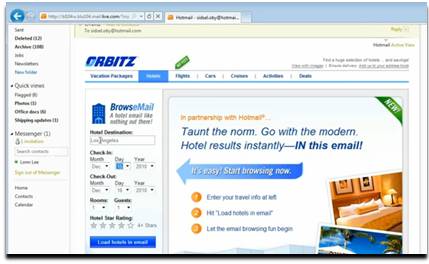
Note: Image sourced from a Hotmail YouTube video.

Introduction

The Hotmail Team has introduced an interactive email technology called Active Views.  The technology allows recipients of Active Views emails (within Hotmail) to interact with the email itself.

Hotmail showed examples of two of their early partners, Orbitz and Monster.  Recipients of the emails could search a flight (in the Orbitz email) or search for jobs (in the Monster email).

Interactive Emails and Virtual Event Promotions

Interactive email technologies present interesting possibilities for virtual event email promotions – and, more broadly, for any email promotion that seeks to elicit a response.  Imagine the following for virtual event email promotions:

  1. Register for the virtual event
  2. Enter your Twitter, Facebook, LinkedIn, etc. identity and see which of your followers, friends, connections, etc. have already registered
  3. Navigate through the session schedule and indicate which sessions you’re interested in attending
  4. Complete your attendee profile – upload your image/photo and add a short bio
  5. Social sharing – let your social networks know that you’re interested in the event – or, that you’ve just registered

The possibilities are endless.

Considerations

  1. Only Hotmail “trusted parties” can utilize Active Views
  2. The technology is platform-specific (it’s limited to Hotmail)
  3. The technology is new and largely untested (at a large scale)
  4. It remains to be seen how well the technology functions across platforms (e.g. email clients, operating systems, tablet devices, etc.)
  5. While security provisions are in place, it may open a window for providers of phishing and malware

Related Links

  1. Active Views introduction on the Inside Windows Live blog
  2. TechCrunch: “Hotmail Active Views Look To Make Email Interactive
  3. ClickZ: “Hotmail Active Views Revives E-mail Innovation in 2011

Lead Generation With Virtual Events (#LeadGen Resources)

January 10, 2011

Introduction

Virtual events can be a highly effective tool for generating sales leads (if done right!).  I’ve assembled a few relevant and timely resources related to virtual event lead generation.

Lead Generation & Virtual Events @ Virtual Edge Summit

I gave a presentation at Virtual Edge Summit 2011 titled “Lead Gen and Nurturing with Virtual Events“.  I was joined by Tom Donoghue (Enterprise Developer News) and Craig Rosenberg (FOCUS).  In the session, we covered:

  1. How to generate leads (promotional tactics)
  2. How to engage with leads during the virtual event
  3. How to qualify and follow up with leads after the virtual event

I’ve included my portion of the presentation – which focused on 5 Tips for engaging with your audience at a virtual event.

Fork In The Road Blog on Virtual Event “Selling”

I spoke to Michelle Bruno (@michellebruno) about my 5-Step Plan for exhibiting at virtual events:

  1. Define your mission statement
  2. Assemble an all-star team
  3. Build and promote your presence
  4. Engage with prospects
  5. Qualify and follow up with prospects

Michelle provides a great summary of our conversation on her blog.

RainToday.com Podcast – Accelerated Lead Generation

I spoke to Michelle Davidson, Editor at RainToday.com, about lead generation and virtual events.  I call it accelerated (online) lead generation, since you can generate leads, while engaging with them in real-time.  You can listen to the recording – or download it – on the RainToday podcast page.

Conclusion

I’d love to hear about the gaps in the market – if you’re interested in generating leads with virtual events, what questions have not yet been answered for you?


2010 In Review for It’s All Virtual

January 2, 2011

The stats helper monkeys at WordPress.com mulled over how this blog did in 2010, and here’s a high level summary of its overall blog health:

The Blog-Health-o-Meter™ reads Wow.

Crunchy numbers
About 3 million people visit the Taj Mahal every year. This blog was viewed about 33,000 times in 2010. If it were the Taj Mahal, it would take about 4 days for that many people to see it.

In 2010, there were 87 new posts, growing the total archive of this blog to 202 posts. There were 220 pictures uploaded, taking up a total of 8mb. That’s about 4 pictures per week.

The busiest day of the year was September 28th with 213 views. The most popular post that day was Trends In The Virtual Worlds Industry.

Where did they come from?
The top referring sites in 2010 were twitter.com, linkedin.com, facebook.com, en.wikipedia.org, and hootsuite.com.

Some visitors came searching, mostly for virtual calendar, match.com, all virtual worlds, gregory house, and comdex.

Attractions in 2010
These are the posts and pages that got the most views in 2010.

1

Trends In The Virtual Worlds Industry September 2010
6 comments and 1 Like on WordPress.com,

2

Virtual Events Calendar December 2008
14 comments

3

The Business Benefits Of Second Life March 2010
2 comments

4

About December 2008
16 comments

5

COMDEX Re-Launches As A Virtual Trade Show March 2010
1 comment