Online Marketers: How to Sell Virtual Tradeshows to the Boss

December 15, 2008

Has Bruce Springsteen (The Boss) ever participated in a Virtual Tradeshow (VTS)?  I’m not sure, but if I were an online marketer, here’s how I’d convince my Boss on them.  The first thing I’d do is look for B-to-B publishers who are “flooring” industry virtual events that align with my product marketing initiatives.  Go find out (from the publishers) who’s already committed to sponsor the VTS.  If you’re picking the right events, you’ll notice that your competitors are already on the list.  If they’re not there, then perhaps you need to seek out alternative events.  But wait – you could also be “first in” with the right event – so just be sure the event’s theme aligns with your marketing plans.

So the first point to make to your boss is that your competitors are already on board.  So, NOT participating in the same event is a lost opportunity to have a place at the table alongside your competitors.  I do see attendees at virtual events ask, “Why isn’t <COMPANY> here?”.  If it’s a prominent industry VTS, your absence can speak volumes.  Next, develop an explicit goal for your boss  that clearly demonstrates the ROI.  For instance, how about a goal of 5 late-stage sales engagements – where you’d have to come up with a clear definition (for your boss) of “late-stage”.

Now that you have your boss’ ear, go with the lower tier sponsorship available.  These sponsorships are priced less because rather than receiving all leads (including no-shows), you only generate leads from attendees who directly interact with you (e.g. visit your sponsor booth or download your content).

This puts the onus on you, because you become directly responsible for the success of the campaign – the more visitors you can drive to your booth, the more leads you generate.  The upside, though, is that you can influence the cost per lead (CPL) that you achieve.  And there’s a possible win-win scenario: low CPL’s and a better qualified lead.  Your boss might like to hear about the low CPL, but make sure to emphasize the qualified leads – they’ve had direct interaction with you and their actions with your people or your content tells a lot about them.

Now, to get you to those 5 late-stage sales engagements, you have more work to do.  Remember that these are shared leads, not exclusive leads.  If a VTS had 10 exhibitors, a given attendee might have visited 7 of the 10 booths.  This means that they become leads for 6 other companies, some of whom are your direct competitors.  You’ll need to convert these leads more effectively than your competition.  And often times, this comes down to the simple determinant of, “who acts first”.  Don’t let those hot VTS leads sit in limbo in a spreadsheet or CRM system queue.  Get those leads over to telesales (or direct sales) and call them tomorrow.  If you don’t, you can be sure that your competition is.  And that hot lead suddenly becomes your competitor’s customer.  A shame!

So in summary, here’s an approach that leverages VTS to fuel the sales pipeline at a reasonable cost (making you and The Boss look good):

  1. Convince the boss
  2. Go with the lower tier VTS sponsorship (costs less – but places onus on you)
  3. Be an All-Star performer at the VTS (see related article)
  4. Close the loop by having Sales follow up with the hottest leads
  5. Reap the benefits
  6. Lather, rinse and repeat!

If you’ve never exhibited at a VTS before, enjoy the ride.  I think you’ll find it to be fun.


Leverage Twitter for Virtual Tradeshow Outreach

December 15, 2008

When Sarah Lacy interviewed Mark Zuckerberg on-stage at South by Southwest Interactive this past March, rumblings spread throughout the audience regarding Lacy’s interview style.  A few in the audience extended the rumblings online via Twitter – and from there, Twitter’s network effect quickly spread the commentary across the globe.  The power of Twitter (and related social networks) can be a real boon to B-to-B events, precisely because of the network effect:

So let’s imagine I’m logged in to a Live Virtual Tradeshow (VTS).  I’m visiting exhibitor booths, viewing Live Webcasts and interacting with peers.  All in all, I’m enjoying myself.  I want to spread the word to friends and colleagues.  One quick (and efficient) way to do that is to post a message to Twitter.

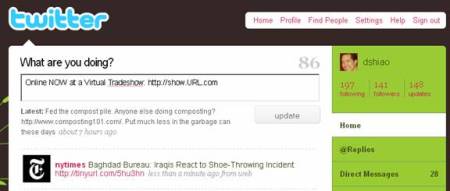
Twitter home page

Twitter home page

I can “tweet” about the Virtual Tradeshow and pass along a URL to my 141 followers.  If any of those followers likes the recommendation, they can “retweet” my message to their followers.  If 5 of my followers spread the word and they each have an average of 100 followers, then my message had a potential audience of 141 + (5 * 100) = 641.  And that doesn’t even count any downstream distribution via my followers’ followers.  If my tweet happens to be picked up by a Twitter power user, my message could be seen by her 10,000 followers!

You can see how quickly and efficiently information is published.  And that’s the beauty of the network effect.  As I amass more followers – and, as more users sign up with Twitter – the potential audience of my “tweets” grows exponentially.  The result is a powerful tool for B-to-B marketers and publishers, if used right.  Publishers need to grow their audience in order to grow their revenue – new audience results in more page views, more ad impressions delivered, more online sales leads.  Where can you find that audience?  On social networks like Twitter.

VTS platform providers may want to consider:

  1. A “post to Twitter” utility within the VTS – make it convenient for VTS attendees to post a message to Twitter, including an auto-shortened URL (so their followers can access the event)
  2. A “Twitter reflector” that takes selected chat messages from the VTS and posts them to Twitter.  Imagine a user engaged in a “group chat” area who wants to share her insight simultaneously to the VTS attendees and her Twitter followers.  Allow her an easy way to do that.  Again, include a shortened URL that points back to the event

Of course, Twitter is not the only social network out there (I haven’t even mentioned Facebook and its 130MM users).  So while I’ve outlined a few ideas that are specific to Twitter, the bigger picture concept is about integrating the VTS platform with an assortment of networks.  The trick will be to pick the right ones.

You can follow me on Twitter here: http://twitter.com/dshiao


How to Exhibit at B-to-B Virtual Tradeshows

December 14, 2008

Planning to be an exhibitor at a B-to-B Virtual Tradeshow (VTS)?  Here’s how to become a VTS All-Star:

  1. The right people – to attain All-Star status, first find your own team of all-stars from within your company.  You’ll want a good mix of product folks (product managers and/or product marketers), sales folks (direct sales reps or Inside sales reps) and technical folks (engineers or sales engineers).  Prepare your team for the event by bringing them up to speed on VTS (if this is their first time) and give each member clear goals of what you’d like them to do and accomplish.  For instance, the sales folks proactively connect with attendees; the product marketers participate in the public forums; the sales engineers are “on call” to the product marketer in case a really tough technical question is asked.
  2. The right content – place content in your virtual booth that is directly applicable to the theme of the event.  Take the time to carefully select your White Papers, Case Studies, podcasts, videos, etc.  Don’t simply repeat what you used at an unrelated event.  Attendees will be on the look-out for useful content, so if you’re selections are on the mark, you’ll generate more views and downloads.  Think of it as a form of search engine optimization – where the “spider” is the visitor to your booth.
  3. The right actions – train your booth reps to proactively connect with your booth visitors.  Thank them for their visit, send them a virtual business card, invite them to review your booth’s content.  Ask them about specific challenges they face and have your product marketers suggest solutions.  You’ll come out ahead if you help the attendees, rather than doing a hard sell on your products and services.  Attendees at B-to-B virtual events are not shy about seeking you out, which means they’ll come asking for pricing and product information.  When they do, make sure you have answers – or, be able to find an answer within an hour.  There’s no greater shame than getting hot leads at a VTS and then making them wait for the info they’ve asked for.
  4. The right prizes – that’s right, everyone loves the giveaway, even if it’s as small as a $25 gas card or coffee card.  A “big prize” (e.g. Nintendo Wii or HDTV) always attracts attention, but I like doing a large number of smaller prizes – reason being, attendees like the immediate gratification of winning a small prize, instead of receiving a chance to win the big prize.  So whether  it’s 100 USB drives or 50 Starbucks gift cards, you’ll get the attendees’ attention.  The most effective prize I’ve seen – copies of a book (by an expert) whose name was known by all attendees.

So there you go.  Do the “right” thing to secure your spot on the VTS All-Star Team.  Good luck and have fun.