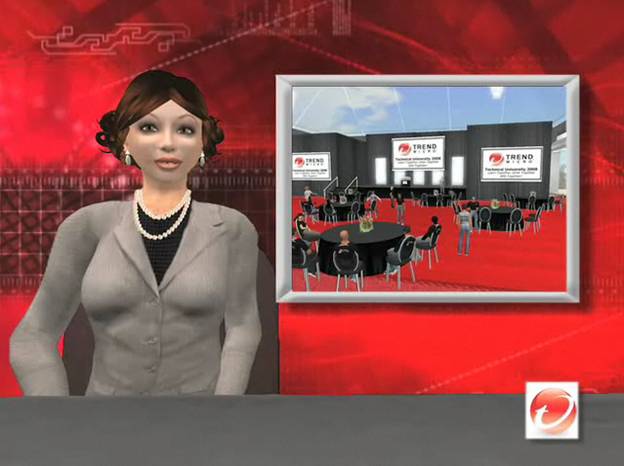
Virtualis and Trend Micro Put On Quite A Show

February 5, 2009

Trend Micro

Source: Trend Micro

The Virtualis Convention and Learning Center is an island within Second Life that’s produced by California-based Corporate Planners Unlimited.  Trend Micro, a technology provider of endpoint, messaging and web security, recently hosted a 2-day live event within the Virtualis’ Second Life convention center.  Virtual Worlds News has detailed coverage of the event here:

http://www.virtualworldsnews.com/2009/02/corporate-planners-unlimited-growing-virtual-events-in-second-life.html

Dan Parks, President and Creative Director at Corporate Planners Unlimited (and Founder of Virtualis) is quoted extensively in this article regarding the demand for virtual events (and Virtualis), their cost efficiency and uses of Virtualis by other clients of his.  As interesting as the technology is (and it sure is cool), I found the virtual event planning (by Virtualis and Trend Micro) to be most interesting.

In the Virtual Worlds News article, you can view a 2 minute video overview of the event (given by a Second Life avatar / news reporter, no less).  Alternatively, the same video is available on this page: http://silverandgoldie.com/trendmicro.htm (Machinima by Silver & Goldie, who [presumably] produced this nifty segment).

Virtualis and Trend Micro named the event Trend Micro Virtual Technical University – an internal-facing training venue for 75 Trend employees (also called Trenders) across 5 locations.  Day 1 started with an introduction (and keynote of sorts) by Harry Coit, Trend Micro’s Director of Technical Support, North America.  Harry welcomed the Trenders, who sat around round tables in folding chairs.  Harry’s goals for the 2 days:

  • Collaborate
  • Building strong relationships
  • Have some fun

The in-world sessions were spread across two tracks – product sessions and educational sessions.  The product sessions provided product updates on emerging technologies, along with case studies on the latest web threats.  The educations sessions included creativity sessions, which were held in futuristic settings (where avatars sat around in Jetson-like furniture).

Trend Micro

Source: Trend Micro / Virtualis

For fun, the event included four unique technical challenges.  In a parachute challenge, avatars descended from the sky in parachutes and had to score points by grabbing balls that flew by.  A treasure hunt challenged participants to find specified items throughout the island – scores were tabulated and the top 2 teams squared off in a Trend Micro Tech Challenge – a live game show that was played in front of the entire audience.

Trend Micro

Source: Trend Micro / Virtualis

At the end of the first day, a night club hosted dancing, along with music from “one of Second Life’s most popular entertainers”.  All in all, quite a show.  I admire the attention to detail paid by Virtualis and Trend Micro in planning the events – this was truly a melding of virtual world benefits with the full trappings of an all-day physical (corporate) outing.  The typical applications of virtual worlds and virtual tradeshows –  lead generation, marketing, exhibiting products and services, internal training – has now taken on a new angle.  We’re now seeing internal training, complete with virtual team building!


Search Engine Optimization (SEO) For Virtual Events

February 2, 2009

Flickr (martin.canchola)

Source: Flickr (martin.canchola)

These days, any publisher of information on the web is very keen to Search Engine Optimization (SEO).  If you build it (SEO) into your pages, they will come.  If you don’t, then you’re missing out on page views.  But, with all the effort we place on optimizing our web sites (e.g. corporate web sites, content sites, social media sites, etc.), how much SEO effort do we put into our virtual event pages?  I get the feeling that the answer today is “not much”.

For the external (non-private) virtual event, show organizers and exhibitors often judge success based on the number of registrations, attendees and interactions.  Basically, “the more, the better”.  However, what’s the largest source of registrations for most virtual events?  Outbound email promotions to (usually) large lists of users – where you’re hoping that some percentage of users open your email, click on the email and convert into a pre-registered attendee.  Very low on the list today is organic traffic from search engines like Google, Yahoo or MSN.

So the opportunity is quite large – improve the SEO of your virtual event and you can make a big impact on registrations, attendees and exhibitor satisfaction.  But where to start?  Well, first identify the pages on which to apply your SEO tactics.  For a virtual event, we’re usually talking about the microsite that describes your event – date, hours, speaker bios, etc..  The microsite often has separate tabs to list the event’s agenda, existing exhibitors, contacts for sponsorship info and (importantly) the event’s registration page.  All of these pages/tabs should have SEO applied.

A nice overview on SEO is titled “Search Engine Optimization 101” by Marketleap, a division of Acxiom Digital.  You’ll want to apply some of the basic concepts discussed here – including the right content on your virtual event pages; the use of meta tags; how to write good titles and strategic use of keywords.

Next, you’ll want to foster in-bound links to your virtual event microsite.  Promote the virtual event on your corporate web site (with a link).  Place links to the virtual event in your social networks (e.g. Twitter, Facebook, Linkedin, etc.).  Find blogs related to your industry and leave comments there.  Don’t blatantly promote your virtual event in the blog comment, but refer back to it (e.g. when leaving the comment, have your name be hyperlinked back to your virtual event’s microsite).  The more inbound links you can create, the higher your microsite will rank with the search engines.

Correction: comments you leave on other blogs can help with clicks (back to your blog), but do not help with SEO – most blog sites utilize a nofollow directive on the anchor tag, so search engines do not “follow” hyperlinks left in blog comments.

Finally, if your virtual event is not behind a registration wall (e.g. maybe it’s a 365 day, open environment), then make sure you provide “search engine friendly” content pages within the platform that search engine spiders can index.  Stay away from the Flash-heavy page and go with a flat, content-rich page.  Users will land here (from search engines), so be sure to provide easy navigation from this page to the main areas of the event (or environment).

For b-to-b virtual tradeshows, I’d estimate that well south of 10% of registrants are sourced from search engine traffic today.  Make it a goal at your next event to hit the 10% mark.  Your email lists will thank you.