Draft The Right Team For A Successful Virtual Event

June 28, 2009

draft_team

Last week, the National Basketball Association (NBA) held its annual draft in New York City’s Madison Square Garden.  Some teams were looking for the missing link to their 2010 NBA title aspirations – while others were looking to build a new foundation from scratch.

In either case, it’s important to know what you need – and then make the right talent evaluations to select the players that best fit your needs.  Similarities exist when planning a virtual event – draft and assemble the right team and you have the potential to bring home the championship.  Build your team incorrectly and you’ll miss the playoffs.

Continuing with the basketball analogy, here’s how I’d assemble my virtual event team:

  1. The Center – for many teams, both the offense and defense revolve around the important center position.  For a virtual event, the Center is your content – the theme, the independent expert presenters, the presentations themselves, etc. Make this your number one draft pick – identify the target audience for your virtual event and then select the best players who will deliver the most compelling content to that audience.  Be sure to make this a slam dunk (pun intended).
  2. The Point Guard – the point guard is often considered the surrogate coach on the floor – s/he dribbles the ball up the court and commands the offense.  In a virtual event, the point guard is the Event Host or Event Planner – the person who’s responsible for coordinating all the various parties involved in the execution of the event.  Rookie point guards rarely excel in the NBA – so make sure you have a veteran player running point in your virtual event.  If you have rookies on board, have them play the understudy role, so that they can grow into a starting role for the next virtual event.  A virtual event is best produced by someone who’s run the show many times before.
  3. The Shooting Guard, Small Forward and Power Forward – these players round out your squad – in basketball, they do a combination of scoring, defending, shooting, passing and rebounding – just about everything.  In a virtual event, these are your production assistants, project managers, webcasting engineers, video engineers, campaign managers, quality assurance engineers, etc.  As with any top team, this portion of your roster needs to have talent and depth – when one player becomes unavailable, the next one must step right in.  Championships cannot wait – and neither can the virtual event that’s one month away.

As general managers are astutely aware, assembling the right pieces is no guarantee of success.  As in sports, virtual events depend on the following:

  1. Team Chemistry – if pairs of groups have worked well in the past, keep them together for subsequent events.   This way, they don’t have to re-learn each others’ working habits and personalities.  As in sports, team continuity improves the likelihood that you’ll win over and over.  On the client-facing side, identify team members whom specific clients love – and keep them on those same client accounts – they’ll thank you for it.
  2. The Front Office – in sports, a front office that puts a good team on the field often reaps the benefits of strong ticket sales.  In virtual events, the quality of the team is independent of attendee interest.  Here, you need talented and knowledgeable front office staff to handle the audience generation for the virtual event – email blasts, web site syndication, social media integration, etc.  The best  (execution) team on the planet is useless if your virtual attendance is poor – so the audience generation crew is critical.
  3. In-Season Moves – championships are often won and lost by in-season moves – trades, player signings, managerial firings/hirings, etc.  For virtual events, you’ll find many inflection points where critical decisions need to be made.  Whether it’s a shift in the audience generation strategy or a change to the content/theme – making the right decision can make or break the event.  Make sure you weigh all decisions as a team – and remember, virtual event decisions do not need to be approved by the league office (ha ha).

With the virtual event season in full swing – best of luck to you all – bring home a winner!


A Virtual Event For All Seasons

June 17, 2009

Scheduling of large physical events seems to follow a seasonal pattern.  With the exception of CES (Jaunuary 7-10 2010) and Macworld (February 9-13 2010), there are fewer events at the very start of a calendar year – many event planners are probably thinking that fresh off the holidays, potential attendees are less inclined to travel.

The event schedule then picks up a little steam in February and March and by spring time, we’re in full bloom.  The summer seems to get its fair share of events – but at the same time, some event planners may scale back on a summer schedule due to vacation schedules (and the fact that kids are home from school).  As we head towards the Thanksgiving holiday in the U.S., the event schedule seems to taper – and during the December holidays (Christmas, Hanukkah, etc.) there seem to be very few physical events scheduled.

Virtual events follow a similar seasonal pattern. There were virtual events in January and February of this year, but the pace seemed to pick up in March – with a build-up to June, which could be our high water mark for virtual events this year.  I maintain an informal Virtual Events Calendar, which lists 21 virtual events in June, with only 3 currently listed for July.

Seasonality

Do virtual events really need to follow seasonal patterns?  Here are my thoughts:

  1. Consider the convenience factors – virtual events are convenient for all parties involved (virtual event planners, exhibitors, attendees) – there are no travel arrangements to be made and no booth materials to ship.  For booth material, one can leverage existing White Papers, Product Collateral, etc. – and not have to send hundreds of documents to the color printer.  For exhibiting or attending, one can login from anywhere (in pajamas).  As such, the traditional danger zones (e.g. Thanksgiving week, Christmas week, etc.) may be less relevant for virtual.
  2. Use virtual to complement physical – would I place all my bets on a successful virtual event on December 23rd?  No.  But, I might want to floor a virtual event on December 23rd that complements another physical or virtual event.  Additionally, I may want to leverage the virtual event platform to power a business community that’s open year-round, rather than being “live” on a given date.

The key to the success of a virtual business community will be a critical mass of participants.  Live virtual events are successful because a critical mass of live attendees gather to view content and interact with one another.  If I login to an virtual community and no one else is online, it means I have no ability to interact with someone in real-time.

I’ll be able to view content and participate in message boards, blogs, etc. – but at that point, it’s no different from using a conventional social networking site.  All in all, the possibilities are very exciting.  I know that my own calendar is booked solid (virtually) through the end of the year.


Real-Time Search For Virtual Events

June 15, 2009

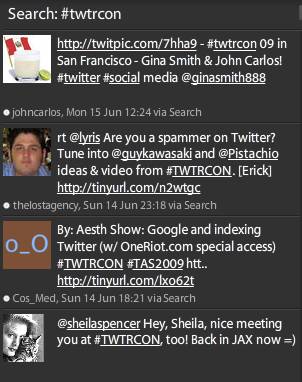
Among its many uses, Twitter has become an indispensable technology for event planners – whether the events are physical, virtual or mesh/hybrid.  Just about every event today defines a Twitter hashtag, which allows Twitter users (“tweeps”) to associate their tweets with the event.  If you want to follow comments about TWTRCON SF 09 (which is now over), just search for the hash tag “#twtrcon” in the Twitter client of your choosing.  Here’s how it looks for me in Tweetdeck:

tweetdeck_twtrcon

The great thing about Tweetdeck is that the “search view” updates in near-real-time, which means that as new tweets are posted with that hashtag, I see them appear in this particular search pane.  Periodically glancing at a hashtag search in Tweetdeck allows me to keep my finger on the pulse of a live event that might be occurring hundreds of miles away.

Similarly, I’ve attended physical events where I’ve spotted Tweetdeck running on attendees’ laptops – clearly, they’re tweeting about panel discussions, keynote presentations, etc. right there from the event itself.  Those who left their laptops tucked away are likely sending status updates from a Twitter client on their smartphone.

The beauty of Twitter is not just in its capability for organizing a global discussion around particular events – it’s also great for tracking what’s being discussed around a topic.  For a b-to-b marketer, you might want to know what’s being said about your products and services.  For a salesperson, you might want to know how the competition is positioning themselves.  Twitter allows you to search for that chatter in real-time – and, third party services (e.g. tweetbeep, twilert, etc.) allow you to set up agents to send you search results via email.

Now, let’s consider a virtual event.  With all due respect to great White Papers, Case Studies and Product Collateral, I find that the most interesting content at a virtual event is the group chat that occurs in booths and lounges (e.g. the Networking Lounge).  If microblogging content occurs in the statusphere, then I think of a virtual event’s chat content as the chat-o-sphere.

In a very active/engaging virtual event (e.g. lots of activity, plus a number of interesting Webcasts/Videocasts), it can be hard to keep up with all the interesting discussion in the chat-o-sphere.  If I’ve attended a 50-minute Webcast and return to the Lounge, I’ll often find 100 chat entries added since my last visit – it can be challenging to read through what I’ve missed.

Virtual event platforms may need to consider Twitter-like capabilities to search the chat-o-sphere in real-time – and, provide Tweetdeck-like widgets to keep real-time views on specific tags or search terms.  Exhibitors at a virtual event may be interested in real-time searches on the following terms (within a Lounge chat):

  1. Mentions of my company’s name
  2. Mentions of my own name
  3. Mentions of my competitor companies’ names
  4. Mentions of my products
  5. Mentions of my compentitors companies’ products

An exhibitor tracking these search terms can quickly send a product marketer, sales engineer, etc. into the Lounge to quickly address questions being posed – or, simply participate in the discussion.

What do you think about the chat-o-sphere in virtual events – is there value in real-time search against it?

Related Links

  1. NY Times: Hey, Just a Minute (or Why Google Isn’t Twitter)
  2. Blog posting: For Virtual Worlds Info, Here’s Whom I Follow on Twitter (and Why)
  3. Blog posting: Leverage Twitter for Virtual Tradeshow Outreach

Four Ways To Make Virtual Conferences Better

June 9, 2009

Nick Morgan, on the Conversation Starter blog at Harvard Business Publishing, wrote a recent posting titled “Three Ways To Make Conferences Better“.  To summarize, Nick’s suggestions are:

  1. Tell a unique story
  2. Make attendees active participants, rather than onlookers
  3. Leverage the gathered group to give something back to the community in which the conference is held

Nick’s blog posting served as inspiration for me – I’d like to cover ways to make virtual conferences better.  Virtual conferences (along with virtual tradeshows, virtual job fairs, etc.) do allow attendees to participate – in fact, some of the more interesting “content” in a virtual conference is the free form text chat that occurs in areas like the Networking Lounge.

And by its nature, a virtual conference gives back to the community in the form of carbon emission avoidance, time savings, convenience and productivity gains.  As for telling a unique story – that’s something I have not seen virtual conferences achieve.  But at the same time, I don’t think physical conferences do a good job of  this, either.

Without further ado, here’s my list:

  1. Leverage a Requests For Proposal (RFP) Tool for attendees – in a b-to-b virtual conference, you often find that the exhibitors offer a common set of products and services (they’re direct competitors).  As an attendee, the virtual conference affords me with a convenient and efficient means for comparison shopping.  So if I’m in the market for blade servers, I might want to spend time visiting numerous booths, downloading product collateral and chatting with some booth reps.  Instead, what if I could fill out an online form (within the virtual conference) and tell prospective vendors what I’m looking for?  Perhaps I need 1U blade servers with redundant power supplies and are remotely manageable.  I fill out my RFP form, check off the exhibitors that I’d like to receive my request and click “Submit”.  I then receive responses within the virtual conference environment from exhibitors – and start to create my short list, based on those responses.  As one can imagine, such a tool could greatly benefit attendees and exhibitors.
  2. Play some games – making games available within the virtual conference creates a sense of fun, which increases attendee satisfaction – this, in turn, increases retention and session time (attendees remain in the environment longer).  And of course, you’re not hosting the game solely for the sake of fun – you’re forcing participants to perform desired activities (e.g. visit a booth, view a Webcast, etc.) in order to advance within the game.  Again, win-win scenario – attendees and exhibitors benefit.
  3. Incorporate social media – attendees at physical conferences generate lots of Twitter, Facebook, etc. updates  from their PDAs.  In a virtual conference, it’s all too easy to remain well-connected with your social networks.  That being said, don’t force attendees to leave the virtual environment – instead, provide interfaces for them to post a status update directly from the virtual conference platform!  They should be able to tweet directly from the virtual conference, update their Facebook wall, etc.  This provides a convenience to the attendee and generates no-cost “PR” of the virtual conference across social networks.
  4. Embark with an Aardvark – a new service that describes itself this way —  “just send Aardvark a message through IM, like you do when talking to a friend.  Aardvark figures out who might be able to answer, and asks on your behalf — Aardvark is the hub.”  While it might be interesting to consider an integration directly from the virtual conference to the Aardvark service, it’s the concept that most interests me.  And that is, tapping into the collective wisdom assembled at a virtual conference in order to help attendees answer questions.  After all, most b-to-b virtual conference audiences login to the event with a common set of business or technical challenges.
Source: Aardvark (vark.com)

Source: Aardvark (vark.com)

Related Links

  1. Blog posting: Three Ways To Make Conferences Better
  2. Blog posting: Virtual Events And The Power Of Social Media (authored by me on my company’s blog)
  3. Blog posting: Cisco has integrated Twitter into their Cisco Live Virtual event
  4. About Us page: Aardvark

A Second Look At Second Life

June 3, 2009

Source: San Francsisco Business Times

Source: San Francsisco Business Times

“A lot of Silicon Valley has written Second Life off.  The tech world will have to revisit Second Life as a phenomenon in the next six months or so.”

Thus spoke Wagner James Au, noted virtual worlds author and blogger in a San Francisco  Business Times article on Second Life (note: the full article is available to paid subscribers only).  Au, who blogs at New World Notes about Second Life, notes in the article that Linden Lab CEO Mark Kingdon has renewed the Second Life brand that was created by founder Philip Rosedale.

While the revenue model for Twitter is slowly coming clearer (judging by the accounts in the business media), Linden Labs’ strategy under Kingdon is becoming quickly self-evident with the announcements of the past few months.  From my perspective, Kingdon’s growth strategy is around a few core pillars:

  1. Enterprise use of Second Life – makes sense, as enterprises and corporations can be monetized at a higher clip than individuals, artists, hobbyists, etc.  Enterprises (in the former of marketers) were a big portion of Second Life during its initial peak – and it seems the current focus is to bring marketers back into the fold, along with complementary uses in non-marketing disciplines (e.g. training, enablement, collaboration, etc.).  In the past 6 months, Linden Lab has hired 25 marketing and product people as part of their push for enterprise clients.  In addition, the company recently hired Amanda Van Nuys as Executive Director of Enterprise Marketing, signaling a further endorsement of the opportunity in the enterprise.
  2. Nebraska – an on-premises software version of Second Life  (compared to their Software as a Service model), which enterprises can run on their own servers behind the firewall.  IBM has been an active partner with Linden Lab on behind-the-firewall integration – the telltale sign will be how many other large enterprises opt for the Nebraska model.  For “behind the firewall” use, I have to think that we’re talking less about marketing and more about collaboration.
  3. Voice – not mentioned in the Business Times article, but Virtual Worlds News covered it well – Linden Lab is poised to go after the Skype market with capabilities to bridge voice calls and SMS messages between the real world and Second Life.  In the Virtual Worlds News article, Linden Lab Vice President of Platform and Technology Development Joe Miller notes, “The opportunity to monetize at a significant added value for our business is there”, regarding the opportunity in Voice.

IBM marrketing executive Karen Keeter notes in the San Francisco Business Times article that nearly 100 IBM’ers are “working on virtual world tools for commercial sale in Second Life and on other platforms”.  As such, IBM stands to achieve commercial gain from increased use (by enterpises) of Second Life and related virtual worlds.

In fact, it wouldn’t surprise me to see IBM leverage virtual worlds to generate services revenue.  Two things come to mind – IBM Global Services and IBM’s Smarter Planet initiative.  IBM Global Services could assist enterprises on their virtual worlds strategy (e.g. build me a virtual world representation of my data center, so that I can run heating and cooling simulations) – or, IBM could go in-world to enterprise’s private virtual worlds to provide traditional consulting services within the virtual world.

So a manufacturer who’s replicated their factory in a 3D world can have Global Services visit (in-world) to optimize their factory floor workflow.  Then, of course, Global Services could help facilitate the parallel action in the real world.  On the Smarter Planet project, IBM might create 3D models of the next generation power plant to show utilities how to become more energy efficient.  In a virutal world, I’m sure the possibilites are limitless.

Finally, Dan Parks of Virtualis is featured in the article.  Virtualis created a compound in Second Life with 34,000 square yards of meeting rooms.  Quite an interesting model – an event producer that leverages a re-usable area (virtually) to host meetings for corporate clients.  Companies who have done events with Virtualis include Deloitte, Oracle and Trend Micro.

I’d be interested in your thoughts – what do you think about the potential of Second Life for enterprises?

Related Links:

  1. Blog posting on Virtual Offices, with reference to Amanda Van Nuys’ use of Second Life
  2. Blog Posting: Virtualis and Trend Micro Put On Quite A Show
  3. Blog Posting: Philip Rosedale On Building A Business: Practice Extreme Transparency
  4. Blog Posting: IBM’s Second Life ROI: The Headline Beneath The Headline