What the San Francisco Food Bank (@SFFoodBank) Taught Me about Volunteerism #GivingTuesday

November 27, 2012

#GivingTuesday: November 27, 2012

Today, November 27, 2012, is #GivingTuesday. Learn more about #GivingTuesday and consider getting involved.

Introduction

The San Francisco Food Bank

Recently, I volunteered at the San Francisco Food Bank (@SFFoodBank). I joined the Northern California chapter of my college’s alumni association and spent two hours sorting, packing and sealing one-pound bags of rice.

The rice would be going to partner organizations, to be prepared and served on Thanksgiving. Volunteering at the food bank was quite rewarding — and at the same time, it taught me a number of things about volunteerism. Let’s explore further.

1) Together, we can solve big problems.

Volunteers in the kitchen of the San Francisco Food Bank

Image: My volunteer group at San Francisco Food Bank.

I was delighted to see well over 60 volunteers participate in our volunteer session. In addition to our alumni group, there were college students, individuals and families. Broad and complex issues exist (e.g. hunger, homelessness, etc.) but together, with the spirit of volunteerism, I think we can make a difference.

2) Break large and complex problems into solvable chunks.

Food Banking graphic

Image source: The Global Food Banking Network.

A fairly sophisticated supply chain helps to feed the hungry. Suppliers donate food items to food banks, volunteers help process and package the donated food, the food banks distribute the food to partner organizations and the partner organizations prepare the food and provide them directly to those in need.

In addition, national and global organizations exist to provide services across entire networks of food banks. One such example is Feeding America. So in short, no one organization does it all. Instead, organizations exist inside a supply chain and play a particular role. They receive input from another organization and drive output (which becomes input to yet another entity).

At the San Francisco Food Bank, we used another sort of supply chain, in the form of an assembly line. The volunteers at each table had defined roles:

  1. Pour rice from large bags into a bin.
  2. Approximate one pound of rice (into a bag).
  3. Measure the bag to precisely one pound.
  4. Seal the bag.
  5. Confirm the seal and pack the bags into a box.
  6. Seal the boxes.

3) Be specific about the impact of volunteering.

While sorting and sealing the one pound bags of rice, we were told that rice would be prepared and served on Thanksgiving. So each bag that we packaged could feed one person (or more). At the end of our shift, we were told that the group collectively packaged 3,360 one-pound bags of rice.

So we did a small part in helping thousands of people get a Thanksgiving Day meal. Knowing the specific impact of your effort makes the volunteering more rewarding – and, encourages you to come back again. Next time, perhaps, you’ll sort meats that will go to feed thousands more.

Similarly, I love the model of DonorsChoose.org, a web site that accepts donations for specific classroom needs (posted by the classroom teacher). With charitable giving, you sometimes don’t know where your donation is going. With DonorsChoose, it’s just the opposite, as your donation funds a particular need – and, you’ll even receive a progress report from the classroom.

4) Be specific about the impact of donations.

Three ways you can help the SF Food Bank

Speaking of donations, food banks depend on financial donations. And right up front, the San Francisco Food Bank tells you the impact of your donation: “For every $1 you donate we’ll distribute $6 worth of food!”

Similarly, Feeding America shows different donation amounts, along with the number of meals they can purchase:

Make a difference by donating to Feeding America

Image source: http://feedingamerica.org/about-us/mission-and-values.aspx

5) Encourage participation by groups.

I performed my volunteer shift along with my college’s alumni group. I also saw families (including kids!) and groups of college students. Encouraging volunteerism via groups is a win/win, as more people participate, which means that more people go home and spread the word. In addition, a group volunteering activity can bring the group (i.e. a family) closer together.

Conclusion

Volunteering at the food bank convinced me that we can make an impact on the world, a dent in the universe. This Thanksgiving, in fact, the San Francisco Food Bank delivered over one million pounds of food! The great thing about volunteerism is that it’s so easy to get involved. If you don’t have time, consider donating money. If you don’t have money to spare, consider sparing some time.

Note: I invite you to connect with me on .


How a Pinterest Board Gained Popularity After I Stopped Pinning

November 19, 2012

@dshiao's MLB 2012 pin board on Pinterest

Read my prior post: 5 Things I’ve Learned About Pinterest

Introduction

At the start of the baseball season, I created a MLB 2012 pin board on Pinterest. Throughout the season, I’d pin images (mostly of players) as I read articles about the teams I follow.

I’d see a modest amount of Likes and Repins. I’d get more activity around popular or “interesting” players – injured closer Brian Wilson (of the San Francisco Giants) fitting into the latter category.

As the regular season drew to a close, my activity on Pinterest waned. My last pin was on September 30, 2012, before the start of the post-season. Throughout the playoffs, I’d continue to see modest amounts of activity on my board. And then the San Francisco Giants won the World Series.

Current Events Drive Interest in Pins and Boards

Once the Giants won the World Series, activity on Giants-related pins increased

While I’m a diehard New York Yankees fan, I reside in the Bay Area. And that means that I follow the local teams, the Giants and the A’s. Not surprisingly, you’ll find lots of Yankees, Giants and A’s in my MLB board.

The Email Settings menu in Pinterest

My Pinterest account is configured to send me email notifications for activity on my boards. And let me tell you, ever since the World Series ended, I’ve been receiving a daily stream of emails. Users are finding images I pinned (of Giants players) and they’re Liking and Repinning quite a lot.

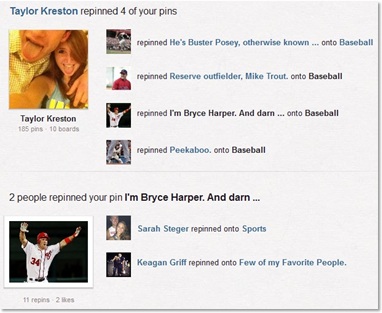
Of course, shortly after the World Series comes the post-season awards (e.g. Cy Young, MVP, etc.). So it’s not a coincidence to see activity (on my Board) related to the award winners: Mike Trout and Bryce Harper (rookies of the year) and Buster Posey (NL MVP):

Activity for pins on Bryce Harper, Buster Posey and Mike Trout

What Makes Pinterest Unique

I found the result counter-intuitive: that activity would pick up on a social network after I ceased my own activity on it. That would not happen on Twitter, Facebook or Google+. And that’s what makes Pinterest unique. Let’s consider the reasons.

It’s Both Timeless and Timely.

I’ve written before about how Twitter rules the roost on the real-time web. Real-time content, however, is “forgotten” a minute, hour or day later. On Twitter, it’s quite rare to receive a retweet on content tweeted a few days (or weeks) prior. On Pinterest, as you’ve seen with my MLB board, the activity continues to occur on images I pinned weeks (and months) earlier.

And while the unit of content (an image) is timeless, interest around that content can be tied to timeliness (e.g. the Giants winning the World Series). So as far as content sharing goes, you have content that “lives longer” than real-time content – and, can spur activity around events happening in real-time.

It Drives a Different Consumption Model.

Twitter (and Facebook, too) is all about the “scan.” I have hundreds (or thousands) of items in my feed and I quickly scan for items of interest, not paying particular attention to any one item. Pinterest also drives “scans” (of images), but because of the timeless aspect, there’s more browsing than scanning.

On Twitter, the half-life of content is short: current events, sports scores and the like, and that adds to the “quick scan” consumption model. On Pinterest, users are more apt to browse, discover and take their time.

Its Attribution Model Facilitates Curation

Let’s compare the retweet to the repin. Here’s how a retweet (that I performed) appears in my profile:

How a retweet appears in the user's Twitter profile

You’ll notice that the original tweet is preserved, including the “author” of the original tweet (@AllthingsIC). Now, let’s consider a repin. I originally pinned this image of Brandon Crawford and here’s how the repin appears on another user’s board:

How a re-pinned pin appears in the user's board

You’ll see that my original caption (about Brandon Crawford) is preserved (although users have the option to change it when repinning), but notice that, unlike in a retweet, my identity (as the original author) is not listed. You have to click on the pin to see the attribution:

The original pinner has attribution listed on the pin detail page

This attribution model facilitates curation because it leaves a “cleaner” board, while providing proper attribution one level deep.

For Marketers, It’s The Gift That Keeps Giving.

My MLB 2012 board has taught me that on Pinterest, content can have nine lives. Online marketers using Facebook and Twitter should consider a Pinterest strategy. Pinterest can create an annuity around your content: an investment that continues to pay out over time.

And here’s the kicker: you pin content from pages, which means that users who find your pins have the option of clicking through to the page (on which the image is found). What does that mean for online marketers? The ability to drive page views – and even product sales, for online merchants.

Conclusion

Let’s recap. Pinterest is an entirely unique social network. It all starts with a timeless “sharing unit” (an image), which can gain popularity around current events. The consumption and attribution models help to drive sharing (via curation). And users (i.e. pinners), can receive ongoing returns for activity they generated months (or even years) prior.

Note: I invite you to connect with me on .


10 Reasons Print Rules in The Digital Age

November 12, 2012

Image source: User delusionalcubsfan on flickr.

Introduction

I subscribed to a magazine just once in my lifetime: it was in high school and I responded to a promotional offer for a 12-month subscription of SPORT magazine. According to Wikipedia, the magazine was shuttered in August 2000.

I’m now onto my second-ever magazine subscription, which is somewhat ironic in this day and age. Why did I do it? Because an airline (which I don’t fly any more) sent me a notice in the mail, indicating that a significant number of my frequent flyer miles were about to expire.

One way to consume those miles is to purchase magazine subscriptions. And I did just that, opting for 12 month relationships with Sports Illustrated and The Economist. In this era of tablets and smartphones, I’ve discovered a number of benefits of old fashioned print. Here are ten of them.

1) Raises questions from the kids.

I have one child, so when I say “kids,” I mean my daughter and her grade school friends. Today’s generation engaged with technology moments after exiting the womb. And it amuses me how much technology shapes their world.

When kids saw the DVD display in the ceiling of my car (a technological marvel when it was installed), they were amazed that a physical disc is needed to watch a film. One child asked, “Can’t you download the movie onto that?” So with magazines, it’s great when kids ask me what is “that thing” I’m reading? After all, it doesn’t reside on a tablet.

2) Opening and viewing a two-page spread is (still) magical.

A two-page spread in Sports Illustrated, featuring Oscar De Lla Hoya

Yes, the iPad, with its retina display, provides visually stunning images. But there’s something about opening up a two-page spread in Sports Illustrated (SI) and “taking in” the image for a little while. After the 2012 World Series, SI published a three-page spread, with the third page tucked underneath the first page. The top half was a panoramic shot of the Giants’ AT&T Park. The bottom half was Comerica Field. And it was awesome.

3) Gives you an excuse to go offline.

It’s rare to be offline these days. We’re always an email, text or phone call away from work, family and friends. But with a magazine, I can head to a park bench, tuck my phone in my pocket and read an entire issue from front to back. Note: despite that statement, I’m rarely able to make it happen.

4) Creates an appointment-based experience.

I love checking my mailbox for the week's issue of SI

I’m a creature of habit, a lover of routines. So I love going to my mailbox every Thursday and grabbing the SI from among the circulars, junk mail and related offers. It’s like the days when I was a Netflix subscriber and I’d look first for that red envelope. I save portions of my Thursday evenings for reading the latest issue of SI. And that routine is supreme.

5) Allows you to fully immerse in something.

Related to being offline, the magazine allows me to go somewhere quiet and fully immerse myself. SI keeps me up to date on the sports world, while The Economist keeps me current on the world. How often can you claim that you’re fully immersed in anything these days?

6) It’s so retro, it’s in.

Publishers are shuttering magazines and newspapers and moving things online (if at all). In relative terms, there’s a dearth of print publications out there. So I when I walk through town toting my SI issue, I’m not afraid to show it. I’m retro and I know it.

7) Engage with advertisements. Yes, advertisements.

I pay attention to the ads in SI

Sure, magazines have been far less successful of late in selling ad pages. If magazines were pizza, we’d all learn to appreciate the thin crust variety. But what I’ve found is that the ads that do make it in are quite contextual to the adjacent pages. And that’s good for readers.

Unlike online banner ads, I pay full attention to the ads in magazines. Banner ads can be contextual, but the amount of targeting and re-targeting done is reaching the point of creepiness. So  I love knowing that my viewing of a print ad is not being track by Big Brother Online. At least not yet!

8) Page turning feels right.

Yes, we’re all used to the swipe of an index finger to turn a page. But we do that so much that I’ve come to enjoy the physical page turning involved in magazines. And that also applies to books, for which I’ve been reading the old fashioned format (print).

9) Multiple ways to hold and fold.

On a tablet, it’s portrait or landscape. With a magazine, there are more ways to hold the pages. Do I spread out both pages, or do I fold the two in half? Or, do I fold half of the right page over the back of the left page? The possibilities are endless.

10) Exercise more fingers.

With a tablet, it’s all about the index finger, with occasional thumb action. With print, I’m able to keep more fingers in shape by involving them in the experience.

Note: I invite you to connect with me on .


Ten Ways Marketing Services Differs from Marketing Products

November 7, 2012

Linda Holroyd, CEO and Founder of FountainBlue

The following is a guest post by Linda Holroyd, CEO and Founder of FountainBlue.

Read this blog’s related posts on product marketing.

Introduction

Back in the day when Sun workstations sold like hotcakes and everyone was waiting with bated breath for Windows 95 (98, 2000), product marketing managers for technology products were well respected for what they did:

Define and drive the product development cycle in collaboration with marketing, sales and engineering.

This is not so long ago, but times have changed to the point where products are becoming more commoditized, where software solutions are in the cloud, where services rein over products, and where even companies like Microsoft are looking at how to provide customized services to their network of customers.

Product Marketing for Service-Oriented Solutions

What does this mean for today’s product marketing managers, who are focusing more on service-oriented solutions? We interviewed Dr. Juan P. Montermoso, President at Montermoso Associates and Professor of Practice in Marketing at Santa Clara University, who spoke at the October 3 SVPMA event titled “Marketing the Experience: Applying PM Concepts to Services and Events.”

The program description notes that more than 70% of GDP in places like the United States, the Netherlands or Australia is service-based, while 60% of revenues for companies like IBM are attributable to services. For tech product managers and CMOs of tech products and services companies, the message is clear: designing, marketing, and delivering not just profitable services but memorable experiences will be the keys to success.

10 Tips for Marketing Services

Here are the top ten keys for doing just this. Product marketing a service has the same fundamental qualities as marketing a product: its focus on products, pricing, and promotion.

  1. Know your product details, market segment and your customer niche, and communicate your offerings based on the needs of your customers.
  2. Your promotion and pricing should speak to the needs of the customer and your product offerings should be designed to serve their needs, not the other way around.
  3. Continually seek feedback from the customer about the value of what you are providing and get their input about how to make it better for them. It is essential to gather this feedback to refine product features and definitions, pricing strategies, promotional plans.
  4. Create a community for your clients, partners and other stakeholders and provide value-added information, connection and services to them. This is an efficient way to build deeper relationships, connect with your customers, and add value beyond your current offerings.
  5. Work in conjunction with the marketing, sales, engineering and management team to address the needs of the customer, for knowing what the customer wants, in isolation of what a company will deliver is only half the solution. The new way users are selecting products and services is no longer about the sales process and funnel, but has evolved into a complex, multi-faceted, multi-directional stages of evaluation, consideration, advocation, experiencing and buying, as well as bonding with others throughout the process. (See McKinsey Quarterly Report article’ The funnel is dead. The new consumer decision journey,’ http://www.mckinseyquarterly.com/The_consumer_decision_journey_2373). So as we evolve into the marketing of services, and address the decision processes for the more empowered user, we must still consider the products, price and promotion, but also look further into the overall user experience:, the process, physical environment and people who impact the users and the choices they make.
  6. The experience a user undergoes to evaluate, adopt, advocate, endorse, recommend a service must be seamless and elegant, and should be easy to communicate to friends and groups. And collaboration between marketing, sales, management and engineering is even more important to deliver this experience.
  7. There must be an efficient process for customers to easily adjust and communicate parameters and requirements, as well as a process and methodology for providers to efficiently and sustainably deliver these customized services.
  8. Bonding is now an element of the decision-making process, so it is more important to identify and speak to the needs of niche customer groups as well as individual customers, and creating and leveraging social media and community development and support abilities will be more important as you do so.
  9. Content matters. Service marketing must communicate the core technology offering, as well as the range of customized adaptations of what you could do with the core technology, and speak in a vocabulary and voice a customer will understand. And this must hold true for each niche audience.
  10. Social media solutions will be an integral part of success service marketing efforts. Leaders in this space such as LinkedIn, Facebook and Twitter are strategizing on how to create and support niche communities of many different colors and stripes, and creating a value to these individuals and companies, a value worth charging for. Product/service marketing professionals would benefit from following what’s happening with these social media leaders as they consider the privacy, policy, outreach, integration and other challenges and opportunities for creating and developing these niche audiences.

Conclusion

Regardless of where you are in the product/service continuum, product marketing will continue to play an essential role in the success of any tech company. I invite you to share your thoughts in the Comments section below. You may also contact FountainBlue via email.

About Linda Holroyd

As CEO and founder of FountainBlue, Linda and her team produces in-person events and writes and speaks on market, technology and leadership trends. Linda also serves as a start-up adviser to Silicon-Valley-based high tech companies focused on delivering personalized services to clients worldwide.

Previously, Linda was co-founder and CEO for Galatia, a high-tech, service-oriented web consultancy in the emerging internet field, where she oversaw the development of dynamically-generated web sites in the financial services, government, high tech, and academic industries.

Prior to that, she engaged in similar marketing, alliance, operational and sales roles in three emerging start-ups in the document imaging, file security and web development space. Two of the start-ups were purchased and one of them is still running. Linda is a graduate of UC Davis with a major in Psychology and a minor in Education, and earned certificates in nonprofit management, executive management and program management through UCSC Extension and San Jose State.

She serves on the advisory boards for VLAB, WITI and WCA, as well as her client companies.


Twitter on The Real-Time Web: There is #NothingBetter

November 5, 2012

Image source: User “thecampbells” on flickr.

Introduction

It’s a Sunday afternoon and the New York Giants are visiting the Dallas Cowboys. The game is being shown locally (in the Bay Area), but I’m at an outlet mall in Napa, CA. I search the stores and the food court, but no one is showing the game.

So I do the next best thing. With the battery on my phone running low, I make my way to the mall’s management office. It’s closed, but there’s an air conditioned hallway and bingo! An available outlet. So I charge my phone and make myself comfortable on the floor. From that spot, I take in the second half of this exciting game … via ESPN Gamecast.

ESPN Gamecast

If you can't watch on TV, using ESPN Gamecast on the web is the next best thing

ESPN Gamecast, delivered via your browser, is quite good. I’ve been using it to “watch” MLB and NFL games. It provides near real-time, play-by-play updates on the game, all without having to refresh the page.

In NFL games, Gamecast provides you with the result (e.g. “10 yard pass to the NYG 40 yard line”) and a few seconds later, updates the play with more details (e.g. “10 yard pass to the NYG 40 yard line. On a CROSSING PATTERN”).

Occasionally, I’ll get antsy when no update has been posted for 10 seconds. I’ll refresh the page to see if that pulls in the latest play. Sometimes that works. Other times, the game may have gone to a TV timeout without me realizing it.

An Endless Wait on a Key Play

And then it happened. Late in the fourth quarter, Gamecast posted an update that Dez Bryant of the Cowboys had caught a go-ahead touchdown. I was quite bummed. But then I noticed that no further updates (e.g. extra point, kickoff, etc.) were posted for close to a minute.

I then saw Gamecast post an update that the play was under review. A few minutes turned into a few more minutes. I nervously anticipated the replay result, but no news as of yet. So I turned to Twitter.

Real-Time Updates on Twitter

On checking my Twitter stream, I immediately saw tweets like these:

Twitter users provide insight about a key play in the game

And that’s when I realized:

On the real-time web, there is nothing more real-time than Twitter.

As it turned out, the call was reversed and the Giants held on to win the game.

It's official: the play was overturned

If you weren’t watching on TV, then Twitter was the place where you’d get the replay result first (it beat Gamecast by a few minutes). Twitter can be even quicker than real-time in some instances – it can serve as a leading indicator of what’s about to happen (e.g. sports, stocks, box office receipts, elections, etc.).

How Twitter Facilitates Real-Time So Well

The User Adoption and the Follow Model

Let’s face it, Twitter is the place where athletes, coaches, sports writers, general managers and owners choose to provide their updates, thoughts and musings to the world.

When I watch a big game, I can always turn to Twitter to get real-time scoring updates – and importantly, real-time commentary on what’s happening. And it’s all because the “right” people are active on Twitter – and, I’ve chosen to follow them there.

#WorldSeries was a popular hash tag during the Fall Classic

Additionally, beyond the athletes and the “experts,” millions of fans (like me) are active on Twitter as well. And while I may not follow them all, I can experience their tweets via event or team-specific hash tags, such as #Giants, #Postseason, #WorldSeries and #SuperBowl.

The Efficiency of 140 Characters

Twitter would be an entirely different animal if it permitted 280, 560 or 1,400 characters. The 140 character limit results in short bursts of updates and the smaller “payload” means that information can be distributed, read and processed quicker. For real-time updates, after all, we don’t want essays, we want snippets.

Accessibility Any Time, Anywhere

When watching sports at home, we’re likely on our laptop or tablet. Outside of home, however, we’re probably on our smartphone. And that makes it convenient to share real-time information with others – and to consume it as well.

That’s why Twitter has been effective in providing real-time information during natural disasters. A Mercury News article about the Tohoku Earthquake (in Japan) noted that the Internet (and Twitter) was used to communicate information when the phone system was unavailable.

To quote a member of Cisco Systems’ emergency response operations, “text data uses a relatively smaller portion of bandwidth than voice data does.”

Conclusion

In the big picture, an NFL game is trivial compared to other real-world events. But like those other events, things unfold in real-time.

And experiencing this NFL game via Twitter helped me fully grasp how effective it is for real-time communications. In fact, I’m looking forward to tomorrow’s presidential election here in the United States, during which Twitter will provide me with updates. In real-time, of course.

Note: I invite you to connect with me on .