Launch Your Next Product Online

December 22, 2008

In 2008, I worked with a few savvy technology vendors to launch their products online in a virtual event.  We called these “virtual launch events”.  They were hugely successful – the vendors generated a slew of net new sales leads, educated prospects and customers about the features of the new product and connected employees, executives and channel partners directly with the same prospects and customers.

Because all users participated online, costs were efficient and the participation was highly convenient.  Additionally, the vendors and their partners were able to achieve deep (online) engagement with prospects, including in-depth text chats regarding the products.

If you’re considering a virtual launch event of your own for 2009, here are my Top 3 best practices:

  1. Encourage participation from your partner ecosystem – your resellers, consultants, etc. should have booths at the event.  This reinforces the full “value chain” of your product – showing prospects that your solution is backed by an assortment of partners who sell the product and provide valuable services around it.  Secondly, you can recoup some of the costs of the event by charging your partners to exhibit.  After all, they’re receiving sales leads as a result of participating.
  2. Active participation from your executive team – have the SVP or GM of your product officially launch the product via video – prospects and customers will apprecitate the personal connection of video (vs. slides and audio).  In addition, have the same exec(s) participate in the booths and networking areas, connecting directly with attendees.  Customers and prospects highly value direct access to your executivies.  And, your SVP or GM will find the experience valuable, since they’d likely admit that they’d like to get out in front of clients more often.  Finally, a successful event makes you a hero in front of the SVP/GM.
  3. Bring an independent voice – you probably have relationships with analyst firms (e.g. Forrester, Gartner).  Have a prominent analyst give her perspective on the product you’re launching and what it means for your market.  This independent voice helps complement all of your (and our partners’) presentations.

Best of luck on your 2009 launches!


Utilize Surveys in Virtual Events

December 19, 2008

Online marketers often speak of hard ROI (explicit return) and soft ROI.  In this economic climate, soft ROI is being cut and marketers are focusing (with rare exception) on hard ROI.  But what if you could generate hard ROI and soft ROI simultaneously?  Would your CMO or CFO like that?  I’d bet that the CMO would, at minimum.

So consider the use of surveys within your virtual events.  Let’s say you generated 200 visitors to your booth.  And let’s say 70% of those visitors completed an online survey that was available right there in your booth (equalling 140 survey completes).  You might think I’m crazy to suggest that 70% of visitors would actually fill out a survey.  But what if you provided a prize?  And, you qualified visitors into the prize drawing via completion of the survey?  I’ve seen it with my own two eyes – one particular event had 70% of booths visitors completing the exhibitors’ in-booth survey (i.e. for those who chose to utilize a survey).

140 survey completes results in a statistically significant sample size.  And you’re likely not going to generate such a high response rate if you message to these visitors post-event.  Here are my Top 3 reasons for doing a survey in a virtual event:

  1. Plan your marketing content – let your target audience tell you what they’re interested in, what media formats they like to consume, what content they want (from you)  as they evaluate your products and services.  Leverage this valuable information to plan your White Papers, webinars and follow-on virtual events.
  2. Generate insights for your Product Manager – partner with your company’s product managers and ask them what info they’d like from customers and prospective customers.  You’d be a hero to Product Management and the success will certainly bubble up to the CMO or VP of Products.  And, by the way, this may help your company design better products.
  3. Intelligent lead follow-up –  survey questions are very similar to the qualifying questions that online marketers use on lead gen registration forms.   Don’t be afraid to review individual survey responses to better plan your lead follow-up with selected leads.

Now, what’s the cost of doing the survey?  Well, the prize will set you back a few hundred dollars (e.g. for a GPS, Nintendo Wii, iPod, etc.).  When evaluated against the soft ROI you can  generate,  I think the investment is worth it.  As Richard Dawson may ask, “Survey says?” – YES.


The Effect of “Online” on the Event Industry

December 18, 2008

Newspapers and other print-focused publications have been hit hard by the migration of readers to the Internet.  Is the event industry facing a similar challenge?  It seems so, especially in today’s economic climate, when travel costs are receiving heightened scrutiny from the CFO.  In a previous blog post, I predicted that 2009 would be the Year We Go Virtual, as we witness a very sharp decline in the number of face-to-face events.

In a blog post titled “Are bloggers & social networks killing the big shows?“, Robert Scoble (@scobleizer) presents a similar view.  To quote Robert:

My sponsor, Seagate, told me they are reducing their spend this year at CES. AMD and Delphi are doing the same thing and I’m hearing about many other companies who will either stop going, or reduce the size of their booths, either this year, if they could, or in 2010 (contracts make it tough to shrink booths as fast as companies might want).

And here’s one reason why:

What’s killing them? The Internet. You can launch a product live now from a living room. Thanks to Stickam, Ustream, Qik, Kyte, YouTube, Flixwagon, Viddler, Vimeo, SmugMug, etc and blogs.

I agree with Robert, though I’d add that in the B-to-B space, you might want to launch a product from a studio (vs. your living room) and extend the reach of social networks by partnering with B-to-B publishers in your space.  The fact remains, though, that there are low-cost means for capturing, publishing and distributing video and related multimedia for launching and evagenlizing your products and services.

And, with active social nets like Facebook and Twitter, you have a cost effective publishing system for quickly spreading the word, assuming you’re spreading the right message to the right people and not spamming the universe.  I’ve seen Virtual Tradeshows as a great vehicle for handling product launches – they include the live keynote video from an executive, the follow-on presentations (Webcasts/Videocasts) and the discussions/networking (online) that you’d typically see at a physical launch event.

Of course, when you’re online, everything can be tracked and reported on.  And, you extend the reach of the content/event beyond geographical boundaries.  As Robert said, I can pitch my product from my living room.  And an IT Pro in Hong Kong can be on the receiving end of my pitch!  Another benefit of online is passalong, which can make a video, podcast or virtual event go viral.  With physical events, that’s just not possible.

While the newspaper industry is still seeking a magic potion to shift their revenues from print to online, I think the event industry should consider 2009 as the year where complementary versions of their events get launched online.  After all, that’s where we all are.


Virtual Tradeshow Technologies

December 17, 2008

Virtual Worlds group

LinkedIn: Virtual Worlds group

I participate in a virtual worlds group over at LinkedIn.   A few members there asked me about a Virtual Tradeshow’s (VTS) underlying technologies.  I don’t pretend to know the full set of technologies that power a VTS, but I will list my Top 3 (in order of importance).

  1. The SaaS Engine Virtual Tradeshow platform providers often call this the “self service utility”.  What it boils down to is a 100% web-based interface that allows event organizers to build a VTS environment from scratch.  Every last detail of the event (down to the number of pixels to use on a particular image on the show floor) can be configured or selected via this web app.  While some clients will always want the extra attention of a “full service model” (where the VTS provider’s staff uses the same web app to build the entire show), consider the power of “self service” – VTS platform providers can scale their businesses by selling leases on their SaaS platform, where their clients do all the heavy lifting.  This means that the better you build this web app, your clients will create more events and they’ll create them more quickly.  This means more revenue and (possibly) earlier revenue recognition.
  2. The Chat system – Today, the power of a VTS lies largely in the text chat sessions that attendees engage in with exhibitors (or, attendee<->attendee sessions).  Platforms used to employ basic HTML to support chat, but the trend is towards client/server technologies, such as Flash Media Server (FMS).  The platform needs to account for corporate firewalls, as many firewalls are configured to block chat-like protocols – if your users cannot chat within a VTS, they lose out on a significant show feature.  If you employ a workaround – such as HTTP tunneling – beware, as some corporate firewalls can utilize deep packet inspection, to figure out that you’re trying to tunnel FMS within HTTP.  And, they then block those packets from reaching their destination, which means that chat fails.  Finally, as webcams and Skype-like video chat emerge in virtual tradeshows, keep in mind that moving from text chat to video chat means that you lose the ability to save a transcript of the chat.  This may be an opportunity for platform providers to support such a feature (e.g. auto-transcribe the audio from a video chat).
  3. Event Reporting – For event organizers, an open-ended web reporting system is useful.  Give them the ability to generate custom reports, kind of like a rudimentary business intelligence app.  For exhibitors, the creation of easy-to-understand canned reports is important.  For both organizers and exhibitors, the reporting system is critical.  Once the live event is over, the reports (and the data contained in them) are the “living record” of the show’s success and both constituencies will lean on the reports to derive their ROI on the event.

What technologies do you feel are important in a VTS?


Giving Thanks Where Thanks Are Due

December 17, 2008

I have a sparkling new header on the blog page today.  This is the artistic work of Brent Sheets, who blogs over at the very useful site, mactoids.com.  Brent also blogs at ITKnowledgeExchange.com (“ITKE”).  If you own a Mac, head on over to mactoids.com and if you’re interested in Information Technology questions and answers, check out ITKE.


Interview with Ian Hughes, Metaverse Evangelist (part 2 of 2)

December 17, 2008

And here’s Part 2 of my interview with Ian Hughes, Metaverse Evangelist at IBM:

  1. What do you see as the biggest opportunity for users of virtual worlds? For users, well we are all users. As a user there is the opportunity to gather the right people, the right resources and do what you want to do. This applies to web 2.0 as much as to VW’s specifically in my opinion. That means as a social user, connecting with friends, as a business user connecting with customers and colleagues. As a mastery of these environments lets people choose to lead groups and people choosing to follow, to gather the right people they need to complete some task it removes the need for many structures that add cost and overhead. Virtual worlds and the web in general lets people get things done, just by doing it. With a connection you don’t need to find property to have an office, you don’t need to all be in the same physical place at the same time, local becomes global.  That leads to a new breed of entrepreneur, that already exists and that can be anyone. So there are a whole host of business problems that can be solved, and opportunities to be explored. In a sense it has made all business open source, not just the operating system, browser or software platform. That leads to innovation and opportunity. Or you can just have fun too 🙂
  1. What’s the best business use you’ve seen in a virtual world? Most of the best business uses I have seen really has been around internal communication inside the enterprise. To be able to seamlessly gather your colleagues for a meeting, to have a pre-event mingle as often happens, to then launch into the crux of the meeting with all the resources available to you, to action the decisions whilst in the meeting then to leave the virtual world and carry on. That is the best business use. That is done on all sorts of platforms, in all sorts of ways. It is not one application, not one use, but it does weave into general day to day workflow. The post event conversations, the serendipity, the memory of the meeting “oh when you sat opposite in Hursley house and you said….” are all fantastic secondary benefits to the one of not having to travel quite as much.
  2. What’s the neatest consumer application you’ve seen? One of my favourite consumer applications has to be Timeless Protoype’s multi-gadget in Second Life.  In particular the fact that it has those wonderful multi-chairs. They indicate to people the dynamic nature of the spaces in virtual worlds. You simply drop a chair and table, or fire and log, and if you sit down, it creates another chair, someone else sits and the circle widens again. Its an instant meeting point of reference, chair and table a little more formal than log and fire. Those chairs are all over the place, in many meeting places and for us in eightbar also seem culturally significant.
  3. What keeps you up at night? Trying to figure out why everyone has not got the point of all this yet, why there is still a fear, or a suspicion about how these things all work. Why the heck people don’t share more information with colleagues and friends. The important thing is not that we have the perfect implementation right now, because that can’t happen. 1) This has to keep evolving 2) even if it was perfect people would still be scared as there is a huge cultural change in communicating on the web anyway.
  4. What’s next? We should keep in mind there could be a revolution waiting to happen to. A mode of interacting that is not the common model that 99% of metaverses currently use, of avatars and islands, rooms, spaces.  The real what’s next though in my mind is 3d printing, or rapid fabrication. We have an increasingly cheaper way to make data come to life as a physical object. To make the virtual real. Virtual worlds then become a design and delivery platform for product. If you need something buy it online, don’t have it shipped, but print it out locally. Its taking the principles of long tail usually applied to data only products, like music and film and changing that to apply to mobile phone covers, cups and saucers, washers, toys almost anything. The 3d printers we have today are getting very much cheaper, the design tools for 3d have got more accessible with the rise of virtual worlds. We can have things designed, even try them out in the virtual world, buy them, use them virtually, but have them also brought into physical form. I had my avatar printed by http://www.fabjectory.com a few years ago now. The avatar is my design, my green hair, my leather jacket, my eightbar t-shirt and wearing the Reebok trainers bought and customized in-world.   Imagine being able to print anything you need anywhere in the world, a local 3d printer in a remote village would allow an engineer to deliver a solution to broken water pump in seconds, not require mass parts built all over the world, shipped all over the world and packaged in non eco-friendly boxes. Just print what you need, when and where you need it.  It’s not perfect, not there yet, but going the right way.  The rise of the fabricaneur  in virtual worlds is the next wave of manufacturing and design.

Interview with Ian Hughes, Metaverse Evangelist (part 1 of 2)

December 17, 2008

eightbar1

Ian Hughes is a Metaverse Evangelist (at IBM) and blogger at eightbar (http://eightbar.co.uk/).  Ian and I connected to discuss virtual worlds and I posed a few questions to him.  In the first of a two-part series, I’ve posted the first five questions, along with Ian’s answers.

  1. So tell us a little bit about yourself? I am 41 year old forever tech geek. I started programming around 14. I grew up in a seaside town and watched the explosion in video games in the arcades. I wanted to know how they worked – I loved playing but was intrigued by the workings of them too. This led me to understand programming, my first Eureka moment. Oh! that’s how it works. I also look at the various combinations of tech and usage including coding as an art form, relying on intuition and flowing patterns as much as running it by the numbers. I joined IBM in 1990 as a full timer and have been here ever since, though explored lots of emerging technologies in various places, the arrival of the PC to a green screen world, client server models, web in the early days and into dot com, then that has led through web 2.0 (before it was called that) to where I am now with virtual worlds and metaverses.
  2. So you’re a Metaverse Evangelist – can you explain what that entails? An evangelist attitude is one that is not always obvious to people. Seeing and feeling a use for something, embedding it into your life and work and helping others see why they should do the same is tricky. It is a mix of sales, pr, marketing and in my case tech, delivery and understanding. By its very nature an evangelist is of no need to people who don’t know what the the evangelist is explaining, once explained, as it is so obvious the evangelist is again of no need.  Metaverse is the generic term for virtual worlds from the book Snowcrash. A few years ago I would have been a web 2.0 evangelist.
  3. What are virtual worlds platforms doing right? In my personal opinion virtual worlds are helping people understand that there is more to communicating electronically at distance than just email or telephones. They all tend to tap into the human patterns of understanding of space, proximity, visual and audio feedback. Most of the important things in understanding one another from non verbal communication. Virtual worlds can be a much richer version of a smiley 🙂 in a piece of text.
  4. Where can virtual worlds platforms improve? It tends to be people refer to usability and those first experiences people have in any virtual world, which applies to any software product, or hardware product. The experience will of course evolve, the ways of interacting will evolve, our tolerance and understanding of how to interact, the social language of virtual worlds will also evolve. So evolution is the main improvement. Also, as with the web we need to try and solve the interoperability problems, both technical, social and legal. There are clearly opportunities to explore ways to interact with various environments, this is not about a Warcraft character turning up in Second Life, it is really about people having the things they need where they need them at the time, in a suitable form.
  5. What do you see as the biggest opportunity for virtual worlds platforms? The opportunities span all human communication needs. Clearly gaming has been the growth, a multiplayer console game is as much a virtual world as a the current crop of non gaming environments. The mode of operation, of people gathering together to achieve and objective, communicating live, seeing the results, acting to deal with problems is as valid in a quest in WoW as it is in dealing with an order for a stack of goods from a customer in an enterprise. Clearly the toolset may differ, but to be able to manipulate business models, see what is going on the in the enterprise, bring the right people in to help visualize and solve the problem, live. Is a massive opportunity. It needs to be smooth for business, but its already smooth for gamers. Most gamers wont play a game if its bad, if they cant quickly do what they need to do, if they cant connect to servers etc. The same applies for business. So a combination of the needs of the gaming world, with the business world, with the social media world and we have some really interesting opportunities.

Get Closer to Your Customer with Virtual Tradeshows

December 16, 2008

In B-to-B, the predominant use of Virtual Tradeshows (VTS) is in generating net new leads to fuel a sales pipeline.  I urge B-to-B marketers to dig deeper with your existing customer base.  After all, the customer that you know is more valuable than the sales prospect that you don’t.  Especially in this economic environment – I believe you can drive more business from existing customers than you can from generating brand new leads and trying to convert them into sales.

Ask yourself the simple question – how well do I really know my customers?  Or, perhaps ask a slightly harder question – how well do I understand my customers’ challenges today (vs. the challenges that existed when they purchased my product)?  I’d argue that now is different from then, especially in the IT space, where the rate of change is high.

So the approach is simple.  Get deeper penetration with your customers, drive deeper relationships and serve them better.  If you can hear and understand their challenges today, you can help them address these challenges (with your products and services).  You end up with customers who are happier and they end up buying more products and services from you.

How can you accomplish this these days?  Online.  Imagine coordinating an online event where Sales, Sales Engineering, Product Development and your executive team can convene online and connect with customers, customers, customers.  You can efficiently “publish” shiny new product guides, troubleshooting guides, case studies, etc.  And, you can interact with customers via private chat, group chat, the networking lounge, etc.  Of course, all those interactions are recorded, so it’s important to meet with your internal teams post-event and make sense of the collective input you received.  Then, act on it.

Go into such an event with two simple goals:

  • I want to hear from my customers
  • I want my customers to hear from me about products and services that they were not aware I provided

There’s also a win-win scenario that you could go for – floor a Custom Virtual Tradeshow that serves the dual purpose of generating net new sales leads and invite your customer base in.  Your content (and your people) provides information that is useful to both constituencies.  Prospects want to learn about your latest products and services – and I bet some of your customers do as well.

So go off and serve those customers – they’ll thank you for it in more ways than one.


Online Marketers: How to Sell Virtual Tradeshows to the Boss

December 15, 2008

Has Bruce Springsteen (The Boss) ever participated in a Virtual Tradeshow (VTS)?  I’m not sure, but if I were an online marketer, here’s how I’d convince my Boss on them.  The first thing I’d do is look for B-to-B publishers who are “flooring” industry virtual events that align with my product marketing initiatives.  Go find out (from the publishers) who’s already committed to sponsor the VTS.  If you’re picking the right events, you’ll notice that your competitors are already on the list.  If they’re not there, then perhaps you need to seek out alternative events.  But wait – you could also be “first in” with the right event – so just be sure the event’s theme aligns with your marketing plans.

So the first point to make to your boss is that your competitors are already on board.  So, NOT participating in the same event is a lost opportunity to have a place at the table alongside your competitors.  I do see attendees at virtual events ask, “Why isn’t <COMPANY> here?”.  If it’s a prominent industry VTS, your absence can speak volumes.  Next, develop an explicit goal for your boss  that clearly demonstrates the ROI.  For instance, how about a goal of 5 late-stage sales engagements – where you’d have to come up with a clear definition (for your boss) of “late-stage”.

Now that you have your boss’ ear, go with the lower tier sponsorship available.  These sponsorships are priced less because rather than receiving all leads (including no-shows), you only generate leads from attendees who directly interact with you (e.g. visit your sponsor booth or download your content).

This puts the onus on you, because you become directly responsible for the success of the campaign – the more visitors you can drive to your booth, the more leads you generate.  The upside, though, is that you can influence the cost per lead (CPL) that you achieve.  And there’s a possible win-win scenario: low CPL’s and a better qualified lead.  Your boss might like to hear about the low CPL, but make sure to emphasize the qualified leads – they’ve had direct interaction with you and their actions with your people or your content tells a lot about them.

Now, to get you to those 5 late-stage sales engagements, you have more work to do.  Remember that these are shared leads, not exclusive leads.  If a VTS had 10 exhibitors, a given attendee might have visited 7 of the 10 booths.  This means that they become leads for 6 other companies, some of whom are your direct competitors.  You’ll need to convert these leads more effectively than your competition.  And often times, this comes down to the simple determinant of, “who acts first”.  Don’t let those hot VTS leads sit in limbo in a spreadsheet or CRM system queue.  Get those leads over to telesales (or direct sales) and call them tomorrow.  If you don’t, you can be sure that your competition is.  And that hot lead suddenly becomes your competitor’s customer.  A shame!

So in summary, here’s an approach that leverages VTS to fuel the sales pipeline at a reasonable cost (making you and The Boss look good):

  1. Convince the boss
  2. Go with the lower tier VTS sponsorship (costs less – but places onus on you)
  3. Be an All-Star performer at the VTS (see related article)
  4. Close the loop by having Sales follow up with the hottest leads
  5. Reap the benefits
  6. Lather, rinse and repeat!

If you’ve never exhibited at a VTS before, enjoy the ride.  I think you’ll find it to be fun.


Leverage Twitter for Virtual Tradeshow Outreach

December 15, 2008

When Sarah Lacy interviewed Mark Zuckerberg on-stage at South by Southwest Interactive this past March, rumblings spread throughout the audience regarding Lacy’s interview style.  A few in the audience extended the rumblings online via Twitter – and from there, Twitter’s network effect quickly spread the commentary across the globe.  The power of Twitter (and related social networks) can be a real boon to B-to-B events, precisely because of the network effect:

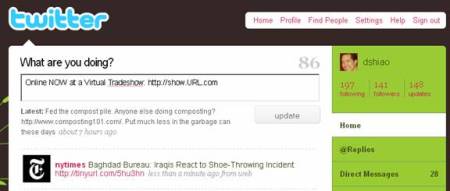
So let’s imagine I’m logged in to a Live Virtual Tradeshow (VTS).  I’m visiting exhibitor booths, viewing Live Webcasts and interacting with peers.  All in all, I’m enjoying myself.  I want to spread the word to friends and colleagues.  One quick (and efficient) way to do that is to post a message to Twitter.

Twitter home page

Twitter home page

I can “tweet” about the Virtual Tradeshow and pass along a URL to my 141 followers.  If any of those followers likes the recommendation, they can “retweet” my message to their followers.  If 5 of my followers spread the word and they each have an average of 100 followers, then my message had a potential audience of 141 + (5 * 100) = 641.  And that doesn’t even count any downstream distribution via my followers’ followers.  If my tweet happens to be picked up by a Twitter power user, my message could be seen by her 10,000 followers!

You can see how quickly and efficiently information is published.  And that’s the beauty of the network effect.  As I amass more followers – and, as more users sign up with Twitter – the potential audience of my “tweets” grows exponentially.  The result is a powerful tool for B-to-B marketers and publishers, if used right.  Publishers need to grow their audience in order to grow their revenue – new audience results in more page views, more ad impressions delivered, more online sales leads.  Where can you find that audience?  On social networks like Twitter.

VTS platform providers may want to consider:

  1. A “post to Twitter” utility within the VTS – make it convenient for VTS attendees to post a message to Twitter, including an auto-shortened URL (so their followers can access the event)
  2. A “Twitter reflector” that takes selected chat messages from the VTS and posts them to Twitter.  Imagine a user engaged in a “group chat” area who wants to share her insight simultaneously to the VTS attendees and her Twitter followers.  Allow her an easy way to do that.  Again, include a shortened URL that points back to the event

Of course, Twitter is not the only social network out there (I haven’t even mentioned Facebook and its 130MM users).  So while I’ve outlined a few ideas that are specific to Twitter, the bigger picture concept is about integrating the VTS platform with an assortment of networks.  The trick will be to pick the right ones.

You can follow me on Twitter here: http://twitter.com/dshiao