All I Know About SEO I Learned in Kindergarten

September 28, 2013

Photo credit: Flickr user woodleywonderworks via photopin cc

Introduction

I attended kindergarten at Zena Elementary School in Kingston, New York, where my teacher was Ms. Silvernail. Back then, Search Engine Optimization (SEO) didn’t yet exist. Search engines didn’t exist because the web was not yet invented. Mainframes dominated the computing landscape and PC’s were a decade away from invention.

Despite the lack of tablets, apps and the web, I sure learned a lot in kindergarten. It was my first formal setting with other kids my age and Ms. Silvernail taught us a lot about manners and other social norms. When I look at today’s “white hat” SEO strategies – that is, those that follow search engine rules and guidelines and focus on the “human audience,” I see a lot of similarities with the concepts I learned back in kindergarten.

Let’s consider how kindergarten helped give me the foundation for today’s SEO practices.

Respect authority. “Listen to what the teacher says.”

Prior to kindergarten, we learned to respect the authority of our parents. In a school setting, we had to learn how to respect our teacher, along with other authority figures at the school.

With SEO, the search engines are authorities who hold a lot of “power.” In fact, they determine your effectiveness, in the same way that teachers determine your grades. For optimum results on Google, for instance, a good first step is to use Google Webmaster Tools.

Google will use this tool to send you “Messages” about your site’s availability, as well as instances where it suspects that link spam is pointing to your site. If a teacher asks you to sit up straight, you do it. If Google finds link spam pointing to your site, you investigate and resolve it.

“If you get something that’s not your’s, give it back.”

A classmate hands me something that’s clearly not mine. I’d tell Ms. Silvernail, explain that it’s not mine and she’d take it away from me. There’s a similar arrangement with SEO. Let’s say Google finds links to your site that violate their quality guidelines. You’ve never heard of the site linking to you and don’t understand why they’d want to do so.

You can use the “disavow links” feature in Google Webmaster Tools: “In other words, you can ask Google not to take certain links into account when assessing your site.” (read more at Google’s disavow links page). For expected turnaround time on the disavow, Google says this:

“It may take some time for Google to process the information you’ve uploaded. In particular, this information will be incorporated into our index as we recrawl the web and reprocess the pages that we see, which can take a number of weeks.”

“Play within the rules.”

Whether it was in the classroom or on the playground, we played by Ms. Silvernail’s rules. If we strayed from the rules, there were consequences to pay. Google has posted its own rules: a detailed Webmaster Guidelines that includes a number of sections. Pay close attention to the “Quality guidelines” section.

Also, have a look at a useful video from Google’s Matt Cutts regarding the Google Penguin 2.0 update, which deployed on May 22, 2013:

Alternatively, read a summary of the Cutts video, posted by Search Engine Land.

“No cheating.”

Truth be told, I can’t recall whether the concept of cheating surfaced in kindergarten (for me). But it was certainly introduced during elementary school. Google has a page detailing link schemes, which “includes any behavior that manipulates links to your site or outgoing links from your site.” Carefully review the “forbidden” practices listed in this article. And know that for SEO, it never pays to cheat (Ms. Silvernail said so).

“Be honest. Say what you feel.”

We were taught to be honest in kindergarten. The web, on the other hand, has seen shady practices that were implemented to “game” the search engines. For the most part, these practices are no longer effective: keyword stuffing, unnatural anchor text, etc.

Write content for your audience (of human beings) and not for search engines. Write clearly and “say what you feel.” Read your page content aloud to confirm whether it sounds natural. Search engines now reward quality content over “crawler optimized” content.

If you’ve been punished, correct bad behavior and let the teacher know.

Let’s say your website traffic fell off a cliff. Perhaps you can trace it back to May 22, 2013, when Google deployed Penguin 2.0. Just as in kindergarten, you work on correcting the “bad behavior,” then let the teacher know.

While a teacher explicitly tells you what you did wrong, the search engines aren’t nearly as direct. So the biggest challenge may be identifying the (perceived) bad behavior. Titan SEO has a good article on the “road to resubmission” that lists things to investigate. The article notes that after correcting issues, you can submit a reconsideration request to Google.

Conclusion

While the details of search engine optimization may seem complex, they’re based on principles that we learned in kindergarten. Follow guidelines, avoid tricks and be honest. And if you do stray from the guidelines, correct past wrongs to get back in the good graces of the authorities.

Unlike kindergarten, the rules and guidelines of SEO are constantly changing. Google makes more changes in a given day than your kindergarten made all year long. So keep up to date with changes from Google and the other search engines.

And if you’re reading this, Ms. Silvernail, I hereby disavow the free lunch that I received from the cafeteria on the first day of kindergarten.

Related Webinar

Titan SEO did a webinar titled “Google’s Latest Algorithm Update! What You Need to Know.” You can register to view the webinar replay. In addition, we’ve included the webinar slides below:

This post was originally published on the DNN Software blog.


10 Ways to Optimize Your Social Media Channels

September 14, 2013

Social media channels
Photo credit: Flickr user mkhmarketing via photopin cc

Introduction

Some organizations are rocking the house with social media (a few come to mind: Coca Cola, Starbucks, Virgin America). At the same time, many organizations I speak to are challenged to achieve the results they desire using social media.

ON-DEMAND WEBINAR: Social Media Optimization: 10 Tips in 30 Minutes.

The challenge? It’s usually a combination of “lack of know-how” and lack of resources (or both). So here are ten easy steps to take to optimize your social media channels. You can perform these steps in any order.

1) Use consistent branding across channels.

For personal use of social media, I recommend that people use the same profile photo across all social channels. Why? Because followers who know you on Twitter will recognize you on SlideShare.

So the consistent photo removes a barrier to gaining that new follower. For organizations, use the same logo everywhere. Also, if you’re running a campaign, use the same campaign theme across your channels.

2) Strategically hyperlink from profile pages.

Check out all the valuable hyperlinks we’re afforded on the DNN Google+ page. Take advantage of these opportunities. You can drive clicks (to your web properties) from views of your social profile pages.

And, the inbound links will help with Search Engine Optimization (SEO). Don’t be too cute, however. Make sure your link’s anchor text aligns with the page you’re linking to.

Additional tip: YouTube allows hyperlinks in the description area of your video:

Hyperlinks on YouTube

3) Reciprocate.

Gain a new follower on Twitter? Verify they’re a “real” person (vs. a “bot”), then follow them back. It’s a nice gesture on social media to follow back. And, by following back, you get the opportunity to listen to what your followers are saying. On Twitter, following back allows your followers to send you a “Direct Message” (a private message), which is often an effective channel for customer service or related inquiries.

4) Tag (link to) other users.

When I share an article on social media, I like to “link” to both the publication and the author. Why? Because it gets you (or your organization) noticed by the publication and the author (in addition to sending them some good karma). The author may follow you, retweet you or respond to you. In turn, the author’s followers may decide to follow you. In short, good things can happen.

5) Learn the tricks of the trade of each social network.

Using the “retweet” button on Twitter. Setting up a Google+ Hangout. Managing your Circles in Google+. Each of these things is unique to that service: get to know these unique features well and your use of that service becomes more effective.

6) Measure, evaluate, adjust.

Become BFF’s with analytics (and yes, you really should become best friends forever). Did you know: Twitter now provides free analytics dashboards to all Twitter users (read more on the Constant Contact blog).

Use analytics to evaluate your social media effectiveness across a number of dimensions (e.g. content type, content format, topic, time of day, etc.). Metrics to track include reach, engagement and traffic. Next, draw conclusions that help inform your subsequent social sharing.

7) Mix it up.

I know of professional sportswriters whose Twitter profile is an automated feed of every article they write (and nothing else). While I love their sports writing, I don’t follow them on Twitter. Instead, I follow other sportswriters who comment, respond, retweet and engage. So mix it up: share content, retweet, respond and engage. Don’t be a social media automaton.

8) Engage proactively and respond promptly.

Users on social media can be chatty. And they expect responses to their issues or comments. Your role: listen to what they’re saying and respond promptly. A same-day (or same-hour) response is far better than one that comes tomorrow or next week.

9) Cross-promote your channels.

While your primary goal is to “be useful” on any given social network, there are times when you’ll want to promote your other social networks. Let fans know that you “exist” elsewhere. And, when you’re running events, contests or campaigns on a particular network, use your other channels to drive additional awareness of those activities.

10) Experiment with paid advertising.

Twitter Ads Dashboard

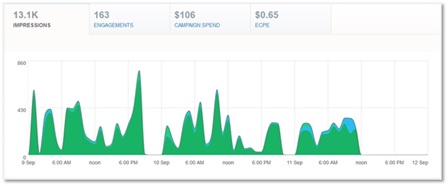
Image: a Twitter Ads dashboard for Promoted Tweets.

It’s great that you have a lot of fans and followers on social media. But did you know they’ll miss 80+% of what you post (that’s my own, unscientific estimate)? That’s just reality.

Paid advertising can create a higher likelihood that fans see your content – and, it extends your reach to people not currently following you. We’ve had fun experimenting with it here at DNN.

Conclusion

Social media can drive tremendous value to your organization – and, it can be a lot of fun doing it. I hope you found these tips useful. I presented a DNN webinar on this same topic recently – you can find the presentation slides below.

Originally published on the DNN Software blog.


10 Reasons Professional Athletes Love Twitter

September 8, 2013

Bumper sticker: I heart Twitter

Photo credit: Flickr user “…love Maegan” via photopin cc

Introduction

After a big game, with reporters huddled around in a semi-circle, professional athletes are provided with a “platform” to talk about the game, the team and themselves. At other times, athletes are given a platform when they appear on ESPN’s Sunday Conversation, Late Show with David Letterman or The Today Show.

While those interviews and programs still give professional athletes an outlet, today, that “platform” has become Twitter. Just about every well-known athlete uses Twitter’s 140 characters to share thoughts, updates, photos and videos. The athletes love it, as do their adoring fans.

Let’s cover ten reasons professional athletes love Twitter.

1) Their fans love it.

It’s often said that we operate in a 24-hour news cycle. Like New York, Twitter is the “city that never sleeps.” Everything is in real-time and there’s a constant stream of activity, no matter the time of day (or night). In a world where content is produced by the second, fans seemingly thirst for more.

Twitter helps fill that need, as fans check Twitter for updates from their favorite players. Fans also benefit from an extended ecosystem: teams, coaches, general managers, owners, sportswriters and commentators all actively use Twitter to share information.

2) 140 characters suit them.

Bill Belichick of the New England Patriots

Photo source: the Wikipedia page for Bill Belichick.

Sure, there are athletes who can write long-form articles. But for the most part, the brevity of Twitter suits athletes well. It’s kind of like the Bill Belichick school of interviewing: some coaches, like Belichick, already instruct athletes to answer in 140 characters or less.

3) Twitter fuels their competitive nature.

Twitter’s followers and following count naturally leads to “count watching” and competition. Who has the most followers on a given team? Who’s the most followed NBA player? Whose tweets get the most retweets? You can be sure most athletes on Twitter are aware of this stuff.

4) It’s the new and easy way to break news.

Shaq announced his retirement on Twitter. Alex Rodriguez (of the New York Yankees) announced that he’s ready to return to the field. No need to schedule a press conference any more. Use 140 characters (or less) and you’re on Sportscenter a few hours (or minutes) later.

5) They can conveniently follow other athletes.

The “network effect” is in effect on Twitter. Athletes sign up for the service because their teammates are already using it. Athletes enjoy interacting with other athletes as much as they like to share information with the world. They also get to keep in touch and get updates from other athletes.

6) It’s great for engaging with fans.

Today’s Twitter “Interactions” (mentions) are yesterday’s fan mail. Before Twitter, athletes interacted with their fans in person. Today, they interact with fans any day, any time, in short spurts of 140 characters (and often less).

7) It’s great for “gamesmanship.”

Athletes will do whatever they can to get a leg up. During game play, they’ll taunt other players and try to get inside the opponent’s head. On Twitter, they can do those sorts of things well before the game. Of course, this tactic may not be effective, as it often provides heightened motivation for the opponent.

8) Get quoted.

Sportscenter, the 11 o’clock news, CNN and many other news outlets now use athletes’ tweets as primary news sources. 140 characters can bring athletes fame, fortune, applause, respect, shame and embarrassment. The last two aren’t appealing for most athletes, but they’ll take their chances!

9) The RT is the new autograph.

Pen and paper are so antiquated, right? Today, parents no longer wait in line to ask athletes for their autograph. They’ll get on Twitter and ask for an RT. The single click of the “retweet” button has replaced the signing of a ball, cap or piece of paper.

10) It’s a platform for causes, opinions and political views.

Many athletes have interests, passions and causes beyond the world of sports. Their involvement in professional sports gives them recognition and Twitter gives them a platform. Twitter is a great vehicle for branching beyond sports to advance a cause, support a movement or make the world a better place.