Economic Downturn To Spur Virtual Job Fairs

January 10, 2009

On Friday, the U.S. Bureau of Labor Statistics reported that the nation’s unemployment rate hit a 16-year high of 7.2%, with 11.1 million Americans out of work.  Many of the unemployed are turning to sites like Yahoo HotJobs, Monster.com, Dice.com and Linkedin.  With such a wide pool of available talent, companies looking to fill positions will receive no shortage of attention (and job submissions). While this is a good thing for the hiring companies, they’ll be challenged to efficiently filter through the submissions and find the right candidates for the jobs.

Let’s consider today’s dynamic for hiring companies:

  1. Large potential applicant base (11.1 million unemployed)
  2. Applicants are cash-strapped
  3. Hundreds (or thousands) of submissions generated for a given job posting

What’s a good solution to address this combination of factors?  The virtual job fair.  With the unemployed less likely to incur expense to attend a physical job fair, placing the event online means that you’ll attract a larger (and potentially global) audience.  And while you won’t be face-to-face with potential hires, there are plenty of advantages of flooring such an event virtually.

First, let’s consider your job at the job fair. While your ultimate goal is to source attractive candidates, it’s just as important to sell your company (amd the benefits of working there) to these candidates. Some possibilities to consider for the virtual job fair:

  1. Place detailed information about the job (and your company) in your virtual booth – supplement with external links (back to your corporate site)
  2. Invite senior executives to the event (not just the hiring manager, but the hiring manager’s manager) – including your CEO!  Your CEO’s participation is quite possible with a virtual event, but may not be practical at a physical event
  3. Invite employees who hold the same (or similar) position – and have them network with candidates
  4. Host presentations about your company (e.g. webinars)
  5. Include on-demand video in your booth – so that candidates can hear (and see) from your company representatives
  6. Host sesssions in the event that show candidates how your company operates.  For instance, if you’re supplementing your software development team, stage a developer meeting for folks to observe. Virtual worlds like Second Life or web.alive can facilitate such a session. 

As for filtering through the candidates, you’ll want to review the chat transcripts that they had with your company representatives and review activity reports (e.g. booth visits, documents downloaded) to gauge their interest level in your company.  Additionally, work with your platform provider on applications you might leverage, such as surveys or quizzes to differentiate candidates.

On the attendee side, I recommend the following:

  1. Carefully select your avatar, since it’s a representation of you in the virtual world.  You’re sending a signal to your potential employer. Picking an unsuitable avatar is equivalent to attending a physical job fair unshowered and in your pajamas
  2. Take care in all your touchpoints.  Potential employers will be able to pick up on your writing abilities within text chat, for instance. Does your resume claim, “excellent written communication skills”?  Well, be sure to demonstrate them!
  3. Bring useful and relevant resources to supplement your candidacy – e.g. writing samples, code excerpts, etc. Additionally, look up potential employers online (e.g. on Linkedin) for additional context.

TMP Worldwide (parent company of Monster.com) hosted a number of virtual job fairs in Second Life during 2007.  EMC, Accenture, GE and U.S. Cellular exhibited, among other companies.  You can still visit the Network in World site here.

On January 14, 2009, P&G is hosting a U.S. Diversity Virtual Career Fair (full disclosure: my employer [InXpo] is powering this event).  I expect to see several more virtual job fairs in 2009, especially as job openings begin to pick up again from hiring companies.  If you have plans to attend or exhibit at a virtual job fair this year, leave a comment below with some details!


Review: Lenovo’s eLounge Virtual World

January 8, 2009

Lenovo eLounge (screen capture of author's avatar)

Source: Lenovo eLounge (screen capture of author's avatar)

Lenovo today unveiled a virtual world called eLounge, which is powered by Nortel’s recently announced virtual world platform, web.alive.  Lenovo appears to be using this venue as a social and interactive platform for providing information on their products and services (notably, their laptops).  Here’s Lenovo’s description of eLounge:

Experience a truly virtual 3D on-line shopping experience. Ask your friends to join you, and together explore and learn about lenovo products. It is similar to shopping in a retail store except you are on-line and in control of your real time interactive shopping experience.

* Create your own personal avatar
* Browse and interact with our virtual products
* Walk around and share your experience with customers from around the globe
* Get support from one of our virtual avatar product specialists

I reviewed eLounge on a Dell Latitude D630 running Windows Vista Business on Firefox 3.0.5 (perhaps I should have been on a Lenovo Thinkpad instead?).  eLounge runs within a browser, but first requires a download of Nortel’s web.alive software.  Here are the system requirements:

To help ensure that you receive the best possible experience, we recommend the following minimum computer set up:

* Windows XP/Vista
* Intel 945 integrated graphics or better
* 1 GB RAM, 1.50GHz CPU
* Broadband network connection (e.g., cable/DSL)
* USB stereo headset with microphone

Shortly after my download completed and I ran the executable, the eLounge virtual world appeared in the Firefox browser tab from which I initiated the download.  On initial entry, I saw 7-10 other avatars in the immediate vicinity and heard a female avatar ask, “How do I leave?”.  A Lenovo staffer politely addressed this inquiry and off she went.  As I got myself acclimated to the environment, I enjoyed viewing my auto-selected avatar – a svelte-looking, 5′ 5”, 150 pound male (image above).

After lounging in the environment and observing the avatar passersby, I was greeted by an avatar named Nicholas – turns out this was Nicholas Sauriol, the Venture Leader of Project Chainsaw at Nortel, the initiative at Nortel behind web.alive.  Nicholas gave me an extensive tour of eLounge, starting with some stations where Lenovo Thinkpads were on display.  By left-clicking on the mouse and hitting “w” on the keyboard, I was able to walk toward a Thinkpad, at which point its full configuration appeared on my screen.

At the bottom of the description was a link lableled (“Customize and buy”) — neat idea.  Nicoholas then walked me to a separate room – an auditorium where a few avatars were hanging out and an image of a Star Trek spaceship appeared on stage.  This is an area designated for product launches and announcements – leveraging a feature of web.alive called OmniVoice.  Typically in web.alive, sound volume correlates to your proximity to an avatar.  With Nicholas up close, I could hear him fine – but if he walked away, his voice would start to get faint.  With OmniVoice, the speaker gets the equivalent of a microphone, so  her voice is projected throughout the area (auditorium).

Side conversations could still occur while the presenter was speaking (in the same way that you can chat (whisper!) with your colleague during a physical presentation).  Nicholas then escorted me into a private room that he likened to an executive briefing center:

Lenovo eLounge (screen capture of private room)

Source: Lenovo eLounge (with presenter Nic Sauriol)

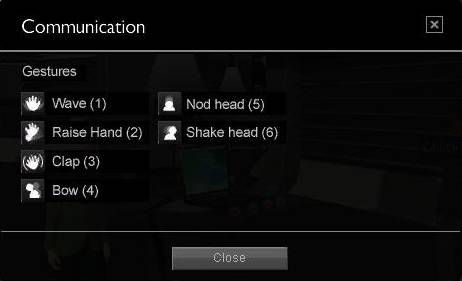
In this area, Lenovo can utilize PDF, PowerPoint, etc. to present to clients.  So the large displays (above) can render a PowerPoint, just like using a projector in a conference room.  Overall, I found the user interface of web.alive (and eLounge) to be quite intuitive.  I was immediately able to pick up on the relevant commands – the use of “overlay” text that appears transparently on top of the screen was useful.  And menus like this are handy:

Lenovo eLounge

Source: Lenovo eLounge

The numbers (above) represent keyboard shortcuts that allow you to “emote”.

The web.alive platform is built on top of the Unreal Engine from Epic Games.  Virtual Worlds News has some good coverage of eLounge, along with Nortel’s licensing of Unreal:

http://www.virtualworldsnews.com/2009/01/lenovo-using-nortels-webalive-for-ecommerce.html

http://www.virtualworldsnews.com/2009/01/nortel-licenses-unreal-engine-for-webalive-opening-up-to-development-community.html

In Summary

For a “Day 1” experience, I found Lenovo eLounge (and web.alive) to be quite good – I’m sure Nicholas and team at Nortel will continue to build it out with more features.  It will be interesting to see the applications that other companies may have for web.alive.  According to Sauriol, Lenovo is the first public launch of a web.alive client – there will be other public launches forthcoming – and there are a number of clients using web.alive behind the firewall (which we won’t hear about).

I’ll also be interested to hear how Lenovo is driving users into eLounge  (i.e. generating interest / demand), along with what sort of ROI they’re looking to generate from this investment.  Kudos on a good start to both Project Chainsaw (Nortel) and Lenovo.

UPDATE: Some supplementary information about the underlying technologies:


A Real Government Goes Virtual

January 4, 2009

Washington Post

Source: Washington Post

O Brave New World That Has Such Avatars in It! That’s the title of a Sunday article in The Washington Post by Michael Laris, in which he describes the efforts of the Arlington County (Virginia) government to create a presence in Second Life.  Here’s the basic idea:

Curious executives can swing by to gather market research aimed at luring grocery chains to Arlington. County officials can conduct presentations on an interactive white board as they promote the region to corporate prospects. And later this month, anyone interested will be able to join a confab on how to launch a business in Arlington.

Apparently, the Washington area has become a hotbed activity for virtual worlds:

The Bethesda-based National Library of Medicine, for instance, has created in Second Life a potentially noxious world of everyday health hazards called Tox Town, where clicking on a tower in a dusty construction site produces a list of the chemical properties of neighborhood runoff.

At the University of the District of Columbia, criminal justice students practice investigations and patrols and deal with such imaginary perp behavior as the attempted theft of Professor Angelyn Flowers’s pink convertible.

Other designers have created in Second Life a virtual Capitol Hill, where plans are afoot for a white-tie inaugural ball Jan. 20. Instructions are forthcoming on how to find a good tux.

I admire this initiative by Arlington County and encourage other governments (local, county, State and Federal) to follow suit.  I see the following benefits:

  1. The world becomes flatter and smaller, as governments get closer to their constituents (and vice versa)
  2. Governments may be able to save costs (imagine that) by utilizing the online/virtual world to connect with residents, rather than connecting in person at physical locations
  3. Assuming a critical mass of audience within the virtual world (I know, we’re not yet there), governments can efficiently distribute information, in the form of updated rules/regulations/bylaws, government news.  Also, how about regular visits by the County Executive within the virtual world
  4. Residents/constituents will feel more connected to their government, which will spur increased involvement in the community

The man behind Arlington’s virtual presence if John Feather, who is volunteering his time to make it happen.  For me, the following quote from Feather hits home:

For Feather, helping nudge the county into Second Life has opened a creative spigot.

In November, he started working on a 3D map of Arlington’s major buildings. Touching images on the map calls up Web pages about them, and he and his colleagues want to add real-time rent data and detailed visuals from architects and developers so that “when you click on that building, you go in the door.”

Such technology will eclipse standard Web sites, including the county’s, Feather said. “You’ll start to walk around places instead of going to flat pages.”

I agree – web pages will increasingly have the same 3D and interactive elements found in virtual worlds.  Web 2.0 has been fun, but the next phase of the Internet is going to be Web 3D-dot-oh.


Bringing Virtual Worlds to The Blind

December 30, 2008


IBM alphaWorks Services

Source: IBM alphaWorks Services

According to Wikipedia, approximately 40 million people in the world are blind.  IBM’s alphaWorks Services division has embarked on a noble project aimed to benefit these 40 million.  Called “Virtual Worlds User Interface for the Blind”, an overview can be found here:

http://services.alphaworks.ibm.com/virtualworlds/

And an FAQ document here:

http://services.alphaworks.ibm.com/virtualworlds/virtualworldsFAQ.pdf

The service currently works with Second Life (only), but IBM may support additional virtual worlds in the future.  If they do add such support, they’ll tie new virtual worlds into the existing client, so that users only need to learn a single application.

With the IBM application, a virtual world is rendered via text (no graphics) and sighted users have the ability to annotate objects of the virtual worlds via text descriptions or recorded audio.

The implementers chose to leverage some open source and off-the-shelf technology:

The user interface is a Web application, a thin client running locally in the Firefox browser that communicates with Second Life through an agent on our server. The application is implemented partly with the JavaScript programming language, and it uses Dojo Toolkit widgets to provide a virtual world user interface that is entirely keyboard-navigable and screen reader-friendly. Nothing is permanently installed on the user’s computer. 

The system also uses Quicktime (to play event sound prompts and verbal annotations) and NVDA (an open source screen reader).  IBM recommends the use of the open source software Audacity for recording the verbal narrations).

I commend IBM for this effort and admire the flexibility and openness they’ve chosen in the implementation.


Home for the Holidays in Sony’s Virtual World

December 29, 2008

Sony’s virtual world for PlayStation 3 gamers (called “Home”) is currently in beta status.  While I’m not “Home for the holidays” (I don’t own a PS3), I’ve been reading about the early returns with the service.  Ryan Kim of the San Francisco Chronicle had a Sunday article titled “Sony struggles with creation of its virtual world“.  While there have been numerous challenges during the beta period, one analyst encourages patience:

Ted Pollak, a market analyst at Jon Peddie Research and portfolio manager for the Electronic Entertainment Fund, said users need to be patient with Home, which is bound to have numerous kinks in the beginning. He said it took other virtual worlds and online games like Second Life and World of Warcraft a while to get a handle on problems and address them.

I suspect that Sony’s foray into virtual worlds is based on the following objectives:

  1. Increase sales of PS3 consoles (e.g. if Home proves to be successful and popular, users may buy PS3 consoles to interact with friends – connect with them socially and participate in multi-user games)
  2. Differentiation from the competition – make the PS3 stand out from the Xbox 360 and Nintendo Wii
  3. Spur commerce – generate revenue (eventually) via transactions and advertising within Home

To me, a key factor in the success of Home will be the manner in which Sony integrates it into the gaming experience.  It needs to be designed and presented in a way to encourage gamers to participate and be valuable enough that they want to return.  I wonder if gamers will have the motivation (or interest) to put their favorite game aside to enter a virtual world.

On the other hand, if Sony were to unveil exclusive features (only available in Home) that could change things.  Maybe it’s new release games that are initially exclusive witin Home.  Or, it’s virtual goods or real-world prizes to encourage users to enter.  Suffice it to say, it will be interesting to watch user adoption and growth.

Finally, here’s a nice overview/review on Home by Dean Takahasi of Venture Beat

http://venturebeat.com/2008/12/10/sony-to-launch-home-virtual-world-for-playstation-3-on-dec-11/


Real Growth in The Virtual World

December 26, 2008

With a recession stifling business activity across the globe, what economy is expected to generate growth in 2009?  The virtual world economy, of course!  I believe that with consumers affording less these days, they’ll naturally spend an increasing amount of time online (in social networks and virtual worlds) and in video games.  Consider the following chart from Linden Lab:

Monthly User Hours from Second Life residents is at an all-time high.  Linden Labs’ data also shows that User to User Transactions had strong growth in 2H 2008 totalling over $100MM in Q3 2008 alone.  Strong growth should continue through 2009 for Second Life and other virtual worlds.  The virtual world platforms will benefit both from new member sign-ups, as well as increased activity from existing members.  We should see a network effect take place, where new users sign up via encouragement from their in-world friends.

Sale of virtual goods will also see strong growth.  Jeremy Liew of Lightspeed Venture Partners estimates that Facebook is generating virtual goods sales at a clip of $35MM per year.  That’s pretty good – and I expect that virtual worlds platforms can benefit from similar volume/revenue.  After all, virtual worlds are a natural venue to exchange virtual goods.  Linden Labs tracks user to user transactions and I think a trend in 2009 will be user to merchant transactions, in Second Life and elsewhere.

Another area of interest is in video games, where in-game advertising and commerce seem to be a natural fit.  I believe that gamers are more engaged in their activity compared to virtual worlds users or social networkers.  And while that may result in sensitivity to advertising, I think that relevant and useful ads can receive significant response rates and that in-game commerce can be huge.  We’ll want to watch this area in 2009 and beyond.


Instant Messaging Moves In-Page

December 22, 2008

In 2008, we began to see the migration of instant messaging features away from standalone client/server systems and onto the web, residing in-line with web page content.  Thanks to folks like Meebo, Facebook and others, I see this trend taking off in 2009, as more and more social networking sites allow users to interact in real-time, right there on site pages.

In an BusinessWeek article titled “The End of Instant Messaging (As We Know It)“, Douglas MacMillan highlights this instant messaging shift.  Meebo CEO Seth Sternberg had an interesting quote in this article:

“The interesting thing about live chat is that it forces the user to focus persistently.  If a site’s [average engagement time] is three minutes, we can move it to six.”

I think an analogy can be made to engagement time in virtual events – the existence of chat (both private and public chat) extends the average engagement time of attendees.  Smart social networks will be quick to incorporate a chat/IM feature in-page on their sites, like Flixster has done with Meebo (see BusinessWeek article for more info).

I’d argue that AOL’s Instant Messenger was the true genesis of the “social web” and the emergence of Web 2.0 has been in parallel to the disparate IM systems.  Now that the two worlds are coming together, the social web becomes that much more social.  This makes social networking sites stickier — and all the more better for it.


Interview with Ian Hughes, Metaverse Evangelist (part 2 of 2)

December 17, 2008

And here’s Part 2 of my interview with Ian Hughes, Metaverse Evangelist at IBM:

  1. What do you see as the biggest opportunity for users of virtual worlds? For users, well we are all users. As a user there is the opportunity to gather the right people, the right resources and do what you want to do. This applies to web 2.0 as much as to VW’s specifically in my opinion. That means as a social user, connecting with friends, as a business user connecting with customers and colleagues. As a mastery of these environments lets people choose to lead groups and people choosing to follow, to gather the right people they need to complete some task it removes the need for many structures that add cost and overhead. Virtual worlds and the web in general lets people get things done, just by doing it. With a connection you don’t need to find property to have an office, you don’t need to all be in the same physical place at the same time, local becomes global.  That leads to a new breed of entrepreneur, that already exists and that can be anyone. So there are a whole host of business problems that can be solved, and opportunities to be explored. In a sense it has made all business open source, not just the operating system, browser or software platform. That leads to innovation and opportunity. Or you can just have fun too 🙂
  1. What’s the best business use you’ve seen in a virtual world? Most of the best business uses I have seen really has been around internal communication inside the enterprise. To be able to seamlessly gather your colleagues for a meeting, to have a pre-event mingle as often happens, to then launch into the crux of the meeting with all the resources available to you, to action the decisions whilst in the meeting then to leave the virtual world and carry on. That is the best business use. That is done on all sorts of platforms, in all sorts of ways. It is not one application, not one use, but it does weave into general day to day workflow. The post event conversations, the serendipity, the memory of the meeting “oh when you sat opposite in Hursley house and you said….” are all fantastic secondary benefits to the one of not having to travel quite as much.
  2. What’s the neatest consumer application you’ve seen? One of my favourite consumer applications has to be Timeless Protoype’s multi-gadget in Second Life.  In particular the fact that it has those wonderful multi-chairs. They indicate to people the dynamic nature of the spaces in virtual worlds. You simply drop a chair and table, or fire and log, and if you sit down, it creates another chair, someone else sits and the circle widens again. Its an instant meeting point of reference, chair and table a little more formal than log and fire. Those chairs are all over the place, in many meeting places and for us in eightbar also seem culturally significant.
  3. What keeps you up at night? Trying to figure out why everyone has not got the point of all this yet, why there is still a fear, or a suspicion about how these things all work. Why the heck people don’t share more information with colleagues and friends. The important thing is not that we have the perfect implementation right now, because that can’t happen. 1) This has to keep evolving 2) even if it was perfect people would still be scared as there is a huge cultural change in communicating on the web anyway.
  4. What’s next? We should keep in mind there could be a revolution waiting to happen to. A mode of interacting that is not the common model that 99% of metaverses currently use, of avatars and islands, rooms, spaces.  The real what’s next though in my mind is 3d printing, or rapid fabrication. We have an increasingly cheaper way to make data come to life as a physical object. To make the virtual real. Virtual worlds then become a design and delivery platform for product. If you need something buy it online, don’t have it shipped, but print it out locally. Its taking the principles of long tail usually applied to data only products, like music and film and changing that to apply to mobile phone covers, cups and saucers, washers, toys almost anything. The 3d printers we have today are getting very much cheaper, the design tools for 3d have got more accessible with the rise of virtual worlds. We can have things designed, even try them out in the virtual world, buy them, use them virtually, but have them also brought into physical form. I had my avatar printed by http://www.fabjectory.com a few years ago now. The avatar is my design, my green hair, my leather jacket, my eightbar t-shirt and wearing the Reebok trainers bought and customized in-world.   Imagine being able to print anything you need anywhere in the world, a local 3d printer in a remote village would allow an engineer to deliver a solution to broken water pump in seconds, not require mass parts built all over the world, shipped all over the world and packaged in non eco-friendly boxes. Just print what you need, when and where you need it.  It’s not perfect, not there yet, but going the right way.  The rise of the fabricaneur  in virtual worlds is the next wave of manufacturing and design.

Interview with Ian Hughes, Metaverse Evangelist (part 1 of 2)

December 17, 2008

eightbar1

Ian Hughes is a Metaverse Evangelist (at IBM) and blogger at eightbar (http://eightbar.co.uk/).  Ian and I connected to discuss virtual worlds and I posed a few questions to him.  In the first of a two-part series, I’ve posted the first five questions, along with Ian’s answers.

  1. So tell us a little bit about yourself? I am 41 year old forever tech geek. I started programming around 14. I grew up in a seaside town and watched the explosion in video games in the arcades. I wanted to know how they worked – I loved playing but was intrigued by the workings of them too. This led me to understand programming, my first Eureka moment. Oh! that’s how it works. I also look at the various combinations of tech and usage including coding as an art form, relying on intuition and flowing patterns as much as running it by the numbers. I joined IBM in 1990 as a full timer and have been here ever since, though explored lots of emerging technologies in various places, the arrival of the PC to a green screen world, client server models, web in the early days and into dot com, then that has led through web 2.0 (before it was called that) to where I am now with virtual worlds and metaverses.
  2. So you’re a Metaverse Evangelist – can you explain what that entails? An evangelist attitude is one that is not always obvious to people. Seeing and feeling a use for something, embedding it into your life and work and helping others see why they should do the same is tricky. It is a mix of sales, pr, marketing and in my case tech, delivery and understanding. By its very nature an evangelist is of no need to people who don’t know what the the evangelist is explaining, once explained, as it is so obvious the evangelist is again of no need.  Metaverse is the generic term for virtual worlds from the book Snowcrash. A few years ago I would have been a web 2.0 evangelist.
  3. What are virtual worlds platforms doing right? In my personal opinion virtual worlds are helping people understand that there is more to communicating electronically at distance than just email or telephones. They all tend to tap into the human patterns of understanding of space, proximity, visual and audio feedback. Most of the important things in understanding one another from non verbal communication. Virtual worlds can be a much richer version of a smiley 🙂 in a piece of text.
  4. Where can virtual worlds platforms improve? It tends to be people refer to usability and those first experiences people have in any virtual world, which applies to any software product, or hardware product. The experience will of course evolve, the ways of interacting will evolve, our tolerance and understanding of how to interact, the social language of virtual worlds will also evolve. So evolution is the main improvement. Also, as with the web we need to try and solve the interoperability problems, both technical, social and legal. There are clearly opportunities to explore ways to interact with various environments, this is not about a Warcraft character turning up in Second Life, it is really about people having the things they need where they need them at the time, in a suitable form.
  5. What do you see as the biggest opportunity for virtual worlds platforms? The opportunities span all human communication needs. Clearly gaming has been the growth, a multiplayer console game is as much a virtual world as a the current crop of non gaming environments. The mode of operation, of people gathering together to achieve and objective, communicating live, seeing the results, acting to deal with problems is as valid in a quest in WoW as it is in dealing with an order for a stack of goods from a customer in an enterprise. Clearly the toolset may differ, but to be able to manipulate business models, see what is going on the in the enterprise, bring the right people in to help visualize and solve the problem, live. Is a massive opportunity. It needs to be smooth for business, but its already smooth for gamers. Most gamers wont play a game if its bad, if they cant quickly do what they need to do, if they cant connect to servers etc. The same applies for business. So a combination of the needs of the gaming world, with the business world, with the social media world and we have some really interesting opportunities.