A Second Look At Second Life

June 3, 2009

Source: San Francsisco Business Times

Source: San Francsisco Business Times

“A lot of Silicon Valley has written Second Life off.  The tech world will have to revisit Second Life as a phenomenon in the next six months or so.”

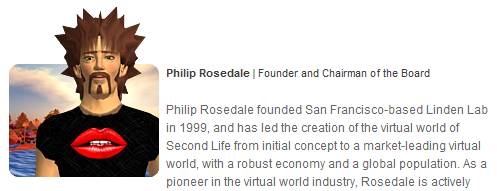
Thus spoke Wagner James Au, noted virtual worlds author and blogger in a San Francisco  Business Times article on Second Life (note: the full article is available to paid subscribers only).  Au, who blogs at New World Notes about Second Life, notes in the article that Linden Lab CEO Mark Kingdon has renewed the Second Life brand that was created by founder Philip Rosedale.

While the revenue model for Twitter is slowly coming clearer (judging by the accounts in the business media), Linden Labs’ strategy under Kingdon is becoming quickly self-evident with the announcements of the past few months.  From my perspective, Kingdon’s growth strategy is around a few core pillars:

  1. Enterprise use of Second Life – makes sense, as enterprises and corporations can be monetized at a higher clip than individuals, artists, hobbyists, etc.  Enterprises (in the former of marketers) were a big portion of Second Life during its initial peak – and it seems the current focus is to bring marketers back into the fold, along with complementary uses in non-marketing disciplines (e.g. training, enablement, collaboration, etc.).  In the past 6 months, Linden Lab has hired 25 marketing and product people as part of their push for enterprise clients.  In addition, the company recently hired Amanda Van Nuys as Executive Director of Enterprise Marketing, signaling a further endorsement of the opportunity in the enterprise.
  2. Nebraska – an on-premises software version of Second Life  (compared to their Software as a Service model), which enterprises can run on their own servers behind the firewall.  IBM has been an active partner with Linden Lab on behind-the-firewall integration – the telltale sign will be how many other large enterprises opt for the Nebraska model.  For “behind the firewall” use, I have to think that we’re talking less about marketing and more about collaboration.
  3. Voice – not mentioned in the Business Times article, but Virtual Worlds News covered it well – Linden Lab is poised to go after the Skype market with capabilities to bridge voice calls and SMS messages between the real world and Second Life.  In the Virtual Worlds News article, Linden Lab Vice President of Platform and Technology Development Joe Miller notes, “The opportunity to monetize at a significant added value for our business is there”, regarding the opportunity in Voice.

IBM marrketing executive Karen Keeter notes in the San Francisco Business Times article that nearly 100 IBM’ers are “working on virtual world tools for commercial sale in Second Life and on other platforms”.  As such, IBM stands to achieve commercial gain from increased use (by enterpises) of Second Life and related virtual worlds.

In fact, it wouldn’t surprise me to see IBM leverage virtual worlds to generate services revenue.  Two things come to mind – IBM Global Services and IBM’s Smarter Planet initiative.  IBM Global Services could assist enterprises on their virtual worlds strategy (e.g. build me a virtual world representation of my data center, so that I can run heating and cooling simulations) – or, IBM could go in-world to enterprise’s private virtual worlds to provide traditional consulting services within the virtual world.

So a manufacturer who’s replicated their factory in a 3D world can have Global Services visit (in-world) to optimize their factory floor workflow.  Then, of course, Global Services could help facilitate the parallel action in the real world.  On the Smarter Planet project, IBM might create 3D models of the next generation power plant to show utilities how to become more energy efficient.  In a virutal world, I’m sure the possibilites are limitless.

Finally, Dan Parks of Virtualis is featured in the article.  Virtualis created a compound in Second Life with 34,000 square yards of meeting rooms.  Quite an interesting model – an event producer that leverages a re-usable area (virtually) to host meetings for corporate clients.  Companies who have done events with Virtualis include Deloitte, Oracle and Trend Micro.

I’d be interested in your thoughts – what do you think about the potential of Second Life for enterprises?

Related Links:

  1. Blog posting on Virtual Offices, with reference to Amanda Van Nuys’ use of Second Life
  2. Blog Posting: Virtualis and Trend Micro Put On Quite A Show
  3. Blog Posting: Philip Rosedale On Building A Business: Practice Extreme Transparency
  4. Blog Posting: IBM’s Second Life ROI: The Headline Beneath The Headline

Philip Rosedale On Building A Business: Practice Extreme Transparency

April 2, 2009

Source: Linden Lab

Source: Linden Lab

At the Web 2.0 Expo in San Francisco, Philip Rosedale (Founder and Chairman of Linden Lab) gave a fascinating presentation titled “Extreme Transparency: Virtual Worlds, the Love Machine, and Other Practical Things That Actually Work in a 300 Person Company“.  Rosedale spoke of his methodology for growing Linden Lab (creators of the virtual world Second Life) from a small team working out of a warehouse on Linden Alley (in San Francisco) to a 320-person, profitable company with multiple locations across the globe.

Instead of a top-down approach to building the business – which starts with a grand vision and then trickles down to all the details that allow that vision to unfold – Rosedale decided to take a bottom-up approach.  An Engineer (and physicist) by trade, Rosedale was very hands-on during the early days – code that he wrote back then still resides in the Second Life software today.

Rosedale’s concept of extreme transparency means that each individual knows what every other individual is working on, accomplishing, doing, etc.  His analogy is one of a sports team (where transparency comes in the form of player statistics).  That’s not to say that Rosedale believes employees should be represented by numerical scores – rather, information should flow freely regarding each and everyone.  When that occurs, Rosedale belives that traditional management (of people) is simplified – and you end up spending much less time managing and more time doing.

Rosedale spoke of an interesting internal application called The Love Machine – an internally developed web site that allows employees to send a message of thanks to another employee.  The web site lists “Sender”, “Recipient”, “Description”, “Time Posted” and scrolls in real-time as new Love is posted.  A posting of Love autogenerates an email, such that if Rosedale entered a posting, the recipient would receive an email with a Subject heading of “Love from Philip”.

I think the point here is that “thanks” is such an easy thing to say, but how often is it really done in a business setting?  Not enough – that is, unless you have a tool (like Love Machine) to foster and facilitate it.  Rosedale noted that transparency needs to be granular – and these love posts are as granular as it gets.  Linden Lab has a data and metrics-driven culture – so of course, Rosedale presented a slide that plotted average love received per employee – to show that the trend line goes up (as more people use the tool to give thanks).

Rosedale next spoke about a Linden profit sharing plan – a certain amount of the company’s profits are divided equally among all employees – everyone from Rosedale down to individual contributors receives the same amount.  But then, employees are asked to distribute their shares to colleagues whom they feel deserving of it.  Rosedale found that profits were shared equally across functional roles (so as an example, Development did not receive an unfair share of the profits compared to another department).  This goes against conventional wisdom, which might say that certain groups would receive more favor than others.

A neat side effect of this plan is that executives get to uncover the hidden heroes of your business – those who did not have full exposure to senior management, but are highly appreciated by the masses.  The result is that their visibility in the organization is heightened – and those heroes become better appreciated.

With regard to data – Rosedale suggests that companies define the metrics that are important to the business.  Then, visualize them and keep them constantly updated.  Linden Lab leverages flat panel displays in many of their offices to display key metrics (via real-time charts).  Total simultaneous users is an important chart – if the count suddenly drops, everyone stops what they’re doing!  Linden Lab provides each employee with a personalized dashboard tool, where metrics can be dragged and dropped in – so, each employee watches (in real-time) data that’s important to them.

On measuring engagement within Second Life, metrics of importance to Linden Lab include average session length, number of Linden dollars spent and retention (since 85% of new sign-ups are gone within the first month).  Of course, a natural platform for transparency within Linden Lab is Second Life itself – and Rosedale spoke of its use for internal meetings.  Rosedale did a demo of the famed Virtual Isabel conference room, which is an in-world representation of a physical conference room at Linden’s headquarters.  A video stream of the physical conference is piped in-world and in the physical conference room, folks can go in-world from their laptops.

One audience member asked how Rosedale handles the media hype cycle – with media coverage today not as positive regarding Second Life compared to a year or two ago.  Rosedale pointed back to his key metrics – and noted that those metrics (e.g. total hours, total Linden dollars spent, etc.) continue to maintain a steady and healthy trend upward.  And that’s what matters most to him (and not what the media thinks).  Rosedale then made a casual reference to the open source movement, in which he’s become more involved of late.

For more info on the culture of Linden, their web site has a page focused on The Tao of Linden.


Insights And Experiences From Virtual Worlds Experts

March 9, 2009

On Monday evening, I attended FountainBlue’s High Tech Entrepreneurs’ Forum at Microsoft’s Mountain View (CA) campus – the event was titled Virtual Worlds: The Hype, The Reality, The In-Between and was sponsored by Microsoft and TIPS Group.  FountainBlue, a “membership-based, for-profit, collaborative organization designed to positively impact the way people, businesses and organizations work,” has organized a new sub-group around virtual worlds, which officially launched coincident with Monday evening’s event.

FountainBlue landed a true All-Star panel of Virtual Worlds visionaries and experts.  Each panel member provided thoughts on virtual worlds and then took questions from the audience.  A summary of each panelist’s thoughts follows.

UPDATE: FountainBlue has posted a summary of this event on their blog.

Steve Nelson – EVP, Chief Strategy Officer, Clear Ink

Steve is EVP and Co-Founder of Clear Ink, an interactive agency based in Berkeley, CA, who has many “claims to fame” in Second Life development. Among their Second Life projects was a simulcast of the 2008 TED Conference (in Monterey), an appearance by Newt Gingrich in-world, the development of a virtual headquarters for Linden Labs and an in-world island in conjunction with the popular sitcom The Office.

Steve started with his definition of “virtual world” – a social platform that’s immediate and immersive – quite a relevant and apt definition, if you ask me.  Steve stressed the immersiveness of 3D virtual worlds by comparing a webinar viewed “standalone” with one viewed in-world.  Steve noted higher retention and recall rates of the in-world viewing – as viewers of traditional webinars are far from immersed – instead, they’re checking their email and multitasking with other apps on their workstation.

Steve noted that Clear Ink assists companies in virtual worlds via three e’s:

  1. Expectations
  2. Experience
  3. Experimentation

In closing, Steve noted five business models for generating revenue with virtual worlds:

  1. Own the virtual world platform
  2. Sell virtual goods
  3. Create virtual worlds tools and utilities
  4. Be an agency – design, consulting, etc.
  5. Use virtual worlds effectively as an enterprise – save money and be a more effective company

Robin Harper – Former VP of Marketing and Community Development, Linden Labs

Robin took us back to the very early days of Second Life and noted that in the initial development stage, Linden Labs thought the platform was about facilitating entertainment.  Fast forward to today and Robin believes that virtual worlds are so much more than entertainment.  In the past 18 months alone, Robin notes that growth in Second Life has been driven by education and enterprise (which each have grown by 2x in that period).  There is an increased use for simulation, prototyping, design and experiential learning.  60,000 residents are profitable (meaning they generate revenue that exceeds their land costs) and the top resident grossed over $1.7MM in US dollars (real money) by selling virtual shoes.

Robin notes that the power of virtual worlds lies in the collaborative tools that are provided with minimal constraints. She compared the development of virtual worlds to the development of third world countries – growth is facilitated by allowing residents to own their own land, own the intellectual property (of their land assets) and participate in an economy that fuels commerce.  Important areas of development today are “behind the firewall” applications, as well as interoperability across worlds.

UPDATE from Robin Harper: I’d like to clarify the statement attributed to me above. The figures I reported were originally estimates based on one quarter of data, so should not be taken as more than an annualized estimate. In addition, my reference to the sale of virtual shoes was in the context of the types of industries that are generating return in Second Life. In the top group of earners based on the estimates, most were involved in the land business, and a couple were in other businesses like events management and retail/virtual goods, including shoes. For more information, please see my blog: http://couldtherebewhales.blogspot.com/2009/03/correction.html

Michael Gialis – New Business Development, Sun Microsystems

Michael works in Sun Labs, with a focus on online gaming and virtual worlds.  Sun’s technologies in this space are Project Darkstar, Project Wonderland and Project Sun SPOT.  Michael notes that the #1 barrier to virtual worlds adoption is the non-intuitive nature of the client application.  Michael’s comments stirred some discussion among the panel regarding enhanced client capabilities, such as the use of sensors in lieu of keystrokes.  Robin noted that Mitch Kapor is experimenting with a 3D camera – when you smile, your avatar smiles. Some panelists, however, noted that some contexts may require separation between your true feelings and your avatar’s expressions – for instance, in a learning environment, you may not always want your true emotions to be on display.

Anne-Marie Roussel – Business Development Director, Microsoft

Anne-Marie manages Microsoft’s digital media portfolio, which includes Xbox, Zune and MediaRoom.  Anne-Marie noted Microsoft’s early efforts in the virtual world with its Flight Simulator game – which in turn led to the development of a product called Microsoft ESP (for 3D visualization).  Anne-Marie gave the interesting example of leveraging virtual worlds for training sales staff – if you sell Ferraris, then your clientele are much different from those buying Fords, so a virtual world can train sales staff on how to interact with prospective customers and face the sorts of questions/issues that Ferrari buyers are sure to present you with.  Anne-Marie spoke of Microsoft Virtual Earth and noted work being done to marry its 3D visual maps with crime scene data (to assist local law enforcement).

Susan Stucky – Manager, Service System Design, IBM Almaden Research Center

Susan noted that IBM’s involvement in virtual worlds is not to be a platform provider – instead, IBM is platform agnostic.  Susan’s interest in the virtual world is to achieve results that would be harder to accomplish in the real world.  One example noted was the practicing of negotiations of complex deals – reviewers (of the deal maker) could provide a virtual thumbs up or thumbs down.  Trainees could then replay the segment and view the feedback as it occurred.  Susan spoke of the need to capture data to better understand in-world behavior.  IBM Researchers developed technology to take audio chat, utilize voice-to-text to transcribe it and then perform unstructured text analysis to decipher patterns of behavior.  Susan also spoke of IBM’s Sametime 3D initiative and referenced the use of Second Life to facilitate a virtual meeting for IBM’s Academy of Technology.

If you’re interested in related events from FountainBlue, have a look at their events calendar.


IBM’s Second Life ROI: The Headline Beneath The Headline

March 4, 2009

Source: Linden Lab Case  Study

Source: Linden Lab Case Study

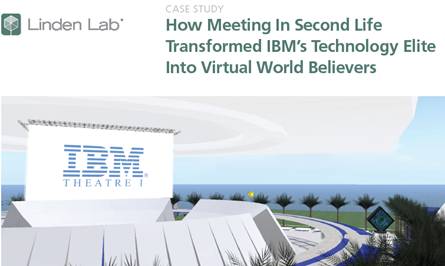
A Case Study published by Linden Lab (the company behind Second Life), documents IBM’s use of Second Life to hold a Virtual World Conference and Annual Meeting.  The meeting, organized by IBM’s Academy of Technology, brought together 200+ participants from across the globe (virtually) and had an ROI estimated (by IBM) to be $320K.

The $320K is derived from taking initial hard costs of $80K, then factoring in $250K in savings from travel and venue costs and $150K from productivity gains (since attendees participated from their desks – and could presumably do on-the-job tasks while in-world).  So that’s ($80K – $250K – $150K) = $320K in total savings.

So that’s the headline story – and what a great story it is.  I can understand why the Case Study led with this angle – in this economic environment, any talk of significant cost savings is going to score points with the CMO, CFO, CEO and Board.  And while I’m not one to diminish cost savings that’s simultaneously eco-friendly, what excites me most about the ROI equation here is the value add that virtual provides – the headline beneath the headline.

If IBM had convened this meeting at a physical location, I’m sure the event would have been equally valuable – but, at the event’s conclusion, the walls come down and participants leave with some photographs, business cards and memories – and may never be incented to re-gather and collaborate again, aside from the next scheduled (and organized) gathering.

With virtual, however, what IBM discovered was a build it once and reap the continued benefits phenomenon.  The island(s) built for this virtual event remain available on an ongoing, 7×24 basis.  So, participants who met and collaborated with specific colleagues may want to arrange for follow-on in-world meetings to further brainstorm their ideas together.

Additionally, IBM found a way to leverage the event to support an unrelated gathering – the Academy of Technology’s Annual General Meeting, originally scheduled in Florida.  The general meeting moved virtual and included live webcasting and videoconferencing – while leveraging the pre-built island in Second Life to support 120 poster sessions.  The beauty with the ROI equation here is that the more IBM can leverage what they’ve already built, the more “R” they generate in “ROI”.  And of course, this sort of re-use is eco-friendly.


Real Growth in The Virtual World

December 26, 2008

With a recession stifling business activity across the globe, what economy is expected to generate growth in 2009?  The virtual world economy, of course!  I believe that with consumers affording less these days, they’ll naturally spend an increasing amount of time online (in social networks and virtual worlds) and in video games.  Consider the following chart from Linden Lab:

Monthly User Hours from Second Life residents is at an all-time high.  Linden Labs’ data also shows that User to User Transactions had strong growth in 2H 2008 totalling over $100MM in Q3 2008 alone.  Strong growth should continue through 2009 for Second Life and other virtual worlds.  The virtual world platforms will benefit both from new member sign-ups, as well as increased activity from existing members.  We should see a network effect take place, where new users sign up via encouragement from their in-world friends.

Sale of virtual goods will also see strong growth.  Jeremy Liew of Lightspeed Venture Partners estimates that Facebook is generating virtual goods sales at a clip of $35MM per year.  That’s pretty good – and I expect that virtual worlds platforms can benefit from similar volume/revenue.  After all, virtual worlds are a natural venue to exchange virtual goods.  Linden Labs tracks user to user transactions and I think a trend in 2009 will be user to merchant transactions, in Second Life and elsewhere.

Another area of interest is in video games, where in-game advertising and commerce seem to be a natural fit.  I believe that gamers are more engaged in their activity compared to virtual worlds users or social networkers.  And while that may result in sensitivity to advertising, I think that relevant and useful ads can receive significant response rates and that in-game commerce can be huge.  We’ll want to watch this area in 2009 and beyond.