Virtual Events For Online Dating

February 21, 2009

Source: Match.com

Source: Match.com

The Internet Dating industry has a conference called iDate.  This year, iDate 2009 is scheduled for Los Angeles, London and Miami.  The event is billed as “the largest conference that covers the business management for the Internet Dating and Social Networking Industries.”  iDate has launched a virtual conference to complement their physical events [see press release].

Perhaps at the iDate 2009 events, industry players can collaborate on leveraging virtual event platforms to faciliate online matchmaking.  What are some of the challenges of online matchmaking today?

  1. Interaction is via asynchronous messaging (either via email – or, via messaging within the service’s web site)
  2. You never get to learn much about potential mates besides what they’ve chosen to provide in their online profile
  3. You’re never sure if that uploaded picture is “true” – for singles of a more advanced age, perhaps the picture is one from 10 years ago
  4. You don’t truly get a feel for your potential mate prior to a phone call or in-person meet-up

So for the likes of eHarmony, Match.com, Yahoo Personals, etc. – why not organize virtual events for online matchmaking!  There would be numerous benefits:

  1. The game changer: webcams – require all participants to utilize a webcam.  Without one, you truly won’t know who’s on the other end of a chat window.  With one, you’ll be able to discover whether the picture (that attracted your attention) matches up with the individual who uploaded it.  And, you’re able to interact via spoken word to other attendees – and see their facial expressions.
  2. Global access, from home – the event would have elements of a physical meet-up, but attendees could participate from anywhere.  That being said, regionalized virtual events may be necessary, to facilitate match making of individuals within close geographic proximity.
  3. Profile matchmaking – some virtual event platforms already have this feature – for online dating, this is the secret sauce that differentiates one service over another.  For an eHarmony, perhaps they integrate their sophisticated algorithms into the event platform, so that attendees can be paired up in the virtual event like they are on eHarmony.com.
  4. Speed dating via webcam – facilitate five minute private webcam sessions between two attendees – after which, they’re rotated to brand new webcam partners.
  5. Post-event data portal – after the event, participants can login to a personalized web-based portal, where they can review all the interactions they had with other attendees.  If you met over 20 people online, you might need such a feature to remember whom you really liked!
  6. Find mates by observing – topical chat rooms could be organized (e.g. Music, Sports, Food, Travel), where attendees could congregate to chat about their hobbies and interests.  The chat need not be restricted to text – some platforms support multi-webcam rooms, where participants can speak and see the other participants.  By observing, one might find someone interesting/attractive – and later on, you can connect with that person privately (e.g. in a 1-on-1 chat).

For the online matchmaking service providers, virtual events provide a nice up-sell opportunity to complement subscription-based revenue.  To avoid canibalization of the subscription business, perhaps you only allow access to the virtual event for existing subscribers.

The virtual events could also serve to generate new subscriptions – imagine tying the event into Facebook’s ~175MM active users via Facebook Connect.  Attendees could see which of their Facebook friends are in the event – and, post updates back to their Wall, driving new users into the event (and hence, new subscriptions to your service).

So, time to get moving – millions of singles across the globe await!


VMworld Complements Physical Conference With Virtual Conference

February 7, 2009

VMworld

Source: VMworld

What do you do when you produce the world’s leading virtualization conference?  You make it better, of course!  VMware teamed with Jive Software to take the once-per-year VMworld conference and extended it (online) into a 365-day-per-year, always-on community.  A Case Study on this initiative can be found here:

http://www.jivesoftware.com/customers/case-studies/vmware

And this quote from Eric Nielsen of VMware sums it all up:

We expanded the VMworld conference from a three day event for 15,000 to a 365 day/year destination for 50,000 virtualization professionals.   — Eric Nielsen, Director of Web Communities, VMware

So that’s a triple play for VMworld – by complementing their event online, they’ve generated a more than 3x increase of participating virtualization professionals.  As quoted in the Case Study, the VMworld.com community has 35,000 active members, generates 35,000 page views per day and 2,000 video views per day.

Quite an impressive level of activity.  A clear example of an active community at work – 35,000 page views (in a single day) is hard to come by with traditional b-to-b content.  However, in a highly active social community, the blog posts, discussion board entries, podcast downloads, video views, “ask the expert” questions, etc. – all contribute to traffic generation.

Just have a look at the volume of Discussion Board traffic:

VMworld.com - Discussion Board

Source: VMworld.com - Discussion Board

Now that’s an active community at work.  But there’s a chicken and egg problem – how do you generate an active community in the first place?  Well, the organizers of VMworld.com made the wise move to integrate a full suite of social networking tools – essentially building a mini-Facebook around the conference.  Tools available include:

  1. Discussion Boards
  2. Podcasts – both those produced for the conference, as well as third party / external podcasts
  3. Integration with social networking sites (e.g. Facebook, Twitter, etc.)
  4. Blogs – both in-house and third party
  5. Ask The Expert sessions and content
  6. Video
  7. Photo Wall (with pictures from the physical event)

VMworld.com also leveraged neat tools within Jive Software’s platform to encourage activity.  For instance, on a blog post, a user can click on “Watch This Blog Post” and be notified when comments are appended to that post.  Additionally, most content pages have a left-hand sidebar titled “More Like This”, which certainly encourages additional clicks and page views (it worked for me!).

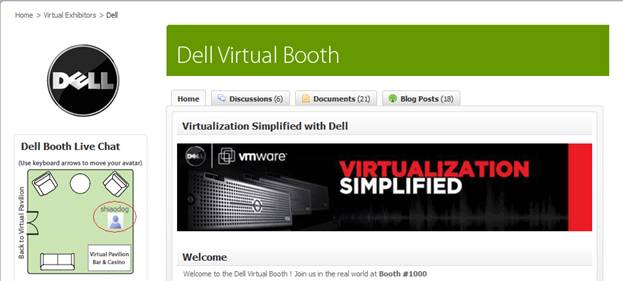
VMworld created virtual conference sponsorship packages for exhibitors, with pricing discounted if you’re already exhibiting at the VMworld physical conference.  3D style booths are planned – the current community features 2D style booths.  Here’s the Dell booth:

VMworld.com - Dell's Booth

Source: VMworld.com - Dell's Booth

This shows the top third of the booth – below it is Dell content, along with community content (blogs, discussion posts, etc.) around Dell topics. You’ll notice a “floor map” of the booth, which shows the physical location of my avatar.  Users utilize the arrow keys on their keyboard to move around within the booth.

VMworld Europe “floors” later this month (February 24-26) in Cannes.  If you’re lucky enough to get to Cannes, enjoy the show.  If you’re not able to attend, then go online and enjoy the online networking.  Registration for VMworld Europe can be found here:

http://vmworld.com/community/conferences/europe2009/


Search Engine Optimization (SEO) For Virtual Events

February 2, 2009

Flickr (martin.canchola)

Source: Flickr (martin.canchola)

These days, any publisher of information on the web is very keen to Search Engine Optimization (SEO).  If you build it (SEO) into your pages, they will come.  If you don’t, then you’re missing out on page views.  But, with all the effort we place on optimizing our web sites (e.g. corporate web sites, content sites, social media sites, etc.), how much SEO effort do we put into our virtual event pages?  I get the feeling that the answer today is “not much”.

For the external (non-private) virtual event, show organizers and exhibitors often judge success based on the number of registrations, attendees and interactions.  Basically, “the more, the better”.  However, what’s the largest source of registrations for most virtual events?  Outbound email promotions to (usually) large lists of users – where you’re hoping that some percentage of users open your email, click on the email and convert into a pre-registered attendee.  Very low on the list today is organic traffic from search engines like Google, Yahoo or MSN.

So the opportunity is quite large – improve the SEO of your virtual event and you can make a big impact on registrations, attendees and exhibitor satisfaction.  But where to start?  Well, first identify the pages on which to apply your SEO tactics.  For a virtual event, we’re usually talking about the microsite that describes your event – date, hours, speaker bios, etc..  The microsite often has separate tabs to list the event’s agenda, existing exhibitors, contacts for sponsorship info and (importantly) the event’s registration page.  All of these pages/tabs should have SEO applied.

A nice overview on SEO is titled “Search Engine Optimization 101” by Marketleap, a division of Acxiom Digital.  You’ll want to apply some of the basic concepts discussed here – including the right content on your virtual event pages; the use of meta tags; how to write good titles and strategic use of keywords.

Next, you’ll want to foster in-bound links to your virtual event microsite.  Promote the virtual event on your corporate web site (with a link).  Place links to the virtual event in your social networks (e.g. Twitter, Facebook, Linkedin, etc.).  Find blogs related to your industry and leave comments there.  Don’t blatantly promote your virtual event in the blog comment, but refer back to it (e.g. when leaving the comment, have your name be hyperlinked back to your virtual event’s microsite).  The more inbound links you can create, the higher your microsite will rank with the search engines.

Correction: comments you leave on other blogs can help with clicks (back to your blog), but do not help with SEO – most blog sites utilize a nofollow directive on the anchor tag, so search engines do not “follow” hyperlinks left in blog comments.

Finally, if your virtual event is not behind a registration wall (e.g. maybe it’s a 365 day, open environment), then make sure you provide “search engine friendly” content pages within the platform that search engine spiders can index.  Stay away from the Flash-heavy page and go with a flat, content-rich page.  Users will land here (from search engines), so be sure to provide easy navigation from this page to the main areas of the event (or environment).

For b-to-b virtual tradeshows, I’d estimate that well south of 10% of registrants are sourced from search engine traffic today.  Make it a goal at your next event to hit the 10% mark.  Your email lists will thank you.


For Virtual Worlds Info, Here’s Whom I Follow on Twitter (and Why)

January 16, 2009

Author's "Twitter Home"

Source: Author's "Twitter Home"

The pace of change and innovation is quite brisk in the area of virtual worlds and virtual tradeshows.  How does one keep up with the pace? One tool that I use is Twitter, the popular and very useful microblogging platform.  As it relates to virtual worlds, my uses of Twitter are:

  1. Find the news of the day – I check Twitter (and FriendFeed, too) with my morning coffee, in the same way I might have walked down the driveway to pick up the morning newspaper (when I was a kid, of course!).  My RSS feeds in Google Reader are good, but I often find more applicable and more timely virtual worlds news via the folks I follow on Twitter.
  2. Stay connected with the metaverse – I discover the influencers (and, who may soon be an influencer) and keep tabs on the chatter and commentary related to virtual worlds.
  3. Distribute information – Guy Kawasaki has blogged about how he leverages his Twitter network to generate interest in Alltop.com.  You can find one relevant post here: http://blog.guykawasaki.com/2008/12/how-to-use-twit.html.  I’ll often let my Twitter followers know about new blog posts that I’ve authored.  In fact, you may notice that I’ve done just that for this blog posting!
  4. Source new business contacts and leads – Twitter moves in two directions – you follow (and receive benefits from) others, but you ought to “give back” and share information that the community (and your followers) may find useful.  When you do that, you find that your list of followers starts growing magically (Twitter users are eager to follow others have a way of finding you), which, in turn, expands your universe of potential business partners.  In fact, you may find that business opportunities will come finding you, without any action on your part (aside from being active on Twitter) – it’s happened to me, for sure.

I follow 253 people on Twitter.  Among those, I’ll provide a short list of the folks I follow specifically for virtual worlds info (and why):

  1. @malburns: Mal Burns has made 29,696 updates on Twitter, most of which are about virtual worlds news.  I don’t quite know how he can be so prodigious, but I do know that I check his tweets to get the latest news each day.  For virtual worlds, he’s my Daily News and New York Times in one
  2. @epredator: Ian Hughes is a metaverse evangelist at IBM (based in the UK) and a blogger at eightbar – he has lots of interesting insights into the metaverse.  See related interviews that I did with Ian: Part 1 and Part 2
  3. @NickWilson and @OnderSkall – Nick Wilson and Caleb Booker (OnderSkall) are executives at Clever Zebra, a virtual worlds business.  Caleb publishes a weekly “Business in Virtual Worlds News Roundup” on his blog that’s loaded with lots of useful links and articles.  Here’s a sample: http://www.calebbooker.com/blog/2009/01/11/business-in-virtual-worlds-news-roundup-jan-5-11-2009/
  4. @skribe – skribe Forti is a Digital Media Consultant at Skribe Productions – he has his fingers on the pulse of the (virtual) world
  5. @Dusanwriter – Doug Thompson is CEO of Remedy Communications who travels in the virtual world as Dusan Writer.  He blogs about virtual worlds at http://dusanwriter.com/
  6. @reubstock – Reuben Steiger is CEO of Millions of Us (http://millionsofus.com/blog/)
  7. ADDED: @Consiliera – Gaby K. Benkwitz is “Futurist, consultant, educator” who links to articles and blog entries about the metaverse.  I also subscribe to her excellent newsfeed on Friendfeed: http://friendfeed.com/rooms/metaversenews

I’m sure I’m missing some key people – so drop a comment below to let me know whom else I should be following for virtual worlds info – and, I’ll follow them!

Of course, if you want to follow me, I’m at @dshiao.


Real Growth in The Virtual World

December 26, 2008

With a recession stifling business activity across the globe, what economy is expected to generate growth in 2009?  The virtual world economy, of course!  I believe that with consumers affording less these days, they’ll naturally spend an increasing amount of time online (in social networks and virtual worlds) and in video games.  Consider the following chart from Linden Lab:

Monthly User Hours from Second Life residents is at an all-time high.  Linden Labs’ data also shows that User to User Transactions had strong growth in 2H 2008 totalling over $100MM in Q3 2008 alone.  Strong growth should continue through 2009 for Second Life and other virtual worlds.  The virtual world platforms will benefit both from new member sign-ups, as well as increased activity from existing members.  We should see a network effect take place, where new users sign up via encouragement from their in-world friends.

Sale of virtual goods will also see strong growth.  Jeremy Liew of Lightspeed Venture Partners estimates that Facebook is generating virtual goods sales at a clip of $35MM per year.  That’s pretty good – and I expect that virtual worlds platforms can benefit from similar volume/revenue.  After all, virtual worlds are a natural venue to exchange virtual goods.  Linden Labs tracks user to user transactions and I think a trend in 2009 will be user to merchant transactions, in Second Life and elsewhere.

Another area of interest is in video games, where in-game advertising and commerce seem to be a natural fit.  I believe that gamers are more engaged in their activity compared to virtual worlds users or social networkers.  And while that may result in sensitivity to advertising, I think that relevant and useful ads can receive significant response rates and that in-game commerce can be huge.  We’ll want to watch this area in 2009 and beyond.


Instant Messaging Moves In-Page

December 22, 2008

In 2008, we began to see the migration of instant messaging features away from standalone client/server systems and onto the web, residing in-line with web page content.  Thanks to folks like Meebo, Facebook and others, I see this trend taking off in 2009, as more and more social networking sites allow users to interact in real-time, right there on site pages.

In an BusinessWeek article titled “The End of Instant Messaging (As We Know It)“, Douglas MacMillan highlights this instant messaging shift.  Meebo CEO Seth Sternberg had an interesting quote in this article:

“The interesting thing about live chat is that it forces the user to focus persistently.  If a site’s [average engagement time] is three minutes, we can move it to six.”

I think an analogy can be made to engagement time in virtual events – the existence of chat (both private and public chat) extends the average engagement time of attendees.  Smart social networks will be quick to incorporate a chat/IM feature in-page on their sites, like Flixster has done with Meebo (see BusinessWeek article for more info).

I’d argue that AOL’s Instant Messenger was the true genesis of the “social web” and the emergence of Web 2.0 has been in parallel to the disparate IM systems.  Now that the two worlds are coming together, the social web becomes that much more social.  This makes social networking sites stickier — and all the more better for it.


The Effect of “Online” on the Event Industry

December 18, 2008

Newspapers and other print-focused publications have been hit hard by the migration of readers to the Internet.  Is the event industry facing a similar challenge?  It seems so, especially in today’s economic climate, when travel costs are receiving heightened scrutiny from the CFO.  In a previous blog post, I predicted that 2009 would be the Year We Go Virtual, as we witness a very sharp decline in the number of face-to-face events.

In a blog post titled “Are bloggers & social networks killing the big shows?“, Robert Scoble (@scobleizer) presents a similar view.  To quote Robert:

My sponsor, Seagate, told me they are reducing their spend this year at CES. AMD and Delphi are doing the same thing and I’m hearing about many other companies who will either stop going, or reduce the size of their booths, either this year, if they could, or in 2010 (contracts make it tough to shrink booths as fast as companies might want).

And here’s one reason why:

What’s killing them? The Internet. You can launch a product live now from a living room. Thanks to Stickam, Ustream, Qik, Kyte, YouTube, Flixwagon, Viddler, Vimeo, SmugMug, etc and blogs.

I agree with Robert, though I’d add that in the B-to-B space, you might want to launch a product from a studio (vs. your living room) and extend the reach of social networks by partnering with B-to-B publishers in your space.  The fact remains, though, that there are low-cost means for capturing, publishing and distributing video and related multimedia for launching and evagenlizing your products and services.

And, with active social nets like Facebook and Twitter, you have a cost effective publishing system for quickly spreading the word, assuming you’re spreading the right message to the right people and not spamming the universe.  I’ve seen Virtual Tradeshows as a great vehicle for handling product launches – they include the live keynote video from an executive, the follow-on presentations (Webcasts/Videocasts) and the discussions/networking (online) that you’d typically see at a physical launch event.

Of course, when you’re online, everything can be tracked and reported on.  And, you extend the reach of the content/event beyond geographical boundaries.  As Robert said, I can pitch my product from my living room.  And an IT Pro in Hong Kong can be on the receiving end of my pitch!  Another benefit of online is passalong, which can make a video, podcast or virtual event go viral.  With physical events, that’s just not possible.

While the newspaper industry is still seeking a magic potion to shift their revenues from print to online, I think the event industry should consider 2009 as the year where complementary versions of their events get launched online.  After all, that’s where we all are.


Leverage Twitter for Virtual Tradeshow Outreach

December 15, 2008

When Sarah Lacy interviewed Mark Zuckerberg on-stage at South by Southwest Interactive this past March, rumblings spread throughout the audience regarding Lacy’s interview style.  A few in the audience extended the rumblings online via Twitter – and from there, Twitter’s network effect quickly spread the commentary across the globe.  The power of Twitter (and related social networks) can be a real boon to B-to-B events, precisely because of the network effect:

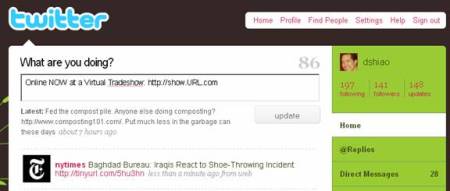
So let’s imagine I’m logged in to a Live Virtual Tradeshow (VTS).  I’m visiting exhibitor booths, viewing Live Webcasts and interacting with peers.  All in all, I’m enjoying myself.  I want to spread the word to friends and colleagues.  One quick (and efficient) way to do that is to post a message to Twitter.

Twitter home page

Twitter home page

I can “tweet” about the Virtual Tradeshow and pass along a URL to my 141 followers.  If any of those followers likes the recommendation, they can “retweet” my message to their followers.  If 5 of my followers spread the word and they each have an average of 100 followers, then my message had a potential audience of 141 + (5 * 100) = 641.  And that doesn’t even count any downstream distribution via my followers’ followers.  If my tweet happens to be picked up by a Twitter power user, my message could be seen by her 10,000 followers!

You can see how quickly and efficiently information is published.  And that’s the beauty of the network effect.  As I amass more followers – and, as more users sign up with Twitter – the potential audience of my “tweets” grows exponentially.  The result is a powerful tool for B-to-B marketers and publishers, if used right.  Publishers need to grow their audience in order to grow their revenue – new audience results in more page views, more ad impressions delivered, more online sales leads.  Where can you find that audience?  On social networks like Twitter.

VTS platform providers may want to consider:

  1. A “post to Twitter” utility within the VTS – make it convenient for VTS attendees to post a message to Twitter, including an auto-shortened URL (so their followers can access the event)
  2. A “Twitter reflector” that takes selected chat messages from the VTS and posts them to Twitter.  Imagine a user engaged in a “group chat” area who wants to share her insight simultaneously to the VTS attendees and her Twitter followers.  Allow her an easy way to do that.  Again, include a shortened URL that points back to the event

Of course, Twitter is not the only social network out there (I haven’t even mentioned Facebook and its 130MM users).  So while I’ve outlined a few ideas that are specific to Twitter, the bigger picture concept is about integrating the VTS platform with an assortment of networks.  The trick will be to pick the right ones.

You can follow me on Twitter here: http://twitter.com/dshiao