How to Handle Those Hot Virtual Tradeshow Sales Leads

December 31, 2008

It’s the holy grail of online lead generation – you generate sales leads that pursue you and your company (rather than the other way around).  This holy grail scenario often plays out in B-to-B Virtual Tradeshows.  Some attendees come to the virtual event with approved budget, purchasing authority and a specific need.  As such, they’re shopping around with the various exhibitors to see who offers the solution that best fits their requirements.

These attendees will ask you (or your colleagues) very specific questions, covering technical specifications, product features and pricing.  At the conclusion of their visit, they may ask to be connected to a sales representative from your company.  How better can it get for you as an online marketer?  For this opportunity that fell into your lap – be sure to close the loop (with sales) on this lead or else the happy ending may be told by your competitor.

Here’s a sample chat that’s representative of what I’ve seen in virtual events:

Attendee: Thanks for the information about your products.
Exhibitor: You’re welcome!
Attendee: I’d like to set up a meeting to price out a configuration and discuss a few requirements that the product needs to meet
Exhibitor: Where are you based?
Attendee: New York City
Exhibitor: (a few minutes later) OK, the area sales manager for NYC is Bob Johnson.  His email address is bjohnson@acme.com and his phone number is 212-555-1212.
Attendee: Thanks, I’ll contact him.

Not good enough!  The exhibitor missed out on a golden opportunity here.  Additional steps that I’d recommend:

  1. Copy/paste the transcript of the chat and immediately email it to Bob Johnson
  2. Connect with Bob via email, IM, etc. – letting him know about the hot lead
  3. Update your CRM system (e.g. Salesforce.com, SalesLogix, etc.) with the transcript of the chat and a summary of the sales inquiry
  4. Urge Bob to follow up immediately with the attendee — let the attendee know (during the chat session) that “Bob is ready to take your call right now” – or, “Bob will call you first thing in the morning”
  5. Get Bob to login to the virtual event right now – you already know that there’s one hot lead from his territory – a sales opportunity waiting for Bob to close
  6. Provide your own contact info to the attendee, letting her know that you can be contacted if Bob cannot be reached

Remember, leads in a virtual tradeshow can be very hot.  Handle with care and don’t treat them like hot potatoes.  If you do, then your competitors may be eating your lunch.


What Cost Per Lead (CPL) Should I Pay for Virtual Tradeshow Sponsorships?

December 28, 2008


Flickr (TheTruthAbout)

Source: Flickr ("TheTruthAbout")

For online marketers responsible for lead generation, the name of the game is Cost Per Lead (CPL).  While it’s not the be-all, end-all, CPL is certainly top-of-mind for marketers – and in this economic environment, CPL is receiving heightened attention from the online marketer, her CMO and her CFO (and possibly even the CEO).

So let’s get the numbers out of the way first.  For B-to-B virtual tradeshows (VTS), I’ve seen CPL’s in a range of $15-$50 for worldwide leads.  The low end reflects events where the organizer has over-delivered on leads or priced the sponsorships reasonably (or both). The high end reflects a more focused event or an event that has slightly underdelivered.  I’ve seen a few events fall outside this range, with CPL’s as low as $10 (or even lower) and as high as $70.

So you’d want your sponsorship to be within this range.  But, I think that for VTS, “What is my CPL” is not the right question!  The following questions are more applicable:

  1. What’s the quality of the audience and does it match my target profile (e.g. geography, purchasing authority, has budget, etc.)
  2. What level of interactions did I have with the attendees
  3. What was my cost per sales engagement and how does that compare to my other marketing activities
  4. What was my cost per customer acquisition and how does that compare to my other marketing activities

So as an example, I’d be fine with paying a CPL of $60, if the resulting cost per sales engagement was lower than my other marketing programs. Remember a key point about these leads, though – they are shared with the other exhibitors at the event.  As such, it’s important to:

  • Distinguish your company at the event – attract visitors to your booth and generate interactions with sales prospects.  If you put in the hard work here, you can short-circuit the lead nurturing and lead follow-up stages – as you can find prospects who are in the later stages of their purchasing decisions and very receptive to hearing more from you.
  • Distinguish your company after the event – follow up with prospects intelligently and promptly.  Don’t forget that if you do your job at the event, then the after-event steps become much easier.

Like with most purchasing decisions, shop wisely – and rememer that there’s much more to the equation than just the CPL price tag.


Eloqua’s Digital Body Language

December 24, 2008

An article in ClickZ titled “TriNet Uses Digital Body Language to Arm Sales Reps” describes how TriNet (an HR services company) leveraged Eloqua’s Program Builder to augment their process of online lead qualification.  When I attended an Eloqua sales presentation on Digital Body Language, I immediately agreed with their approach – and found their digital body language analogy to be quite apt.  Prospects who are interacting with you (e.g. via a visit to your web site) leave tremendously valuable fingerprints.  Web site publishers ought to leverage this valuable data to smarten their lead qualification and follow-up.

 I think that a perfect complement to this digital body language concept can be found in virtual events.  Here, prospects are providing rather explicit cues regarding their interest in your products and services – they’re downloading your White Papers, returning to visit your booth, chatting with your booth reps, etc.  Your nurturing and qualification cycle become condensed down into a single event (e.g. the virtual event!).

If you’re an online marketer who’s using Eloqua’s system, a great complementary program for 2009 might be a virtual event sponsorship.  I think you’ll find valuable body language (from prospects).  Some might even ask you out on a date (to meet with one of your sales reps, that is!).


Use Treasure Hunts to Increase Engagement in Virtual Events

December 23, 2008


Flickr ("Crazy Cake Lady")

Source: Flickr ("Crazy Cake Lady")

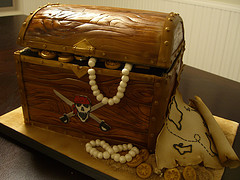
You’ve planned a great virtual event.  You sold a number of high profile sponsorships.  You promoted the event to your members and generated strong registrant counts.  You’re looking forward to the big day, when the exhibitors (and your boss) pat you on the back.  But wait!  You’re work is not done.  Even if you have a large audience – and, the right audience, exhibitors will deem the event underwhelming if that audience doesn’t adequately engage with them.

In a prior blog post, I wrote about the effectiveness of prize giveaways at virtual events.  In that post, I wrote about the notion of smaller prizes to generate interest.  Here, I endorse a slightly different approach: use a grand prize (e.g. flat screen HDTV, if budget allows) and up the ante for prize qualification.  Instead of “presence” in some event location, require that attendees complete all steps of a treasure hunt in order to qualify for the prize.

With a multi-sponsor virtual event, you’re going to want to keep all of your exhibitors happy (without favoring any particular exhibitor).  So set up the treasure hunt so that each exhibitor benefits.  Here is a sample treasure hunt template.  I’ll leave it as an exercise to the reader to determine what actions each step encourages.

Sample Treasure Hunt

  1. Find the White Paper titled Best Practices for Data Deduplication.  Name the author of the White Paper
  2. Find the White Paper titled Data Backup and Recovery.  Name the sponsor booth in which it’s located
  3. There is a booth representative in this event named Joe Kennedy.  Name the sponsor booth in which he’s stationed
  4. In the second Webcast presentation today, the speaker is from what company?

If you go with a treasure hunt, be sure to promote it heavily, both within the event and in email promotions and web site listings prior to the event.  To select the grand prize winner, ask your virtual event platform provider if the platform’s survey function can do the trick.  You may be able to “host” the treasure hunt quiz via the survey – using either multiple choice selections or, using a free-form text field to solicit answers from treasure hunt participants.

Happy Hunting!


Launch Your Next Product Online

December 22, 2008

In 2008, I worked with a few savvy technology vendors to launch their products online in a virtual event.  We called these “virtual launch events”.  They were hugely successful – the vendors generated a slew of net new sales leads, educated prospects and customers about the features of the new product and connected employees, executives and channel partners directly with the same prospects and customers.

Because all users participated online, costs were efficient and the participation was highly convenient.  Additionally, the vendors and their partners were able to achieve deep (online) engagement with prospects, including in-depth text chats regarding the products.

If you’re considering a virtual launch event of your own for 2009, here are my Top 3 best practices:

  1. Encourage participation from your partner ecosystem – your resellers, consultants, etc. should have booths at the event.  This reinforces the full “value chain” of your product – showing prospects that your solution is backed by an assortment of partners who sell the product and provide valuable services around it.  Secondly, you can recoup some of the costs of the event by charging your partners to exhibit.  After all, they’re receiving sales leads as a result of participating.
  2. Active participation from your executive team – have the SVP or GM of your product officially launch the product via video – prospects and customers will apprecitate the personal connection of video (vs. slides and audio).  In addition, have the same exec(s) participate in the booths and networking areas, connecting directly with attendees.  Customers and prospects highly value direct access to your executivies.  And, your SVP or GM will find the experience valuable, since they’d likely admit that they’d like to get out in front of clients more often.  Finally, a successful event makes you a hero in front of the SVP/GM.
  3. Bring an independent voice – you probably have relationships with analyst firms (e.g. Forrester, Gartner).  Have a prominent analyst give her perspective on the product you’re launching and what it means for your market.  This independent voice helps complement all of your (and our partners’) presentations.

Best of luck on your 2009 launches!


Utilize Surveys in Virtual Events

December 19, 2008

Online marketers often speak of hard ROI (explicit return) and soft ROI.  In this economic climate, soft ROI is being cut and marketers are focusing (with rare exception) on hard ROI.  But what if you could generate hard ROI and soft ROI simultaneously?  Would your CMO or CFO like that?  I’d bet that the CMO would, at minimum.

So consider the use of surveys within your virtual events.  Let’s say you generated 200 visitors to your booth.  And let’s say 70% of those visitors completed an online survey that was available right there in your booth (equalling 140 survey completes).  You might think I’m crazy to suggest that 70% of visitors would actually fill out a survey.  But what if you provided a prize?  And, you qualified visitors into the prize drawing via completion of the survey?  I’ve seen it with my own two eyes – one particular event had 70% of booths visitors completing the exhibitors’ in-booth survey (i.e. for those who chose to utilize a survey).

140 survey completes results in a statistically significant sample size.  And you’re likely not going to generate such a high response rate if you message to these visitors post-event.  Here are my Top 3 reasons for doing a survey in a virtual event:

  1. Plan your marketing content – let your target audience tell you what they’re interested in, what media formats they like to consume, what content they want (from you)  as they evaluate your products and services.  Leverage this valuable information to plan your White Papers, webinars and follow-on virtual events.
  2. Generate insights for your Product Manager – partner with your company’s product managers and ask them what info they’d like from customers and prospective customers.  You’d be a hero to Product Management and the success will certainly bubble up to the CMO or VP of Products.  And, by the way, this may help your company design better products.
  3. Intelligent lead follow-up –  survey questions are very similar to the qualifying questions that online marketers use on lead gen registration forms.   Don’t be afraid to review individual survey responses to better plan your lead follow-up with selected leads.

Now, what’s the cost of doing the survey?  Well, the prize will set you back a few hundred dollars (e.g. for a GPS, Nintendo Wii, iPod, etc.).  When evaluated against the soft ROI you can  generate,  I think the investment is worth it.  As Richard Dawson may ask, “Survey says?” – YES.


The Effect of “Online” on the Event Industry

December 18, 2008

Newspapers and other print-focused publications have been hit hard by the migration of readers to the Internet.  Is the event industry facing a similar challenge?  It seems so, especially in today’s economic climate, when travel costs are receiving heightened scrutiny from the CFO.  In a previous blog post, I predicted that 2009 would be the Year We Go Virtual, as we witness a very sharp decline in the number of face-to-face events.

In a blog post titled “Are bloggers & social networks killing the big shows?“, Robert Scoble (@scobleizer) presents a similar view.  To quote Robert:

My sponsor, Seagate, told me they are reducing their spend this year at CES. AMD and Delphi are doing the same thing and I’m hearing about many other companies who will either stop going, or reduce the size of their booths, either this year, if they could, or in 2010 (contracts make it tough to shrink booths as fast as companies might want).

And here’s one reason why:

What’s killing them? The Internet. You can launch a product live now from a living room. Thanks to Stickam, Ustream, Qik, Kyte, YouTube, Flixwagon, Viddler, Vimeo, SmugMug, etc and blogs.

I agree with Robert, though I’d add that in the B-to-B space, you might want to launch a product from a studio (vs. your living room) and extend the reach of social networks by partnering with B-to-B publishers in your space.  The fact remains, though, that there are low-cost means for capturing, publishing and distributing video and related multimedia for launching and evagenlizing your products and services.

And, with active social nets like Facebook and Twitter, you have a cost effective publishing system for quickly spreading the word, assuming you’re spreading the right message to the right people and not spamming the universe.  I’ve seen Virtual Tradeshows as a great vehicle for handling product launches – they include the live keynote video from an executive, the follow-on presentations (Webcasts/Videocasts) and the discussions/networking (online) that you’d typically see at a physical launch event.

Of course, when you’re online, everything can be tracked and reported on.  And, you extend the reach of the content/event beyond geographical boundaries.  As Robert said, I can pitch my product from my living room.  And an IT Pro in Hong Kong can be on the receiving end of my pitch!  Another benefit of online is passalong, which can make a video, podcast or virtual event go viral.  With physical events, that’s just not possible.

While the newspaper industry is still seeking a magic potion to shift their revenues from print to online, I think the event industry should consider 2009 as the year where complementary versions of their events get launched online.  After all, that’s where we all are.


Virtual Tradeshow Technologies

December 17, 2008

Virtual Worlds group

LinkedIn: Virtual Worlds group

I participate in a virtual worlds group over at LinkedIn.   A few members there asked me about a Virtual Tradeshow’s (VTS) underlying technologies.  I don’t pretend to know the full set of technologies that power a VTS, but I will list my Top 3 (in order of importance).

  1. The SaaS Engine Virtual Tradeshow platform providers often call this the “self service utility”.  What it boils down to is a 100% web-based interface that allows event organizers to build a VTS environment from scratch.  Every last detail of the event (down to the number of pixels to use on a particular image on the show floor) can be configured or selected via this web app.  While some clients will always want the extra attention of a “full service model” (where the VTS provider’s staff uses the same web app to build the entire show), consider the power of “self service” – VTS platform providers can scale their businesses by selling leases on their SaaS platform, where their clients do all the heavy lifting.  This means that the better you build this web app, your clients will create more events and they’ll create them more quickly.  This means more revenue and (possibly) earlier revenue recognition.
  2. The Chat system – Today, the power of a VTS lies largely in the text chat sessions that attendees engage in with exhibitors (or, attendee<->attendee sessions).  Platforms used to employ basic HTML to support chat, but the trend is towards client/server technologies, such as Flash Media Server (FMS).  The platform needs to account for corporate firewalls, as many firewalls are configured to block chat-like protocols – if your users cannot chat within a VTS, they lose out on a significant show feature.  If you employ a workaround – such as HTTP tunneling – beware, as some corporate firewalls can utilize deep packet inspection, to figure out that you’re trying to tunnel FMS within HTTP.  And, they then block those packets from reaching their destination, which means that chat fails.  Finally, as webcams and Skype-like video chat emerge in virtual tradeshows, keep in mind that moving from text chat to video chat means that you lose the ability to save a transcript of the chat.  This may be an opportunity for platform providers to support such a feature (e.g. auto-transcribe the audio from a video chat).
  3. Event Reporting – For event organizers, an open-ended web reporting system is useful.  Give them the ability to generate custom reports, kind of like a rudimentary business intelligence app.  For exhibitors, the creation of easy-to-understand canned reports is important.  For both organizers and exhibitors, the reporting system is critical.  Once the live event is over, the reports (and the data contained in them) are the “living record” of the show’s success and both constituencies will lean on the reports to derive their ROI on the event.

What technologies do you feel are important in a VTS?


Get Closer to Your Customer with Virtual Tradeshows

December 16, 2008

In B-to-B, the predominant use of Virtual Tradeshows (VTS) is in generating net new leads to fuel a sales pipeline.  I urge B-to-B marketers to dig deeper with your existing customer base.  After all, the customer that you know is more valuable than the sales prospect that you don’t.  Especially in this economic environment – I believe you can drive more business from existing customers than you can from generating brand new leads and trying to convert them into sales.

Ask yourself the simple question – how well do I really know my customers?  Or, perhaps ask a slightly harder question – how well do I understand my customers’ challenges today (vs. the challenges that existed when they purchased my product)?  I’d argue that now is different from then, especially in the IT space, where the rate of change is high.

So the approach is simple.  Get deeper penetration with your customers, drive deeper relationships and serve them better.  If you can hear and understand their challenges today, you can help them address these challenges (with your products and services).  You end up with customers who are happier and they end up buying more products and services from you.

How can you accomplish this these days?  Online.  Imagine coordinating an online event where Sales, Sales Engineering, Product Development and your executive team can convene online and connect with customers, customers, customers.  You can efficiently “publish” shiny new product guides, troubleshooting guides, case studies, etc.  And, you can interact with customers via private chat, group chat, the networking lounge, etc.  Of course, all those interactions are recorded, so it’s important to meet with your internal teams post-event and make sense of the collective input you received.  Then, act on it.

Go into such an event with two simple goals:

  • I want to hear from my customers
  • I want my customers to hear from me about products and services that they were not aware I provided

There’s also a win-win scenario that you could go for – floor a Custom Virtual Tradeshow that serves the dual purpose of generating net new sales leads and invite your customer base in.  Your content (and your people) provides information that is useful to both constituencies.  Prospects want to learn about your latest products and services – and I bet some of your customers do as well.

So go off and serve those customers – they’ll thank you for it in more ways than one.


Online Marketers: How to Sell Virtual Tradeshows to the Boss

December 15, 2008

Has Bruce Springsteen (The Boss) ever participated in a Virtual Tradeshow (VTS)?  I’m not sure, but if I were an online marketer, here’s how I’d convince my Boss on them.  The first thing I’d do is look for B-to-B publishers who are “flooring” industry virtual events that align with my product marketing initiatives.  Go find out (from the publishers) who’s already committed to sponsor the VTS.  If you’re picking the right events, you’ll notice that your competitors are already on the list.  If they’re not there, then perhaps you need to seek out alternative events.  But wait – you could also be “first in” with the right event – so just be sure the event’s theme aligns with your marketing plans.

So the first point to make to your boss is that your competitors are already on board.  So, NOT participating in the same event is a lost opportunity to have a place at the table alongside your competitors.  I do see attendees at virtual events ask, “Why isn’t <COMPANY> here?”.  If it’s a prominent industry VTS, your absence can speak volumes.  Next, develop an explicit goal for your boss  that clearly demonstrates the ROI.  For instance, how about a goal of 5 late-stage sales engagements – where you’d have to come up with a clear definition (for your boss) of “late-stage”.

Now that you have your boss’ ear, go with the lower tier sponsorship available.  These sponsorships are priced less because rather than receiving all leads (including no-shows), you only generate leads from attendees who directly interact with you (e.g. visit your sponsor booth or download your content).

This puts the onus on you, because you become directly responsible for the success of the campaign – the more visitors you can drive to your booth, the more leads you generate.  The upside, though, is that you can influence the cost per lead (CPL) that you achieve.  And there’s a possible win-win scenario: low CPL’s and a better qualified lead.  Your boss might like to hear about the low CPL, but make sure to emphasize the qualified leads – they’ve had direct interaction with you and their actions with your people or your content tells a lot about them.

Now, to get you to those 5 late-stage sales engagements, you have more work to do.  Remember that these are shared leads, not exclusive leads.  If a VTS had 10 exhibitors, a given attendee might have visited 7 of the 10 booths.  This means that they become leads for 6 other companies, some of whom are your direct competitors.  You’ll need to convert these leads more effectively than your competition.  And often times, this comes down to the simple determinant of, “who acts first”.  Don’t let those hot VTS leads sit in limbo in a spreadsheet or CRM system queue.  Get those leads over to telesales (or direct sales) and call them tomorrow.  If you don’t, you can be sure that your competition is.  And that hot lead suddenly becomes your competitor’s customer.  A shame!

So in summary, here’s an approach that leverages VTS to fuel the sales pipeline at a reasonable cost (making you and The Boss look good):

  1. Convince the boss
  2. Go with the lower tier VTS sponsorship (costs less – but places onus on you)
  3. Be an All-Star performer at the VTS (see related article)
  4. Close the loop by having Sales follow up with the hottest leads
  5. Reap the benefits
  6. Lather, rinse and repeat!

If you’ve never exhibited at a VTS before, enjoy the ride.  I think you’ll find it to be fun.