Interview with Ian Hughes, Metaverse Evangelist (part 1 of 2)

December 17, 2008

eightbar1

Ian Hughes is a Metaverse Evangelist (at IBM) and blogger at eightbar (http://eightbar.co.uk/).  Ian and I connected to discuss virtual worlds and I posed a few questions to him.  In the first of a two-part series, I’ve posted the first five questions, along with Ian’s answers.

  1. So tell us a little bit about yourself? I am 41 year old forever tech geek. I started programming around 14. I grew up in a seaside town and watched the explosion in video games in the arcades. I wanted to know how they worked – I loved playing but was intrigued by the workings of them too. This led me to understand programming, my first Eureka moment. Oh! that’s how it works. I also look at the various combinations of tech and usage including coding as an art form, relying on intuition and flowing patterns as much as running it by the numbers. I joined IBM in 1990 as a full timer and have been here ever since, though explored lots of emerging technologies in various places, the arrival of the PC to a green screen world, client server models, web in the early days and into dot com, then that has led through web 2.0 (before it was called that) to where I am now with virtual worlds and metaverses.
  2. So you’re a Metaverse Evangelist – can you explain what that entails? An evangelist attitude is one that is not always obvious to people. Seeing and feeling a use for something, embedding it into your life and work and helping others see why they should do the same is tricky. It is a mix of sales, pr, marketing and in my case tech, delivery and understanding. By its very nature an evangelist is of no need to people who don’t know what the the evangelist is explaining, once explained, as it is so obvious the evangelist is again of no need.  Metaverse is the generic term for virtual worlds from the book Snowcrash. A few years ago I would have been a web 2.0 evangelist.
  3. What are virtual worlds platforms doing right? In my personal opinion virtual worlds are helping people understand that there is more to communicating electronically at distance than just email or telephones. They all tend to tap into the human patterns of understanding of space, proximity, visual and audio feedback. Most of the important things in understanding one another from non verbal communication. Virtual worlds can be a much richer version of a smiley 🙂 in a piece of text.
  4. Where can virtual worlds platforms improve? It tends to be people refer to usability and those first experiences people have in any virtual world, which applies to any software product, or hardware product. The experience will of course evolve, the ways of interacting will evolve, our tolerance and understanding of how to interact, the social language of virtual worlds will also evolve. So evolution is the main improvement. Also, as with the web we need to try and solve the interoperability problems, both technical, social and legal. There are clearly opportunities to explore ways to interact with various environments, this is not about a Warcraft character turning up in Second Life, it is really about people having the things they need where they need them at the time, in a suitable form.
  5. What do you see as the biggest opportunity for virtual worlds platforms? The opportunities span all human communication needs. Clearly gaming has been the growth, a multiplayer console game is as much a virtual world as a the current crop of non gaming environments. The mode of operation, of people gathering together to achieve and objective, communicating live, seeing the results, acting to deal with problems is as valid in a quest in WoW as it is in dealing with an order for a stack of goods from a customer in an enterprise. Clearly the toolset may differ, but to be able to manipulate business models, see what is going on the in the enterprise, bring the right people in to help visualize and solve the problem, live. Is a massive opportunity. It needs to be smooth for business, but its already smooth for gamers. Most gamers wont play a game if its bad, if they cant quickly do what they need to do, if they cant connect to servers etc. The same applies for business. So a combination of the needs of the gaming world, with the business world, with the social media world and we have some really interesting opportunities.

Get Closer to Your Customer with Virtual Tradeshows

December 16, 2008

In B-to-B, the predominant use of Virtual Tradeshows (VTS) is in generating net new leads to fuel a sales pipeline.  I urge B-to-B marketers to dig deeper with your existing customer base.  After all, the customer that you know is more valuable than the sales prospect that you don’t.  Especially in this economic environment – I believe you can drive more business from existing customers than you can from generating brand new leads and trying to convert them into sales.

Ask yourself the simple question – how well do I really know my customers?  Or, perhaps ask a slightly harder question – how well do I understand my customers’ challenges today (vs. the challenges that existed when they purchased my product)?  I’d argue that now is different from then, especially in the IT space, where the rate of change is high.

So the approach is simple.  Get deeper penetration with your customers, drive deeper relationships and serve them better.  If you can hear and understand their challenges today, you can help them address these challenges (with your products and services).  You end up with customers who are happier and they end up buying more products and services from you.

How can you accomplish this these days?  Online.  Imagine coordinating an online event where Sales, Sales Engineering, Product Development and your executive team can convene online and connect with customers, customers, customers.  You can efficiently “publish” shiny new product guides, troubleshooting guides, case studies, etc.  And, you can interact with customers via private chat, group chat, the networking lounge, etc.  Of course, all those interactions are recorded, so it’s important to meet with your internal teams post-event and make sense of the collective input you received.  Then, act on it.

Go into such an event with two simple goals:

  • I want to hear from my customers
  • I want my customers to hear from me about products and services that they were not aware I provided

There’s also a win-win scenario that you could go for – floor a Custom Virtual Tradeshow that serves the dual purpose of generating net new sales leads and invite your customer base in.  Your content (and your people) provides information that is useful to both constituencies.  Prospects want to learn about your latest products and services – and I bet some of your customers do as well.

So go off and serve those customers – they’ll thank you for it in more ways than one.


Online Marketers: How to Sell Virtual Tradeshows to the Boss

December 15, 2008

Has Bruce Springsteen (The Boss) ever participated in a Virtual Tradeshow (VTS)?  I’m not sure, but if I were an online marketer, here’s how I’d convince my Boss on them.  The first thing I’d do is look for B-to-B publishers who are “flooring” industry virtual events that align with my product marketing initiatives.  Go find out (from the publishers) who’s already committed to sponsor the VTS.  If you’re picking the right events, you’ll notice that your competitors are already on the list.  If they’re not there, then perhaps you need to seek out alternative events.  But wait – you could also be “first in” with the right event – so just be sure the event’s theme aligns with your marketing plans.

So the first point to make to your boss is that your competitors are already on board.  So, NOT participating in the same event is a lost opportunity to have a place at the table alongside your competitors.  I do see attendees at virtual events ask, “Why isn’t <COMPANY> here?”.  If it’s a prominent industry VTS, your absence can speak volumes.  Next, develop an explicit goal for your boss  that clearly demonstrates the ROI.  For instance, how about a goal of 5 late-stage sales engagements – where you’d have to come up with a clear definition (for your boss) of “late-stage”.

Now that you have your boss’ ear, go with the lower tier sponsorship available.  These sponsorships are priced less because rather than receiving all leads (including no-shows), you only generate leads from attendees who directly interact with you (e.g. visit your sponsor booth or download your content).

This puts the onus on you, because you become directly responsible for the success of the campaign – the more visitors you can drive to your booth, the more leads you generate.  The upside, though, is that you can influence the cost per lead (CPL) that you achieve.  And there’s a possible win-win scenario: low CPL’s and a better qualified lead.  Your boss might like to hear about the low CPL, but make sure to emphasize the qualified leads – they’ve had direct interaction with you and their actions with your people or your content tells a lot about them.

Now, to get you to those 5 late-stage sales engagements, you have more work to do.  Remember that these are shared leads, not exclusive leads.  If a VTS had 10 exhibitors, a given attendee might have visited 7 of the 10 booths.  This means that they become leads for 6 other companies, some of whom are your direct competitors.  You’ll need to convert these leads more effectively than your competition.  And often times, this comes down to the simple determinant of, “who acts first”.  Don’t let those hot VTS leads sit in limbo in a spreadsheet or CRM system queue.  Get those leads over to telesales (or direct sales) and call them tomorrow.  If you don’t, you can be sure that your competition is.  And that hot lead suddenly becomes your competitor’s customer.  A shame!

So in summary, here’s an approach that leverages VTS to fuel the sales pipeline at a reasonable cost (making you and The Boss look good):

  1. Convince the boss
  2. Go with the lower tier VTS sponsorship (costs less – but places onus on you)
  3. Be an All-Star performer at the VTS (see related article)
  4. Close the loop by having Sales follow up with the hottest leads
  5. Reap the benefits
  6. Lather, rinse and repeat!

If you’ve never exhibited at a VTS before, enjoy the ride.  I think you’ll find it to be fun.


Leverage Twitter for Virtual Tradeshow Outreach

December 15, 2008

When Sarah Lacy interviewed Mark Zuckerberg on-stage at South by Southwest Interactive this past March, rumblings spread throughout the audience regarding Lacy’s interview style.  A few in the audience extended the rumblings online via Twitter – and from there, Twitter’s network effect quickly spread the commentary across the globe.  The power of Twitter (and related social networks) can be a real boon to B-to-B events, precisely because of the network effect:

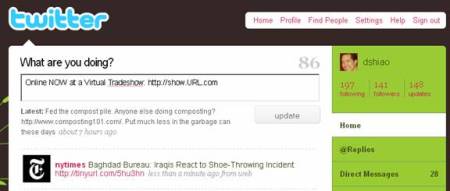
So let’s imagine I’m logged in to a Live Virtual Tradeshow (VTS).  I’m visiting exhibitor booths, viewing Live Webcasts and interacting with peers.  All in all, I’m enjoying myself.  I want to spread the word to friends and colleagues.  One quick (and efficient) way to do that is to post a message to Twitter.

Twitter home page

Twitter home page

I can “tweet” about the Virtual Tradeshow and pass along a URL to my 141 followers.  If any of those followers likes the recommendation, they can “retweet” my message to their followers.  If 5 of my followers spread the word and they each have an average of 100 followers, then my message had a potential audience of 141 + (5 * 100) = 641.  And that doesn’t even count any downstream distribution via my followers’ followers.  If my tweet happens to be picked up by a Twitter power user, my message could be seen by her 10,000 followers!

You can see how quickly and efficiently information is published.  And that’s the beauty of the network effect.  As I amass more followers – and, as more users sign up with Twitter – the potential audience of my “tweets” grows exponentially.  The result is a powerful tool for B-to-B marketers and publishers, if used right.  Publishers need to grow their audience in order to grow their revenue – new audience results in more page views, more ad impressions delivered, more online sales leads.  Where can you find that audience?  On social networks like Twitter.

VTS platform providers may want to consider:

  1. A “post to Twitter” utility within the VTS – make it convenient for VTS attendees to post a message to Twitter, including an auto-shortened URL (so their followers can access the event)
  2. A “Twitter reflector” that takes selected chat messages from the VTS and posts them to Twitter.  Imagine a user engaged in a “group chat” area who wants to share her insight simultaneously to the VTS attendees and her Twitter followers.  Allow her an easy way to do that.  Again, include a shortened URL that points back to the event

Of course, Twitter is not the only social network out there (I haven’t even mentioned Facebook and its 130MM users).  So while I’ve outlined a few ideas that are specific to Twitter, the bigger picture concept is about integrating the VTS platform with an assortment of networks.  The trick will be to pick the right ones.

You can follow me on Twitter here: http://twitter.com/dshiao


How to Exhibit at B-to-B Virtual Tradeshows

December 14, 2008

Planning to be an exhibitor at a B-to-B Virtual Tradeshow (VTS)?  Here’s how to become a VTS All-Star:

  1. The right people – to attain All-Star status, first find your own team of all-stars from within your company.  You’ll want a good mix of product folks (product managers and/or product marketers), sales folks (direct sales reps or Inside sales reps) and technical folks (engineers or sales engineers).  Prepare your team for the event by bringing them up to speed on VTS (if this is their first time) and give each member clear goals of what you’d like them to do and accomplish.  For instance, the sales folks proactively connect with attendees; the product marketers participate in the public forums; the sales engineers are “on call” to the product marketer in case a really tough technical question is asked.
  2. The right content – place content in your virtual booth that is directly applicable to the theme of the event.  Take the time to carefully select your White Papers, Case Studies, podcasts, videos, etc.  Don’t simply repeat what you used at an unrelated event.  Attendees will be on the look-out for useful content, so if you’re selections are on the mark, you’ll generate more views and downloads.  Think of it as a form of search engine optimization – where the “spider” is the visitor to your booth.
  3. The right actions – train your booth reps to proactively connect with your booth visitors.  Thank them for their visit, send them a virtual business card, invite them to review your booth’s content.  Ask them about specific challenges they face and have your product marketers suggest solutions.  You’ll come out ahead if you help the attendees, rather than doing a hard sell on your products and services.  Attendees at B-to-B virtual events are not shy about seeking you out, which means they’ll come asking for pricing and product information.  When they do, make sure you have answers – or, be able to find an answer within an hour.  There’s no greater shame than getting hot leads at a VTS and then making them wait for the info they’ve asked for.
  4. The right prizes – that’s right, everyone loves the giveaway, even if it’s as small as a $25 gas card or coffee card.  A “big prize” (e.g. Nintendo Wii or HDTV) always attracts attention, but I like doing a large number of smaller prizes – reason being, attendees like the immediate gratification of winning a small prize, instead of receiving a chance to win the big prize.  So whether  it’s 100 USB drives or 50 Starbucks gift cards, you’ll get the attendees’ attention.  The most effective prize I’ve seen – copies of a book (by an expert) whose name was known by all attendees.

So there you go.  Do the “right” thing to secure your spot on the VTS All-Star Team.  Good luck and have fun.


Breakdown: Exhibitors of Virtual Tradeshows

December 13, 2008

I’ve had the privilege of working with dozens of Virtual Tradeshow (VTS) exhibitors, ranging from scrappy start-up technology vendors to Fortune 100 giants.  I’ve found that each exhibitor, independent of the type of company represented, approaches VTS differently, with a wide range of knowledge, experience and plain old know-how.  Here is my breakdown of VTS exhibitors:

  1. The savvy elite (1%) – they know how to best leverage the VTS experience – they understand that a Live VTS embodies characteristics of social media, conventional online lead generation and face-to-face events.  They’re active and proactive.  They utilize tactics to drive interest to their brand and traffic to their booth.  They leverage tricks of the trade from physical events and translate them well to the online world.  Some gain this status from experience at past virtual events – others “get it” during their very first VTS.  The savvy elite excel not only on the front end, but also on the back end – in their ability to extract the valuable engagements they’ve generated and place that data in their CRM system.  By perfecting the back-end, the savvy elite hand their salesforce focused and prequalified leads.  Here, the VTS accomplishes the two-step process of lead generation and lead qualification.  The savvy elite can re-use their telesales staff on other programs, where more rigorous qualification is necessary.
  2. The group with good intentions (15%).  This group understands the potential of a virtual event.  For the most part, they do an effective job at interacting with attendees/prospects.  Some could use a little fine-tuning in their approach.  Where this group ultimately falls short is on the back-end.   They are sending Sales a mix of hot and cold leads, leaving Sales to pursue nine or ten  (or more) leads before they find one that’s worthy.
  3. Needs significant assistance (79%).  Here’s your bulk of VTS exhibitors today.  They need help on the front end and the back end.  On the front end, they tend to sit back and wait for attendees to contact them.  Imagine doing that at a physical tradeshow – you’d end up speaking to very few people.  This group requires a little more handholding on what works and what doesn’t – things that the savvy elite know instinctually.  On the back end, this group tends to throw all generated leads “over the wall” to telesales.  And the result is phone calls or emails to leads with no explicit association with the virtual event (quite a shame).  So here’s the opportunity to B-toB publishers and VTS platform providers: provide the necessary tools, utilities and reports (to this oversized constituency) to highlight the “best” leads to the exhibitors, based on automated analysis of the attendee engagement data.  If I had 57 private chat sessions with prospects, tell me which ones I should care about.  By doing this, all parties will derive more ROI from these events – you take a pre-existing set of leads – and instantly make them better.
  4. List buyers (5%).  They sponsor VTS’s in order to buy themselves a list of sales prospects.  They tend not to staff their booth.  They place little to no content in their booth.  They send the entire list of leads over to telesales and hope for the best.  On the back-end, this group sees significantly lower sales conversions compared to the savvy elite.

With 2009 being the year of virtual events, I’m hoping that the savvy elite grow from 1% to 10% share.  That growth won’t happen magically – the publishers and the platform providers will need to do their part.  If they do, it only serves to make virtual event marketing all the more compelling.


2009: The Year We Go Virtual

December 12, 2008

Year of the Ox

Year of the Ox

The Chinese will celebrate 2009 as the Year of the Ox.  For B-to-B marketers, I’m convinced that 2009 is the Year of the Virtual Event.  While virtual events have already taken shape – in the IT space, 2007 was a growth year and 2008 was even stronger – I believe we’re facing a watershed moment when a “perfect storm” of factors will lead to a phenomenal surge in virtual events.

I believe that companies who provide products and services around virtual events will experience 50%, 100%, 200% and higher annual revenue growth in 2009.  On the flip side, companies whose primary business is around supporting B-to-B face-to-face events will experience diminishing demand and all but the top 5-10% will struggle to survive.

Here are the factors I see contributing to this watershed moment:

  1. Attendee demand – let’s consider the IT Pro.   Those who survived a layoff are facing significant internal cost controls.  It’s likely that all travel has been cut, which means that Joe IT Pro will not be attending a face-to-face event, even if it’s in the nearest major city.  This is one factor driving B-to-B event marketers to scale back their 2009 event plans.
  2. Exhibitors’ requirement for cost efficiency – if you’re lucky enough to have marketing budget for 2009, you don’t want to spend it on a high-end hotel (with their elevated food and beverage costs), along with the travel and lodging costs for your colleagues.  Instead, you could pay less for an online event.  Today, more than 50% of a virtual event’s cost is associated with the headcount required by the platform provider to configure the event.  The virtual event platforms, however, are moving to a full-blown  SaaS model, where the exhibitor becomes a mere tenant on the multi-tenant platform – and configures the event 100% on her own.  This means that the costs will trend downward over time (imagine that).
  3. The Green Movement – who hasn’t been encouraged lately to think and act Green?  A virtual event is virtually carbon-free.  Exhibitors stay at home (or in the office); attendees stay at home (or in the office).
  4. Measurability – with a virtual event, exhibitors can track and analyze all of the discrete actions taken by an attendee.  In addition, with tools like text chat (the equivalent of instant messaging), exhibitors can interact with attendees and have all the chat transcripts available for later review.  Other tools, like search, allow exhibitors to identify (and connect with) target attendees who are online in the event right now.  What this means is that exhibitors can measure and calculate their Return on Investment with higher precision and accuracy.
  5. The human touch – event marketers will tell you that nothing beats a face-to-face, in-person meeting.  2009 is a year where virtual events will merge with telepresence – with early adoption most likely in closed/private event spaces.  There are cost factors with telepresence – but, imagine virtual events combined with high fidelity video and it’s  like you’re in the same room as the person half way around the world.  With telepresence costs bound to come down over the long term, I see virtual events + telepresence being a killer combination.

All in all, I look forward to 2009 with great excitement.  For folks in the virtual events space, the Year of the Ox may be better labeled the Year of the Racehorse – as it’s off to the races we go.