2010 Trend Watch: Virtual Events

February 25, 2010

Source: flickr (User: b.frahm)

For the virtual events industry, the premier face-to-face event of the year is Virtual Edge Summit, the “summit on virtual events, marketing & communities”.  Virtual Edge 2010 concluded earlier this week – the face-to-face event floored in Santa Clara, CA, while several vendors provided virtual components, allowing remote (virtual) attendees to participate in the experience.  The event saw record crowds from attendees, exhibitors and presenters.

From my observations at this year’s event, the following are a set of emerging trends in the industry.

Beyond Novelty Phase

Judging by the turn-out alone, the virtual event industry has officially “graduated” beyond the novelty phase.  Awareness of virtual events has broadened – now, when I meet someone at a social gathering and describe what I do for a living, the blank stare of years past has become a “oh yes, I’ve attended one of those”.

The increase of awareness (and, perceived importance) could be seen in the amount of coverage that Virtual Edge 2010 received – an increase in the number of publications (on-site), bloggers (both on-site and virtually) and analysts (both on-site and virtually).  Lastly, the volume of tweets (via hash tag: #ve10) was 5-10 times greater than last year – with more tweets per person and many more people tweeting.

With that being said, there are enormous untapped and unexplored markets, which will provide the industry much of its growth in 2010 and beyond.

More Players Emerge

I noticed a near doubling in the number of exhibitors this year, which means that new/emerging vendors significantly developed (or expanded) their virtual event capabilities – or, from a marketing standpoint, they determined it was the right time to get their products and services in front of this audience.

Last year, the exhibitors were fairly homogeneous – they provide apples-to-apples solutions and directly compete with one another.  This year, the breadth of solutions offerings (from the exhibitors) has expanded – some exhibitors do not necessarily compete directly with one another.

In some cases, a client may use one vendor for a particular type of virtual event and a different vendor in another type of event.  The result?  More “burden” on the attendees (buyers) to understand the solutions offered and determine which solution best fits their needs.  This affords some  industry players (agencies, consultants) a great opportunity to help clients and prospects navigate the waters.

Early Adopters Become Industry Thought Leaders

Practitioners (especially some of the early adopters in our industry) are quickly becoming the thought leaders and “go to source” for ideas, expertise and wisdom.  Many of these thought-leading practitioners were on stage this week – they were very generous with their sharing of experiences.  And, more than ever, they know precisely what they want from their vendors (which is a great thing for those in the vendor space).

In the early days, the practitioner would ask the vendor, “show me what you have” or “show me what you can do’.  Today, the tables have been turned.  Practitioners (clients) are now telling the vendors, “let me tell you what I need” or “make this experiential vision come to life for me”. This is an important aspect of the industry’s evolution – vendors crafting innovation via direct input from practitioners (as opposed to creating “innovation in a vacuum”).

3D Immersiveness

Interest in 3D immersiveness is picking up.  In fact, at Virtual Edge this year, roughly 20% of the session content involved 3D / immersiveness and a formal “Business 3Di” track was created.  The 3Di track featured practitioners, along with vendors such as Linden Lab, Teleplace, Altadyn, Digitell and web.alive (Avaya).  Like last year, Digitell provided a simulcast of the event proceedings into their 3D immersive platform (VirtualU).

Those are the “pure play” immersive environments.  In addition, virtual event platforms are coming on board as well.  In my 2010 predictions on virtual events, I wrote, “(virtual event) platforms take first step towards immersiveness”.  This prediction has come true.

It’s interesting, however – some vendors have a clear vision of what immersiveness enables for exhibitors and attendees of virtual events, while others appear to be adding immersiveness for the sake of adding it (i.e. lacking a clear and compelling use case).  It’s in the best interest of virtual event vendors to explore and enable immersiveness via specific client use cases – this way, the capabilities are added to meet a client need – and, serve as a reference (to the rest of the industry) on the true value delivered via immersiveness.

Social Media Integration

2009 was a monumental year in the evolution of both social media and virtual events.  In 2010, there continues to be a lot of talk about both topics – including discussion around how they integrate with one another.  Social media (and related social networks) were central to the discussion in many workshops and breakout sessions.

And of course, social networking was flourishing in and around the event, with a high volume of tweets, a fair number of Facebook status updates and (I’m sure) lots of LinkedIn connections made.  While I am not aware of any groundbreaking announcements from Virtual Edge on social media integration, I’d expect that platforms enable more and more social networking as 2010 unfolds.  I expect to see the platforms themselves becomes more social (natively) and increase the depth of their integration with third party social networks.  Twitter, Facebook and LinkedIn are commonly mentioned – but expect to see industry-specific, niche networks and communities integrated as well.

Industry Ecosystem Begins to Take Shape

Virtual event platform vendors have established a number of strategic partnerships to extend account/client reach and grow/scale business opportunities.  Most of those partners were present at Virtual Edge – and a number of partners had prominent speaking roles in the sessions.  By this time next year, even more partners will enter the space and appear at the event.

Additionally, smaller businesses (and individuals as well) are seeking to leverage opportunities within virtual events to bring in new business – or sign on for consulting roles.  The list includes video production companies, design agencies, digital signage providers, freelance producers/writers/story-tellers, streaming providers and emerging social network / community sites.  As these “players” look to get a small piece of the industry pie, they serve to grow the overall ecosystem of this industry.

Finally, hands-on practitioners are finding a fluid and welcoming job market, despite the less inviting macro job environment.  Virtual events are still new enough that production staff, developers and strategic consultants have highly specialized knowledge and skills – as such, they’re able to quickly transition from their existing (or past) role to a new vendor, service provider or practitioner (client side).  Most of the vendors in the space are aggressively hiring, which means that savvy job seekers leveraged the conference to generate meaningful employment leads.

Conclusion

It’s an exciting time in our industry – I’m looking forward to seeing how things shape up for Virtual Edge 2011.

Tweet this posting:


How 3D Virtual Worlds Can Be More Like Twitter And Facebook

February 8, 2010

3D Virtual Worlds Diagram

Facebook and Twitter have taught us that people of all ages love to utilize the web for self-expression, connecting and staying in touch.  3D virtual worlds have similar characteristics: the ability for self-expression via customized avatars and the creation of your own ‘island’; the ability to connect with friends (or meet people you’d never get a chance to meet in the real world); and the ability to be part of a vibrant community.

In addition, 3D virtual worlds offer a fully immersive environment, that allows you to escape from the real world – and, experience virtual representations of real-world locations. For virtual worlds experiencing declining usage, however, “community” becomes a challenge to maintain (i.e. imagine using Facebook when none of your friends or family are using it).

Mark Kingdon (in-world: “M Linden“), the CEO of Linden Lab, laid out his vision of Second Life’s evolution, tying it in with the recent acquisition of Avatars United.

M. Linden on Community:

“When we talk to the users who sign up but then decide not to stay, they say they left, in part, because they had a hard time finding people to hang out with. Either their friends weren’t there, or they have a hard time meeting new ones inworld, or sometimes both.  We need to fix this.”

M. Linden on Social Sharing:

“Another part of the “social glue” of any community is the concept of sharing.  Inworld, it’s easy to share and we’ll make it even easier.  But sharing between Second Life and the larger social Web is not as easy.  As an avid photographer (well, aspiring to be avid), I’d love to be able to easily share my snapshots from Second Life with my friends on other Web services, and be able to watch a feed of the people I’m interested in.”

Reaction

Kingdon’s blog posting generated a wealth of comments from the Second Life community – I’d characterize the comments as mixed to fairly positive.  My own reaction to the blog posting was very positive – my use of Second Life (and other virtual worlds) would increase based on my knowledge of in-world events/happenings attended by members of my social graph.

Here are my thoughts on how to increase community engagement and social sharing in a 3D virtual world.

Facebook and Twitter

Direct Integration with Twitter, Facebook

With Avatars United, according to Kingdon, “you’ll start to build an activity feed (similar to Facebook or Twitter) that keeps you in closer touch with the people you’re connected to in Second Life.” While I see value in a single feed that aggregates content from multiple social networks, I see equal (if not more) value in direct integration of Twitter, Facebook, etc., into the virtual world.

The Twitter API and Facebook Connect make doing so fairly straightforward.  A B2B company with an island in Second Life may want to integrate a Twitter stream that displays tweets related to the company.  Similarly, the company could prompt visitors to tweet about their visit and have that message be distributed to all of the visitor’s followers on Twitter.

By enabling this, the owner of the island generates “free” promotion to the social web – and, the underlying platform gains wider reach as well.  A relevant analogy is Ustream’s Social Stream, which allows viewers to “chat with your friends over Twitter” while they’re viewing a live video.

On the Facebook front, imagine if the virtual world platform enabled Facebook Connect, thus allowing residents to sign in to Facebook and find a list of their Facebook friends who are also residents.  Then, imagine showing users a real-time list of their Facebook friends who are in-world right now, with “links” to teleport to the friends’ locations.

Borrowing from another popular service (Foursquare or Gowalla), the virtual world platform could enable residents to “check in” at different locations (islands).  Broadcasting their whereabouts to their social graph may result in more “planned encounters” within the virtual world.  If my friends just checked in to “virtual island”, I may choose to teleport and join them there if I happen to be free.

“I Like It!”

Virtual worlds could create a stronger “shared experience” by allowing visitors to leave a trail of breadcrumbs reflecting their visited locations.  If I “friend” someone in-world – or, if an in-world resident is a Facebook friend of mine, then I might want to follow the path they took during their last session.  Additionally, the platform could support location endorsements, in the same way Facebook allows me to “like” a friend’s wall posting.

As I enter a location in the virtual world, I can see whether members of my social graph previously visited – and, what their comments were.  Alternatively, I could see a list of all past visitors – with a link to view their in-world avatar and profile.  If a past visitor panned a location, but I enjoyed it, allow me to send an offline message to that user, who can read my message the next time she logs in.  This allows me to connect with other users even when they’re not online (a form of virtual world email).

Source: flickr (User: Indiewench)

Virtual World Closed-Circuit TV

Business owners leverage closed-circuit TV technology to perform surveillance of their store front or office.  Wouldn’t a similar service be useful for virtual world residents, especially those who “own” an island?  While we tend to be online during our waking hours, it may not be practical to be in-world all the time.  How about a virtual world thin client – it provides a read-only “view” of a given location, similar to closed-circuit TV.

Since it doesn’t allow you to navigate, teleport, interact with others, etc. – the client is entirely lightweight and can sit in a corner of your desktop with only a portion of the CPU/RAM consumed by the full-blown client.  So if you’re interested in a given location, the closed-circuit TV can alert you to visitors – and with one click, the thin client can launch the full client and teleport you to the location.

Services (like this one) that can instantaneously connect users are a win-win – they generate more logins to the platform and enable more connections, upon which a stronger sense of community develops.  Alternatively, the virtual world platform can provide even more lightweight notification mechanisms: it can generate an email, Twitter direct message or Facebook email whenever a user enters a designated space.  The notification could contain a link that teleports the recipient into that space to connect with the current visitor(s).

Embed Web Content In-World

As Twitter and Facebook have demonstrated, users of social services are inclined to share interesting content, often in the form of web links.  Within a virtual world, “sharing” often results in the launching of a web browser to render the shared page.  Why not provide sharing capabilities that render the shared content on an in-world wall or projection screen?  This keeps users engaged, while retaining their attention in-world.  Building upon this, I may want to look up Facebook friends and be taken to all locations in which they shared content in-world (as I have an interest in what my friends are reading and sharing).

On Demand TV (for Virtual Worlds)

Facebook has a great utility that allows me to record a video on my laptop’s webcam, upload it to Facebook and share it on Facebook.  Virtual world platforms should enable users to press a “record” button and have their current session saved for later playback.  Perhaps I’m attending an in-world concert or watching a keynote presentation – capturing a recording of the session allows me to share it with members of my social graph who weren’t able to attend.  Treet TV provides similar services (with professional quality) – this capability empowers end users to create on-demand programming with the click of a mouse.

Conclusion

3D virtual worlds have a lot to offer already – by adopting useful social sharing services, they can tap into the phenomenon (social media) that’s the force behind many of today’s most popular web sites.

Related Links

  1. Wagner James Au in New World Notes, “How To Make Second Life Truly Mass Market, Part 1: Deep Integration With Facebook

Tweet this posting:


Ubivent Enters The Virtual Events Platform Market

December 2, 2009

Based in Mannheim, Germany, ubivent has entered the virtual events platform market with a recently launched platform.  According to Michael Geisser, Managing Director Market Development, the ubivent co-founders “met at university, working together in an IT research program and pursuing our PhD”.  The co-founders then spent several years working at multinational corporations, where they held numerous roles in IT and IT management.

In fact, Geisser and co-founder Thomas Butter (Managing Director Research and Development) were recently with SAP, where they worked on some of SAP’s first virtual events.  Ubivent is off to a fast start – they received 12 months of funding from EXIST, “a program of the European Union and the German Federal Ministry of Economics and Technology” designed to support innovation.  In addition, in late November, ubivent was selected as the most promising young company in Mannheim.

Target market

Ubivent’s initial target market is to serve large and distributed corporations – large companies have already adopted the basic technologies required for virtual events (including sufficient bandwidth capacity) and distributed companies can immediately leverage the convenience and cost savings of virtual collaboration (versus in-person).

“However, this does not mean that we do not offer our services for small, non-IT organizations”, noted Geisser. “We’ve also done projects with local authorities. Obviously, the entire project size has been not that extensive as for a global event with multiple thousands of participants.”

Since the European market for virtual events has not developed as quickly as the U.S. market, Geisser sees plenty of opportunity in Europe.  Geisser sees opportunity in all sorts of event types, but notes that “the type of the event is not as important as the content and the participants. We see the advantages of virtual events especially for knowledge-intense content (e.g. software, finance, etc.) with globally distributed participants”.

In comparing the U.S. and European markets, Geisser believes that while “US based customers put more emphasis on the look and feel, the European customers are very keen on getting a technically scalable and secure platform. Fortunately we’re combining both.”

Technology platform

Ubivent is a member of Microsoft BizSpark, a program that provides “software, support and visibility” to software start-ups.  While most virtual event platforms are built on top of Adobe Flash, ubivent’s platform is based on JavaFX, a platform for building rich internet applications that runs on top of JRE (Java Runtime Environment).

According to Geisser, the use of JavaFX serves as a competitive advantage for ubivent over competing Flash-based platforms – “JavaFX is one key advantage of our platform. This opens the door for completely new functionalities which are not possible with other technologies (e.g. Flash)”.

Ubivent developed an accessibility framework to assist visually impaired people in using their virtual events platform via a screen reader.  The source code for the accessibility framework has been published as open source.  The framework is built on top of JavaFX, which means that other platforms seeking to incorporate it would need to run JavaFX as well.

Virtual events vs. immersive virtual worlds

Geisser has taken a look at 3D immersive virtual worlds, such as Second Life and Twinity.  He believes, however, that the immersive virtual world is currently more suited to B2C or C2C use cases, whereas his B2B market is more focused on quick and convenient access to selected content.  Notes Geisser, “In a B2B context, the desire for avatars and the ability to walk through a virtual world is less distinct. Here, the focus is more the ability to quickly access information and other participants. The need to ‘walk’ through the virtual world to access this information or participant is considered adverse with regard to this goal.”

In closing

It will be interesting to watch the European market for virtual events in 2010.  Ubivent and IMASTE are two of the leading European-based providers – while they may encounter each other in common client accounts, I’m sure the providers from the U.S. market will be looking towards Europe (and Asia) as well.

Related links

  1. Follow ubivent on Twitter
  2. Ubivent’s Facebook page
  3. Ubivent-developed accessibility framework, fxaccessible
  4. Ubivent’s executive management team
  5. Audio interview – ubivent speaks about their JavaFX-based virtual events platform

How Location Awareness And Augmented Reality Can Be Leveraged For Events

November 24, 2009

Photo source: Layar.com

With the addition of a compass, GPS and associated software, the PDA/smartphone has become as powerful as ever.  Services are emerging that blend social networking and location awareness (e.g. Foursquare, Google Latitude) – in addition, augmented reality has received a lot of recent attention.  Amsterdam-based Layar has interesting technology that they call Layar Reality Browser – Version 2.0 (a mobile, augmented reality browser).

How could location awareness and augmented reality apply to events and trade shows?

Event Check-In

Source: flickr (User: Buckeye Beth)

Event planners could partner with location awareness providers to determine which registrants have appeared on site.  Attendees would need to register and opt-in to the location awareness service – but once they do, the technology can determine who’s on site and provide automated check-in.  Imagine arriving at the event, skipping past the long check-in line and going straight to a self-service kiosk, where you can print your event badge.  Once you have your badge printed, perhaps the event planner disables the location service, to give attendees the reassurance that they’re not being watched, a la Big Brother.

Eco-friendly maps

Photo source: Layar.com

You’re at the main lobby of the event – imagine holding up your PDA and having a map appear of the venue.  You no longer need to ask where the keynote session is being held – your PDA can map it for you – and perhaps guide you right there via its GPS function.  Such a service would make support overhead more efficient (less staff required to direct attendees) and be eco-friendly, since the printed event guide (and map) may no longer be required.

Augmented Reality at Exhibitor Booths

For trade shows that include exhibitor booths, augmented reality provides for some interesting possibilities.  I’m standing at the event’s most popular booth – the event staff is swarmed with visitors and I have to wait in line to speak to the exhibitor and/or get my product demo.  While I’m waiting, I bring up the augmented reality app on my PDA – it shows an image of the physical booth (right in front of me) with the following information overlaid:

  1. Related content from the exhibitor that I can view (right now) from my PDA – documents, white papers, on-demand videos, etc.
  2. Bios/profiles of event staffers who are in the booth right now – so I know that the most popular demo is being given by the exhibitor company’s Senior Product Manager for Mobile – I can view his LinkedIn profile, so that when my turn comes, I already know that we have a connection in common.
  3. An option to view the demo – perhaps the physical booth demos are being streamed out to the web – e.g.  into a hybrid virtual event.  With a click, I’m able to view the live stream of the demo via my PDA.  I’ll admit, it’s an odd thought to watch a live demo that’s occurring a few feet from you – but sometimes at events, it is truly hard to see the demo from the back of an assembled crowd.
  4. An option to join a text chat with a virtual booth staffer – again, in a concurrent virtual event, perhaps the exhibitor supplements their physical staffers with online staffers in the virtual environment.

Social gaming and following friends/colleagues

Events could incorporate a gaming aspect, with points tied to actions – and activity tracked via location awareness.  Exhibitors no longer need to scan an attendee’s badge – instead, the location awareness service tracks which booths they’ve visited.  Safeguards need to be established, of course, to ensure that a booth visit was real/substantial, as opposed to a “drive by”.  To use a Foursquare analogy, perhaps exhibitors offer a grand prize (e.g. HDTV) and award that to the attendee who holds the title of “mayor” (of that booth) at the conclusion of the event.

In a sales meeting, on the other hand, you often have colleagues who want to attend sessions together – instead of texting or IM’ing to coordinate meet-ups, a location awareness service (think Google Latitude) can allow opted-in attendees to track one another’s location on the show floor.  If your colleague is spending too long on line for coffee, go grab him so that you’re both not late to your boss’ presentation.

The important stuff – food!

Photo source: Layar.com

Layar, Yelp and Urbanspoon have all released augmented reality apps related to restaurants.  Whether it’s lunch during the event or dinner afterwards, you’ll always be a few augmented clicks away from knowing where’s the best burger, steak or burrito.

Perhaps what we need is a conference on augmented reality and location awareness – where all of this becomes reality!


For Software Development Teams, The World is Flat (And Virtual)

October 18, 2009

Source: flickr (User: reinholdbehringer)

Source: flickr (User: reinholdbehringer)

Software development teams are traditionally located in the same (or nearby) physical office location(s).  It’s useful for these teams to work from adjacent cubicles (or offices) as the close proximity facilitates collaboration, mentoring and joint code reviews.  In fact, the increasingly popular agile software development methodology lists the following in its Agile Manifesto: “The most efficient and effective method of conveying information to and within a development team is face-to-face conversation”.

I won’t debate this particular point, but I do think that the trends are pointing towards distributed (vs. centralized) software development teams.  Some of the factors that are causing this trend:

  1. Outsourcing and off-shore development – while the core software development team may be based out of a single physical location, corporations are increasingly leveraging off-shore development – both for its lower costs and its ability to tackle ad-hoc product requirements and requests.
  2. Working from home / telecommuting trend – whether it’s a child’s doctor’s appointment or the local outbreak of the H1N1 virus, workers are spending more and more time getting their work done outside of the office.  Ever walk into a large software development shop’s offices during the afternoon?  You probably noticed that more than half the developers’ cubicles were unoccupied.
  3. Good developers can be hard to find – your software development team’s most attractive developers may be located half-way around the globe.  Talented developers are hard to find these days – so why not extend your team’s depth but bringing on remote workers?  As an example of a distributed team working together on a large project, consider the development of the Linux kernel – according to the Linux Foundation, “over 3700 individual developers from over 200 different companies have contributed to the kernel”.
  4. Software developers and product owner in separate locations – it’s not uncommon for the software developers to be in a different location than the business or product owner who’s driving the product and project’s requirements.  As the internal customer, the product owner is obviously a key member of the team.

With all of these factors at play, it seems reasonable that alternatives need to be in place when face-to-face meetings are not possible.  And I have good news on that front – with the emergence and maturation of virtual worlds / virtual meeting technologies, there are plenty of solutions available.

Some technologies available to distributed software development teams:

  1. Virtual Meetings – e.g. WebEx Meetings, GoToMeeting, Adobe Breeze, etc.  These technologies allow users to share their desktops and participate in shared whiteboards.  With the desktop sharing, this allows one developer to “look over the shoulder” as another developer codes.  The New York  Times recently published an interesting article on pair programming – with virtual meeting technology, the “pair” can reside in separate physical locations.  A shared whiteboard may not be useful for writing code together – however, it could certainly come in handy during the pre-coding stage, to map out an architectural diagram or outline a software program’s flow chart.  For a no-cost alternative, developers can interact with audio and video on Skype, which now includes a free desktop sharing feature.
  2. 3D / Immersive Technologies – these solutions provide similar features to a virtual meeting, but add a layer of 3D and immersiveness.  There’s Second Life, of course – and there are also solutions tailored for very specific enterprise use.  Options include Teleplace (formerly Qwaq) and Forterra Systems.  Teleplace offers a solution called Program Management that seems well suited to the distributed software development team – it offers text chat, VoIP chat, video via webcam, shared documents and shared applications (all in an immersive 3D environnment).  Similarly Forterra’s OLIVE platform enables collaborative meetings, training and more.

In this “flat world” that we now live in, I expect software development teams will increasingly collaborate virtually.


College Recruiting 2.0: The Virtual Campus Experience

October 7, 2009

Source: flickr (User: Heidi SeraKorea)

Source: flickr (User: Heidi SeraKorea)

I read an interesting article in the New York Times this week – titled “M.I.T. Taking Student Blogs to Nth Degree“, the article describes how M.I.T. (and other colleges and universities) is leveraging student blogs as a recruiting tool.  The idea is that the blogs allow prospective students to get a glimpse into life on campus – and help them determine whether they’d like to apply for admission.

The dean of admissions at Haverford College was quoted in the article: “High school students read the blogs, and they come in and say ‘I can’t believe Haverford students get to do such interesting things with their summers.  There’s no better way for students to learn about a college than from other students.”

While I’m certainly a big fan of blogs, it occurred to me that virtual world and virtual event technologies could extend this concept to a whole new level.

3D Virtual Worlds

Hundreds of colleges and universities have a presence in Second Life (and other 3D virtual worlds).  Professors have been using 3D virtual worlds to complement their real-world classes – and in some cases, classes have moved entirely into a virtual world.  Universities who created 3D replicas of their campus (in Second Life, for example) could leverage the existing island(s) as a recruiting tool.  One could provide links from the student blogs, inviting high school students (who are so inclined) to enter the virtual campus for a real-time and interactive experience.

Recruitment activities you could facilitate in a 3D virtual world:

  1. Student-led virtual campus tour – the same exact concept as the real-world – prospective students meet the student guide at a designated place and time and the guide takes visitors (and their parents!) on a tour of the campus.  Of course, in a 3D virtual world, visitors would be required to download the client (if needed) and familiarize themselves with the user interface – they’d also need to teleport to the tour site and learn the basics of navigation / walking.  For colleges who built extensive campus replicas, however, the virtual tour gives prospective students a great feel for the real-world campus.  Later, prospective students can return at their own leisure to explore the campus at their own pace – and have random encounters with enrolled students or other prospective students.
  2. Student blogs -> 3D virtual dorm rooms – existing student bloggers can create “in-world content” to complement their blogs.  How about an in-world replica of your real-world dorm room?  It would come complete with in-world residents (you and your roomates), along with renderings of your wall posters, unwashed clothes (strewn across the floor), collection of beer cans, etc.  What better way to give a taste of campus life than taking prospective students into some 3D virtual dorms?

Virtual Event Platform

While the 3D virtual worlds facilitate outreach from enrolled students to prospective students, virtual event technologies could be leveraged by admissions and administration (of the university).  Instead of an immersive 3D environment, admissions and administration could utilize a 2.5D rendering of the campus in a virtual tradeshow fashion:

  1. University Departments as “booths” – Admissions, Administration, Law, Chemistry, Mathematics, etc. – each department could have a “booth” in the virtual environment, where they provide information on the department – and, representatives can staff the booth to greet and interact with prospective students via text or webcam chat.
  2. University Resource Center – a convenient one-stop-shop for all content placed in the department booths, allowing students to find the documents, web pages, videos, podcasts, etc. that interest them.
  3. Auditorium – allows your administration and departments to put a face and voice to your university – by way of live (or on-demand) video, podcasts, etc.  How about a monthly live videocast from your University president, provost or dean of admissions?  Prospective students would get a lot of value from that.
  4. “Lead” and engagement tracking – by requiring prospective students to provide a minimum amount of demographic information, you can use activity reports (provided by the virtual event platform) as a gauge of applicants’ interest level in your university.  This type of data may be quite relevant to the admissions department.

I don’t think that virtual worlds and virtual events will be adopted by all prospective students – there will still be quite a few who prefer the simplicity and low-overhead of browsing blogs.  That being said, those who are so inclined to participate virtually may signify the more “engaged” of the prospective student base – and next Fall, they’ll be the ones leading the virtual campus tour.


The Advantages Of Virtual Meetings

September 5, 2009

Source: Forbes Insights

Source: Forbes Insights

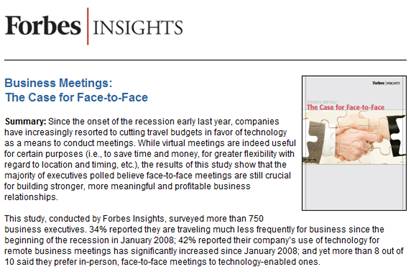
Forbes Insights published a study titled “Business Meetings: The Case for Face-to-Face“, in which the key finding was this: “the majority of executives polled believe face-to-face meetings are still crucial for building stronger, more meaningful and profitable business relationships.”  Excellent points were made in the blogosphere this week regarding this study:

  1. Forbes in a Funk over Virtual Meetings and Events (Virtual Edge)
  2. Virtual Augments Face-to-Face – Reply to Forbes and HSMAI Surveys (Virtual Insights | InXpo)

I don’t wish to question the conclusion of the Forbes Insights study – nor do I wish to have a debate on “face-to-face vs. virtual”.  Despite the fact that I’m passionate about virtual, I’m a true believer in the value of face-to-face.  What I would like to highlight is that face-to-face and virtual have unique capabilities.  Meeting planners must consider these capabilities and apply them appropriately.

With virtual, an often-touted benefit is that they’re green and carbon-friendly.  And while that’s certainly a nice side-effect, I think it’s important to focus on unique in-meeting capabilities of virtual – here are a few that come to mind:

  1. Participatory training with seamless presenter transitions – while it’s true that a face-to-face meeting is hard to beat with regard to audience participation – in a virtual meeting, there’s still plenty of room for audience participation.  In fact, with a shared whiteboard, participants can annotate a technical diagram simultaneously, which is trickier to do with more than 2 people (annotating) in a physical space.  In addition, participants can be “handed the ball” and take turns serving as the presenter – without having to stand up, walk to the front of the room and plug their laptop into the projector.  In an instant, a new presenter can start sharing her desktop applications for the rest of the meeting participants to see.  In a 3D virtual meeting (e.g. Second Life, Lotus Sametime 3D), participation becomes even richer, allowing medical students, fighter pilots (in training), computer technicians, etc. to learn by interacting with 3D objects.
  2. Meetings On Demand – what if your technical meeting needed to split up into a set of smaller focus groups?  In a physical meeting, you’d need to gather up each sub-group and go seek out new conference rooms (or, migrate into corners of the same room, which could be distracting for everyone).  Or, take another scenario whereby a senior executive wants to faciliate an ad-hoc face-to-face meeting during the coming weekend – all required participants would then need to make the necessary travel (and lodging) arrangements to get to the meeting venue.  With virtual, meetings are truly on demand – you create the meeting with the click of a mouse and the participants arrive with the click of a mouse.
  3. Putting the cards on the table – while this is difficult to quantify or prove, I believe that participants are more “at ease” in a virtual meeting and more likely to reveal thoughts that they’d otherwise be hesitant to do in person.  A virtual tradeshow is a good example.  Exhibitors have found that visitors to their booth are more transparent and revealing about budget, timeframe, decision making process, etc.  – when interacting via text chat.  The same person in a physical booth may be hesitant to reveal those details.  So for meetings that can stand to benefit from more transparency and openness (and not all of them do!), virtual can be a boon.
  4. More efficient person-to-person interactions – if you’re the chief executive of a company with 500 or more employees, I’m sure it’s hard for you to achieve the same quality time (with employees) as when you had 50 employees.  If you assemble the company at a physical meeting, it’s a challenge to mingle with the crowd and achieve any true quality – you’ll be more akin to a president or dignitary, who walks down a receiving line shaking hands and patting folks on the shoulder.  If you invite the same 500 employees to a virtual meeting or virtual event, you’ll find an easier ability to have meaningful interactions (via text chat) – including the potential to carry on multiple chats at the same time.  Employees will also find that they receive more access to the chief (and other execs) than they would in a (crowded) physical space.

So those are some advantages that come to mind for me.  What advantages have I missed?


Low Cost Options For Virtual Events And Communities

August 5, 2009

Source: flickr (User: businesspictures)

Source: flickr (User: businesspictures)

Can you run a virtual event with zero budget?  Maybe, but maybe not.  Let’s consider one use case – the B-to-B Editor or Editorial Director.  For the Editorial side of b-to-b publications, virtual events can be quite productive and rewarding.  They put you in direct contact with your readers, allowing you to engage via interactive tools (e.g. text or webcam chat) while both parties remain in the comfort of their office or home.

During the virtual event, attendees (who often come from across the globe, no matter what the time of day) can provide direct feedback to Editors regarding the event content, theme, speakers, presentations, etc.  Often, Editors will also receive input regarding the online content they’re publishing (on their web site) – and even find sources for upcoming articles.  I’ve spoken to a number of Editors who were thrilled about the attendee/reader interactions they experienced at a virtual event.

There’s an economic model to a virtual event, however – and that rests on the fact that the event needs to generate revenue – enough to cover the cost of the event, with room for a profit margin.  Thus, at a b-to-b publisher, it’s not the Editor that drives the virtual event, but rather the Publisher, VP Sales or Sales Director.  If there’s no forecasted revenue around a particular event topic, budget isn’t approved and the event has no funding to move forward.

I was recently contacted by an Editor, who was interested in pursuing virtual events (or virtual communities) – he wanted to facilitate interactions around new topics.  However, as with many new topics, they were not mature enough to achieve the right revenue model for the Publisher.  As such, the Editor asked me for available low cost (or no-cost) options.  Here were my initial responses:

  1. OpenSim – according to the FAQ, “OpenSim is a platform for operating a virtual world, and supports multiple independent regions connecting to a single centralized grid. This is somewhat similar to the web, where anyone can run their own web server, tied together through the internet. It can also be used to create a private grid, analogous to a private intranet.”  I noted that OpenSim has no hard cost, but there’s soft cost (e.g. your time).
  2. BlogTalkRadio – a web-based, free service that allows you to create your own Internet radio show.  Your host and your guests call into a standard telephone bridge and the audio is streamed over the web in real-time.  For the free model, you may have house ads served up around your content – there are premium service options available, however.

So my off-the-cuff response was based upon two concepts: (1) try out a no-cost, 3D virtual world environment and/or (2) generate a community discussion (via streaming audio) with no hard costs.  In thinking about my response further, however, I realized I could do better.  First, about OpenSim.  I think OpenSim is great, but it’s probably not the tool of choice in this particular scenario.

First, the build instructions and configuration instructions indicate to me that a fairly technical person  (e.g. SysAdmin) needs to build out your grid.  Second, end users (e.g. the Editor’s readers) need to install an OpenSim client in order to participate.  That might work in some industries (e.g. a gaming publication), but probably not for a b-to-b audience (as they rarely use an OpenSim / SecondLife client on their work computer).

BlogTalkRadio has a lot of potential – in fact, I think b-to-b publishers would be well served by hosting live broadcasts for their readership.  However, the nature of a call-in radio show (even if you have active callers participating) is fundamentally different from the private and group chat activity that occurs in a virtual event.

Source: Metaplace

Source: Metaplace

Taking all of these considerations into account, I felt that Metaplace might be an interesting solution – it allows the creation of a customized 3D world (with avatars) that requires no software download (as it’s Flash based) and can be easily embedded in web pages or blogs.  That may fit nicely at a b-to-b site – in relevant blog postings or article pages, you cam embed the Metaplace world.  So you pair your created 3D world (it’s theme) with content you’re already developing  for your sites – and then use reader traffic to drive participation in the Metaplace world.  And then that community can grow on its own (hopefully).  Again, no software download and no hard cost.

After all that, I’m still not satisfied with my answer – what tools or technologies would YOU recommend to this Editor?


Create More Effective Virtual Events With Web Analytics

July 31, 2009

Source: flickr (User: kantan2007a)

Source: flickr (User: kantan2007a)

Melinda Kendall wrote an interesting posting on her Event View blog titled, “Improving event flow“.  Her blog posting begins:

Run across ethnoMetrics yet?  They put 45 video cameras with 360-degree panning in the ceiling of a convention center and watch what really happens at an event.  A lot of the value comes in analyzing the behavior of attendees at individual booths…information that, if acted on, could really improve an exhibitor’s results from an event.

Melinda references a May 2009 issue of Expo that highlights optimizations and improvements made by the RSNA (Radiological Society of North America) event team for their conference.  For me, the technology from ethnoMetrics is intriguing, but what most interests me is their methodology – that is, capture detailed information from an event (that otherwise would have been “lost”) and perform in-depth analysis to improve an event’s ROI.

Can an equivalent approach of analysis be applied to virtual events?  Of course – because virtual event platforms already track all activities – meaning the 360-degree panning ceiling cameras area already installed.  Today, however, most virtual event show hosts view event data in a tactical, results-based manner.  Important metrics include number of registrants/attendees, number of visits per booth, number of viewers per Webcast, number of chats, number of document downloads, etc.

And while that’s all fine and good, both the show host and virtual event platform provider might want to take a step back (once the event is done) and analyze the overall attendee experience.  I’ll call this Web Analytics for your Virtual Event.  For content and e-commerce sites, web analytics can be a very effective tool to increase page views (content site) or online purchases (e-commerce site).  So in the same way that an e-tailer may analyze “shopping cart abandonments”, a virtual event show host (and provider) may want to analyze why the average visit time to an exhibitor’s booth was only 5 minutes long.

Other analytics exercises that come to mind:

  1. Greenscreen video –  did you invest a lot of time and money to have your CEO welcome visitors to your booth?  Have a look at average view time of that greenscreen unit.  Then, look at the number of return visitors who “clicked to play” to replay the greenscreen video a second time.  If you score a lot of replays, your use of greenscreen was effective.
  2. Where is my traffic coming from –  or, where is it not coming from?  On the web, we frequently look at “referral URL” – for virtual events, the same need applies.  If I had 1,000 booth visits, did they come from the Exhibit Hall?  Or, did they come from a search result – or, somewhere else?  If 70% of my booth visits came from sources other than the Exhibit Hall, then I need to assess (a) the amount of traffic to the Exhibit Hall in the first place and (b) the effectiveness of my Exhibit Hall layout.
  3. Biological tracking – this obviously adds to your costs, but consider pairing your web analytics with physical instrumentation – have a panel of users experience your virtual event and track eye movement, heart rate, facial expressions, etc.  If I spent 2 months creating a visually rich 3D environment, did it make an emotional impact on the user who saw it for the first time?  Are users looking at areas of the event that I want them to?  Or, are they skipping past the important areas?

The possibilities are nearly endless.  This is an important next step for the  industry – with video monitors already installed, tapping into the existing data will be a key to creating better and more effective virtual events.

Related links:

  1. Event View blog
  2. ethnoMetrics home page
  3. Wikipedia entry on web analytics
  4. NY Times article: Lab Watches Web Surfers to See Which Ads Work

A Look Inside Virtual Job Fairs With IMASTE

July 28, 2009

IMASTE Co-Founders: Miguel Fernandez Lapique, Aitor Zabala, Miguel Arias

IMASTE Co-Founders: Miguel Fernandez Lapique, Aitor Zabala, Miguel Arias

Founded in 2003 and headquartered in Madrid, Spain, IMASTE has a mission statement that reads, “We create innovative contact platforms for our customers and their potential users”.  According to Miguel Arias, Director-Partner at IMASTE, “We founded IMASTE with the purpose of enabling a bridge between companies and university graduates. We first started organizing real events and after two years we became the Spanish leader in university recruitment events in Spain.”  As technologies began to emerge, IMASTE found it natural to leverage the web to complement their physical recruitment events with virtual job fairs.

Today, IMASTE has three primary product categories:

  1. Virtual Fairs – Virtual Job Fairs have been produced in Spain, France, UK, Brazil and Portugal – and IMASTE is working on a sustainability virtual fair in France.
  2. Virtual Environments Lab – based on Adobe Flex, IMASTE builds rich internet applications for clients.  Arias notes, “We have developed the virtual corporate office for Deloitte, the virtual campus for Everis, a virtual music festival for Universia and a virtual petrol station for CEPSA.”
  3. On-Campus (Physical) Job Fairs – IMASTE organizes more than ten Spanish university job fairs, a primary source for Spanish employers to tap into a pool of young graduates.
Monster Edays Event, Powered by IMASTE

Monster Edays Event, Powered by IMASTE

IMASTE worked with Monster to produce Monster Edays, a 2-week virtual job fair that leveraged instant messaging and video chat and enabled more than 90 online company presentations.  IMASTE leveraged Adobe Flex for 3D renderings and animations, as well as the Red5 video conferencing application.  With the event targeting the French market, IMASTE enabled French language support in their platform and coordinated video production activities from Paris.

According to a Case Study posted on the IMASTE web site:

With more than 35 participating companies, over 100,000 unique visitors and over 8,000 collected CVs, the project was a huge success. The media buzz generated more than 350 referring sites and great blogger reviews.  Thus increasing heavily the brand awareness among jobseekers.

Like many providers of virtual events and virtual event technology, IMASTE has a fairly healthy schedule of events.  In the Fall of 2009 alone, they have virtual fairs planned in Croatia, France, Spain, UK and Ireland – with a second edition of a Brazilian virtual job fair scheduled as well.

Speaking of the European market, Arias notes that Europe encompasses many countries, languages and cultures – for virtual event success, “one needs to take into account the cultural differences of each country and localize your platform to each specific need.”  Sprinkling in a bit of humor, Arias concludes, “Therefore, you need to be very flexible and code a lot.”

Arias believes that vast growth opportunities lie ahead, since the European market has not yet fully embraced virtual events – “corporate and marketing executives are not so keen of web innovations and there is a very strong culture of the importance of physical events to enable networking.”

Perhaps IMASTE should leverage their physical job fair business – and prove the ROI and benefits to the European market by turning them into hybrid (phyical+virtual) events.  This way, European exhibitors/sponsors still experience a comfort level (with the physical event sponsorship) and begin to experience the corresponding benefits of the virtual experience.

Related links

  1. A list of IMASTE’s products
  2. The IMASTE blog
  3. The IMASTE Team
  4. IMASTE blog posting on SEO and social networks
  5. Blog posting: For Virtual Events, Globalization Means Localization