A Second Look At Second Life

June 3, 2009

Source: San Francsisco Business Times

Source: San Francsisco Business Times

“A lot of Silicon Valley has written Second Life off.  The tech world will have to revisit Second Life as a phenomenon in the next six months or so.”

Thus spoke Wagner James Au, noted virtual worlds author and blogger in a San Francisco  Business Times article on Second Life (note: the full article is available to paid subscribers only).  Au, who blogs at New World Notes about Second Life, notes in the article that Linden Lab CEO Mark Kingdon has renewed the Second Life brand that was created by founder Philip Rosedale.

While the revenue model for Twitter is slowly coming clearer (judging by the accounts in the business media), Linden Labs’ strategy under Kingdon is becoming quickly self-evident with the announcements of the past few months.  From my perspective, Kingdon’s growth strategy is around a few core pillars:

  1. Enterprise use of Second Life – makes sense, as enterprises and corporations can be monetized at a higher clip than individuals, artists, hobbyists, etc.  Enterprises (in the former of marketers) were a big portion of Second Life during its initial peak – and it seems the current focus is to bring marketers back into the fold, along with complementary uses in non-marketing disciplines (e.g. training, enablement, collaboration, etc.).  In the past 6 months, Linden Lab has hired 25 marketing and product people as part of their push for enterprise clients.  In addition, the company recently hired Amanda Van Nuys as Executive Director of Enterprise Marketing, signaling a further endorsement of the opportunity in the enterprise.
  2. Nebraska – an on-premises software version of Second Life  (compared to their Software as a Service model), which enterprises can run on their own servers behind the firewall.  IBM has been an active partner with Linden Lab on behind-the-firewall integration – the telltale sign will be how many other large enterprises opt for the Nebraska model.  For “behind the firewall” use, I have to think that we’re talking less about marketing and more about collaboration.
  3. Voice – not mentioned in the Business Times article, but Virtual Worlds News covered it well – Linden Lab is poised to go after the Skype market with capabilities to bridge voice calls and SMS messages between the real world and Second Life.  In the Virtual Worlds News article, Linden Lab Vice President of Platform and Technology Development Joe Miller notes, “The opportunity to monetize at a significant added value for our business is there”, regarding the opportunity in Voice.

IBM marrketing executive Karen Keeter notes in the San Francisco Business Times article that nearly 100 IBM’ers are “working on virtual world tools for commercial sale in Second Life and on other platforms”.  As such, IBM stands to achieve commercial gain from increased use (by enterpises) of Second Life and related virtual worlds.

In fact, it wouldn’t surprise me to see IBM leverage virtual worlds to generate services revenue.  Two things come to mind – IBM Global Services and IBM’s Smarter Planet initiative.  IBM Global Services could assist enterprises on their virtual worlds strategy (e.g. build me a virtual world representation of my data center, so that I can run heating and cooling simulations) – or, IBM could go in-world to enterprise’s private virtual worlds to provide traditional consulting services within the virtual world.

So a manufacturer who’s replicated their factory in a 3D world can have Global Services visit (in-world) to optimize their factory floor workflow.  Then, of course, Global Services could help facilitate the parallel action in the real world.  On the Smarter Planet project, IBM might create 3D models of the next generation power plant to show utilities how to become more energy efficient.  In a virutal world, I’m sure the possibilites are limitless.

Finally, Dan Parks of Virtualis is featured in the article.  Virtualis created a compound in Second Life with 34,000 square yards of meeting rooms.  Quite an interesting model – an event producer that leverages a re-usable area (virtually) to host meetings for corporate clients.  Companies who have done events with Virtualis include Deloitte, Oracle and Trend Micro.

I’d be interested in your thoughts – what do you think about the potential of Second Life for enterprises?

Related Links:

  1. Blog posting on Virtual Offices, with reference to Amanda Van Nuys’ use of Second Life
  2. Blog Posting: Virtualis and Trend Micro Put On Quite A Show
  3. Blog Posting: Philip Rosedale On Building A Business: Practice Extreme Transparency
  4. Blog Posting: IBM’s Second Life ROI: The Headline Beneath The Headline

My Earth Day Visit To IBM’s Green Data Center

April 22, 2009

Source: IBM Green Data Center in Second Life

Source: IBM Green Data Center in Second Life

To commemorate Earth Day 2009, I decided to head off this morning and visit IBM’s Green Data Center.  However, to ensure that my visit was carbon neutral, I left my car keys on the coffee table, grabbed my coffee mug and visited the data center in my pajamas.  My visit took place in the virtual world of Second Life, in which IBM has built an impressive Virtual Green Data Center.  The screen capture that you see above shows my visit to the data center lobby, with an interior design around a green (colored) theme [of course].

My interest in IBM’s Virtual Green Data Center was based on an article in Virtual Worlds News, which describes IBM’s partnership with Conversive on the deployment of automated avatars that “will greet users, answer basic questions, and direct them to other locations. The avatar also offers a guided tour”.  I did receive a welcome from the avatar and here’s the transcript of our chat session:

Source: Transcript of author's chat

Source: Transcript of author's chat

I’ll have to try again, but on this visit, the IBM Concierge did not respond to my inquiries.  My journey continued, nonetheless – upon opening the door to the data center’s mantrap (“a small room with double doors used to control entry to the data center and temperature levels”), I walked through the mantrap and into the data center.  Here’s the view from the first floor:

Source: First floor of IBM's Virtual Green Data Center

Source: First floor of IBM's Virtual Green Data Center

After walking past several racks filled with servers, I decided to teleport to the second floor.  Upon arriving there, I skimmed through a number of information kiosks placed there by IBM.  On a small display monitor mounted to the wall, I clicked to view some video footage from IBM executives.  I then walked over to additional information kiosks that provided customer case studies – highlighting success stories of IBM data center customers.

Interestingly, clicking on a kiosk that asked for feedback on my visit launched an external web page, on which IBM provided the survey questions.  I thought it would have been neater to capture my feedback in-world – but perhaps this capability (and the associated tracking and reporting) isn’t yet available in Second Life.

All in all, I was impressed with the layout of the data center, along with the information available.  I think that 3D virtual worlds are effective vehicles for explaining and promoting a company’s products and services.  That being said, I found it interesting that on Earth Day, I did not come across any other visitors – and, while the data center is supposed to be staffed 7×24 by live sales assistants / avatars, I did not see any of those, either.  I’ll return in a week or two to try again.


Virtual Berlin Relocates To Downtown San Francisco

April 6, 2009

Source: Twinity

Source: Twinity

At Web 2.0 Expo in San Francisco last week, one of the exhibitors who caught my attention was Twinity – the virtual world from Berlin-based Metaversum.  On occasion of their appearance at Web 2.0, the company issued a press release with the entertaining title, “Metaversum Takes 16 Square Miles of the German Capital to San Francisco with Twinty.”  I stopped by the Twinity booth (which, interestingly, was part of a larger presence from the city of Berlin) and received a demo of Virtual Berlin from Twinity’s CMO, Mirko Caspar.

Twinity is not unlike other virtual worlds businesses – but their unique angle is in the creation of real-life representations of cities, with each block, each building, each sidewalk recreated down to a pixel by pixel level of detail.  In fact, the Twinity motto is “powered by real life”.  I find their approach to virtual worlds interesting:

  1. Real world cities – with generic virtual worlds, any given resident has only a certain likelihood of visiting the land or island you create.  What Twinity does is start with world famous cities (e.g. Berlin, London [coming soon]) – places that everyone on Earth has heard of and might want to visit (virtually).  Whether I’ve visited Berlin or not, I might like to visit its virtual represetation – to explore a new city (if I’ve never been there) or to recall spots from my past visit – and, see how the current city has changed from the last time I visited.
  2. Land scarcity – unlike a generic virtual world, where land development is only limited by the dollars invested in new land sales, Twinity’s approach is a methodical launch schedule of selected cities.  This creates a certain level of demand and pricing power (in the cities that do exist) compared to a virtual land grab where hundreds of islands are developed over the course of a few months.  I compare it to a baseball park that consistently sells out its 30,000 seats (at a premium) vs. a McStadium of 70,000 seats that may never sell out a game.

The Twinity business model is based on four pillars:

  1. Dynamic in-world advertising (via partnership with JOGO Media)
  2. Product placement and sponsorship – with sponsorship, one can host events, in-world, for instance
  3. V-commerce and E-commerce – generate sales in-world – or, generate an e-commerce transaction that occurs outside of Twinity
  4. Virtual real estate market

In addition, Twinity has a freemium model, where basic membership is free, with premium membershp benefits available at additional cost.

I asked Caspar about the potential for cybersquatting of land assets in Virtual Berlin – for instance, what if I purchased the virtual office of a Fortune 500 company, but they come in later to claim the rights to it?  Caspar responded that certain real estate is reserved by Twinity (e.g. a national musuem, a government facility, etc.).  For business-related land, however, it’s all fair game and “first come, first served” with regard to virtual land purchase.

Twinity, however, enforces certain rules in its user agreement – if Adidas purchased the virtual land of Niketown, then Adidas would not be permitted to use their logo on virtual land associated with Nike (as an example).

Twinity is currently in public beta with Virtual Berlin the first available city.  Virtual London is on tap – and, Twinity was awarded a grant from the Singapore government to build a Virtual Singapore.  Given Twinity’s recent visit to the Bay Area, one has to wonder whether San Francisco is up next.


There’s A Sparkle (IM) In My Virtual Eye

March 31, 2009

Source: Genkii

Source: Genkii

Related coverage: TechCrunch – “Sparkle: The iPhone Gets Its First Virtual World (And It’s Completely 3D)”

There’s a sparkle in my eye – it’s from a Tokyo-based company named Genkii and the product is, of course, Sparkle.  Genkii announced two products – Sparkle IM and Sparkle 3D.

Sparkle IM is an app available in the iPhone App Store (for $4.99) and supported on both the iPhone and iPod Touch.  In essence, Sparkle IM is a lightweight gateway to Second Life and OpenSim.  So you get to send and receive IM’s with your Second Life or OpenSim avatar, but without the download of the thick client.  Instead, you do it all from your iPhone.  You can find a short YouTube video on the Sparkle web page: http://sparkle.genkii.com.

Why is this exciting to me?

  1. This is the first step in the placeshifting of virtual worlds experiences – analogous to what podcasts and portable MP3 players did for music consumption.  Now, you no longer need to be tethered to a laptop or PC to experience a virtual world – you go in-world from wherever your iPhone takes you (assuming adequate cell coverage).
  2. This could foreshadow virtual event support on PDA’s (see my prior blog posting on the notion of virtual events in a wireless world).  I’ve participated in many virtual events where exhibitors told me they were on the go – but, able to check in from their BlackBerry.  And today, what’s the most critical “application” in a virtual event?  Most would say it’s the chat application.  So apply the Sparkle IM “gateway” principal to virtual events – and presto! – virtual event chat on BlackBerry’s and iPhones.  Exhibitors would love it.

On to Sparkle 3D.  The TechCrunch post provides full details (with images).  Essentially, Genkii has developed their own 3D virtual world – for use on the iPhone and iPod Touch.  The support on the iPhone is interesting enough – but what might be the game changer here is Genkii’s vision of integration – they’re considering an integration with Sony’s Playstation Home virtual world and there’s speculation concerning integration with browser-based clients, the Nintento Wii and non-Apple phones, such as those running the Android OS.

Sparkle 3D can be quite powerful and pervasive if they’re able to integrate their platform this broadly.  No other virtual world is supported across this spectrum of devices and platforms (e.g. gaming systems, PDA’s, browsers), which could make Sparkle 3D the de-facto, cross-platform standard.  What other platform has been able to gain a footprint across an equally broad ecosystem?   Adobe’s Flash.


Insights And Experiences From Virtual Worlds Experts

March 9, 2009

On Monday evening, I attended FountainBlue’s High Tech Entrepreneurs’ Forum at Microsoft’s Mountain View (CA) campus – the event was titled Virtual Worlds: The Hype, The Reality, The In-Between and was sponsored by Microsoft and TIPS Group.  FountainBlue, a “membership-based, for-profit, collaborative organization designed to positively impact the way people, businesses and organizations work,” has organized a new sub-group around virtual worlds, which officially launched coincident with Monday evening’s event.

FountainBlue landed a true All-Star panel of Virtual Worlds visionaries and experts.  Each panel member provided thoughts on virtual worlds and then took questions from the audience.  A summary of each panelist’s thoughts follows.

UPDATE: FountainBlue has posted a summary of this event on their blog.

Steve Nelson – EVP, Chief Strategy Officer, Clear Ink

Steve is EVP and Co-Founder of Clear Ink, an interactive agency based in Berkeley, CA, who has many “claims to fame” in Second Life development. Among their Second Life projects was a simulcast of the 2008 TED Conference (in Monterey), an appearance by Newt Gingrich in-world, the development of a virtual headquarters for Linden Labs and an in-world island in conjunction with the popular sitcom The Office.

Steve started with his definition of “virtual world” – a social platform that’s immediate and immersive – quite a relevant and apt definition, if you ask me.  Steve stressed the immersiveness of 3D virtual worlds by comparing a webinar viewed “standalone” with one viewed in-world.  Steve noted higher retention and recall rates of the in-world viewing – as viewers of traditional webinars are far from immersed – instead, they’re checking their email and multitasking with other apps on their workstation.

Steve noted that Clear Ink assists companies in virtual worlds via three e’s:

  1. Expectations
  2. Experience
  3. Experimentation

In closing, Steve noted five business models for generating revenue with virtual worlds:

  1. Own the virtual world platform
  2. Sell virtual goods
  3. Create virtual worlds tools and utilities
  4. Be an agency – design, consulting, etc.
  5. Use virtual worlds effectively as an enterprise – save money and be a more effective company

Robin Harper – Former VP of Marketing and Community Development, Linden Labs

Robin took us back to the very early days of Second Life and noted that in the initial development stage, Linden Labs thought the platform was about facilitating entertainment.  Fast forward to today and Robin believes that virtual worlds are so much more than entertainment.  In the past 18 months alone, Robin notes that growth in Second Life has been driven by education and enterprise (which each have grown by 2x in that period).  There is an increased use for simulation, prototyping, design and experiential learning.  60,000 residents are profitable (meaning they generate revenue that exceeds their land costs) and the top resident grossed over $1.7MM in US dollars (real money) by selling virtual shoes.

Robin notes that the power of virtual worlds lies in the collaborative tools that are provided with minimal constraints. She compared the development of virtual worlds to the development of third world countries – growth is facilitated by allowing residents to own their own land, own the intellectual property (of their land assets) and participate in an economy that fuels commerce.  Important areas of development today are “behind the firewall” applications, as well as interoperability across worlds.

UPDATE from Robin Harper: I’d like to clarify the statement attributed to me above. The figures I reported were originally estimates based on one quarter of data, so should not be taken as more than an annualized estimate. In addition, my reference to the sale of virtual shoes was in the context of the types of industries that are generating return in Second Life. In the top group of earners based on the estimates, most were involved in the land business, and a couple were in other businesses like events management and retail/virtual goods, including shoes. For more information, please see my blog: http://couldtherebewhales.blogspot.com/2009/03/correction.html

Michael Gialis – New Business Development, Sun Microsystems

Michael works in Sun Labs, with a focus on online gaming and virtual worlds.  Sun’s technologies in this space are Project Darkstar, Project Wonderland and Project Sun SPOT.  Michael notes that the #1 barrier to virtual worlds adoption is the non-intuitive nature of the client application.  Michael’s comments stirred some discussion among the panel regarding enhanced client capabilities, such as the use of sensors in lieu of keystrokes.  Robin noted that Mitch Kapor is experimenting with a 3D camera – when you smile, your avatar smiles. Some panelists, however, noted that some contexts may require separation between your true feelings and your avatar’s expressions – for instance, in a learning environment, you may not always want your true emotions to be on display.

Anne-Marie Roussel – Business Development Director, Microsoft

Anne-Marie manages Microsoft’s digital media portfolio, which includes Xbox, Zune and MediaRoom.  Anne-Marie noted Microsoft’s early efforts in the virtual world with its Flight Simulator game – which in turn led to the development of a product called Microsoft ESP (for 3D visualization).  Anne-Marie gave the interesting example of leveraging virtual worlds for training sales staff – if you sell Ferraris, then your clientele are much different from those buying Fords, so a virtual world can train sales staff on how to interact with prospective customers and face the sorts of questions/issues that Ferrari buyers are sure to present you with.  Anne-Marie spoke of Microsoft Virtual Earth and noted work being done to marry its 3D visual maps with crime scene data (to assist local law enforcement).

Susan Stucky – Manager, Service System Design, IBM Almaden Research Center

Susan noted that IBM’s involvement in virtual worlds is not to be a platform provider – instead, IBM is platform agnostic.  Susan’s interest in the virtual world is to achieve results that would be harder to accomplish in the real world.  One example noted was the practicing of negotiations of complex deals – reviewers (of the deal maker) could provide a virtual thumbs up or thumbs down.  Trainees could then replay the segment and view the feedback as it occurred.  Susan spoke of the need to capture data to better understand in-world behavior.  IBM Researchers developed technology to take audio chat, utilize voice-to-text to transcribe it and then perform unstructured text analysis to decipher patterns of behavior.  Susan also spoke of IBM’s Sametime 3D initiative and referenced the use of Second Life to facilitate a virtual meeting for IBM’s Academy of Technology.

If you’re interested in related events from FountainBlue, have a look at their events calendar.


Interview With Nic Sauriol, Venture Lead on Nortel’s web.alive Platform

March 1, 2009

Nic Sauriol, Venture Lead of web.alive

Nic Sauriol, Venture Lead of web.alive

Related Links:

  1. Lenovo eLounge
  2. Project Chainsaw
  3. My review of Lenovo eLounge

Amidst great fanfare in January at CES 2009, Lenovo unveiled the Lenovo eLounge virtual environment. Powered by Nortel’s web.alive platform, eLounge allowed users to enter a 3D virtual world to learn about Lenovo Thinkpad notebook computers (with an option to purchase), interact with other visitors and “meet” with representatives from Lenovo and Nortel.

Nic Sauriol is the Venture Lead for web.alive (also referred to as Project Chainsaw).  Nic co-founded the project a few years ago with Arn Hyndman, the chief architect.  I sat down (virtually) with Nic to get his thoughts on web.alive, eLounge, enterprise virtual worlds and more.  Here’s the interview.

If you met someone on the street, how would you describe (or explain) the web.alive platform to him/her?

Nic: web.alive is a collaboration platform designed to integrate into an existing website much like flash. When a web site has web.alive and people visit that site, they can experience a rich and immersive environment and interact with other users – including the website’s employees/staff who are also on that site . They can interact in an immersive and fluid way thanks to real world positional audio. Fundamentally, web.alive is about bringing live, immersive and interactive communications to connect people in real-time via the web.

It’s designed to be a very engaging and entertaining experience – great for social networking efforts. A social experience of the web where a group of friends could meet up on Facebook or LinkedIn and then go visit a few stores like the Lenovo eLounge, watch some shows in Hulu and then comment on the news at Yahoo is what web.alive is about in this context.

web.alive also offers tremendous potential as a tool to facilitate collaborative learning.  Gone are the days of an instructor broadcasting content in one direction – today’s learning requirements call for more collaborative work between instructors and students.  web.alive provides engaging and collaborative environments to make this mode of learning a reality.

In the enterprise, web.alive offers a new world of opportunities to change in a positive way how people communicate. Moving away from calendar based meetings and formal phone calls, to a much more dynamic means of interaction. A place where employees from all over the world can go, bump into each other, exchange ideas, grab a meeting room to discuss and collaborate etc. Simply embedding the web.alive client into existing intranet web sites, integrating into a UC [unified communications] solution (visit Nortel if you don’t already have one) and suddenly your employees are collaborating as though they were collocated.

Nortel and Lenovo received quite a bit of buzz regarding Lenovo’s eLounge and its use of Nortel’s web.alive platform – what do you view as the successes of the launch – and, what were some of the challenges that you had to address?

Nic: The beta launch at CES of the Lenovo eLounge was a tremendous success from our perspective. We saw a great opportunity to help Lenovo take their customer service to an entirely new level. Significantly more users than we had expected visited the beta launch (articles and blogs like yours were a significant factor) and most importantly we saw the kinds of metrics we could have only hoped for. I personally assisted a number of customers who toured the eLounge to browse Lenovo’s laptops. What is most important is that these  – for the most part  – were purchases that otherwise may not have happened, at least not on a traditional retail web site. In addition, we have seen excellent retention rates. Even when users don’t make purchases, they spend a lot of time surrounded by Lenovo’s brand – over time this will also help conversions.

Obviously there are customers that go to the Lenovo web site that intend to make a purchase, and various tools facilitate that. While we are excited to help in that regard, what we always hoped would happen was that users would visit the site that did not have a specific intention of making a purchase, and would otherwise have bought from a retail store (likely helping a competitor to Lenovo) and instead they make the purchase from the eLounge as a result of an unplanned/informal conversation with a sales person or some other person like myself who just happens to be there.

In terms of challenges, there have been many. While the majority of users have had a smooth experience, some users encountered a variety of different bugs which we are fixing as they arrive (users send us e-mails at support@projectchainsaw.com with their bugs). Most users were able to get in and navigate without any specific help, but here have been some that required assistance, so we are working to make interaction even more intuitive and fluid. One really notable challenge was that Lenovo sales staff had to adjust their mode of operation. Call centers wait for a customer to call to initiate a dialogue, unlike the real world where we can reach out to shoppers.

We had to spend time honing that skill to get the right balance of support (i.e. not jump in someone’s face when they first arrive, but make certain that they know you are there and available to assist if you need help). The biggest challenge of all is that people want more, a lot more.

Have there been any new developments with eLounge since the time of the CES 2009 launch?

Nic: Yes, there have been a number of new developments, some deployed others coming soon. Most importantly, Lenovo has seen the positive metrics we had hoped for and have committed to coming out of beta and doing a full supported launch (coming soon!). Changes that have been deployed include a large number of bug fixes, a few new features in the client (like notification when new users arrive via a desktop balloon) with many more coming. While there have been a few minor content updates, there will be many more coming when the site launches out of beta.

Tell us about other enterprise use of web.alive?

Nic: There has been a tremendous interest in web.alive from an enterprise perspective. Whether it be as a global water cooler (e.g. as an enterprise, place web.alive on your global internal home page to enable informal/accidental collaboration and discussion between your employees) or as an alternative for internal meetings (in particular those that would require travel). We have been particularly happy with the tremendous support and pull from within Nortel and have slowly been rolling out web.alive for internal use. We have also been building a number of features to better support internal collaboration beyond just positional voice and slides etc.

Our ultimate goal is to find ways that we can make web.alive collaboration more effective than face to face. The seams ambitious, but there are a number of challenges with face to face communication, let alone current telecommunication technologies that we believe we can address. The simplest example is knowing who you are speaking to or who is talking – this is often a challenge even face to face. More exciting examples include detecting and displaying emotion – there are people who don’t communicate very effectively because they are not skilled at detecting emotion (in the extreme, people with forms of autism) – we believe that over time we can augment and provide that kind of information.

Has there been any existing or planned consumer use of web.alive?

Nic: We are actively working on models to support low-end deployments of web.alive. I have always stated as a goal that my mother in-law should be able to embed web.alive in her personal web site. While technically we support a simple embed tag (in theory she could embed the eLounge on her page), we have yet to deploy a single environment built for this purpose. Most challenging of course if establishing the right business model for this, which is something we are actively working on. We will have something this year that will support small businesses.

What are customers telling you they’d like to see in web.alive?

Nic: This is a really difficult question to answer because we have talked to so many people, whether they be casual users in the eLounge or companies that we have talked with. Common themes would include a higher degree of interaction (e.g. shaking hands, more fluid and realistic animation, taking apart laptops etc.); more audio controls like the ‘cone of silence’ for private discussions; means to invite friends and better ways of staying connected.

What’s on the feature roadmap for web.alive?

Nic: We will be working to further optimize the new user experience (from client optimizations in size and speed to usability etc.), enable small businesses, enhance collaboration and make the whole experience much more immersive and interactive. We are also looking to start rolling out our community (user and developer) in 2009 to enable more contribution and an eco-system of value co-creation.

What does the future hold for enterprise focused virtual environments?

Nic: There is no question in my mind that immersive positional audio will fundamentally transform how we communicate. I believe we will start to see the kind of connectionless (from a user perspective) communications that happen in web.alive that enable “accidental collaboration” to permeate how enterprise users interact with each other, their suppliers and their customers. Eventually, calendar based meetings will become significantly less frequent as issues are resolved on the fly. Ultimately, I am convinced that virtual environments will facilitate this way of communicating by enabling rich immersive and dynamic collaboration. Just consider how an enterprise could use web.alive to improve their brand awareness by letting their customers hold virtual events or get-togethers with their network of friends, family and associates.

The best part if that we have a number of surprises (well, if you’re a techie like me they are surprises 🙂 – features that have not been rolled out but that we have built and are playing with. I won’t expand on what they are just yet, but we will roll some of them out over the coming weeks and months, and I assure you they are exciting. These features will really help incentivize enterprises into taking the leap and jumping into this kind of technology by doing things that can only be done with the kind of architecture.


Virtual Events 101 For Corporations

February 16, 2009

Some of us learn through observation – and I’ve had the privilege of observing (and learning from) many corporations in their use of virtual events and virtual worlds. First, I will provide “newbie” corporations with some pointers on how to best leverage virtual events (by way of links to some past blog posts).  Then, I will summarize some recent examples of virtual events (and virtual worlds) by corporations – all of which I admired.

How to Leverage Virtual Events

  1. Get closer to your customers – by understanding customers’ current challenges (which may differ from the challenges they faced when they originally purchased your product), you can create solutions, make your customers more satisfied and generate additional revenue (https://allvirtual.wordpress.com/2008/12/16/get-closer-to-your-customer-with-virtual-tradeshows/)
  2. Launch your next product – whether you complement your physical launch – or, do it exclusively online, the virtual event platform allows you to conveniently launch your next product online to a global audience – and, track all the interactions generated with customers, sales prospects and analysts/press (https://allvirtual.wordpress.com/2008/12/22/launch-your-next-product-online/)

Virtual Events: How Corporations Are Leveraging Them

  1. Quest Software produces an annual virtual event titled Quest Connect to provide information on their products and services (https://allvirtual.wordpress.com/2009/01/02/marketers-as-event-organizers/)
  2. Lenovo utilized Nortel’s 3D-based web.alive platform to drive interest and product sales of its laptops during (and after) CES 2009 (https://allvirtual.wordpress.com/2009/01/08/review-lenovos-elounge-virtual-world/)
  3. Adobe held a virtual product launch in Second Life to complement their real-world launch of eLearning Suite (https://allvirtual.wordpress.com/2009/01/25/adobes-real-world-launch-is-suppplemented-with-virtual-launch/)
  4. Trend Micro teamed with Virtualis to host an internal training event titled Trend Technical University in Second Life (https://allvirtual.wordpress.com/2009/02/05/virtualis-and-trend-micro-put-on-quite-a-show/)
  5. VMware launched an online companion to their physical VMworld conference, running on Jive Software’s platform (https://allvirtual.wordpress.com/2009/02/07/vmworld-complements-physical-conference-with-virtual-conference/)

So if you’re a newbie on virtual events, read up on what these companies have done – and decide whether (and how) virtual events and virtual worlds can benefit your company.  Better yet, if you have ideas on new ways corporations can leverage virtual events, be sure to leave a comment below.  Either way, I’m excited to see and hear about the new things that are in store.


The Future Of Newspapers: Online, Interactive Communities

February 14, 2009

NYTimes.com

Source: NYTimes.com

There’s been much discussion about the future of newspapers.  Some have shuttered, others are struggling for their survival.  Business analysts and bloggers have even speculated on the future of The New York Times.  NYTimes.com had 14 million unique visitors in August 2008 (according to this Wikipedia entry).  Many web-centric businesses have been able to build large market capitalizations off a base of 14+M users.  So how can NYTimes.com monetize their users beyond display advertising?

Let’s see.  How about creating a community around these 14+M readers – and creating an interactive, real-time newspaper?  That’s right, folks.  I’m proposing that NYTimes.com be powered by a virtual event platform.  I’m NOT proposing a 3D environment with avatars.  Instead, I’m proposing a 2D “tradeshow-like” platform that would enable a business that’s rich in content (and, deep in Editorial talent) to best monetize their resources.

So let’s break down what this might look like:

  1. The newspaper’s main sections each map to “booths” within the platform – Of course, we’re not going to call these booths – I’m just drawing a parallel to the virtual tradeshow (VTS) model.  But, the functions and features here are the same that power a VTS booth.  So for NYTimes.com, there are “booths” labeled World, U.S., Politics, Business, Sports, etc. – you get the idea.
  2. The booth is the central holding place for that section’s content – Just like a newspaper has a front page – in a booth, the day’s content is rendered prominently as you enter – and, Editors swap out stale content (into the booth’s archive) for fresh content.
  3. Editors staff the booth and connect with readers – To me, this is the real game changer with this concept.  Editors (when time permits) can login to the environment and interact in real-time with readers.  What better a way to find out what your readers are interested in?  And, what better a way to find and connect with sources for you and your reporters?
  4. Readers interact with other readers – Another game changer here, as the platform would allow readers to tap into social networking to interact with other readers, all in the context of your content.  Valuable interactions keep those readers coming back in for more, creating site loyalty.

So imagine I enter the NYTimes.com Sports Booth – and I see this:

NYTimes.com

Source: NYTimes.com

I can click on Harvey Araton’s profile and read about Harvey’s interests and specialties.  If Harvey is online, perhaps I initiate a chat session with him – or, I drop him an in-show email to tell him I read his articles.  This provides a benefit for both of us – I feel directly connected with NYTimes.com – and, Harvey is able to efficiently connect directly with his readers.

Now granted, with 14+M people, it may be quite a challenge for Times Editors to spend time in an online community, juggling between user-initiated chats and their “real job”.  However, what if each attendee of this environment was a paying member?  Perhaps that changes the equation a bit.  So let’s talk about monetization opportunities:

  1. Advertising – NYTimes can sell “run of booth” or “run of platform” ads – and also offer up specific areas of the environnment for sponsorship (e.g. Networking Lounge sponsored by American Express).
  2. Direct Response – The platform (using a pay per click model) could house placements of advertiser content and drive clicks to advertiser web sites
  3. Subscription – Start off with a freemium model – anyone can access the environment at no cost, but certain features (e.g. access to premium content, ability to chat 1-on-1 with a Times Editor, ability to participate in real-time Q&A sessions, etc.) require a paid subscription
  4. A la carte content monetization – Why not create “booths” that house the entire archive of New York Times content.  Staff these booths with digital archivists, who can search through the virtual microfilm and find you the article you need.  Only premium (paid) members get access to these booths – and, you pay for each article that’s delivered from the archive.
NYTimes.com

Source: NYTimes.com

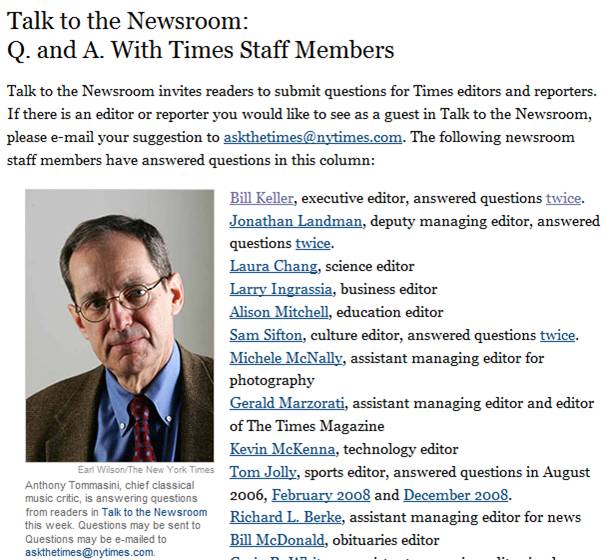
Now, let’s talk about the social media angle.  The Times could support the “Talk to the Newsroom” feature (above) via a real-time, text-based grroup chat!  They could even have the host be visible via a webcam, if so desired.  Here are some possibilities:

  1. Scheduled chat sessions with Editors, Publishers, executives, etc. (e.g. “Talk to the Newsroom”)
  2. Columnist and subscriber blogs – Published directly within the environment, with support for comments
  3. Forums around the paper’s main topics
  4. Presence indication – Provides readers with the feeling that they’re part of a global community. Reading the newspaper (which used to be a somewhat private experience) now becomes a communal one, where you’re reading, you’re sharing and you’re interacting – with other interested parties from around the world
  5. Real-time briefing rooms or crisis centers – Recall how quickly Twitter spread the news about the Mumbai terrorist attacks.  Why not have ad-hoc briefing rooms where NYTimes.com readers can engage around breaking news and current events?  In this scenario, the “daily newspaper” transforms into a real-time, 7×24 “always on” environment.

So some day, when I get my morning coffee and sit down with NYTimes.com, I’m hoping I’ll see you “there”.


Adobe’s Real World Launch Is Suppplemented With Virtual Launch

January 25, 2009

PRWeb / Adobe

Source: PRWeb / Adobe

When launching a product suite with “eLearning” in the title, what better a place to hold launch activities than the virtual world?  Last week, Adobe launched two new product suites, Adobe eLearning Suite and Adobe Technical Communication Suite 2.  This coming week, Adobe will be holding virtual launch activities of eLearning Suite in the virtual world of Second Life.  The virtual launch is the work of Moderne Interactive, a digital advertising agency whose practices include “custom and private virtual worlds”.  Details of the launch activities planned in Second Life:

Adobe Product Evangelist RJ Jacquez will lead an interactive demonstration from Second Life at Noon Pacific Time (12 p.m. SLT) both days. Jacquez will showcase the powerful features that the new Captivate 4 and eLearning Suite products can offer to education, government, and other communities. In addition to live product demonstrations by Jacquez, Adobe and Moderne representatives will be on hand to distribute free trials of the innovative software, to answer questions, and to direct users to further resources.

At 7 p.m. on Monday and at 4 p.m. on Tuesday, the Adobe eLearning Island will also hold a celebration of Second Life community that will feature resident Second Life musicians and artists who will share their talents with the gathered crowds.

A virtual world is a great place to demonstrate a product – vendors provide a rich, 3D representation of the product (or, in the case of software, a 2D representation of the actual software) and prospects can see the product in action.  Prospects may also be able to interact with the product directly.  Moderne Interactive and Adobe were wise to provide parallels to a physical launch – such as the free trial giveaways (of the software) and the obligatory musical entertainment.

What’s another neat feature of the virtual world?  The ongoing presence.  With a physical launch event, you tear down the event once the day is over.  Your booth comes down, you bring your product collateral and launch material back to your office and all participants go home.  With a virtual launch, you keep your launch material online, making it available 24×7 to anyone across the globe.  And that’s precisely what Adobe is doing:

During and after the launch events, Adobe will keep its eLearning Island open to the public to highlight its eLearning Suite and Captivate 4 products via, which launched early this week. The island features several interactive elements meant to educate and entertain audiences about Adobe’s eLearning products. Adobe’s eLearning Island can be reached in Second Life at the following location: http://slurl.com/secondlife/Adobe%20eLearning/38/38/37.

“Educate and entertain” – a great approach not only in leveraging the virtual world, but a best practice for launching a product in general.  If you’re a product evangelist (like RJ Jacquez at Adobe), a product marketer or a product manager, I suggest that you learn the logistics and customs of virtual worlds.  Pretty soon, your VP Products or CMO may have you supplementing your trade show and physical launches with appearances in the virtual world!

Here’s hoping that Moderne Interactive and Adobe provide some archived footage from their Second Life events for those of us who aren’t able to attend live.  After all, when RJ is providing a demo of Adobe Captivate 4, I’m sure someone else can be using that same software (in the real world) to record a screencast for us!  Best of luck on a great SL event.

Related links

  1. SLentrepreneur Magazine: Adobe in Second Life: Moderne Interactive Builds Immersive Learning Center for Adobe

Review: Lenovo’s eLounge Virtual World

January 8, 2009

Lenovo eLounge (screen capture of author's avatar)

Source: Lenovo eLounge (screen capture of author's avatar)

Lenovo today unveiled a virtual world called eLounge, which is powered by Nortel’s recently announced virtual world platform, web.alive.  Lenovo appears to be using this venue as a social and interactive platform for providing information on their products and services (notably, their laptops).  Here’s Lenovo’s description of eLounge:

Experience a truly virtual 3D on-line shopping experience. Ask your friends to join you, and together explore and learn about lenovo products. It is similar to shopping in a retail store except you are on-line and in control of your real time interactive shopping experience.

* Create your own personal avatar
* Browse and interact with our virtual products
* Walk around and share your experience with customers from around the globe
* Get support from one of our virtual avatar product specialists

I reviewed eLounge on a Dell Latitude D630 running Windows Vista Business on Firefox 3.0.5 (perhaps I should have been on a Lenovo Thinkpad instead?).  eLounge runs within a browser, but first requires a download of Nortel’s web.alive software.  Here are the system requirements:

To help ensure that you receive the best possible experience, we recommend the following minimum computer set up:

* Windows XP/Vista
* Intel 945 integrated graphics or better
* 1 GB RAM, 1.50GHz CPU
* Broadband network connection (e.g., cable/DSL)
* USB stereo headset with microphone

Shortly after my download completed and I ran the executable, the eLounge virtual world appeared in the Firefox browser tab from which I initiated the download.  On initial entry, I saw 7-10 other avatars in the immediate vicinity and heard a female avatar ask, “How do I leave?”.  A Lenovo staffer politely addressed this inquiry and off she went.  As I got myself acclimated to the environment, I enjoyed viewing my auto-selected avatar – a svelte-looking, 5′ 5”, 150 pound male (image above).

After lounging in the environment and observing the avatar passersby, I was greeted by an avatar named Nicholas – turns out this was Nicholas Sauriol, the Venture Leader of Project Chainsaw at Nortel, the initiative at Nortel behind web.alive.  Nicholas gave me an extensive tour of eLounge, starting with some stations where Lenovo Thinkpads were on display.  By left-clicking on the mouse and hitting “w” on the keyboard, I was able to walk toward a Thinkpad, at which point its full configuration appeared on my screen.

At the bottom of the description was a link lableled (“Customize and buy”) — neat idea.  Nicoholas then walked me to a separate room – an auditorium where a few avatars were hanging out and an image of a Star Trek spaceship appeared on stage.  This is an area designated for product launches and announcements – leveraging a feature of web.alive called OmniVoice.  Typically in web.alive, sound volume correlates to your proximity to an avatar.  With Nicholas up close, I could hear him fine – but if he walked away, his voice would start to get faint.  With OmniVoice, the speaker gets the equivalent of a microphone, so  her voice is projected throughout the area (auditorium).

Side conversations could still occur while the presenter was speaking (in the same way that you can chat (whisper!) with your colleague during a physical presentation).  Nicholas then escorted me into a private room that he likened to an executive briefing center:

Lenovo eLounge (screen capture of private room)

Source: Lenovo eLounge (with presenter Nic Sauriol)

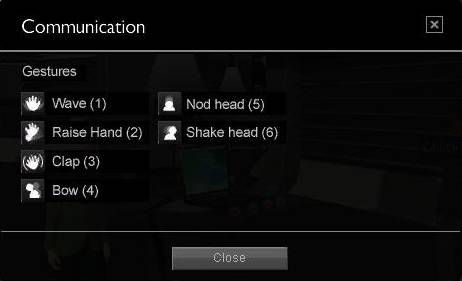
In this area, Lenovo can utilize PDF, PowerPoint, etc. to present to clients.  So the large displays (above) can render a PowerPoint, just like using a projector in a conference room.  Overall, I found the user interface of web.alive (and eLounge) to be quite intuitive.  I was immediately able to pick up on the relevant commands – the use of “overlay” text that appears transparently on top of the screen was useful.  And menus like this are handy:

Lenovo eLounge

Source: Lenovo eLounge

The numbers (above) represent keyboard shortcuts that allow you to “emote”.

The web.alive platform is built on top of the Unreal Engine from Epic Games.  Virtual Worlds News has some good coverage of eLounge, along with Nortel’s licensing of Unreal:

http://www.virtualworldsnews.com/2009/01/lenovo-using-nortels-webalive-for-ecommerce.html

http://www.virtualworldsnews.com/2009/01/nortel-licenses-unreal-engine-for-webalive-opening-up-to-development-community.html

In Summary

For a “Day 1” experience, I found Lenovo eLounge (and web.alive) to be quite good – I’m sure Nicholas and team at Nortel will continue to build it out with more features.  It will be interesting to see the applications that other companies may have for web.alive.  According to Sauriol, Lenovo is the first public launch of a web.alive client – there will be other public launches forthcoming – and there are a number of clients using web.alive behind the firewall (which we won’t hear about).

I’ll also be interested to hear how Lenovo is driving users into eLounge  (i.e. generating interest / demand), along with what sort of ROI they’re looking to generate from this investment.  Kudos on a good start to both Project Chainsaw (Nortel) and Lenovo.

UPDATE: Some supplementary information about the underlying technologies: