Virtual Events: Year In Review 2009

August 18, 2009

virtually_actionpacked

Coming into this year, I considered 2009 a taking-off point for the virtual events industry.  Sure, virtual events and virtual tradeshows have been around for some time, but I felt 2009 would see enormous growth (in both event volume and in the breadth of industries entering the mix), as virtual event organizers (and virtual event platform providers) pushed the envelope with new technologies and new event models.

From my perspective, this has come to fruition – 2009 has had so much activity and excitement that I’ve decided to publish my year in review before the summer is out!  And maybe I should re-label this – I don’t intend to provide a review of the entire year – but rather, highlight the important trends that I’ve noticed in 2009:

  1. Virtual events go global – since I reside in the United States, it’s not surprising that many virtual events I hear about are produced by U.S.-based show hosts  (e.g. b-to-b publishers, corporations, etc. based here).  In 2009, I saw a marked increase in virtual events outside of the U.S. – including those for a global audience and those targeting a specific geography.  I saw a few “24 hour consecutive” virtual events that sought to follow the sun.  I saw the launch of ExpoNZ (a global showcase for New Zealand) and virtual job fairs in Europe, powered by IMASTE.  I expect to see this trend continue into 2010.
  2. Many new industries come on board – prior to 2009, b-to-b publishers and technology vendors took up the lion’s share of virtual events.  That’s no longer the case now.  In my Virtual Events Calendar, you’ll see events from the following industries: pharmaceutical, packaging, consumer goods, mortgage, travel, healthcare, retail, textile.  I’m sure there were other industries (not listed here) that saw their first virtual event in 2009 (e.g. auto, financial).  Expect this trend to continue as well – in 2010, additional industries will surely enter the mix.
  3. The emergence of hybrid events – it’s only logical to complement your physical event with a virtual component.  In the technology space, SAP and Cisco ran virtual events concurrent with their annual customer conferences.  In the minds of the virtual events industry, this trend is quite clear, as more and more physical events will be expected to have a virtual component.  I haven’t yet seen a scenario whereby a physical event was produced to complement an existing virtual event – so perhaps that’s a trend to come in 2010.
  4. The shift from event to ongoing community – the use of live show dates will continue with virtual events – but increasingly, show hosts are looking to take the audience generated for the event – and support post-event continuation, in the form of an ongoing community.  Virtual events are shifting from a single (or multi) day focus – to one of a 365 day/year community, sprinkled in with pre-scheduled live dates throughout the year.  Working hand-in-hand here is another important 2009 trend – the integration of social networks into virtual events.  Jeremiah Owyang had a very interesting blog posting on this topic.
  5. The shift from single-day to multi-day events – prior to 2009, the typical virtual event ran during the business hours of the show host’s local timezone (e.g. 9AM to 6PM ET).  In 2009, we witnessed some 24-hour consecutive virtual events, along with an increasing number of events that ran for 2 consecutive days or more.  Part of the multi-day trend runs in parallel with the hybrid event trend – for physical events that run multi-day, it’s only natural that a virtual event also span more than one day.

And that wraps up my 2009 trend watch for the virtual event industry.  Let me know which trends I missed!


A Look Inside Virtual Job Fairs With IMASTE

July 28, 2009

IMASTE Co-Founders: Miguel Fernandez Lapique, Aitor Zabala, Miguel Arias

IMASTE Co-Founders: Miguel Fernandez Lapique, Aitor Zabala, Miguel Arias

Founded in 2003 and headquartered in Madrid, Spain, IMASTE has a mission statement that reads, “We create innovative contact platforms for our customers and their potential users”.  According to Miguel Arias, Director-Partner at IMASTE, “We founded IMASTE with the purpose of enabling a bridge between companies and university graduates. We first started organizing real events and after two years we became the Spanish leader in university recruitment events in Spain.”  As technologies began to emerge, IMASTE found it natural to leverage the web to complement their physical recruitment events with virtual job fairs.

Today, IMASTE has three primary product categories:

  1. Virtual Fairs – Virtual Job Fairs have been produced in Spain, France, UK, Brazil and Portugal – and IMASTE is working on a sustainability virtual fair in France.
  2. Virtual Environments Lab – based on Adobe Flex, IMASTE builds rich internet applications for clients.  Arias notes, “We have developed the virtual corporate office for Deloitte, the virtual campus for Everis, a virtual music festival for Universia and a virtual petrol station for CEPSA.”
  3. On-Campus (Physical) Job Fairs – IMASTE organizes more than ten Spanish university job fairs, a primary source for Spanish employers to tap into a pool of young graduates.
Monster Edays Event, Powered by IMASTE

Monster Edays Event, Powered by IMASTE

IMASTE worked with Monster to produce Monster Edays, a 2-week virtual job fair that leveraged instant messaging and video chat and enabled more than 90 online company presentations.  IMASTE leveraged Adobe Flex for 3D renderings and animations, as well as the Red5 video conferencing application.  With the event targeting the French market, IMASTE enabled French language support in their platform and coordinated video production activities from Paris.

According to a Case Study posted on the IMASTE web site:

With more than 35 participating companies, over 100,000 unique visitors and over 8,000 collected CVs, the project was a huge success. The media buzz generated more than 350 referring sites and great blogger reviews.  Thus increasing heavily the brand awareness among jobseekers.

Like many providers of virtual events and virtual event technology, IMASTE has a fairly healthy schedule of events.  In the Fall of 2009 alone, they have virtual fairs planned in Croatia, France, Spain, UK and Ireland – with a second edition of a Brazilian virtual job fair scheduled as well.

Speaking of the European market, Arias notes that Europe encompasses many countries, languages and cultures – for virtual event success, “one needs to take into account the cultural differences of each country and localize your platform to each specific need.”  Sprinkling in a bit of humor, Arias concludes, “Therefore, you need to be very flexible and code a lot.”

Arias believes that vast growth opportunities lie ahead, since the European market has not yet fully embraced virtual events – “corporate and marketing executives are not so keen of web innovations and there is a very strong culture of the importance of physical events to enable networking.”

Perhaps IMASTE should leverage their physical job fair business – and prove the ROI and benefits to the European market by turning them into hybrid (phyical+virtual) events.  This way, European exhibitors/sponsors still experience a comfort level (with the physical event sponsorship) and begin to experience the corresponding benefits of the virtual experience.

Related links

  1. A list of IMASTE’s products
  2. The IMASTE blog
  3. The IMASTE Team
  4. IMASTE blog posting on SEO and social networks
  5. Blog posting: For Virtual Events, Globalization Means Localization

Coming To A Physical Event Web Site Near You: Video, Blogs, Social Networks

July 23, 2009

Source: BtoB Media Business

Source: BtoB Media Business

In the current issue of BtoB Media Business, Charlotte Woodward published a cleverly named article, “Face to Facebook“, that highlights the incorporation (by physical event organizers) of digital technologies into the once-static event web site.  The inclusion of these technologies is helping show hosts extend the life of their events and support a 365 day/year experience – with a (hopefully) engaged online community to go along with it.

The article references the latest CEIR / GPJ research report:

Digital sponsorships contribute only about 7% of an event’s marketing budget, according to a recent report from the Center for Exhibition Industry Research and George P. Johnson. The study, “Digital+Exhibiting Marketing Insights 2009,” conducted online in April and May, surveyed 287 event managers and corporate brand exhibitors about the use of digital media.

As a result of the trends noted in the article, my belief is that in next year’s report, the percent of event marketing budget allocated  to digital will climb to 15-20%.  Why?  Because online/virtual will become a standard component of physical events.  The “new” event web sites of today – that include video, blogs, social networking, trackability, additional “impressions” for exhibitors, additional revenue for event organizers, etc. – could stand to benefit by leveraging a virtual event platform.  So rather than building your own event web site from scratch, you leverage virtual event/tradeshow technology to power the next generation “site”.

For the event organizer, the business model seems rather straightforward:

  1. Bundle sponsorship of the online community with the physical event sponsorship – upsell those low/mid-level sponsorship packages into a premium package, which includes a presence in the virtual component (e.g. full-blown virtual booth, signage within the environment, etc.).  You can create a “presence” for all of your physical event sponsors, but only those who have signed on for the full bundle will have real content behind the virtual booth storefront.  Those who opt not to purchase the bundle will have only their logo in the environment – a great way to incent the non-believers to enter the fray.
  2. Create value to attract online attendees – the online venue cannot solely be an area to appease exhibitors/sponsors.  In the same way you attract attendees to your physical event, you need to make it valuable for online attendees to visit your virtual community.  For me, this means a combination of compelling content (e.g. videos, articles, external links, etc.) and effective social/sharing tools (e.g. blogs, message boards, chat, etc.).

The incorporation (blending) of physical and virtual events creates very exciting possibilities.  Let’s consider what b-to-b publisher Hanley Wood is doing:

Additional improvements also integrate all the customer data Hanley Wood has collected, demonstrating to exhibitors and attendees who register that Hanley Wood remembers them and allowing the company to make recommendations based on a customer’s profile and history of participation at its events.

“We can put together some cross-show marketing, as well as up-sell the events that these people participate in,” Buraglio said.

The aggregation of attendee data from physical + virtual creates value:

  1. Attendees – by better understanding all of the touch points by an attendee (across physical + virtual), event organizers can more effectively package and target content that’s uniquely tailored to that attendee.  Give attendees precisely what they want (or need) and you create a more satisfied user, who will be more likely to stay engaged and return to the site frequently.
  2. Exhibitors/Advertisers – by building a complete picture of physical + virtual engagement from attendees, you can more intelligently plan and execute your lead follow-up paths.  If a user had her badge scanned at your physical booth, then entered your virtual booth to download 3 separate documents, she’s probably an advanced lead / “A” lead.

Related links

  1. Blog posting: The ABC’s Of Lead Follow-Up For Virtual Events
  2. Blog posting: The Convergence Of Physical Events And Virtual Events

Four Ways To Make Virtual Conferences Better

June 9, 2009

Nick Morgan, on the Conversation Starter blog at Harvard Business Publishing, wrote a recent posting titled “Three Ways To Make Conferences Better“.  To summarize, Nick’s suggestions are:

  1. Tell a unique story
  2. Make attendees active participants, rather than onlookers
  3. Leverage the gathered group to give something back to the community in which the conference is held

Nick’s blog posting served as inspiration for me – I’d like to cover ways to make virtual conferences better.  Virtual conferences (along with virtual tradeshows, virtual job fairs, etc.) do allow attendees to participate – in fact, some of the more interesting “content” in a virtual conference is the free form text chat that occurs in areas like the Networking Lounge.

And by its nature, a virtual conference gives back to the community in the form of carbon emission avoidance, time savings, convenience and productivity gains.  As for telling a unique story – that’s something I have not seen virtual conferences achieve.  But at the same time, I don’t think physical conferences do a good job of  this, either.

Without further ado, here’s my list:

  1. Leverage a Requests For Proposal (RFP) Tool for attendees – in a b-to-b virtual conference, you often find that the exhibitors offer a common set of products and services (they’re direct competitors).  As an attendee, the virtual conference affords me with a convenient and efficient means for comparison shopping.  So if I’m in the market for blade servers, I might want to spend time visiting numerous booths, downloading product collateral and chatting with some booth reps.  Instead, what if I could fill out an online form (within the virtual conference) and tell prospective vendors what I’m looking for?  Perhaps I need 1U blade servers with redundant power supplies and are remotely manageable.  I fill out my RFP form, check off the exhibitors that I’d like to receive my request and click “Submit”.  I then receive responses within the virtual conference environment from exhibitors – and start to create my short list, based on those responses.  As one can imagine, such a tool could greatly benefit attendees and exhibitors.
  2. Play some games – making games available within the virtual conference creates a sense of fun, which increases attendee satisfaction – this, in turn, increases retention and session time (attendees remain in the environment longer).  And of course, you’re not hosting the game solely for the sake of fun – you’re forcing participants to perform desired activities (e.g. visit a booth, view a Webcast, etc.) in order to advance within the game.  Again, win-win scenario – attendees and exhibitors benefit.
  3. Incorporate social media – attendees at physical conferences generate lots of Twitter, Facebook, etc. updates  from their PDAs.  In a virtual conference, it’s all too easy to remain well-connected with your social networks.  That being said, don’t force attendees to leave the virtual environment – instead, provide interfaces for them to post a status update directly from the virtual conference platform!  They should be able to tweet directly from the virtual conference, update their Facebook wall, etc.  This provides a convenience to the attendee and generates no-cost “PR” of the virtual conference across social networks.
  4. Embark with an Aardvark – a new service that describes itself this way —  “just send Aardvark a message through IM, like you do when talking to a friend.  Aardvark figures out who might be able to answer, and asks on your behalf — Aardvark is the hub.”  While it might be interesting to consider an integration directly from the virtual conference to the Aardvark service, it’s the concept that most interests me.  And that is, tapping into the collective wisdom assembled at a virtual conference in order to help attendees answer questions.  After all, most b-to-b virtual conference audiences login to the event with a common set of business or technical challenges.
Source: Aardvark (vark.com)

Source: Aardvark (vark.com)

Related Links

  1. Blog posting: Three Ways To Make Conferences Better
  2. Blog posting: Virtual Events And The Power Of Social Media (authored by me on my company’s blog)
  3. Blog posting: Cisco has integrated Twitter into their Cisco Live Virtual event
  4. About Us page: Aardvark

Virtual Event Adoption By The C-Suite (CIO, CMO, etc.)

May 8, 2009

In my former role as a b-to-b media industry product manager, I developed product packages that utilized audio podcasts for delivering IT-specific content to IT practitioners and IT managers.  The conventional wisdom at the time  (early on, at least) was, “CIO’s will not download and listen to podcasts”.  I wasn’t so sure about that – after all, podcasts made it easier for busy executives to consume content they wanted – when and where they wanted to consume it.  So why wouldn’t a busy executive leverage technology to make her day more efficient?

Lo and behold, a CIO speaker at an event I attended was asked about the different content types he leveraged to get his job done.  He mentioned that he takes a 30 minute ferry boat ride to and from work each day.  While most boat passengers are reading the daily newspaper, this CIO would listen to IT-specific podcasts on each ride – and, he insisted that each downloaded podcast be 30 minutes long (or less), so that he could listen its entirety on the ride.

With virtul events, I’ve heard from event organizers and event sponsors who wonder whether the CIO (and her companions in the C-Suite) will adopt virtual events and virtual tradeshows.  I think the answer is “yes”.  First, let’s characterize some of the C-Suite occupants:

  1. CEO – may be too busy to attend virtual events – but, will occasionally make the keynote appearance to kick off a virtual event.  Many CEO’s do not use a computer, but most carry PDAs.  This means that the path to CEO participation in virtual events may be via the PDA.
  2. CMO – they see the value of virtual events as a marketing and lead generation vehicle, so one of their key roles today is in funding and approving budget.  As for attendance, my feeling is that they’re interested in doing so.
  3. CIO – like with podcasts, virtual events enable and empower an executive.  The CIO can attend a virtual event to peer network with like-minded CIO’s and not miss a day in the office to do so.
  4. CTO – intimate with technology, the CTO is virtually a slam dunk to participate (pun intended).
  5. CFO – not so sure about CFO’s, but I will note that IBM Cognos produced a virtual event called Virtual Finance Forum 2009 that targeted finance executives.  Cognos produced the same event in 2008 as well.

B-to-B publishers have caught on to the notion that CIO’s will attend virtual events, as past virtual events have specifically targeted the CIO.  Two upcoming events are taking a similar approach:

  1. CIO Virtual Forum: Navigating Through Dynamic Times (May 19, 2009 – CIO.com and Cisco)
  2. CIO Summit:  Driving Business Value and Customer Value in the Global Economy (June 10, 2009 – InformationWeek)

In my experience with technology focused virtual events, I found that of all registrants, 7-9% had senior IT titles (CIO, CTO, VP of Technology, etc.).  So an event with 1,000 registrants would have 70-90 of them be CIO’s or CTO’s.  Why would the C-Suite attend a virtual event?  I think there are a few primary benefits:

  1. Conveniently network with like-minded peers – one of the draws of attending an event is the ability to network with other attendees.  With a virtual event, a busy executive can do so without losing a day outside the office.
  2. Efficiently connect with partners and customers – an online experience can’t re-create the dyamics of an in-person interaction, but it does allow a busy executive to connect with many more partners and customers than could have occurred in-person.
  3. Extend your social graph and social presence – some C-Suite execs have enthusiastically adopted Twitter, Facebook and other social networks.  Industry-specific virtual events allow the executive to further expand the social graph.  And of course, they’ll be tweeting about the event as soon as they login.

What has your experience been – has the C-Suite at your own company attended a virtual event?


How To Use Social Media To Stay Current On Virtual Events And Virtual Worlds

April 21, 2009

In 2009, I’ve seen a surge in the volume of content published around virtual events and virtual worlds – coverage in mainstream media, blog postings, videos, podcasts and even entirely new web sites developed to cover these specific industries.  It’s all great – but with a rising volume of information comes the challenge of how to efficiently stay current.  I’ll highlight a few social media services that I use to keep current on events, track emerging technologies and find relevant commentary on all things virtual.

  1. Twitter (http://www.twitter.com)  – I published a prior blog posting regarding some of the specific people I follow on Twitter for virtual worlds information. To stay current on virtual worlds, find the authorities in that space and start reading their blogs or articles.  If you like what you find, see if they publish their Twitter handle – or, search for it yourself – and start following them.  I can easily stay current on virtual worlds by following a few select experts.  Their posts to interesting content serve as a virtual wire service for me (pun intended).
  2. Tweetbeep (http://www.tweetbeep.com) – I follow over 300 people on Twitter.  And as you may know, some of the A-level Tweeps obtain that status because of  their verbosity.  I tend to notice that a core set of 15-20 people (that I’m following) contribute about 80% of the tweets that I scan at any moment.  What’s the downside to this?  Well, that virtual events pioneer who only sends 2 tweets per day gets lost in the shuffle, as I’ll miss his tweets.  That’s why I use Tweetbeep to set up Twitter alerts by email – it’s like a Google Alerts for Twitter.  I set up search terms such as “virtual event”, “virtual tradeshow”, “virtual worlds” – and when I wake up in the morning, the alerts are there in my email inbox.  Now, if that pioneer tweets about virtual events, I’ll know what he said.  Also, I do have parallel Google Alerts configured, so that I learn about new content that Google has crawled on these same search terms.
  3. Google Reader (http://google.com/reader) – I’ll find blogs and web sites that focus on virtual – and subscribe to them (via RSS) in Google Reader.  This requires a bit more time, to skim through RSS headlines and determine what’s worth reading (similar to scanning an email inbox).  So it’s not quite as efficient as Tweetbeep or Google Alerts, but very valuable nonetheless.
  4. Friendfeed (http://friendfeed.com) – similar to Twitter, but also different – I find myself following a unique set of people on Friendfeed – and the neat thing with this service is that I can see not only their tweets, but links they’re reading via Google Reader and pages they’ve bookmarked with del.icio.us, to name a few.  In addition, I’ll check in on a Friendfeed Room called Metaverse News, where Gaby Benkwitz posts links to interesting articles about the virtual world.
  5. Facebook (http://facebook.com) – I created a Virtual Events Strategists Facebook Group – so I’ll check in there from time to time to see what’s been posted by group members (articles, images, questions, etc.) – and I’ll try to contribute to the group by posting articles that I’m reading about the industry.  I’ve also noticed that virtual event producers are leveraging Facebook Groups to promote their event – which is neat.
  6. Linkedin (http://linkedin.com) – I’ll use Linkedin to connect with folks I meet in the industry – and to keep current, I’ll check in on a few Linkedin Groups when I can (e.g. Virtual Worlds, Virtual Edge, Virtuual Events Forum, Event Managers, etc.).  Some groups tend to be more “spammy” than others – so I’ll find those with the best signal-to-noise-ratio and receive postings via a weekly digest email.

All in all, this probably involves a bit more effort than it needs to – that’s why I think the future of staying current will be about services like Tweetbeep and Google Alerts – you configure what you want to see and an “agent” goes out, finds it and delivers it to your doorstep.  Virtually, of course!


How A UC Davis Professor Leverages Second Life For Research

April 8, 2009

Professor Peter Yellowlees of UC Davis

Professor Peter Yellowlees of UC Davis

Dr. Peter Yellowlees, professor of psychiatry at UC Davis, has done some innovative work using Second Life to help educate people on schizophrenia.  I referenced Professor Yellowlees in an earlier blog posting about virtual worlds technologies that benefit the real world.  I contacted Peter to get some more information about his research and his thoughts on virtual worlds, Web 2.0 and the future.

  1. Tell us a little bit about yourself? I am a professor of psychiatry at UC Davis in Sacramento California, and I also run the UCD Health Informatics Graduate program, where we currently have over 40 graduate students enrolled in our masters and certificate programs. I trained in medicine in London, England, then spent 20 years in Australia, before being offered a position at UC 5 years ago. I am married to Barb and we have 4 grown children, and one “furry daughter” – a puppy called Lucy who  thinks she is human.
  2. Tell us how you are using technology (including virtual worlds) in your research? I use it to teach about the experience of schizophrenia. It is hard for students to imagine what it is like to hallucinate – to hear voices and see visions – and the capacity to have the avatar undergo those experiences is very helpful for the students and lets them understand about the lived experience of psychosis.
  3. When you heard of the concept of a virtual world, what was your first thought? I have been working with virtual reality for more than 10 years – I started with a CAVE (collaborative virtual environment) in Australia and developed software applications for that type of environment, and then moved “downscale” to the much cheaper more available internet environment when I came to the US.
  4. Besides Second Life, do you participate in other virtual worlds? Not currently, although I am constantly looking at other software systems, particularly the ones used by USC to model the Iraq war environment and treat PTSD.
  5. What’s missing in virtual worlds technologies that could benefit your research efforts? In SL the main missing element is the relative lack of realism of the environment – it is still rather cartoon-like and can’t compete for “reality” with the very expensive VR games that are now widely available. I would also like to see the avatars being able to change more easily on the fly, although the creation of avatar bots is great.
  6. What Web 2.0 services or social networks do you participate in? I blog regularly at http://informationagehealth.blogspot.com and am also on facebook and twitter. I have recently published a couple of ebooks at www.smashwords.com ( one of them is free) and have my own website at www.informationagehealth.com that is set up to both support patients that I see in the real world, as well as to promote my book on internet healthcare – “your health in the information age” published by iUniverse and available through Amazon and most online and f2f bookstores
  7. Do you see benefits of social networks as they relate to your research interests? I am very interested in them and would really like your readers to comment on how they think that social networks could be used in healthcare – they clearly can be a support and information system for patients but I feel they should have more capacity than this and am looking at how they can be combined with mobile environments –  I carry both a blackberry and an iPhone for instance, and am interested in how they could be used for monitoring behavior and symptoms.
  8. What are related fields of science that could benefit from virtual worlds? Certainly the social sciences – also probably genetics, by allowing us to link with unknown family members better…and many others…
  9. What does the future hold? Read my book!!!! – go to www.informationagehealth.com – the last chapter is all about the future of healthcare on the internet – lots of fascinating areas, and I think visualization of large data sets is particularly important – in 3D in virtual worlds – allowing scientists to literally get inside their data – amazing possibilities.

Identity And Access Management In The Virtual World

March 18, 2009

In the physical world, it’s quite easy and simple to separate your work identity from your personnal identity.  Work is at the office – and for some, work stays in the office.  Your personal life and family are in your home.  Similarly, access rules apply within the same structure – you have access to work-related  information in the office (even though we know that’s extended to your PDA these days) and you spend quality time with family members around the home.  It’s simple, black and white.  As we spend more time online these days (and virtual), our worlds begin to merge and what was once black and white becomes gray.

There’s no better example of this merging world than the desktop or notebook you use for work.  Let’s list out the applications you run during the work day, segmented by business vs. personal:

Business

  1. Email client
  2. Instant messaging (IM) client
  3. Browser tabs: Intranet, corporate reporting system, CRM system, ERP system, etc.

Personal

  1. Email client (e.g. Yahoo Mail, Gmail, etc.)
  2. Instant messaging (IM) client [possibly the same client you use for business purposes]
  3. Browser tabs: Facebook, Twitter, eBay, NCAA picks, etc.

Now, let’s say I’m doing a desktop sharing session  – I’m running through a demo of a virtual event and I’ve forgotten to sign out of my personal IM client.  My mother, not knowing that I’m sharing my desktop, decides to send me an instant message.  What happens is that my audience of ten gets to see a reminder from Mom to call Uncle Jasper to wish him a Happy Birthday.  A bit embarassing, but all too possible when access to your business and personal profiles are enabled by a common resource (your PC).

To provide for a separation, one solution is to utilize virtualization – run one virtual machine (VM) with all of your business applications and a different VM with all of your personal applications.  The hassle here is the need to toggle between the two – but hey, perhaps you get more work done.

Now, let’s extend things a bit – as the business use of social media and virtual worlds grows, I think the same need for separation (e.g. identity and access management) applies.  For instance, many tell me that Facebook is strictly for friends and family, while Linkedin and Twitter are used strictly for business associates.  So users are using a manual configuration to separate their social network identities (and access to those identities).

But perhaps there’s a cleaner way – something I think of as identity virtualization.  Similar in concept to virtual machines, users of social networking and virtual worlds should be able to have a base profile (information that’s globally available and applies to all identities), along with specific identities suited for a defined purpose (e.g. business, personal, etc.).  Perhaps your virtual worlds identity (for business) uses your real name, whereas your virtual worlds identity (for personal) uses a fictional name (a la Second Life).

For this to work across your social network sites, they’d all need to work together against a common standard (for profiles).  In the meantime, this concept is precisely what Facebook was thinking, when they rolled out recent changes to help users better segment updates across their Facebook friends.  So while I certainly don’t have all the answers, my simple thought is that, as use of social networks and virtual worlds grows, the identity and access management issue will become more and more important.


Bringing Virtual Benefits To Business Travel

March 14, 2009

Source: Virgin America

Source: Virgin America

Recently, I embarked an a now-uncommon routine (for me) of a business trip – flying round trip on Virgin America, one of my favorite airlines.  Since most of my business these days is conducted virtually, the logistics of checking in at the airport, waiting in the security line, boarding the plane, checking into the hotel, etc. – gave me plenty of time to reflect on the dynamics of business travel.  Here are some observations:

  1. By its nature, business travel means that you’re constantly in close proximity to other businesspeople – some of whom are in your industry – or, could benefit you as a business partner (or vice versa)
  2. Those who are less outgoing / personable may only meet 2% of the fellow businesspeople they travel with – and really get to know only 1% (or less!)
  3. On my return flight to SFO, I’d guess that 1 out of every 15 people was a Silicon Valley entrepreneur.  If you were a start-up entrepreneur and on that flight, I’d guess that 1 out of every 25 on that plane was a Silicon Valley venture capitalist – or, someone who had funds to invest in your company

And while we’ve all heard stories about the sales deal or business partnership that was sourced by the “person next to me on the plane”, how many other business connections fall by the wayside because two or more individuals never connected?  Lots, I’m sure.  Technology helps flatten the world – but it can also be a further flattener to enable strangers in physical proximity to connect.

We do know that business travelers are quite active on social networks.  There are plenty of business travel blogs out there.  And, users of Facebook and Twitter are quite active while traveling.  They’re constantly chiming in from airports, conferences, hotels and restaurants.  They’ll also tell you whom they’re about to go in to meet with – and how it went.  So we know that busniesspeople are active on social networks during travel – but, how often are they engaging socially in person?

And there’s the irony – social media allows you to connect and socialize globally – but while you’re tweeting from your BlackBerry in the hotel lobby, might you be missing out on an introduction to a potential business partner who’s about to grab a cab to the same place you’re going?  Here’s where localized social media –  targeted at the local business traveler – could be a big win.

Some ideas:

  1. Virtual Flight Lounge, powered by Virgin America RED – when booking your Virgin America reservation online, Virgin asks you to opt in to their Linkedin connector – by opting in and supplying your Linkedin credentials, Virgin is able to capture key data from your Linkedin profile – and, obtain a list of your Linkedin connections.  Once on board, you pull up RED (Virgin’s in-flight entertainment system) and it displays Linkedin connections of your’s who are on the flight.  Additionally, it recommends business partners (with their seat numbers) based on a comparison of your profile against other profiles of passengers who also opted in.  If you’re interested, you can engage in RED’s seat-to-seat chat with your new-found friend.
  2. Marriott Virtual Lobby – when making your Marriott reservation online, you’re prompted to opt in to the hotel’s business networking feature.  You’re asked to provide information to populate a profile, such as what business you’re conducting, what business opportunities are you interested in, what are your food preferences, what are you in the market to purchase, etc.  Once you arrive at the hotel (and connect to the hotel’s paid wireless service, of course), you’re invited into a virtual lobby (similar to a virtual event), where you’re able to see all other guests who have opted in to the service.  You’re able to perform search, view guest profiles and participate in private and group chat (either via text or webcam).

In each scenario, the idea is that two or more potential business partners could discover one another (via their published profiles) – connect virutally and then arrange for the old-fashioned cocktail at the hotel bar or a steak dinner downtown.  That’s right, virtual begets physical.

Why would Virgin or Marriott do this?  The costs are fairly low (and fixed) – and can earn a high and recurring return – that being customer satisfaction and retention, which sure has a high ROI in this economic environment.  And what’s the value to the business traveler in opting in and using such a service?  Well, what’s the value of a new business partner or a new client?  I’m sure it’s much higher than the hard cost (zero) and worth the time and effort.

The concept here is similar to the popular “Who’s Close To Me” service provided by TripIt – but the difference is that here, you’re sourcing brand new business contacts, as opposed to discovering if your existing contacts are nearby.  So if I don’t bump into you in the security check at SFO, perhaps I’ll connect with you virtually and then grab a coffee with you in person.


Join A Group To Collaborate On Virtual Events

February 23, 2009

Over the past few months, I’ve observed an increasing amount of chatter within Twitter (the popular micro-blogging service) regarding virtual events and virtual tradeshows.  In many cases, Twitter users who are considering their first virtual event will submit a tweet such as, “considering my first virtual event.  Anyone have information on best practices?”.  I chime in when I can, but Twitter and its 140 character limit does not facilitate much in the way of extended dialog.

In fact, when two or more Twitter users need to delve deep on a topic, the next step is usually to “connect offline”.  Similarly, this blog is a useful vehicle for the communication of my thoughts and ideas – but isn’t great for facilitating discussion.  Despite the comment feature of blogs, there hasn’t been much extended discussion here, by way of commenters.

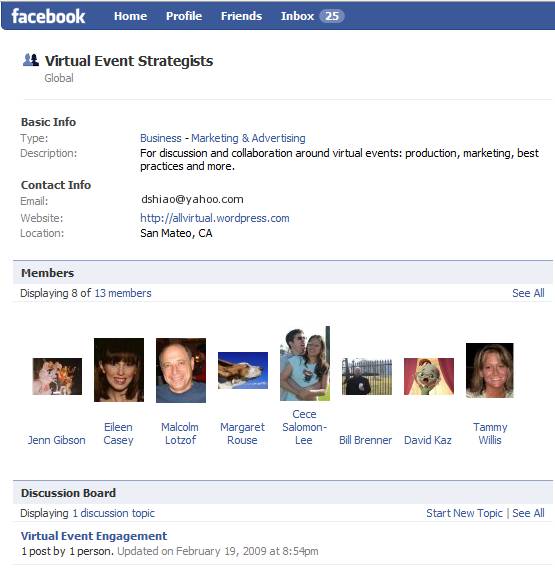
So I decided to create a Facebook Group to address these challenges – it’s called Virtual Event Strategists and is open to anyone interested (you need a Facebook account to join).  Here’s a snapshot of the group page:

Source: Virtual Event Strategists' Group Page

Source: Virtual Event Strategists' Group Page

Why a Facebook Group?  A few reasons:

  1. The 175MM active users (of Facebook) – most readers of this blog are likely on Facebook – if not, let me know why not!
  2. Threaded discussions – are you a first-timer in virtual events?  Well, starting up a threaded discussion may be just the thing to do
  3. The Wall – post miscellaneous thoughts and ideas about virtual events
  4. Post Links – let us know what interesting blogs or articles you’re reading about virtual events
  5. Post Video – Facebook has a convenient video recording and hosting capability – plug in a webcam and start using it

In fact, I’ll be doing brief “Virtual Event Tip of the Day” video clips on the Group page.  Here’s one of my first video clips, where I talk about the use of prizes in virtual events:

fb_video

I’ve seeded the site with some initial content – but, what I’d most like is to hear from all of you.  So, start some discussions, post some videos, post some links.  The group page is:

http://www.new.facebook.com/group.php?gid=52325833170#/home.php?ref=home

Let’s collaborate and learn together – see you there!