Marketers as Event Organizers

January 2, 2009

Rebecca Lieb of ClickZ penned an interesting article titled “Marketers as Publishers”. Rebecca discusses the trend of marketers as full-blown content creators, especially in this age of digital media.  Examples cited by Rebecca include:

  1. Low cost video content creation and distribution (e.g. with a digital video camera to record and YouTube for distribution)
  2. Big brands creating original content (e.g. Bud.tv, along with Johnson and Johnson’s Baby.com)
  3. Creation and propagation of consumer generated media

I agree with Rebecca – spending the past few years in tech media, I’ve watched the transition of technology vendors into prodigious publishers, with their mix of White Papers, Webinars, Podcasts, Case Studies, Videocasts and Product Collateral.  Some technology vendors are producing hundreds or thousands of pieces of content a year, giving their technology media partners a run for their money (on volume).

Adding to Rebecca’s list, I think we’ll see an increasing number of marketers turn to virtual events – whereby marketers can easily morph into event organizers (in addition to publishers).  Perhaps you’re an up and coming vendor in an IT market – you see the benefits of doing a customer conference, but the business case isn’t quite there yet.

With costs for virtual events coming down, you now have the opportunity to launch that customer event in 2009.  You do it online, making it efficient and convenient – and bringing its availability to a global audience of customers and prospects.  Take Quest Software as an example.   This maker of products and services for Enterprise IT has run virtual conferences the past two years.  Last year’s event was titled Quest Connect 2008 and included presentations (webcasts) on just about every technology produced by Quest.

I wouldn’t be surprised to see Quest produce the same event (or events) in 2009 – so as you can see, they’re morphing into an event producer and event organizer (where the ongoing events occur online).

With regard to consumer generated media (CGM), I’ve found that virtual events are a natural venue for fostering CGM.  Engaged attendees who participate in your event are not shy about expressing their thoughts and opinions.  You’re bound to see a lot of CGM around your products and services – and I’d argue that good or bad, the discussion and interaction  is valuable to your company.  In some cases, I’ve seen questions posed by attendees that are directly answered by other attendees.  How efficient!  Customer support (and prospect management) via CGM.

So publishers (I mean, marketers), as you plan your activities for 2009, consider the virtual customer conference.  And, consider extending your (physical) customer conference into the virtual world.


How to Handle Those Hot Virtual Tradeshow Sales Leads

December 31, 2008

It’s the holy grail of online lead generation – you generate sales leads that pursue you and your company (rather than the other way around).  This holy grail scenario often plays out in B-to-B Virtual Tradeshows.  Some attendees come to the virtual event with approved budget, purchasing authority and a specific need.  As such, they’re shopping around with the various exhibitors to see who offers the solution that best fits their requirements.

These attendees will ask you (or your colleagues) very specific questions, covering technical specifications, product features and pricing.  At the conclusion of their visit, they may ask to be connected to a sales representative from your company.  How better can it get for you as an online marketer?  For this opportunity that fell into your lap – be sure to close the loop (with sales) on this lead or else the happy ending may be told by your competitor.

Here’s a sample chat that’s representative of what I’ve seen in virtual events:

Attendee: Thanks for the information about your products.
Exhibitor: You’re welcome!
Attendee: I’d like to set up a meeting to price out a configuration and discuss a few requirements that the product needs to meet
Exhibitor: Where are you based?
Attendee: New York City
Exhibitor: (a few minutes later) OK, the area sales manager for NYC is Bob Johnson.  His email address is bjohnson@acme.com and his phone number is 212-555-1212.
Attendee: Thanks, I’ll contact him.

Not good enough!  The exhibitor missed out on a golden opportunity here.  Additional steps that I’d recommend:

  1. Copy/paste the transcript of the chat and immediately email it to Bob Johnson
  2. Connect with Bob via email, IM, etc. – letting him know about the hot lead
  3. Update your CRM system (e.g. Salesforce.com, SalesLogix, etc.) with the transcript of the chat and a summary of the sales inquiry
  4. Urge Bob to follow up immediately with the attendee — let the attendee know (during the chat session) that “Bob is ready to take your call right now” – or, “Bob will call you first thing in the morning”
  5. Get Bob to login to the virtual event right now – you already know that there’s one hot lead from his territory – a sales opportunity waiting for Bob to close
  6. Provide your own contact info to the attendee, letting her know that you can be contacted if Bob cannot be reached

Remember, leads in a virtual tradeshow can be very hot.  Handle with care and don’t treat them like hot potatoes.  If you do, then your competitors may be eating your lunch.


Eloqua’s Digital Body Language

December 24, 2008

An article in ClickZ titled “TriNet Uses Digital Body Language to Arm Sales Reps” describes how TriNet (an HR services company) leveraged Eloqua’s Program Builder to augment their process of online lead qualification.  When I attended an Eloqua sales presentation on Digital Body Language, I immediately agreed with their approach – and found their digital body language analogy to be quite apt.  Prospects who are interacting with you (e.g. via a visit to your web site) leave tremendously valuable fingerprints.  Web site publishers ought to leverage this valuable data to smarten their lead qualification and follow-up.

 I think that a perfect complement to this digital body language concept can be found in virtual events.  Here, prospects are providing rather explicit cues regarding their interest in your products and services – they’re downloading your White Papers, returning to visit your booth, chatting with your booth reps, etc.  Your nurturing and qualification cycle become condensed down into a single event (e.g. the virtual event!).

If you’re an online marketer who’s using Eloqua’s system, a great complementary program for 2009 might be a virtual event sponsorship.  I think you’ll find valuable body language (from prospects).  Some might even ask you out on a date (to meet with one of your sales reps, that is!).


Use Treasure Hunts to Increase Engagement in Virtual Events

December 23, 2008


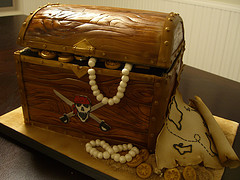
Flickr ("Crazy Cake Lady")

Source: Flickr ("Crazy Cake Lady")

You’ve planned a great virtual event.  You sold a number of high profile sponsorships.  You promoted the event to your members and generated strong registrant counts.  You’re looking forward to the big day, when the exhibitors (and your boss) pat you on the back.  But wait!  You’re work is not done.  Even if you have a large audience – and, the right audience, exhibitors will deem the event underwhelming if that audience doesn’t adequately engage with them.

In a prior blog post, I wrote about the effectiveness of prize giveaways at virtual events.  In that post, I wrote about the notion of smaller prizes to generate interest.  Here, I endorse a slightly different approach: use a grand prize (e.g. flat screen HDTV, if budget allows) and up the ante for prize qualification.  Instead of “presence” in some event location, require that attendees complete all steps of a treasure hunt in order to qualify for the prize.

With a multi-sponsor virtual event, you’re going to want to keep all of your exhibitors happy (without favoring any particular exhibitor).  So set up the treasure hunt so that each exhibitor benefits.  Here is a sample treasure hunt template.  I’ll leave it as an exercise to the reader to determine what actions each step encourages.

Sample Treasure Hunt

  1. Find the White Paper titled Best Practices for Data Deduplication.  Name the author of the White Paper
  2. Find the White Paper titled Data Backup and Recovery.  Name the sponsor booth in which it’s located
  3. There is a booth representative in this event named Joe Kennedy.  Name the sponsor booth in which he’s stationed
  4. In the second Webcast presentation today, the speaker is from what company?

If you go with a treasure hunt, be sure to promote it heavily, both within the event and in email promotions and web site listings prior to the event.  To select the grand prize winner, ask your virtual event platform provider if the platform’s survey function can do the trick.  You may be able to “host” the treasure hunt quiz via the survey – using either multiple choice selections or, using a free-form text field to solicit answers from treasure hunt participants.

Happy Hunting!


Launch Your Next Product Online

December 22, 2008

In 2008, I worked with a few savvy technology vendors to launch their products online in a virtual event.  We called these “virtual launch events”.  They were hugely successful – the vendors generated a slew of net new sales leads, educated prospects and customers about the features of the new product and connected employees, executives and channel partners directly with the same prospects and customers.

Because all users participated online, costs were efficient and the participation was highly convenient.  Additionally, the vendors and their partners were able to achieve deep (online) engagement with prospects, including in-depth text chats regarding the products.

If you’re considering a virtual launch event of your own for 2009, here are my Top 3 best practices:

  1. Encourage participation from your partner ecosystem – your resellers, consultants, etc. should have booths at the event.  This reinforces the full “value chain” of your product – showing prospects that your solution is backed by an assortment of partners who sell the product and provide valuable services around it.  Secondly, you can recoup some of the costs of the event by charging your partners to exhibit.  After all, they’re receiving sales leads as a result of participating.
  2. Active participation from your executive team – have the SVP or GM of your product officially launch the product via video – prospects and customers will apprecitate the personal connection of video (vs. slides and audio).  In addition, have the same exec(s) participate in the booths and networking areas, connecting directly with attendees.  Customers and prospects highly value direct access to your executivies.  And, your SVP or GM will find the experience valuable, since they’d likely admit that they’d like to get out in front of clients more often.  Finally, a successful event makes you a hero in front of the SVP/GM.
  3. Bring an independent voice – you probably have relationships with analyst firms (e.g. Forrester, Gartner).  Have a prominent analyst give her perspective on the product you’re launching and what it means for your market.  This independent voice helps complement all of your (and our partners’) presentations.

Best of luck on your 2009 launches!


Utilize Surveys in Virtual Events

December 19, 2008

Online marketers often speak of hard ROI (explicit return) and soft ROI.  In this economic climate, soft ROI is being cut and marketers are focusing (with rare exception) on hard ROI.  But what if you could generate hard ROI and soft ROI simultaneously?  Would your CMO or CFO like that?  I’d bet that the CMO would, at minimum.

So consider the use of surveys within your virtual events.  Let’s say you generated 200 visitors to your booth.  And let’s say 70% of those visitors completed an online survey that was available right there in your booth (equalling 140 survey completes).  You might think I’m crazy to suggest that 70% of visitors would actually fill out a survey.  But what if you provided a prize?  And, you qualified visitors into the prize drawing via completion of the survey?  I’ve seen it with my own two eyes – one particular event had 70% of booths visitors completing the exhibitors’ in-booth survey (i.e. for those who chose to utilize a survey).

140 survey completes results in a statistically significant sample size.  And you’re likely not going to generate such a high response rate if you message to these visitors post-event.  Here are my Top 3 reasons for doing a survey in a virtual event:

  1. Plan your marketing content – let your target audience tell you what they’re interested in, what media formats they like to consume, what content they want (from you)  as they evaluate your products and services.  Leverage this valuable information to plan your White Papers, webinars and follow-on virtual events.
  2. Generate insights for your Product Manager – partner with your company’s product managers and ask them what info they’d like from customers and prospective customers.  You’d be a hero to Product Management and the success will certainly bubble up to the CMO or VP of Products.  And, by the way, this may help your company design better products.
  3. Intelligent lead follow-up –  survey questions are very similar to the qualifying questions that online marketers use on lead gen registration forms.   Don’t be afraid to review individual survey responses to better plan your lead follow-up with selected leads.

Now, what’s the cost of doing the survey?  Well, the prize will set you back a few hundred dollars (e.g. for a GPS, Nintendo Wii, iPod, etc.).  When evaluated against the soft ROI you can  generate,  I think the investment is worth it.  As Richard Dawson may ask, “Survey says?” – YES.


How to Exhibit at B-to-B Virtual Tradeshows

December 14, 2008

Planning to be an exhibitor at a B-to-B Virtual Tradeshow (VTS)?  Here’s how to become a VTS All-Star:

  1. The right people – to attain All-Star status, first find your own team of all-stars from within your company.  You’ll want a good mix of product folks (product managers and/or product marketers), sales folks (direct sales reps or Inside sales reps) and technical folks (engineers or sales engineers).  Prepare your team for the event by bringing them up to speed on VTS (if this is their first time) and give each member clear goals of what you’d like them to do and accomplish.  For instance, the sales folks proactively connect with attendees; the product marketers participate in the public forums; the sales engineers are “on call” to the product marketer in case a really tough technical question is asked.
  2. The right content – place content in your virtual booth that is directly applicable to the theme of the event.  Take the time to carefully select your White Papers, Case Studies, podcasts, videos, etc.  Don’t simply repeat what you used at an unrelated event.  Attendees will be on the look-out for useful content, so if you’re selections are on the mark, you’ll generate more views and downloads.  Think of it as a form of search engine optimization – where the “spider” is the visitor to your booth.
  3. The right actions – train your booth reps to proactively connect with your booth visitors.  Thank them for their visit, send them a virtual business card, invite them to review your booth’s content.  Ask them about specific challenges they face and have your product marketers suggest solutions.  You’ll come out ahead if you help the attendees, rather than doing a hard sell on your products and services.  Attendees at B-to-B virtual events are not shy about seeking you out, which means they’ll come asking for pricing and product information.  When they do, make sure you have answers – or, be able to find an answer within an hour.  There’s no greater shame than getting hot leads at a VTS and then making them wait for the info they’ve asked for.
  4. The right prizes – that’s right, everyone loves the giveaway, even if it’s as small as a $25 gas card or coffee card.  A “big prize” (e.g. Nintendo Wii or HDTV) always attracts attention, but I like doing a large number of smaller prizes – reason being, attendees like the immediate gratification of winning a small prize, instead of receiving a chance to win the big prize.  So whether  it’s 100 USB drives or 50 Starbucks gift cards, you’ll get the attendees’ attention.  The most effective prize I’ve seen – copies of a book (by an expert) whose name was known by all attendees.

So there you go.  Do the “right” thing to secure your spot on the VTS All-Star Team.  Good luck and have fun.


2009: The Year We Go Virtual

December 12, 2008

Year of the Ox

Year of the Ox

The Chinese will celebrate 2009 as the Year of the Ox.  For B-to-B marketers, I’m convinced that 2009 is the Year of the Virtual Event.  While virtual events have already taken shape – in the IT space, 2007 was a growth year and 2008 was even stronger – I believe we’re facing a watershed moment when a “perfect storm” of factors will lead to a phenomenal surge in virtual events.

I believe that companies who provide products and services around virtual events will experience 50%, 100%, 200% and higher annual revenue growth in 2009.  On the flip side, companies whose primary business is around supporting B-to-B face-to-face events will experience diminishing demand and all but the top 5-10% will struggle to survive.

Here are the factors I see contributing to this watershed moment:

  1. Attendee demand – let’s consider the IT Pro.   Those who survived a layoff are facing significant internal cost controls.  It’s likely that all travel has been cut, which means that Joe IT Pro will not be attending a face-to-face event, even if it’s in the nearest major city.  This is one factor driving B-to-B event marketers to scale back their 2009 event plans.
  2. Exhibitors’ requirement for cost efficiency – if you’re lucky enough to have marketing budget for 2009, you don’t want to spend it on a high-end hotel (with their elevated food and beverage costs), along with the travel and lodging costs for your colleagues.  Instead, you could pay less for an online event.  Today, more than 50% of a virtual event’s cost is associated with the headcount required by the platform provider to configure the event.  The virtual event platforms, however, are moving to a full-blown  SaaS model, where the exhibitor becomes a mere tenant on the multi-tenant platform – and configures the event 100% on her own.  This means that the costs will trend downward over time (imagine that).
  3. The Green Movement – who hasn’t been encouraged lately to think and act Green?  A virtual event is virtually carbon-free.  Exhibitors stay at home (or in the office); attendees stay at home (or in the office).
  4. Measurability – with a virtual event, exhibitors can track and analyze all of the discrete actions taken by an attendee.  In addition, with tools like text chat (the equivalent of instant messaging), exhibitors can interact with attendees and have all the chat transcripts available for later review.  Other tools, like search, allow exhibitors to identify (and connect with) target attendees who are online in the event right now.  What this means is that exhibitors can measure and calculate their Return on Investment with higher precision and accuracy.
  5. The human touch – event marketers will tell you that nothing beats a face-to-face, in-person meeting.  2009 is a year where virtual events will merge with telepresence – with early adoption most likely in closed/private event spaces.  There are cost factors with telepresence – but, imagine virtual events combined with high fidelity video and it’s  like you’re in the same room as the person half way around the world.  With telepresence costs bound to come down over the long term, I see virtual events + telepresence being a killer combination.

All in all, I look forward to 2009 with great excitement.  For folks in the virtual events space, the Year of the Ox may be better labeled the Year of the Racehorse – as it’s off to the races we go.