Incorporate Gaming In Virtual Events

November 5, 2009


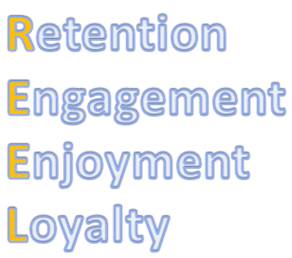
We’ve reached a point in the virtual events industry where users who have attended 1-5 events (or more) are starting to ask, “What’s next”?  If the industry doesn’t effectively answer that question, then users will eventually stop coming back and attendance will suffer.  One concept that makes a lot of sense is to introduce gaming into virtual events.  By doing so, you’ll achieve real results.  Why gaming?  It’s all about REEL:
REEL_img

Retention

Retention is a key objective of any virtual event – whether it’s a lead generation event (virtual tradeshow), partner education event or a virtual sales meeting, you want attendees to leave the event with a level of retention over the content you’ve provided (e.g. exhibitor product information, your own product and technology specifications or the the coming year’s sales priorities and initiatives).  Even in a virtual career fair, “retention” is about job candidates retaining information about your company and why they might want to work there.

With gaming, retention isn’t going to be achieved magically.  Rather, you’ll need to be very strategic in weaving your content message (and objectives) into the games themselves.  So you’re not providing games for 100% fun – but rather, crafting real business value out of participation in the games.  So first determine the messaging you want to convey to your attendees – and itemize the set of desired actions/outcomes you’d like to see them take in the virtual event.  Your tactics will then fall out from there, in terms of how to achieve your objectives within the games.  Sample tactics include:

  1. Place clues in the games that require participants to find and consume content in the show (e.g. view Webcasts, visit booths, etc.)
  2. Award game points based on participant actions
  3. Reward participants who successfully complete quizzes – whereby the questions are associated with content that can be found within the event

In summary, the structure of the game is all about driving business value – with attendees leaving your event with the desired level of retention.  The retention level translates into ROI on behalf of the event exhibitors, executive sponsors and show hosts.

Engagement

All virtual event hosts want to maximize engagement at their event – long session times, high attendee participation, etc.  The way this is achieved via gaming is not just in the sheer interaction with the game elements.  There’s also the factor of competition.  It’s natural for users to exhibit a competitive spirit – competition brings us validation (to know that we’re “better” than the “opponents”), recognition (to achieve a certain status or to see our name atop the leaderboard) and acclaim (to know that we’ve been crowned the champion).

So be sure to make competition a key element of your gaming, as it provides the constant “pulse” (heartbeat) behind the event.  With a leaderboard that’s updated in near-realtime, there will be constant buzz and activity as players jockey with one another for the top billing.

At the platform level, use the familiar video game tactic of “unlocking” certain features or capabilities based on levels you achieve in the game.  Perhaps it’s a special avatar or profile image (to designate your status) or a capability that puts me at an advantage against other gamers.  Lastly, provide compelling prize(s) to participants – otherwise, their incentive to compete may wane.

Enjoyment

When’s the last time you heard someone say they “had fun” at a virtual event?  Not too often, I’d imagine.  Well that’s a goal of gaming – while driving business value, you can simultaneously allow attendees to have some pure, old-fashioned fun.

Perhaps you create a game or two that has no (or very subtle) tie-in to your business objectives.  Or, you create a fun game that has business association, but is very fun to participate in (e.g. Jeopardy, Deal Or No Deal, Who Wants To Be A Millionaire, etc.).  If you’ve generated retention on the part of attendees – and they enjoyed the experience, then you’ve just created a win-win scenario.

Loyalty

An obvious point, but enjoyment lends itself to loyalty.  The more I enjoy an experience, the more I want to do it again.  With gaming, you have a real (or “REEL”) opportunity to create attendee loyalty, so that they come back for your next event.

Furthermore, in hosting an extended event (consider the case of an ongoing event that runs around the clock for a few weeks), the competitive aspect of the event keeps users coming back in to interact with the games, accumulate points and keep (or improve) their standing on the leaderboard.  As a virtual event host, loyalty is your pot of gold – loyal attendees means loyal exhibitors, sponsors, etc.

In summary, incorporating gaming into virtual events is a REEL opportunity that you should consider – if done right, all of your constituents will thank you for it.

Related links

  1. Gaming and Virtual Reality at Cisco’s Annual Sales Meeting (blogs.cisco.com)
  2. Cisco GSX — A Countdown to a Landmark Virtual Event (virtualedge.org)
  3. Marketing Lessons from Foursquare (rocketwatcher.com – observations on the mobile gaming service created by Foursquare)

How To Promote Your Virtual Event On Twitter

October 26, 2009

tweetdeckIMG

With a rapidly growing and highly engaged user base, Twitter can be a great vehicle for driving registrations and attendance to your next virtual event.  Here’s a step-by-step guide on how to get that done:

  1. Find your target audience on Twitter – first, of course, you need to define the target audience of your virtual event.  Once you do, go seek them out on Twitter – you don’t need to engage with them on Twitter just yet, but you can start following them – and identify the “places” where they tend to congregate (e.g. read their tweets, click through on links they’re sharing, read their blogs, attend chats they participate in, etc.).  You may find that by following folks, they’ll follow you back – and, may engage with you on their own.  Next, leverage Twitter’s search capabilities – search on key terms associated with your virtual event and observe who’s tweeting about them.  Sign up for a service like tweetbeep and you’ll receive daily email alerts with all tweets about your selected terms.  Start following the folks who seem to know what they’re talking about, as your virtual event may be of interest to them.
  2. Identify Twitter users whom your target audience follows – if you handled Step #1 well, then you’ve half-way completed this step already.  By researching topics (and users) on Twitter, you’ll begin to build an authority map – those with more authority on topics tend to have more followers.  Identify users whom your target audience is following – then, determine which users they’re following (and so on).  You’re now starting to build potential promoters who can help in the outreach efforts of your virtual event.
  3. Leverage prominent or active tweeters in your own company – is your CEO or VP Marketing an active tweeter?  If so, them reach out to their multitude of followers to promote the virtual event.  On your corporate web site, use a service such as TweepML to share a list of your company’s Twitter users – giving web site visitors a single-click option to start following every member of that list!
  4. Identify other prominent / relevant Twitter users – find prominent industry bloggers and start reading their blogs.  Engage with them by leaving comments on their blogs or send them @replies via Twitter.  Making these folks aware of your virtual event is a good thing (e.g. perhaps they’ll attend) – having them promote the event on your behalf is even better.
  5. Build your Twitter following – if you’ll be using a corporate branded Twitter account to focus your marketing efforts, use the aforementioned steps to start building your list of followers.  For me, quality always trumps quantity with Twitter followers – I’d rather have the right people follow my corporate branded account than have 200 “non relevant” folks follow me (in the hopes that I’ll follow them back).  Especially with a corporate Twitter account – make every tweet count.  Potential followers will often review your last 5 or last 10 tweets – if you tweet too often about breakfast or the weather, then you will NOT be followed.
  6. Start promoting by adding value – first, you never want to over-promote your virtual event.  Doing so will only turn users off from your corporate branded Twitter account.  Each time you promote the virtual event, you want to add value.  So again, make every tweet (promotion) account and give users something useful each time.  Similarly, ask your fellow promoters to start spreading the word – and suggest phrases or facts they should be using in their tweets.  Use a link shortener such as bit.ly and track the number of clicks you generate – this way, you can start to determine what’s working and what’s not working.
  7. Define (and use) your virtual event’s hash tag – make sure all tweets (e.g. from you, your colleagues and your fellow promoters) utilize the hash tag that you’ve created for your virtual event.  Ask your event’s exhibitors to pitch in as well – have them tweet about their presence at the event.  Once you’ve seeded the discussion with your event’s hash tag, you may see the interaction and commentary spread – if a few prominent tweeters jump in (e.g. >100,000 followers) and their tweets are then re-tweeted by other prominent tweeters, then awareness of your virtual event can spread beyond even your wildest dreams.
  8. Leverage other (relevant) hash tags – the hash tag can be a wildly effective means for promoting content to indirect followers – I may only have a few hundred followers, but if I post something insightful with the #eventprofs hash tag, I may have my message seen by the 50,000 (this number used merely as an example) users who monitor that hash tag.  Make sure the hash tag is relevant to your virtual event – assuming it is, including that hash tag along with your event’s tag. [Addendum, 10/27/09: be careful not to over-promote to the related hash tags, as constant promotion of your virtual event will surely turn off the followers of that hash tag – you’ll even receive backlash from them]
  9. Think outside the box – instead of continually pointing users to the registration page for your virtual event, try to mix things up – link to other areas, such as: short video of the keynote speaker; text quote from a prominent presenter; a testimonial (quote) from a pre-registered attendee; a twitpic (image) of the event’s show floor or auditorium; a page that lists titles or companies who have already registered.  Of course, on all of these pages, place a link to your event’s registration page.
  10. Have fun – Twitter can be an effective business tool – but remember, it’s also fun!

Tweet this posting:

How To Promote Your #Virtual Event On Twitter: http://bit.ly/n74Aj #eventprofs

tweetthis_img


What Virtual Events Can Learn From Twitter

October 13, 2009

Virtual Events - Twitter

Virtual Events - Twitter

In 2009, Twitter has taken the world by storm – in fact, it wouldn’t surprise me if Time magazine named Twitter their Person of the Year.  In my opinion, Twitter’s success hinges on its simplicity, celebrity (use by celebrities, that is) and portability (users stay connected to the service from nearly anywhere).

While virtual events have been around for a few years – they too took the world by storm in 2009 – mostly, the business-to-business world.  As we look forward into 2010, here’s what virtual events can learn from Twitter:

  1. 140 characters or less – I often find it a challenge to condense my thought into 140 characters – the usual trick is to lean on acronyms (or abridged versions of words) to get under the limit.  The better approach is to be more efficient, using less words to make the same point.  While I still get frustrated at times (having to distill my thought down to 140 characters) – other times, I find that my message comes across clearer and more elegant in the shorter form.  In virutal events, a lot of chatter (e.g. group chat in the Lounge) is long-winded.  It would be interesting to participate in a group chat in which each chat message was limited to 140 characters.  I get the feeling that the chat would be much more enjoyable and productive.
  2. Application Programming Interface (API) – Twitter was recently valued at $1B – it couldn’t have possibly reached that valuation without it’s excellent API and the rich ecosystem that’s been created by developers and start-ups.  The API has made possible desktop clients such as Tweetdeck and Seesmic Desktop, along with numerous third party services, such as Tweetbeep, Twimailer and many more.  Virtual event platform providers should look to “open up” their platform via API’s – allowing show hosts and exhibitors to tap into underlying registration data; customize the look and feel of their events; and develop functional mini-apps that ride on top of the platform.  As Twitter discovered, opening up the platform creates a “wealth” of opportunity.
  3. Mobile support – Twitter’s API allow for applications like TwitterBerry (for BlackBerry) and Tweetie (for iPhone).  Users are increasingly on the go these days – whereby less and less interaction with the web occurs from their desk and keyboard.  Virtual event platforms that can extend their reach to smartphones will stand to benefit greatly – adoption will increase, as will average session time and overall session counts.  Twitter also integrates with the Short Messaging Service (SMS) – making access nearly universal (e.g. from non-smartphone cell phones).  Perhaps there are capabilities in a virtual event that can also be triggered via “commands” transmitted via SMS.
  4. Connecting with others – Twitter’s growth in 2009 has resulted from (a) needing to connect with your friends, family and colleagues who are already on the service and (b) a desire to “follow” celebrities or sports figures.  In business-to-business virtual events, you won’t have this same sort of dynamic (wanting to follow others) – however, the platforms can do a better job of finding and recommending folks you should be following or connected to.  For instance, a CIO at a small-and-medium sized business (SMB) may want to know that a CIO from another SMB company is also in attendance.
  5. Self service / self starter – Many companies are now active on Twitter, to provide customer outreach, customer service, outbound marketing and even e-commerce sales.  Other than learning the basics of social media and Twitter etiquette, the process to get started with Twitter is very straightforward.  Virtual event platform providers ought to provide a means for curious/inquisitive users to set themselves up with a test event – some day, configuring your virtual event (a basic one, at least) should be analogous to creating a new blog in WordPress.

And there you have it – adopt these five principles and your virtual event platform may some day be worth $1B as well!


How To Create A Vibrant (And Virtual) Business Community

September 25, 2009

Source: flickr (User: Samuele Storari)

Source: flickr (User: Samuele Storari)

The virtual events industry got its start in replications of a physical trade show or conference – the very first virtual events were virtual tradeshows, whereby platform providers re-created the look and feel of a physical trade show within a web-based environment.  These sorts of virtual events continue to gain traction and I expect to see continued growth as additional corporations (and entire industries) enter the mix this year and into 2010.

Due to the flexible nature of virtual event platforms, however, we’re seeing parallel growth occurring via many other virtual applications that ride atop the same shared infrastructure and platform.  As I wrote in a blog posting titled “Virtual Events: Available In Many Flavors“, we’re seeing virtual job fairs, virtual sales kickoffs and virtual partner summits running on vendors’ virtual event platforms.

Another application/venue that’s gained traction in 2009 is the virtual business community.  Rather than a discrete and fixed event that occurs over a live date (or a series of live dates), the virtual business community is a 365 day/year service that users leverage for explicit business benefits.  In my opinion, the Intranet of 2001-2008 will be moving towards virtual business communities, powered by the same platforms that service virtual tradeshows.

For me, the concept of intranet does not inspire much excitement or enthusiasm.  I’ve used intranets to find information (specifications, pricing, a phone number, etc.), but have never yearned to log into the intranet while bringing up my morning email.  “It’s just there” was the mentality I used to have.  I believe that virtual event platforms can create a vibrant and virtual business community, significantly moving the intranet concept up the value chain.  In fact, the business community becomes a virtual office, tearing down physical walls (and cubicles) to turn a globally distributed workforce into a close-knit and collaborative team.

Here are key tactics in building a vibrant business community:

Get users to keep coming back

You want your user base to login to the business community each morning before they even fire up their email client.  In fact, a truly successful business community may support email-like communications within the platform, making users less dependent on email.  To get your users to return over and over, you need:

  1. Content – it needs to be timely, relevant and useful.  Business-critical content should be housed here – the type of information that users need to get their job done – pricing sheets, internal contact information, customer contact information, product documentation, competitive analysis, etc.  Don’t lose sight of the timely angle – have your executives post company updates/news and make them available via videocasts or video webcam.
  2. Network effect – a bit of a chicken-and-egg problem here – but, you need to get a critical mass of engaged and sought-after employees interacting in the business community.  Once you have that critical mass, you’ll see the community grow, as the “draw” will be access to and interactions with key colleagues.  This is the same network effect that AOL Instant Messenger, Facebook and Twitter enjoyed – users sign up because their friends, family or colleagues were already there.
  3. Enable social and interactive tools – today’s intranet needs to be empowered with the capabilities of AIM, Skype, Twitter and Facebook.  This way, I not only find documents to download, but I interact with key people who have the answers I need.  If I’m a product manager and need an answer from a lead software developer, he might not answer my phone call or return my email right away, but if I connect with him via text or video chat, perhaps he will.  After all, I’m finding him in an (online) environment that he’s most comfortable operating in.

Enterprise-enable your Business Community

Today’s most successful social networking sites/services are used in a consumer setting (i.e. friends and family) – ask yourself what makes them successful and determine how those features can be adopted in a 100% (internal) business social network.  I could see parallels of the following services made available internally within the business community platform:

  1. flickr
  2. Yahoo Answers
  3. Skype
  4. Facebook
  5. Twitter
  6. StumbleUpon
  7. del.icio.us
  8. Google
  9. digg

The key, I believe, is not just to enable social tools for the sake of being social – it’s to enable social tools while simultaneously connecting those tools to your business applications and business processes.  Possible ideas:

  1. Integration with your HR / Human Capital Database – if you have a rich profile on each employee (birth date, interests, job function, etc.), expose shareable information within your social tools and auto-fill that information to make it convenient for all users.  So if I’m sending out an internal tweet, my user ID is hyperlinked to a rich profile that describes all shareable information about me and my job role.
  2. Integration with CRM Database – are users posting links to industry news and analysis?  How about doing a keyword search by company and matching those up to sales opportunities in your CRM database?  If an article was posted about Acme Corporation’s latest product launch, let Acme’s sales rep know, so that she can contact them about applicable services that you offer.
  3. Integration with ERP systems – perhaps a crazy idea, but what if you could tweet about your latest business trip and have the expense management system parse your (internal) tweet and auto-generate a row in your online expense report?

All told, the possibilities are endless and quite exciting.  I foresee the virtual business community (powered by a virtual event platform) to be a significant trend in the coming year.  I believe this to be the future of the intranet for 2010 and beyond.


How To Run A Virtual Event Command Center

September 19, 2009

Source: flickr (User: Verizon Business)

Source: flickr (User: Verizon Business)

Your extended team worked weeks and months to plan and strategize for your virtual event – now, it’s time to deliver.  While your attendees enjoy the convenience of joining the virtual event from anywhere, the functional leads on your team ought to convene in a single physical location while supporting the event.  As I wrote in a posting on Virtual Tradeshow Best Practices, it’s a good idea to set up a virtual event war room – or, what I prefer to call a Command Center.

The notion is ironic – attendees gather virtually, but the support team gathers in person?  Well, there’s tremendous value to face-to-face when supporting a large scale event.  The benefits include:

  1. Instant communication – If I discover an important issue, I can yell out my discovery and have the entire room hear me.  Those responsible for addressing the issue can jump right onto it.  I suppose you could set up an audio conference bridge to accomplish this sort of coordination, but sitting around the table (in the same room) makes it all the more convenient.
  2. Better facilitates instant collaboration and problem solving – if there’s an issue that requires triage, I can lean over and look over the shoulder at my colleague’s monitor.  We can troubleshoot the issue together and call over other functional leads as necessary.
  3. Quick turnaround on requests –  in any virtual event, there’s a series of requests that one functional team requires another to implement.  Rather than handle the request communications via email or IM, it can be easier to walk to the other side of the room, communicate what’s needed and receive instant confirmation that the request is being addressed.
  4. Builds camraderie – whether it’s the large cheer in the room when the two thousandth attendee enters or the laughing and joking at a team member’s expense, being in the same physical location builds a sense of team closeness and camraderie that’s hard to achieve over a conference bridge.

I fully expect that technologies will emerge to make a virtual command center an intriguing possibility – for now, however, I’m a firm believer in gathering the support team face-to-face.  Here are some best practices in configuring and running the command center:

  1. Carefully select the command center staff – you don’t want too many people in the room – however, you do want a lead from each functional area (e.g. Operations, Engineering, Marketing, Strategy, Communications, Support, etc.).  Make sure the right staffers are present – and communicate to the rest of the extended team via IM, email and virtual meetings.
  2. Arrange the command center seating strategically – similar to how a business might arrange employees’ cubicle assignments, determine the common collaboration paths – and seat applicable combinations of people close to one another.  This way, Operations doesn’t need to walk across the room to huddle with Engineering – instead, they can tap one another on the shoulder.
  3. Configure large-screen displays with dashboards – use the displays to show the virtual event in action – also create dashboards of key metrics that allow the team to spot trends or issues.  For instance, a real-time graph of simultaneous users can flag a system issue if the upward trend line suddenly drops.  Additionally, use displays to monitor attendee feedback, such as chat room activity and Twitter comments.
  4. Schedule regular checkpoint meetings – make sure the team has a chance to stop what they’re doing and take a step back to collectively review where things stand.  You want to provide a summary of recent happenings (or metrics), highlight issues that need addressing and identify any key trends for the team to be aware of.  Take a moment to review your key metrics and ask all functional leads to provide an update.  With everyone moving at a fast pace, it’s important to pause and get a handle on the bigger picture.

And finally, what’s one last benefit of the command center?  At the successful conclusion of your big event, you all get to go out together for the celebratory dinner.


The Advantages Of Virtual Meetings

September 5, 2009

Source: Forbes Insights

Source: Forbes Insights

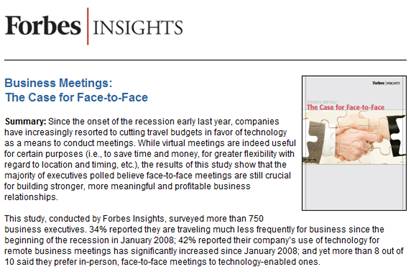
Forbes Insights published a study titled “Business Meetings: The Case for Face-to-Face“, in which the key finding was this: “the majority of executives polled believe face-to-face meetings are still crucial for building stronger, more meaningful and profitable business relationships.”  Excellent points were made in the blogosphere this week regarding this study:

  1. Forbes in a Funk over Virtual Meetings and Events (Virtual Edge)
  2. Virtual Augments Face-to-Face – Reply to Forbes and HSMAI Surveys (Virtual Insights | InXpo)

I don’t wish to question the conclusion of the Forbes Insights study – nor do I wish to have a debate on “face-to-face vs. virtual”.  Despite the fact that I’m passionate about virtual, I’m a true believer in the value of face-to-face.  What I would like to highlight is that face-to-face and virtual have unique capabilities.  Meeting planners must consider these capabilities and apply them appropriately.

With virtual, an often-touted benefit is that they’re green and carbon-friendly.  And while that’s certainly a nice side-effect, I think it’s important to focus on unique in-meeting capabilities of virtual – here are a few that come to mind:

  1. Participatory training with seamless presenter transitions – while it’s true that a face-to-face meeting is hard to beat with regard to audience participation – in a virtual meeting, there’s still plenty of room for audience participation.  In fact, with a shared whiteboard, participants can annotate a technical diagram simultaneously, which is trickier to do with more than 2 people (annotating) in a physical space.  In addition, participants can be “handed the ball” and take turns serving as the presenter – without having to stand up, walk to the front of the room and plug their laptop into the projector.  In an instant, a new presenter can start sharing her desktop applications for the rest of the meeting participants to see.  In a 3D virtual meeting (e.g. Second Life, Lotus Sametime 3D), participation becomes even richer, allowing medical students, fighter pilots (in training), computer technicians, etc. to learn by interacting with 3D objects.
  2. Meetings On Demand – what if your technical meeting needed to split up into a set of smaller focus groups?  In a physical meeting, you’d need to gather up each sub-group and go seek out new conference rooms (or, migrate into corners of the same room, which could be distracting for everyone).  Or, take another scenario whereby a senior executive wants to faciliate an ad-hoc face-to-face meeting during the coming weekend – all required participants would then need to make the necessary travel (and lodging) arrangements to get to the meeting venue.  With virtual, meetings are truly on demand – you create the meeting with the click of a mouse and the participants arrive with the click of a mouse.
  3. Putting the cards on the table – while this is difficult to quantify or prove, I believe that participants are more “at ease” in a virtual meeting and more likely to reveal thoughts that they’d otherwise be hesitant to do in person.  A virtual tradeshow is a good example.  Exhibitors have found that visitors to their booth are more transparent and revealing about budget, timeframe, decision making process, etc.  – when interacting via text chat.  The same person in a physical booth may be hesitant to reveal those details.  So for meetings that can stand to benefit from more transparency and openness (and not all of them do!), virtual can be a boon.
  4. More efficient person-to-person interactions – if you’re the chief executive of a company with 500 or more employees, I’m sure it’s hard for you to achieve the same quality time (with employees) as when you had 50 employees.  If you assemble the company at a physical meeting, it’s a challenge to mingle with the crowd and achieve any true quality – you’ll be more akin to a president or dignitary, who walks down a receiving line shaking hands and patting folks on the shoulder.  If you invite the same 500 employees to a virtual meeting or virtual event, you’ll find an easier ability to have meaningful interactions (via text chat) – including the potential to carry on multiple chats at the same time.  Employees will also find that they receive more access to the chief (and other execs) than they would in a (crowded) physical space.

So those are some advantages that come to mind for me.  What advantages have I missed?


The Importance Of The Virtual Event Debrief

August 30, 2009

postevent_review

Philosopher and essayist George Santayana was quoted as saying, “Those who cannot remember the past are condemned to repeat it”.  With virtual events, the “past” is fairly recent.  However, the spirit of Santayana’s quote holds true – we need to learn from our prior virtual event in order to make the next one better.

In the virtual events I’ve worked on, the conclusion of the virtual event is very much like crossing the finish line of a marathon – you’ve worked and trained hard and now it’s time to unwind, rest and relax.  The team that worked on a virtual event often has to move on to “the next project”, without much time to reflect on the event that just concluded.  As a virtual event show host, it’s your job to round up the team for a debrief meeting – you’ve all completed the marathon, but now it’s time for the half-mile cool-down jog to reflect back on the race.

The keys to a virtual event debrief:

  1. Define, measure and review virtual event goals and metrics – the first step in the debrief has to occur prior to the start of the project.  During or before your kick-off meeting, you and your team need to define the goals of the virtual event – and the associated metrics that you’ll use to quantify those goals.  Whether it’s “maximize sponsorship revenue”, “maximize user engagement” or “generate leads for exhibitors”, you’ll want to define measurable and non-subjective data points to serve as the basis of your virtual event report card.  So the first segment of the debrief is to review the data (i.e. the measured metrics).
  2. Review what worked – a combination of the metrics results – and, more subjective/anecdotal feedback regarding the overall event.  The key here is to understand why (or how) it worked and determine whether you want to repeat that success in your next event.  For the most part, what works in one virtual event should be carried over into the next.
  3. Review what didn’t work – again, a combination of metrics plus anecdotal feedback.  This is one of the most important components of the debrief – be honest in your assessments of what didn’t work – so that you are not “condemned to repeat it”.  My experience has been that when things don’t work, the reasons are usually “not enough lead time” / “too rushed”, “communications mix-up”, “human error” and “mismatch in expectations”.  Another category is “technology issue”.  I believe that all of these are correctable, with technology being the most straightforward and human error / communication / lead time being a bit trickier to nail down.
  4. Review and judge your constituents’ experiences – different event types will have difference constituents.  In a virtual tradeshow, the constituents include yourself (show host), attendees, exhibitors and presenters.  You may want to ask each constituent to complete a survey that’s specific to their experience.  Did attendees find the content useful?  How about the event experience – was it easy to navigate?  Did exhibitors have meaningful interactions with attendees?  For speakers, did they find the webcasting presenters’ interface intuitive?  Each constituent in a virtual event is important – if they were not 100% satisfied in this event, make it a goal to achieve 100% in the next event.

With the growth we’re seeing in this industry, chances are that when one virtual event concludes, you’re rushing off to your next one.  My recommendation is to stop and take a breath.  Take the time to gather the team and do a debrief.  Then, document the debrief and be sure to review it before you start planning the next event.


Virtual Events: Available In Many Flavors

August 25, 2009

Source: flickr (User: rkeohane)

Source: flickr (User: rkeohane)

In my Virtual Events Year In Review: 2009, I summarized key trends that I witnessed in the virtual events industry this year.  The trends for 2009 included global adoption, emergence of new industries (as virtual event show hosts), emergence of hybrid (virtual/physical) events, the shift to ongoing communities and the shift to multi-day events.  There was one trend I neglected to include – and it may be the number one trend for 2009: virtual events in many flavors (aka virtual events take on many shapes and sizes).

Virtual tradeshows still constitute the majority of virtual events in 2009 – however, new flavors emerged (or generated strong growth) in 2009.  Here’s how they’re different from virtual tradeshows:

  1. Virtual Job Fairs – first off, virtual job fairs are quite similar to virtual tradeshows, especially in structure.  There are exhibitor booths, lounges, presentations (live Webcasts or live Video), prize giveaways, a document Resource Center, etc.  Here’s a big difference with the job fair, however – attendees pursue the exhibitors more than the exhibitors pursue the attendees.  The virtual job fair brings a rather engaged attendee, who’s more keen to visit booths and interact with exhibitors (hiring companies) than typical virtual tradeshows.  Hosts of virtual job fairs will want to work with their virtual event platform provider to create unique tools/applications within the show – for instance, a resume wizard (builder), resume submission tools, attendee<->exhibitor match-making (i.e. find the right job for you – find the right candidate for the hiring company), etc.
  2. Virtual Sales Kickoff – that’s right, the annual sales meeting (for some companies) is moving 100% virtual.  Michael Doyle of Virtual Edge published an interesting article on Cisco’s Global Sales Experience.  For most companies, the goal of an annual sales meeting is to bring the entire salesforce together, reflect back on the past year (acknowledging and rewarding sales reps for their efforts) and talk about the year ahead (set priorities and goals).  Similar to a virtual tradeshow, education (e.g. live sessions) is a focus for this type of event.  Unlike a virtual tradeshow, however, there’s less pitching and selling (from exhibitors to attendees) and the need to network (e.g. find new contacts) is lessened.  It’s incumbent on show hosts to make the virtual sales meeting fun and engaging, as attendees are used to going out for dinner, drinks and parties after physical sales meetings.  Virtual cocktails don’t work too well, so be sure to make the virtual experience memorable and fun.
  3. Virtual Partner Summits – a virtual event platform makes perfect sense for a b-to-b vendor’s partner / reseller network – gather the network of partners virtually, give them the training and tools on your products and services and allow them to network with one another.  You improve relations between you and your partners – and, you encourage resellers to partner together to create joint solutions for the market.  Cisco Virtual Partner Summit ran concurrently with a Boston-based physical Partner Summit (June 2009).  Oracle has similar plans for a virtual partner summit.  PartnerPoint has created a 24×7 virtual community “to help connect Microsoft Customers with qualified Microsoft  Partners from around the globe”.  While virtual tradeshows tend to be “lead focused”, virtual partner summits revolve around networking among exhibitors [peers] – they’re unique in that the exhibitors and attendees are one and the same.

My prediction for 2010 – these three flavors will gain further adoption.  Virtual tradeshows will still carry the majority – however, we’ll be seeing more and more off these flavors, in the following order:

  1. Virtual Sales Kick-off
  2. Virtual Partner Summit
  3. Virtual Job Fair

Virtual Events: Year In Review 2009

August 18, 2009

virtually_actionpacked

Coming into this year, I considered 2009 a taking-off point for the virtual events industry.  Sure, virtual events and virtual tradeshows have been around for some time, but I felt 2009 would see enormous growth (in both event volume and in the breadth of industries entering the mix), as virtual event organizers (and virtual event platform providers) pushed the envelope with new technologies and new event models.

From my perspective, this has come to fruition – 2009 has had so much activity and excitement that I’ve decided to publish my year in review before the summer is out!  And maybe I should re-label this – I don’t intend to provide a review of the entire year – but rather, highlight the important trends that I’ve noticed in 2009:

  1. Virtual events go global – since I reside in the United States, it’s not surprising that many virtual events I hear about are produced by U.S.-based show hosts  (e.g. b-to-b publishers, corporations, etc. based here).  In 2009, I saw a marked increase in virtual events outside of the U.S. – including those for a global audience and those targeting a specific geography.  I saw a few “24 hour consecutive” virtual events that sought to follow the sun.  I saw the launch of ExpoNZ (a global showcase for New Zealand) and virtual job fairs in Europe, powered by IMASTE.  I expect to see this trend continue into 2010.
  2. Many new industries come on board – prior to 2009, b-to-b publishers and technology vendors took up the lion’s share of virtual events.  That’s no longer the case now.  In my Virtual Events Calendar, you’ll see events from the following industries: pharmaceutical, packaging, consumer goods, mortgage, travel, healthcare, retail, textile.  I’m sure there were other industries (not listed here) that saw their first virtual event in 2009 (e.g. auto, financial).  Expect this trend to continue as well – in 2010, additional industries will surely enter the mix.
  3. The emergence of hybrid events – it’s only logical to complement your physical event with a virtual component.  In the technology space, SAP and Cisco ran virtual events concurrent with their annual customer conferences.  In the minds of the virtual events industry, this trend is quite clear, as more and more physical events will be expected to have a virtual component.  I haven’t yet seen a scenario whereby a physical event was produced to complement an existing virtual event – so perhaps that’s a trend to come in 2010.
  4. The shift from event to ongoing community – the use of live show dates will continue with virtual events – but increasingly, show hosts are looking to take the audience generated for the event – and support post-event continuation, in the form of an ongoing community.  Virtual events are shifting from a single (or multi) day focus – to one of a 365 day/year community, sprinkled in with pre-scheduled live dates throughout the year.  Working hand-in-hand here is another important 2009 trend – the integration of social networks into virtual events.  Jeremiah Owyang had a very interesting blog posting on this topic.
  5. The shift from single-day to multi-day events – prior to 2009, the typical virtual event ran during the business hours of the show host’s local timezone (e.g. 9AM to 6PM ET).  In 2009, we witnessed some 24-hour consecutive virtual events, along with an increasing number of events that ran for 2 consecutive days or more.  Part of the multi-day trend runs in parallel with the hybrid event trend – for physical events that run multi-day, it’s only natural that a virtual event also span more than one day.

And that wraps up my 2009 trend watch for the virtual event industry.  Let me know which trends I missed!


Create More Effective Virtual Events With Web Analytics

July 31, 2009

Source: flickr (User: kantan2007a)

Source: flickr (User: kantan2007a)

Melinda Kendall wrote an interesting posting on her Event View blog titled, “Improving event flow“.  Her blog posting begins:

Run across ethnoMetrics yet?  They put 45 video cameras with 360-degree panning in the ceiling of a convention center and watch what really happens at an event.  A lot of the value comes in analyzing the behavior of attendees at individual booths…information that, if acted on, could really improve an exhibitor’s results from an event.

Melinda references a May 2009 issue of Expo that highlights optimizations and improvements made by the RSNA (Radiological Society of North America) event team for their conference.  For me, the technology from ethnoMetrics is intriguing, but what most interests me is their methodology – that is, capture detailed information from an event (that otherwise would have been “lost”) and perform in-depth analysis to improve an event’s ROI.

Can an equivalent approach of analysis be applied to virtual events?  Of course – because virtual event platforms already track all activities – meaning the 360-degree panning ceiling cameras area already installed.  Today, however, most virtual event show hosts view event data in a tactical, results-based manner.  Important metrics include number of registrants/attendees, number of visits per booth, number of viewers per Webcast, number of chats, number of document downloads, etc.

And while that’s all fine and good, both the show host and virtual event platform provider might want to take a step back (once the event is done) and analyze the overall attendee experience.  I’ll call this Web Analytics for your Virtual Event.  For content and e-commerce sites, web analytics can be a very effective tool to increase page views (content site) or online purchases (e-commerce site).  So in the same way that an e-tailer may analyze “shopping cart abandonments”, a virtual event show host (and provider) may want to analyze why the average visit time to an exhibitor’s booth was only 5 minutes long.

Other analytics exercises that come to mind:

  1. Greenscreen video –  did you invest a lot of time and money to have your CEO welcome visitors to your booth?  Have a look at average view time of that greenscreen unit.  Then, look at the number of return visitors who “clicked to play” to replay the greenscreen video a second time.  If you score a lot of replays, your use of greenscreen was effective.
  2. Where is my traffic coming from –  or, where is it not coming from?  On the web, we frequently look at “referral URL” – for virtual events, the same need applies.  If I had 1,000 booth visits, did they come from the Exhibit Hall?  Or, did they come from a search result – or, somewhere else?  If 70% of my booth visits came from sources other than the Exhibit Hall, then I need to assess (a) the amount of traffic to the Exhibit Hall in the first place and (b) the effectiveness of my Exhibit Hall layout.
  3. Biological tracking – this obviously adds to your costs, but consider pairing your web analytics with physical instrumentation – have a panel of users experience your virtual event and track eye movement, heart rate, facial expressions, etc.  If I spent 2 months creating a visually rich 3D environment, did it make an emotional impact on the user who saw it for the first time?  Are users looking at areas of the event that I want them to?  Or, are they skipping past the important areas?

The possibilities are nearly endless.  This is an important next step for the  industry – with video monitors already installed, tapping into the existing data will be a key to creating better and more effective virtual events.

Related links:

  1. Event View blog
  2. ethnoMetrics home page
  3. Wikipedia entry on web analytics
  4. NY Times article: Lab Watches Web Surfers to See Which Ads Work