How iPads Transform Product Marketing

July 25, 2012

Note: The following is a guest post by Gavin Finn, President & CEO of Kaon Interactive, Inc.

Introduction

Most of us are very well aware of how mobile platforms (smartphones and tablets) are transforming sales for B2B companies. Many companies are now arming their sales forces with these tools, and we see what is happening right at the moment of each sales encounter: a very much more excited prospect. An iPad is much more than a mobile email and CRM platform for the salesperson to use on-the-go: it is a new way of engaging customers directly.

Mobile Device Content

“Marketers are generally delivering exactly the same brochures, videos, and presentations for use on the iPads as they were previously delivering on the laptop. What a missed opportunity!”

But what is less obvious, yet just as important, is a new focus on answering the question “what exactly is on these mobile devices?”  It’s all very well to put a mobile device in the hands of the sales force, but what content are you going to use to truly capitalize on this innovative platform?

In reality, today the answer, sadly, is that marketers are generally delivering exactly the same brochures, videos, and presentations for use on the iPads as they were previously delivering on the laptop. What a missed opportunity!

This new delivery environment is designed for a very different type of encounter — not so much a presentation as an interactive dialogue between the salesperson (or marketer) and the prospect. Why not take advantage of this interactive environment by creating and delivering truly interactive content?

Interactive Content

What is interactive content? This is a new kind of application that does not follow a linear demonstration or presentation sequence. It allows users to interact directly with the content itself, rather than watching a video or a pre-sequenced flow of slides.

A great example of this is a fully interactive 3D Product Model — where the user sees a photo-realistic virtual representation of the physical product, and can touch the screen to rotate the product, zoom in to any area, measure, and explore the product in any area of detail that is of interest or importance to that user.

What’s unique about this encounter is that even though the information in the 3D product model is the same for every user, each customer experiences this product in a distinctive way. They each have a very specific path that they follow through learning about the product — spending as much time on any detail that they want, and looking at features or benefits in any order.

Interactive Content is Better

Why is this better? Cognitive studies have shown that when people are presented with information (either via a video or by a person) they retain a very small portion of the material (anywhere from 5 to 20%).

However, when a person is actively involved in the process of delivering this information, they remember dramatically more (anywhere from 66 – 75% for the same time period.)  So, it is much more effective to get the prospect involved in the delivery of the marketing or sales information through interactivity, because they will remember more of what you want them to know.

Interactive Sales Experiences

In order to make a sales experience interactive, it needs to engage the prospect in three ways:

  1. Intellectual: There has to be meaningful information conveyed: information that is of interest and is relevant to their needs;
  2. Sensory: One or more of the five human senses must be engaged (sight, smell, sound, taste, touch);
  3. Emotional: The experience has to evoke some specific emotion (anger, joy, fun)

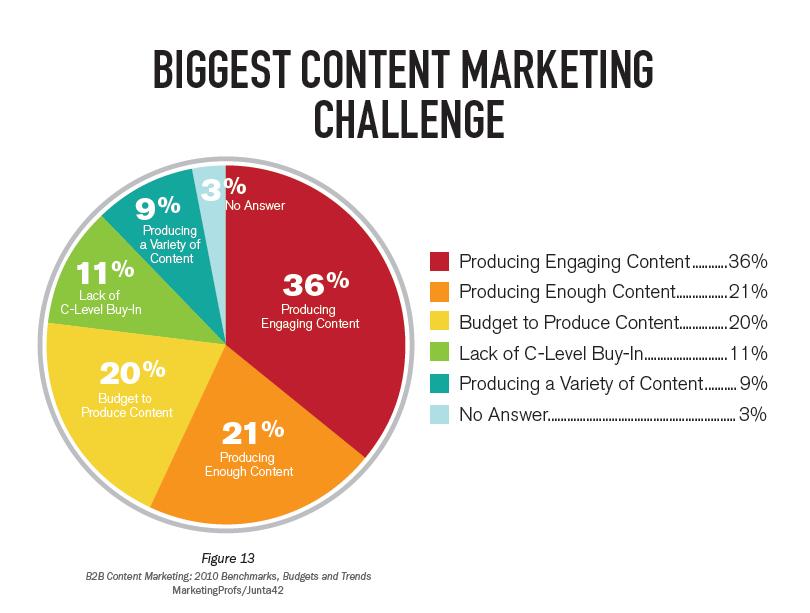
All of the developments in mobile platforms (and interactive content) come at a propitious time for marketers. MarketingProfs released a study that found that B2B marketers had a far greater need for content that was “more engaging” than simply “more” content.

What we know is that studies have shown that many sales people don’t use up to 60% of the content that marketers deliver, and it is not uncommon for sales teams to spend up to 40% of their time customizing or developing content of their own. In other words, there is a really strong demand for more engaging and effective content. Now, happily, there is also an ideal platform on which this kind of content can be delivered! The mobile device — smartphone or iPad.

“A mobile application is an easy way to put a product demo into the hands of a salesperson. Instead of carrying a big physical presentation around, it can be in their hands at all times and deliver collateral that engages the client.” –Michael Greene, Forrester Research Analyst

Kaon 3D Product App

The Kaon 3D Product App, mobile application is an example of the perfect combination of stunning visuals, interactivity, and ideal delivery device. When sales teams have the ability to show their customers every product in their portfolio, at every sales and marketing encounter, they are empowered to capture the most out of every planned and unexpected face-to-face customer touch point.
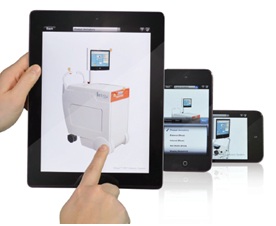
But when those sales encounters are turbo-charged by giving the customer control of their own interactive experience, a powerful and transformative experience is realized. Not only does the right message get conveyed at the right time, but it is also delivered in the most effective way possible — so that the customer retains the critical information necessary for them to understand the benefits resulting from the differentiation inherent in your products and solutions.

The direct sales and marketing benefits from this type of interactive solution on the iPad are many, and companies realize these benefits almost immediately.

Cisco Systems uses its Interactive 3D Product Showcase on the iPad to shorten sales cycles, in more than 100 countries. Ciena Corporation uses its Interactive Product Portfolio on the iPad to deliver its product and solution message at a variety of venues, helping to eliminate 85% of shipping and drayage expense from trade shows.

Other companies have developed interactive 3D Product catalogs on the iPad, using Kaon’s mobile applications, to deliver a consistent, compelling sales message to sales and channel partners all over the world, ensuring that everyone is selling using a common set of the most effective value propositions.

Conclusion

True interactivity, putting the customer in the “driver’s seat”, means more effective delivery of the right product information in a way that will have a positive effect on buying decisions.

Mobile platforms mean that no sales opportunity is missed — whether at a customer’s office, an unexpected airport meeting, or a trade show. Fully interactive 3D product models mean that marketers don’t have to ship physical products to every venue — saving a great deal of money, time, and effort, while achieving superior results. Isn’t that what every marketing and sales department wants? More sales, at a lower cost.

About the Author

Gavin A. Finn, Ph.D., is President and CEO of Kaon Interactive, Inc. For questions about this post, feel free to contact Gavin via email.


Let’s Hangout, Then Share Our Conversation with the World

July 21, 2012

Introduction

I’ve met neither Heidi Thorne (@heidithorne) nor Marti Konstant (@martikonstant) in person. I’ve known Heidi for quite some time (via Twitter) and earlier this week, she introduced me to Marti. It’s the sort of thing that I wrote about previously – how magical social media can be in forging new connections.

Here’s the sequence of events:

  1. I met Heidi (via Twitter) – several years ago.
  2. We followed (Twitter) and circled (Google+) each other.
  3. I caught up with Heidi (via Skype) – this week.
  4. Heidi introduced me to Marti (via Twitter), because she saw a similar background and set of interests (between Marti and me).
  5. Marti and I followed (Twitter) and circled (Google+) each other.
  6. Marti invited me to be interviewed in her Marketing Hack Chat (#marketinghack) on Google+.

Looking back on this sequence, I found it interesting that these connections and conversations occurred via Twitter, Google+, Skype and Google+ Hangouts. What was absent? Phones, emails and automobiles.

Marketing Hack Chats

I wanted to further highlight these Marketing Hack Chats that Marti has put together. You can view these on Marti’s Google+ Page and on her YouTube Channel. Let’s cover some reasons I find Marti’s chats appealing.

Simple Logistics: Video at the Speed of a Mouse Click

Marti’s own marketing hack involves the use of the “Hangouts On Air” feature, which live streams the interview to YouTube, but also records the session, for on-demand playback on YouTube – and in embedded players, such as Marti’s Google+ page.

The video logistics are super simple and so is the publishing process. In fact, there’s no “process,” as Marti can publish the “finished product” to her Google+ page instantly. In addition, the video becomes available for viewing (and search) on YouTube at the same time.

How’s this for efficiency: I joined Marti’s Hangout at 12PM PT and the video was published on her Google+ page a mere 22 minutes later. Nice.

Cost Effectiveness

With Google+ Hangouts, Marti doesn’t have to worry about a video studio, a video crew, editing software or purchasing mass amounts of storage. As you’ll see in these videos, Marti records them from home, with a staff of one (herself).

So, assuming Marti already had a computer, webcam, broadband line, etc., then her incremental cost for the Marketing Hack Chat is ZERO. She plans to interview and record 20-30+ marketing professionals from all over the world. Where else (besides social media and social technologies) can all of this be coordinated and executed at a cost of zero?

Now, of course, by “cost,” I mean hard costs. There is the time and energy required (by Marti) to network with marketers, recruit speakers, prepare for the interviews, hold the interviews, promote the videos, etc.

The Theme

Marti told me that the idea behind her program is to provide marketers with actionable advice that they can use right away. I love this principle. As a marketer herself, Marti is finding a great recipe to connect with other marketers:

  1. Advice from peers “in the trenches.”
  2. Video as the delivery mechanism.
  3. Useful information (a “hack”) that can be put to use right away.
  4. Shorter is better (3-5 minute videos).
  5. A hash tag (#marketinghack) to further brand and promote the program

Conclusion

Thanks for having me on your program, Marti! I enjoyed chatting with you. I’m working my way through all of the marketing hacks and look forward to the subsequent interviews you’ll publish. And for those of you interested, you can view my hack below:


Initial Impressions of Google+ Events and Hangouts

July 14, 2012

Introduction

I attended my first Google+ Event this week. It had no physical venue, taking place exclusively on Google+ and YouTube. The New York Times hosted the event. In the lead-up to the 2012 Olympics, the Times has been hosting Google+ Hangouts with Olympians. I came across the Hangouts while visiting the Times’ London 2012 Olympics page.

You can still check out the Google+ Events page. On that page, as well as on YouTube.com, you can view an on-demand video of the entire Hangout.

The Hangout was hosted by Ken Belson, a sports reporter from the New York Times and featured Shalane Flanagan (a U.S. marathon runner), Mary Wittenberg, (President of New York Road Runners) and Bob Sherman (a recreational runner, who’s completed 29 consecutive NYC Marathons).

I’d like to share my initial impressions of Google+ Events and Hangouts.

What I Liked

Logistics

As far as streaming technology goes, the Google+ Hangout experience (which broadcast via an embedded YouTube viewer) was quite good. The video picture was sharp and crisp. Google+ Hangouts auto-detect who’s speaking and switches the focus to that person.

These transitions worked so well that it reminded me of watching television (where there’s a human being controlling those switching decisions). As the host, Belson did a fine job of detecting ambient noise and asking whether a participant wanted to speak. He’d pause to ask, “did you want to jump in?”

Experimentation and Exploration

I commend the New York Times for exploring and experimenting with emerging technology. The Times has always been a primary news source for me, but the experience has revolved around articles, with occasional on-demand videos.

A live event brings an entirely new experience for Times’ readers. First, the event allows Times’ columnists (e.g. Ken Belson) to connect more closely to their readers. Second, readers can see and hear from personalities that otherwise would not have been possible (e.g. an Olympic athlete).

The use of emerging technology comes with some risk. For instance, at one point in the Hangout, Ms. Flanagan’s image froze, and then her presence dropped off completely. She re-joined a few minutes later and continued to field questions.

To me, that was completely fine. It’s a learning experience. The Times learned from this and we’ll all learn and evolve – I’m sure it was the same with television broadcasts in the early days. Let’s keep experimenting and exploring.

What I’d Like to See

The Times has done a great job of connecting U.S. Olympic athletes to its readers. And to start, it’s not surprising that they sought a controlled environment, with a host (Belson) who steered the conversation among the three guests.

As media outlets continue to use online (and social!) broadcasting tools, I’d like to see them take more advantage of the interactive and engagement capabilities that these platforms provide.

Stronger Connection from Audience to Guests

Users could post questions (for Ms. Flanagan) within the Google+ Events page and I noticed that a number of good questions had been submitted prior to the Hangout. In addition, during the Hangout, I noticed a number of comments and questions posted.

While Belson did pose a user-submitted question to Flanagan, it was from “a reader,” rather than a question posted within the activity stream. In the future, I’d love to see more questions selected directly from the social platform, with guests actively reviewing and commenting on thoughts posted by viewers.

A More Active Role for Audience Members

I’m sure the Google+ Team is busy at work on product features to support a more complete Google+ Events and Hangout experience. Beyond the existing commenting system, I’d like to see more tools for users to provide feedback and to collaborate with one another.

In addition, audience members should have the opportunity to help steer the direction of the conversation. How about integrating Google Moderator to allow audience members to read and vote on the submitted questions?

Conclusion

While I concluded my first Google+ Event wanting a bit more (interactivity-wise), I commend the Times for what they’ve done. There’s something about a Hangout (compared to a TV interview, for instance) that puts you closer to an Olympic athlete. You hear about their diet and their training regimen, all with the intimacy of seeing them from their laptop’s webcam.

I look forward to subsequent Hangouts. And to Shalane Flanagan, best of luck in London!


How Social Media Can Create Lifelong Friends (That You Never Meet)

July 12, 2012

Introduction

I thought it would be neat to create a Twitter List of people I’ve met “in real life” (you can find the list here: @dshiao/met-in-real-life). I’d scan both my Twitter stream and my “Interactions” tab and add people to the list.

And then a funny thing happened: for a few people, I had to think long and hard about whether we’ve met “in person.” For some people, I was about to add them to the list, then had to do a double take, think some more and realize that we’ve actually never met.

This exercise led me to conclude how wonderful social media can be. Some of these folks whom I’ve never met, I actually consider to be good friends. They may end up becoming lifelong friends, in fact, in which our interactions take place exclusively online.

Let’s consider a few other conclusions I’ve drawn from this.

The Killer Combo: Twitter and Facebook

In the early days of Twitter, I discovered #eventprofs, which I consider a community forged by a single hash tag. I followed active users, they followed me back and we’d check out tweets tagged with the #eventprofs hash tag regularly.

Some #eventprofs users (along with other, non-events folks I’ve “met” on Twitter) “friended me” on Facebook. I gladly accepted. In doing my Twitter List curation, I found Twitter+Facebook to form the killer combo. That is, if we follow each other on Twitter and are friends on Facebook, the lines blur to the point where I have to think hard whether we’ve met in person.

By looking at the links you share on Twitter, I’m able to better understand your interests (i.e. your interest graph). On Facebook, I learn about your interests – and much, much more. I’ll “hear” about your weekend plans, movies you’re watching, comments your kids made and updates on your favorite teams.

In addition, seeing pictures of your friends and your extended family makes me (by extension) a second order member of the family. The New York Times ran a piece about family estrangement in the Facebook Era, which made wonder whether I’m seeing pictures (in my Facebook Newsfeed) that some family members (of my Facebook friends) are not.

In any case, Twitter+Facebook are quite effective in sustaining friendships – and, in creating new friendships (online).

Status Updates Build a Complete Picture

Disney executive Bob Iger once said, “I’ve learned more about my daughters on their Facebook pages than I did while I was raising them.” (quote source).

I love that quote and happen to agree: family members can live in the same house, but learn more about each other from status updates. It’s a perverse thought that may be decried by the populace at large, to which I say: “it is what it is.” Here’s how status updates help to build a complete picture of yourself:

  1. Captures trivial moments. I may post about something that catches my attention or that I find entertaining. I may mention the moment to family members later on, but then again, I may not!
  2. Ongoing archive. Look back at your own Facebook Timeline. You’ll probably notice ideas, emotions, frustrations, elation and more. The series of status updates really do say a lot about you.
  3. Captures fleeting thoughts. Sometimes I’ll post a thought, idea or joke to Facebook that’s fleeting. If I didn’t post it at that moment, I might have forgotten about it. But I did, so it’s now part of that ongoing archive.
  4. Communicates goals and aspirations. Via status updates, people share what they want to do this weekend, what they want to achieve this quarter and what they want to do in life.
  5. Shows what’s important (to you) in life. Status updates also build a picture of what’s important in our lives: our family, our jobs, our values, etc.

Online Towns More Effective Than Physical Towns?

Let’s take all the people I’ve met online (and know fairly well) – let’s call it 250 people. Let’s put those same 250 in the same town as me. I wonder: would I have ended up meeting those people and getting to know them, in the same manner that I did online?

You know, I’m not so sure about that. Some of the 250, I may never have met in the first place – there are still families in my neighborhood less than ten doors away that I’ve yet to meet. This is again a perverse thought, but here’s why “online towns” facilitate more meet-ups:

Meeting doesn’t require serendipity.

In a small town, you often meet people via serendipity: you bump into someone at the post office or supermarket, or you take a run at the same time as a neighbor. There’s less serendipity online: people have a fixed presence and you can always find them, even if they’re not currently “online.”

Lower barrier to interaction.

When you meet someone face-to-face, there are certain social norms and customs that we follow. When you “meet” someone online, the social norms take a different dynamic and there’s often less holding us back.

For instance, I may tweet to someone about their awesome profile photo (on Twitter), whereas I’m less inclined to walk up to that same person (at the supermarket) and make a similar comment. As such, I wonder whether meet-ups and interactions I’ve had online would have worked out as well in person.

Lifelong Friends Should Meet (Eventually)

Now don’t get me wrong: despite my observations (above), I don’t believe in living life exclusively online. In fact, I crave face-to-face connections, especially meeting new people. So despite my observations of the “online town,” I’d love nothing more than a physical town, in which meeting others could be as convenient as happens online.

I have a colleague with whom I’ve had numerous conference calls, video conferences and related meetings. After a year working together, we had the chance to meet in person. I was prepared to say “great to finally meet you,” but she jumped in first. Her comment? “Nice to see you again.”

And that’s just the thing with these online friendships (or colleagues) – you develop such close ties online, that it’s a shame to never meet in person. At business conferences, I’ll run into people that I follow on Twitter (but have never met) and it’s a great feeling. You know each other so well that you tend to hug, rather than shake hands.

Conclusion

I often wonder what the world would be like if Facebook, Twitter and other social networks didn’t exist. Would I still meet new people? Would the Arab Spring have happened? I think the answer to both might just be “yes,” but one thing I know for sure: there’s just no way I could have “met” so many people from so many parts of the world without social networks. And when I come to a town near you, I may look you up (on Twitter).

Note: I invite you to connect with me on .


Lessons, Tips and Useful Thoughts on Social Marketing [PRESENTATION]

July 5, 2012

The following is a guest post by Autom Tagsa. Follow Autom on Twitter (@autom8).

Introduction

The recent and successful Canadian Association of Exposition Management’s 2012 annual conference (#caem2012) offered me a chance to share the preso below on the topic of social media and marketing. I am honoured to have had the opportunity to speak and am profoundly thankful to both SME Canada and the CAEM for granting me the privilege.

The Presentation

Those who occasionally thumb through my blog will know that the majority of the content in the preso is not terribly new. Nonetheless, the  points serve to remind seasoned SM users while offering pointers and “AHA” moments to those just beginning to sink their teeth into social.

All that I have read, tried, tested, learned, blogged about and assimilated through observation, conversation and practice since 2008 makes up this presentation. Inspiration comes easily with specific points of reference during one’s ongoing journey in social media. This is why I never tire of praising my Twitter follows (yes, y’all rock) for their continued feedback, support and constructive exchanges.

View the Presentation via Google Docs

The menu

AppetizerPersonal branding and some wild Stats

Main course:

  1. Tips on social strategy
  2. Blogging: key lessons
  3. Mobile is here and you’re already behind

Dessert:

  1. Influence vs reputation

Thank you Dennis Shiao (Director, Product Marketing, INXPO) and Joseph Fiore (Owner, RepuMetrix): gentlemen and scholars alike. Thanks again for your invaluable review and input.