Identity And Access Management In The Virtual World

March 18, 2009

In the physical world, it’s quite easy and simple to separate your work identity from your personnal identity.  Work is at the office – and for some, work stays in the office.  Your personal life and family are in your home.  Similarly, access rules apply within the same structure – you have access to work-related  information in the office (even though we know that’s extended to your PDA these days) and you spend quality time with family members around the home.  It’s simple, black and white.  As we spend more time online these days (and virtual), our worlds begin to merge and what was once black and white becomes gray.

There’s no better example of this merging world than the desktop or notebook you use for work.  Let’s list out the applications you run during the work day, segmented by business vs. personal:

Business

  1. Email client
  2. Instant messaging (IM) client
  3. Browser tabs: Intranet, corporate reporting system, CRM system, ERP system, etc.

Personal

  1. Email client (e.g. Yahoo Mail, Gmail, etc.)
  2. Instant messaging (IM) client [possibly the same client you use for business purposes]
  3. Browser tabs: Facebook, Twitter, eBay, NCAA picks, etc.

Now, let’s say I’m doing a desktop sharing session  – I’m running through a demo of a virtual event and I’ve forgotten to sign out of my personal IM client.  My mother, not knowing that I’m sharing my desktop, decides to send me an instant message.  What happens is that my audience of ten gets to see a reminder from Mom to call Uncle Jasper to wish him a Happy Birthday.  A bit embarassing, but all too possible when access to your business and personal profiles are enabled by a common resource (your PC).

To provide for a separation, one solution is to utilize virtualization – run one virtual machine (VM) with all of your business applications and a different VM with all of your personal applications.  The hassle here is the need to toggle between the two – but hey, perhaps you get more work done.

Now, let’s extend things a bit – as the business use of social media and virtual worlds grows, I think the same need for separation (e.g. identity and access management) applies.  For instance, many tell me that Facebook is strictly for friends and family, while Linkedin and Twitter are used strictly for business associates.  So users are using a manual configuration to separate their social network identities (and access to those identities).

But perhaps there’s a cleaner way – something I think of as identity virtualization.  Similar in concept to virtual machines, users of social networking and virtual worlds should be able to have a base profile (information that’s globally available and applies to all identities), along with specific identities suited for a defined purpose (e.g. business, personal, etc.).  Perhaps your virtual worlds identity (for business) uses your real name, whereas your virtual worlds identity (for personal) uses a fictional name (a la Second Life).

For this to work across your social network sites, they’d all need to work together against a common standard (for profiles).  In the meantime, this concept is precisely what Facebook was thinking, when they rolled out recent changes to help users better segment updates across their Facebook friends.  So while I certainly don’t have all the answers, my simple thought is that, as use of social networks and virtual worlds grows, the identity and access management issue will become more and more important.


Insights And Experiences From Virtual Worlds Experts

March 9, 2009

On Monday evening, I attended FountainBlue’s High Tech Entrepreneurs’ Forum at Microsoft’s Mountain View (CA) campus – the event was titled Virtual Worlds: The Hype, The Reality, The In-Between and was sponsored by Microsoft and TIPS Group.  FountainBlue, a “membership-based, for-profit, collaborative organization designed to positively impact the way people, businesses and organizations work,” has organized a new sub-group around virtual worlds, which officially launched coincident with Monday evening’s event.

FountainBlue landed a true All-Star panel of Virtual Worlds visionaries and experts.  Each panel member provided thoughts on virtual worlds and then took questions from the audience.  A summary of each panelist’s thoughts follows.

UPDATE: FountainBlue has posted a summary of this event on their blog.

Steve Nelson – EVP, Chief Strategy Officer, Clear Ink

Steve is EVP and Co-Founder of Clear Ink, an interactive agency based in Berkeley, CA, who has many “claims to fame” in Second Life development. Among their Second Life projects was a simulcast of the 2008 TED Conference (in Monterey), an appearance by Newt Gingrich in-world, the development of a virtual headquarters for Linden Labs and an in-world island in conjunction with the popular sitcom The Office.

Steve started with his definition of “virtual world” – a social platform that’s immediate and immersive – quite a relevant and apt definition, if you ask me.  Steve stressed the immersiveness of 3D virtual worlds by comparing a webinar viewed “standalone” with one viewed in-world.  Steve noted higher retention and recall rates of the in-world viewing – as viewers of traditional webinars are far from immersed – instead, they’re checking their email and multitasking with other apps on their workstation.

Steve noted that Clear Ink assists companies in virtual worlds via three e’s:

  1. Expectations
  2. Experience
  3. Experimentation

In closing, Steve noted five business models for generating revenue with virtual worlds:

  1. Own the virtual world platform
  2. Sell virtual goods
  3. Create virtual worlds tools and utilities
  4. Be an agency – design, consulting, etc.
  5. Use virtual worlds effectively as an enterprise – save money and be a more effective company

Robin Harper – Former VP of Marketing and Community Development, Linden Labs

Robin took us back to the very early days of Second Life and noted that in the initial development stage, Linden Labs thought the platform was about facilitating entertainment.  Fast forward to today and Robin believes that virtual worlds are so much more than entertainment.  In the past 18 months alone, Robin notes that growth in Second Life has been driven by education and enterprise (which each have grown by 2x in that period).  There is an increased use for simulation, prototyping, design and experiential learning.  60,000 residents are profitable (meaning they generate revenue that exceeds their land costs) and the top resident grossed over $1.7MM in US dollars (real money) by selling virtual shoes.

Robin notes that the power of virtual worlds lies in the collaborative tools that are provided with minimal constraints. She compared the development of virtual worlds to the development of third world countries – growth is facilitated by allowing residents to own their own land, own the intellectual property (of their land assets) and participate in an economy that fuels commerce.  Important areas of development today are “behind the firewall” applications, as well as interoperability across worlds.

UPDATE from Robin Harper: I’d like to clarify the statement attributed to me above. The figures I reported were originally estimates based on one quarter of data, so should not be taken as more than an annualized estimate. In addition, my reference to the sale of virtual shoes was in the context of the types of industries that are generating return in Second Life. In the top group of earners based on the estimates, most were involved in the land business, and a couple were in other businesses like events management and retail/virtual goods, including shoes. For more information, please see my blog: http://couldtherebewhales.blogspot.com/2009/03/correction.html

Michael Gialis – New Business Development, Sun Microsystems

Michael works in Sun Labs, with a focus on online gaming and virtual worlds.  Sun’s technologies in this space are Project Darkstar, Project Wonderland and Project Sun SPOT.  Michael notes that the #1 barrier to virtual worlds adoption is the non-intuitive nature of the client application.  Michael’s comments stirred some discussion among the panel regarding enhanced client capabilities, such as the use of sensors in lieu of keystrokes.  Robin noted that Mitch Kapor is experimenting with a 3D camera – when you smile, your avatar smiles. Some panelists, however, noted that some contexts may require separation between your true feelings and your avatar’s expressions – for instance, in a learning environment, you may not always want your true emotions to be on display.

Anne-Marie Roussel – Business Development Director, Microsoft

Anne-Marie manages Microsoft’s digital media portfolio, which includes Xbox, Zune and MediaRoom.  Anne-Marie noted Microsoft’s early efforts in the virtual world with its Flight Simulator game – which in turn led to the development of a product called Microsoft ESP (for 3D visualization).  Anne-Marie gave the interesting example of leveraging virtual worlds for training sales staff – if you sell Ferraris, then your clientele are much different from those buying Fords, so a virtual world can train sales staff on how to interact with prospective customers and face the sorts of questions/issues that Ferrari buyers are sure to present you with.  Anne-Marie spoke of Microsoft Virtual Earth and noted work being done to marry its 3D visual maps with crime scene data (to assist local law enforcement).

Susan Stucky – Manager, Service System Design, IBM Almaden Research Center

Susan noted that IBM’s involvement in virtual worlds is not to be a platform provider – instead, IBM is platform agnostic.  Susan’s interest in the virtual world is to achieve results that would be harder to accomplish in the real world.  One example noted was the practicing of negotiations of complex deals – reviewers (of the deal maker) could provide a virtual thumbs up or thumbs down.  Trainees could then replay the segment and view the feedback as it occurred.  Susan spoke of the need to capture data to better understand in-world behavior.  IBM Researchers developed technology to take audio chat, utilize voice-to-text to transcribe it and then perform unstructured text analysis to decipher patterns of behavior.  Susan also spoke of IBM’s Sametime 3D initiative and referenced the use of Second Life to facilitate a virtual meeting for IBM’s Academy of Technology.

If you’re interested in related events from FountainBlue, have a look at their events calendar.


IBM’s Second Life ROI: The Headline Beneath The Headline

March 4, 2009

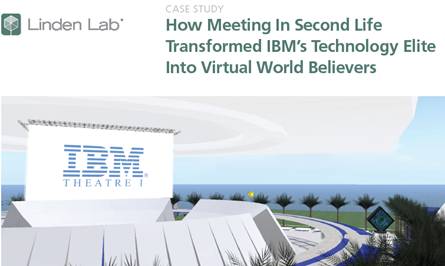
Source: Linden Lab Case  Study

Source: Linden Lab Case Study

A Case Study published by Linden Lab (the company behind Second Life), documents IBM’s use of Second Life to hold a Virtual World Conference and Annual Meeting.  The meeting, organized by IBM’s Academy of Technology, brought together 200+ participants from across the globe (virtually) and had an ROI estimated (by IBM) to be $320K.

The $320K is derived from taking initial hard costs of $80K, then factoring in $250K in savings from travel and venue costs and $150K from productivity gains (since attendees participated from their desks – and could presumably do on-the-job tasks while in-world).  So that’s ($80K – $250K – $150K) = $320K in total savings.

So that’s the headline story – and what a great story it is.  I can understand why the Case Study led with this angle – in this economic environment, any talk of significant cost savings is going to score points with the CMO, CFO, CEO and Board.  And while I’m not one to diminish cost savings that’s simultaneously eco-friendly, what excites me most about the ROI equation here is the value add that virtual provides – the headline beneath the headline.

If IBM had convened this meeting at a physical location, I’m sure the event would have been equally valuable – but, at the event’s conclusion, the walls come down and participants leave with some photographs, business cards and memories – and may never be incented to re-gather and collaborate again, aside from the next scheduled (and organized) gathering.

With virtual, however, what IBM discovered was a build it once and reap the continued benefits phenomenon.  The island(s) built for this virtual event remain available on an ongoing, 7×24 basis.  So, participants who met and collaborated with specific colleagues may want to arrange for follow-on in-world meetings to further brainstorm their ideas together.

Additionally, IBM found a way to leverage the event to support an unrelated gathering – the Academy of Technology’s Annual General Meeting, originally scheduled in Florida.  The general meeting moved virtual and included live webcasting and videoconferencing – while leveraging the pre-built island in Second Life to support 120 poster sessions.  The beauty with the ROI equation here is that the more IBM can leverage what they’ve already built, the more “R” they generate in “ROI”.  And of course, this sort of re-use is eco-friendly.


Interview With Nic Sauriol, Venture Lead on Nortel’s web.alive Platform

March 1, 2009

Nic Sauriol, Venture Lead of web.alive

Nic Sauriol, Venture Lead of web.alive

Related Links:

  1. Lenovo eLounge
  2. Project Chainsaw
  3. My review of Lenovo eLounge

Amidst great fanfare in January at CES 2009, Lenovo unveiled the Lenovo eLounge virtual environment. Powered by Nortel’s web.alive platform, eLounge allowed users to enter a 3D virtual world to learn about Lenovo Thinkpad notebook computers (with an option to purchase), interact with other visitors and “meet” with representatives from Lenovo and Nortel.

Nic Sauriol is the Venture Lead for web.alive (also referred to as Project Chainsaw).  Nic co-founded the project a few years ago with Arn Hyndman, the chief architect.  I sat down (virtually) with Nic to get his thoughts on web.alive, eLounge, enterprise virtual worlds and more.  Here’s the interview.

If you met someone on the street, how would you describe (or explain) the web.alive platform to him/her?

Nic: web.alive is a collaboration platform designed to integrate into an existing website much like flash. When a web site has web.alive and people visit that site, they can experience a rich and immersive environment and interact with other users – including the website’s employees/staff who are also on that site . They can interact in an immersive and fluid way thanks to real world positional audio. Fundamentally, web.alive is about bringing live, immersive and interactive communications to connect people in real-time via the web.

It’s designed to be a very engaging and entertaining experience – great for social networking efforts. A social experience of the web where a group of friends could meet up on Facebook or LinkedIn and then go visit a few stores like the Lenovo eLounge, watch some shows in Hulu and then comment on the news at Yahoo is what web.alive is about in this context.

web.alive also offers tremendous potential as a tool to facilitate collaborative learning.  Gone are the days of an instructor broadcasting content in one direction – today’s learning requirements call for more collaborative work between instructors and students.  web.alive provides engaging and collaborative environments to make this mode of learning a reality.

In the enterprise, web.alive offers a new world of opportunities to change in a positive way how people communicate. Moving away from calendar based meetings and formal phone calls, to a much more dynamic means of interaction. A place where employees from all over the world can go, bump into each other, exchange ideas, grab a meeting room to discuss and collaborate etc. Simply embedding the web.alive client into existing intranet web sites, integrating into a UC [unified communications] solution (visit Nortel if you don’t already have one) and suddenly your employees are collaborating as though they were collocated.

Nortel and Lenovo received quite a bit of buzz regarding Lenovo’s eLounge and its use of Nortel’s web.alive platform – what do you view as the successes of the launch – and, what were some of the challenges that you had to address?

Nic: The beta launch at CES of the Lenovo eLounge was a tremendous success from our perspective. We saw a great opportunity to help Lenovo take their customer service to an entirely new level. Significantly more users than we had expected visited the beta launch (articles and blogs like yours were a significant factor) and most importantly we saw the kinds of metrics we could have only hoped for. I personally assisted a number of customers who toured the eLounge to browse Lenovo’s laptops. What is most important is that these  – for the most part  – were purchases that otherwise may not have happened, at least not on a traditional retail web site. In addition, we have seen excellent retention rates. Even when users don’t make purchases, they spend a lot of time surrounded by Lenovo’s brand – over time this will also help conversions.

Obviously there are customers that go to the Lenovo web site that intend to make a purchase, and various tools facilitate that. While we are excited to help in that regard, what we always hoped would happen was that users would visit the site that did not have a specific intention of making a purchase, and would otherwise have bought from a retail store (likely helping a competitor to Lenovo) and instead they make the purchase from the eLounge as a result of an unplanned/informal conversation with a sales person or some other person like myself who just happens to be there.

In terms of challenges, there have been many. While the majority of users have had a smooth experience, some users encountered a variety of different bugs which we are fixing as they arrive (users send us e-mails at support@projectchainsaw.com with their bugs). Most users were able to get in and navigate without any specific help, but here have been some that required assistance, so we are working to make interaction even more intuitive and fluid. One really notable challenge was that Lenovo sales staff had to adjust their mode of operation. Call centers wait for a customer to call to initiate a dialogue, unlike the real world where we can reach out to shoppers.

We had to spend time honing that skill to get the right balance of support (i.e. not jump in someone’s face when they first arrive, but make certain that they know you are there and available to assist if you need help). The biggest challenge of all is that people want more, a lot more.

Have there been any new developments with eLounge since the time of the CES 2009 launch?

Nic: Yes, there have been a number of new developments, some deployed others coming soon. Most importantly, Lenovo has seen the positive metrics we had hoped for and have committed to coming out of beta and doing a full supported launch (coming soon!). Changes that have been deployed include a large number of bug fixes, a few new features in the client (like notification when new users arrive via a desktop balloon) with many more coming. While there have been a few minor content updates, there will be many more coming when the site launches out of beta.

Tell us about other enterprise use of web.alive?

Nic: There has been a tremendous interest in web.alive from an enterprise perspective. Whether it be as a global water cooler (e.g. as an enterprise, place web.alive on your global internal home page to enable informal/accidental collaboration and discussion between your employees) or as an alternative for internal meetings (in particular those that would require travel). We have been particularly happy with the tremendous support and pull from within Nortel and have slowly been rolling out web.alive for internal use. We have also been building a number of features to better support internal collaboration beyond just positional voice and slides etc.

Our ultimate goal is to find ways that we can make web.alive collaboration more effective than face to face. The seams ambitious, but there are a number of challenges with face to face communication, let alone current telecommunication technologies that we believe we can address. The simplest example is knowing who you are speaking to or who is talking – this is often a challenge even face to face. More exciting examples include detecting and displaying emotion – there are people who don’t communicate very effectively because they are not skilled at detecting emotion (in the extreme, people with forms of autism) – we believe that over time we can augment and provide that kind of information.

Has there been any existing or planned consumer use of web.alive?

Nic: We are actively working on models to support low-end deployments of web.alive. I have always stated as a goal that my mother in-law should be able to embed web.alive in her personal web site. While technically we support a simple embed tag (in theory she could embed the eLounge on her page), we have yet to deploy a single environment built for this purpose. Most challenging of course if establishing the right business model for this, which is something we are actively working on. We will have something this year that will support small businesses.

What are customers telling you they’d like to see in web.alive?

Nic: This is a really difficult question to answer because we have talked to so many people, whether they be casual users in the eLounge or companies that we have talked with. Common themes would include a higher degree of interaction (e.g. shaking hands, more fluid and realistic animation, taking apart laptops etc.); more audio controls like the ‘cone of silence’ for private discussions; means to invite friends and better ways of staying connected.

What’s on the feature roadmap for web.alive?

Nic: We will be working to further optimize the new user experience (from client optimizations in size and speed to usability etc.), enable small businesses, enhance collaboration and make the whole experience much more immersive and interactive. We are also looking to start rolling out our community (user and developer) in 2009 to enable more contribution and an eco-system of value co-creation.

What does the future hold for enterprise focused virtual environments?

Nic: There is no question in my mind that immersive positional audio will fundamentally transform how we communicate. I believe we will start to see the kind of connectionless (from a user perspective) communications that happen in web.alive that enable “accidental collaboration” to permeate how enterprise users interact with each other, their suppliers and their customers. Eventually, calendar based meetings will become significantly less frequent as issues are resolved on the fly. Ultimately, I am convinced that virtual environments will facilitate this way of communicating by enabling rich immersive and dynamic collaboration. Just consider how an enterprise could use web.alive to improve their brand awareness by letting their customers hold virtual events or get-togethers with their network of friends, family and associates.

The best part if that we have a number of surprises (well, if you’re a techie like me they are surprises 🙂 – features that have not been rolled out but that we have built and are playing with. I won’t expand on what they are just yet, but we will roll some of them out over the coming weeks and months, and I assure you they are exciting. These features will really help incentivize enterprises into taking the leap and jumping into this kind of technology by doing things that can only be done with the kind of architecture.


The Future Of Newspapers: Online, Interactive Communities

February 14, 2009

NYTimes.com

Source: NYTimes.com

There’s been much discussion about the future of newspapers.  Some have shuttered, others are struggling for their survival.  Business analysts and bloggers have even speculated on the future of The New York Times.  NYTimes.com had 14 million unique visitors in August 2008 (according to this Wikipedia entry).  Many web-centric businesses have been able to build large market capitalizations off a base of 14+M users.  So how can NYTimes.com monetize their users beyond display advertising?

Let’s see.  How about creating a community around these 14+M readers – and creating an interactive, real-time newspaper?  That’s right, folks.  I’m proposing that NYTimes.com be powered by a virtual event platform.  I’m NOT proposing a 3D environment with avatars.  Instead, I’m proposing a 2D “tradeshow-like” platform that would enable a business that’s rich in content (and, deep in Editorial talent) to best monetize their resources.

So let’s break down what this might look like:

  1. The newspaper’s main sections each map to “booths” within the platform – Of course, we’re not going to call these booths – I’m just drawing a parallel to the virtual tradeshow (VTS) model.  But, the functions and features here are the same that power a VTS booth.  So for NYTimes.com, there are “booths” labeled World, U.S., Politics, Business, Sports, etc. – you get the idea.
  2. The booth is the central holding place for that section’s content – Just like a newspaper has a front page – in a booth, the day’s content is rendered prominently as you enter – and, Editors swap out stale content (into the booth’s archive) for fresh content.
  3. Editors staff the booth and connect with readers – To me, this is the real game changer with this concept.  Editors (when time permits) can login to the environment and interact in real-time with readers.  What better a way to find out what your readers are interested in?  And, what better a way to find and connect with sources for you and your reporters?
  4. Readers interact with other readers – Another game changer here, as the platform would allow readers to tap into social networking to interact with other readers, all in the context of your content.  Valuable interactions keep those readers coming back in for more, creating site loyalty.

So imagine I enter the NYTimes.com Sports Booth – and I see this:

NYTimes.com

Source: NYTimes.com

I can click on Harvey Araton’s profile and read about Harvey’s interests and specialties.  If Harvey is online, perhaps I initiate a chat session with him – or, I drop him an in-show email to tell him I read his articles.  This provides a benefit for both of us – I feel directly connected with NYTimes.com – and, Harvey is able to efficiently connect directly with his readers.

Now granted, with 14+M people, it may be quite a challenge for Times Editors to spend time in an online community, juggling between user-initiated chats and their “real job”.  However, what if each attendee of this environment was a paying member?  Perhaps that changes the equation a bit.  So let’s talk about monetization opportunities:

  1. Advertising – NYTimes can sell “run of booth” or “run of platform” ads – and also offer up specific areas of the environnment for sponsorship (e.g. Networking Lounge sponsored by American Express).
  2. Direct Response – The platform (using a pay per click model) could house placements of advertiser content and drive clicks to advertiser web sites
  3. Subscription – Start off with a freemium model – anyone can access the environment at no cost, but certain features (e.g. access to premium content, ability to chat 1-on-1 with a Times Editor, ability to participate in real-time Q&A sessions, etc.) require a paid subscription
  4. A la carte content monetization – Why not create “booths” that house the entire archive of New York Times content.  Staff these booths with digital archivists, who can search through the virtual microfilm and find you the article you need.  Only premium (paid) members get access to these booths – and, you pay for each article that’s delivered from the archive.
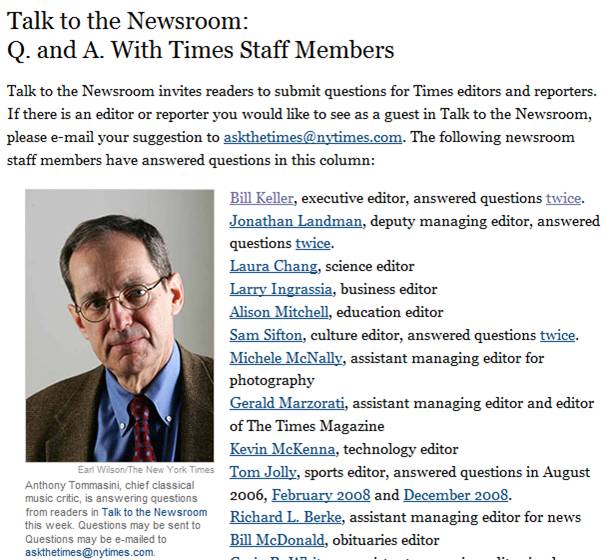
NYTimes.com

Source: NYTimes.com

Now, let’s talk about the social media angle.  The Times could support the “Talk to the Newsroom” feature (above) via a real-time, text-based grroup chat!  They could even have the host be visible via a webcam, if so desired.  Here are some possibilities:

  1. Scheduled chat sessions with Editors, Publishers, executives, etc. (e.g. “Talk to the Newsroom”)
  2. Columnist and subscriber blogs – Published directly within the environment, with support for comments
  3. Forums around the paper’s main topics
  4. Presence indication – Provides readers with the feeling that they’re part of a global community. Reading the newspaper (which used to be a somewhat private experience) now becomes a communal one, where you’re reading, you’re sharing and you’re interacting – with other interested parties from around the world
  5. Real-time briefing rooms or crisis centers – Recall how quickly Twitter spread the news about the Mumbai terrorist attacks.  Why not have ad-hoc briefing rooms where NYTimes.com readers can engage around breaking news and current events?  In this scenario, the “daily newspaper” transforms into a real-time, 7×24 “always on” environment.

So some day, when I get my morning coffee and sit down with NYTimes.com, I’m hoping I’ll see you “there”.


Virtualis and Trend Micro Put On Quite A Show

February 5, 2009

Trend Micro

Source: Trend Micro

The Virtualis Convention and Learning Center is an island within Second Life that’s produced by California-based Corporate Planners Unlimited.  Trend Micro, a technology provider of endpoint, messaging and web security, recently hosted a 2-day live event within the Virtualis’ Second Life convention center.  Virtual Worlds News has detailed coverage of the event here:

http://www.virtualworldsnews.com/2009/02/corporate-planners-unlimited-growing-virtual-events-in-second-life.html

Dan Parks, President and Creative Director at Corporate Planners Unlimited (and Founder of Virtualis) is quoted extensively in this article regarding the demand for virtual events (and Virtualis), their cost efficiency and uses of Virtualis by other clients of his.  As interesting as the technology is (and it sure is cool), I found the virtual event planning (by Virtualis and Trend Micro) to be most interesting.

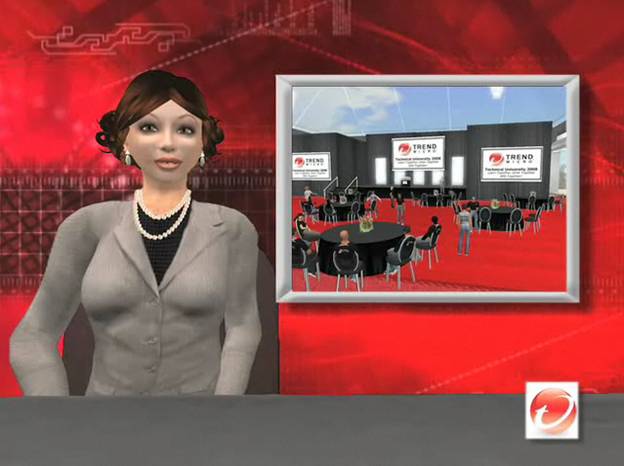
In the Virtual Worlds News article, you can view a 2 minute video overview of the event (given by a Second Life avatar / news reporter, no less).  Alternatively, the same video is available on this page: http://silverandgoldie.com/trendmicro.htm (Machinima by Silver & Goldie, who [presumably] produced this nifty segment).

Virtualis and Trend Micro named the event Trend Micro Virtual Technical University – an internal-facing training venue for 75 Trend employees (also called Trenders) across 5 locations.  Day 1 started with an introduction (and keynote of sorts) by Harry Coit, Trend Micro’s Director of Technical Support, North America.  Harry welcomed the Trenders, who sat around round tables in folding chairs.  Harry’s goals for the 2 days:

  • Collaborate
  • Building strong relationships
  • Have some fun

The in-world sessions were spread across two tracks – product sessions and educational sessions.  The product sessions provided product updates on emerging technologies, along with case studies on the latest web threats.  The educations sessions included creativity sessions, which were held in futuristic settings (where avatars sat around in Jetson-like furniture).

Trend Micro

Source: Trend Micro / Virtualis

For fun, the event included four unique technical challenges.  In a parachute challenge, avatars descended from the sky in parachutes and had to score points by grabbing balls that flew by.  A treasure hunt challenged participants to find specified items throughout the island – scores were tabulated and the top 2 teams squared off in a Trend Micro Tech Challenge – a live game show that was played in front of the entire audience.

Trend Micro

Source: Trend Micro / Virtualis

At the end of the first day, a night club hosted dancing, along with music from “one of Second Life’s most popular entertainers”.  All in all, quite a show.  I admire the attention to detail paid by Virtualis and Trend Micro in planning the events – this was truly a melding of virtual world benefits with the full trappings of an all-day physical (corporate) outing.  The typical applications of virtual worlds and virtual tradeshows –  lead generation, marketing, exhibiting products and services, internal training – has now taken on a new angle.  We’re now seeing internal training, complete with virtual team building!


Home Depot’s EXPO Design Centers Should Go Virtual

January 29, 2009

In a press release issued this week, Home Depot announced that it’s shuttering its doors on all 34 EXPO Design Center stores:

The EXPO business has not performed well financially and is not expected to anytime soon. Even during the recent housing boom, it was not a strong business. It has weakened significantly as the demand for big ticket design and decor projects has declined in the current economic environment. Continuing this business would divert focus and resources from the Company’s core “orange box” stores. Therefore, over the next two months, the Company will be closing 34 EXPO Design Center stores, five YardBIRDS stores, two Design Center stores and a bath remodeling business known as HD Bath, with seven locations.

But wait!  Let’s not be too quick to liquidate all the inventory and tear down the walls.  Images and footage can be captured from the existing design centers — and placed online.  With a Virtual EXPO Design Center, Home Depot can:

  1. Generate leads/business to their core orange box stores
  2. Facilitate e-commerce transactions directly within the virtual design center
  3. Bring the design center to the entire world (and not just those in the vicinity of the 34 physical stores)
  4. Differentiate from the competition

And, they can do all of this for fairly low cost – much lower than their costs for maintaining the original 34 physical design centers.  The concept here is a mashup between Realtor.com and Amazon.  With Realtor.com, prospective home buyers search for homes, view photos and take 360 degree tours.

With Amazon, shoppers of goods peruse, search and eventually purchase (online).  With a virtual design center, you facilitate both activities – prospects search for particular appliances and take 360 degree tours of model kitchens and baths.  By clicking on a particular item, the user can be provided with its full specifications (dimensions, weight, etc.) and  be taken to homedepot.com to purchase it immediately.

So visit the showrooms that are still standing and capture photos, videos and 360 tours.  There are many affordable solutions for capturing and rendering 360 views, such as IPIX and 360iSight.  Next, go interview some of the 5,000 employees you were planning to lay off and find the ones who are most personable and most “online savvy”.

Offer selected employees positions to remain with the company – as virtual showroom staff.  In their new role, their job is to be an embassador (online), answer questions in online chat and discussion forums (within the virtual design center) and help facilitate e-commerce or real-world sales.  To mix in some fun, outfit their avatars with the Home Depot orange apron (and yes, I know, that’s from the orange box stores – but, we’re having fun – and, it might help reinforce the brand).

To provide value to your ecosystem of partners and vendors, allow selected vendors (e.g. GE, Maytag, Kohler) to have booths within the virtual design center, which would provide a centralized collection of the vendor’s products.  Feel free to charge these vendors for their booth, so that you recoup some of your costs for building this environment.

Vendors could provide their own employees to staff the booth.  And once a week, allow a selected vendor to provide a live presentation (webinar or videocast) in the design center’s Auditorium.  Instead of driving clicks to the vendor’s web sites, allow users to click into homedepot.com to purchase the vendor’s products there.

Now, if you have leftover budget or time, mix in more fun into the environment – provide interactive areas where users can interact with kitchen or bath appliances.  Allow a user to turn on/off a stove; set an oven timer; open/close cabinets; fill up a jacuzzi tub with water.  Features like this increase the stickiness of the site and may keep users coming back.  I’m sure there’s much more than can be done – so whether it’s Home Depot or another retailer, I’m expecting to see this concept (virtual design center) become a reality in 2009.

Viking range?  $1,099.99.  LG refrigerator?  $799.99.  Online leads, interactivity and e-commerce?  Priceless.


Adobe’s Real World Launch Is Suppplemented With Virtual Launch

January 25, 2009

PRWeb / Adobe

Source: PRWeb / Adobe

When launching a product suite with “eLearning” in the title, what better a place to hold launch activities than the virtual world?  Last week, Adobe launched two new product suites, Adobe eLearning Suite and Adobe Technical Communication Suite 2.  This coming week, Adobe will be holding virtual launch activities of eLearning Suite in the virtual world of Second Life.  The virtual launch is the work of Moderne Interactive, a digital advertising agency whose practices include “custom and private virtual worlds”.  Details of the launch activities planned in Second Life:

Adobe Product Evangelist RJ Jacquez will lead an interactive demonstration from Second Life at Noon Pacific Time (12 p.m. SLT) both days. Jacquez will showcase the powerful features that the new Captivate 4 and eLearning Suite products can offer to education, government, and other communities. In addition to live product demonstrations by Jacquez, Adobe and Moderne representatives will be on hand to distribute free trials of the innovative software, to answer questions, and to direct users to further resources.

At 7 p.m. on Monday and at 4 p.m. on Tuesday, the Adobe eLearning Island will also hold a celebration of Second Life community that will feature resident Second Life musicians and artists who will share their talents with the gathered crowds.

A virtual world is a great place to demonstrate a product – vendors provide a rich, 3D representation of the product (or, in the case of software, a 2D representation of the actual software) and prospects can see the product in action.  Prospects may also be able to interact with the product directly.  Moderne Interactive and Adobe were wise to provide parallels to a physical launch – such as the free trial giveaways (of the software) and the obligatory musical entertainment.

What’s another neat feature of the virtual world?  The ongoing presence.  With a physical launch event, you tear down the event once the day is over.  Your booth comes down, you bring your product collateral and launch material back to your office and all participants go home.  With a virtual launch, you keep your launch material online, making it available 24×7 to anyone across the globe.  And that’s precisely what Adobe is doing:

During and after the launch events, Adobe will keep its eLearning Island open to the public to highlight its eLearning Suite and Captivate 4 products via, which launched early this week. The island features several interactive elements meant to educate and entertain audiences about Adobe’s eLearning products. Adobe’s eLearning Island can be reached in Second Life at the following location: http://slurl.com/secondlife/Adobe%20eLearning/38/38/37.

“Educate and entertain” – a great approach not only in leveraging the virtual world, but a best practice for launching a product in general.  If you’re a product evangelist (like RJ Jacquez at Adobe), a product marketer or a product manager, I suggest that you learn the logistics and customs of virtual worlds.  Pretty soon, your VP Products or CMO may have you supplementing your trade show and physical launches with appearances in the virtual world!

Here’s hoping that Moderne Interactive and Adobe provide some archived footage from their Second Life events for those of us who aren’t able to attend live.  After all, when RJ is providing a demo of Adobe Captivate 4, I’m sure someone else can be using that same software (in the real world) to record a screencast for us!  Best of luck on a great SL event.

Related links

  1. SLentrepreneur Magazine: Adobe in Second Life: Moderne Interactive Builds Immersive Learning Center for Adobe

Business Innovation: Powered by World of Warcraft

January 21, 2009

They’re called massively multiplayer online games (“MMOG”).  Hundreds (if not thousands) of users connect and “collaborate” in a game that’s held not just on the individual’s device, but online – where that individual is connected to all other players simultaneously.  World of Warcraft (aka WoW) is one of the more notable MMOGs out there.  In a BusinessWeek article titled “How World of Warcraft Promotes Innovation“, authors John Hagel and John Seely Brown discuss design features of the popular MMOG and apply those features towards business opportunities around innovation.  The authors list the “bottom-line lessons for executives”:

  1. Reduce barriers to entry and to early advancement
  2. Provide clear and rich metrics to assess performance
  3. Keep raising the bar
  4. Don’t neglect intrinsic motivations
  5. Provide opportunities to develop tacit knowledge, but do not neglect broader knowledge exchange
  6. Create opportunities for teams to self-organize around challenging performance targets
  7. Encourage frequent and rigorous performance feedback
  8. Create an environment that rewards new dispositions

For each “lesson” (above), the authors describe how it is applied in WoW – and, how the lesson can be applied to business innovation.  Now, let’s move from the world of MMOGs to virtual worlds and virtual events.  I’m a believer that if these same principles are applied to business-oriented virtual “communities”, that we can significantly empower (and generate) untold amounts of business innovation.

On the web, we already have communities of individuals who coalesce around any number of topics and interests – everything from iPhone enthusiasts in a Facebook group to a discussion forum about Tandy’s TRS-80 desktop microcomputer.  Members of these communities are quite engaged in their area of interest and tend to spend a lot of time online.  If provided with a platform that’s also engaging and online, it’s safe to say that they wouldn’t need much convincing to participate.

As such, it seems to me that the bulletin boards, discussion forms, chat areas (and even Facebook or Yahoo groups) of today may migrate (in the near future) to a hybrid virtual world/event, with more real-time interaction and engagement.  Let’s consider a business example.  Take any large corporation that sells its products and services via a “partner ecosystem”.  Much of this company’s revenue is generated from sales that are directly sourced by its partners.  But, how well are partners connected – and how often do they partner up (on their own) to create unique and compelling solutions?  If the answer is “not too often”, then an online medium, using principles drawn from WoW, may be a big win.

As seen in WoW, if a venue allows individuals to assemble, collaborate and generate actions (with a built-in reward and recognition system to motivate the participants), you find that progress, development and innovation fall out naturally.  Create the foundation and a house gets built.  Companies can leverage these online communities (aka virtual worlds) to tap into the Wisdom of Crowds and be able to crowdsource the next great product.  The crowd may give your next product the true WoW factor.


Hey Kids! I’ve Got a Virtual World For You

January 14, 2009

As a parent, their existence is virtually unavoidable – the online companion to a kid-themed product.  A Reuters article (published by MSNBC) titled “Disney’s Penguin spreads its wings globally“, describes Disney’s ambitious plans with its Club Penguin virtual world.  Operating out of Sao Paolo, Disney will launch the first non-English version of Club Penguin in Brazil.  There are additional plans to launch in other Latin American countries and France.  Forget the climactic limitations of the species – penguins will now be spanning the globe.

When Disney acquired Club Penguin in 2007, one may have thought that the strategy was around product/brand integration of Disney properties (and characters) with the Club Penguin world and audience.  While that possibility still exists, it seems Disney is looking to Club Penguin as a full-fledged brand in its own right.  Accordinng to the article:

Within two years of launch, Penguin claimed more than 12 million registered users, of which about 900,000 were premium subscribers typically paying $5.95-$6.95 per month for access to additional features and virtual collectibles.

If I’m doing my math right, 900K subscribers paying $6.50 a month (taking the midpoint of the prices quoted) amounts to $70.2MM in revenue per year (wow).  And here’s a clear sign of Disney’s plan to grow Club Penguin as its own brand:

Over the past year, Disney has been busy taking some of its most popular licenses, such as “Pirates of the Caribbean,” “Cars” and Tinkerbell and creating virtual worlds around them.

But with Penguin, that strategy has been somewhat reversed, giving the property the chance to leverage Disney’s retail muscle. The recent launch of a toy line includes plush versions of popular characters, a set of figurines as well as an Igloo Playset. The brand was also extended into the lucrative game field with the introduction of “Club Penguin: Elite Penguin Force” for the Nintendo DS.

So if you’re a parent paying for that premium subscription, the next thing your child will be asking for is the Igloo Playset, along with the Club Penguin game for her Nintendo DS.  Or, she’ll be asking you to buy the Nintendo DS so that she can attain Elite Penguin Force status!  Also mentioned in the article is a related, kid-themed virtual world, Webkinz:

Of course merchandising is not new in virtual worlds and has already proven to be far more than a branding play. Toronto-based Ganz is estimated to be earning more than $100 million annually from collectible plush toys and accessories kids buy that allow them to unlock virtual goods online at Webkinz World.

I’ve found Webkinz model to be quite interesting, as they’ve reversed the traditional marketing flow.  Instead of online promotions to drive product sales in the physical world, Webkinz employs small stuffed animals as a physical world “footprint” to drive kids (and their parents) online.  So the physical “product” is sort of a loss leader (or, promotion) to generate online memberships, where the online world is the true end game.

And once you’re in-world at Webkinz World, there’s lots to do (and buy) – collect KinzCash, play online games, collect Gems to exchange at the Curio Shop, etc.  Then there are additional toys that tie in to the world, called W-Plus Items (e.g. bookmarks, charms, body spray, lip gloss, etc.).  There’s also trading cards and a recently launched Webkinz eStore, where one can make purchases of virtual goods.  All in all, it’s not surprising that Ganz (parent company of Webkinz) generates $100MM per year.

By launching an online presence, toy makers seem to have the following goals:

  1. Commerce (including subscriptions)
  2. Branding
  3. Both!

With Club Penguin and Webkinz, the clear focus is on commerce – but keep in mind that once you’ve established a strong footprint and audience, you will have opportunities for branding – imagine subtle tie-ins within Club Penguin to other Disney properties (including exclusive offers for Club Penguin members).  On the branding (microsite) side, I checked some toy brands (off the top of my head) and found the following:

  1. Cabbage Patch Kids – Flash-based microsite.  If the original Cabbage Patch product launched today, I’m nearly certain they would have developed a full-blown virtual world
  2. BarbieGirls Virtual World – This looks to be branding focused – but may have related commerce
  3. Beanie Babies 2.0 – Flash-based microsite
  4. Playtime in Ponyville – Microsite for the My Little Pony franchise

One notable exception – a quick search did not turn up any microsite or virtual world for the Leapfrog franchise.  Perhaps that’s in the works for 2009!  Anyway, as a parent who has enabled/used some of these sites at home (for my child, of course!), I see them as a powerful branding vehicle that builds customer loyalty and (potentially) spurs product sales (both in the virtual and real worlds).

I compare the microsite to banner advertising – but instead of having your creative agency design your next Flash banner ad, spend a little more and have them build out a Flash microsite.  Then, your destination becomes your “advertising” and instead of trying to reach your audience across the web, you find that your audience comes to find you.  This is much more efficient than running a large amount of banner impressions and television commercials.  Your microsite fulfills the advertising concept of “frequency and reach”.

And that’s a wrap for now – my daughter needs this computer to access Playtime in Ponyville.