I Finally Joined Google Plus, So Let’s Circle Each Other

November 18, 2011

Introduction

I like to show up fashionably late to most parties. While most of you set up your Google Plus profiles several months ago, I’m just getting around to that now.

Google Plus and Girl Scouts

The Girl Scouts sing a song called “Make New Friends.” The song includes the following lyrics:

A circle is round, it has no end
That’s how long I want to be your friend.
Here is my hand, and here is the other
Let’s put them together and we have each other.

Let’s Circle Each Other

Let’s put our circles together. You can view my profile here:

http://gplus.to/dshiao

Add me to your Circle and I’ll add you back!


Why Second Life Passes The Milkshake Test (But Fails In Other Ways)

November 14, 2011

Introduction

Chip and Dan Heath have published a new book, “The Myth of the Garage” (get it for free on Kindle at Amazon.com). In an excerpt of the book published at Slate titled “Why Second Life Failed,” the authors put Second Life to the “milkshake test.”

Adapted from Clay Christensen’s book “The Innovator’s Solution,” the milkshake test asks the question, “what job is a product designed to do?” According to the Heath brothers, “Most successful innovations perform a clear duty. When we craved on-the-go access to our music collections, we hired the iPod. When we needed quick and effective searches, we hired Google.”

The authors then conclude that Second Life failed the milkshake test:

“But what ‘job’ did Second Life perform? It was like a job candidate with a fascinating résumé — fluent in Finnish, with stints in spelunking and trapeze — but no actual labor skills.”

My Take: Second Life as Multiple Milkshakes

While I agree with the authors when they write, “today, Second Life limps along,” I disagree on the milkshake test result. In this post, I’ll highlight why Second Life passes the milkshake test, but fails in other ways.

Hired for: Escapism

Dictionary.com defines escapism as “the avoidance of reality by absorption of the mind in entertainment or in an imaginative situation, activity, etc.” And this is precisely what many users loved about the service. They “hired” Second Life as a perfect way to escape from the real world.

If you’re a middle aged man with a 9-to-5 job in real life, you could be a muscle-bound, highly attractive (and young) ladies’ man in your second life. In a matter of a few hours (or less), your “new you” (an avatar representation, that is) is ready to go explore the “world.”

Downfall: Turns out most of us want the opposite of escaping. We want the real world.

The mainstream has voted with their mouse clicks and tablet swipes. Their preference is rooted more in the real world and the ability to share, connect and stay in touch with friends, family and others. Instead of spending time on 3D islands, they’re logging on to Facebook, Twitter and other social networks.

Hired for: Self-Expression

It’s quite easy to “hire” Second Life for self-expression. Everything you do there can be about self-expression, from the look and appearance of your avatar, to art that you create in-world, to entire islands that you build there.

You can be a virtual DJ and spin tunes in Second Life (e.g. see Doubledown Tandino, @Ravelong on Twitter) or you can create virtual art to sell. So not only can you self-express, you can make income as well.

Downfall: With a complete free reign on self-expression, instances of prostitution, nudity, sex and lewdness drove away any chance of an ongoing presence from mainstream users.

Counter-example: IMVU is a service that allows for self-expression and is doing quite well. Interestingly, their Terms of Service do not permit you to “use explicit/obscene language or solicit/post sexually explicit images.”

Hired for: Simulation and Training

Perhaps its largest success in passing the milkshake test is in simulation and training. Several branches of the Federal Government have used Second Life for military training and combat simulations. Loyalist College in Canada used Second Life in a training program for border crossing patrol agents. And finally, Dr. Peter Yellowless at UC Davis used Second Life to teach about the experience of schizophrenia.

Downfall: Linden Lab didn’t take the necessary steps to formalize products, services and support around this particular use of Second Life.

If they “productized” a simulation and training offering (perhaps on private, self-contained islands), I think we’d be hearing about a lot more compelling case studies. And it might even place Second Life into a different product/service category.

Conclusion

While I agree with the Heath brothers’ characterization that Second Life is limping along, I continue to see potential in the service. Today, Second Life’s milkshakes are like Baskin Robbins (available in 31 flavors). They’d be better off going Neapolitan, with milkshakes available in chocolate, vanilla and strawberry only.

Related Links

  1.  Thoughts from New World Notes on the same Slate article.
  2. Summary of virtual worlds innovators from a Stanford Media X event.

Subscribe

Did you enjoy this blog posting? If so, you can subscribe to the feed here: https://allvirtual.wordpress.com/feed/


The New Klout Scoring Model Reflects a Shift to Klout 2.0

November 7, 2011

Introduction

Key happenings in October 2011: the NFL in full swing, Halloween, a World Series that was a true October classic and a new scoring model from Klout. I think the World Series received the most commentary, with the Klout scoring changes finishing a close second.

For the most part, people’s Klout scores went down. And not surprisingly, that created a stir, with reactions that ranged from annoyance to sheer outrage.

My Klout score dropped quite a bit. And while I was initially dismayed by the drop, further reflection leads me to conclude that the scoring changes reflect a shift (on their part) from Klout 1.0 to Klout 2.0. Let’s first summarize Klout 1.0.

Klout 1.0

Klout 1.0 was all about generating awareness. Klout was happy to have leading social media experts tweeting about the service and logging in daily to check on their score (and how much it rose in the past day). In addition, Klout kept us all hooked via a crafty use of game mechanics. These game mechanics had us checking our score each day (on klout.com) and engaging with the service. Examples:

Appointment.

While a time was not pre-determined, we did feel an “appointment need” to login to the site each day to check on our latest “rewards.”

Progression.

On your Dashboard page, Klout listed out the following steps:

  1. Connect with Twitter
  2. Connect with Facebook
  3. Follow Klout on Twitter
  4. Like Klout on Facebook
  5. Share Your Klout Score
  6. Visit your profile

When you completed a step, it was visually “crossed out.” The progression dynamic certainly worked on me, in the same way that I was compelled to make my profile “100% complete” on LinkedIn.

Virtual currency.

Second Life has Linden dollars, Klout has “+K” (and they do not cost any US Dollars, unlike Lindens). Each Klout user has an allotment of “+K” that they can award to other users for selected topics. If I think a friend is an expert in social media, I can award her “+K” on that topic. It’s not clear whether receiving +K’s has an impact on your Klout score, though.

Points.

Your Klout score is a form of “points.” And Klout makes you all too aware of your score and its comparison to other users’ scores. In fact, Klout.com allows you to compare yourself to another user. Klout will tell you things like:

  1. You have a higher Klout score
  2. You have a larger Network Influence
  3. You have a larger Amplification Probability
  4. You have a larger True Reach

Status.

Klout’s algorithm assigns you into a particular category (or status). I’m a “Specialist,” which Klout describes as such:

You are a Specialist. You may not be a celebrity, but within your area of expertise your opinion is second to none. Your content is likely focused around a specific topic or industry with a focused, highly-engaged audience.

Klout 2.0

Klout 1.0 made savvy use of game mechanics to stir up early interest and engagement. In the 1.0 world, user advocacy was a big thing, as early adopters who told other early adopters allowed awareness and usage to spread.

The change of scoring method, however, signals a clear shift from the users of Klout to the underlying score itself. Frankly, Klout could care less about noisy users (who are unhappy with their scores dropping). Their focus, instead, is to become the gold standard for online influence.

comScore is “a global leader in measuring the digital world and preferred source of digital business analytics.” Nielsen provides “the complete view of what consumers watch and buy through powerful insights that clarify the relationship between content and commerce.”

Today, Klout sells Klout Perks programs to advertisers.  In the near future, I think Klout wants to become the comScore and Nielsen of online influence.

Conclusion

I have to admit that when my Klout score decreased, I logged into the site much less frequently. But for Klout, that’s OK. What they care about is the fact that the right methodology is now in place behind my current score – one they can track and maintain over time, for the benefit of “watchers” (e.g. advertisers and other future clients).

What are your thoughts on Klout? Share them with us in the Comments section below.

Subscribe

Did you enjoy this blog posting? If so, you can subscribe to the feed here: https://allvirtual.wordpress.com/feed/


Top 5 Ways Virtual Events Are Like Football Games

October 31, 2011

Introduction

The 2011 World Series was simply amazing. But now that baseball is over, it’s time to turn my sporting attention entirely to football (American football, that is). After watching a weekend’s worth of football, it occurred to me that there are similarities between winning football games and producing successful virtual events. Let’s consider 5 ways they’re similar.

1) The Importance of the Game Plan

In the NFL, head coaches spend the entire week preparing for the upcoming game. They’ll put in 16 hour days and sleep on the sofa in their office. They plan the offensive schemes, the defensive schemes and they’ll even map out the play calls for their first drive.

Once they’ve done all their preparation, execution on the field becomes secondary. Yes, it’s important, but without a solid game plan, teams are less likely to claim victory. With virtual events, the game plan and preparation are equally important. As in football, make sure you script out your plays ahead of time.

2) Games Are Won and Lost on Turnovers

Interceptions and lost fumbles often dictate the outcome of football games. In virtual events, a “turnover” is anything that doesn’t occur as expected. It may be a technical glitch or a speaker who never shows up.

When a turnover happens in a football game, your defense must step up to the plate to limit the damage. In a virtual event, you’ll want contingency plans documented (in your pre-game planning) so that you have a “set of plays” to use for each possible turnover.

3) Delegate Important Tasks to Your Team

In football, wins and losses rest on the shoulders of the Head Coach. The coach, however, has an entire staff behind him, much in the same way that the President of The United States has a cabinet. Football teams have coaches for the offense, the defense, the offensive line, the quarterback and much more.

Are you the “Head Coach” of your virtual event? The first step will be to identify all the staff positions you need (e.g. marketing, operations, speaker coordination, sponsorship sales, etc.). Then, fill those positions with competent coaches, then delegate.

4) In-game Analysis and Adjustments

Ever see a quarterback on the sidelines, viewing a photograph with his coaches? By viewing a snapshot of that play’s formations, the quarterback is able to analyze what he did (or did not do) correctly on the given play.

In your virtual event, pause and take “snap shots” throughout the event. You’ll want to analyze things like number of attendees, attendance rate, average session time, number of chats, viewers per session, etc. Just as the quarterback may use photo analysis to make adjustments, learn from what your event snap shots tell you and make the appropriate in-game adjustments.

5) The Importance of Clock Management

Clock management, especially at the end of the two halves, is critical in football. You can’t score if you’ve run out of time.

In virtual events, clock management is first about mapping out the right schedule. For one thing, make sure you provide enough “down time” between scheduled activities so that everyone (e.g. staffers, attendees, presenters) can properly transition from one activity to the next.

Next, clock management in a virtual event is about sticking to your published schedule. If a session is scheduled to run 30 minutes, make sure you begin the “wrap-up” with 5 minutes remaining. Or better yet, go with football’s “two minute warning.”

Conclusion

Here’s to your success on the field. Remember that it all starts in your coaches’ office and practice facility. If you execute well in your virtual event, you can go home a hero on Friday’s and spend the weekends watching football. If you’re so inclined, that is!


How Facebook’s Latest Changes Point To The Future of Virtual Event Experiences

October 24, 2011

Photo source: ivanwalsh on flickr.

Introduction

Have you heard? Facebook announced a set of changes to its service. Some changes are active now, while others will be rolled out in the coming weeks or months. Previously, I wrote about why Facebook is the world’s largest virtual event. Looking at the changes Facebook announced, I think that some of the new features should be adopted by virtual event platforms, to improve the user experience. Let’s take a closer look.

Subscribe (for Personal Pages)

You can now subscribe to a user’s personal page without having that person “friend” you back (a la the “follow” on Twitter). This feature is useful for celebrities who have a personal page, but no associated brand page. Where can this be useful in virtual events? Allowing attendees to subscribe to exhibitors in virtual trade shows.

The “subscribe” action creates a much more valuable “relationship” (to exhibitors) compared to the booth visit, document download or document view. By subscribing to an exhibitor, I see “status updates” that they post during the life of the event. This forces exhibitors to:

  1. Publish content (status updates, special offers, etc.) during the event.
  2. Have an ongoing conversation with you, without the pressure for you to respond back.
  3. Be useful to you.

I “Like” it.

The New Timeline

While not yet rolled out, the Timeline replaces your Profile page. It’s an auto-generated, visual summary of your entire life (on Facebook). It provides you with a “scrapbook on life,” and could be a convenient way for your Facebook friends to quickly check out what you’ve been up to.

Virtual events should create an “Event Timeline” that’s dynamically updated throughout the event. As with the Facebook Timeline, certain events are condensed, especially those that happened in the past. The Event Timeline could include:

  1. A listing of all sessions.
  2. Activity updates (e.g. the 1000th user just logged in; 500 attendees viewed this session; etc.).
  3. Announcements.
  4. Special offers from exhibitors (e.g. sponsored listings).
  5. On-demand content (e.g. a prior session that is now available on-demand).

Top Stories

If something happened a week ago that Facebook deems noteworthy, it wants to keep that event (e.g. a status update from a family member) in the Top Stories section atop your News Feed. Virtual Events can leverage this concept alongside the “Event Timeline” (discussed above). An event’s Top Stories could include:

  1. The most viewed sessions.
  2. The most downloaded documents.
  3. The most popular users (e.g. most connections, most friends).
  4. The most active users (e.g. most chat postings)
  5. The most visited areas of the event.

The Ticker

Facebook’s Ticker resides on the right side of your News Feed and lists interesting things that your friends have done. For a one-day virtual event, it’s not likely that I’m going to build out a significant list of friends or followers. So instead, a virtual event’s Ticker could simply be a updated and scrolling area that displays the Event Timeline and Top Stories (discussed above), as they unfold.

Bonus Item: iPhone 4S Assistant

Apple recently launched its iPhone 4S, which includes an Assistant (Siri). You speak to Siri, it understands what you say and it attempts to perform the actions youv’e asked it to do (e.g. find a restaurant, give me directions, etc.). We need a Siri personal assistant (activated by voice commands) for virtual events. And of course, it needs to work on smartphones and tablets.

Conclusion

Facebook is “always on” to its end users, who use it day and night and all year round. Virtual events tend to be “point in time” occurrences that happen on a single day, or over a few days. While it’s interesting to consider these concepts, their value will surface only if applied correctly. That being said, let’s get to work.

Related Resources

  1. David Pogue of The New York Times writes “Facebook Changes Inspire More Grumbling
  2. Learn more about the iPhone Assistant (Siri).
  3. My thoughts: Why Facebook Is The World’s Largest Virtual Event

#HybridEvents: A Look Back and A Look Ahead via @bXbOnline

October 20, 2011

Read my guest post: http://bxbonline.com/blog/2011/10/the-last-four-years-and-the-next-four-years-in-virtual-and-hybrid-events/

Introduction

When I attended my first virtual trade show four years ago, I said to myself, “This is the future of online lead generation.” At the time, I was managing webinar programs for technology advertisers. They’d do 60-minute, audio-based webinars and hope to generate leads to fuel their sales pipeline. At this virtual trade show, those same “leads” attended an online event for hours and had the opportunity to have real-time engagements with those same advertisers. The users loved it and the advertisers loved it.

Fast forward to today and we’ve significant growth in virtual trade shows. But we’ve also seen the underlying technology platforms applied to many other uses, including virtual job fairs, virtual product launches and importantly, hybrid events.

While some appear before Congress and state that they’re “not here to talk about the past,” I’d like to quickly look back and enthusiastically look forward. Let’s take it in four year intervals, shall we?

To read the full post, visit the bXb Online blog:

http://bxbonline.com/blog/2011/10/the-last-four-years-and-the-next-four-years-in-virtual-and-hybrid-events/


Turn Outings into Professional Networking Opportunities with @sonarme

October 19, 2011

Introduction

Recently, I took the family out to a pumpkin patch. As my daughter rode off on a guided pony tour, I had some free time on my hands. As I looked around, I saw a few other dads with wandering glances. Because I’m quite “networking oriented,” I wondered what these other dads did for a living and whether we shared any common interests.

It occurred to me that a mobile app could work well in this scenario. You could “check in” to a particular location and see “profiles” (e.g. LinkedIn profiles) of other individuals who checked in to the same spot. Perhaps you discover an individual who works for a company that you’re trying to sell into. Or, perhaps you volunteer for a non-profit organization and find an individual who’s a potential donor.

When I returned home, I did a search for such an app. I found Sonar™ (@sonarme).

Sonar Overview

On its web site, Sonar describes itself as “a mobile application that uncovers the hidden connections you share with people nearby. We bottle the 1000s of connections that you miss every day- friends, friends of friends, fellow alumni, likeminded strangers- and put them in the palm of your hand. Sonar helps you use the information you share about yourself online to connect with the person sitting next to you.”

Sonar searches publically available data on Foursquare (checkins), Twitter (tweets) and Facebook (posts) to determine who’s nearby and how you may be connected to those people.

Finding People via Sonar

In the image above, I’m at (or near) the Jacob Javits Convention Center and see a list of people who recently checked in there (presumably, via Foursquare).  From here, I can click on a user and see their profile card.

The profile card shows me that I have mutual friends, connections and interests on Facebook, LinkedIn and Twitter, respectively. I can drill down to find out more details on the common connections. For Twitter, “shared interests” include common friends and common followers. In addition, I can “Say Hi” to the user, which posts a public tweet (Twitter at-reply) directed to the user.

Here’s a tweet I generated via my own use of the service:

Hi @(username-removed). I saw on @sonarme that we’re both checked-in @ Cisco – Building 9 so I thought I’d say hello!

Sonar’s design is elegant, as the service can be useful even without a lot of users (downloads). I download the app, but since Sonar parses publically available data, the people I find do not need to be users of the service. Also, rather than encouraging random (if not intrusive) introductions, Sonar seeks to find common attributes that connect you with others, so that you may leverage those common elements as a means of introduction.

Recommendations for Sonar

That being said, here are a few things I’d like to see added to the service.

Opt-In for the Random Introduction

While Sonar seeks to find common connections tying two people together, I’d love to see a “random introduction mode,” in which those who opt in can introduce themselves to one another at random (i.e. without any connection whatsoever). If I’m selling into a company and I see people listed from that company, I want to introduce myself (virtually) and let them know I’d like to chat. The key here is that they’ve already opted in, so an introduction is not unexpected.

Saving of Contacts

Sonar allows me to find new people and send them messages. However, I don’t see a means for saving discovered contacts within the app. I’d love to have a record of whom I discovered (and where) and be able to view their “discovered” profile, including the common elements Sonar discovered on Facebook, LinkedIn and Twitter.

Built-In Messaging System

Currently, Sonar allows me to send messages to other users via Twiter. I’d like a built-in messaging system that allows supports “SMS-like texting” to other users.  I’d use this capability to reach out to other users (privately) and invite them to meet up at a particular time and spot. In addition,  for groups of users that discover each other via the service, a built-in group messaging service (a la GroupMe) would be neat.

Linking Additional Services

How about linking to Instagram (a popular photo-sharing app for the iPhone). Location data can be parsed from Instagram users who choose to share it. Posting a picture (with location information enabled) becomes a form of “check in” and Sonar users could use commentary on the shared photo as a means for starting up a conversation.

Conclusion

Now that I have Sonar installed on my iPhone, I’m planning on “checking in” to it from time to time. It will be especially useful when I’m out and about, and happen to have some idle time. Shopping malls, airports and sports stadiums come to mind. And don’t even get me started about trade shows and events!

Here’s a short video about Sonar:


Pondering The Future With PCMA, VEI and … Event Camp?

October 16, 2011

Note: The thoughts expressed in this post are my own.

Introduction

Recently, the Virtual Edge Institute (VEI) announced that it received a strategic investment from the Professional Convention Management Association (PCMA). Michelle Bruno, in her Fork In the Road blog, provided some great insights on this partnership, in a posting titled “Why PCMA’s Investment in the Virtual Edge Institute Means More than Just Cash.”

Michelle commended PCMA for endorsing an open source model “to unlock the innovation around virtual and hybrid event technology.” I think PCMA should create a trifecta by making a strategic investment in Event Camp (EC). Commenting on this point via Twitter, Michelle tweeted, “Agree. Event Camp Europe gave me the idea about open source innovation in event context.”

Let’s dive into the potential benefits.

Funding

Event Camp has achieved great things to date. They’ve used their own hybrid events (“Event Camps”) to experiment and innovate on meeting and event planning. They’ve reached these heights primarily from the passion of their volunteer organizers and secondarily from supporting sponsors.

And while I believe that innovation can result from budgetary constraints, imagine the possibilities with an investment from an organization such as PCMA. I believe that a stronger financial foothold will create ever more innovative and engaging Event Camps.

Colocation

Event Camp meetings would have a lot to gain by colocating with PCMA gatherings, in the same way that Virtual Edge Summit benefited from its colocation with PCMA Convening Leaders.

In the future, this trifecta could kick off the calendar year with colocation of three events (in one): PCMA Convening Leaders, Virtual Edge Summit and Event Camp National Conference. Given that several PCMA members are key contributors to Event Camp, colocation makes all the more sense.

In addition, there are additional PCMA events that may stand to benefit from VEI and EC involvement, such as the mid-year PCMA Education Conference.

Feeder Organization

Talk about synergy. Event Camp can spin out innovation via experimentation. The innovation fostered is then fleshed out, refined and documented. In this way, Event Camp becomes a feeder organization into Virtual Edge Institute’s certification programs and PCMA’s educational programs.

Open Source Innovation

Jenise Fryatt (@JeniseFryatt) did a great interview with Nick Balestra (@nickbalestra) about Event Camp Europe titled, “Using Open Source to Remix Your Event.” According to Balestra, “creating events can be somehow similar, so taking an open-source approach while thinking about your events can lead to  smarter ways to create them.”

As Michelle Bruno stated in her piece, PCMA and VEI are supporting an open source model for the benefit of the entire events community. Event Camp, with their model built around “innovation from experimentation” would be a perfect fit for this open source event model to further grow and flourish.

Conclusion

I have a dream to one day visit every major league baseball park in the U.S. and Canada. On the meetings and events side, perhaps I’ll one day be able to attend PCMA Convening Leaders, Virtual Edge Summit and Event Camp in one fell swoop. As for the MLB parks, that’ll have to wait till retirement.

Related Posts

  1. My Thoughts: Virtual Edge Institute’s Digital Event Strategist Certification

Subscribe

Did you enjoy this blog posting? If so, you can subscribe to the feed here: https://allvirtual.wordpress.com/feed/


Demand Generation Has Evolved: The Convergence of Lead Generation & Lead Qualification

October 14, 2011

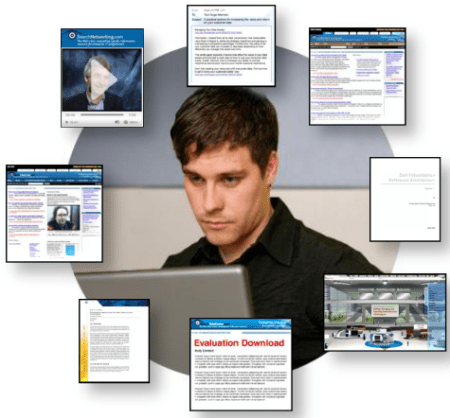
Image source: TechTarget, in a presentation delivered at the TechTarget Online ROI Summit.

Introduction

Demand generation is evolving. In the days of old, marketers focused primarily on “getting the lead,” whether it was via a banner ad, white paper listing or search ad. And while getting the lead is a critical piece of demand generation, leads become worthless if they’re not qualified well and passed on to the right individuals in your organization.

Lazy marketers put up an offer, generate a lead list and then “dump” those leads into a telemarketing queue. Now, lazy marketers have evolved into smart marketers. Smart marketers engage with leads in real-time – or, if they can’t engage with them directly, they study their leads’ interactions with content to make qualification decisions on:

  1. Where leads are in the buying cycle.
  2. What purchasing authority they have.
  3. Who is the best individual to engage with them, and how.

In my book, “Generate Sales Leads With Virtual Events,” I called this “accelerated lead generation.” That is, marketers generate and qualify leads in the same step.

Activity Intelligence™ from TechTarget

At the TechTarget Online ROI Summit in San Francisco, Justin Hoskins introduced a concept called Activity Intelligence™. By adding this service to demand generation campaigns, TechTarget not only generates leads for advertisers, but provides them with a wealth of insights on those leads, in the form of this activity intelligence. Let’s take a further look.

Holistic Account View

It seems elementary, but all too often, demand generation campaigns do not group leads from the same company together. As a result, a sales rep may call on the same company multiple times. Or, multiple sales reps place calls into the same company at the same time. Yikes!

With dashboards provided in Activity Intelligence™, I see that Sandra, Joe, Peter and Barry are from the same company. They may all be on the same team, or they may be in different teams, but at least I get a holistic view, allowing me to plan offers and follow-up activities strategically.

Undiscovered Contacts

Next, there’s the concept of “undiscovered contacts.” These are people from the same company – they didn’t view your content, but they looked at similar content. Activity Intelligence™ won’t provide you with the identity of these contacts, but it’ll tell you how active they are in topics related to your content.

Now, you know that there are other influencers in the prospects’ organization. This is useful, as it indicates an active need. And active needs provide you with better leads (rhyme intended).

Account Mindshare

Related to “other” content, Activity Intelligence™ dashboards provide you with insights into “mindshare,” which comprises:

  1. Your content.
  2. Your competitors’ content (in aggregate).
  3. TechTarget editorial content.

If your competitors’ mindshare is higher than your’s and your prospects are not returning phone calls from Sales, perhaps they’re closing in on a decision with your competitor.

And while that’s not a great result, the intelligence provided can help guide you. Perhaps you have your Sales team focus on more qualified prospects. Or, you re-orient your marketing content to focus on competitive assessments or special offers.

How to Apply to Virtual Events

The concepts of Activity Intelligence™ can be applied to virtual event platforms, to enhance online events oriented around demand generation. Consider the following:

  1. Reporting: provide sponsor reports oriented around holistic account views.
  2. Undiscovered contacts: let sponsors know that “undiscovered contacts” attended the virtual event and provide a measure of their activity within the event.
  3. Mindshare: provide “report cards” that show prospects’ engagement with a sponsor’s content, compared to an average of the other sponsors. In other words, “tell me how this prospect interacted with me, in comparison to my competitors.”

Conclusion

TechTarget’s Activity Intelligence™ is powering an evolution in demand generation: the convergence of lead generation and lead qualification.

The closer you can bring the two steps together, the better chance you have on turning leads into opportunities and opportunities into bookings.

For the digital events industry, we need to be thinking about how we can bring “activity intelligence concepts” into our events, to the benefit of sponsors’ demand generation campaigns.

Disclosure: I was formerly employed by TechTarget.

Related Resources

  1. TechTarget’s presentation on Activity Intelligence™.
  2. Buy the book: “Generate Sales Leads With Virtual Events
  3. Blog posting on Virtual Event Lead Management

Subscribe

Did you enjoy this blog posting? If so, you can subscribe to the feed here: https://allvirtual.wordpress.com/feed/