Virtual And Social Technologies: A Perfect Fit

August 12, 2009

virtual_social

Jeremiah Owyang has an interesting posting on his Web Strategy blog titled “Web Strategy: How To Integrate Social Technologies with Virtual Events“.  Jeremiah notes that the integration of social technologies should apply to both virtual and physical events – by way of these principles:

Three Principles Of Modern Events
To be successful, virtual –and real world– event planners must abide by the following principles:
1. Events should integrate with existing communities and social networks where they exist.
2. Events should have a strategy that includes the before and after –not just during.
3. The audience can assert control over the event, so encourage audience participation and know when to get out of the way.

I left the following comment for Jeremiah:

blog_comment

I’m a big fan of social networks – today, my primary networks are Twitter, Facebook and Linkedin.  That being said, I’ve considered today’s social networks to be a Version 1.0 of Web 2.0.  Now that social networks have built a critical mass of audience/community, I think that some key technologies can advance us to Version 2.0 of Web 2.0.  Some examples:

  1. Presence Indication – While Jeremiah blogs that email was the first social network, I think of instant messaging as the dawn of social networking.  So all the way back in the mid 90’s, we had a technology to allow us to connect with friends, family and colleagues – and, provide presence indication.  I knew if my mom, colleague or best friend was online – and if they were online, they could indicate to me whether they were available or “Away from my desk”.  While some social network sites include in-page presence indication (including Facebook, with its Facebook Chat), I’m surprised that presence indication (and chat) have not been more tightly integrated into the core service of social networks.  If I’m running a social network site, but my users are using AOL IM or Skype for presence indication and text/webcam chat, then I’d want to build better presence/chat tools into my core platform.  Or, integrate existing technology, so that my users launch their IM client within my service.
  2. Personalized Spaces – Facebook has done a great job in allowing me to post pictures, videos, links, status updates, etc.  What about blending the existing technologies/applications within Facebook with virtual world technologies to create a virtual room (for personal use) or a virtual office (for b-to-b use).  Vivaty is thinking along these lines, as they’ve integrated their 3D virtal world technology into Facebook.  So within Facebook, I can build a personalized room with Vivaty and invite my friends (or colleagues) to visit and interact with the objects I’ve placed in that room (e.g. perhaps a link to a movie review).
  3. Profile Matchmaking to Extend Your Network – Virtual Event technologies have their roots in b-to-b use, in which virtual event show hosts tend to collect a deep registration profile on attendees.  This provides data points that allow the virtual event platform to recommend  like-minded attendees (who have similar profiles).  For personal use of social networks, matchmaking may not be relevant – you know whom your friends and family are and you’re probably not inclined to go find new friends (with the exception of a social site for online dating).  In a b-to-b setting, however (e.g. Linkedin), profile matching can be very powerful, as it allows you the potential to extend your network.  B-to-b networking sites that combine presence with matchmaking can create a powerful combination – imagine that I find like-minded people.  Instead of pressuring them to accept me as a connection, I can chat with them (based on presence indication) and introduce myself.  Later, both parties may be comfortable enough to become connections within that social network.

I’d be interested in your thoughts – what related technologies should social network sites look to build or integrate?


Low Cost Options For Virtual Events And Communities

August 5, 2009

Source: flickr (User: businesspictures)

Source: flickr (User: businesspictures)

Can you run a virtual event with zero budget?  Maybe, but maybe not.  Let’s consider one use case – the B-to-B Editor or Editorial Director.  For the Editorial side of b-to-b publications, virtual events can be quite productive and rewarding.  They put you in direct contact with your readers, allowing you to engage via interactive tools (e.g. text or webcam chat) while both parties remain in the comfort of their office or home.

During the virtual event, attendees (who often come from across the globe, no matter what the time of day) can provide direct feedback to Editors regarding the event content, theme, speakers, presentations, etc.  Often, Editors will also receive input regarding the online content they’re publishing (on their web site) – and even find sources for upcoming articles.  I’ve spoken to a number of Editors who were thrilled about the attendee/reader interactions they experienced at a virtual event.

There’s an economic model to a virtual event, however – and that rests on the fact that the event needs to generate revenue – enough to cover the cost of the event, with room for a profit margin.  Thus, at a b-to-b publisher, it’s not the Editor that drives the virtual event, but rather the Publisher, VP Sales or Sales Director.  If there’s no forecasted revenue around a particular event topic, budget isn’t approved and the event has no funding to move forward.

I was recently contacted by an Editor, who was interested in pursuing virtual events (or virtual communities) – he wanted to facilitate interactions around new topics.  However, as with many new topics, they were not mature enough to achieve the right revenue model for the Publisher.  As such, the Editor asked me for available low cost (or no-cost) options.  Here were my initial responses:

  1. OpenSim – according to the FAQ, “OpenSim is a platform for operating a virtual world, and supports multiple independent regions connecting to a single centralized grid. This is somewhat similar to the web, where anyone can run their own web server, tied together through the internet. It can also be used to create a private grid, analogous to a private intranet.”  I noted that OpenSim has no hard cost, but there’s soft cost (e.g. your time).
  2. BlogTalkRadio – a web-based, free service that allows you to create your own Internet radio show.  Your host and your guests call into a standard telephone bridge and the audio is streamed over the web in real-time.  For the free model, you may have house ads served up around your content – there are premium service options available, however.

So my off-the-cuff response was based upon two concepts: (1) try out a no-cost, 3D virtual world environment and/or (2) generate a community discussion (via streaming audio) with no hard costs.  In thinking about my response further, however, I realized I could do better.  First, about OpenSim.  I think OpenSim is great, but it’s probably not the tool of choice in this particular scenario.

First, the build instructions and configuration instructions indicate to me that a fairly technical person  (e.g. SysAdmin) needs to build out your grid.  Second, end users (e.g. the Editor’s readers) need to install an OpenSim client in order to participate.  That might work in some industries (e.g. a gaming publication), but probably not for a b-to-b audience (as they rarely use an OpenSim / SecondLife client on their work computer).

BlogTalkRadio has a lot of potential – in fact, I think b-to-b publishers would be well served by hosting live broadcasts for their readership.  However, the nature of a call-in radio show (even if you have active callers participating) is fundamentally different from the private and group chat activity that occurs in a virtual event.

Source: Metaplace

Source: Metaplace

Taking all of these considerations into account, I felt that Metaplace might be an interesting solution – it allows the creation of a customized 3D world (with avatars) that requires no software download (as it’s Flash based) and can be easily embedded in web pages or blogs.  That may fit nicely at a b-to-b site – in relevant blog postings or article pages, you cam embed the Metaplace world.  So you pair your created 3D world (it’s theme) with content you’re already developing  for your sites – and then use reader traffic to drive participation in the Metaplace world.  And then that community can grow on its own (hopefully).  Again, no software download and no hard cost.

After all that, I’m still not satisfied with my answer – what tools or technologies would YOU recommend to this Editor?


A Look Inside Virtual Job Fairs With IMASTE

July 28, 2009

IMASTE Co-Founders: Miguel Fernandez Lapique, Aitor Zabala, Miguel Arias

IMASTE Co-Founders: Miguel Fernandez Lapique, Aitor Zabala, Miguel Arias

Founded in 2003 and headquartered in Madrid, Spain, IMASTE has a mission statement that reads, “We create innovative contact platforms for our customers and their potential users”.  According to Miguel Arias, Director-Partner at IMASTE, “We founded IMASTE with the purpose of enabling a bridge between companies and university graduates. We first started organizing real events and after two years we became the Spanish leader in university recruitment events in Spain.”  As technologies began to emerge, IMASTE found it natural to leverage the web to complement their physical recruitment events with virtual job fairs.

Today, IMASTE has three primary product categories:

  1. Virtual Fairs – Virtual Job Fairs have been produced in Spain, France, UK, Brazil and Portugal – and IMASTE is working on a sustainability virtual fair in France.
  2. Virtual Environments Lab – based on Adobe Flex, IMASTE builds rich internet applications for clients.  Arias notes, “We have developed the virtual corporate office for Deloitte, the virtual campus for Everis, a virtual music festival for Universia and a virtual petrol station for CEPSA.”
  3. On-Campus (Physical) Job Fairs – IMASTE organizes more than ten Spanish university job fairs, a primary source for Spanish employers to tap into a pool of young graduates.
Monster Edays Event, Powered by IMASTE

Monster Edays Event, Powered by IMASTE

IMASTE worked with Monster to produce Monster Edays, a 2-week virtual job fair that leveraged instant messaging and video chat and enabled more than 90 online company presentations.  IMASTE leveraged Adobe Flex for 3D renderings and animations, as well as the Red5 video conferencing application.  With the event targeting the French market, IMASTE enabled French language support in their platform and coordinated video production activities from Paris.

According to a Case Study posted on the IMASTE web site:

With more than 35 participating companies, over 100,000 unique visitors and over 8,000 collected CVs, the project was a huge success. The media buzz generated more than 350 referring sites and great blogger reviews.  Thus increasing heavily the brand awareness among jobseekers.

Like many providers of virtual events and virtual event technology, IMASTE has a fairly healthy schedule of events.  In the Fall of 2009 alone, they have virtual fairs planned in Croatia, France, Spain, UK and Ireland – with a second edition of a Brazilian virtual job fair scheduled as well.

Speaking of the European market, Arias notes that Europe encompasses many countries, languages and cultures – for virtual event success, “one needs to take into account the cultural differences of each country and localize your platform to each specific need.”  Sprinkling in a bit of humor, Arias concludes, “Therefore, you need to be very flexible and code a lot.”

Arias believes that vast growth opportunities lie ahead, since the European market has not yet fully embraced virtual events – “corporate and marketing executives are not so keen of web innovations and there is a very strong culture of the importance of physical events to enable networking.”

Perhaps IMASTE should leverage their physical job fair business – and prove the ROI and benefits to the European market by turning them into hybrid (phyical+virtual) events.  This way, European exhibitors/sponsors still experience a comfort level (with the physical event sponsorship) and begin to experience the corresponding benefits of the virtual experience.

Related links

  1. A list of IMASTE’s products
  2. The IMASTE blog
  3. The IMASTE Team
  4. IMASTE blog posting on SEO and social networks
  5. Blog posting: For Virtual Events, Globalization Means Localization

Virtual Tradeshow Best Practices: Top 10 Exhibitor Tactics

May 20, 2009

At b-to-b virtual tradeshows (VTS), exhibitors compete for the attention and interest of the attendees.  And many times, the competition for attention occurs “against” the competitors of your business.  Thus, it’s even more important to make your mark, which places an onus on exhibitors to leverage new and creative ways to generate interest.  Here are Top 10 Exhibitor Tactics that I’ve observed while working with virtual tradeshow exhibitors.

  1. Set up a (physical) war room – it seems a bit contradictory, given that you’re exhibiting virtually, but if it’s practical to gather in a single location (physically), you’ll be more effective and coordinated.  As visitors pour into your booth and engage with you, it will be easy to shout aloud, “I’ll take this one” and have everyone immediately know what you’re referring to.  In addition, being together physically creates a buzz as the event goes on – you’ll hear cheers, shouts, jeers, etc. as activities unfold throughout the day.  I’ve participated in one and it does help with coordination and build camraderie.  Short of a physical gathering, another option is to keep a telephone conference bridge active throughout the day to coordinate activities.
  2. Send product experts into the Networking Lounge – you need to solicit your subject matter experts to participate in the virtual tradeshow in the first place.  And believe me, their presence will be worth it.  Send them into the lounge to soak in all the discussion – and encourage them to chime in.  The idea here is to demonstrate thought leadership and generate “organic interest” in your company and your company’s booth.  During one event I attended, an expert’s presence in the Lounge generated interest from an industry analyst, who set up a follow-up meeting (with the expert’s company) to further discuss their products and services.
  3. Leverage a compelling booth welcome – always make a good first impression for that first-time visitor.  Create a Flash video for your booth’s “front screen” that’s unique to the VTS – or, have your CTO or CEO (via greenscreen video) greet visitors with a short video welcome.
  4. Ad-hoc prize giveaways – drop a surprise on attendees and let them know that you’re giving away prizes in your booth.  Got leftover giveaways from a physical event?  Distribute that excess inventory to your virtual event visitors.  Draw them into the Group Chat in your booth and ask them to answer questions posted there (about your products and services)  in order to win.  You’ll end up not just with some happy booth visitors – but you’ll also have educated others who observed the group chat.
  5. Be practical with booth displays – if you have scheduled chats occuring in your booth – or, if you have distinguished experts staffing your booth, let visitors know!  How about an animated image that displays in the front screen of your booth, which rotates through the miscellaneous activites scheduled there that day.  Sometimes, the simplest and most practical approach is the most effective.
  6. Staff your booth with your product experts – for those experts that you send into the Networking Lounge – be sure they’re available to interact with your booth visitors as well.  When your expert has won over the respect of an attendee, then that attendee becomes more comfortable with your company’s products and services.  I’ve witnessed a few experts field requests for pricing information or a follow-up sales call.  While that’s best handled by a salesperson, it clearly demonstrates the effectiveness of having your products experts in your booth.  Another observation: if your experts are having engaging interactions with booth visitors, their presence will encourage repeat visits.
  7. Invite your company executives to participate – a virtual tradeshow affords your company executives with an easy and convenient way to connect directly with customers and prospects.  The attendees find the interactions engaging, as it’s not often they have direct access to your executives.  Additionally, your executives gain further appreciation of the virtual event via their first hand participation, which makes budget approvals quicker for subsequent events.
  8. Got extra books?  Give them away as prizes – first, you need to find the right book for the particular audience – one that will generate strong demand.  Then, by giving away a large number of them (50, 100, etc.), you generate interest because of the likelihood of winning one.  One event I attended awarded a free book to the first 100 booth visitors.  The particular book was authored by an industry expert whom all attendees were familiar with.  The first 100 visits occurred within minutes of the opening of the event!  Later in the day, visitors will still coming into the booth, asking if the book was still available.
  9. Functional avatar images – some exhibitors select their avatar image from the event platform’s image library.  Others upload a picture of themselves.  One exhibitor went a different route and created custom images that denoted the functional expertise of each exhibitor. The image had the company logo as a background, with text overlaid on top (e.g. “Product Expert”, “Integration Expert”, etc.).  Since attendees can determine your functional domain (by your avatar), they can immediately determine whether to interact with you.
  10. Use a “call to action” image in the final slide of a Live Webcast – want viewers to visit your booth at the conclusion of your Live Webcast?  Make your closing slide an image of the virtual environment, with a big arrow pointing to your booth’s location on the Exhibit Hall.  Title the slide, “Got more questions?  Visit our booth”.

So there you have it.  Try some of these tactics at your next virtual tradeshow and let me know how it goes!


Virtual Event Adoption By The C-Suite (CIO, CMO, etc.)

May 8, 2009

In my former role as a b-to-b media industry product manager, I developed product packages that utilized audio podcasts for delivering IT-specific content to IT practitioners and IT managers.  The conventional wisdom at the time  (early on, at least) was, “CIO’s will not download and listen to podcasts”.  I wasn’t so sure about that – after all, podcasts made it easier for busy executives to consume content they wanted – when and where they wanted to consume it.  So why wouldn’t a busy executive leverage technology to make her day more efficient?

Lo and behold, a CIO speaker at an event I attended was asked about the different content types he leveraged to get his job done.  He mentioned that he takes a 30 minute ferry boat ride to and from work each day.  While most boat passengers are reading the daily newspaper, this CIO would listen to IT-specific podcasts on each ride – and, he insisted that each downloaded podcast be 30 minutes long (or less), so that he could listen its entirety on the ride.

With virtul events, I’ve heard from event organizers and event sponsors who wonder whether the CIO (and her companions in the C-Suite) will adopt virtual events and virtual tradeshows.  I think the answer is “yes”.  First, let’s characterize some of the C-Suite occupants:

  1. CEO – may be too busy to attend virtual events – but, will occasionally make the keynote appearance to kick off a virtual event.  Many CEO’s do not use a computer, but most carry PDAs.  This means that the path to CEO participation in virtual events may be via the PDA.
  2. CMO – they see the value of virtual events as a marketing and lead generation vehicle, so one of their key roles today is in funding and approving budget.  As for attendance, my feeling is that they’re interested in doing so.
  3. CIO – like with podcasts, virtual events enable and empower an executive.  The CIO can attend a virtual event to peer network with like-minded CIO’s and not miss a day in the office to do so.
  4. CTO – intimate with technology, the CTO is virtually a slam dunk to participate (pun intended).
  5. CFO – not so sure about CFO’s, but I will note that IBM Cognos produced a virtual event called Virtual Finance Forum 2009 that targeted finance executives.  Cognos produced the same event in 2008 as well.

B-to-B publishers have caught on to the notion that CIO’s will attend virtual events, as past virtual events have specifically targeted the CIO.  Two upcoming events are taking a similar approach:

  1. CIO Virtual Forum: Navigating Through Dynamic Times (May 19, 2009 – CIO.com and Cisco)
  2. CIO Summit:  Driving Business Value and Customer Value in the Global Economy (June 10, 2009 – InformationWeek)

In my experience with technology focused virtual events, I found that of all registrants, 7-9% had senior IT titles (CIO, CTO, VP of Technology, etc.).  So an event with 1,000 registrants would have 70-90 of them be CIO’s or CTO’s.  Why would the C-Suite attend a virtual event?  I think there are a few primary benefits:

  1. Conveniently network with like-minded peers – one of the draws of attending an event is the ability to network with other attendees.  With a virtual event, a busy executive can do so without losing a day outside the office.
  2. Efficiently connect with partners and customers – an online experience can’t re-create the dyamics of an in-person interaction, but it does allow a busy executive to connect with many more partners and customers than could have occurred in-person.
  3. Extend your social graph and social presence – some C-Suite execs have enthusiastically adopted Twitter, Facebook and other social networks.  Industry-specific virtual events allow the executive to further expand the social graph.  And of course, they’ll be tweeting about the event as soon as they login.

What has your experience been – has the C-Suite at your own company attended a virtual event?


A Virtual Battle To Combat Swine Flu

April 28, 2009

Source: US Centers for Disease Control & Prevention

Source: US Centers for Disease Control & Prevention

The number of deaths in Mexico has surpassed 150.  The Department of Homeland Security has delcared a public health emergency in the United States.  The European Union’s health commission urged people to avoid non-essential travel to the affected areas.  Confirmed cases have now been reported in the Middle East and Asia Pacific regions.

Clearly, the rapid spread of swine flu has become a serious, global issue.  With scientists and government officials (across the globe) leaping into action, now is the time to leverage web and virtual technologies to faciliate the global effort to combat the disease and outbreak.

To get through a crisis, information sharing is paramount.  To combat swine flu, it will be critical to faciliate:

  1. Information distribution – real-time updates, to help all parties have a global view of the situation.  We need to understand where the illness has spread, along with in-country updates on how (and how severe) the illness is affecting the local population
  2. Information exchange – experts in the field of medicine, outbreak, crisis management, etc. need to provide their insights to those who need it
  3. Collaboration and dialog – related to information exchange – key parties need to have real-time dialog and collaboration to discuss current conditions and strategize on next steps

Here’s why a virtual event platform would be effective as a crisis management platform:

  1. Global access – with travel a limited option, participants can access this platform from any location with an Internet connection.
  2. Simple technical requirements – a basic PC (or Mac) with Adobe Flash should do the trick, which means that most Internet-connected computers will be fine.
  3. Tracking and transcripts – collaboration among participants can be tracked, with transcripts of communications saved for later review.
  4. Facilitates document sharing and access control – virtual event platforms can store, index and catalog documents, presentations, rich media, etc.  In addition, some platforms provide for user-level access controls, which allow the administrator to provide sensitive or confidential documents to a selected set of participants.  While I’d argue that in a crisis, all information should be shared, there may be certain information during this crisis that is provided early on to selected members, to review before others.
  5. Facilitates ad-hoc discussions – place 25 scientists and government officials into a text-based group chat area (giving some the option to participate via webcam) and I think that many benefits will follow.

Here are some of the primary components that the platform could offer:

  1. Resource Center – make the platform the “home page” for crisis management.  Have the US CDC (Centers for Disease Control and Prevention) and the WHO (World Health Organization) place updates, documents, links, presentations, etc. into a folder structure – and, provide a robust search capability for participants to find the information they need.  As new information becomes available, it is placed in the Resource Center.
  2. Auditorium – allow those same organizations to provide live, streaming broadcasts (audio or video) to participants, to cover breaking news, status of the outbreak globally, etc.  In addition, representatives from the pharmaceutical industry can provide updates on the development of a vaccine to combat swine flu.
  3. Lounge – create structured chat areas for participants to exchange information and collaborate.
  4. Private Chat – for conversation that need to happen outside of the Lounge, private, one-on-one chat can be faciliated.
  5. End User Search – during times of crisis, it’s often useful to find and connect with others, who may be able to provide information, assistance, etc.  You might need to find an in-country expert in Asia Pac to help assess the situation there.  Or, you might be in need of an expert to analyze conditions that are unique to your region.  With the virtual platform, a robust end user search (based on users’ profile information) can facilitate these connections.

What are your thoughts – would such a platform be useful to help battle swine flu – and, how could this be organized in order to faciliate global participation?

Note: The World Health Organization has a useful FAQ on swine flu here: http://www.who.int/csr/swine_flu/swine_flu_faq.pdf


My Earth Day Visit To IBM’s Green Data Center

April 22, 2009

Source: IBM Green Data Center in Second Life

Source: IBM Green Data Center in Second Life

To commemorate Earth Day 2009, I decided to head off this morning and visit IBM’s Green Data Center.  However, to ensure that my visit was carbon neutral, I left my car keys on the coffee table, grabbed my coffee mug and visited the data center in my pajamas.  My visit took place in the virtual world of Second Life, in which IBM has built an impressive Virtual Green Data Center.  The screen capture that you see above shows my visit to the data center lobby, with an interior design around a green (colored) theme [of course].

My interest in IBM’s Virtual Green Data Center was based on an article in Virtual Worlds News, which describes IBM’s partnership with Conversive on the deployment of automated avatars that “will greet users, answer basic questions, and direct them to other locations. The avatar also offers a guided tour”.  I did receive a welcome from the avatar and here’s the transcript of our chat session:

Source: Transcript of author's chat

Source: Transcript of author's chat

I’ll have to try again, but on this visit, the IBM Concierge did not respond to my inquiries.  My journey continued, nonetheless – upon opening the door to the data center’s mantrap (“a small room with double doors used to control entry to the data center and temperature levels”), I walked through the mantrap and into the data center.  Here’s the view from the first floor:

Source: First floor of IBM's Virtual Green Data Center

Source: First floor of IBM's Virtual Green Data Center

After walking past several racks filled with servers, I decided to teleport to the second floor.  Upon arriving there, I skimmed through a number of information kiosks placed there by IBM.  On a small display monitor mounted to the wall, I clicked to view some video footage from IBM executives.  I then walked over to additional information kiosks that provided customer case studies – highlighting success stories of IBM data center customers.

Interestingly, clicking on a kiosk that asked for feedback on my visit launched an external web page, on which IBM provided the survey questions.  I thought it would have been neater to capture my feedback in-world – but perhaps this capability (and the associated tracking and reporting) isn’t yet available in Second Life.

All in all, I was impressed with the layout of the data center, along with the information available.  I think that 3D virtual worlds are effective vehicles for explaining and promoting a company’s products and services.  That being said, I found it interesting that on Earth Day, I did not come across any other visitors – and, while the data center is supposed to be staffed 7×24 by live sales assistants / avatars, I did not see any of those, either.  I’ll return in a week or two to try again.


How To Improve Virtual Event Interactions

April 19, 2009

Source: LiveOps

Source: LiveOps

In a recent New York Times article titled “Software That Monitors Your Work, Wherever You Are“, Damon Darlin profiles the technology and business model of LiveOps, a start-up based in Santa Clara, California.  LiveOps is in the call center business – without having a central call center.  Instead, they employ 20,000 home-based agents, who work as independent consultants for the company.  Sound different?  Well, it doesn’t end there.  The “brains” behind the service is software – what Darlin terms the “real middle manager”.

Maynard Webb, CEO of LiveOps, explains how the software works:

The software moves a company beyond simple cost-cutting. Mr. Webb says greater efficiencies can be found because the company’s software measures the results from each agent according to criteria determined by the client. If a client wants agents to persuade callers to buy additional products, the software tracks that — and then directs calls to the agents who do it best. Those agents prosper.

In the virtual events I’ve participated in, I’ve seen a wide variety of exhibitor personas.  The most effective exhibitors were the true subject matter experts – they have a wealth of information to share with prospects, potential partners and even competitors.  And they’re the rock stars of their virtual booth – highly in-demand and running a mile a minute trying to handle the influx of private and group chat requests.

What makes them rock stars is not just their expertise – it’s really their expertise combined with their desire to network, assist and collaborate.  They not only respond quickly to private chat questions, but they’re proactively commenting in group chats.  On the other extreme, I’ve seen the “don’t call one me” persona – analogous to the right fielder on the softball team who hopes the ball is not hit his way.  These exhibitors bring a limited scope of knowledge, combined with little desire to interact.

Perhaps virtual event platforms should adopt the LiveOps model – route the inquiries and chat requests to those exhibitors who are most likely to achieve the desired outcome.  Here’s how it might work:

  1. Build rating and request functions into the chat application – without some explicit indication from the attendee (booth visitor), the only way to know if the exhibitor (booth rep) was effective is to use natural language processing to interpret the content of the chat (which, indeed, would be a neat feature!).  Instead, build actions into the chat function, as dictated by the exhibitor.  One action might be “rate this chat session” or “rate this booth rep” – the data would be used to determine the worthiness of the rep for subsequent chats.  Another action might be “request more product information” – whereby clicks would increase the effectiveness rating of the booth rep.
  2. Define metrics to rate booth rep effectiveness – examples may include “mean time to answer a private chat request”, “mean time to a ‘request more info’ click” (where shorter times might be considered better) or “mean rating score”.  Of course, for booth reps who receive neither ratings nor requests for more info, perhaps the absence of action works against them.
  3. Distinguish the highest rated booth reps – just like department stores and supermarkets have the “Employee of the Month” parking spot or picture – virtual event standouts should be recognized as well.  Allow the highest rated booth reps to have a specially desigated avatar image (or logo) indicating that they provide excellent service.

Let me know what you think – would such a rating system help improve interactions between virtual event booth visitors and booth reps?


Virtual Event: Digital Marketing World (Spring 2009)

April 1, 2009

Source: MarketingProfs

Source: MarketingProfs

If you’re an online marketer, you might want to attend “Digital Marketing World – Spring 2009” today.  It’s free to attend and the only travel required is to click on over to it  (it’s a virtual event).  If you’re not already registered, there’s an event registration page that you can fill out – and then enter the show right away.  The event generated over 12,000 pre-registered users – so, come on in and join plenty of your online marketing colleagues.

David Plouffe, Campaign Manager for Barack Obama’s 2008 Presidential Campaign is doing a video keynote presentation to kick things off.  I’ve seen lots of excellent chat occuring while David was speaking – many of the comments were around David’s presentation material around social media:

Source: screenshot capture during MarketingProfs' virtual event

Source: screenshot captured during MarketingProfs' virtual event

I’m online as an exhibitor at this event – so if you decide to join, come say hi – I’ll be in the InXpo booth:

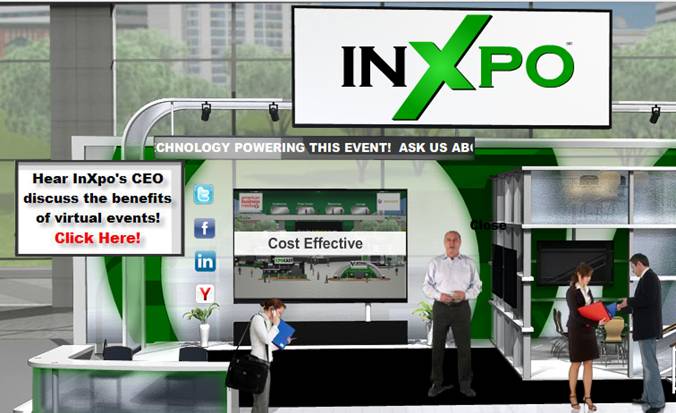
Source: InXpo's booth at MarketingProfs' virtual event

Source: InXpo's booth at MarketingProfs' virtual event


Newspapers: With Print Declining, Go Virtual

March 24, 2009

Source: GlobalPost

Source: GlobalPost

In a previous blog posting, I wrote that newspapers could leverage virtual event platforms to transform the reader experience from one of unidirectional consumption to an interactive community of participation and engagement.  In an article titled “A Web Site’s For-Profit Approach to World News “, the New York Times highlights Boston-based GlobalPost.  The good folks at GlobalPost are clearly thinking outside the “print box”, with an approach that mirrors (somewhat) some of the points I made in my original blog posting.

For one, GlobalPost has deployed a freemium model, built upon a wealth of freely available, advertising supported content.  The premium service comes into play with a service called Passport, which, as eloquently stated by GlobalPost, “offers an entrée into GlobalPost’s inner circle”.  According to the New York Times article:

Passport subscribers, who pay as much as $199 a year, can suggest article ideas. “If you are a member, you have a voice at the editorial meeting,” although the site will decide which stories to pursue, said Charles Sennott, a GlobalPost founder and its executive editor. He said Passport is meant to “create a feeling of community” for subscribers who might otherwise see newsrooms as “impenetrable and fortresslike.”

On the GlobalPost Passport web page titled “Benefits of Membership“, one can discover further detalis about the access afforded to Passport subscribers:

Passport also gives you a significant voice in the news. We invite you to join us in reinventing the media equation, empowering members for the Web 2.0 era. Instead of the old top-down model where editors decide what you need to read, as a Passport member you play an unprecedented role in shaping the stories that get covered, via ForeignDesk, Correspondent Calls and Newsmaker Interviews. Simply put, it’s access that gives you an edge.

While GlobalPost would need to find a business model to profitably support this – I can envision the use of a virtual event platform to serve as the foundation for their interactive community.  By “profitably support”, I mean that the additional cost (e.g. virtual event platform, higher costs for editorial staff, etc.) would need to be weighed against the additional revenue.

But that being said, the use of a virtual event platform could facilitate:

  1. Direct, interactive access from Passport subscribers to GlobalPost’s Editorial Staff – in the form of text chat (both private and group), webcam chat (both private and group), forums and blogs (in the platform), etc.  What better a way to shape the editorial focus than for the Passport members (the most loyal of readers) to engage directly with the folks responsible for producing the content.
  2. Direct engagement among Passport subsribers – generate and sustain subscriber loyalty and retention by allowing them to connect with one another.  After all, two subscribers who visit the “United Kingdom” section of GlobalPost.com likely have common things to discuss.
  3. Drive incremental revenue by upselling your Passport subscribers – one you have a loyal following of Passport subscribers, upsell them into higher and higher premium services – e.g. scheduled video chat sessions with your Publisher; access to exclusive content; access to all archived content, etc.

Kudos to GlobalPost on their somewhat contrarian model – and best of luck on the new site and success of Passport.