Gamification Predictions for 2011

December 22, 2010

Introduction

At Mashable, Gabe Zichermann (@gzicherm) provided his 5 Predictions for Game Mechanics in 2011.  Gabe’s article inspired me to provide my own predictions.

A New Name in 2011

In the second half of 2010, the term “gamification” became bi-polar: you either loved it or hated it.  People on the “love” side see it as the future of engagement and marketing.  People on the “hate” side see it as a gimmick.

Gabe provides his thoughts in an article at Huffington Post.  While the term is effective in capturing the essence, it’s not perfect.  As a result, “gamification” will be used less and less in 2011.  In its place will be a set of new terms, based on its specific applications (e.g. game-based marketing, game-based social initiatives, etc.).

A Sub-Industry Develops


This is more an observation, rather than a prediction (since it’s already happening): an industry has developed around “gamification”.  When folks convene for a conference or summit, that’s my measuring stick to tell me that an industry is emerging.  In the virtual events space, that happened in 2009 with the Virtual Edge Summit (which, by the way, has its third annual conference, also in January 2011).

If you look at the sponsor and speaker lists for this event, you’ll see a number of start-ups who built their business around gamification.  In 2011, we’ll see some “bubble like” behavior (perhaps we’re already seeing it now), where entrepreneurs look to build the next great gamification companies.  In the second half of 2011, however, the bubble settles and the early winners emerge.

Related: Gamification gets its own conference (VentureBeat)

Game Mechanics for The Greater Good

Jane McGonigal of Palo Alto-based Institute for the Future once said, “Any time I consider a new project, I ask myself, is this pushing the state of gaming toward Nobel Prizes? If it’s not, then it’s not doing anything important enough to spend my time.” (source: Salon.com article from 2007).

In 2011, we’ll see game mechanics applied increasingly to the “greater good” – initiatives that can change the world.

Armchair Revolutionary is a great example – consider one of their slogans, “shape the future by playing a game”.  In 2011, lots of “revolutionaries” emerge to rally those who can, to provide help to those in need.

Game Mechanics Go Mainstream – But Consumers Don’t Know It

Game mechanics are going mainstream, but the typical user won’t know that they’re participating in them.  They simply know that they’re engaging in enjoyable activities (side note: there will be similar growth in Foursquare, Gowalla, etc., but users, of course, won’t know that they’re using “location based services”).

For example, Universal Studios announced successful sales of their “Despicable Me” DVD – their press release attributes some of the success to a “Minions Madness” promotion, “a points-based reward and social media program spotlighting the film’s beloved mischief-makers, the Minions.” This promotion was powered by Bunchball, a game mechanics start-up.

Bunchball (and related companies) has built a nice client list of broadcast networks, cable networks and film studios.  In 2011, additional media outlets come on board.  Game mechanics  go more and more mainstream, even though the typical mainstream user doesn’t know it.  Watch out in 2012, however, as consumer-based game mechanics suffer some fatigue (as consumers then see “much too much” of it).

Established Web Players Incorporate Game Mechanics

2011 sees established players incorporate game mechanics to increase engagement (e.g. “time on site”, clicks, e-commerce sales, etc.).

Google adopts game mechanics as a means for bridging their search business and social services (e.g. adding game mechanics to Google Me). Others who add game mechanics include Netflix, eBay and Groupon.  Of course, it’s natural to expect that more and more virtual event experiences will add game mechanics, too.

Conclusion

2010 has been an interesting year for gamification. 2011 will kick off with an industry event and where we go from there will be exciting to watch.  I’ll check back mid-year with a report card on these predictions. Here’s hoping I attain the “crystal ball badge”.


What Virtual Events Can Learn From Groupon, Quora and FarmVille

December 18, 2010

Introduction

Successful web sites provide a great opportunity: the chance to study what makes them successful and apply those learnings to your own websites or applications.  In 2010, three of the “most talked about” web sites were Groupon, Quora and FarmVille (though FarmVille is more a discrete app, rather than a web site).  Let’s consider how some of their concepts can be applied to virtual event experiences.

Groupon


Groupon is said to be in the local advertising space, but they’re really much more than that.  They’ve hit the mark with a group buying phenomenon (using bulk purchasing to drive down prices) combined with creative and entertaining email copy that keeps subscribers eager to receive the next day’s email.

Groupon, which serves local businesses, segments their offering by geography.  So I might subscribe via San Jose, CA and receive offers from merchants who are near me.  But the Groupon model could certainly apply to national or even global brands.

Group Viewing at Virtual Trade Shows

Now, let’s consider a common dynamic at virtual trade shows.  Exhibitors (sponsors) would like to get their message across to attendees, while attendees are resistant to hearing unsolicited product pitches.

How can you “arbitrate” this situation?  Consider Groupon, where the “daily deal” only registers when a certain number of users agree to purchase the item(s).  Here’s how it might work with sponsor presentations (webinars) at a virtual trade show:

  1. Five sponsors list their webinar title in the trade show Auditorium
  2. Each sponsor is “on alert”, ready to begin broadcasting their live presentation
  3. No presentation begins until it receives 50 (or more) viewers
  4. The presentation continues, only if it can continually sustain 35 simultaneous viewers – if it drops below 35 viewers for more than 5 minutes, the presentation closes

Benefits

  1. Puts portions of the presentation agenda in the hands of attendees
  2. Forces sponsors to present on relevant topics
  3. Forces sponsors to “deliver what they sold” with regard to the presentation
  4. Ups the overall quality of sponsor presentations, as sponsors need to both “sell” the topic and sustain the audience

Quora

Quora is “a continually improving collection of questions and answers created, edited, and organized by everyone who uses it.”  Question and Answer (Q&A) services have been around for some time. Quora has picked up steam in 2010 due to the quality of the members participating (e.g. some of the leading thinkers on the web – and in Silicon Valley).

In virtual events, experts and leading thinkers in a particular industry have gathered online.  They can listen to featured experts (e.g. the presenters), but the event doesn’t fully extract and share the collective knowledge of those assembled. If done right, a Q&A service layered on top of a virtual event can be quite useful.

In fact, let’s consider a related Q&A service, Aardvark, which is now part of Google.  With Aardvark, “you email or instant-message your question to Aardvark, it figures out around half a dozen people you know who might have a good answer, then emails or IMs them for a response and sends what they say back to you.” (source: VentureBeat article).

A virtual event platform could implement a “Quora meets Aardvark” model, whereby questions are distributed to online attendees – and answers are fed back in semi-real-time.  Questions (and their answers) could be shared not only with the requester – but, all attendees, based on their selection of particular topics.

FarmVille

On the surface, FarmVille is about planting your virtual crops and tending to your virtual farm.  But below the surface, its “power” is in the psychological reward of achieving success in something you take pride in.  It’s the same dynamic that fuels entrepreneurs (who take pride in their businesses) and Twitter power users (who take pride in their following).

As virtual events shift from “point in time” live events to “365 day communities”, the challenge becomes how to sustain an ongoing and active community – who will visit the environment on days where absolutely nothing is scheduled.  It’s the same challenge Zynga had – how do you incent farmers to tend to their virtual farm each day?

Virtual Farm Meets Virtual Community

For virtual communities, there needs to be a parallel to that virtual farm – an abstraction that allows members to feel psychological reward when they’ve done something meaningful.  Ideas include:

  1. Elevated  member profiles. Turn the “vanilla” user profile of today into the parallel of the virtual farm
  2. “Pimp my space”. Exhibitors get to build booths – now, allow attendees the freedom to create their own spaces and receive ratings on them
  3. Leverage “status badges” on the profiles – but ensure that demand consistently outstrips supply
  4. “Rate the ratings” – allow members to rate the worthiness of a rating (a la Amazon.com, and “Was this review helpful to you?”) – top rated members receive elevated status in the community
  5. Prominent Leaderboards related to particular activities, games, etc. – these can be a tremendous draw, as users continually return to check on their position on the board

Conclusion

Groupon, Quora and FarmVille have taught us some valuable lessons.  The rising demand for virtual events tells us something as well.  Aardvark may have hit upon the right model – in which they combined social collaboration with a real-time (or semi-real-time) component.  Perhaps Grouopon and the like have something to “learn” from virtual as well.


The Name Of The “Game” Is Engagement

August 9, 2010

Future brand loyalist or virtual goods buyer?

Introduction

Social gaming start-ups are a hot commodity these days.  In the past 12 months, Playfish was acquired by Electronic Arts and Playdom (more recently) was acquired by Disney.  Zynga, which remains independent, has a valuation that’s reported to be as high as $5B.  I expect that CrowdStar, another independent gaming start-up, will be acquired before 2010 closes.

These gaming companies provide “free to play” games on the web and on smartphones.  They then sell virtual goods (within the games) so users can achieve an elevation in status (e.g. a sharper sword, more crop for the farm, designer sunglasses to replace your generic pair, etc.).

Sustainable Growth Can Be Challenging

These gaming start-ups have attractive attributes:

  1. Ability to generate hundreds of millions in revenue (in some cases, more)
  2. High growth rates in users, revenue
  3. High profit margins, since the “cost of goods” (for virtual goods) is virtually zero

While it’s hard to argue with the results that these start-ups are turning in, I wonder if we might be in a mini-gaming-bubble, in terms of current valuations and the potential of sustainable, long term growth.

Social games can be similar to the recording and film industries.  Success depends on the blockbuster hit.  Over time, it becomes more and more challenging to consistently produce the blockbusters, especially in the face of growing competition.  Today, Facebook serves as a great “record label” for the gaming companies.  It provides a marketing vehicle that you can’t find anywhere else – “distribution” to its 500+ MM “listeners” (users).

The gaming companies know, however, that they can’t put all their eggs in the Facebook basket – hence, the plans from Zynga to launch their own Zynga Live platform (as one example).  The gaming companies need their blockbuster hits to turn into self-standing brands (e.g. FarmVille), which then relies on a variety of distribution vehicles.

We know that consumers can be fickle, however.  Recall the progression of “hot social network”, from Friendster to MySpace to Twitter/Facebook.  Games will have a related challenge.  FarmVille is not going to be the #1 game forever, which means that Zynga is already figuring out the “next FarmVille”.

I believe there will be a short list of winners in a market that will be increasingly fierce.  In addition, I wonder if over the long term, the rate of virtual goods purchasing is sustainable – or whether it will continue to grow over the long term.

A New Game in Town?

One of the challenges of the virtual goods model is the funding source. Revenue growth is dependent on fickle consumers, who could love your game one day and move on to another game the next day.  And yes, I realize that part of good game design is to build in the hooks to create user loyalty.

That being said, what about services whose funding source comes from brands that want to reach consumers?  The bills in their “wallet” are of higher denominations than the $1’s and $5’s that consumers use to purchase virtual goods.  In addition, “brands are already brands”, which mean that they have a pre-existing following from consumers.

Foursquare

Consider Foursquare.  Some consider it a “location based service”.  I view Foursquare as an engagement platform that’s built on top of a location based system.  In fact, Foursquare has a loyalty program that generated successful outcomes for Starbucks, Ben & Jerry’s, Whole Foods and many others.

The Foursquare business model is both powerful and scalable: powerful in its use of technology (e.g. location based check-ins) and scalable in leveraging existing brands (e.g. Starbucks) for the consumer following and activity.

Location based technology is great, but the long term success of Foursquare is more about the engagement and loyalty programs it facilitates for brands, based on the applicable and available technology of the day.

Nitro Participation Engine from Bunchball

Keep your eye on the Nitro Participation Engine from Bunchball – a Silicon Valley start-up who counts NBC, Warner Brothers and Victoria’s Secret as clients.  The Nitro engine “drives participation using Gamification”, which means that any brand can easily add gaming elements to their web site(s) – and then leverage the Nitro engine to track user actions, points, status and leaderboard. In addition, brands can use Nitro to deploy and sell virtual goods.

What This Could Mean

I think we could be witnessing a transformation of the advertising industry.  If the 90’s and the 00’s were about banner ads and paid search, this coming decade could be about engagement and loyalty platforms.

Foursquare, Bunchball and others have much to gain – if they can tap into a small percentage of the $100+B spent on advertising annually, they’ll make their investors very happy.

These engagement platforms can move from brand impressions (90’s) to brand engagements – where the engagements are longer lasting and more valuable than a click on a paid search ad.  They’re more participatory and can result in immediate purchases (e.g. the latte that someone just purchased at Starbucks).  In addition and perhaps more importantly, they enhance loyalty between consumers and brands, which is great for the long term.

Of course, sustainable growth is a challenge with any technology. Engagement platforms will face their own challenges as they see adoption grow.  Consumers will only be able to participate in so many engagement or loyalty programs.  That being said, consumers are taking batting practice right now – the first inning has yet to start.  Enjoy the ballgame!

I’ve now managed to speak enough.  Leave a comment below to share your thoughts on this topic.

Related Links

  1. ClickZ article (by Christopher Heine) on brand engagement featuring Booyah, Loopt, Brightkite, Gowalla and Stickybits
  2. Foursquare’s Future Slowly Takes Shape“, by Om Malik of GigaOM
  3. Social-media games: Badges or badgering?“, by Caroline McCarthy of CNET

What I’ve Been Tweeting (Edition 1.1)

August 2, 2010

Because tweets are temporal, while blog postings are permalinked…

Virtual Events

  1. Virtual Meetings and Exhibits Still Coming of Age: http://bit.ly/aFZF3B #eventprofs #virtualevents
  2. RT @CiscoIBSG: Can Virtual Experts Smooth Expat Transition? How P&G Is Successfully Using Cisco #TelePresence: http://bit.ly/afrmsS
  3. From @CiscoLive & @dveale: embed event video across the web, drive new registrations! http://bit.ly/9CWvxC #eventprofs
  4. Event Planners ‘Check In’ To Location Based Services: http://bit.ly/cFMH9A #eventprofs #wec10
  5. Getting started with #virtualevents? Download my eBook, “Virtual Events: Ready, Set, Go”: http://bit.ly/asJqFs #eventprofs
  6. RT @InXpo: We’re excited: “Latest Cisco Offering: ‘Collaboration for Events’ features INXPO Virtual Platform”: http://bit.ly/apKOH6
  7. Virtual Events ROI Case Study: @virtualedge Hybrid Event: http://bit.ly/cRJt2b #eventprofs #virtualevents #ROI

Social Media

  1. RT @clickz It’s All Fun and Games for Brand Marketers: http://bit.ly/aV8H3r (by @tessawegert)
  2. Twitter time-savers by @markwschaefer: Success in just 20 minutes a day: http://bit.ly/9aHoiu via @addthis
  3. RT @mashable How Twitter in the Classroom is Boosting Student Engagement: http://bit.ly/bmgxpw #classroom #education
  4. From @MarketingSherpa: #Webinar Promotion that Delivers: Use Email, Social, Viral Referrals and Video: http://bit.ly/ddDbhY
  5. 5 tips for lively Twitter chats: http://bit.ly/dqjQlL via @addthis – great article, @leeodden
  6. RT @mashable SCVNGR Launches Sophisticated Rewards Program http://bit.ly/bEQz5l #foursquare #marketing #rewards

Product Ideas

  1. Idea for @LinkedIn: ability to add “Notes” to a Connection (e.g. “Met at SXSW”, “Ask for recommendation”, etc.)
  2. Idea for MLB: for fans’ favorite players, send mobile alerts for “check ins” from home plate, 1B, 2B, 3B
  3. Next move for Facebook: embedding “Like” capability into rich media (e.g. video, audio). Let me “Like” a song from my iPod
  4. Idea for @Facebook: use Facebook Questions (itself) to address users’ questions about the new service
  5. Idea: integrate a brand’s CRM w/their Facebook Fan page – brand mgr sees user’s likes and comments superimposed w/their CRM records
  6. Idea for Google: when search results contain an address, embed Maps functionality, so I can see driving directions right there

General

  1. Good quote from Ask.com: “Google is a verb. But don’t forget that ‘ask’ is a verb too”
  2. Excited to be working for one of Lead411’s hottest companies in the Midwest (@INXPO): http://bit.ly/b2g1Ox – we’re also hot on West Coast!
  3. Physicians confirm we’re alive by checking our pulse. Bloggers, check the ‘pulse’ of your own blog – is there a constant, steady beat?
  4. Event and meeting planners have so many tools at their disposal these days that they’ll need to start wearing Craftsman belts
  5. ESPN and Playdom now under the same parent company (Disney). Wondering (and excited) about possible tie-ups…
  6. Interesting POV from @kimmaicutler: “Why the Facebook/Amazon integration is bigger than you think”: http://bit.ly/bVwz5J

Previously, I posted “What I’ve Been Tweeting” Edition 1.0.

Tweet this posting:


Video: Virtual Events With IMASTE

December 11, 2009

Miguel Arias (@mike_arias), Co-Founder and Director-Partner of IMASTE, visited Silicon Valley (Northern California) this week.  IMASTE, the leading virtual events provider in Europe, was 1 of 10 Spanish technology companies selected to visit Silicon Valley to meet with the likes of Google, Yahoo and venture capitalists.

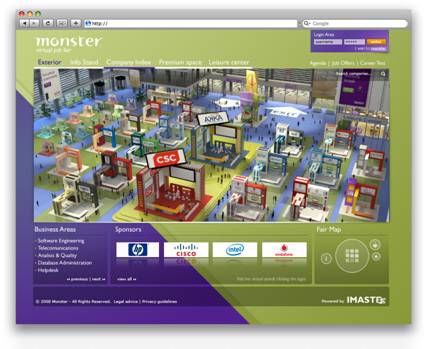
In 2009, IMASTE produced a number of virtual career fairs, including a large scale job fair for Monster Worldwide.  In addition to virtual career fairs, IMASTE produced virtual tradeshows, including hybrid (physical + virtual) events.  IMASTE serviced clients in Europe and Brazil, including a virtual event in Croatian, for a client based in Croatia.

Looking ahead to 2010, Arias sees strong growth in the European market, as awareness of virtual events is growing – in addition, Arias believes hybrid events will be a large growth area in Europe.

View this video for more details about IMASTE – the video includes a brief demo of the Monster virtual career fair that IMASTE powered.