3 Virtual Worlds Technologies To Watch

September 26, 2010

On September 24th, FountainBlue held its annual virtual worlds conference.  This year’s event was hosted on Cisco’s campus in Milpitas, CA.

The event was attended by entrepreneurs, intrapreneurs, investors and virtual worlds practitioners.  Several virtual worlds entrepreneurs spoke on the scheduled panel discussions and a few set up stations to demonstrate their technology.

I’d like to highlight 3 virtual worlds technologies that caught my attention.

RocketOn: A virtual world layer on top of the entire web

Presenting executive: Steve Hoffman, CEO

RocketOn takes my “Best in Show Award” for most innovative virtual worlds technology.  While Facebook and Twitter have propelled social networking to mainstream adoption, surfing the web is still a solitary experience.

While many web sites have added community features (e.g. membership, comments, Facebook social graph integration, etc.) – it’s still the case that when I browse my favorite content sites, I have no idea who else is reading the same page at the same time.

RocketOn seeks to change that.  Using a Flash layer placed on top of web pages via an i-frame, RocketOn users can create their own avatar and have them walk atop any web page.  They can then see other RocketOn users who may be visiting the same web page.

Perhaps you’re reading a movie review and happen to bump into a friend, who’s reading the same review.  You decide to visit a site that hosts a trailer for the movie, so you both navigate to the trailer site, watch it there and continue your chat.

A Foursquare for the entire web

One of the captivating features of Foursquare is the ability to see who else is at the same physical location as you.  RocketOn has built a similar feature for the entire web.  While the service is focused on a consumer audience initially, imagine how this technology could be used in a corporate setting.

Browsing your company’s intranet could become much more productive and engaging.  Now, water cooler conversations could occur online, as you bump into colleagues at the employee directory page (rather than the kitchen).

Additional Information

  1. The “About Us” page for RocketOn
  2. More details on the RocketOn platform
  3. Neat 2-minute video about the RocketOn service

Zenitum: Bringing virtual worlds into the real world

Presenting executive: Albert Kim, CEO

I admire technologies that flip conventional models upside down.  While we visit virtual worlds from the real world, Zenitum seeks to have virtual worlds elements visit us in the real world.  CEO Albert Kim receives the “Jetsettter Badge”, having attended the conference from Zenitum’s home base in Seoul, Korea.

When publicly released (later this year), Zenitum’s technology will be supported on iPhone, Android and Symbian.  Zenitum will provide their app and an SDK (software development kit) for free.  They are encouraging widespread adoption of their technology – consumers use their app and device manufacturers develop services using their SDK. Zenitum will monetize their service via advertising (“augmented advertising”, perhaps).

Our reality will forever be augmented

When you run the app, your smartphone scans your surroundings, attempting to recognize images.  If it finds a match, Zenitum overlays a 3D animated object on top (or around) the real world object.  For example, let’s say a comic book publisher is running a campaign and loads an image of a comic strip into the Zenitum platform.

The same image is on a billboard on a city street.  When I walk down that street with the app running (and my smartphone positioned properly), Zenitum detects the comic strip image.  It then inserts animated 3D objects (perhaps other characters from the comic strip) around the real world object.  As I move my phone left, right, up and down, the animated objects adjust their positions accordingly.

Possible use cases

Imagine the use of this technology at a museum – as you walk past a painting, its “virtual artist” could appear on your phone and speak to you about the inspiration behind the work.  At a trade show or conference, walking down an aisle could cause executives (virtually) to spring up and give you a brief pitch about their product.

Neat stuff – I hope we’re able to keep the distinction clear, though, on what’s real and what’s virtual!

Additional Information

  1. Zenitum’s “Company” page on their web site

Digitell: Bringing a global audience to your next meeting

Presenting executive: Jim Parker, President

Digitell uses the ActiveWorlds 3D platform to bring you hybrid meetings, virtual events, virtual communities and webcasts.  Jim Parker, Digitell’s President, notes that a common client of his service is associations, who want to extend the audience for their annual meetings.  Parker notes that the immersive experience of Digitell makes attendees “feel like they’re there” (at the physical event).

Parker’s clients who run these hybrid events often charge the same amount on virtual attendance as they do for the on-site event.  In this way, the common objection of cannibalization goes away, as the virtual component generates additional audience – and additional revenue for the meeting organizer.

Dispelling the notion that virtual worlds are for the younger generation, Parker notes that the average age of a Digitell user is 44 (wow!).  Users are so passionate about the experience that they often comment, “when’s the next event, I want to use my avatar!”.

Parker has created 3D replicas of museums, which allows students (across the globe) to visit and experience the museum’s works, without having to be “bused” to the physical building.  Imagine how easy it would be to have a virtual guide take students on a tour of the museum’s main works, any time of day, with students participating from all over the world.

Additional Information

  1. More info on Hybrid Meetings from Digitell

Conclusion

While the term “virtual worlds” has a negative connotation in the minds of many, it hasn’t stopped innovative entrepreneurs from developing new and exciting services.  It will be interesting to watch each of these technologies to review their adoption, growth and monetization.


Event Planners “Check In” To Location Based Services

July 26, 2010

Introduction

Due to the rising popularity of Foursquare, Gowalla and related apps, location based services (LBS) is quite the buzzword both in consumer and technology circles.  Logically, the ability to “check in” at venues, connect with friends/associates and make new contacts has relevance to events and event planners.

Let’s highlight some of last week’s articles and blog postings on this topic.

Trade Show News Network

Michelle Bruno (@michellebruno) wrote an article in Trade Show News Network (@TSNN_com_US) titled “Checking Out ‘Checking In’ for Events“.  The article references Foursquare and Gowalla and then profiles a technology provider named Double Dutch.  According to its web site, Double Dutch provides “White label geolocation apps for your brand”.

Michelle references a key point regarding hybrid events, in which event planners support both physical and virtual venues.  Michelle writes, “If a virtual event is also taking place, live attendees can check in at the online and offline events for more recognition”.

Tracking and supporting check-ins across physical and virtual locations can build a more cohesive and compelling hybrid event.  In fact, it can serve to bridge the physical and virtual venues.

Virtual event platforms should look into this.  In fact, I blogged about location based services and virtual events previously.

Cisco Live

In Cisco’s Virtual Environments blog, Dannette Veale (@dveale) writes about virtual technologies that Cisco has incorporated into their Cisco Live (@CiscoLive) annual conference.  The 2010 Cisco Live event concluded recently – the physical component was hosted in Las Vegas, while a virtual component ran concurrently.

Disclosure: My employer (@INXPO) provided the virtual platform for Cisco Live

Dannette describes an innovative use  of Foursquare by Cisco Live’s event planners – a type of scavenger hunt, in which conference attendees received a clue (via social media channels) about a check-in location.  The first 75 attendees to check in at that location (and complete an additional task) would receive buttons, which could be used to redeem a daily prize at the Cisco Store.

The contest generated 802 checkins and allowed conference attendees to network and make connections with one another.

SCVNGR (Mashable)

SCVNGR, “a game about doing challenges at places”, this week announced the social check-in.  Two or more users can bump phones (or, wave them at each other in close proximity) and check in at the same time and place.  There are many ways event planners can leverage this technology.

In a trade show, attendees could be encouraged to perform social check-ins with each other – or, with exhibitors.  In a user conference, the social check-in could be used as a back-drop to a game that encouraged attendees to network with one another.  In a corporate setting, social check-ins could be used to encourage team building.

Conclusion

The concepts of “check ins”, location awareness and location tracking have natural uses for events.  While they’re a great fit for physical events, think about tie-ins between physical and virtual for your hybrid event.  And, think about ways in which “location tracking” (in a virtual event) can create connections, engagement and interaction.

Tweet this posting:


Virtual Events 101: What Is A Virtual Event?

May 12, 2010

Definitions, definitions.  Terms can be best explained by breaking them down into their component parts.

“Virtual event” – let’s cover the second part first, the “event”.  An “event” can mean many things to many people; however, I like the following definition from Dictionary.com:

Source: Dictionary.com

An event is “something that occurs in a certain place during a particular interval of time”.  With a virtual event, the same definition applies – however, the “certain place” happens to be “online” or “on the web”.  For “virtual event”, the Dictionary.com definition could be re-worded to:

something that occurs in a certain web destination during a particular interval of time

Of course, like any loosely worded definition, many “things” fit this description, which you and I typically would not consider a virtual event (e.g. a multi-party instant messenger chat qualifies, but isn’t typically considered a virtual event).  In my mind, a virtual event is

a web and occasion-based gathering that facilitates information sharing, collaboration and interaction.

To date, the look and feel of virtual events have been modeled after a physical counterpart (e.g. a trade show, user conference, sales meeting or job fair).  As the industry evolves, the experience will evolve as well – and unique, web-based experiences will emerge.  For instance, expect to see virtual trade shows that look and feel nothing like their physical counterpart (hence the power of the web).

There are no “bare minimum requirements” for a virtual event (e.g. Auditorium, Exhibit Hall, Networking Lounge, Booth) – an experience with no Auditorium and no booths can still qualify.  Virtual events come in many flavors – with many more on the way.  There are a variety of use cases and objectives that can be achieved virtually.

Virtual events are known for the following benefits:

  1. Green technology that minimizes carbon emissions
  2. Supports a global audience
  3. Convenience – participate from your home, office, beach
  4. Ongoing showcase – the event is not required to be “torn down” at the conclusion of the live date(s)
  5. Granular engagement tracking – activity is recorded an deep engagement profiles generated

Variations

While virtual events occur on the web without a physical (face-to-face) component, some event planners are creating hybrid event experiences, whereby a face-to-face event is combined with a virtual component.  The virtual component can occur before, during or after the face-to-face event – when done concurrent to the physical event, interesting opportunities arise for blending the physical and virtual experiences.

While events occur “during a particular interval of time”, some virtual event planners are creating 365 day/year virtual communities, which have a focus around periodic “events”.  So rather than create a virtual event that’s live for a single day, event planners create an evergreen (and virtual) business community that sees consistent activity throughout the year, with spikes of activity during scheduled days of “live event activity”.

Conclusion

Virtual events are here to stay – the broad definition of a virtual event will hold – however, more specific definitions will morph over time, as the industry and experience grow and evolve.  Tomorrow’s virtual events may look (and feel) nothing like today’s.

Related Links

  1. Browse the Virtual Events 101 Index Page
  2. Download the eBook, “Virtual Events: Ready, Set, Go

Note: I invite you to connect with me on .


Happy New Year 2010: Time To Plan A Hybrid Event

December 18, 2009

I wrote a posting on the InXpo blog about 2010 – I believe the coming year will see lots of hybrid (physical + virtual) events.  I’m excited about watching (and perhaps participating in) the innovation that will occur in the blending of physical and virtual experiences.  In the blog posting, I cover:

  1. Audience Augmentation
  2. Physical <-> Virtual Integration Points
  3. How to Segment Physical/Virtual Features and Options

Here’s the link to the full blog posting:

2010: The Year Of The Hybrid Event

Tweet This on Twitter
Why 2010 is the Year of the Hybrid by @InXpo: http://bit.ly/2010Hybrid_Event #virtual #marketing #eventprofs


Video: Virtual Events With IMASTE

December 11, 2009

Miguel Arias (@mike_arias), Co-Founder and Director-Partner of IMASTE, visited Silicon Valley (Northern California) this week.  IMASTE, the leading virtual events provider in Europe, was 1 of 10 Spanish technology companies selected to visit Silicon Valley to meet with the likes of Google, Yahoo and venture capitalists.

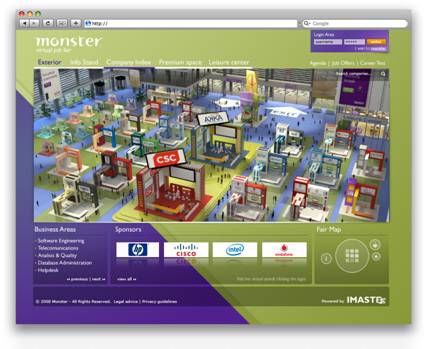
In 2009, IMASTE produced a number of virtual career fairs, including a large scale job fair for Monster Worldwide.  In addition to virtual career fairs, IMASTE produced virtual tradeshows, including hybrid (physical + virtual) events.  IMASTE serviced clients in Europe and Brazil, including a virtual event in Croatian, for a client based in Croatia.

Looking ahead to 2010, Arias sees strong growth in the European market, as awareness of virtual events is growing – in addition, Arias believes hybrid events will be a large growth area in Europe.

View this video for more details about IMASTE – the video includes a brief demo of the Monster virtual career fair that IMASTE powered.


A Look Inside Virtual Job Fairs With IMASTE

July 28, 2009

IMASTE Co-Founders: Miguel Fernandez Lapique, Aitor Zabala, Miguel Arias

IMASTE Co-Founders: Miguel Fernandez Lapique, Aitor Zabala, Miguel Arias

Founded in 2003 and headquartered in Madrid, Spain, IMASTE has a mission statement that reads, “We create innovative contact platforms for our customers and their potential users”.  According to Miguel Arias, Director-Partner at IMASTE, “We founded IMASTE with the purpose of enabling a bridge between companies and university graduates. We first started organizing real events and after two years we became the Spanish leader in university recruitment events in Spain.”  As technologies began to emerge, IMASTE found it natural to leverage the web to complement their physical recruitment events with virtual job fairs.

Today, IMASTE has three primary product categories:

  1. Virtual Fairs – Virtual Job Fairs have been produced in Spain, France, UK, Brazil and Portugal – and IMASTE is working on a sustainability virtual fair in France.
  2. Virtual Environments Lab – based on Adobe Flex, IMASTE builds rich internet applications for clients.  Arias notes, “We have developed the virtual corporate office for Deloitte, the virtual campus for Everis, a virtual music festival for Universia and a virtual petrol station for CEPSA.”
  3. On-Campus (Physical) Job Fairs – IMASTE organizes more than ten Spanish university job fairs, a primary source for Spanish employers to tap into a pool of young graduates.
Monster Edays Event, Powered by IMASTE

Monster Edays Event, Powered by IMASTE

IMASTE worked with Monster to produce Monster Edays, a 2-week virtual job fair that leveraged instant messaging and video chat and enabled more than 90 online company presentations.  IMASTE leveraged Adobe Flex for 3D renderings and animations, as well as the Red5 video conferencing application.  With the event targeting the French market, IMASTE enabled French language support in their platform and coordinated video production activities from Paris.

According to a Case Study posted on the IMASTE web site:

With more than 35 participating companies, over 100,000 unique visitors and over 8,000 collected CVs, the project was a huge success. The media buzz generated more than 350 referring sites and great blogger reviews.  Thus increasing heavily the brand awareness among jobseekers.

Like many providers of virtual events and virtual event technology, IMASTE has a fairly healthy schedule of events.  In the Fall of 2009 alone, they have virtual fairs planned in Croatia, France, Spain, UK and Ireland – with a second edition of a Brazilian virtual job fair scheduled as well.

Speaking of the European market, Arias notes that Europe encompasses many countries, languages and cultures – for virtual event success, “one needs to take into account the cultural differences of each country and localize your platform to each specific need.”  Sprinkling in a bit of humor, Arias concludes, “Therefore, you need to be very flexible and code a lot.”

Arias believes that vast growth opportunities lie ahead, since the European market has not yet fully embraced virtual events – “corporate and marketing executives are not so keen of web innovations and there is a very strong culture of the importance of physical events to enable networking.”

Perhaps IMASTE should leverage their physical job fair business – and prove the ROI and benefits to the European market by turning them into hybrid (phyical+virtual) events.  This way, European exhibitors/sponsors still experience a comfort level (with the physical event sponsorship) and begin to experience the corresponding benefits of the virtual experience.

Related links

  1. A list of IMASTE’s products
  2. The IMASTE blog
  3. The IMASTE Team
  4. IMASTE blog posting on SEO and social networks
  5. Blog posting: For Virtual Events, Globalization Means Localization