Low Cost Options For Virtual Events And Communities

August 5, 2009

Source: flickr (User: businesspictures)

Source: flickr (User: businesspictures)

Can you run a virtual event with zero budget?  Maybe, but maybe not.  Let’s consider one use case – the B-to-B Editor or Editorial Director.  For the Editorial side of b-to-b publications, virtual events can be quite productive and rewarding.  They put you in direct contact with your readers, allowing you to engage via interactive tools (e.g. text or webcam chat) while both parties remain in the comfort of their office or home.

During the virtual event, attendees (who often come from across the globe, no matter what the time of day) can provide direct feedback to Editors regarding the event content, theme, speakers, presentations, etc.  Often, Editors will also receive input regarding the online content they’re publishing (on their web site) – and even find sources for upcoming articles.  I’ve spoken to a number of Editors who were thrilled about the attendee/reader interactions they experienced at a virtual event.

There’s an economic model to a virtual event, however – and that rests on the fact that the event needs to generate revenue – enough to cover the cost of the event, with room for a profit margin.  Thus, at a b-to-b publisher, it’s not the Editor that drives the virtual event, but rather the Publisher, VP Sales or Sales Director.  If there’s no forecasted revenue around a particular event topic, budget isn’t approved and the event has no funding to move forward.

I was recently contacted by an Editor, who was interested in pursuing virtual events (or virtual communities) – he wanted to facilitate interactions around new topics.  However, as with many new topics, they were not mature enough to achieve the right revenue model for the Publisher.  As such, the Editor asked me for available low cost (or no-cost) options.  Here were my initial responses:

  1. OpenSim – according to the FAQ, “OpenSim is a platform for operating a virtual world, and supports multiple independent regions connecting to a single centralized grid. This is somewhat similar to the web, where anyone can run their own web server, tied together through the internet. It can also be used to create a private grid, analogous to a private intranet.”  I noted that OpenSim has no hard cost, but there’s soft cost (e.g. your time).
  2. BlogTalkRadio – a web-based, free service that allows you to create your own Internet radio show.  Your host and your guests call into a standard telephone bridge and the audio is streamed over the web in real-time.  For the free model, you may have house ads served up around your content – there are premium service options available, however.

So my off-the-cuff response was based upon two concepts: (1) try out a no-cost, 3D virtual world environment and/or (2) generate a community discussion (via streaming audio) with no hard costs.  In thinking about my response further, however, I realized I could do better.  First, about OpenSim.  I think OpenSim is great, but it’s probably not the tool of choice in this particular scenario.

First, the build instructions and configuration instructions indicate to me that a fairly technical person  (e.g. SysAdmin) needs to build out your grid.  Second, end users (e.g. the Editor’s readers) need to install an OpenSim client in order to participate.  That might work in some industries (e.g. a gaming publication), but probably not for a b-to-b audience (as they rarely use an OpenSim / SecondLife client on their work computer).

BlogTalkRadio has a lot of potential – in fact, I think b-to-b publishers would be well served by hosting live broadcasts for their readership.  However, the nature of a call-in radio show (even if you have active callers participating) is fundamentally different from the private and group chat activity that occurs in a virtual event.

Source: Metaplace

Source: Metaplace

Taking all of these considerations into account, I felt that Metaplace might be an interesting solution – it allows the creation of a customized 3D world (with avatars) that requires no software download (as it’s Flash based) and can be easily embedded in web pages or blogs.  That may fit nicely at a b-to-b site – in relevant blog postings or article pages, you cam embed the Metaplace world.  So you pair your created 3D world (it’s theme) with content you’re already developing  for your sites – and then use reader traffic to drive participation in the Metaplace world.  And then that community can grow on its own (hopefully).  Again, no software download and no hard cost.

After all that, I’m still not satisfied with my answer – what tools or technologies would YOU recommend to this Editor?


The Convergence Of Physical Events And Virtual Events

July 1, 2009

convergence

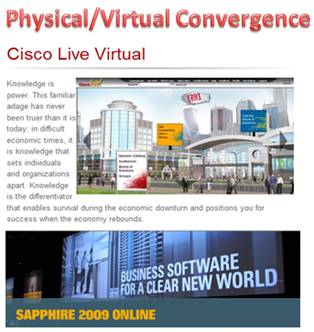
In May, SAP’s annual SAPPHIRE conference (SAPPHIRE 09) floored physically in Orlando, Florida, with a concurrent virtual event online.  This week, Cisco’s annual Cisco Live conference followed suit, with a physical event in San Francisco, California and a concurrent virtual event online.

Full disclosure: My company (InXpo) was the virtual event platform provider for both the SAPPHIRE and Cisco Live virtual events – and, I worked on the Cisco Live virtual event.

During a presentation at the Virtual Edge Summit in May, a presenter from SAP noted that considerations were made concerning the potential of cannibalization – whereby physical attendees may stay at home to attend virtually instead.  However, he noted that in reality, a combination of physical and virtual event extended the overall reach – and the virtual component served to augment the overall attendance count.  When combined (physical+virtual), this year’s attendee count for SAPPHIRE was the largest ever.

This week, I attended Cisco Live on-site, but spent most of my time online to support the virtual event.  However, in experiencing all the touch points of the event, it quickly occurred to me that the entire notion of physical vs. virtual is blurring – they’re coming together to form an aggregate attendee experience.

Some participants are not able to travel to the event’s venue – and as such, their only choice is to participate in a virtual component.  For those on-site, they can choose the attendee path that suits their preferences.  Perhaps that means attending the John Chambers keynote in person, grabbing a cup of coffee, visiting the World of Solutions (exhibit floor) and then returning to the hotel room to login to the virtual event, to follow up with a few exhibitors in their virtual booth.  Later, that same attendee may visit the customer apprecation event in Second Life, and then attend a tweetup at a nightclub (in person).  Here’s an image of my Second Life avatar at the Tuesday evening Second Life dance party:

The author's avatar with right hand raised

The author's avatar with right hand raised

To make this convergence really work, I believe the following should be done:

  1. Create a unique value proposition for each venue – virtual event, virtual world, physical event – do not simply re-purpose one into the other.  Dannette Veale explains it quite well in a Cisco Virtual Worlds blog entry, The Value of Virtual Events.
  2. Tie the venues together in a logical fashion – link the venues together where it makes sense.  Convergence should happen for a good reason – and not for the sake of convergence.
  3. Give the attendees freedom to choose – allow attendees to choose their own attendee path, without forcing them down any one direction.  Leave the hooks in place and each attendee will follow their own path.  Some physical event attendees may opt out of any convergence and focus 100% on the physical event.  Others may actively engage in the virtual event while on-site physically.  Either path is fine.
  4. Integrate social media across the spectrum – whether it’s Visible  Tweets displayed on a physical monitor or Facebook integration with the virtual event – integrating social media increases engagement within the attendee experience and also extends the reach of the event to networks of social networks.  Here’s an interesting example of user generated, social media at the physical event – a physical whiteboard that asked attendees to write about where they were in 1989:

whiteboard

In Cisco Live Virtual, elements of the physical event were streamed into the virtual event.  By doing so, virtual event attendees (who could not travel to San Francisco) were still able to get a taste of the physical event experience.  For instance, webcams were deployed throughout the physical event to stream in live feeds from the show floor – and to host personalized webcam chats with Cisco executives.  One of the webcams was pointed at this Solutions Theater – from which virtual event attendees had a continous live stream of presentations given throughout the day:

solutionstheater

Here are some of the ways I experienced physical/virtual event convergence:

  1. Watching John Chambers’ keynote presentation online, via a Live Webcast streamed into the virtual event (by On24).
  2. Viewing a Cisco Live Second Life session (LIVE!) from a booth in the virtual event – the session was broadcast by treet.tv in Quicktime – so users needed the Quicktime player but not the Second Life client application.
  3. Watching a live (physical) demo of Telepresence, which was broadcast via a Live Video Webcast, which was carried within the virtual event (many layers of convergence there).
  4. Participating in live chat sessions that Cisco executives (Carlos Dominguez and Padmasree Warrior [separately]) attended via webcam.  Attendees typed their questions (via text) and the executives answered via webcam / audio.  The executives answered just about every question posed, so it felt like a personal meet and greet with the executives.
  5. Walking past the NetQoS physical booth – and noticing one of their demo workstations displaying their booth in the virtual event.  Quite a good idea – host visitors to your physical booth and remind them of your presence in the virtual event.  That prospect can’t return to your physical booth next week (when the event is over), but they sure can visit your booth in the virtual event [at any time] to find the needed information.
  6. Reading one user’s in-show blog, where he asked physical attendees to name the “one [physical] booth that should not be missed”.  This particular user was not able to attend physically – but, he may be able to visit the virtual booths of the vendors recommended by his peers.

Moving forward, I expect to see many more events follow this model – whereby physical events will leverage virtual event and virtual worlds technologies to accomplish the following:

  1. Deliver additional value to the physical event
  2. Extend the reach of the event to a global audience
  3. Blend physical and virtual components to create a more compelling experience
  4. Drive stronger event revenue and ROI!

I hope to see you at a future event – I haven’t decided whether I’ll be there physically, virtually or both.


A Second Look At Second Life

June 3, 2009

Source: San Francsisco Business Times

Source: San Francsisco Business Times

“A lot of Silicon Valley has written Second Life off.  The tech world will have to revisit Second Life as a phenomenon in the next six months or so.”

Thus spoke Wagner James Au, noted virtual worlds author and blogger in a San Francisco  Business Times article on Second Life (note: the full article is available to paid subscribers only).  Au, who blogs at New World Notes about Second Life, notes in the article that Linden Lab CEO Mark Kingdon has renewed the Second Life brand that was created by founder Philip Rosedale.

While the revenue model for Twitter is slowly coming clearer (judging by the accounts in the business media), Linden Labs’ strategy under Kingdon is becoming quickly self-evident with the announcements of the past few months.  From my perspective, Kingdon’s growth strategy is around a few core pillars:

  1. Enterprise use of Second Life – makes sense, as enterprises and corporations can be monetized at a higher clip than individuals, artists, hobbyists, etc.  Enterprises (in the former of marketers) were a big portion of Second Life during its initial peak – and it seems the current focus is to bring marketers back into the fold, along with complementary uses in non-marketing disciplines (e.g. training, enablement, collaboration, etc.).  In the past 6 months, Linden Lab has hired 25 marketing and product people as part of their push for enterprise clients.  In addition, the company recently hired Amanda Van Nuys as Executive Director of Enterprise Marketing, signaling a further endorsement of the opportunity in the enterprise.
  2. Nebraska – an on-premises software version of Second Life  (compared to their Software as a Service model), which enterprises can run on their own servers behind the firewall.  IBM has been an active partner with Linden Lab on behind-the-firewall integration – the telltale sign will be how many other large enterprises opt for the Nebraska model.  For “behind the firewall” use, I have to think that we’re talking less about marketing and more about collaboration.
  3. Voice – not mentioned in the Business Times article, but Virtual Worlds News covered it well – Linden Lab is poised to go after the Skype market with capabilities to bridge voice calls and SMS messages between the real world and Second Life.  In the Virtual Worlds News article, Linden Lab Vice President of Platform and Technology Development Joe Miller notes, “The opportunity to monetize at a significant added value for our business is there”, regarding the opportunity in Voice.

IBM marrketing executive Karen Keeter notes in the San Francisco Business Times article that nearly 100 IBM’ers are “working on virtual world tools for commercial sale in Second Life and on other platforms”.  As such, IBM stands to achieve commercial gain from increased use (by enterpises) of Second Life and related virtual worlds.

In fact, it wouldn’t surprise me to see IBM leverage virtual worlds to generate services revenue.  Two things come to mind – IBM Global Services and IBM’s Smarter Planet initiative.  IBM Global Services could assist enterprises on their virtual worlds strategy (e.g. build me a virtual world representation of my data center, so that I can run heating and cooling simulations) – or, IBM could go in-world to enterprise’s private virtual worlds to provide traditional consulting services within the virtual world.

So a manufacturer who’s replicated their factory in a 3D world can have Global Services visit (in-world) to optimize their factory floor workflow.  Then, of course, Global Services could help facilitate the parallel action in the real world.  On the Smarter Planet project, IBM might create 3D models of the next generation power plant to show utilities how to become more energy efficient.  In a virutal world, I’m sure the possibilites are limitless.

Finally, Dan Parks of Virtualis is featured in the article.  Virtualis created a compound in Second Life with 34,000 square yards of meeting rooms.  Quite an interesting model – an event producer that leverages a re-usable area (virtually) to host meetings for corporate clients.  Companies who have done events with Virtualis include Deloitte, Oracle and Trend Micro.

I’d be interested in your thoughts – what do you think about the potential of Second Life for enterprises?

Related Links:

  1. Blog posting on Virtual Offices, with reference to Amanda Van Nuys’ use of Second Life
  2. Blog Posting: Virtualis and Trend Micro Put On Quite A Show
  3. Blog Posting: Philip Rosedale On Building A Business: Practice Extreme Transparency
  4. Blog Posting: IBM’s Second Life ROI: The Headline Beneath The Headline

My Earth Day Visit To IBM’s Green Data Center

April 22, 2009

Source: IBM Green Data Center in Second Life

Source: IBM Green Data Center in Second Life

To commemorate Earth Day 2009, I decided to head off this morning and visit IBM’s Green Data Center.  However, to ensure that my visit was carbon neutral, I left my car keys on the coffee table, grabbed my coffee mug and visited the data center in my pajamas.  My visit took place in the virtual world of Second Life, in which IBM has built an impressive Virtual Green Data Center.  The screen capture that you see above shows my visit to the data center lobby, with an interior design around a green (colored) theme [of course].

My interest in IBM’s Virtual Green Data Center was based on an article in Virtual Worlds News, which describes IBM’s partnership with Conversive on the deployment of automated avatars that “will greet users, answer basic questions, and direct them to other locations. The avatar also offers a guided tour”.  I did receive a welcome from the avatar and here’s the transcript of our chat session:

Source: Transcript of author's chat

Source: Transcript of author's chat

I’ll have to try again, but on this visit, the IBM Concierge did not respond to my inquiries.  My journey continued, nonetheless – upon opening the door to the data center’s mantrap (“a small room with double doors used to control entry to the data center and temperature levels”), I walked through the mantrap and into the data center.  Here’s the view from the first floor:

Source: First floor of IBM's Virtual Green Data Center

Source: First floor of IBM's Virtual Green Data Center

After walking past several racks filled with servers, I decided to teleport to the second floor.  Upon arriving there, I skimmed through a number of information kiosks placed there by IBM.  On a small display monitor mounted to the wall, I clicked to view some video footage from IBM executives.  I then walked over to additional information kiosks that provided customer case studies – highlighting success stories of IBM data center customers.

Interestingly, clicking on a kiosk that asked for feedback on my visit launched an external web page, on which IBM provided the survey questions.  I thought it would have been neater to capture my feedback in-world – but perhaps this capability (and the associated tracking and reporting) isn’t yet available in Second Life.

All in all, I was impressed with the layout of the data center, along with the information available.  I think that 3D virtual worlds are effective vehicles for explaining and promoting a company’s products and services.  That being said, I found it interesting that on Earth Day, I did not come across any other visitors – and, while the data center is supposed to be staffed 7×24 by live sales assistants / avatars, I did not see any of those, either.  I’ll return in a week or two to try again.


How A UC Davis Professor Leverages Second Life For Research

April 8, 2009

Professor Peter Yellowlees of UC Davis

Professor Peter Yellowlees of UC Davis

Dr. Peter Yellowlees, professor of psychiatry at UC Davis, has done some innovative work using Second Life to help educate people on schizophrenia.  I referenced Professor Yellowlees in an earlier blog posting about virtual worlds technologies that benefit the real world.  I contacted Peter to get some more information about his research and his thoughts on virtual worlds, Web 2.0 and the future.

  1. Tell us a little bit about yourself? I am a professor of psychiatry at UC Davis in Sacramento California, and I also run the UCD Health Informatics Graduate program, where we currently have over 40 graduate students enrolled in our masters and certificate programs. I trained in medicine in London, England, then spent 20 years in Australia, before being offered a position at UC 5 years ago. I am married to Barb and we have 4 grown children, and one “furry daughter” – a puppy called Lucy who  thinks she is human.
  2. Tell us how you are using technology (including virtual worlds) in your research? I use it to teach about the experience of schizophrenia. It is hard for students to imagine what it is like to hallucinate – to hear voices and see visions – and the capacity to have the avatar undergo those experiences is very helpful for the students and lets them understand about the lived experience of psychosis.
  3. When you heard of the concept of a virtual world, what was your first thought? I have been working with virtual reality for more than 10 years – I started with a CAVE (collaborative virtual environment) in Australia and developed software applications for that type of environment, and then moved “downscale” to the much cheaper more available internet environment when I came to the US.
  4. Besides Second Life, do you participate in other virtual worlds? Not currently, although I am constantly looking at other software systems, particularly the ones used by USC to model the Iraq war environment and treat PTSD.
  5. What’s missing in virtual worlds technologies that could benefit your research efforts? In SL the main missing element is the relative lack of realism of the environment – it is still rather cartoon-like and can’t compete for “reality” with the very expensive VR games that are now widely available. I would also like to see the avatars being able to change more easily on the fly, although the creation of avatar bots is great.
  6. What Web 2.0 services or social networks do you participate in? I blog regularly at http://informationagehealth.blogspot.com and am also on facebook and twitter. I have recently published a couple of ebooks at www.smashwords.com ( one of them is free) and have my own website at www.informationagehealth.com that is set up to both support patients that I see in the real world, as well as to promote my book on internet healthcare – “your health in the information age” published by iUniverse and available through Amazon and most online and f2f bookstores
  7. Do you see benefits of social networks as they relate to your research interests? I am very interested in them and would really like your readers to comment on how they think that social networks could be used in healthcare – they clearly can be a support and information system for patients but I feel they should have more capacity than this and am looking at how they can be combined with mobile environments –  I carry both a blackberry and an iPhone for instance, and am interested in how they could be used for monitoring behavior and symptoms.
  8. What are related fields of science that could benefit from virtual worlds? Certainly the social sciences – also probably genetics, by allowing us to link with unknown family members better…and many others…
  9. What does the future hold? Read my book!!!! – go to www.informationagehealth.com – the last chapter is all about the future of healthcare on the internet – lots of fascinating areas, and I think visualization of large data sets is particularly important – in 3D in virtual worlds – allowing scientists to literally get inside their data – amazing possibilities.

How Virtual Worlds Technologies Benefit The Real World

April 5, 2009

Source: Hopecam

Source: Hopecam

Let’s play word association.  “Webcam” – for me, the association is about keeping in touch with family or perhaps collaborating with colleagues and partners on business topics.  “Virtual Worlds” – my association here is 3D, fantasy, escapism and gaming.  While those associations will likely remain that way for quite some time, there have been numerous uses of virtual worlds technologies that go beyond the “neat and fun”.  It’s not an overstatement to say that they are helping humanity.

Take, for instance,  Hopecam, whose motto is “Connecting Homebound Children to LIFE”.  Founded in 2003, this Virginia-based non-profit connects children (undergoing treatment for cancer) with their friends at school with nothing more than a laptop, webcam and high speed Internet connection.  Hopecam has brought this “connection” to over 75 homebound children.  Their web site has an “Our Kids” section that profiles some of these children – and on this page, you can make an online donation to the organization.

Note: I did an earlier interview with a similar, Ireland-based non-profit, Vizitant.

The Washington Post published an article titled “Webcams Allow Students to Stay Connected“, which profiles 7-year-old Becky Wilson, who’s able to virtually attend class at Jamestown Elementary School in Arlington County via a webcam.  Becky, who was diagnosed with leukemia, is a full participant in classroom activities, according to her teacher, Lainie Ortiz:

The webcam has exceeded Ortiz’s expectations as an academic tool. When Becky tunes in for class and has a question, she raises her hand and Ortiz calls on her. During story time, Ortiz will bring the book she’s reading up to the computer, so Becky can see the pictures, too.

At the Baylor College of Medicine in Houston, Texas, researchers are leveraging a grant from the US Department of Education to “develop an intervention program in Second Life® that focuses on self-esteem, a critical element in health and wellness.”  For women with disabilities, virtual world technologies mean that access to rehabilitation services require nothing more than a computer, an Internet connection and a virtual world application:

“Second Life® allows women with disabilities to experience virtual life as an able bodied person,” said Dr. Margaret Nosek, professor of physical medicine and rehabilitation at BCM. “They can be who they want to be in the virtual world rather than living by the standards set by others,” said Nosek.

“Second Life® allows them to interact with other women while learning and practicing new self-esteem building skills in the virtual world,” she said.

The program will be available in late 2009 – the Baylor College of Medicine published a news article about this virtual intervention program.

Finally, a BBC News article titled “What it’s like to have schizophrenia” tells the fascinating story of Dr. Peter Yellowlees, professor of psychiatry at the University of California, Davis, who is leveraging Second Life to take you inside the mind of someone afflicted with schizophrenia.  Currently on a password-protected island, the purpose of this initiative is to educate people on the condition – there are clear benefits to understanding what it’s like to be afflicted schizophrenia:

“We welcome anything that proposes better understanding.”

“It broadens people’s experiences and narrows the gap between ‘us and them’.”

UPDATE: I published an interview with Professor Yellowlees regarding his use of Second Life.

The next time I login to Skype or Second Life, I’ll be thinking about the wonderful applications of these technologies and how they’re able to deeply improve the human condition.


Philip Rosedale On Building A Business: Practice Extreme Transparency

April 2, 2009

Source: Linden Lab

Source: Linden Lab

At the Web 2.0 Expo in San Francisco, Philip Rosedale (Founder and Chairman of Linden Lab) gave a fascinating presentation titled “Extreme Transparency: Virtual Worlds, the Love Machine, and Other Practical Things That Actually Work in a 300 Person Company“.  Rosedale spoke of his methodology for growing Linden Lab (creators of the virtual world Second Life) from a small team working out of a warehouse on Linden Alley (in San Francisco) to a 320-person, profitable company with multiple locations across the globe.

Instead of a top-down approach to building the business – which starts with a grand vision and then trickles down to all the details that allow that vision to unfold – Rosedale decided to take a bottom-up approach.  An Engineer (and physicist) by trade, Rosedale was very hands-on during the early days – code that he wrote back then still resides in the Second Life software today.

Rosedale’s concept of extreme transparency means that each individual knows what every other individual is working on, accomplishing, doing, etc.  His analogy is one of a sports team (where transparency comes in the form of player statistics).  That’s not to say that Rosedale believes employees should be represented by numerical scores – rather, information should flow freely regarding each and everyone.  When that occurs, Rosedale belives that traditional management (of people) is simplified – and you end up spending much less time managing and more time doing.

Rosedale spoke of an interesting internal application called The Love Machine – an internally developed web site that allows employees to send a message of thanks to another employee.  The web site lists “Sender”, “Recipient”, “Description”, “Time Posted” and scrolls in real-time as new Love is posted.  A posting of Love autogenerates an email, such that if Rosedale entered a posting, the recipient would receive an email with a Subject heading of “Love from Philip”.

I think the point here is that “thanks” is such an easy thing to say, but how often is it really done in a business setting?  Not enough – that is, unless you have a tool (like Love Machine) to foster and facilitate it.  Rosedale noted that transparency needs to be granular – and these love posts are as granular as it gets.  Linden Lab has a data and metrics-driven culture – so of course, Rosedale presented a slide that plotted average love received per employee – to show that the trend line goes up (as more people use the tool to give thanks).

Rosedale next spoke about a Linden profit sharing plan – a certain amount of the company’s profits are divided equally among all employees – everyone from Rosedale down to individual contributors receives the same amount.  But then, employees are asked to distribute their shares to colleagues whom they feel deserving of it.  Rosedale found that profits were shared equally across functional roles (so as an example, Development did not receive an unfair share of the profits compared to another department).  This goes against conventional wisdom, which might say that certain groups would receive more favor than others.

A neat side effect of this plan is that executives get to uncover the hidden heroes of your business – those who did not have full exposure to senior management, but are highly appreciated by the masses.  The result is that their visibility in the organization is heightened – and those heroes become better appreciated.

With regard to data – Rosedale suggests that companies define the metrics that are important to the business.  Then, visualize them and keep them constantly updated.  Linden Lab leverages flat panel displays in many of their offices to display key metrics (via real-time charts).  Total simultaneous users is an important chart – if the count suddenly drops, everyone stops what they’re doing!  Linden Lab provides each employee with a personalized dashboard tool, where metrics can be dragged and dropped in – so, each employee watches (in real-time) data that’s important to them.

On measuring engagement within Second Life, metrics of importance to Linden Lab include average session length, number of Linden dollars spent and retention (since 85% of new sign-ups are gone within the first month).  Of course, a natural platform for transparency within Linden Lab is Second Life itself – and Rosedale spoke of its use for internal meetings.  Rosedale did a demo of the famed Virtual Isabel conference room, which is an in-world representation of a physical conference room at Linden’s headquarters.  A video stream of the physical conference is piped in-world and in the physical conference room, folks can go in-world from their laptops.

One audience member asked how Rosedale handles the media hype cycle – with media coverage today not as positive regarding Second Life compared to a year or two ago.  Rosedale pointed back to his key metrics – and noted that those metrics (e.g. total hours, total Linden dollars spent, etc.) continue to maintain a steady and healthy trend upward.  And that’s what matters most to him (and not what the media thinks).  Rosedale then made a casual reference to the open source movement, in which he’s become more involved of late.

For more info on the culture of Linden, their web site has a page focused on The Tao of Linden.


There’s A Sparkle (IM) In My Virtual Eye

March 31, 2009

Source: Genkii

Source: Genkii

Related coverage: TechCrunch – “Sparkle: The iPhone Gets Its First Virtual World (And It’s Completely 3D)”

There’s a sparkle in my eye – it’s from a Tokyo-based company named Genkii and the product is, of course, Sparkle.  Genkii announced two products – Sparkle IM and Sparkle 3D.

Sparkle IM is an app available in the iPhone App Store (for $4.99) and supported on both the iPhone and iPod Touch.  In essence, Sparkle IM is a lightweight gateway to Second Life and OpenSim.  So you get to send and receive IM’s with your Second Life or OpenSim avatar, but without the download of the thick client.  Instead, you do it all from your iPhone.  You can find a short YouTube video on the Sparkle web page: http://sparkle.genkii.com.

Why is this exciting to me?

  1. This is the first step in the placeshifting of virtual worlds experiences – analogous to what podcasts and portable MP3 players did for music consumption.  Now, you no longer need to be tethered to a laptop or PC to experience a virtual world – you go in-world from wherever your iPhone takes you (assuming adequate cell coverage).
  2. This could foreshadow virtual event support on PDA’s (see my prior blog posting on the notion of virtual events in a wireless world).  I’ve participated in many virtual events where exhibitors told me they were on the go – but, able to check in from their BlackBerry.  And today, what’s the most critical “application” in a virtual event?  Most would say it’s the chat application.  So apply the Sparkle IM “gateway” principal to virtual events – and presto! – virtual event chat on BlackBerry’s and iPhones.  Exhibitors would love it.

On to Sparkle 3D.  The TechCrunch post provides full details (with images).  Essentially, Genkii has developed their own 3D virtual world – for use on the iPhone and iPod Touch.  The support on the iPhone is interesting enough – but what might be the game changer here is Genkii’s vision of integration – they’re considering an integration with Sony’s Playstation Home virtual world and there’s speculation concerning integration with browser-based clients, the Nintento Wii and non-Apple phones, such as those running the Android OS.

Sparkle 3D can be quite powerful and pervasive if they’re able to integrate their platform this broadly.  No other virtual world is supported across this spectrum of devices and platforms (e.g. gaming systems, PDA’s, browsers), which could make Sparkle 3D the de-facto, cross-platform standard.  What other platform has been able to gain a footprint across an equally broad ecosystem?   Adobe’s Flash.


Identity And Access Management In The Virtual World

March 18, 2009

In the physical world, it’s quite easy and simple to separate your work identity from your personnal identity.  Work is at the office – and for some, work stays in the office.  Your personal life and family are in your home.  Similarly, access rules apply within the same structure – you have access to work-related  information in the office (even though we know that’s extended to your PDA these days) and you spend quality time with family members around the home.  It’s simple, black and white.  As we spend more time online these days (and virtual), our worlds begin to merge and what was once black and white becomes gray.

There’s no better example of this merging world than the desktop or notebook you use for work.  Let’s list out the applications you run during the work day, segmented by business vs. personal:

Business

  1. Email client
  2. Instant messaging (IM) client
  3. Browser tabs: Intranet, corporate reporting system, CRM system, ERP system, etc.

Personal

  1. Email client (e.g. Yahoo Mail, Gmail, etc.)
  2. Instant messaging (IM) client [possibly the same client you use for business purposes]
  3. Browser tabs: Facebook, Twitter, eBay, NCAA picks, etc.

Now, let’s say I’m doing a desktop sharing session  – I’m running through a demo of a virtual event and I’ve forgotten to sign out of my personal IM client.  My mother, not knowing that I’m sharing my desktop, decides to send me an instant message.  What happens is that my audience of ten gets to see a reminder from Mom to call Uncle Jasper to wish him a Happy Birthday.  A bit embarassing, but all too possible when access to your business and personal profiles are enabled by a common resource (your PC).

To provide for a separation, one solution is to utilize virtualization – run one virtual machine (VM) with all of your business applications and a different VM with all of your personal applications.  The hassle here is the need to toggle between the two – but hey, perhaps you get more work done.

Now, let’s extend things a bit – as the business use of social media and virtual worlds grows, I think the same need for separation (e.g. identity and access management) applies.  For instance, many tell me that Facebook is strictly for friends and family, while Linkedin and Twitter are used strictly for business associates.  So users are using a manual configuration to separate their social network identities (and access to those identities).

But perhaps there’s a cleaner way – something I think of as identity virtualization.  Similar in concept to virtual machines, users of social networking and virtual worlds should be able to have a base profile (information that’s globally available and applies to all identities), along with specific identities suited for a defined purpose (e.g. business, personal, etc.).  Perhaps your virtual worlds identity (for business) uses your real name, whereas your virtual worlds identity (for personal) uses a fictional name (a la Second Life).

For this to work across your social network sites, they’d all need to work together against a common standard (for profiles).  In the meantime, this concept is precisely what Facebook was thinking, when they rolled out recent changes to help users better segment updates across their Facebook friends.  So while I certainly don’t have all the answers, my simple thought is that, as use of social networks and virtual worlds grows, the identity and access management issue will become more and more important.


Insights And Experiences From Virtual Worlds Experts

March 9, 2009

On Monday evening, I attended FountainBlue’s High Tech Entrepreneurs’ Forum at Microsoft’s Mountain View (CA) campus – the event was titled Virtual Worlds: The Hype, The Reality, The In-Between and was sponsored by Microsoft and TIPS Group.  FountainBlue, a “membership-based, for-profit, collaborative organization designed to positively impact the way people, businesses and organizations work,” has organized a new sub-group around virtual worlds, which officially launched coincident with Monday evening’s event.

FountainBlue landed a true All-Star panel of Virtual Worlds visionaries and experts.  Each panel member provided thoughts on virtual worlds and then took questions from the audience.  A summary of each panelist’s thoughts follows.

UPDATE: FountainBlue has posted a summary of this event on their blog.

Steve Nelson – EVP, Chief Strategy Officer, Clear Ink

Steve is EVP and Co-Founder of Clear Ink, an interactive agency based in Berkeley, CA, who has many “claims to fame” in Second Life development. Among their Second Life projects was a simulcast of the 2008 TED Conference (in Monterey), an appearance by Newt Gingrich in-world, the development of a virtual headquarters for Linden Labs and an in-world island in conjunction with the popular sitcom The Office.

Steve started with his definition of “virtual world” – a social platform that’s immediate and immersive – quite a relevant and apt definition, if you ask me.  Steve stressed the immersiveness of 3D virtual worlds by comparing a webinar viewed “standalone” with one viewed in-world.  Steve noted higher retention and recall rates of the in-world viewing – as viewers of traditional webinars are far from immersed – instead, they’re checking their email and multitasking with other apps on their workstation.

Steve noted that Clear Ink assists companies in virtual worlds via three e’s:

  1. Expectations
  2. Experience
  3. Experimentation

In closing, Steve noted five business models for generating revenue with virtual worlds:

  1. Own the virtual world platform
  2. Sell virtual goods
  3. Create virtual worlds tools and utilities
  4. Be an agency – design, consulting, etc.
  5. Use virtual worlds effectively as an enterprise – save money and be a more effective company

Robin Harper – Former VP of Marketing and Community Development, Linden Labs

Robin took us back to the very early days of Second Life and noted that in the initial development stage, Linden Labs thought the platform was about facilitating entertainment.  Fast forward to today and Robin believes that virtual worlds are so much more than entertainment.  In the past 18 months alone, Robin notes that growth in Second Life has been driven by education and enterprise (which each have grown by 2x in that period).  There is an increased use for simulation, prototyping, design and experiential learning.  60,000 residents are profitable (meaning they generate revenue that exceeds their land costs) and the top resident grossed over $1.7MM in US dollars (real money) by selling virtual shoes.

Robin notes that the power of virtual worlds lies in the collaborative tools that are provided with minimal constraints. She compared the development of virtual worlds to the development of third world countries – growth is facilitated by allowing residents to own their own land, own the intellectual property (of their land assets) and participate in an economy that fuels commerce.  Important areas of development today are “behind the firewall” applications, as well as interoperability across worlds.

UPDATE from Robin Harper: I’d like to clarify the statement attributed to me above. The figures I reported were originally estimates based on one quarter of data, so should not be taken as more than an annualized estimate. In addition, my reference to the sale of virtual shoes was in the context of the types of industries that are generating return in Second Life. In the top group of earners based on the estimates, most were involved in the land business, and a couple were in other businesses like events management and retail/virtual goods, including shoes. For more information, please see my blog: http://couldtherebewhales.blogspot.com/2009/03/correction.html

Michael Gialis – New Business Development, Sun Microsystems

Michael works in Sun Labs, with a focus on online gaming and virtual worlds.  Sun’s technologies in this space are Project Darkstar, Project Wonderland and Project Sun SPOT.  Michael notes that the #1 barrier to virtual worlds adoption is the non-intuitive nature of the client application.  Michael’s comments stirred some discussion among the panel regarding enhanced client capabilities, such as the use of sensors in lieu of keystrokes.  Robin noted that Mitch Kapor is experimenting with a 3D camera – when you smile, your avatar smiles. Some panelists, however, noted that some contexts may require separation between your true feelings and your avatar’s expressions – for instance, in a learning environment, you may not always want your true emotions to be on display.

Anne-Marie Roussel – Business Development Director, Microsoft

Anne-Marie manages Microsoft’s digital media portfolio, which includes Xbox, Zune and MediaRoom.  Anne-Marie noted Microsoft’s early efforts in the virtual world with its Flight Simulator game – which in turn led to the development of a product called Microsoft ESP (for 3D visualization).  Anne-Marie gave the interesting example of leveraging virtual worlds for training sales staff – if you sell Ferraris, then your clientele are much different from those buying Fords, so a virtual world can train sales staff on how to interact with prospective customers and face the sorts of questions/issues that Ferrari buyers are sure to present you with.  Anne-Marie spoke of Microsoft Virtual Earth and noted work being done to marry its 3D visual maps with crime scene data (to assist local law enforcement).

Susan Stucky – Manager, Service System Design, IBM Almaden Research Center

Susan noted that IBM’s involvement in virtual worlds is not to be a platform provider – instead, IBM is platform agnostic.  Susan’s interest in the virtual world is to achieve results that would be harder to accomplish in the real world.  One example noted was the practicing of negotiations of complex deals – reviewers (of the deal maker) could provide a virtual thumbs up or thumbs down.  Trainees could then replay the segment and view the feedback as it occurred.  Susan spoke of the need to capture data to better understand in-world behavior.  IBM Researchers developed technology to take audio chat, utilize voice-to-text to transcribe it and then perform unstructured text analysis to decipher patterns of behavior.  Susan also spoke of IBM’s Sametime 3D initiative and referenced the use of Second Life to facilitate a virtual meeting for IBM’s Academy of Technology.

If you’re interested in related events from FountainBlue, have a look at their events calendar.