The Future Of Book Publishing

December 11, 2010

Introduction

I recently published a book, “Generate Sales Leads With Virtual Events“.  I wrote a prior blog posting that described the process of self-publishing the book.

Like other industries (e.g. newspapers, music, entertainment, etc.), the web will have a transformative impact on book publishing.  In fact, my belief is that the coming 2 years will see dramatic shifts – the book publishing industry will never be the same.

Production / Printing

Self-publishing has arrived and it’s here to stay.  Moving the book publishing process into the cloud significantly empowers the author.  Now, authors “prepare the print run” via the web, making tweaks and edits as they see fit.  The cloud has ushered in an era of on-demand printing – or, what I call “agile printing“.  With traditional book publishing, the Second Edition of a book may come out a year later.  With agile printing, it’s possible for the Second Edition to be published the next day.

This does not mean that traditional book publishers will face complete disintermediation.  Instead, I believe savvy publishers will incorporate “cloud technologies” into their publishing process, streamlining the process for editors and authors.  Publishers will rightly conclude that the publishing process could leverage a lot of the same convenience of blog publishing.

Crowd-based Editing

You can put the power of the crowd to work for you and sustain results as good as a single expert. That’s just what Facebook did to enable Facebook.com to be available in 64 languages.  You can add the Facebook Translations application and “join our community of translators and make Facebook available in your language”.

I see a similar opportunity for basic copy editing.  Authors can tap into crowdsourcing providers to have a network of hundreds (or thousands) of “workers” collectively provide copy editing of their manuscript.  To cut costs, traditional book publishers may look to crowdsource copy editing, with a smaller staff of editors in place to “quality check” the resulting work.

Collaborative Writing


What’s better than one author?  Two or more authors.  The beauty of “publishing from the cloud” is that your social graph can be invited directly into the manuscript.  I published my book via FastPencil and it gave me the option of inviting in project managers, co-authors, editors and reviewers to collaborate on my project.

I believe that authors will increasingly bring their social graph into the publishing process.  Survey the suitability of your book to a prior generation by inviting your aunt to review Chapter 2 and then invite past business partners in to write a few chapters.  With self-publishing, we’ll see more “chapter books”, where a collection of experts each write one chapter.

Migration to Digital Readers


While some will insist on sticking to the printed format, we’ll be reading more and more books via digital form.  The combination of digital plus “online” will dramatically change the reading experience in the coming years.  Already, the Amazon Kindle 3 allows readers to copy a selection from the book and share it on Twitter or Facebook.  With digital devices, the reading experience moves from solitary to social.

In the early days of Facebook, I interacted with friends, but it was asynchronous.  I’d post, then an hour later, they’d respond. With Facebook Chat, I’m now noticing that certain friends want to interact in real-time, directly on Facebook.

Book reading will take on similar dynamics. I’ll carry my social graph onto my device (if I choose to) and see which friends are reading the same book as me – right now.  I can start a chat with my friend to discuss Chapter 3.  Or, I can perform a “scan” to see a list of other online users who are reading the same book right now.  The “book of the month club” becomes virtual and global.

Subcription (Rental) Model

On college campuses, Chegg is innovating with a textbook rental business.  With digital books, someone will come along soon (Netflix more likely than Amazon) to disrupt the market with a cloud-based subscription model.  I think the days of “purchasing to own” digital books are numbered.  I think of a digital book like a DVD – I consume it, I enjoy it, I move on.  I don’t need to own it.

With a subscription model, I may get up to 10 digital books per month.  The book content is served up from the cloud, which means I can read it from any device – and I can bookmark the page and move from my laptop to my smartphone.

When I’m done, I “return” the book and can access my next book.  Of course, the challenge will be in the licensing agreements with book publishers – something Netflix has been working through with movie studios for their streaming service.  And, we’ll need an “offline reading mode” for times when users are not connected to the net.

Conclusion

As a new author, I’m excited to see what lies ahead for book publishing.  Based on the web, the cloud and social media, it’s never been a better time to be an author.


Your Guide to Social Media and Virtual Events

August 19, 2010

Announcing the next in our eBook series – the latest is:

Your Guide To: Social Media and Virtual Events

This eBook utilizes the following outline:

Chapter 1: Twitter

How to promote your virtual event using Twitter; how to utilize Twitter Lists; how to provide end user support via Twitter

Chapter 2: Facebook

How to incorporate Share on Facebook, Live Stream Box and Facebook Open Graph

Chapter 3: LinkedIn

How to leverage LinkedIn Events and LinkedIn Widgets

Download your free copy and leave a comment below with your feedback!

Tweet this posting:


What I’ve Been Tweeting (Edition 1.1)

August 2, 2010

Because tweets are temporal, while blog postings are permalinked…

Virtual Events

  1. Virtual Meetings and Exhibits Still Coming of Age: http://bit.ly/aFZF3B #eventprofs #virtualevents
  2. RT @CiscoIBSG: Can Virtual Experts Smooth Expat Transition? How P&G Is Successfully Using Cisco #TelePresence: http://bit.ly/afrmsS
  3. From @CiscoLive & @dveale: embed event video across the web, drive new registrations! http://bit.ly/9CWvxC #eventprofs
  4. Event Planners ‘Check In’ To Location Based Services: http://bit.ly/cFMH9A #eventprofs #wec10
  5. Getting started with #virtualevents? Download my eBook, “Virtual Events: Ready, Set, Go”: http://bit.ly/asJqFs #eventprofs
  6. RT @InXpo: We’re excited: “Latest Cisco Offering: ‘Collaboration for Events’ features INXPO Virtual Platform”: http://bit.ly/apKOH6
  7. Virtual Events ROI Case Study: @virtualedge Hybrid Event: http://bit.ly/cRJt2b #eventprofs #virtualevents #ROI

Social Media

  1. RT @clickz It’s All Fun and Games for Brand Marketers: http://bit.ly/aV8H3r (by @tessawegert)
  2. Twitter time-savers by @markwschaefer: Success in just 20 minutes a day: http://bit.ly/9aHoiu via @addthis
  3. RT @mashable How Twitter in the Classroom is Boosting Student Engagement: http://bit.ly/bmgxpw #classroom #education
  4. From @MarketingSherpa: #Webinar Promotion that Delivers: Use Email, Social, Viral Referrals and Video: http://bit.ly/ddDbhY
  5. 5 tips for lively Twitter chats: http://bit.ly/dqjQlL via @addthis – great article, @leeodden
  6. RT @mashable SCVNGR Launches Sophisticated Rewards Program http://bit.ly/bEQz5l #foursquare #marketing #rewards

Product Ideas

  1. Idea for @LinkedIn: ability to add “Notes” to a Connection (e.g. “Met at SXSW”, “Ask for recommendation”, etc.)
  2. Idea for MLB: for fans’ favorite players, send mobile alerts for “check ins” from home plate, 1B, 2B, 3B
  3. Next move for Facebook: embedding “Like” capability into rich media (e.g. video, audio). Let me “Like” a song from my iPod
  4. Idea for @Facebook: use Facebook Questions (itself) to address users’ questions about the new service
  5. Idea: integrate a brand’s CRM w/their Facebook Fan page – brand mgr sees user’s likes and comments superimposed w/their CRM records
  6. Idea for Google: when search results contain an address, embed Maps functionality, so I can see driving directions right there

General

  1. Good quote from Ask.com: “Google is a verb. But don’t forget that ‘ask’ is a verb too”
  2. Excited to be working for one of Lead411’s hottest companies in the Midwest (@INXPO): http://bit.ly/b2g1Ox – we’re also hot on West Coast!
  3. Physicians confirm we’re alive by checking our pulse. Bloggers, check the ‘pulse’ of your own blog – is there a constant, steady beat?
  4. Event and meeting planners have so many tools at their disposal these days that they’ll need to start wearing Craftsman belts
  5. ESPN and Playdom now under the same parent company (Disney). Wondering (and excited) about possible tie-ups…
  6. Interesting POV from @kimmaicutler: “Why the Facebook/Amazon integration is bigger than you think”: http://bit.ly/bVwz5J

Previously, I posted “What I’ve Been Tweeting” Edition 1.0.

Tweet this posting:


Social Gaming And Virtual Events

July 19, 2010

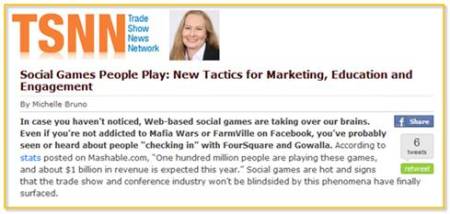
Michelle Bruno (@michellebruno) wrote an excellent article about social gaming in Trade Show News Network (TSNN.com) – I was interviewed by Michelle for the article.  Michelle covers the emergence of social games, including their incorporation into virtual events platform, like INXPO (my employer).

Michelle concludes her article with some compelling thoughts.  First, there’s this:

“As traditional methods of marketing and engagement wane in effectiveness and popularity, social gaming strategies fit nicely into two current trends in the event industry: the ‘social media-ization’ of nearly every technology solution and the blending of the online and offline event worlds.”

These trends play off one another nicely – as social media (and associated tools) are quite effective in blending online and offline event experiences.  I love Michelle’s closing line:

“Social gaming in the event industry could be the spark that ignites a new generation of trade show attendees.”

Love it.

Here’s the full link to the article: http://www.tsnn.com/blog/?p=2692

Tweet this posting:


From Virtual Events To Virtual Business Communities

May 31, 2010

Increasingly, virtual event planners are keeping their virtual events “open” year-round.  The model is evolving from a focus on the annual live event to a focus on the overall business environment, which has live events scheduled throughout the year.

Hence the progression – first, the virtual environment is kept open year-round (“Come in, we’re open”).  From there, virtual event planners become virtual community managers to evolve the environment into an active and engaged community.

Your virtual business community is quite similar to a social network (e.g. Facebook, Twitter, etc.).  Thus, look to those social networks for effective community building and networking tactics.

Content

“Traditional” content forms the foundation of your business community: on-demand webcasts, videos, documents, articles, etc.  That being said “non-traditional” content is what makes a community shine and prosper – it includes other members and their associated user-generated content (e.g. 1:1 and group chat, message boards, blogs and old-fashioned community discussion).

Users may be drawn into your community for the professionally produced content – what makes them stay, however, are the connections with other members and the business conversations that unfold.

Draw them in – with Email

Some community sites (e.g. Facebook) are fortunate enough to have members login as their first stop on the web each day – today, it’s not likely that a virtual business community can achieve the same loyalty.  The key, then, is to provide community members with reasons to return, login and participate.

Email may be considered old fashioned by some, but it still works.  Want proof?   Look no further than Facebook, Twitter and LinkedIn, which all use email effectively to notify members of activity and bring members back into the community.  Examples:

  1. Facebook – I receive email when a Facebook friend has commented on my Wall posting – additionally, when I submit a comment on a friend’s posting, I receive email when subsequent comments are posted.
  2. Twitter – I receive email when new users follow me on Twitter; in addition, when a user sends me a “direct message” (DM), I receive an email with the text of the DM.
  3. LinkedIn – When I comment on a LinkedIn Discussion thread (in a LinkedIn Group), I can opt in to receive email notifications on subsequent comments posted.  This way, I’m instantly notified as other group members comment on my comment, with the email containing the text of the submitted comment.

For your virtual business community, utilize similar email notifications to alert members of new activity and draw them back in to the environment.

Once they’re in, keep them Engaged

Now that you’ve successfully drawn members into the community, keep them active and engaged.  Build tools like the Facebook Status Bar:

The Notification component of the status bar is an area that I check each time I login to Facebook – I want to know who’s “liked” my comment, picture, video or link – and what they wrote about it.

Notifications keeps you engaged once you’re in – and can even serve to draw you there (in the first place).  I occasionally login to Facebook solely to check for new Notifications!

Mobile Integration – Draw them in, from their device

Facebook, LinkedIn, Twitter, Foursquare, etc. provide a variety of mobile apps, developed by the companies themselves and by third party developers.  With mobile apps and mobile clients, members can stay constantly connected to their social networks and communities – they can always stay “in touch”, literally and figuratively.

With a virtual business community, mobile integration does not need to be about 3D spaces, multimedia or immersiveness – things we often associate with virtual events and virtual worlds.  Some day, we may be able to experience full immersiveness on a mobile device.  But in a business community, it’s more about user-to-user connections at a more basic level – e.g. the likes of Twitter @replies and Facebook wall discussions.

Conclusion

Our industry still centers around the occasion-based virtual event – as event planners begin to morph into event-based community managers, they’ll need to map out tools and technologies to keep their communities active, engaged and coming back.  Should be a fun ride.

Tweet this posting:


Virtual Events In Europe: Best Practices, Learnings And Observations

April 19, 2010

The following is a guest post from Miguel Arias of IMASTE.

In the past months we have delivered a virtual career fair in partnership with Monster.com in various European countries. After a number of successful events in France, United Kingdom, Ireland and Italy (and with the imminent launch of the German version and preparations underway for the Polish and Czech versions), it is time to evaluate the project.

With a reach of over 400,000 unique attendees and more than 200 participating exhibitors to date, the Monster European virtual job fairs have become a very relevant case study about the way virtual events and tradeshows are being hold in Europe.

There are a few issues that I would like to point out:

Market differences within Europe

The fact that each of those markets has a different language is a known fact, which demands a certain level of customisation capabilities in the virtual event platform. This affects not only the code language but also all the 3D environments, interfaces size, fonts, etc.

And some of the countries have many official languages; therefore virtual event platforms need to have “real time” Multilanguage capabilities.

But, there are some other subtle differences that may have a big impact for virtual event production and development. For instance, legal differences lead to changes in the résumé data model and in different levels of integration with the partner´s databases.

Different customer expectations

The penetration and market awareness of virtual events is different in the UK, France and Italy. This leads to relevant gaps in terms of pricing, willingness to pay or expected features for the potential customers in each of those countries. Live interaction seems to be more relevant in UK or France, while an immersive user experience ranks higher in the Italian market.

We have also observed that French companies are keener to virtual stand customisations than British companies. It is difficult to generalise, but there seem to be some trends there.

Different marketing approach

In line with the last idea, the effectiveness of some marketing tools is quite diverse. The use of social media to promote the event has proven more successful in our French events than in other countries, while the effect of SEO/SEM strategies have worked better in UK. There is a need of knowing which are the best specific web traffic drivers of each country, to ensure high quality attendees in each event.

Vendor – client relationship

Since virtual events are “live” events, there is a need of a common trust between the event producer and the virtual event vendor. In order to build this relationship, factors like distance, time zone sharing and face-to-face trainings, meetings and follow up are very relevant.

We hired native country managers in Imaste for the French and British market, and will be doing the same with the Italian and German market in the following weeks.

To summarise, I would say that, the Monster Virtual Career fairs, in spite of being delivered for the same company and being the same type of event, implied an important percentage of adaptation and flexibility in each country. And the personal relations that go with a good level of service, involve a cultural understanding of country related particularities.

I believe that Europe can’t be considered a homogeneous market as the US is. American vendors should take this into account when entering the continental Europe market.

About Miguel Arias

Miguel Arias founded IMASTE in 2003 in hopes of building a bridge between companies and university graduates via live career fairs. Over the years, IMASTE has evolved to become one of the major agents in the virtual trade shows and events market, with successful projects in various European and South American countries

IMASTE is a Spanish company, European leading provider of virtual events, 3D online environments and online trade-shows, which connect, inform and engage visitors and exhibitors. IMASTE´s customized solutions reduce travel costs and are environmentally friendly, while our customers are able to generate leads, networking, increase online sales chances and communicate projects or services globally.

IMASTE has delivered more than 100 successful virtual events for global clients across the globe. You may find more info in http://www.imaste-ips.com

Miguel holds a MEng in Civil Engineering from Universidad Politecnica de Madrid and a Professional MBA from the Instituto de Empresa Business School.

Related links:

http://www.monster-edays.fr/2010/printemps/

http://www.monstervirtualjobfair.com/DEMO/

http://www.fieralavoromonster.it/

http://blog.imaste-ips.com

http://www.imaste-ips.com


2010 Trend Watch: Virtual Events

February 25, 2010

Source: flickr (User: b.frahm)

For the virtual events industry, the premier face-to-face event of the year is Virtual Edge Summit, the “summit on virtual events, marketing & communities”.  Virtual Edge 2010 concluded earlier this week – the face-to-face event floored in Santa Clara, CA, while several vendors provided virtual components, allowing remote (virtual) attendees to participate in the experience.  The event saw record crowds from attendees, exhibitors and presenters.

From my observations at this year’s event, the following are a set of emerging trends in the industry.

Beyond Novelty Phase

Judging by the turn-out alone, the virtual event industry has officially “graduated” beyond the novelty phase.  Awareness of virtual events has broadened – now, when I meet someone at a social gathering and describe what I do for a living, the blank stare of years past has become a “oh yes, I’ve attended one of those”.

The increase of awareness (and, perceived importance) could be seen in the amount of coverage that Virtual Edge 2010 received – an increase in the number of publications (on-site), bloggers (both on-site and virtually) and analysts (both on-site and virtually).  Lastly, the volume of tweets (via hash tag: #ve10) was 5-10 times greater than last year – with more tweets per person and many more people tweeting.

With that being said, there are enormous untapped and unexplored markets, which will provide the industry much of its growth in 2010 and beyond.

More Players Emerge

I noticed a near doubling in the number of exhibitors this year, which means that new/emerging vendors significantly developed (or expanded) their virtual event capabilities – or, from a marketing standpoint, they determined it was the right time to get their products and services in front of this audience.

Last year, the exhibitors were fairly homogeneous – they provide apples-to-apples solutions and directly compete with one another.  This year, the breadth of solutions offerings (from the exhibitors) has expanded – some exhibitors do not necessarily compete directly with one another.

In some cases, a client may use one vendor for a particular type of virtual event and a different vendor in another type of event.  The result?  More “burden” on the attendees (buyers) to understand the solutions offered and determine which solution best fits their needs.  This affords some  industry players (agencies, consultants) a great opportunity to help clients and prospects navigate the waters.

Early Adopters Become Industry Thought Leaders

Practitioners (especially some of the early adopters in our industry) are quickly becoming the thought leaders and “go to source” for ideas, expertise and wisdom.  Many of these thought-leading practitioners were on stage this week – they were very generous with their sharing of experiences.  And, more than ever, they know precisely what they want from their vendors (which is a great thing for those in the vendor space).

In the early days, the practitioner would ask the vendor, “show me what you have” or “show me what you can do’.  Today, the tables have been turned.  Practitioners (clients) are now telling the vendors, “let me tell you what I need” or “make this experiential vision come to life for me”. This is an important aspect of the industry’s evolution – vendors crafting innovation via direct input from practitioners (as opposed to creating “innovation in a vacuum”).

3D Immersiveness

Interest in 3D immersiveness is picking up.  In fact, at Virtual Edge this year, roughly 20% of the session content involved 3D / immersiveness and a formal “Business 3Di” track was created.  The 3Di track featured practitioners, along with vendors such as Linden Lab, Teleplace, Altadyn, Digitell and web.alive (Avaya).  Like last year, Digitell provided a simulcast of the event proceedings into their 3D immersive platform (VirtualU).

Those are the “pure play” immersive environments.  In addition, virtual event platforms are coming on board as well.  In my 2010 predictions on virtual events, I wrote, “(virtual event) platforms take first step towards immersiveness”.  This prediction has come true.

It’s interesting, however – some vendors have a clear vision of what immersiveness enables for exhibitors and attendees of virtual events, while others appear to be adding immersiveness for the sake of adding it (i.e. lacking a clear and compelling use case).  It’s in the best interest of virtual event vendors to explore and enable immersiveness via specific client use cases – this way, the capabilities are added to meet a client need – and, serve as a reference (to the rest of the industry) on the true value delivered via immersiveness.

Social Media Integration

2009 was a monumental year in the evolution of both social media and virtual events.  In 2010, there continues to be a lot of talk about both topics – including discussion around how they integrate with one another.  Social media (and related social networks) were central to the discussion in many workshops and breakout sessions.

And of course, social networking was flourishing in and around the event, with a high volume of tweets, a fair number of Facebook status updates and (I’m sure) lots of LinkedIn connections made.  While I am not aware of any groundbreaking announcements from Virtual Edge on social media integration, I’d expect that platforms enable more and more social networking as 2010 unfolds.  I expect to see the platforms themselves becomes more social (natively) and increase the depth of their integration with third party social networks.  Twitter, Facebook and LinkedIn are commonly mentioned – but expect to see industry-specific, niche networks and communities integrated as well.

Industry Ecosystem Begins to Take Shape

Virtual event platform vendors have established a number of strategic partnerships to extend account/client reach and grow/scale business opportunities.  Most of those partners were present at Virtual Edge – and a number of partners had prominent speaking roles in the sessions.  By this time next year, even more partners will enter the space and appear at the event.

Additionally, smaller businesses (and individuals as well) are seeking to leverage opportunities within virtual events to bring in new business – or sign on for consulting roles.  The list includes video production companies, design agencies, digital signage providers, freelance producers/writers/story-tellers, streaming providers and emerging social network / community sites.  As these “players” look to get a small piece of the industry pie, they serve to grow the overall ecosystem of this industry.

Finally, hands-on practitioners are finding a fluid and welcoming job market, despite the less inviting macro job environment.  Virtual events are still new enough that production staff, developers and strategic consultants have highly specialized knowledge and skills – as such, they’re able to quickly transition from their existing (or past) role to a new vendor, service provider or practitioner (client side).  Most of the vendors in the space are aggressively hiring, which means that savvy job seekers leveraged the conference to generate meaningful employment leads.

Conclusion

It’s an exciting time in our industry – I’m looking forward to seeing how things shape up for Virtual Edge 2011.

Tweet this posting:


How Virtual Events Can Adopt Location Based Services

January 28, 2010

These days, it seems the social web is like real estate – it’s all about location, location, location.  Foursquare, Gowalla and Loopt are gaining popularity as location based, mobile social services.  Yelp has rolled out Yelp Check-ins, which mirror a popular activity on the aforementioned services.  Twitter added location awareness to its API in 2009.  Facebook, some speculate, may enter the fray with their own location based services.

So how would it be possible to enable Location Based Services in a virtual event?  Well, consider that location tracking is inherent to the virtual event platform – in other words, it has a built-in GPS for all users!  I wrote previously about gaming in virtual events – that gaming can generate  retention, engagement, enjoyment and loyalty.  Location Based Services, in the form of competition and gaming, can achieve all of these benefits.  Let’s take a look at how.

Source: flickr (User: dvxfilmerdoug)

It Starts With The Buddy List

Users first need to build their social graph.  This can be accomplished with a virtual event platform’s “buddy list” feature – all users in your buddy list would receive status notifications from the location system.  The notifications would be sent to users within the virtual event (if you’re logged in).  Once you log out, you can opt to receive status notifications via email.  This way, even if you’re no longer in the event, you can receive updates (via email) on what your buddies are up to.

Build A Reward System

Next, a reward system serves as an incentive for users to participate.  The concept is similar to the becoming “mayor” of a location on Foursquare.  In a virtual event, perhaps you allow privileged users (who have achieved a certain status) to obtain a badge – whereby the badge can superimposed on their avatar image – or, listed on their profile page.  In addition to the badge system, a master leaderboard (and perhaps segmented leaderboards) should be utilized, allowing users to track their performance relative to other users.

The Virtual Trade Show

First, the notion of a social graph in a virtual trade show may be an upfront challenge.  At most trade shows, you may know a handful of colleagues or associates who are also attending – but for the most part, everyone else is a stranger (to start).  Thus, a system may need to be in place first to encourage users to add other users to their buddy list.

Assuming you can achieve decent-sized buddy lists, then the “check-in” becomes quite relevant in a virtual trade show.  Each visit that I make to an event area can be tracked (by the platform) as a check-in – allowing my buddies to know what areas I visited – and, where I am right now.  Secondly, I might leave a review or comment about a particular area – perhaps I enjoyed the content in an exhibitor’s booth – or, I didn’t find a Webcast to be all that useful.  When my buddies enter those same areas, they can then view the comments I left them from my prior check-ins.  Thus, when a buddy enters the same exhibitor booth, she knows that I visited earlier and enjoyed the content there.

Exhibitors could then sponsor areas of the event (besides their own booth) – the Lounge, Auditorium, Resource Center, etc.  Then, attendees can vie to become the “mayor” of a given area.  At the end of the live event, perhaps the mayor of the Lounge receives a prize that’s awarded by the Lounge’s sponsor – and to receive the prize, agrees to have a short conversation with that sponsor.  Already, you can begin to see how this location “app” can generate additional activity and engagement.

Source: flickr (User: Live Solutions)

The Virtual Sales Conference

In a virtual sales conference (and related corporate events), attendees naturally have a large list of potential buddies – the trick is to incent the attendees to populate that list within the virtual event.  Alternatively, management may choose to pre-select the buddy lists by organizing the sales force into teams – whereby your buddy list is pre-seeded with your fellow team members.  The location app is all about checking in (with each other) and sharing information towards gaining points for your team.  In this manner, the location app helps encourage learning and collaboration, making the virtual sales conference more effective.

Social Networks

For certain types of events (e.g. virtual trade shows), integrating the location system with users’ social networks can be powerful.  For instance, a check-in to the keynote presentation can auto-generate a tweet out to the attendee’s Twitter followers – providing a registration link to the event.  Similarly, a check-in at an exhibitor’s booth may prompt the user whether she wants to post an update to her Facebook wall.  In summary, the location service should facilitate sharing not just within the virtual event, but to external social networks as well.

Prevent Gaming (of the System)

The virtual events platform will need to carefully build the measurement and scoring methodologies to ensure that the “game is not gamed”.  In the real world, there is overhead involved in becoming the mayor of a watering hole – in the virtual world, clicking 50 times to enter an exhibitor’s booth is quite easy.  The scoring system ought to consider rate limits, as well as threshold values around selected activities.  Additionally, becoming “mayor” should factor in actions that are not as “game-able” as mouse clicks or visits.

Conclusion

There’s  probably a lot of work to enable the underlying platform to accomplish this – however, such a system can go a long way to achieving retention, engagement, enjoyment and loyalty.

Tweet this posting:


To Promote Your Physical Or Virtual Event, Think Outside The Inbox

November 21, 2009

Source: flickr (User: Mzelle Biscotte)

For many, email is a constant stream, an endless loop – we receive too much of it, both “important” emails addressed directly to us and marketing emails that are sent as a result of opting in (or not) to past content, webinars, white papers and marketing lists.  Outbound, push-based email promotions face the following challenges:

  1. Imperfect delivery rates (mail server outages, spam filters, etc.)
  2. Decreasing open rates
  3. Perception of spam – if recipients don’t remember opting in to your list (even though they did), they’ll ignore your email – or, opt out from your list
  4. List fatigue due to overuse of marketing lists
  5. Decreasing click-thru rates (CTR) – once you’ve made it past delivery and open, recipients are clicking less on your embedded offers

Adding to this mix is the fact that many users now interact with brands (and by extension, promotional offers from brands) via their social networks, instead of email.  A user is more inclined to respond to an @reply or direct message (on Twitter) compared to a conventional email blast from a marketer.

Given all this, it surprises me that email is still a primary vehicle for promoting physical and virtual events.  Event marketers have much to gain by thinking outside the inbox.

Social media and social sharing

Your first step outside the inbox should be in the direction of social networks.  Build a presence in social communities and you’ll find that you naturally generate interest and awareness to your event.  Previously, I wrote about leveraging Twitter to promote your virtual event.  As Ian McGonnigal (GPJ) astutely pointed out, those same tactics apply quite well to physical events as well.

In addition to Twitter, consider the following:

Create a LinkedIn Event entry for your event

  1. Create a LinkedIn Event for your event – a LinkedIn Event page allows you to post relevant information about your event on LinkedIn (e.g. date, event content, etc.) – LinkedIn members can then indicate whether they’ll be attending, not attending or “interested”.  This can be quite useful, as folks often attend events based on knowing whom else will be attending.  By creating a LinkedIn Event, you’ll receive the benefit of having LinkedIn auto-recommend your event to other members, assuming their profile is a “match” with the profile of your event.  Members may also utilize search and find your event.  More info can be found on the LinkedIn blog page announcing the Event feature.
  2. Post videos to YouTube – it’s the #2 search engine after all (behind parent Google), so having event videos posted on the site will generate traffic from the millions of folks who visit YouTube.com each day.  Record videos of your host, keynote speaker, group publisher, etc. talking about your upcoming event – if your keynote speaker has a prominent name, your videos will attract interest from users who search on that name.  When you have a critical mass of videos, create a YouTube channel.  About.com has a neat guide on how to do just that.
  3. Create a Facebook Fan page for your event – with a fan page, you’ll generate interest for your upcoming event – and, you’ll build an ongoing community that you’ll be able to continuously leverage!  The All Facebook blog has a nice guide on how to build a Facebook fan page.
  4. Leverage blogs – author a blog posting on your corporate blog – or, if you don’t have one, ask a relevant industry blog site whether you can author a guest posting.  Alternatively, leave a comment on postings from relevant industry blogs with a pointer (link) to your event.  The key here is not to over-promote your event – your first goal is to provide useful and relevant content/commentary with your event being a secondary (and subtle) mention.

SEO and in-bound links

If you pay attention to search engine optimization (SEO), your event page(s) will receive “organic” traffic – that is, traffic that finds you, rather than you finding the traffic (i.e. the “pull” from users searching, rather than the “push” from your email promotions).  Think about the search keywords that you’d want to associate with your event [e.g. when users are performing searches] and make sure the content on your event page is rich in those keywords.

To increase the page rank of your event page, increase the number of inbound links that point to your page.  A few simple ideas:

  1. For all of your social media efforts (listed above), make sure they provide links to your event page – shazam, you’ve just created a number of inbound links
  2. For event staff (especially those with large followings on Twitter), ask them to temporarily point the “web site” URL in their Twitter profile to the event page
  3. Ask partners, associates, even clients to post a URL from their web site(s) to your event page
  4. Add a “Share on Facebook” capability on your event page – this may result in page rank benefit as search engines begin to index Facebook wall posts – until then, what this really does is generate awareness and outreach of your event to users’ Facebook friends.  If a potential attendee visits your event page and shares the page with her 100 Facebook friends, then you’ve just received 100 free advertising impressions

Advertise

Some affordable options to consider:

  1. Facebook advertising – purchase targeted ads on Facebook.  For a physical event, you can target by geography (e.g. starting with users who are geographically close to your event site).  For a virtual event, geography is less important, so you may want to target based on attributes in the users’ Facebook profiles.  You can pay per view (of the ad) or per click (on the ad), so the terms are flexible.  eHow has a good overview on Facebook advertising.
  2. Content syndication – purchase web syndication with online publishers in your industry – get your event listed in their directories, content sites, etc.  They may charge you per click or per lead (completed registration).  Not only can this generate registrants for your event, but it also improves your page rank by generating more inbound links to your event page.

Hopefully I’ve covered a few “outside the inbox” options for you to consider – certainly continue to promote your event via email – however, use some of these options to lighten the load a bit on your email marketing lists.


The Social Media Landscape

November 9, 2009

I get a lot of enjoyment following trends and developments in social media and social networks – it’s an exciting time, with things moving so quickly.  Keeping up with the pace of change is part of the fun.  I’ve written a blog posting over on the InXpo blog – where I cover some recent developments in social media:

  1. Twitter Lists
  2. Social Search
  3. Inter-connectedness
  4. Mobile

blogposting_img

The blog posting is titled, “Making Sense Of The Ever-Changing Social Media Landscape“.