Virtual Events For Online Dating

February 21, 2009

Source: Match.com

Source: Match.com

The Internet Dating industry has a conference called iDate.  This year, iDate 2009 is scheduled for Los Angeles, London and Miami.  The event is billed as “the largest conference that covers the business management for the Internet Dating and Social Networking Industries.”  iDate has launched a virtual conference to complement their physical events [see press release].

Perhaps at the iDate 2009 events, industry players can collaborate on leveraging virtual event platforms to faciliate online matchmaking.  What are some of the challenges of online matchmaking today?

  1. Interaction is via asynchronous messaging (either via email – or, via messaging within the service’s web site)
  2. You never get to learn much about potential mates besides what they’ve chosen to provide in their online profile
  3. You’re never sure if that uploaded picture is “true” – for singles of a more advanced age, perhaps the picture is one from 10 years ago
  4. You don’t truly get a feel for your potential mate prior to a phone call or in-person meet-up

So for the likes of eHarmony, Match.com, Yahoo Personals, etc. – why not organize virtual events for online matchmaking!  There would be numerous benefits:

  1. The game changer: webcams – require all participants to utilize a webcam.  Without one, you truly won’t know who’s on the other end of a chat window.  With one, you’ll be able to discover whether the picture (that attracted your attention) matches up with the individual who uploaded it.  And, you’re able to interact via spoken word to other attendees – and see their facial expressions.
  2. Global access, from home – the event would have elements of a physical meet-up, but attendees could participate from anywhere.  That being said, regionalized virtual events may be necessary, to facilitate match making of individuals within close geographic proximity.
  3. Profile matchmaking – some virtual event platforms already have this feature – for online dating, this is the secret sauce that differentiates one service over another.  For an eHarmony, perhaps they integrate their sophisticated algorithms into the event platform, so that attendees can be paired up in the virtual event like they are on eHarmony.com.
  4. Speed dating via webcam – facilitate five minute private webcam sessions between two attendees – after which, they’re rotated to brand new webcam partners.
  5. Post-event data portal – after the event, participants can login to a personalized web-based portal, where they can review all the interactions they had with other attendees.  If you met over 20 people online, you might need such a feature to remember whom you really liked!
  6. Find mates by observing – topical chat rooms could be organized (e.g. Music, Sports, Food, Travel), where attendees could congregate to chat about their hobbies and interests.  The chat need not be restricted to text – some platforms support multi-webcam rooms, where participants can speak and see the other participants.  By observing, one might find someone interesting/attractive – and later on, you can connect with that person privately (e.g. in a 1-on-1 chat).

For the online matchmaking service providers, virtual events provide a nice up-sell opportunity to complement subscription-based revenue.  To avoid canibalization of the subscription business, perhaps you only allow access to the virtual event for existing subscribers.

The virtual events could also serve to generate new subscriptions – imagine tying the event into Facebook’s ~175MM active users via Facebook Connect.  Attendees could see which of their Facebook friends are in the event – and, post updates back to their Wall, driving new users into the event (and hence, new subscriptions to your service).

So, time to get moving – millions of singles across the globe await!


Product Comparison Guides 2.0

February 20, 2009

In the world of Enterprise IT, sales cycles for IT products and services tend to be long and complex.  Decisions are made by committee (vs. by an individual) and the process follows an extended cycle that begins with problem definition, progresses to vendor selection and arrives at a final destination of price negotiation and purchase.  Once the problem has been defined, the committee identifies the set of vendors who provide applicable solutions.

It’s at this stage where technology publishers can often help, with the publication of product reviews and comparison guides.  Here’s an example of a product comparison guide for Hosted CRM, published by InsideCRM.com:

Source: InsideCRM.com (partial view of comparison guide)

Source: InsideCRM.com (partial view of comparison guide)

So this is Product Comparison Guide 1.0.  For version 1.5, you might host this guide on a web site (rather than a PDF) and allow readers to click over to the vendor’s web site — perhaps the vendor’s product page for their Hosted CRM offering.  Maybe you host a registration page and drive sales leads to the Hosted CRM providers.

Now, let’s take it to the next step.  Product Comparison Guide 2.0 is an interactive community site that’s powered by a virtual event platform.  Let’s imagine the same Hosted CRM guide – published as an SEO-friendly HTML page.  Perhaps you leave the high level product information on this page – just enough to entice the reader to continue.  The purpose of this page, then, is to drive traffic into your interactive comparison guide.

Once a user enters the interactive site, you collect some basic demographic information – enough to uniquely identify the user (and contact her), but not too much that the user abandons and leaves your site (e.g. first name, last name, title, email address).  And now, the full product details behind each solution is provided not by you – but, by the vendors themselves – in their product showcase virtual booth!

Within the booth, a vendor might provide:

  1. Detailed specifications about the product
  2. White Papers that describe how the product solves a given technology challenge
  3. Case Studies that describe how customers have used the product
  4. On-Demand Video and Webinars related to the product
  5. Sales and Marketing staff who staff the booth during business hours
  6. Group chat to allow visitors to interact with the vendor – and with each other

Especially in this economic environment, decisions on IT purchases are not taken lightly, even if the offering is a SaaS solution like Hosted CRM.  And what better way to connect with qualified sales prospects than engaging with them while they’re reviewing the solution space?  Having a user enter your staffed booth (to engage with you)  is a much stronger proposition than sending them to your corporate web site to peruse your content.

So vendors “win” in this scenario.  The publisher also wins!  The publisher can sell sponsorships of Product Comparison Guide 2.0, allowing vendors an assortment of features in the environment (e.g. vendor booth, advertising placements, speaking opportunities, etc.).  I’m sure that most vendors listed in your Product Comparison Guide 1.0 (that SEO-friendly web page) will feel pressured to have a virtual booth in the interactive environment – after all, what happens when users click into the environment and interact with your competitors?  Your absence results in a lost opportunity.

With Product Comparison Guide 2.0, the jobs of buyers and sellers now become much easier.


How To Market Your Virtual Event

February 18, 2009

marketing_sherpa

MarketingSherpa published an excellent primer on Virtual Event Marketing.  The 10 tactics listed were:

  1. Partner with assocations
  2. Invest in PR
  3. Get exhibitors involved
  4. Advertise on relevant web sites
  5. Market to internal email database
  6. Email registrants the day before and the day of an event
  7. Use social media to attract attendees
  8. Emphasize the value of the event
  9. Use the virtual event’s microsite
  10. Use sweepstakes as an incentive

Based on my involvement in marketing virtual events to an Information Technology (IT) audience, I’d like to add the following:

  1. Promote early and often – get your microsite launched up to 2 months prior to the live event.  Time is critical, because it gives you options to try different tactics, measure response rates and adapt accordingly.  If you leave yourself too little time, your flexibility is limited and your registrations will suffer.
  2. Invest in search engine optimization (SEO) – make sure your registration page and microsite are optimized for SEO.  For more insights into SEO for virtual events, see this blog posting: https://allvirtual.wordpress.com/2009/02/02/search-engine-optimization-seo-for-virtual-events/
  3. Invest in search engine marketing (SEM) – just like you’d buy keywords to drive visitors to your corporate web site – figure out which search terms are relevant to your virtual event and spend a little of your budget purchasing search engine keywords to drive clicks to your virtual event microsite or registration page.
  4. Use interactive technologies to draw attention – with the amount of email received by your target audience, it’s harder and harder to stick out from the crowd.  To do so, use interactive visuals like a screencast (to give users a sneak preview of what your virtual event environment looks like) or a short video clip embedded within an HTML email.
  5. Use a variety of promotional vehicles – email is the most heavily used, but not all of your users pay attention to promotional emails.  So try display ads, placement in e-Newsletters, text links on publisher web sites and sponsorship of relevant sections of web sites.
  6. Highlight the prominence of expert speakers – in some industries, a well-known speaker can generate the audience all by herself.  If you’ve secured such a speaker, be sure to promote her prominently.  In fact, use her name right in the Subject heading of your promotional emails.
  7. Highlight the ability to interact with executives and experts – once you landed that expert speaker, invite her to participate in the virtual event after her speaking appearance.  In fact, in lieu of a Q&A after the Webcast/Videocast, have her appear in the Networking Lounge to answer questions there (via text chat), interacting directly with the audience.  In addition, invite your executives to participate and interact with the audience.
  8. Display the list of exhibitors – as you sell sponsorships, display the list of companies who will be exhibiting.  That may convince some users that they need to attend – what better a way to narrow your purchasing decision than to “meet” with the candidate solutions providers in one fell swoop?
  9. Provide a sales contact for potential exhibitors – some registrants of your virtual event may represent companies who’d like to exhibit (sponsor).  So give them an email address or phone number and you might have just sold an additional sponsorship.

What has worked well in promoting your virtual events?


Virtual Events 101 For Corporations

February 16, 2009

Some of us learn through observation – and I’ve had the privilege of observing (and learning from) many corporations in their use of virtual events and virtual worlds. First, I will provide “newbie” corporations with some pointers on how to best leverage virtual events (by way of links to some past blog posts).  Then, I will summarize some recent examples of virtual events (and virtual worlds) by corporations – all of which I admired.

How to Leverage Virtual Events

  1. Get closer to your customers – by understanding customers’ current challenges (which may differ from the challenges they faced when they originally purchased your product), you can create solutions, make your customers more satisfied and generate additional revenue (https://allvirtual.wordpress.com/2008/12/16/get-closer-to-your-customer-with-virtual-tradeshows/)
  2. Launch your next product – whether you complement your physical launch – or, do it exclusively online, the virtual event platform allows you to conveniently launch your next product online to a global audience – and, track all the interactions generated with customers, sales prospects and analysts/press (https://allvirtual.wordpress.com/2008/12/22/launch-your-next-product-online/)

Virtual Events: How Corporations Are Leveraging Them

  1. Quest Software produces an annual virtual event titled Quest Connect to provide information on their products and services (https://allvirtual.wordpress.com/2009/01/02/marketers-as-event-organizers/)
  2. Lenovo utilized Nortel’s 3D-based web.alive platform to drive interest and product sales of its laptops during (and after) CES 2009 (https://allvirtual.wordpress.com/2009/01/08/review-lenovos-elounge-virtual-world/)
  3. Adobe held a virtual product launch in Second Life to complement their real-world launch of eLearning Suite (https://allvirtual.wordpress.com/2009/01/25/adobes-real-world-launch-is-suppplemented-with-virtual-launch/)
  4. Trend Micro teamed with Virtualis to host an internal training event titled Trend Technical University in Second Life (https://allvirtual.wordpress.com/2009/02/05/virtualis-and-trend-micro-put-on-quite-a-show/)
  5. VMware launched an online companion to their physical VMworld conference, running on Jive Software’s platform (https://allvirtual.wordpress.com/2009/02/07/vmworld-complements-physical-conference-with-virtual-conference/)

So if you’re a newbie on virtual events, read up on what these companies have done – and decide whether (and how) virtual events and virtual worlds can benefit your company.  Better yet, if you have ideas on new ways corporations can leverage virtual events, be sure to leave a comment below.  Either way, I’m excited to see and hear about the new things that are in store.


VMworld Complements Physical Conference With Virtual Conference

February 7, 2009

VMworld

Source: VMworld

What do you do when you produce the world’s leading virtualization conference?  You make it better, of course!  VMware teamed with Jive Software to take the once-per-year VMworld conference and extended it (online) into a 365-day-per-year, always-on community.  A Case Study on this initiative can be found here:

http://www.jivesoftware.com/customers/case-studies/vmware

And this quote from Eric Nielsen of VMware sums it all up:

We expanded the VMworld conference from a three day event for 15,000 to a 365 day/year destination for 50,000 virtualization professionals.   — Eric Nielsen, Director of Web Communities, VMware

So that’s a triple play for VMworld – by complementing their event online, they’ve generated a more than 3x increase of participating virtualization professionals.  As quoted in the Case Study, the VMworld.com community has 35,000 active members, generates 35,000 page views per day and 2,000 video views per day.

Quite an impressive level of activity.  A clear example of an active community at work – 35,000 page views (in a single day) is hard to come by with traditional b-to-b content.  However, in a highly active social community, the blog posts, discussion board entries, podcast downloads, video views, “ask the expert” questions, etc. – all contribute to traffic generation.

Just have a look at the volume of Discussion Board traffic:

VMworld.com - Discussion Board

Source: VMworld.com - Discussion Board

Now that’s an active community at work.  But there’s a chicken and egg problem – how do you generate an active community in the first place?  Well, the organizers of VMworld.com made the wise move to integrate a full suite of social networking tools – essentially building a mini-Facebook around the conference.  Tools available include:

  1. Discussion Boards
  2. Podcasts – both those produced for the conference, as well as third party / external podcasts
  3. Integration with social networking sites (e.g. Facebook, Twitter, etc.)
  4. Blogs – both in-house and third party
  5. Ask The Expert sessions and content
  6. Video
  7. Photo Wall (with pictures from the physical event)

VMworld.com also leveraged neat tools within Jive Software’s platform to encourage activity.  For instance, on a blog post, a user can click on “Watch This Blog Post” and be notified when comments are appended to that post.  Additionally, most content pages have a left-hand sidebar titled “More Like This”, which certainly encourages additional clicks and page views (it worked for me!).

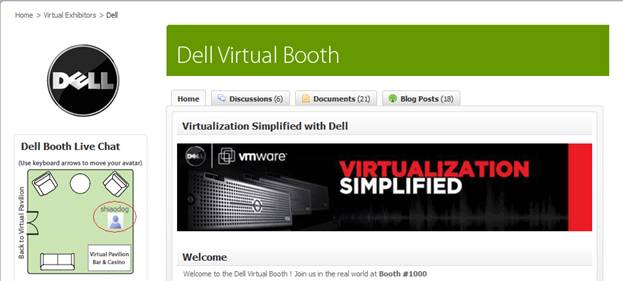
VMworld created virtual conference sponsorship packages for exhibitors, with pricing discounted if you’re already exhibiting at the VMworld physical conference.  3D style booths are planned – the current community features 2D style booths.  Here’s the Dell booth:

VMworld.com - Dell's Booth

Source: VMworld.com - Dell's Booth

This shows the top third of the booth – below it is Dell content, along with community content (blogs, discussion posts, etc.) around Dell topics. You’ll notice a “floor map” of the booth, which shows the physical location of my avatar.  Users utilize the arrow keys on their keyboard to move around within the booth.

VMworld Europe “floors” later this month (February 24-26) in Cannes.  If you’re lucky enough to get to Cannes, enjoy the show.  If you’re not able to attend, then go online and enjoy the online networking.  Registration for VMworld Europe can be found here:

http://vmworld.com/community/conferences/europe2009/


Search Engine Optimization (SEO) For Virtual Events

February 2, 2009

Flickr (martin.canchola)

Source: Flickr (martin.canchola)

These days, any publisher of information on the web is very keen to Search Engine Optimization (SEO).  If you build it (SEO) into your pages, they will come.  If you don’t, then you’re missing out on page views.  But, with all the effort we place on optimizing our web sites (e.g. corporate web sites, content sites, social media sites, etc.), how much SEO effort do we put into our virtual event pages?  I get the feeling that the answer today is “not much”.

For the external (non-private) virtual event, show organizers and exhibitors often judge success based on the number of registrations, attendees and interactions.  Basically, “the more, the better”.  However, what’s the largest source of registrations for most virtual events?  Outbound email promotions to (usually) large lists of users – where you’re hoping that some percentage of users open your email, click on the email and convert into a pre-registered attendee.  Very low on the list today is organic traffic from search engines like Google, Yahoo or MSN.

So the opportunity is quite large – improve the SEO of your virtual event and you can make a big impact on registrations, attendees and exhibitor satisfaction.  But where to start?  Well, first identify the pages on which to apply your SEO tactics.  For a virtual event, we’re usually talking about the microsite that describes your event – date, hours, speaker bios, etc..  The microsite often has separate tabs to list the event’s agenda, existing exhibitors, contacts for sponsorship info and (importantly) the event’s registration page.  All of these pages/tabs should have SEO applied.

A nice overview on SEO is titled “Search Engine Optimization 101” by Marketleap, a division of Acxiom Digital.  You’ll want to apply some of the basic concepts discussed here – including the right content on your virtual event pages; the use of meta tags; how to write good titles and strategic use of keywords.

Next, you’ll want to foster in-bound links to your virtual event microsite.  Promote the virtual event on your corporate web site (with a link).  Place links to the virtual event in your social networks (e.g. Twitter, Facebook, Linkedin, etc.).  Find blogs related to your industry and leave comments there.  Don’t blatantly promote your virtual event in the blog comment, but refer back to it (e.g. when leaving the comment, have your name be hyperlinked back to your virtual event’s microsite).  The more inbound links you can create, the higher your microsite will rank with the search engines.

Correction: comments you leave on other blogs can help with clicks (back to your blog), but do not help with SEO – most blog sites utilize a nofollow directive on the anchor tag, so search engines do not “follow” hyperlinks left in blog comments.

Finally, if your virtual event is not behind a registration wall (e.g. maybe it’s a 365 day, open environment), then make sure you provide “search engine friendly” content pages within the platform that search engine spiders can index.  Stay away from the Flash-heavy page and go with a flat, content-rich page.  Users will land here (from search engines), so be sure to provide easy navigation from this page to the main areas of the event (or environment).

For b-to-b virtual tradeshows, I’d estimate that well south of 10% of registrants are sourced from search engine traffic today.  Make it a goal at your next event to hit the 10% mark.  Your email lists will thank you.


Virtual Event Best Practices

January 23, 2009

With a number of virtual events on tap for 2009 (see the calendar of events here), marketers and exhibitors are busy preparing – assembling content for their booth, rounding up colleagues for “booth duty” and preparing the sales team for a burst of hot sales leads.  I’ve assembled past blog posts into a collection of virtual event best practices.  Without further ado:

  1. Bring the right people, have the right content (in your booth), perform the right actions and provide the right prizes (https://allvirtual.wordpress.com/2008/12/14/how-to-exhibit-at-b-to-b-virtual-tradeshows/)
  2. Utilize surveys to provide a deeper understanding of your customer prospects and generate insights back to your product management team (https://allvirtual.wordpress.com/2008/12/19/utilize-surveys-in-virtual-events/)
  3. Leverage Twitter – show-hosts can look to Twitter to expand the reach of the event’s audience and exhibitors can leverage Twitter to invite their followers to visit their booth at  the event (https://allvirtual.wordpress.com/2008/12/15/leverage-twitter-for-virtual-tradeshow-outreach/)
  4. It’s not always about “net new sales leads” – get closer to your existing customers (https://allvirtual.wordpress.com/2008/12/16/get-closer-to-your-customer-with-virtual-tradeshows/)
  5. Use treasure hunts to increase engagement (https://allvirtual.wordpress.com/2008/12/23/use-treasure-hunts-to-increase-engagement-in-virtual-events/)
  6. Have a process in place to handle the hot sales leads (https://allvirtual.wordpress.com/2008/12/31/how-to-handle-those-hot-virtual-tradeshow-sales-leads/)
  7. Utilize multiple metrics to judge success – Cost Per Lead (CPL) is the key metric for most marketers, but also consider other success metrics [e.g. quality of leads, conversion of inquiry to sales engagement, etc.] (https://allvirtual.wordpress.com/2008/12/28/what-cost-per-lead-cpl-should-i-pay-for-virtual-tradeshow-sponsorships/)

What best practices do you utilize at virtual events?  I welcome your input – feel free to drop a comment below.


Business Innovation: Powered by World of Warcraft

January 21, 2009

They’re called massively multiplayer online games (“MMOG”).  Hundreds (if not thousands) of users connect and “collaborate” in a game that’s held not just on the individual’s device, but online – where that individual is connected to all other players simultaneously.  World of Warcraft (aka WoW) is one of the more notable MMOGs out there.  In a BusinessWeek article titled “How World of Warcraft Promotes Innovation“, authors John Hagel and John Seely Brown discuss design features of the popular MMOG and apply those features towards business opportunities around innovation.  The authors list the “bottom-line lessons for executives”:

  1. Reduce barriers to entry and to early advancement
  2. Provide clear and rich metrics to assess performance
  3. Keep raising the bar
  4. Don’t neglect intrinsic motivations
  5. Provide opportunities to develop tacit knowledge, but do not neglect broader knowledge exchange
  6. Create opportunities for teams to self-organize around challenging performance targets
  7. Encourage frequent and rigorous performance feedback
  8. Create an environment that rewards new dispositions

For each “lesson” (above), the authors describe how it is applied in WoW – and, how the lesson can be applied to business innovation.  Now, let’s move from the world of MMOGs to virtual worlds and virtual events.  I’m a believer that if these same principles are applied to business-oriented virtual “communities”, that we can significantly empower (and generate) untold amounts of business innovation.

On the web, we already have communities of individuals who coalesce around any number of topics and interests – everything from iPhone enthusiasts in a Facebook group to a discussion forum about Tandy’s TRS-80 desktop microcomputer.  Members of these communities are quite engaged in their area of interest and tend to spend a lot of time online.  If provided with a platform that’s also engaging and online, it’s safe to say that they wouldn’t need much convincing to participate.

As such, it seems to me that the bulletin boards, discussion forms, chat areas (and even Facebook or Yahoo groups) of today may migrate (in the near future) to a hybrid virtual world/event, with more real-time interaction and engagement.  Let’s consider a business example.  Take any large corporation that sells its products and services via a “partner ecosystem”.  Much of this company’s revenue is generated from sales that are directly sourced by its partners.  But, how well are partners connected – and how often do they partner up (on their own) to create unique and compelling solutions?  If the answer is “not too often”, then an online medium, using principles drawn from WoW, may be a big win.

As seen in WoW, if a venue allows individuals to assemble, collaborate and generate actions (with a built-in reward and recognition system to motivate the participants), you find that progress, development and innovation fall out naturally.  Create the foundation and a house gets built.  Companies can leverage these online communities (aka virtual worlds) to tap into the Wisdom of Crowds and be able to crowdsource the next great product.  The crowd may give your next product the true WoW factor.


Economic Downturn To Spur Virtual Job Fairs

January 10, 2009

On Friday, the U.S. Bureau of Labor Statistics reported that the nation’s unemployment rate hit a 16-year high of 7.2%, with 11.1 million Americans out of work.  Many of the unemployed are turning to sites like Yahoo HotJobs, Monster.com, Dice.com and Linkedin.  With such a wide pool of available talent, companies looking to fill positions will receive no shortage of attention (and job submissions). While this is a good thing for the hiring companies, they’ll be challenged to efficiently filter through the submissions and find the right candidates for the jobs.

Let’s consider today’s dynamic for hiring companies:

  1. Large potential applicant base (11.1 million unemployed)
  2. Applicants are cash-strapped
  3. Hundreds (or thousands) of submissions generated for a given job posting

What’s a good solution to address this combination of factors?  The virtual job fair.  With the unemployed less likely to incur expense to attend a physical job fair, placing the event online means that you’ll attract a larger (and potentially global) audience.  And while you won’t be face-to-face with potential hires, there are plenty of advantages of flooring such an event virtually.

First, let’s consider your job at the job fair. While your ultimate goal is to source attractive candidates, it’s just as important to sell your company (amd the benefits of working there) to these candidates. Some possibilities to consider for the virtual job fair:

  1. Place detailed information about the job (and your company) in your virtual booth – supplement with external links (back to your corporate site)
  2. Invite senior executives to the event (not just the hiring manager, but the hiring manager’s manager) – including your CEO!  Your CEO’s participation is quite possible with a virtual event, but may not be practical at a physical event
  3. Invite employees who hold the same (or similar) position – and have them network with candidates
  4. Host presentations about your company (e.g. webinars)
  5. Include on-demand video in your booth – so that candidates can hear (and see) from your company representatives
  6. Host sesssions in the event that show candidates how your company operates.  For instance, if you’re supplementing your software development team, stage a developer meeting for folks to observe. Virtual worlds like Second Life or web.alive can facilitate such a session. 

As for filtering through the candidates, you’ll want to review the chat transcripts that they had with your company representatives and review activity reports (e.g. booth visits, documents downloaded) to gauge their interest level in your company.  Additionally, work with your platform provider on applications you might leverage, such as surveys or quizzes to differentiate candidates.

On the attendee side, I recommend the following:

  1. Carefully select your avatar, since it’s a representation of you in the virtual world.  You’re sending a signal to your potential employer. Picking an unsuitable avatar is equivalent to attending a physical job fair unshowered and in your pajamas
  2. Take care in all your touchpoints.  Potential employers will be able to pick up on your writing abilities within text chat, for instance. Does your resume claim, “excellent written communication skills”?  Well, be sure to demonstrate them!
  3. Bring useful and relevant resources to supplement your candidacy – e.g. writing samples, code excerpts, etc. Additionally, look up potential employers online (e.g. on Linkedin) for additional context.

TMP Worldwide (parent company of Monster.com) hosted a number of virtual job fairs in Second Life during 2007.  EMC, Accenture, GE and U.S. Cellular exhibited, among other companies.  You can still visit the Network in World site here.

On January 14, 2009, P&G is hosting a U.S. Diversity Virtual Career Fair (full disclosure: my employer [InXpo] is powering this event).  I expect to see several more virtual job fairs in 2009, especially as job openings begin to pick up again from hiring companies.  If you have plans to attend or exhibit at a virtual job fair this year, leave a comment below with some details!


Should CES And Macworld Go Virtual?

January 7, 2009

Flickr (Domain Barnyard)

Source: Flickr (Domain Barnyard)

With all due respect to the CEA (CES) and IDG World Expo (Macworld), I found it interesting that the primary discussion around CES and Macworld this week has been who and what will not be there, rather than the announcements and happenings scheduled at these venues.  Before I go further, let me state up front that I work in virtual events, so my thoughts are biased.  Now let’s review the “not there, not coming” list:

  1. Bill Gates (CES) — off pursuing his noble not-for-profit initiatives
  2. Steve Jobs (Macworld)
  3. Attendees  – lower numbers expected at both venues, compared to 2008
  4. Exhibitors – lower numbers expected at CES, compared to 2008

“Electronics trade shows change with times” is the headline of a story in today’s USA Today.  Some excerpts from this article:

Software king Adobe Systems and gadget maker Belkin dropped out of Macworld. Networking giant Cisco and Sanyo, being acquired by Panasonic, won’t be exhibiting at CES.

[…]

“I’ve surveyed my clients, and while many will be at the show, they are dramatically cutting back,” says James McQuivey, an analyst at Forrester Research. “If they had 20 people at the show last year, this year it’s just four.”

So clearly, the current economic climate is having its effect on industry events.  I do see a lot of value in the face-to-face event.  In fact, a significant aspect of CES is the brokering of partnership and business development deals between and among vendors, suppliers and retailers.  That activity is very effective “in person” and may not (yet) be well suited to online-only activity.  Another aspect of CES is the schmoozing and the wining and dining of clients and business partners.  This also cannot be replaced online, as far as I’m aware!  So I’m certainly not recommending the shuttering of CES (or Macworld).

But why not launch complementary events online?  For the product announcement angle of these events, online seems a natural fit.  In 2008, several IT vendors skipped the physical launch event and handled 100% of their product launch over the web, whether it was a Live Webinar, Live Videocast or a Virtual Tradeshow.  In an online venue, your potential audience expands, but you can still connect with your target base of customers, prospects and industry analysts.

James McQuivey of Forrester had a relevant quote in the USA Today article:

Says McQuivey, “New products get launched on blogs. There’s no reason to go through all the hassle and expense of trade shows anymore.” Apple said just that as it dropped out of Macworld, citing the reach of its own retail stores and website.

Now, let’s talk a bit about the green angle.  The same article quoted Jason Oxman from CEA:

Jason Oxman, senior vice president at the Consumer Electronics Association, which stages CES, says that even in the downturn, companies that are cutting back aren’t eliminating CES altogether. Like Cisco, they’re just eliminating the convention floor booths and opting for meeting room suites instead.

“Trade shows take on renewed importance in a down economy,” he says. “Every major consumer electronics manufacturer, buyer, installer and retailer is there. It’s the most efficient travel saver imaginable.”

I think Jason’s point is that because “everyone” attends CES, you schedule this one trip in January because you won’t need to go back to meet those same people (individually) later in the year.  While that does seem wise, I disagree on the “most efficient travel saver imaginable” quote.  To me, the most efficient travel saver is not to travel.

Hence, I could see a lot of value in a Virtual CES, where the product announcement angle of CES takes place.  The CEA could supplement their revenue stream by packaging this online opportunity with their physical event sponosorships.  I’m sure they’d draw quite a crowd online.  Exhibitors could demo their latest products from the comfort of their office (or home), be able to track all visits to their booth and have all interactions (with attendees) saved as text transcripts.  Steve Ballmer could still kick things off – but instead of in-person, you’d have him on a live video broadcast.

The uncomfortable angle to this (for the CEA) is that the flagship (physical) event may shrink significantly and be left to the deal makers, winers and diners.  On the flip side, it would cut back dramatically on carbon emissions and if done right, online would become the new flaghship.