This Week: HubSpot Inbound Marketing Virtual Conference

June 14, 2011

Introduction

According to HubSpot, “The Internet has profoundly changed the way people learn about and shop for products. To connect with today’s buyer, you need to stop pushing your message out and start pulling your customers in. The rules of marketing have changed and the key to winning is to use this change to your advantage.”

HubSpot is hosting the first ever virtual conference on inbound marketing.  It’s this Thursday (06/16) from 11AM to 5PM ET.

Session: Inbound Marketing for Your Virtual Conference

Previously, I wrote about how content marketing can drive registrants to your virtual event.  I’m excited to share similar thoughts at the HubSpot virtual conference.  I’ll be joining Eric Vreeland, HubSpot’s Inbound Marketing Manager, in a session titled “Inbound Marketing Best Practices for Your Virtual Conference.”  Our session kicks off the virtual conference at 11AM ET.

Save the Date

Virtual conference details:

Date: 06/16/2011

Time: 11AM – 5PM ET

For further information: http://www.hubspot.com/marketing-webinar/inbound-marketing-virtual-conference/

Disclosure: The HubSpot virtual conference is hosted on the INXPO virtual events platform (my employer).


Virtual Event Audience Generation via Content Marketing

June 13, 2011

Introduction

Email marketing is far from dead. For proof, look no further than Groupon, which recently filed for an IPO. Groupon’s business hinges on “daily deal” emails to their growing audience of subscribers. For virtual events, email blasts bring in 75% (or more) of the registrations [my estimate].

Despite Groupon’s success, virtual events’ reliance on email blasts is not sustainable. In this post, I introduce the concept of applying content marketing to generate an increasing percentage of your virtual event registrations.

Content Marketing is a Renewable Resource

Develop content that promotes your virtual event – and, remains viable well after the event is over. Market your event, while creating sustaining content at the same time. In the process of driving registrations to your virtual event, you’re also creating “inbound marketing,” – your content gets indexed by search engines. Content becomes a renewable resource, which can generate ongoing “returns.”

Email blasts, however, are a different story. You may open that Groupon daily deal email, but an offer to attend a virtual event may not garner the same interest. In addition, “repeat sends” of the same offer have diminishing returns. Get it right with your first offer, because subsequent blasts (to the same list) are dangerous. You’re more likely to generate opt-outs than opens or clicks. Email blasts are interruption-based, while with content marketing, users find you while they’re actively looking and searching.

Virtual Event Planners: The New Media Company

Consider the goals of a media company:

  1. Generate an audience (and associated lists)
  2. Engage the audience
  3. Sustain (and grow) audience loyalty

Virtual event planners are media companies. For virtual events, the above 3 steps become:

  1. Generate registrations (audience)
  2. Engage registrants (so they attend)
  3. Create a great event (so they come back next time)

Content marketing should be leveraged to generate a high attendance rate (i.e. number of attendees divided by number of registrants). Email reminders do not qualify as content marketing. In addition to reminders, share valuable content with registrants on a regular basis, leading up to the virtual event.

Content Marketing Portfolio

Never fear, you don’t have to build a media company on your own. Instead, leverage key stakeholders in the virtual event and invite them to provide content:

  1. Speakers
  2. Exhibitors
  3. Partners
  4. Your employees

The types of content you should be publishing:

  1. Blog postings (your blog)
  2. Guest blog postings (related industry blogs)
  3. YouTube videos
  4. Social sharing (of the above) via your social media channels
  5. Occasional email touches (to registrants) with valuable content [include an opt-out]
  6. Earned media

This content should be mixed and matched to attract new registrations and to interest existing registrants into attending the live event. An added benefit of all this content? Inbound links to your virtual event’s registration page, which increases its ranking with search engines.

Conclusion

Developing quality content is not easy. With a heavy reliance on email blasts (for virtual event audience generation), however, content can be a secret weapon. It’s your natural and untapped resource – and it’s renewable! Share your thoughts in the comments below – how are you using content marketing for your virtual events?


Jack Dorsey’s Awesome Town Square Speech

June 9, 2011

Introduction

TechCrunch published an article about a “TownSquare” speech that Jack Dorsey (@jack), CEO of Square, gave to the company back in November 2010.  The article, “Jack Dorsey & The Golden Gate Bridge (Exclusive Video)” provides a video of the speech, along with the full transcript. As I read the transcript, I drew some parallels to virtual events.

Design is as Much Functional as Visual

To quote Dorsey’s speech, “Design is not just visual, design is efficiency. Design is making something simple. Design is epic. Design is making it easy for a user to get from point A to point B.”

Love it.

Dorsey’s point reminds me of a great book I read, “Design Is How It Works” by Jay Greene. Design can be “visually beautiful,” in the same way the Golden Gate Bridge is beautiful (as Dorsey describes in his speech). But the Golden Gate is also functional – it’s a bridge that Dorsey wants to cross and it’s an experience to do so (unlike other bridges, which are neither cross-able nor great experiences).

This is where we stand today with virtual events. In the beginning, we “designed” virtual events around a visual experience. We tried to make things look like a trade show, with a 2.5D lobby, lounge, auditorium and exhibit hall. These environments were not easy to navigate. We often failed to get the user from point A to point B with ease.

If early stage virtual events were a search engine, we created bells and whistles on top of your search, whereas users just wanted a Google experience, delivering them directly from search query to results page.

Everyone is a Designer

To quote Dorsey, “Every engineer in this room, every operator in this room, every customer service agent in this room, is a designer.”

Everyone involved in a virtual event (e.g. producers, speakers, exhibitors, support staff, AV staff, web developers, graphics designers, etc.) is a designer, because each person plays a part (some more than others) in the resulting attendee experience.

Another quote from Dorsey, which he relayed from colleague “Brian” – “support and feedback is what our customers are telling us, and product is what we’re telling our customers.”

In a virtual event, the attendee experience is the product.  Virtual event designers need to think of attendees as a form of customer – we must build such a good “product” that customers would part with their money for – and, we must create happy customers who will return and “purchase” again.

Building the Brand

Dorsey likes to read The Economist. To quote Dorsey, “The other thing to notice about this is that there are no bylines at all, there are no names in here, not event the editor has a name. It’s The Economist, they’re building The Economist, they’re writing articles for The Economist.”

As I read this quote, I wondered whether an event could take the route of The Economist. I’d find it odd if an event did not list the speakers, their titles and company affiliations. But then I considered that if an event were to do this, the event brand would truly rule the roost. The event that comes closest to this today are the TED conferences.

Conclusion

Dorsey’s speech was both fascinating and inspiring. While Dorsey’s speech focused on building a great product, many parallels can be drawn between great products and great events.

Related Links

  1. TechCrunch article, “Jack Dorsey & The Golden Gate Bridge (Exclusive Video)”
  2. Video of Dorsey’s speech on TechCrunch TV

Engagement Models to Build Audience Loyalty

June 4, 2011

Introduction

Behind every great event is great content.  To generate great content, event professionals need to be publishers as much as planners.  And like any good publisher, you need content that connects with your audience.  We often use the word “attendees” to refer to event consumers – when building a content plan, however, think of them as your audience.

Don’t Broadcast Your Content, Crowdcast It!

All too often, event content is delivered via one-way broadcasts.  Even when the content is engaging, it misses out on engagement.  Involving your audience in the event content (i.e. allowing them to contribute to a session) creates a more rewarding experience and builds audience loyalty.

So be sure to avoid the broadcast – instrument “crowdcasting” instead. Crowdcasting creates a loyal audience, which becomes an annuity of sorts. It guarantees “future payout” in the form of attendance (at future events), referrals (to recruit colleagues) and activity (further participation).

Engagement Models

Let’s consider engagement models that you can apply to your next event.

Asynchronous / Non-Synchronous

I’m a loyal listener of podcasts from ESPN Radio. In some of the podcasts, the hosts answer emails submitted by the audience. Listeners who hear their question answered (on the podcast) are more likely to submit subsequent questions. They’re also more likely start tuning in every day, to see if their latest question gets answered.

How this could apply to virtual events: in the weeks leading up to your event, invite users to submit questions (to the presenters) and provide input to help guide the content of the presentations. Once users see that “they have a voice,” they’re more likely to tune in to your sessions at future events.

Pseudo-Synchronous

I commute to work in a car and often tune in to the radio.  I’ve noticed that more and more, radio hosts are engaging with listeners via social media. Hosts will post to the show’s Facebook page, then read users’ comments on the air. They’ll ask a question via Twitter and read tweets from listeners who responded.

I call this “pseudo-synchronous,” because the dialog unfolds slower than real-time and while the channel is open in both directions, it’s not directly connected. Instead of an instant messaging session, it’s like leaving comments on a blog posting.

How this could apply to virtual events: Webinar presenters make the audience a central component of the presentation. They allocate dedicated segments to review (and discuss) audience feedback and questions submitted via the webinar console and via social media channels. Like radio hosts, they ask questions of the audience and read selected answers.

Fully Synchronous

I’m a big fan of sports talk radio. While the program host can make or break a show, the best part of talk radio are the discussions brought on by the callers. For sports talk radio, I love to hear different fans’ perspectives (as crazy as some perspectives can be) and listen to the host provide his/her response.

Imagine a sports talk program, though, that took no questions from the audience. It wouldn’t work! But that’s how some presentations are structured.

How this could apply to virtual events: For selected sessions, the webinar model should be turned upside down. The “presenter” provides a 5 minute introduction on a topic, then turns into a radio talk show host. Webinar viewers are “passed the ball” (i.e. the presentation controls) and provide their perspective on an issue. As in talk radio, a “call screener” is used to review topics that interested users would like to discuss.

Conclusion

Your audience should be a central component of your “event content.” Allow the audience to have an active voice and it’s a win/win scenario. You win, and your audience wins. Crowdcast, don’t broadcast.

Let us know your thoughts – what are additional ways to engage your audience?


How Virtual Events Can Generate Leads, Launch New Products and More

June 2, 2011

Introduction

I’m excited to be providing an EMC Grassroots Innovation Program presentation titled “How Virtual Events Can Generate Leads, Fill Open Positions, Launch New Products and Facilitate Corporate Learning.”

You may be asking, “will virtual events also create world peace and solve world hunger?” Not quite, but the main point of my presentation will be around the many uses (applications) of virtual events – and more importantly, the benefits they create when used well.

Presentation Abstract

“Remember COMDEX? In 2010, it returned as a virtual event, COMDEXvirtual. Publishers, associations and corporations are increasingly turning to virtual events to generate sales leads, educate their members and workforce and launch new products.

In this session, Dennis will provide an overview of virtual events and discuss the business benefits they can provide. Whether you’re looking to fuel your sales pipeline, bring talented candidates into your organization or enable corporate-wide learning, virtual events can achieve real business goals, all while making the world a greener place.”

Presentation Details

Title: How Virtual Events Can Generate Leads, Fill Open Positions, Launch New Products and Facilitate Corporate Learning

Date: June 7, 2011

Location:

EMC Corporation
2831 Mission College Blvd
San Francisco Conference Room
Santa Clara, CA 95054

Refreshments (pizza, salad, cookies) will be served.

Agenda:

  1. Networking: 5:30 – 6:00 PM
  2. Speaker: 6:00 – 6:45 PM
  3. Questions: 6:45 – 7:00 PM
  4. Networking: 7:00 – 7:30 PM

If you’re interested in attending, visit the event’s registration page.

If you have questions, would like more information, or if you require assistance with your registration, please email Sheryl Chamberlain, Program Director, at elin@emc.com.


Adding Game Mechanics to Your Event

May 27, 2011

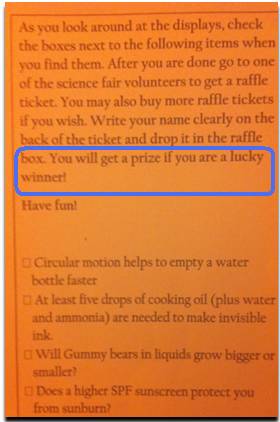
Pictured: A game card employed at an elementary school science fair.

Introduction

I recently attended my child’s elementary school science fair and was intrigued to find game mechanics employed by the fair’s planners. The fair had several rows of “exhibits” (students’ science projects) and a number of students were seen walking studiously from project to project, with a rectangular slip of paper. It turns out the paper was a game card (pictured above), with a list of projects that students needed to find (and check off the list).

The Challenge and Completion Dynamics

I was struck by how many students were participating in the “game,” all under the premise of “you will get a prize if you are a lucky winner.” Adoption was strong because it tapped into a challenge dynamic. Kids were presented with a challenge (“go find these exhibits”). And importantly, there was a structure behind the challenge: the completion dynamic (“find all of the exhibits, then return the card to a volunteer”).

Since a completed card merely got a student a raffle ticket (after which they’d need to hold a winning ticket to gain a prize), motivation was driven by the challenge dynamic – something to keep in mind as it relates to B2B events (i.e. understanding and taking advantage of attendees’ motivations, rather than simply offering up iPads as prizes).

Pros and Cons

Pros: Participants in the game reviewed many more projects than they otherwise would have. Case in point: some students who did not play the game could be found lounging outside the fair, socializing on the patio.

Cons: More a consideration than a negative – game designers need to understand the “completion dynamics.” For the science fair, it’s a good thing for game players to visit many exhibits. The ideal visit is one where the visitor reads through the science project and gains an appreciation for the hypothesis and the result.

The non-optimal visit is the “drive by,” where the visitor is purely motivated by finding another item to check off the list. Good game design will motivate players to immerse themselves in the game, rather than play the game solely to achieve the end result.

How this Applies to Physical & Virtual Events

  1. Motivating participation: when incorporating game mechanics, discover ways to encourage participation beyond the prize.
  2. Contextual relevance: connect the game activities directly to the event content. The science fair did this perfectly.
  3. Encourage immersion and enjoyment: participation needs to go “beyond the result” – participants need to place a higher value on the activity (itself) over the achievement of status or completion.

Related

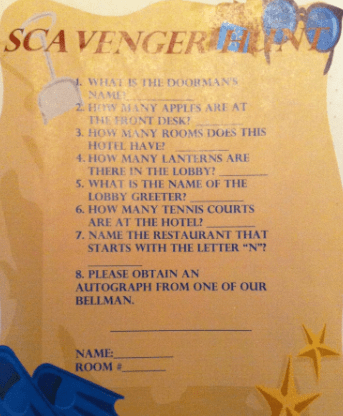
Pictured: a kid-themed scavenger hunt provided by the Ritz Carlton in Half Moon Bay, CA.


Virtual Events and Mainstream Adoption

May 21, 2011

Photo credit: FINALMETAL on flickr.

Introduction

Recently, I had time to spare before a flight home and decided to grab a bite and a drink at a restaurant’s bar at the airport.  While enjoying my food and beverage, I met two traveling salesmen in their 50’s.

We got to talking about our jobs and when it came my turn, I described virtual events. Neither of the gentlemen had heard of virtual events before and their reactions led me to think more about virtual events and mainstream adoption.

We’re Far From “There”

For those of us working in the industry day in and day out, it feels like we’re undergoing rapid growth and increasing adoption – and we are. But for mainstream adoption, “there” is more like the 600MM users on Facebook, not the few million people who have attended a virtual event (my very rough approximation).

In addition, my definition of “mainstream adoption” includes regular use of the technology (by the mainstream).  While there are plenty of “repeat users” across virtual events today, I believe the average user is one who attended a single virtual event and has not yet returned to a subsequent event.

Perception: The Technology is Complicated

Mainstream adoption means traveling salesmen. It means the postal carrier, the hair stylist and Mom and Dad. It doesn’t refer to early adopter, technology-savvy power users. The reaction of the first traveling salesmen at the bar was, “that sounds complicated.”

Now consider the typical, mid-50’s traveling salesman – and for the sake of this example, one who does not sell technology products. The salesman criss-crosses the country every other week and is more proud of his frequent flyer miles than his virtual crops in FarmVille. He uses a laptop for email, but isn’t particularly tech savvy.

To gain mainstream adoption, the user experience for a virtual event needs to be simple and easy.  A grandmother who can create a Facebook account and modify her Facebook profile ought to be able to do the same sort of activity in a virtual event. This would be an interesting scenario to study – could grandma modify her profile on today’s virtual event platforms?

Technology Displaces the Human Connection and … It’s Not Fun

The second traveling salesman conveyed his concern that today’s technologies can disrupt and displace face-to-face connections and interactions. Earlier in the day, he had lunch at a bar at another airport and arrived to find five other bar customers, each immersed in their smartphone. He commented, “I guess I’ll have to get out my device,” got everyone to chuckle and engaged with all of them, to the point where they put down their phones.

When this salesman heard about virtual events, he responded, “that doesn’t sound like fun.” And to a large degree, he’s right.  Virtual trade shows will never replace the handshake or the night out on the town.  This salesman will always choose the physical trade show. But what about his daughter’s college graduation? A virtual option can come in handy then.

Gaining adoption from this salesman will be less about any technology hurdle and more about finding him the right scenario and then making sure he has expectations set properly about what he’ll get out of the experience. Virtual attendance will allow him to experience the content (sessions, speakers, exhibitors, peers) in a convenient fashion, while skipping the cocktails and dinner.

Related: Introducing Virtual Trade Show 2.0

Conclusion

I love to describe virtual events to folks who have never heard of them. The reactions are varied and they tell me a lot about where our market is today and what hurdles we need to address to gain further adoption. Leave a comment below to share your thoughts on how virtual events can reach mainstream adoption.


How I Use Twitter in 2011

May 14, 2011

The Many Uses of Twitter

Introduction

I use Twitter much differently today than I did in 2008. Three years ago, I was just getting my feet on the ground, trying to understand the difference between an at-reply and a direct message. My primary goals were to share content on a single topic (virtual events) and to drive traffic to this blog, which I had just launched. Fast forward to 2011 and I look to Twitter as a swiss army knife – many, many uses.

Notable Changes Since 2008

My mindset on Twitter has been evolving. Some notable changes since 2008:

  1. Mix it up.  I wanted my tweetstream to be focused on virtual events content, so I maintained a 98/2 balance on virtual events and “other” tweets. Today, the balance is more like 85/15, in favor of “other.”
  2. Open up.  I used to stay laser focused on business topics, fearing that including personal interests would cause me to lose followers. But then I saw prominent tweeps (on the business side) do otherwise, so now I’ll include occasional tweets about my Yankees (MLB) or Sharks (NHL) – or, other personal interests.
  3. Make people laugh or think.  10% of my tweets are now conceived while I’m in the shower, where I generate random thoughts (ask a though-provoking question) or random observations (make you laugh [or so I hope!]).
  4. Follow back and interact.  I used to believe that “followers” should be a far greater count than “following.” I also believed that I just couldn’t keep up when following 250+ tweeps. Then I realized that by not following, I’d be missing out. So now I follow back many users who follow me. And, I use at-replies more often, to engage directly with other tweeps.

My other uses of Twitter…

Content Sharing

Whenever I read something interesting, I like to share it with on Twitter. The topics I share tend to be on events (virtual, face-to-face and hybrid), social media and start-ups.  2010 was a big step forward for my sharing abilities, due to a key new feature from Twitter: the tweet button (which you now find on most web sites).

Now, sharing is done with one click. When I share, I like to add my a thought or comment, so that it’s a bit personal and customized. Of course, other tweeps are finding great content, too. So when I see something I find interesting, I’ll often retweet (“RT”). I like to use the official retweet function (from Twitter), so that I don’t have to worry about keeping the RT under 140 characters.

Content Discovery

Being part of “Twitterville” allows me to discover great content. But the most powerful aspect is discovering the content by way of interesting people.  So for me, “discovery” is as much about the people I follow (and connect with) as it is about the wisdom they share.  In this way, Twitter has changed the world.

Twitter’s “unidirectional” following model (i.e. I can follow you without you following me) means that people can share thoughts and insights with “me”, which otherwise would never have happened.

Yes, Hollywood celebrities are cool to follow, but for me, it’s the founder of a great company, the author of a book I’ve just read or an A-list blogger. In fact, Twitter has turned some users into celebrities in their own right, with larger (and more engaged) followings than the celebrities from Hollywood.

Sidebar: Following New Tweeps

As an aside, here’s how I follow new tweeps:

  1. Content: When I read an interesting article, I look to see if the author’s Twitter handle is listed. If so, I immediately follow. If not, I’ll Google the author’s Twitter handle and follow her.
  2. Businesses: If I see “interesting” businesses (or brands) active on Twitter, I’ll follow them.
  3. Athletes: It’s great to see so many athletes take up Twitter in a big way. If my favorite teams have active Twitter users, I’ll follow those athletes.

Events

When I attend an event, whether it’s face-to-face or digital, the first thing I check for is the event hash tag. Twitter has forever changed events, in a good way. It allows me to put a finger on the pulse of the event, from the attendees’ point of view. I’ll find a session that I otherwise would have missed and I’ll often find 20-30 new people to follow. For weeks after the event is over, I’ll continue to watch the hash tag for interesting content. Twitter has helped extend the shelf life of events.

Selling Books

In 2010, I wrote a book on virtual events and placed a link to the Amazon listing page in my Twitter profile. The topic of the book piqued the curiosity of Adam Penenberg (@Penenberg), so we exchanged a few Twitter direct messages (DM) about it. The DM exchange concluded with Adam writing, “Just bought it, you can thank Twitter for the sale.”

Adam listed his own book (“Viral Loop”) in his Twitter profile. Adam’s book “examines the engine driving the growth of web 2.0 businesses,” which aligned perfectly with my interests.  So I bought his book (here’s my review of Viral Loop). It’s fascinating what Twitter enables: content discovery, people discovery and book sales.

Conclusion

First and foremost, thank you, Twitter – you’ve been a big part of my life the past few years. I’m excited to continue using (and adapting) the service and curious to see, in 2013, what I’ll write about regarding my usage patterns.

Leave a comment below, to share thoughts on how you use Twitter. And finally, feel free to follow me – I’m @dshiao. Chances are good that I’ll follow you back.


Take a Survey on The Use of Virtual Technologies In The Workplace

May 12, 2011


Take the survey: http://bit.ly/k0DAoR

Introduction

Virtual Edge Institute (VEI) has announced a comprehensive survey to understand the work-related uses of virtual technologies and digital environments. The Professional Convention Management Association (PCMA) and UBM Studios have teamed up with VEI to conduct and analyze the data for the study.

Survey Details – And a Prize

This survey is dedicated to work-related use of virtual technologies like:

  1. Virtual event, meeting, and virtual learning technologies as well as video streaming, and webcasting
  2. Virtual environments (2D and 3D) such as virtual events, virtual trade shows, conferences, and perpetual (365 days per year) business environments.

According to Michael Doyle, Executive Director of Virtual Edge Institute (VEI), “VEI is giving away two iPads, as well as access to the survey results and our library of on-demand Virtual Edge Summit sessions to ensure strong participation.”

Take the survey: http://bit.ly/k0DAoR

Video: Example of Virtual Environments

The following video from VEI shows examples of the virtual environments covered in their survey.


Social Media Integration for Your Virtual Events

May 9, 2011

Integrate Social Networks into Your Virtual Events

Photo credit: seotips2011 on flickr.

Introduction

Aside from private, “invitation only” virtual events, most other virtual events can benefit from the integration of social media channels.  Integrating social media is a win/win because it increases and augments the degree of engagement within the event.

And, it enables your attendees to promote the event on your behalf.  Awareness extends to your attendees’ friends and followers.  A few retweets and likes later, and the visibility of your event can increase to “near viral” proportions.  Social media integration should not be about slapping up Twitter and Facebook icons throughout the event.  In this posting, I outline READ the FULL POST on the Event Manager Blog.

To Read the Remainder of This Post

The full post is available at The Event Manager Blog (from Julius Solaris).  You can read the full post here:

http://www.eventmanagerblog.com/marketing/virtual-events