VMworld Complements Physical Conference With Virtual Conference

February 7, 2009

VMworld

Source: VMworld

What do you do when you produce the world’s leading virtualization conference?  You make it better, of course!  VMware teamed with Jive Software to take the once-per-year VMworld conference and extended it (online) into a 365-day-per-year, always-on community.  A Case Study on this initiative can be found here:

http://www.jivesoftware.com/customers/case-studies/vmware

And this quote from Eric Nielsen of VMware sums it all up:

We expanded the VMworld conference from a three day event for 15,000 to a 365 day/year destination for 50,000 virtualization professionals.   — Eric Nielsen, Director of Web Communities, VMware

So that’s a triple play for VMworld – by complementing their event online, they’ve generated a more than 3x increase of participating virtualization professionals.  As quoted in the Case Study, the VMworld.com community has 35,000 active members, generates 35,000 page views per day and 2,000 video views per day.

Quite an impressive level of activity.  A clear example of an active community at work – 35,000 page views (in a single day) is hard to come by with traditional b-to-b content.  However, in a highly active social community, the blog posts, discussion board entries, podcast downloads, video views, “ask the expert” questions, etc. – all contribute to traffic generation.

Just have a look at the volume of Discussion Board traffic:

VMworld.com - Discussion Board

Source: VMworld.com - Discussion Board

Now that’s an active community at work.  But there’s a chicken and egg problem – how do you generate an active community in the first place?  Well, the organizers of VMworld.com made the wise move to integrate a full suite of social networking tools – essentially building a mini-Facebook around the conference.  Tools available include:

  1. Discussion Boards
  2. Podcasts – both those produced for the conference, as well as third party / external podcasts
  3. Integration with social networking sites (e.g. Facebook, Twitter, etc.)
  4. Blogs – both in-house and third party
  5. Ask The Expert sessions and content
  6. Video
  7. Photo Wall (with pictures from the physical event)

VMworld.com also leveraged neat tools within Jive Software’s platform to encourage activity.  For instance, on a blog post, a user can click on “Watch This Blog Post” and be notified when comments are appended to that post.  Additionally, most content pages have a left-hand sidebar titled “More Like This”, which certainly encourages additional clicks and page views (it worked for me!).

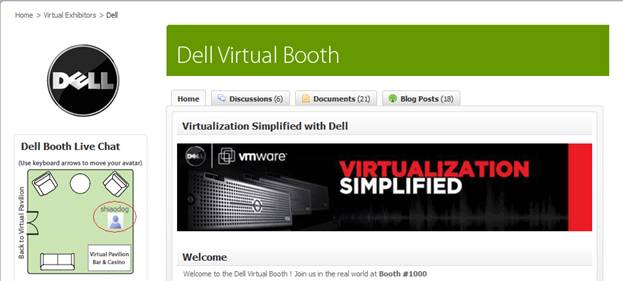
VMworld created virtual conference sponsorship packages for exhibitors, with pricing discounted if you’re already exhibiting at the VMworld physical conference.  3D style booths are planned – the current community features 2D style booths.  Here’s the Dell booth:
VMworld.com - Dell's Booth

Source: VMworld.com - Dell's Booth

This shows the top third of the booth – below it is Dell content, along with community content (blogs, discussion posts, etc.) around Dell topics. You’ll notice a “floor map” of the booth, which shows the physical location of my avatar.  Users utilize the arrow keys on their keyboard to move around within the booth.

VMworld Europe “floors” later this month (February 24-26) in Cannes.  If you’re lucky enough to get to Cannes, enjoy the show.  If you’re not able to attend, then go online and enjoy the online networking.  Registration for VMworld Europe can be found here:

http://vmworld.com/community/conferences/europe2009/


Virtualis and Trend Micro Put On Quite A Show

February 5, 2009

Trend Micro

Source: Trend Micro

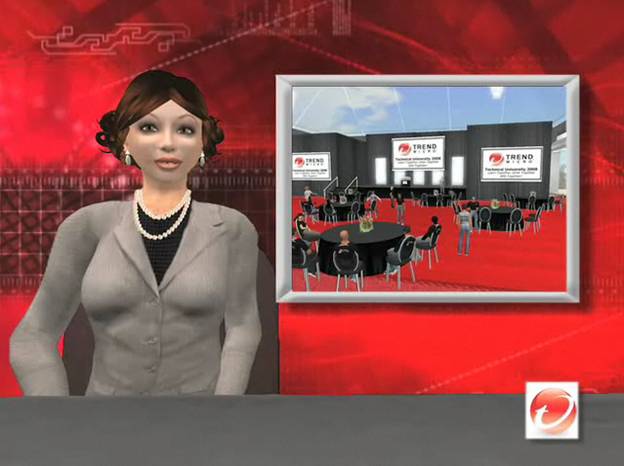
The Virtualis Convention and Learning Center is an island within Second Life that’s produced by California-based Corporate Planners Unlimited.  Trend Micro, a technology provider of endpoint, messaging and web security, recently hosted a 2-day live event within the Virtualis’ Second Life convention center.  Virtual Worlds News has detailed coverage of the event here:

http://www.virtualworldsnews.com/2009/02/corporate-planners-unlimited-growing-virtual-events-in-second-life.html

Dan Parks, President and Creative Director at Corporate Planners Unlimited (and Founder of Virtualis) is quoted extensively in this article regarding the demand for virtual events (and Virtualis), their cost efficiency and uses of Virtualis by other clients of his.  As interesting as the technology is (and it sure is cool), I found the virtual event planning (by Virtualis and Trend Micro) to be most interesting.

In the Virtual Worlds News article, you can view a 2 minute video overview of the event (given by a Second Life avatar / news reporter, no less).  Alternatively, the same video is available on this page: http://silverandgoldie.com/trendmicro.htm (Machinima by Silver & Goldie, who [presumably] produced this nifty segment).

Virtualis and Trend Micro named the event Trend Micro Virtual Technical University – an internal-facing training venue for 75 Trend employees (also called Trenders) across 5 locations.  Day 1 started with an introduction (and keynote of sorts) by Harry Coit, Trend Micro’s Director of Technical Support, North America.  Harry welcomed the Trenders, who sat around round tables in folding chairs.  Harry’s goals for the 2 days:

  • Collaborate
  • Building strong relationships
  • Have some fun

The in-world sessions were spread across two tracks – product sessions and educational sessions.  The product sessions provided product updates on emerging technologies, along with case studies on the latest web threats.  The educations sessions included creativity sessions, which were held in futuristic settings (where avatars sat around in Jetson-like furniture).

Trend Micro

Source: Trend Micro / Virtualis

For fun, the event included four unique technical challenges.  In a parachute challenge, avatars descended from the sky in parachutes and had to score points by grabbing balls that flew by.  A treasure hunt challenged participants to find specified items throughout the island – scores were tabulated and the top 2 teams squared off in a Trend Micro Tech Challenge – a live game show that was played in front of the entire audience.

Trend Micro

Source: Trend Micro / Virtualis

At the end of the first day, a night club hosted dancing, along with music from “one of Second Life’s most popular entertainers”.  All in all, quite a show.  I admire the attention to detail paid by Virtualis and Trend Micro in planning the events – this was truly a melding of virtual world benefits with the full trappings of an all-day physical (corporate) outing.  The typical applications of virtual worlds and virtual tradeshows –  lead generation, marketing, exhibiting products and services, internal training – has now taken on a new angle.  We’re now seeing internal training, complete with virtual team building!


Search Engine Optimization (SEO) For Virtual Events

February 2, 2009

Flickr (martin.canchola)

Source: Flickr (martin.canchola)

These days, any publisher of information on the web is very keen to Search Engine Optimization (SEO).  If you build it (SEO) into your pages, they will come.  If you don’t, then you’re missing out on page views.  But, with all the effort we place on optimizing our web sites (e.g. corporate web sites, content sites, social media sites, etc.), how much SEO effort do we put into our virtual event pages?  I get the feeling that the answer today is “not much”.

For the external (non-private) virtual event, show organizers and exhibitors often judge success based on the number of registrations, attendees and interactions.  Basically, “the more, the better”.  However, what’s the largest source of registrations for most virtual events?  Outbound email promotions to (usually) large lists of users – where you’re hoping that some percentage of users open your email, click on the email and convert into a pre-registered attendee.  Very low on the list today is organic traffic from search engines like Google, Yahoo or MSN.

So the opportunity is quite large – improve the SEO of your virtual event and you can make a big impact on registrations, attendees and exhibitor satisfaction.  But where to start?  Well, first identify the pages on which to apply your SEO tactics.  For a virtual event, we’re usually talking about the microsite that describes your event – date, hours, speaker bios, etc..  The microsite often has separate tabs to list the event’s agenda, existing exhibitors, contacts for sponsorship info and (importantly) the event’s registration page.  All of these pages/tabs should have SEO applied.

A nice overview on SEO is titled “Search Engine Optimization 101” by Marketleap, a division of Acxiom Digital.  You’ll want to apply some of the basic concepts discussed here – including the right content on your virtual event pages; the use of meta tags; how to write good titles and strategic use of keywords.

Next, you’ll want to foster in-bound links to your virtual event microsite.  Promote the virtual event on your corporate web site (with a link).  Place links to the virtual event in your social networks (e.g. Twitter, Facebook, Linkedin, etc.).  Find blogs related to your industry and leave comments there.  Don’t blatantly promote your virtual event in the blog comment, but refer back to it (e.g. when leaving the comment, have your name be hyperlinked back to your virtual event’s microsite).  The more inbound links you can create, the higher your microsite will rank with the search engines.

Correction: comments you leave on other blogs can help with clicks (back to your blog), but do not help with SEO – most blog sites utilize a nofollow directive on the anchor tag, so search engines do not “follow” hyperlinks left in blog comments.

Finally, if your virtual event is not behind a registration wall (e.g. maybe it’s a 365 day, open environment), then make sure you provide “search engine friendly” content pages within the platform that search engine spiders can index.  Stay away from the Flash-heavy page and go with a flat, content-rich page.  Users will land here (from search engines), so be sure to provide easy navigation from this page to the main areas of the event (or environment).

For b-to-b virtual tradeshows, I’d estimate that well south of 10% of registrants are sourced from search engine traffic today.  Make it a goal at your next event to hit the 10% mark.  Your email lists will thank you.


Virtual Event Best Practices

January 23, 2009

With a number of virtual events on tap for 2009 (see the calendar of events here), marketers and exhibitors are busy preparing – assembling content for their booth, rounding up colleagues for “booth duty” and preparing the sales team for a burst of hot sales leads.  I’ve assembled past blog posts into a collection of virtual event best practices.  Without further ado:

  1. Bring the right people, have the right content (in your booth), perform the right actions and provide the right prizes (https://allvirtual.wordpress.com/2008/12/14/how-to-exhibit-at-b-to-b-virtual-tradeshows/)
  2. Utilize surveys to provide a deeper understanding of your customer prospects and generate insights back to your product management team (https://allvirtual.wordpress.com/2008/12/19/utilize-surveys-in-virtual-events/)
  3. Leverage Twitter – show-hosts can look to Twitter to expand the reach of the event’s audience and exhibitors can leverage Twitter to invite their followers to visit their booth at  the event (https://allvirtual.wordpress.com/2008/12/15/leverage-twitter-for-virtual-tradeshow-outreach/)
  4. It’s not always about “net new sales leads” – get closer to your existing customers (https://allvirtual.wordpress.com/2008/12/16/get-closer-to-your-customer-with-virtual-tradeshows/)
  5. Use treasure hunts to increase engagement (https://allvirtual.wordpress.com/2008/12/23/use-treasure-hunts-to-increase-engagement-in-virtual-events/)
  6. Have a process in place to handle the hot sales leads (https://allvirtual.wordpress.com/2008/12/31/how-to-handle-those-hot-virtual-tradeshow-sales-leads/)
  7. Utilize multiple metrics to judge success – Cost Per Lead (CPL) is the key metric for most marketers, but also consider other success metrics [e.g. quality of leads, conversion of inquiry to sales engagement, etc.] (https://allvirtual.wordpress.com/2008/12/28/what-cost-per-lead-cpl-should-i-pay-for-virtual-tradeshow-sponsorships/)

What best practices do you utilize at virtual events?  I welcome your input – feel free to drop a comment below.


Should CES And Macworld Go Virtual?

January 7, 2009

Flickr (Domain Barnyard)

Source: Flickr (Domain Barnyard)

With all due respect to the CEA (CES) and IDG World Expo (Macworld), I found it interesting that the primary discussion around CES and Macworld this week has been who and what will not be there, rather than the announcements and happenings scheduled at these venues.  Before I go further, let me state up front that I work in virtual events, so my thoughts are biased.  Now let’s review the “not there, not coming” list:

  1. Bill Gates (CES) — off pursuing his noble not-for-profit initiatives
  2. Steve Jobs (Macworld)
  3. Attendees  – lower numbers expected at both venues, compared to 2008
  4. Exhibitors – lower numbers expected at CES, compared to 2008

“Electronics trade shows change with times” is the headline of a story in today’s USA Today.  Some excerpts from this article:

Software king Adobe Systems and gadget maker Belkin dropped out of Macworld. Networking giant Cisco and Sanyo, being acquired by Panasonic, won’t be exhibiting at CES.

[…]

“I’ve surveyed my clients, and while many will be at the show, they are dramatically cutting back,” says James McQuivey, an analyst at Forrester Research. “If they had 20 people at the show last year, this year it’s just four.”

So clearly, the current economic climate is having its effect on industry events.  I do see a lot of value in the face-to-face event.  In fact, a significant aspect of CES is the brokering of partnership and business development deals between and among vendors, suppliers and retailers.  That activity is very effective “in person” and may not (yet) be well suited to online-only activity.  Another aspect of CES is the schmoozing and the wining and dining of clients and business partners.  This also cannot be replaced online, as far as I’m aware!  So I’m certainly not recommending the shuttering of CES (or Macworld).

But why not launch complementary events online?  For the product announcement angle of these events, online seems a natural fit.  In 2008, several IT vendors skipped the physical launch event and handled 100% of their product launch over the web, whether it was a Live Webinar, Live Videocast or a Virtual Tradeshow.  In an online venue, your potential audience expands, but you can still connect with your target base of customers, prospects and industry analysts.

James McQuivey of Forrester had a relevant quote in the USA Today article:

Says McQuivey, “New products get launched on blogs. There’s no reason to go through all the hassle and expense of trade shows anymore.” Apple said just that as it dropped out of Macworld, citing the reach of its own retail stores and website.

Now, let’s talk a bit about the green angle.  The same article quoted Jason Oxman from CEA:

Jason Oxman, senior vice president at the Consumer Electronics Association, which stages CES, says that even in the downturn, companies that are cutting back aren’t eliminating CES altogether. Like Cisco, they’re just eliminating the convention floor booths and opting for meeting room suites instead.

“Trade shows take on renewed importance in a down economy,” he says. “Every major consumer electronics manufacturer, buyer, installer and retailer is there. It’s the most efficient travel saver imaginable.”

I think Jason’s point is that because “everyone” attends CES, you schedule this one trip in January because you won’t need to go back to meet those same people (individually) later in the year.  While that does seem wise, I disagree on the “most efficient travel saver imaginable” quote.  To me, the most efficient travel saver is not to travel.

Hence, I could see a lot of value in a Virtual CES, where the product announcement angle of CES takes place.  The CEA could supplement their revenue stream by packaging this online opportunity with their physical event sponosorships.  I’m sure they’d draw quite a crowd online.  Exhibitors could demo their latest products from the comfort of their office (or home), be able to track all visits to their booth and have all interactions (with attendees) saved as text transcripts.  Steve Ballmer could still kick things off – but instead of in-person, you’d have him on a live video broadcast.

The uncomfortable angle to this (for the CEA) is that the flagship (physical) event may shrink significantly and be left to the deal makers, winers and diners.  On the flip side, it would cut back dramatically on carbon emissions and if done right, online would become the new flaghship.


Marketers as Event Organizers

January 2, 2009

Rebecca Lieb of ClickZ penned an interesting article titled “Marketers as Publishers”. Rebecca discusses the trend of marketers as full-blown content creators, especially in this age of digital media.  Examples cited by Rebecca include:

  1. Low cost video content creation and distribution (e.g. with a digital video camera to record and YouTube for distribution)
  2. Big brands creating original content (e.g. Bud.tv, along with Johnson and Johnson’s Baby.com)
  3. Creation and propagation of consumer generated media

I agree with Rebecca – spending the past few years in tech media, I’ve watched the transition of technology vendors into prodigious publishers, with their mix of White Papers, Webinars, Podcasts, Case Studies, Videocasts and Product Collateral.  Some technology vendors are producing hundreds or thousands of pieces of content a year, giving their technology media partners a run for their money (on volume).

Adding to Rebecca’s list, I think we’ll see an increasing number of marketers turn to virtual events – whereby marketers can easily morph into event organizers (in addition to publishers).  Perhaps you’re an up and coming vendor in an IT market – you see the benefits of doing a customer conference, but the business case isn’t quite there yet.

With costs for virtual events coming down, you now have the opportunity to launch that customer event in 2009.  You do it online, making it efficient and convenient – and bringing its availability to a global audience of customers and prospects.  Take Quest Software as an example.   This maker of products and services for Enterprise IT has run virtual conferences the past two years.  Last year’s event was titled Quest Connect 2008 and included presentations (webcasts) on just about every technology produced by Quest.

I wouldn’t be surprised to see Quest produce the same event (or events) in 2009 – so as you can see, they’re morphing into an event producer and event organizer (where the ongoing events occur online).

With regard to consumer generated media (CGM), I’ve found that virtual events are a natural venue for fostering CGM.  Engaged attendees who participate in your event are not shy about expressing their thoughts and opinions.  You’re bound to see a lot of CGM around your products and services – and I’d argue that good or bad, the discussion and interaction  is valuable to your company.  In some cases, I’ve seen questions posed by attendees that are directly answered by other attendees.  How efficient!  Customer support (and prospect management) via CGM.

So publishers (I mean, marketers), as you plan your activities for 2009, consider the virtual customer conference.  And, consider extending your (physical) customer conference into the virtual world.


How to Handle Those Hot Virtual Tradeshow Sales Leads

December 31, 2008

It’s the holy grail of online lead generation – you generate sales leads that pursue you and your company (rather than the other way around).  This holy grail scenario often plays out in B-to-B Virtual Tradeshows.  Some attendees come to the virtual event with approved budget, purchasing authority and a specific need.  As such, they’re shopping around with the various exhibitors to see who offers the solution that best fits their requirements.

These attendees will ask you (or your colleagues) very specific questions, covering technical specifications, product features and pricing.  At the conclusion of their visit, they may ask to be connected to a sales representative from your company.  How better can it get for you as an online marketer?  For this opportunity that fell into your lap – be sure to close the loop (with sales) on this lead or else the happy ending may be told by your competitor.

Here’s a sample chat that’s representative of what I’ve seen in virtual events:

Attendee: Thanks for the information about your products.
Exhibitor: You’re welcome!
Attendee: I’d like to set up a meeting to price out a configuration and discuss a few requirements that the product needs to meet
Exhibitor: Where are you based?
Attendee: New York City
Exhibitor: (a few minutes later) OK, the area sales manager for NYC is Bob Johnson.  His email address is bjohnson@acme.com and his phone number is 212-555-1212.
Attendee: Thanks, I’ll contact him.

Not good enough!  The exhibitor missed out on a golden opportunity here.  Additional steps that I’d recommend:

  1. Copy/paste the transcript of the chat and immediately email it to Bob Johnson
  2. Connect with Bob via email, IM, etc. – letting him know about the hot lead
  3. Update your CRM system (e.g. Salesforce.com, SalesLogix, etc.) with the transcript of the chat and a summary of the sales inquiry
  4. Urge Bob to follow up immediately with the attendee — let the attendee know (during the chat session) that “Bob is ready to take your call right now” – or, “Bob will call you first thing in the morning”
  5. Get Bob to login to the virtual event right now – you already know that there’s one hot lead from his territory – a sales opportunity waiting for Bob to close
  6. Provide your own contact info to the attendee, letting her know that you can be contacted if Bob cannot be reached

Remember, leads in a virtual tradeshow can be very hot.  Handle with care and don’t treat them like hot potatoes.  If you do, then your competitors may be eating your lunch.


What Cost Per Lead (CPL) Should I Pay for Virtual Tradeshow Sponsorships?

December 28, 2008


Flickr (TheTruthAbout)

Source: Flickr ("TheTruthAbout")

For online marketers responsible for lead generation, the name of the game is Cost Per Lead (CPL).  While it’s not the be-all, end-all, CPL is certainly top-of-mind for marketers – and in this economic environment, CPL is receiving heightened attention from the online marketer, her CMO and her CFO (and possibly even the CEO).

So let’s get the numbers out of the way first.  For B-to-B virtual tradeshows (VTS), I’ve seen CPL’s in a range of $15-$50 for worldwide leads.  The low end reflects events where the organizer has over-delivered on leads or priced the sponsorships reasonably (or both). The high end reflects a more focused event or an event that has slightly underdelivered.  I’ve seen a few events fall outside this range, with CPL’s as low as $10 (or even lower) and as high as $70.

So you’d want your sponsorship to be within this range.  But, I think that for VTS, “What is my CPL” is not the right question!  The following questions are more applicable:

  1. What’s the quality of the audience and does it match my target profile (e.g. geography, purchasing authority, has budget, etc.)
  2. What level of interactions did I have with the attendees
  3. What was my cost per sales engagement and how does that compare to my other marketing activities
  4. What was my cost per customer acquisition and how does that compare to my other marketing activities

So as an example, I’d be fine with paying a CPL of $60, if the resulting cost per sales engagement was lower than my other marketing programs. Remember a key point about these leads, though – they are shared with the other exhibitors at the event.  As such, it’s important to:

  • Distinguish your company at the event – attract visitors to your booth and generate interactions with sales prospects.  If you put in the hard work here, you can short-circuit the lead nurturing and lead follow-up stages – as you can find prospects who are in the later stages of their purchasing decisions and very receptive to hearing more from you.
  • Distinguish your company after the event – follow up with prospects intelligently and promptly.  Don’t forget that if you do your job at the event, then the after-event steps become much easier.

Like with most purchasing decisions, shop wisely – and rememer that there’s much more to the equation than just the CPL price tag.


Eloqua’s Digital Body Language

December 24, 2008

An article in ClickZ titled “TriNet Uses Digital Body Language to Arm Sales Reps” describes how TriNet (an HR services company) leveraged Eloqua’s Program Builder to augment their process of online lead qualification.  When I attended an Eloqua sales presentation on Digital Body Language, I immediately agreed with their approach – and found their digital body language analogy to be quite apt.  Prospects who are interacting with you (e.g. via a visit to your web site) leave tremendously valuable fingerprints.  Web site publishers ought to leverage this valuable data to smarten their lead qualification and follow-up.

 I think that a perfect complement to this digital body language concept can be found in virtual events.  Here, prospects are providing rather explicit cues regarding their interest in your products and services – they’re downloading your White Papers, returning to visit your booth, chatting with your booth reps, etc.  Your nurturing and qualification cycle become condensed down into a single event (e.g. the virtual event!).

If you’re an online marketer who’s using Eloqua’s system, a great complementary program for 2009 might be a virtual event sponsorship.  I think you’ll find valuable body language (from prospects).  Some might even ask you out on a date (to meet with one of your sales reps, that is!).


Use Treasure Hunts to Increase Engagement in Virtual Events

December 23, 2008


Flickr ("Crazy Cake Lady")

Source: Flickr ("Crazy Cake Lady")

You’ve planned a great virtual event.  You sold a number of high profile sponsorships.  You promoted the event to your members and generated strong registrant counts.  You’re looking forward to the big day, when the exhibitors (and your boss) pat you on the back.  But wait!  You’re work is not done.  Even if you have a large audience – and, the right audience, exhibitors will deem the event underwhelming if that audience doesn’t adequately engage with them.

In a prior blog post, I wrote about the effectiveness of prize giveaways at virtual events.  In that post, I wrote about the notion of smaller prizes to generate interest.  Here, I endorse a slightly different approach: use a grand prize (e.g. flat screen HDTV, if budget allows) and up the ante for prize qualification.  Instead of “presence” in some event location, require that attendees complete all steps of a treasure hunt in order to qualify for the prize.

With a multi-sponsor virtual event, you’re going to want to keep all of your exhibitors happy (without favoring any particular exhibitor).  So set up the treasure hunt so that each exhibitor benefits.  Here is a sample treasure hunt template.  I’ll leave it as an exercise to the reader to determine what actions each step encourages.

Sample Treasure Hunt

  1. Find the White Paper titled Best Practices for Data Deduplication.  Name the author of the White Paper
  2. Find the White Paper titled Data Backup and Recovery.  Name the sponsor booth in which it’s located
  3. There is a booth representative in this event named Joe Kennedy.  Name the sponsor booth in which he’s stationed
  4. In the second Webcast presentation today, the speaker is from what company?

If you go with a treasure hunt, be sure to promote it heavily, both within the event and in email promotions and web site listings prior to the event.  To select the grand prize winner, ask your virtual event platform provider if the platform’s survey function can do the trick.  You may be able to “host” the treasure hunt quiz via the survey – using either multiple choice selections or, using a free-form text field to solicit answers from treasure hunt participants.

Happy Hunting!