Virtualis and Trend Micro Put On Quite A Show

February 5, 2009

Trend Micro

Source: Trend Micro

The Virtualis Convention and Learning Center is an island within Second Life that’s produced by California-based Corporate Planners Unlimited.  Trend Micro, a technology provider of endpoint, messaging and web security, recently hosted a 2-day live event within the Virtualis’ Second Life convention center.  Virtual Worlds News has detailed coverage of the event here:

http://www.virtualworldsnews.com/2009/02/corporate-planners-unlimited-growing-virtual-events-in-second-life.html

Dan Parks, President and Creative Director at Corporate Planners Unlimited (and Founder of Virtualis) is quoted extensively in this article regarding the demand for virtual events (and Virtualis), their cost efficiency and uses of Virtualis by other clients of his.  As interesting as the technology is (and it sure is cool), I found the virtual event planning (by Virtualis and Trend Micro) to be most interesting.

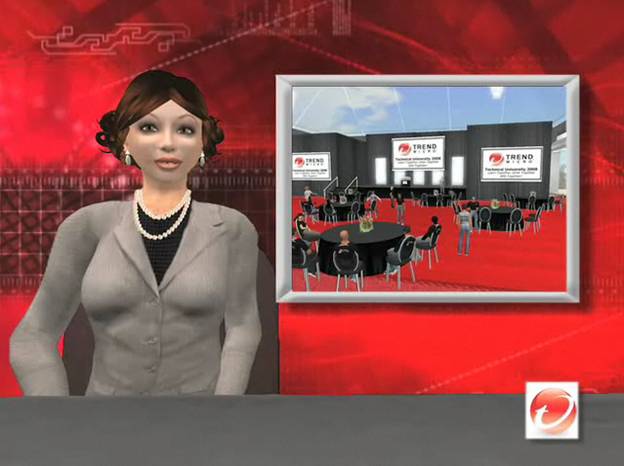
In the Virtual Worlds News article, you can view a 2 minute video overview of the event (given by a Second Life avatar / news reporter, no less).  Alternatively, the same video is available on this page: http://silverandgoldie.com/trendmicro.htm (Machinima by Silver & Goldie, who [presumably] produced this nifty segment).

Virtualis and Trend Micro named the event Trend Micro Virtual Technical University – an internal-facing training venue for 75 Trend employees (also called Trenders) across 5 locations.  Day 1 started with an introduction (and keynote of sorts) by Harry Coit, Trend Micro’s Director of Technical Support, North America.  Harry welcomed the Trenders, who sat around round tables in folding chairs.  Harry’s goals for the 2 days:

  • Collaborate
  • Building strong relationships
  • Have some fun

The in-world sessions were spread across two tracks – product sessions and educational sessions.  The product sessions provided product updates on emerging technologies, along with case studies on the latest web threats.  The educations sessions included creativity sessions, which were held in futuristic settings (where avatars sat around in Jetson-like furniture).

Trend Micro

Source: Trend Micro / Virtualis

For fun, the event included four unique technical challenges.  In a parachute challenge, avatars descended from the sky in parachutes and had to score points by grabbing balls that flew by.  A treasure hunt challenged participants to find specified items throughout the island – scores were tabulated and the top 2 teams squared off in a Trend Micro Tech Challenge – a live game show that was played in front of the entire audience.

Trend Micro

Source: Trend Micro / Virtualis

At the end of the first day, a night club hosted dancing, along with music from “one of Second Life’s most popular entertainers”.  All in all, quite a show.  I admire the attention to detail paid by Virtualis and Trend Micro in planning the events – this was truly a melding of virtual world benefits with the full trappings of an all-day physical (corporate) outing.  The typical applications of virtual worlds and virtual tradeshows –  lead generation, marketing, exhibiting products and services, internal training – has now taken on a new angle.  We’re now seeing internal training, complete with virtual team building!


Home Depot’s EXPO Design Centers Should Go Virtual

January 29, 2009

In a press release issued this week, Home Depot announced that it’s shuttering its doors on all 34 EXPO Design Center stores:

The EXPO business has not performed well financially and is not expected to anytime soon. Even during the recent housing boom, it was not a strong business. It has weakened significantly as the demand for big ticket design and decor projects has declined in the current economic environment. Continuing this business would divert focus and resources from the Company’s core “orange box” stores. Therefore, over the next two months, the Company will be closing 34 EXPO Design Center stores, five YardBIRDS stores, two Design Center stores and a bath remodeling business known as HD Bath, with seven locations.

But wait!  Let’s not be too quick to liquidate all the inventory and tear down the walls.  Images and footage can be captured from the existing design centers — and placed online.  With a Virtual EXPO Design Center, Home Depot can:

  1. Generate leads/business to their core orange box stores
  2. Facilitate e-commerce transactions directly within the virtual design center
  3. Bring the design center to the entire world (and not just those in the vicinity of the 34 physical stores)
  4. Differentiate from the competition

And, they can do all of this for fairly low cost – much lower than their costs for maintaining the original 34 physical design centers.  The concept here is a mashup between Realtor.com and Amazon.  With Realtor.com, prospective home buyers search for homes, view photos and take 360 degree tours.

With Amazon, shoppers of goods peruse, search and eventually purchase (online).  With a virtual design center, you facilitate both activities – prospects search for particular appliances and take 360 degree tours of model kitchens and baths.  By clicking on a particular item, the user can be provided with its full specifications (dimensions, weight, etc.) and  be taken to homedepot.com to purchase it immediately.

So visit the showrooms that are still standing and capture photos, videos and 360 tours.  There are many affordable solutions for capturing and rendering 360 views, such as IPIX and 360iSight.  Next, go interview some of the 5,000 employees you were planning to lay off and find the ones who are most personable and most “online savvy”.

Offer selected employees positions to remain with the company – as virtual showroom staff.  In their new role, their job is to be an embassador (online), answer questions in online chat and discussion forums (within the virtual design center) and help facilitate e-commerce or real-world sales.  To mix in some fun, outfit their avatars with the Home Depot orange apron (and yes, I know, that’s from the orange box stores – but, we’re having fun – and, it might help reinforce the brand).

To provide value to your ecosystem of partners and vendors, allow selected vendors (e.g. GE, Maytag, Kohler) to have booths within the virtual design center, which would provide a centralized collection of the vendor’s products.  Feel free to charge these vendors for their booth, so that you recoup some of your costs for building this environment.

Vendors could provide their own employees to staff the booth.  And once a week, allow a selected vendor to provide a live presentation (webinar or videocast) in the design center’s Auditorium.  Instead of driving clicks to the vendor’s web sites, allow users to click into homedepot.com to purchase the vendor’s products there.

Now, if you have leftover budget or time, mix in more fun into the environment – provide interactive areas where users can interact with kitchen or bath appliances.  Allow a user to turn on/off a stove; set an oven timer; open/close cabinets; fill up a jacuzzi tub with water.  Features like this increase the stickiness of the site and may keep users coming back.  I’m sure there’s much more than can be done – so whether it’s Home Depot or another retailer, I’m expecting to see this concept (virtual design center) become a reality in 2009.

Viking range?  $1,099.99.  LG refrigerator?  $799.99.  Online leads, interactivity and e-commerce?  Priceless.


Adobe’s Real World Launch Is Suppplemented With Virtual Launch

January 25, 2009

PRWeb / Adobe

Source: PRWeb / Adobe

When launching a product suite with “eLearning” in the title, what better a place to hold launch activities than the virtual world?  Last week, Adobe launched two new product suites, Adobe eLearning Suite and Adobe Technical Communication Suite 2.  This coming week, Adobe will be holding virtual launch activities of eLearning Suite in the virtual world of Second Life.  The virtual launch is the work of Moderne Interactive, a digital advertising agency whose practices include “custom and private virtual worlds”.  Details of the launch activities planned in Second Life:

Adobe Product Evangelist RJ Jacquez will lead an interactive demonstration from Second Life at Noon Pacific Time (12 p.m. SLT) both days. Jacquez will showcase the powerful features that the new Captivate 4 and eLearning Suite products can offer to education, government, and other communities. In addition to live product demonstrations by Jacquez, Adobe and Moderne representatives will be on hand to distribute free trials of the innovative software, to answer questions, and to direct users to further resources.

At 7 p.m. on Monday and at 4 p.m. on Tuesday, the Adobe eLearning Island will also hold a celebration of Second Life community that will feature resident Second Life musicians and artists who will share their talents with the gathered crowds.

A virtual world is a great place to demonstrate a product – vendors provide a rich, 3D representation of the product (or, in the case of software, a 2D representation of the actual software) and prospects can see the product in action.  Prospects may also be able to interact with the product directly.  Moderne Interactive and Adobe were wise to provide parallels to a physical launch – such as the free trial giveaways (of the software) and the obligatory musical entertainment.

What’s another neat feature of the virtual world?  The ongoing presence.  With a physical launch event, you tear down the event once the day is over.  Your booth comes down, you bring your product collateral and launch material back to your office and all participants go home.  With a virtual launch, you keep your launch material online, making it available 24×7 to anyone across the globe.  And that’s precisely what Adobe is doing:

During and after the launch events, Adobe will keep its eLearning Island open to the public to highlight its eLearning Suite and Captivate 4 products via, which launched early this week. The island features several interactive elements meant to educate and entertain audiences about Adobe’s eLearning products. Adobe’s eLearning Island can be reached in Second Life at the following location: http://slurl.com/secondlife/Adobe%20eLearning/38/38/37.

“Educate and entertain” – a great approach not only in leveraging the virtual world, but a best practice for launching a product in general.  If you’re a product evangelist (like RJ Jacquez at Adobe), a product marketer or a product manager, I suggest that you learn the logistics and customs of virtual worlds.  Pretty soon, your VP Products or CMO may have you supplementing your trade show and physical launches with appearances in the virtual world!

Here’s hoping that Moderne Interactive and Adobe provide some archived footage from their Second Life events for those of us who aren’t able to attend live.  After all, when RJ is providing a demo of Adobe Captivate 4, I’m sure someone else can be using that same software (in the real world) to record a screencast for us!  Best of luck on a great SL event.

Related links

  1. SLentrepreneur Magazine: Adobe in Second Life: Moderne Interactive Builds Immersive Learning Center for Adobe

Business Innovation: Powered by World of Warcraft

January 21, 2009

They’re called massively multiplayer online games (“MMOG”).  Hundreds (if not thousands) of users connect and “collaborate” in a game that’s held not just on the individual’s device, but online – where that individual is connected to all other players simultaneously.  World of Warcraft (aka WoW) is one of the more notable MMOGs out there.  In a BusinessWeek article titled “How World of Warcraft Promotes Innovation“, authors John Hagel and John Seely Brown discuss design features of the popular MMOG and apply those features towards business opportunities around innovation.  The authors list the “bottom-line lessons for executives”:

  1. Reduce barriers to entry and to early advancement
  2. Provide clear and rich metrics to assess performance
  3. Keep raising the bar
  4. Don’t neglect intrinsic motivations
  5. Provide opportunities to develop tacit knowledge, but do not neglect broader knowledge exchange
  6. Create opportunities for teams to self-organize around challenging performance targets
  7. Encourage frequent and rigorous performance feedback
  8. Create an environment that rewards new dispositions

For each “lesson” (above), the authors describe how it is applied in WoW – and, how the lesson can be applied to business innovation.  Now, let’s move from the world of MMOGs to virtual worlds and virtual events.  I’m a believer that if these same principles are applied to business-oriented virtual “communities”, that we can significantly empower (and generate) untold amounts of business innovation.

On the web, we already have communities of individuals who coalesce around any number of topics and interests – everything from iPhone enthusiasts in a Facebook group to a discussion forum about Tandy’s TRS-80 desktop microcomputer.  Members of these communities are quite engaged in their area of interest and tend to spend a lot of time online.  If provided with a platform that’s also engaging and online, it’s safe to say that they wouldn’t need much convincing to participate.

As such, it seems to me that the bulletin boards, discussion forms, chat areas (and even Facebook or Yahoo groups) of today may migrate (in the near future) to a hybrid virtual world/event, with more real-time interaction and engagement.  Let’s consider a business example.  Take any large corporation that sells its products and services via a “partner ecosystem”.  Much of this company’s revenue is generated from sales that are directly sourced by its partners.  But, how well are partners connected – and how often do they partner up (on their own) to create unique and compelling solutions?  If the answer is “not too often”, then an online medium, using principles drawn from WoW, may be a big win.

As seen in WoW, if a venue allows individuals to assemble, collaborate and generate actions (with a built-in reward and recognition system to motivate the participants), you find that progress, development and innovation fall out naturally.  Create the foundation and a house gets built.  Companies can leverage these online communities (aka virtual worlds) to tap into the Wisdom of Crowds and be able to crowdsource the next great product.  The crowd may give your next product the true WoW factor.


For Virtual Worlds Info, Here’s Whom I Follow on Twitter (and Why)

January 16, 2009

Author's "Twitter Home"

Source: Author's "Twitter Home"

The pace of change and innovation is quite brisk in the area of virtual worlds and virtual tradeshows.  How does one keep up with the pace? One tool that I use is Twitter, the popular and very useful microblogging platform.  As it relates to virtual worlds, my uses of Twitter are:

  1. Find the news of the day – I check Twitter (and FriendFeed, too) with my morning coffee, in the same way I might have walked down the driveway to pick up the morning newspaper (when I was a kid, of course!).  My RSS feeds in Google Reader are good, but I often find more applicable and more timely virtual worlds news via the folks I follow on Twitter.
  2. Stay connected with the metaverse – I discover the influencers (and, who may soon be an influencer) and keep tabs on the chatter and commentary related to virtual worlds.
  3. Distribute information – Guy Kawasaki has blogged about how he leverages his Twitter network to generate interest in Alltop.com.  You can find one relevant post here: http://blog.guykawasaki.com/2008/12/how-to-use-twit.html.  I’ll often let my Twitter followers know about new blog posts that I’ve authored.  In fact, you may notice that I’ve done just that for this blog posting!
  4. Source new business contacts and leads – Twitter moves in two directions – you follow (and receive benefits from) others, but you ought to “give back” and share information that the community (and your followers) may find useful.  When you do that, you find that your list of followers starts growing magically (Twitter users are eager to follow others have a way of finding you), which, in turn, expands your universe of potential business partners.  In fact, you may find that business opportunities will come finding you, without any action on your part (aside from being active on Twitter) – it’s happened to me, for sure.

I follow 253 people on Twitter.  Among those, I’ll provide a short list of the folks I follow specifically for virtual worlds info (and why):

  1. @malburns: Mal Burns has made 29,696 updates on Twitter, most of which are about virtual worlds news.  I don’t quite know how he can be so prodigious, but I do know that I check his tweets to get the latest news each day.  For virtual worlds, he’s my Daily News and New York Times in one
  2. @epredator: Ian Hughes is a metaverse evangelist at IBM (based in the UK) and a blogger at eightbar – he has lots of interesting insights into the metaverse.  See related interviews that I did with Ian: Part 1 and Part 2
  3. @NickWilson and @OnderSkall – Nick Wilson and Caleb Booker (OnderSkall) are executives at Clever Zebra, a virtual worlds business.  Caleb publishes a weekly “Business in Virtual Worlds News Roundup” on his blog that’s loaded with lots of useful links and articles.  Here’s a sample: http://www.calebbooker.com/blog/2009/01/11/business-in-virtual-worlds-news-roundup-jan-5-11-2009/
  4. @skribe – skribe Forti is a Digital Media Consultant at Skribe Productions – he has his fingers on the pulse of the (virtual) world
  5. @Dusanwriter – Doug Thompson is CEO of Remedy Communications who travels in the virtual world as Dusan Writer.  He blogs about virtual worlds at http://dusanwriter.com/
  6. @reubstock – Reuben Steiger is CEO of Millions of Us (http://millionsofus.com/blog/)
  7. ADDED: @Consiliera – Gaby K. Benkwitz is “Futurist, consultant, educator” who links to articles and blog entries about the metaverse.  I also subscribe to her excellent newsfeed on Friendfeed: http://friendfeed.com/rooms/metaversenews

I’m sure I’m missing some key people – so drop a comment below to let me know whom else I should be following for virtual worlds info – and, I’ll follow them!

Of course, if you want to follow me, I’m at @dshiao.


Hey Kids! I’ve Got a Virtual World For You

January 14, 2009

As a parent, their existence is virtually unavoidable – the online companion to a kid-themed product.  A Reuters article (published by MSNBC) titled “Disney’s Penguin spreads its wings globally“, describes Disney’s ambitious plans with its Club Penguin virtual world.  Operating out of Sao Paolo, Disney will launch the first non-English version of Club Penguin in Brazil.  There are additional plans to launch in other Latin American countries and France.  Forget the climactic limitations of the species – penguins will now be spanning the globe.

When Disney acquired Club Penguin in 2007, one may have thought that the strategy was around product/brand integration of Disney properties (and characters) with the Club Penguin world and audience.  While that possibility still exists, it seems Disney is looking to Club Penguin as a full-fledged brand in its own right.  Accordinng to the article:

Within two years of launch, Penguin claimed more than 12 million registered users, of which about 900,000 were premium subscribers typically paying $5.95-$6.95 per month for access to additional features and virtual collectibles.

If I’m doing my math right, 900K subscribers paying $6.50 a month (taking the midpoint of the prices quoted) amounts to $70.2MM in revenue per year (wow).  And here’s a clear sign of Disney’s plan to grow Club Penguin as its own brand:

Over the past year, Disney has been busy taking some of its most popular licenses, such as “Pirates of the Caribbean,” “Cars” and Tinkerbell and creating virtual worlds around them.

But with Penguin, that strategy has been somewhat reversed, giving the property the chance to leverage Disney’s retail muscle. The recent launch of a toy line includes plush versions of popular characters, a set of figurines as well as an Igloo Playset. The brand was also extended into the lucrative game field with the introduction of “Club Penguin: Elite Penguin Force” for the Nintendo DS.

So if you’re a parent paying for that premium subscription, the next thing your child will be asking for is the Igloo Playset, along with the Club Penguin game for her Nintendo DS.  Or, she’ll be asking you to buy the Nintendo DS so that she can attain Elite Penguin Force status!  Also mentioned in the article is a related, kid-themed virtual world, Webkinz:

Of course merchandising is not new in virtual worlds and has already proven to be far more than a branding play. Toronto-based Ganz is estimated to be earning more than $100 million annually from collectible plush toys and accessories kids buy that allow them to unlock virtual goods online at Webkinz World.

I’ve found Webkinz model to be quite interesting, as they’ve reversed the traditional marketing flow.  Instead of online promotions to drive product sales in the physical world, Webkinz employs small stuffed animals as a physical world “footprint” to drive kids (and their parents) online.  So the physical “product” is sort of a loss leader (or, promotion) to generate online memberships, where the online world is the true end game.

And once you’re in-world at Webkinz World, there’s lots to do (and buy) – collect KinzCash, play online games, collect Gems to exchange at the Curio Shop, etc.  Then there are additional toys that tie in to the world, called W-Plus Items (e.g. bookmarks, charms, body spray, lip gloss, etc.).  There’s also trading cards and a recently launched Webkinz eStore, where one can make purchases of virtual goods.  All in all, it’s not surprising that Ganz (parent company of Webkinz) generates $100MM per year.

By launching an online presence, toy makers seem to have the following goals:

  1. Commerce (including subscriptions)
  2. Branding
  3. Both!

With Club Penguin and Webkinz, the clear focus is on commerce – but keep in mind that once you’ve established a strong footprint and audience, you will have opportunities for branding – imagine subtle tie-ins within Club Penguin to other Disney properties (including exclusive offers for Club Penguin members).  On the branding (microsite) side, I checked some toy brands (off the top of my head) and found the following:

  1. Cabbage Patch Kids – Flash-based microsite.  If the original Cabbage Patch product launched today, I’m nearly certain they would have developed a full-blown virtual world
  2. BarbieGirls Virtual World – This looks to be branding focused – but may have related commerce
  3. Beanie Babies 2.0 – Flash-based microsite
  4. Playtime in Ponyville – Microsite for the My Little Pony franchise

One notable exception – a quick search did not turn up any microsite or virtual world for the Leapfrog franchise.  Perhaps that’s in the works for 2009!  Anyway, as a parent who has enabled/used some of these sites at home (for my child, of course!), I see them as a powerful branding vehicle that builds customer loyalty and (potentially) spurs product sales (both in the virtual and real worlds).

I compare the microsite to banner advertising – but instead of having your creative agency design your next Flash banner ad, spend a little more and have them build out a Flash microsite.  Then, your destination becomes your “advertising” and instead of trying to reach your audience across the web, you find that your audience comes to find you.  This is much more efficient than running a large amount of banner impressions and television commercials.  Your microsite fulfills the advertising concept of “frequency and reach”.

And that’s a wrap for now – my daughter needs this computer to access Playtime in Ponyville.


Review: Lenovo’s eLounge Virtual World

January 8, 2009

Lenovo eLounge (screen capture of author's avatar)

Source: Lenovo eLounge (screen capture of author's avatar)

Lenovo today unveiled a virtual world called eLounge, which is powered by Nortel’s recently announced virtual world platform, web.alive.  Lenovo appears to be using this venue as a social and interactive platform for providing information on their products and services (notably, their laptops).  Here’s Lenovo’s description of eLounge:

Experience a truly virtual 3D on-line shopping experience. Ask your friends to join you, and together explore and learn about lenovo products. It is similar to shopping in a retail store except you are on-line and in control of your real time interactive shopping experience.

* Create your own personal avatar
* Browse and interact with our virtual products
* Walk around and share your experience with customers from around the globe
* Get support from one of our virtual avatar product specialists

I reviewed eLounge on a Dell Latitude D630 running Windows Vista Business on Firefox 3.0.5 (perhaps I should have been on a Lenovo Thinkpad instead?).  eLounge runs within a browser, but first requires a download of Nortel’s web.alive software.  Here are the system requirements:

To help ensure that you receive the best possible experience, we recommend the following minimum computer set up:

* Windows XP/Vista
* Intel 945 integrated graphics or better
* 1 GB RAM, 1.50GHz CPU
* Broadband network connection (e.g., cable/DSL)
* USB stereo headset with microphone

Shortly after my download completed and I ran the executable, the eLounge virtual world appeared in the Firefox browser tab from which I initiated the download.  On initial entry, I saw 7-10 other avatars in the immediate vicinity and heard a female avatar ask, “How do I leave?”.  A Lenovo staffer politely addressed this inquiry and off she went.  As I got myself acclimated to the environment, I enjoyed viewing my auto-selected avatar – a svelte-looking, 5′ 5”, 150 pound male (image above).

After lounging in the environment and observing the avatar passersby, I was greeted by an avatar named Nicholas – turns out this was Nicholas Sauriol, the Venture Leader of Project Chainsaw at Nortel, the initiative at Nortel behind web.alive.  Nicholas gave me an extensive tour of eLounge, starting with some stations where Lenovo Thinkpads were on display.  By left-clicking on the mouse and hitting “w” on the keyboard, I was able to walk toward a Thinkpad, at which point its full configuration appeared on my screen.

At the bottom of the description was a link lableled (“Customize and buy”) — neat idea.  Nicoholas then walked me to a separate room – an auditorium where a few avatars were hanging out and an image of a Star Trek spaceship appeared on stage.  This is an area designated for product launches and announcements – leveraging a feature of web.alive called OmniVoice.  Typically in web.alive, sound volume correlates to your proximity to an avatar.  With Nicholas up close, I could hear him fine – but if he walked away, his voice would start to get faint.  With OmniVoice, the speaker gets the equivalent of a microphone, so  her voice is projected throughout the area (auditorium).

Side conversations could still occur while the presenter was speaking (in the same way that you can chat (whisper!) with your colleague during a physical presentation).  Nicholas then escorted me into a private room that he likened to an executive briefing center:

Lenovo eLounge (screen capture of private room)

Source: Lenovo eLounge (with presenter Nic Sauriol)

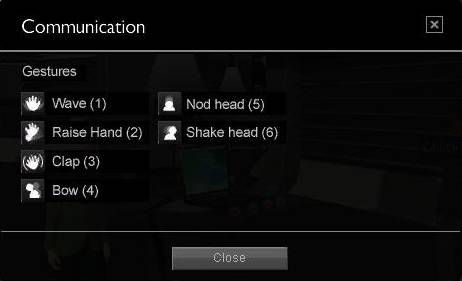
In this area, Lenovo can utilize PDF, PowerPoint, etc. to present to clients.  So the large displays (above) can render a PowerPoint, just like using a projector in a conference room.  Overall, I found the user interface of web.alive (and eLounge) to be quite intuitive.  I was immediately able to pick up on the relevant commands – the use of “overlay” text that appears transparently on top of the screen was useful.  And menus like this are handy:

Lenovo eLounge

Source: Lenovo eLounge

The numbers (above) represent keyboard shortcuts that allow you to “emote”.

The web.alive platform is built on top of the Unreal Engine from Epic Games.  Virtual Worlds News has some good coverage of eLounge, along with Nortel’s licensing of Unreal:

http://www.virtualworldsnews.com/2009/01/lenovo-using-nortels-webalive-for-ecommerce.html

http://www.virtualworldsnews.com/2009/01/nortel-licenses-unreal-engine-for-webalive-opening-up-to-development-community.html

In Summary

For a “Day 1” experience, I found Lenovo eLounge (and web.alive) to be quite good – I’m sure Nicholas and team at Nortel will continue to build it out with more features.  It will be interesting to see the applications that other companies may have for web.alive.  According to Sauriol, Lenovo is the first public launch of a web.alive client – there will be other public launches forthcoming – and there are a number of clients using web.alive behind the firewall (which we won’t hear about).

I’ll also be interested to hear how Lenovo is driving users into eLounge  (i.e. generating interest / demand), along with what sort of ROI they’re looking to generate from this investment.  Kudos on a good start to both Project Chainsaw (Nortel) and Lenovo.

UPDATE: Some supplementary information about the underlying technologies:


A House Call Via Webcam

January 6, 2009

Flickr (neverland_rose)

Source: Flickr (neverland_rose)

While channel surfing during the holidays, I came across a re-run of House, the excellent medical drama on FOX.  In this particular episode, Dr. Gregory House was performing some patient triage over a webcam.  I thought to myself, “that’s a really neat application of video calling technology”.  Today, I read an article in the New York Times by Claire Cain Miller, “Doctors Will Make Web Calls in Hawaii”.  The company enabling this service is American Well, a Boston-based start-up who is pioneering the “New Healthcare Marketplace”.  The web call service in Hawaii works like this:

Patients use the service by logging on to participating health plans’ Web sites. Doctors hold 10-minute appointments, which can be extended for a fee, and can file prescriptions and view patients’ medical histories through the system. American Well is working with HealthVault, Microsoft’s electronic medical records service, and ActiveHealth Management, a subsidiary of Aetna, which scans patients’ medical history for gaps in their previous care and alerts doctors during their American Well appointment.

For patients insured by Hawaii Medical Service Association (American Well’s customer), the cost is $10 to use the service.  How affordable.  Back when gas prices were sky high, one might spend this same amount just to make the drive to the doctor’s office!  And in Hawaii, as the article notes, the islands are remote, which means that getting to see one’s physician may truly be a journey.

There are concerns, however, with such an approach:

However, some critics of doctor visits via webcam worry that doctors will miss important symptoms if they do not see patients in person. Others doubt that the poor and uninsured will have the broadband connection and webcams to use the service. .

“It’s a tool to help doctors do better, the way a stethoscope is a tool,” said Robert Sussman, a family practice doctor on Oahu. “You still have to use your common sense, your medical knowledge.”

I agree with Dr. Sussman – this technology does not replace the house call or doctor’s visit, but it does create a convenient, cost effective and carbon friendly “tool” for receiving health care.

Perhaps some medical insurers will create a network of Telepresence centers, where residents in certain locations (e.g. who live far from their physician) can travel a shorter distance to receive a “web call” via a high-tech, high definition solution. Of course, the doctor would need to use a Telepresence station on her end as well (so, some details need to be worked out!).

Or some day, perhaps you’ll beam a 3D representation of yourself into a virtual world and ask Dr. House to meet you there (for your check-up).  The possibilities await!


A Real Government Goes Virtual

January 4, 2009

Washington Post

Source: Washington Post

O Brave New World That Has Such Avatars in It! That’s the title of a Sunday article in The Washington Post by Michael Laris, in which he describes the efforts of the Arlington County (Virginia) government to create a presence in Second Life.  Here’s the basic idea:

Curious executives can swing by to gather market research aimed at luring grocery chains to Arlington. County officials can conduct presentations on an interactive white board as they promote the region to corporate prospects. And later this month, anyone interested will be able to join a confab on how to launch a business in Arlington.

Apparently, the Washington area has become a hotbed activity for virtual worlds:

The Bethesda-based National Library of Medicine, for instance, has created in Second Life a potentially noxious world of everyday health hazards called Tox Town, where clicking on a tower in a dusty construction site produces a list of the chemical properties of neighborhood runoff.

At the University of the District of Columbia, criminal justice students practice investigations and patrols and deal with such imaginary perp behavior as the attempted theft of Professor Angelyn Flowers’s pink convertible.

Other designers have created in Second Life a virtual Capitol Hill, where plans are afoot for a white-tie inaugural ball Jan. 20. Instructions are forthcoming on how to find a good tux.

I admire this initiative by Arlington County and encourage other governments (local, county, State and Federal) to follow suit.  I see the following benefits:

  1. The world becomes flatter and smaller, as governments get closer to their constituents (and vice versa)
  2. Governments may be able to save costs (imagine that) by utilizing the online/virtual world to connect with residents, rather than connecting in person at physical locations
  3. Assuming a critical mass of audience within the virtual world (I know, we’re not yet there), governments can efficiently distribute information, in the form of updated rules/regulations/bylaws, government news.  Also, how about regular visits by the County Executive within the virtual world
  4. Residents/constituents will feel more connected to their government, which will spur increased involvement in the community

The man behind Arlington’s virtual presence if John Feather, who is volunteering his time to make it happen.  For me, the following quote from Feather hits home:

For Feather, helping nudge the county into Second Life has opened a creative spigot.

In November, he started working on a 3D map of Arlington’s major buildings. Touching images on the map calls up Web pages about them, and he and his colleagues want to add real-time rent data and detailed visuals from architects and developers so that “when you click on that building, you go in the door.”

Such technology will eclipse standard Web sites, including the county’s, Feather said. “You’ll start to walk around places instead of going to flat pages.”

I agree – web pages will increasingly have the same 3D and interactive elements found in virtual worlds.  Web 2.0 has been fun, but the next phase of the Internet is going to be Web 3D-dot-oh.


Bringing Virtual Worlds to The Blind

December 30, 2008


IBM alphaWorks Services

Source: IBM alphaWorks Services

According to Wikipedia, approximately 40 million people in the world are blind.  IBM’s alphaWorks Services division has embarked on a noble project aimed to benefit these 40 million.  Called “Virtual Worlds User Interface for the Blind”, an overview can be found here:

http://services.alphaworks.ibm.com/virtualworlds/

And an FAQ document here:

http://services.alphaworks.ibm.com/virtualworlds/virtualworldsFAQ.pdf

The service currently works with Second Life (only), but IBM may support additional virtual worlds in the future.  If they do add such support, they’ll tie new virtual worlds into the existing client, so that users only need to learn a single application.

With the IBM application, a virtual world is rendered via text (no graphics) and sighted users have the ability to annotate objects of the virtual worlds via text descriptions or recorded audio.

The implementers chose to leverage some open source and off-the-shelf technology:

The user interface is a Web application, a thin client running locally in the Firefox browser that communicates with Second Life through an agent on our server. The application is implemented partly with the JavaScript programming language, and it uses Dojo Toolkit widgets to provide a virtual world user interface that is entirely keyboard-navigable and screen reader-friendly. Nothing is permanently installed on the user’s computer. 

The system also uses Quicktime (to play event sound prompts and verbal annotations) and NVDA (an open source screen reader).  IBM recommends the use of the open source software Audacity for recording the verbal narrations).

I commend IBM for this effort and admire the flexibility and openness they’ve chosen in the implementation.