The #SocialMedia Revolution Is Here. Here’s How to Adapt.

September 26, 2011

Image source: “Social Media Revolution 2011” video on YouTube.

Introduction

“We don’t have a choice on whether we DO social media, the question is how well we DO it,” notes Erik Qualman (@equalman) in his video, “Social Media Revolution 2011.” I knew that technology and social media have created a revolution. But, it was Qualman’s video that made me take a step back and realize how much the world has changed and evolved. And with that change comes a need (for many) to adapt and adjust, in order to take advantage of what’s unfolding in front of us.

Facts and Figures

Qualman’s video contains a series of fascinating facts and figures. For instance:

  1. 50% of the mobile Internet traffic in the UK is for Facebook.
  2. Generation Y and Z consider e-mail passe.
  3. Social gamers will buy $6 billion in virtual goods by 2013. Movie goers buy only $2.5 billion in real goods.
  4. If Wikipedia were made into a book, it would be 2.25 MILLION pages long and would take you over 123 years to read.
  5. 90% of consumers trust peer recommendations. Only 14% trust advertisements.

Generation Y and Z are entering your organization today. Some short time later, they’ll be running your organization. These generations were not born with a silver spoon in their mouth. Instead, they were born with an iPod in one hand and a texting device in the other. How do you adapt to these new generations of digital natives? Here are my thoughts.

Learn from Your Kids

Those of us with kids in school have an advantage: we interact with this generation on a daily (or hourly) basis. We can directly observe their social interactions, learning styles and learning preferences and understand the role technology plays. We can pick up on lingo and hear about the hottest new “toys.” Apply your parental lessons (from this generation) to your organization or workplace.

Empower the Incoming Class

Think outside the box. Generation Y and Z do not need to enter your organization at “entry level” positions. Consider making the leap to place new hires (from these generations) directly into middle manager roles. After all, your customers are (or soon will be) from the same generation.

Reverse Training

Your tenured employees will need to “onboard” and train the incoming crew of Generation Y/Z. But it’s those same tenured employees who can stand to learn a lot in return. Have the new generation train the “older generation” on new technologies, such as instant messaging, Skype and Facebook. An organization more informed on Generations Y and Z is one that’s better suited to achieve growth.

Learn the New Engagement Models

Everything today is instantaneous: obtaining facts (Google), asking a question or favor (SMS), obtaining feedback (gaming, social media). Your organization’s engagement models need to parallel the feedback systems that social networks, games and technology provide. If Generation Y/Z needs to “wait” too long for answers and feedback, then you’ve “lost them at hello.”

Plan for Mobile First

Instagram launched on iPhone (only). Other platforms (including web) will follow. I think that’s the right model. Whether you’re a producer of content or software, deploy first on mobile. That’s where Generation Y/Z prefers to engage with you.

The Video

Here’s the video that spurred my thoughts on this topic. Check it out, it’s worth it.

Related Resources

  1. Web Site: Socialnomics
  2. YouTube channel: Socialnomics
  3. Erik Qualman on Twitter: @equalman

Subscribe

Did you enjoy this blog posting? If so, you can subscribe to the feed here: https://allvirtual.wordpress.com/feed/


#eventprofs Profile: Jenise Fryatt (@JeniseFryatt) on Event Evolution and More

August 5, 2011

“Events will change, but they will also thrive because nothing is more satisfying than turning our online relationships into real-life face to face friendships”

Introduction

Jenise Fryatt (@JeniseFryatt, @IconPresentsAV) is Co-Owner and Marketing Director for Icon Presentations, an independent audio visual company that provides sound, video, projection & lighting support for events. Jenise is based in Southern California. Online, however, you can find her everywhere.

Jenise founded the #EIR movement by creating the associated hash tag and promoting Twitter users who “Engage, Inform and Retweet.” She’s a power user and influencer in the #eventprofs community, sharing a constant stream of useful resources that rivals the pace of Jeff Hurt (@JeffHurt).

In addition, Jenise is Community Manager for Engage365, an online community for event professionals that focuses on technology and innovation. She’s also a co-organizer for Event Camp Europe, taking place this Fall in London.

Thoughts on: Event Camp

Event Camp is a collection of events that was formed by the #eventprofs community on Twitter. Its mission is “to bring together like-minded professionals, to share best practices, and learn new strategies, for leveraging social media and technology to create enhanced event experiences.”

Event Camp Twin Cities (#ectc11) is fast approaching and Jenise recommends you attend. “Last year ECTC blew everyone away with its masterful hybrid event presentation,” said Jenise. “I’m happy to say that this year I will be sharing improv concepts and a game or two with the ECTC participants,” continued Jenise.

Event Camp East Coast gives event pros the opportunity to experience a completely attendee-driven event.  According to Jenise, “That one changed my life last year starting me on a new career path sharing improv games with non-performers.“

Thoughts on: Hybrid Events

Jenise attended her first hybrid event in 2010 (Event Camp).  She was immediately captivated by the power of hybrid events. “I particularly like what people like Emilie Barta (@EmilieBarta) have done to improve the presentation quality by blending platforms and including remote and onsite audiences as participants in one event,” said Jenise.

Thoughts on: Event Evolution

Jenise is excited by the movement in the event industry to “recognize and make use of the collective knowledge of our event participants.” According to Jenise, “I have performed and studied improv for several years and know first-hand that magic happens when you give a group the proper tools for collaborating and just let them go.”

I expect this model of active attendee involvement to accelerate. Millenials, who grew up with the web at their fingertips, are frustrated by passive audience models. Jenise expects to see “creativity in new technology and formats like virtual events, gaming elements in events and participant driven events.”

Thoughts on: Event Evolution for Associations

“One thing to watch is the threat that these new ways of meeting and collaborating so easily and inexpensively pose to the traditional ways associations are run.  Associations will have to evolve to remain relevant. Events will change, but they will also thrive because nothing is more satisfying than turning our online relationships into real-life face to face friendships.”

Thoughts on: Social Marketing for Small Business

To market a small business online, Jenise partakes in a steady diet of content creation. She maintains two blogs, Sound n’ Sight and Eventprov. She uses Twitter to promote her blog posts – and at the same time, uses Twitter to share related content that clients may find useful.

Jenise guest blogs whenever asked, moderates Twitter chats for #eventprofs and #Engage365 and regularly posts on Facebook, LinkedIn and Google+. Like I said earlier, she’s everywhere. It’s hard work, but it pays off for Icon Presentations. According to Jenise, “We now rank #1 for almost all of our key words. And I have had many business opportunities as a result of my online friendships.”

For other small businesses looking to market themselves online, Jenise has this bit of sage advice: “Change your perception about marketing.  It’s not about one-way broadcasting anymore.  It’s about building relationships with potential clients as well as those who will help to sing your praises.”

Thoughts on: Google+

Jenise has been experimenting with Google+, noting that the most active people are the early-adopter, social media geek types. So far, she likes how Google+ combines some of her favorite attributes of Facebook and Twitter.

She’s excited by Google Hangouts, the group video feature of Google+. “A few of my online friends and I have been meeting for group video chats for more than a year and have struggled with tech difficulties on several platforms we’ve tried. When we tried Hangouts it was easy and all the tech problems were gone.”

Related Resources

  1. Web site: Icon Presentations
  2. Blog: Sound n’ Sight
  3. Blog: Eventprov
  4. Web site: Engage365
  5. Web site: Event Camp Twin Cities

Subscribe

Did you enjoy this blog posting? Subscribe to the feed here: https://allvirtual.wordpress.com/feed/


In This Era of Digital and Social, The Extended Family is Closer than Ever

July 16, 2011

Note: I found this image to be perfect for this post; however, I have no known relation to the nice couple pictured.

Introduction

While nuclear families remain in one household, doesn’t it seem like our extended families spread further and further away from us over the years? Weddings, job transfers, lifestyle moves, home upgrade/downsizing, etc. – they pull our extended families in all sorts of directions, both within the States and across the globe.

And yet, with today’s prevalence of broadband, mobile technologies and social tools, doesn’t it feel like we’re as close as ever? How great is that.

Analog Days

Back when I was in elementary school, I remember recording audio tapes with my sister (in Chinese) that my mom would send to our maternal grandmother. Wouldn’t it be great for her to hear her U.S.-raised grandchildren attempt to speak Mandarin? Some two weeks later, grandma would get the tapes in the mail and be able to play them.

Fast forward to today, where my daughter leaves comments for her grandmother on Facebook (via my account), records a video greeting for her via my smartphone, or simply “dials” her up for a real-time video chat via Skype. In this era of digital and social, interactions are in real-time (when we want them to be) and we know more about our extended family than ever before.

I’ll highlight some of the tools that my extended family uses to stay in touch.

Photo and Status Sharing on Facebook

I once read a quote from a prominent executive, who noted that he learned more about his daughters in a few months on Facebook than he learned over all the years raising them. Isn’t that amazing? For people I’m closest to, I’ll learn things on Facebook that I otherwise would not have learned seeing them day in and day out.

In my extended family, photo and status sharing on Facebook has been great for daughters, sons, cousins, aunts, uncles and grandparents to have a sense of what’s going on in everyone’s lives.

Related Post: Why Facebook Is The World’s Largest Virtual Event.

Photo and Video Capture via Handheld Devices

From the iPhone’s high-quality camera to Flip video recorders, it’s easier than ever to record special moments wherever you happen to be: at home, on vacation, at graduation, or watching baby’s first steps.  The image and video quality captured by handheld devices has never been better.

In addition, the ability to instantly share, via email, Facebook, Twitter, etc. has allowed extended family members to “participate” in the moment a few seconds after it happened.  My mom, who would receive frequent Flip video footage of granddaughters on each coast, once remarked that “I love the Flip, it’s allowed me to watch my granddaughters develop.”

Real-Time Video Chat via Skype

My extended family is a big fan of Skype. We tend to do synchronized video calls, where we pick a set time to call one another. We have three generations of the family using it, from grandchildren through to their grandparents. It’s really a lot of fun to observe grandparents video chatting with their grandchildren.

While I don’t expect the grandparents in our family to be enabled with mobile video, I do expect the younger generations of the family to practice more and more “spur of the moment” video calling, via Facetime, Skype for iPhone/Android and related technologies.

Related Post: How Mobile Video Changes Things.

Email

Email is the original “connector” for my extended family and for many others. Email continues to serve a purpose. It’s often used to ask a question of other family members (where, perhaps, Facebook is not the right tool).

And it’s a common distribution vehicle for much of the sharing we do (i.e. you want some more private sharing options beyond Facebook). But it’s interesting how email usage within the extended family is down a bit, due to the extensive sharing via Facebook, Skype, etc.

Conclusion

It’s a great time for extended families. With the combination of broadband, digital and social, go ahead and move halfway across the world – we can remain as close as ever.

Use the comments area below to let me know how your extended family stays in touch! Thank you.

Subscribe

Did you enjoy this blog posting? Subscribe to the feed here: https://allvirtual.wordpress.com/feed/


Why Facebook Is The World’s Largest Virtual Event

July 5, 2011

Introduction

I define a virtual event as “a web and occasion-based gathering that facilitates information sharing, collaboration and interaction.” Virtual events typically involve hundreds, if not thousands of simultaneous users.

Facebook enables the very same information sharing, collaboration and interaction, but does so on top of a user base of 700+ million registered users and 500 million active users.

Facebook is by far the world’s largest virtual event.  The “Facebook virtual event” is a perpetual motion machine that runs 24x7x365. If Facebook were a city, it would be The Big Apple (the city that never sleeps).

Millions of Simultaneous Users

Of Facebook’s 500 million active users, 50% (250 million) log on during any given day (source: Facebook statistics page). For highly active Facebook users, “being awake” or “being online” equate to “being on Facebook,” whether from their desktop computer at work or the mobile device in their pocket.

Of the 250 million users who login to Facebook, let’s assume that 25% are currently asleep (after all, 70% of Facebook users are outside of the United States). That leaves us with 187.5 million users. Of those, let’s say 50% are not currently on Facebook – perhaps they’re at work, or otherwise occupied. We’ll say the remaining 50% are online and “actively engaged” with Facebook.

Our non-scientific analysis leads us to conclude that there are approximately 93.75 million users online right now on Facebook.

Virtual “Events” for Brands (aka Status-casting)

Facebook isn’t a single virtual event, of course. It’s a collection of ad hoc, “spur of the moment” events that any person (or page) can create.

Brands now leverage their Facebook Pages for real-time engagement with fans, customers and prospects. In the past, brands tried to broadcast their message to the world (e.g. a TV commercial). Today with Facebook, they can status-cast.

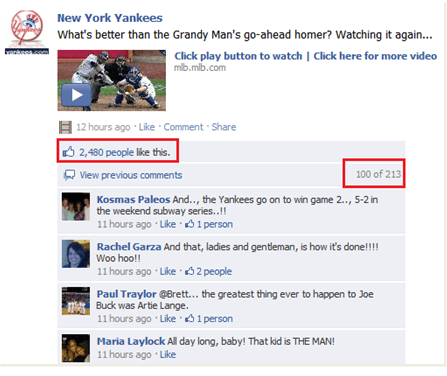
I define a Facebook status-cast as a wall post that invites fans/followers to view content and provide input. On a brand page with a large following, a status-cast can generate hundreds of comments and thousands of “Likes” within a few minutes of the original post. Brands who status-cast typically share content that’s “on demand” (e.g. a video highlight from the game), but it’s also possible to stream live video from your brand page, as the Obama administration has done on the White House Facebook Page.

Virtual Events for Users

Beyond viewing friends’ status updates and checking out their photos, look at all of the “tools” at my disposal (above) as a Facebook user. It’s no wonder why users “stay on” Facebook for so long. I can:

  1. Look for upcoming Events
  2. Chat (in real-time) with Friends
  3. Play games
  4. Share my “game status” with Friends, or invite them to help
  5. Ask a Facebook Question
  6. Join new Groups
  7. See what my favorite brands are up to
  8. “Check in” (from my mobile device)
  9. Look for Deals
  10. Find new Apps

Conclusion

The world’s largest virtual event is one that never ends. Facebook started as a way to connect with friends and share status updates and photos. Today, it serves as The World’s Fair, online.

Subscribe

Did you enjoy this blog posting? Subscribe to the feed here: https://allvirtual.wordpress.com/feed/

Note: I invite you to connect with me on .


Virtual Events and Mainstream Adoption

May 21, 2011

Photo credit: FINALMETAL on flickr.

Introduction

Recently, I had time to spare before a flight home and decided to grab a bite and a drink at a restaurant’s bar at the airport.  While enjoying my food and beverage, I met two traveling salesmen in their 50’s.

We got to talking about our jobs and when it came my turn, I described virtual events. Neither of the gentlemen had heard of virtual events before and their reactions led me to think more about virtual events and mainstream adoption.

We’re Far From “There”

For those of us working in the industry day in and day out, it feels like we’re undergoing rapid growth and increasing adoption – and we are. But for mainstream adoption, “there” is more like the 600MM users on Facebook, not the few million people who have attended a virtual event (my very rough approximation).

In addition, my definition of “mainstream adoption” includes regular use of the technology (by the mainstream).  While there are plenty of “repeat users” across virtual events today, I believe the average user is one who attended a single virtual event and has not yet returned to a subsequent event.

Perception: The Technology is Complicated

Mainstream adoption means traveling salesmen. It means the postal carrier, the hair stylist and Mom and Dad. It doesn’t refer to early adopter, technology-savvy power users. The reaction of the first traveling salesmen at the bar was, “that sounds complicated.”

Now consider the typical, mid-50’s traveling salesman – and for the sake of this example, one who does not sell technology products. The salesman criss-crosses the country every other week and is more proud of his frequent flyer miles than his virtual crops in FarmVille. He uses a laptop for email, but isn’t particularly tech savvy.

To gain mainstream adoption, the user experience for a virtual event needs to be simple and easy.  A grandmother who can create a Facebook account and modify her Facebook profile ought to be able to do the same sort of activity in a virtual event. This would be an interesting scenario to study – could grandma modify her profile on today’s virtual event platforms?

Technology Displaces the Human Connection and … It’s Not Fun

The second traveling salesman conveyed his concern that today’s technologies can disrupt and displace face-to-face connections and interactions. Earlier in the day, he had lunch at a bar at another airport and arrived to find five other bar customers, each immersed in their smartphone. He commented, “I guess I’ll have to get out my device,” got everyone to chuckle and engaged with all of them, to the point where they put down their phones.

When this salesman heard about virtual events, he responded, “that doesn’t sound like fun.” And to a large degree, he’s right.  Virtual trade shows will never replace the handshake or the night out on the town.  This salesman will always choose the physical trade show. But what about his daughter’s college graduation? A virtual option can come in handy then.

Gaining adoption from this salesman will be less about any technology hurdle and more about finding him the right scenario and then making sure he has expectations set properly about what he’ll get out of the experience. Virtual attendance will allow him to experience the content (sessions, speakers, exhibitors, peers) in a convenient fashion, while skipping the cocktails and dinner.

Related: Introducing Virtual Trade Show 2.0

Conclusion

I love to describe virtual events to folks who have never heard of them. The reactions are varied and they tell me a lot about where our market is today and what hurdles we need to address to gain further adoption. Leave a comment below to share your thoughts on how virtual events can reach mainstream adoption.


Social Media Integration for Your Virtual Events

May 9, 2011

Integrate Social Networks into Your Virtual Events

Photo credit: seotips2011 on flickr.

Introduction

Aside from private, “invitation only” virtual events, most other virtual events can benefit from the integration of social media channels.  Integrating social media is a win/win because it increases and augments the degree of engagement within the event.

And, it enables your attendees to promote the event on your behalf.  Awareness extends to your attendees’ friends and followers.  A few retweets and likes later, and the visibility of your event can increase to “near viral” proportions.  Social media integration should not be about slapping up Twitter and Facebook icons throughout the event.  In this posting, I outline READ the FULL POST on the Event Manager Blog.

To Read the Remainder of This Post

The full post is available at The Event Manager Blog (from Julius Solaris).  You can read the full post here:

http://www.eventmanagerblog.com/marketing/virtual-events


Book Review: Viral Loop

February 12, 2011

Image courtesy of Amazon.com

Introduction

Adam L. Penenberg’s “Viral Loop” was published in 2009, but retains a lot of relevance in 2011.  Its subtitle is “From Facebook To Twitter,  How Today’s Smartest Businesses Grow Themselves”.  The book begins by telling the story of the web site “Hot or Not” and how that web site (in 2000) “rode a simple idea to a fortune”, by virtue of “an insanely viral scheme”.

It goes further back in time to the original viral models, Tupperware and Ponzi Schemes and then works its way up through many of the present day (or past-present day) Web 2.0 success stories (e.g. Mosaic, Netscape, Ning, Hotmail, eBay, PayPal and more).

The Viral Coefficient

Early in the book, Penenberg explains the “viral coefficient”, or the “number of additional members each person brings in” (to a web site or service).  The success of a web site, or even a YouTube video, “going viral” hinges on this figure.  Penenberg explains that if the coefficient is equal to 1, the site “will grow, but at a linear rate, eventually topping out”.  Then, “above 1, it achieves exponential growth”.

The early growth of Ning was due to the fact that its viral coefficient was 2.0 – “each person who signs up is worth, on average, two people (compounded daily)”.  And while Ning doesn’t attain the lofty position it once had, its viral coefficient (and how it achieved it) is important in understanding its early success.

Web 2.0 History Lessons

Viral Loop Cover with Social Media icons

Image courtesy of ViralLoop.com

Netscape

In addition to explaining viral coefficients and how viral loops are created, Penenberg provides interesting history lessons (stories) behind some of the web’s most well known creations.  He tells the story of how Marc Andreessen created the Mosaic browser at the University of Illinois in Urbana-Champaign, left Illinois to move west to Silicon Valley, and there co-founded Netscape with Jim Clark.  Version 1.0 of the Netscape browser was released on December 15, 1994, and Netscape engineers “rigged servers so a cannon fired every time a browser was downloaded”.

eBay

In a chapter titled “eBay and the Viral Growth Conundrum”, Penenberg tells the story of Pierre Omidyar, whose inspiration for eBay came from a stock order gone bad – he placed a pre-IPO order for a stock, only to see it jump 50% on the day of its IPO. Omidyar, whose business was called AuctionWeb, hosted the site on eBay.com because his desired domain, Echobay.com, was already taken.

PayPal

The chapter “PayPal: The First Stackable Network”, takes us through the very genesis of PayPal, starting with a lecture at Stanford, given by Peter Thiel. Max Levchin was one of six in the audience. They agreed to meet for breakfast the next week and over breakfast, agreed to launch a start-up around Levchin’s ideas for cryptography software.  The initial company was called Fieldlink and went through a few iterations of cryptography business ideas until they settled on the idea that would become PayPal.

Epilogue

Before reaching the Epilogue, we learn about the beginnings of several other well-known names, including Flickr, MySpace, Bebo and Facebook.  In the Epilogue, Penenberg summarizes the characteristics of viral loop companies and compares the similarities to human population growth – “the human population growth  rate [also] mirrors the curves for companies like Skype, Hotmail, Ning, Facebook”.

Penenberg’s book makes me ponder the coming decade (2011-2020). What new viral loop companies will be created (and how) – and who will be this decade’s Hot or Not, Ning and Netscape?


The Virtual Book Tour

January 21, 2011

Introduction

I recently read the excellent book “The On-Demand Brand: 10 Rules for Digital Marketing Success in an Anytime, Everywhere World,” by Rick Mathieson. In addition, I published my own book, “Generate Sales Leads With Virtual Events”.

To uphold the “on-demand brand” of the new book, I’ve decided to forego the traditional book tour. Instead, I’ll embark on a virtual book tour.  I consider the virtual book tour a “virtual event”, which is what my book is about, after all.

Virtual Book Tour

OK, so it’s not even a full blown virtual tour, I admit. That may come, some day.  In the meantime, I will be handing out 5 free copies of the book.  Here’s how you can grab a copy:

  1. Visit the book’s Facebook page.
  2. “Like” the book’s Facebook page. If you’ve previously “Liked” the page, I thank you for that – as a special reward, skip to step #3.
  3. Post a “valid question” about the book to the Facebook page’s Wall.

“Valid questions” must show that you’ve read the description of the book – and, understand the premise. I promise to answer all questions deemed valid.

How to get your copy

The first 5 people to complete the three steps (above) will receive a free copy of the book, which includes free shipping to the address of your choosing.

Unfortunately, I need to restrict the free shipping offer to continental U.S.  only – I’ll contact you to arrange shipping if you’re a winner who resides outside of the U.S.


Introduction to HuzuTech: A Social Media Software Company

January 17, 2011

Note: The following posting was submitted by Graeme Harvey, Managing Director, HuzuTech

Graeme Harvey is MD of HuzuTech, a social media software company. He’s been involved with HuzuTech since 2009, and before that he started up a successful digital publishing division within Harpercollins publishers, concentrating on online, desktop and mobile application development. There, he developed a digital business that underpinned the Collins Language division – the first of its kind within Harpercollins UK (it included the first e-commerce, e-book and mobile app presence).

Introduction

HuzuTech is a British social and virtual technology company. We’ve just launched our white label virtual world platform, HuzuVirtual, which lets brands, publishers and film or TV production houses create their own branded virtual worlds and online environments – at a fraction of the cost of building one from scratch.

We also white label our own social networking platform, HuzuSocial, which lets brands offer secure social networking facilities (including within a virtual world, through full integration with HuzuVirtual) and the ability to link to Facebook.

Branded communities

We announced the launch of HuzuVirtual at AdTech New York recently, and the response was fantastic. We know that virtual worlds are a huge growth area for publishers and media companies, but what was really interesting was the appetite for brands to create their own communities.

As online communities become integral to brands’ marketing campaigns, there is a reluctance to hand over control of customer data and relationships to a third party like Facebook, and requirements for more sophisticated or bespoke technology to manage those relationships effectively.

Customisation

As a result, our technology is completely customisable, with functionality that includes things like the creation of different virtual environments, rooms or ‘levels’ to the world; avatar creation; virtual (or real) goods shop; fully moderated chat functionality; custom-branded avatars; and special events such as online meetings, concerts, and VIP areas. It’s cloud-based, because it is designed to be able to cope with rapid growth, when the community grows exponentially.

Monetisation

There’s also the thorny issue of monetisation. More and more, brands are seeking to monetise their online environments. Sales of branded goods are expected to grow by more than 100 per cent over the next three years. We’ve included virtual shopping features in HuzuVirtual, and the feedback we’ve had so far has been that brands definitely want to control an environment where customers are paying for their goods.

Demonstrating the Technology

We’ve developed a site to show how the technology works, including some really great features like routing technology (which means an avatar will always follow a path – rather than walking ‘through’ obstacles), and ‘motion’ sensors (see how the car alarms going off when the avatar walks past them) here: http://paperworld.huzutech.com/.

Note: this isn’t a virtual world in itself, but shows the kind of technology we can use. We’re constantly tinkering with it to make it better, and we’re always interested to know what other people think of it.

The first full virtual world built on our platform will be out in around June 2011, and is for Scholastic’s Horrible Histories™ – it’s a great one to be working on and shows how the publishing industry is one of the first to adopt these new technologies to market books.

If you’re interested to know more, visit our website: www.huzutech.com.


Virtual Event Email Promotions and Hotmail Active Views

January 14, 2011

Note: Image sourced from a Hotmail YouTube video.

Introduction

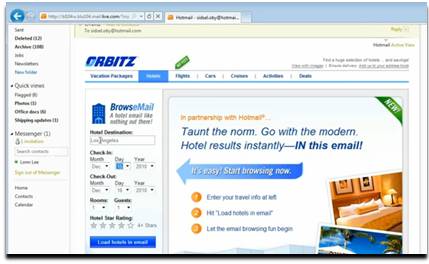
The Hotmail Team has introduced an interactive email technology called Active Views.  The technology allows recipients of Active Views emails (within Hotmail) to interact with the email itself.

Hotmail showed examples of two of their early partners, Orbitz and Monster.  Recipients of the emails could search a flight (in the Orbitz email) or search for jobs (in the Monster email).

Interactive Emails and Virtual Event Promotions

Interactive email technologies present interesting possibilities for virtual event email promotions – and, more broadly, for any email promotion that seeks to elicit a response.  Imagine the following for virtual event email promotions:

  1. Register for the virtual event
  2. Enter your Twitter, Facebook, LinkedIn, etc. identity and see which of your followers, friends, connections, etc. have already registered
  3. Navigate through the session schedule and indicate which sessions you’re interested in attending
  4. Complete your attendee profile – upload your image/photo and add a short bio
  5. Social sharing – let your social networks know that you’re interested in the event – or, that you’ve just registered

The possibilities are endless.

Considerations

  1. Only Hotmail “trusted parties” can utilize Active Views
  2. The technology is platform-specific (it’s limited to Hotmail)
  3. The technology is new and largely untested (at a large scale)
  4. It remains to be seen how well the technology functions across platforms (e.g. email clients, operating systems, tablet devices, etc.)
  5. While security provisions are in place, it may open a window for providers of phishing and malware

Related Links

  1. Active Views introduction on the Inside Windows Live blog
  2. TechCrunch: “Hotmail Active Views Look To Make Email Interactive
  3. ClickZ: “Hotmail Active Views Revives E-mail Innovation in 2011