COMDEX Re-Launches As A Virtual Trade Show

March 4, 2010

The virtual events industry had a lot of exciting moments over the past two years.  I believe we’ll look back upon today, however, as an one of the most important and historic moments for our industry.  Everything Channel (a UBM company) announced that they’re re-launching COMDEX as a 100% virtual trade show.

Press Release: Introducing the New COMDEX, the Next Generation in Virtual Events

During its heyday, COMDEX was the “go to” trade show in the computer and technology industry, “where all levels of manufacturers and developers of computers, peripherals, software, components and accessories came in direct contact with retailers, consultants and their competitors” (source: Wikipedia)

COMDEX was discontinued in 2004.  In 2006, UBM acquired the event assets of COMDEX via their purchase of MediaLive International Inc.  COMDEX Virtual will fit nicely in UBM’s Everything Channel business, whose objective is “accelerating technology sales” and whose publications include Channelweb and CRN.  This is very exciting news – I gave some thought to what this means to our industry.

Game Changer and Turning Point

Today’s news is nothing short of a game changer and turning point for our industry.  Virtual events have enjoyed growing adoption – initially from B2B publishers and recently from corporations.  Adoption rates have been particularly strong from the same technology vendors who used to exhibit at COMDEX.  Now, however, one of the most widely known event brands has made the move to embrace virtual.

COMDEX Virtual will be watched (and attended) closely by related event brands – its success will incent many more well-known event brands to come on board virtually.  Staying within the technology space, CES and Macworld may be encouraged to consider a hybrid model for their events, adding a virtual component to complement their in-person event.  Discontinued event brands may similarly move to re-launch as a virtual-only experience.

Confirmed: Options and Flexibility with Going Virtual

Virtual event technology afforded Everything Channel with a flexible way to bring back the COMDEX brand.  First, the costs are lower.  Second, the financial commitment around a physical event venue was avoided.  Third, a virtual event affords exhibitors with a convenient and cost-effective means to return to COMDEX.

Re-sellers and systems integrators tend to be small-to-medium sized businesses (SMB) – they operate “lean and mean” without an abundance of marketing budget.  In the past, their entire year’s marketing spend may have been put towards COMDEX.  Now, the same exhibitors can exhibit virtually and avoid the travel costs and “out of office” costs of sending their company representatives to Las Vegas – affording them remaining marketing dollars to use elsewhere.

With the flexibility afforded, COMDEX Virtual allows Everything Channel a convenient and efficient way to bring COMDEX back to life.  If the virtual event exceeds expectations, more options become available, such as a physical component to complement the virtual – creating a hybrid event after first testing the waters virtually.

Virtual Extensions

Industry observers have noted that more focused events (e.g. CES in consumer electronics and Interop in computer networking) began to steal interest away from COMDEX – many believed that it had become too broad.  Subsequent to its November 2010 launch, COMDEX Virtual may want to consider a series of smaller and more focused virtual events – around industry sectors or by specific geographies.

Additionally, virtual affords COMDEX the option of extending its presence globally – both via participation from a global audience, as well as regionalized virtual events that cater to specific regions (e.g. EMEA, Asia Pacific, etc.).  With the localization capabilities provided by virtual event platforms, attendees can choose the language in which they experience the event.
Unique, Branded Experiences

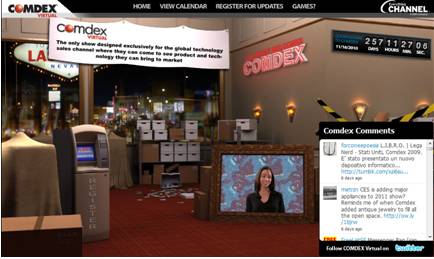
COMDEX had a unique brand – with COMDEX Virtual, there seems to be a clear desire to create a unique experience that carries unique and distinctive branding.  Put another way, COMDEX Virtual should not look like any other virtual event – it needs to stand apart.  As such, UBM Studios, a “creative and strategic marketing agency” will create original and highly engaging event areas for COMDEX Virtual, including the Grand Hall of Masters, Hospitality Suites and the CRN Test Center.

This is part of a continuing trend in our industry – the desire (and capability) of show hosts to create highly engaging and unique experiences that adhere to their branding guidelines – or, create new brand experiences.  As such, clients with the budget (or capabilities) will “in-source” the creative development and look to the virtual event platforms to “carry the payload” – providing the foundation on which the event rides, along with essential platform features and services.

Taking the game to the next level

To support the size and scale of COMDEX (virtually), event platforms will need to bring their “A game”.  If the event will house hundreds of exhibitors interacting with tens of thousands of attendees, the virtual event platform will need to deliver on performance, reliability and scalability.  In addition, useful platform features need to enable exhibitors to demonstrate their products and services.

Match-making tools should enable exhibitors to find the “right” attendees and for attendees to find and make useful business contacts.  Lastly, the platforms need to enable pervasive use of video – both on-demand video and live-streamed video.  After all, a key element of past COMDEX events was the ability to see, hear and engage (visually) with others.

Conclusion

The “countdown to COMDEX” is on – between now and November, I’m sure there’s plenty of work and planning to get done.  In the meantime, with today’s announcement alone, a bit of history has already been made.

Tweet this posting:


Evolving The Virtual Event Group Chat

February 26, 2010

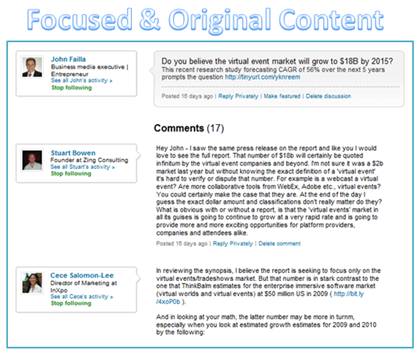
Excerpt of LinkedIn Discussion ("Virtual Events Forum")

For me, the best content in LinkedIn is found in Discussion threads in LinkedIn Groups to which I belong.  Why is the content so good?

  1. It has a precise focus that’s aligned with the charter or focus area of the group
  2. It’s based around timely topics (i.e. what group members are currently interested in discussing)
  3. It’s interactive with a loopback mechanism – there’s a dialog that unfolds – someone making a wild claim will be called on it and will need to return to the discussion to justify the claim (or, lose credibility by remaining silent)
  4. It’s the best form of “user generated content” – from subject matter experts and hands-on practitioners

As such, some content in LinkedIn Discussions can prove to be more useful and valuable than comparable content in related industry publications and web sites.  The LinkedIn Discussion thread is a great example of the “wisdom of the crowds” surpassing the knowledge of a handful of individuals.

Virtual Event Group Chat

While allowing for the fact that a portion of virtual event group chat is logistics-related (e.g. “I don’t hear the audio on the Live Webcast”), chat content related to the event’s theme (topic) comprises some of the most useful and compelling content in the entire event.  Why is that?  It’s for all the same reasons I list (above) for the LinkedIn discussion.

The challenge in leveraging an event’s group chat, however, is this:

If I’m not actively monitoring the group chat, how do I participate?

In my mind, the virtual event group chat needs to evolve to better serve attendees.

Group Chat Threading

Attendees may visit a group chat area (e.g. Networking Lounge), with an interest to discuss numerous topics (see example with LinkedIn Discussion topics, above).  In an unstructured group chat, the introductory chat message (to start the discussion) is likely to be “interrupted” with other, unrelated messages.  The result is some “scattering” of the chat content, with the possibility that a meaningful discussion (on the original topic) never happens.

Today’s “Wild, Wild West” of group chat needs to become threaded – the group chat’s user interface needs to allow participants to denote which message(s) they are commenting on – with the resulting “chat window” nesting (or otherwise grouping) messages within the same thread.  Additionally, the chat system should auto-populate information on which user one is responding to.  This way, participants no longer need to preface their comment with the name of the person they’re responding to.

A wealth of additional features become possible once this sort of threading feature is enabled.

Embraces and extends chat topics

I submit a chat message, asking if folks are interested in “Topic X”.  If no one answers me back within the next 10 minutes, that chat topic is dead.  Threaded chat, however, allows attendees to bring topics back from the dead.  If a visitor enters three hours later and decides to reply to my original message, that section of “threaded chat” can be moved to the “current timeline” in the group chat area – much in the same way a comment on a friend’s Facebook posting moves the original posting “up” in your News Feed.

Real-Time Search!

If I’m not able to dedicate the time to visit and monitor a group chat area, the next best thing would be a virtual event search function that provides real-time (or near-real-time) indexing of the group chat content.  Imagine the following capabilities:

  1. Exhibitor: perform searches on my company name – allows me to determine whether I need to enter the group chat to repsond
  2. Attendee: perform searches on topics that interest me – and be able to see the entire discussion thread on that topic
  3. Attendee: search on other attendees in my Buddy List – show me chat comments posted by my buddies
  4. Attendee: search discussion threads for comments posted subsequent to my own comments

Content Re-Use

For a B2B publisher – and, for some corporations – the content of selected discussion threads could be re-used and posted on the web as original (or, semi-original) content.  B2B sites often publish “how to guides” and best practices articles – discussion thread content (with the “right” mix of contributors) can be re-published on the web – or, used as the basis for a more in-depth article.

Conclusion

With group chat being one of the most valuable components of a virtual event, its features should evolve to better leverage the “wisdom of the crowds”.

Tweet this posting:


2010 Trend Watch: Virtual Events

February 25, 2010

Source: flickr (User: b.frahm)

For the virtual events industry, the premier face-to-face event of the year is Virtual Edge Summit, the “summit on virtual events, marketing & communities”.  Virtual Edge 2010 concluded earlier this week – the face-to-face event floored in Santa Clara, CA, while several vendors provided virtual components, allowing remote (virtual) attendees to participate in the experience.  The event saw record crowds from attendees, exhibitors and presenters.

From my observations at this year’s event, the following are a set of emerging trends in the industry.

Beyond Novelty Phase

Judging by the turn-out alone, the virtual event industry has officially “graduated” beyond the novelty phase.  Awareness of virtual events has broadened – now, when I meet someone at a social gathering and describe what I do for a living, the blank stare of years past has become a “oh yes, I’ve attended one of those”.

The increase of awareness (and, perceived importance) could be seen in the amount of coverage that Virtual Edge 2010 received – an increase in the number of publications (on-site), bloggers (both on-site and virtually) and analysts (both on-site and virtually).  Lastly, the volume of tweets (via hash tag: #ve10) was 5-10 times greater than last year – with more tweets per person and many more people tweeting.

With that being said, there are enormous untapped and unexplored markets, which will provide the industry much of its growth in 2010 and beyond.

More Players Emerge

I noticed a near doubling in the number of exhibitors this year, which means that new/emerging vendors significantly developed (or expanded) their virtual event capabilities – or, from a marketing standpoint, they determined it was the right time to get their products and services in front of this audience.

Last year, the exhibitors were fairly homogeneous – they provide apples-to-apples solutions and directly compete with one another.  This year, the breadth of solutions offerings (from the exhibitors) has expanded – some exhibitors do not necessarily compete directly with one another.

In some cases, a client may use one vendor for a particular type of virtual event and a different vendor in another type of event.  The result?  More “burden” on the attendees (buyers) to understand the solutions offered and determine which solution best fits their needs.  This affords some  industry players (agencies, consultants) a great opportunity to help clients and prospects navigate the waters.

Early Adopters Become Industry Thought Leaders

Practitioners (especially some of the early adopters in our industry) are quickly becoming the thought leaders and “go to source” for ideas, expertise and wisdom.  Many of these thought-leading practitioners were on stage this week – they were very generous with their sharing of experiences.  And, more than ever, they know precisely what they want from their vendors (which is a great thing for those in the vendor space).

In the early days, the practitioner would ask the vendor, “show me what you have” or “show me what you can do’.  Today, the tables have been turned.  Practitioners (clients) are now telling the vendors, “let me tell you what I need” or “make this experiential vision come to life for me”. This is an important aspect of the industry’s evolution – vendors crafting innovation via direct input from practitioners (as opposed to creating “innovation in a vacuum”).

3D Immersiveness

Interest in 3D immersiveness is picking up.  In fact, at Virtual Edge this year, roughly 20% of the session content involved 3D / immersiveness and a formal “Business 3Di” track was created.  The 3Di track featured practitioners, along with vendors such as Linden Lab, Teleplace, Altadyn, Digitell and web.alive (Avaya).  Like last year, Digitell provided a simulcast of the event proceedings into their 3D immersive platform (VirtualU).

Those are the “pure play” immersive environments.  In addition, virtual event platforms are coming on board as well.  In my 2010 predictions on virtual events, I wrote, “(virtual event) platforms take first step towards immersiveness”.  This prediction has come true.

It’s interesting, however – some vendors have a clear vision of what immersiveness enables for exhibitors and attendees of virtual events, while others appear to be adding immersiveness for the sake of adding it (i.e. lacking a clear and compelling use case).  It’s in the best interest of virtual event vendors to explore and enable immersiveness via specific client use cases – this way, the capabilities are added to meet a client need – and, serve as a reference (to the rest of the industry) on the true value delivered via immersiveness.

Social Media Integration

2009 was a monumental year in the evolution of both social media and virtual events.  In 2010, there continues to be a lot of talk about both topics – including discussion around how they integrate with one another.  Social media (and related social networks) were central to the discussion in many workshops and breakout sessions.

And of course, social networking was flourishing in and around the event, with a high volume of tweets, a fair number of Facebook status updates and (I’m sure) lots of LinkedIn connections made.  While I am not aware of any groundbreaking announcements from Virtual Edge on social media integration, I’d expect that platforms enable more and more social networking as 2010 unfolds.  I expect to see the platforms themselves becomes more social (natively) and increase the depth of their integration with third party social networks.  Twitter, Facebook and LinkedIn are commonly mentioned – but expect to see industry-specific, niche networks and communities integrated as well.

Industry Ecosystem Begins to Take Shape

Virtual event platform vendors have established a number of strategic partnerships to extend account/client reach and grow/scale business opportunities.  Most of those partners were present at Virtual Edge – and a number of partners had prominent speaking roles in the sessions.  By this time next year, even more partners will enter the space and appear at the event.

Additionally, smaller businesses (and individuals as well) are seeking to leverage opportunities within virtual events to bring in new business – or sign on for consulting roles.  The list includes video production companies, design agencies, digital signage providers, freelance producers/writers/story-tellers, streaming providers and emerging social network / community sites.  As these “players” look to get a small piece of the industry pie, they serve to grow the overall ecosystem of this industry.

Finally, hands-on practitioners are finding a fluid and welcoming job market, despite the less inviting macro job environment.  Virtual events are still new enough that production staff, developers and strategic consultants have highly specialized knowledge and skills – as such, they’re able to quickly transition from their existing (or past) role to a new vendor, service provider or practitioner (client side).  Most of the vendors in the space are aggressively hiring, which means that savvy job seekers leveraged the conference to generate meaningful employment leads.

Conclusion

It’s an exciting time in our industry – I’m looking forward to seeing how things shape up for Virtual Edge 2011.

Tweet this posting:


2009 Year In Review: Virtual Events

December 24, 2009

2009 was a landmark year for the virtual events industry – early adopters expanded their virtual event initiatives and leveraged the technology in innovative ways.  Many industries (and associated corporations) entered the mix, producing their first ever virtual event in 2009.  Despite the economy (or perhaps aided by the downturn), virtual event platform providers enjoyed healthy growth in client demand, event volume and revenue.  The platform market expanded beyond the U.S., with the emergence of new platforms in Europe and New Zealand.  We even had the industry’s first ever face-to-face event, the Virtual Edge Summit (U.S. – Santa Clara, CA).

To get a better sense of how 2009 unfolded, I reviewed the past 12 months of postings on this blog and sought to categorize the trends and patterns.

Source: flickr (User: Linzi's Cakes)

Assorted Shapes and Sizes

In the early days, the industry was all about virtual tradeshows.  During 2007-2008, new event types were spawned – and in 2009, we saw many more instances of non-tradeshow events: virtual job fairs, virtual sales meetings, virtual partner summits.  In addition, we saw innovative concepts applied in hybrid events – where event planners staged concurrent physical and virtual events.  I wrote about learnings and observations from Cisco Live and Networkers Virtual, in which virtual and physical blended together.  In 2010, I expect to see many more hybrid events, with event planners leveraging creative ways to tie virtual together with physical.  In fact, I believe 2010 will be The Year of The Hybrid Event.

In addition to the assorted event types – we’re starting to see the use of virtual event technology to support ongoing business communities.  The community concept makes a lot of sense in conjunction with physical or virtual events – instead of “going dark” between live event dates, event planners can leverage the “platform” to keep the community interaction and dialog going – where the events serve as “momentum points” to drive continued activity within the online business community.  I brainstormed about tactics that could be applied to sustain virtual business community loyalty.

Social Media and Twitter

With all due respect to Facebook and other services, I believe 2009 was The Year of Twitter.  There are many ways in which Twitter can be leveraged for virtual events – here are a few ideas that I blogged about:

  1. Leverage Twitter for Virtual Tradeshow Outreach
  2. How to Promote Your Virtual Event on Twitter
  3. Leverage Twitter Lists for your Physical or Virtual Event

Virtual event platforms have integrated with Twitter and other social networks – in 2010, I see the breadth and depth of integration expanding.  The expansion will be fueled both by interest (from the virtual event platforms and from clients) as well as richer interfaces (APIs) from the social network sites.  For instance, LinkedIn recently announced an open API for their platform.

In parallel to virtual events, 2009 was a watershed year for social gaming (e.g. Zynga, Playdom and other sites).  In 2010, we’ll see virtual event platforms leverage gaming for a mix of fun and business use.  I wrote about the reasons that virtual events should incorporate gaming.  Lastly, I believe the tried and true webinar needs to become more social – webinars need to encourage and support more participation from the audience.

The market extends beyond the U.S.

In 2009, virtual events platform vendors emerged globally – in order of appearance in this blog:

  1. ExpoNZ – New Zealand
  2. IMASTE – Spain
  3. Ubivent – Germany

I expect to see a few more virtual event platforms emerge in Europe in 2010 – Asia Pac is sure to see local entrants as well.

Virtual Event Best Practices

I wrote a lot about virtual event best practices in the past 12 months. Here’s a selection of the more popular postings:

  1. Virtual Event Best Practices
  2. How to Market your Virtual Event
  3. Best Practices for Virtual Tradeshow Exhibitors
  4. Lead Follow-Up for Virtual Events
  5. Assemble the Right Team for your Virtual Event
  6. Increase Your Virtual Event ROI
  7. Think Outside the Inbox for Virtual Event Promotion
  8. How to Run a Virtual Event Command Center

Happy Holidays to all.  2009 was a great year for virtual events.  And I have news for you – 2010 will be even better!


2010 Predictions For Virtual Events

December 3, 2009

Source: flickr (User: sassycrafter)

Back in August, I jumped the gun a bit and wrote a “year in review” posting about virtual events.  Now that we’re in December,  I think it’s high time to peer into the Magic 8 Ball and speculate on what’s in store for the virtual events industry in 2010.  Away we go…

Widescale adoption and integration of video conferencing

Virtual events have incorporated a lot of on-demand and live video – however, to date, the majority of attendee interaction has been via text (e.g. private text chat, group text chat, etc.).  Many platforms have enabled the use of attendee webcams (a la Skype) and that was a nice start.  In 2010, I believe that the virtual event platforms will integrate with third party video conferencing technologies in a big way – stirred largely by client demand for it.

Think about it – multinational corporations have adopted high-end video conferencing to encourage collaboration and save on travel costs.  They have the budget to invest in Cisco Telepresence or HP Halo.  As those same corporations look to adopt virtual events (e.g. for an annual virtual sales meeting), it’s only natural that they incorporate the video conferencing technology that they already have running.

To capture mid-market and small business interest, virtual event platforms will look to integrate with mid-tier video conferencing systems, such as Tandberg (whose acquisition by Cisco is pending) and Polycom.

Another interesting player is LifeSize Communications, an Austin-based provider of “mainstream telepresence” that was acquired by Logitech in November.  LifeSize recently launched an offering called Passport, which they term “a portable telepresence-quality system” that fits in the palm of your hand.

I see continued use of consumer-grade webcam technology in 2010 virtual events  – however, the game changer will be the incorporation of multi-party, HD video conferencing.

Emergence of global players

We’ve already seen the emergence in Europe of virtual event platforms – IMASTE in Spain and Ubivent in Germany.  I expect to see another European-based platform emerge in 2010, along with one or more in Asia Pac.  In addition, we’ll see services companies launch to capitalize on the demand (for virtual events) from publishers, corporations and event marketers.  The companies will provide both strategic and logistical services around virtual events.  You’ll see some start-up companies and you’ll also see physical event marketers spawn service offerings around virtual (or more logically, hybrid) events.

Industry consolidation

We’ll see the merging or acquiring of virtual event platform companies.  Some providers will look to acquire/merge out of platform capability gaps – while stronger players will look to complementary/synergistic technologies offered by the competition.  As the economic environment comes back around, companies (and their investors) will be more apt to combine forces to fuel the next phase of growth.  Lastly, larger and more established players in the “collaboration space” may look to acquire virtual event platform companies, to add a complementary piece to their product portfolio.

Decrease in “relative response rates”

Virtual events had a great run in 2009, but we’re now past the novelty, “wow, this is cool” phase.  In the B2B market, we now have plenty of users who have attended two or more virtual events.  If virtual event show hosts continue to use the same graphical templates, organize the same presentation agenda and re-create an identical experience to their last event, then “relative response rates” will drop – meaning, it will become harder and harder to recruit users to register and attend.

Decreased response rates are natural as any new “content type” grows beyond infancy – and the supply/demand ratio begins to tilt towards having more supply than demand (e.g. lots of virtual events).  Virtual event show hosts will need to consider the incorporation of gaming, the creation of affinity programs and more.  The solution to decreased response rates will be fun to watch – innovators will step to the table to find creative ways to engage and attract virtual event attendees.

Platforms take first step towards immersiveness

While virtual event attendees may not “require” the immersiveness of Second Life and other 3D virtual worlds – immersive capabilities provide real value in a B2B setting.  The most obvious use case is an immersive rendering of a complex product – consider the high-end video conferencing system, the high-end router, the latest luxury car model.  Instead of a 2D PowerPoint slide that highlights the capabilities of the video conferencing system, how about an immersive experience where attendees (aka prospects) get to experience the system and interact with it?

Client interest and demand will drive some platforms to add immersive capabilities in 2010.  I don’t expect a software download, however – it would serve platforms well to support the immersive experience within their existing framework (e.g. Flash, JavaFX, Silverlight).

Those are my 2010 predictions for virtual events.  I’d love to hear your’s!


Cisco GSX: Learnings, Best Practices, Looking Forward

December 3, 2009

In 2009, Cisco moved their annual Global Sales Meeting from a physical gathering to a 100% virtual event called Cisco Global Sales Experience (GSX).  I authored a posting on the InXpo blog regarding GSX – with numerous insights from Angie Smith (Manager, Global Sales Experience at Cisco), I covered:

  1. Best Practices – Virtual Sales Meeting
  2. Considerations for a Hybrid (Physical+Virtual) Sales Meeting

Here’s a link to the full blog posting:

http://inxpo.wordpress.com/2009/11/30/the-hybrid-model-comes-to-global-sales-meetings/


Ubivent Enters The Virtual Events Platform Market

December 2, 2009

Based in Mannheim, Germany, ubivent has entered the virtual events platform market with a recently launched platform.  According to Michael Geisser, Managing Director Market Development, the ubivent co-founders “met at university, working together in an IT research program and pursuing our PhD”.  The co-founders then spent several years working at multinational corporations, where they held numerous roles in IT and IT management.

In fact, Geisser and co-founder Thomas Butter (Managing Director Research and Development) were recently with SAP, where they worked on some of SAP’s first virtual events.  Ubivent is off to a fast start – they received 12 months of funding from EXIST, “a program of the European Union and the German Federal Ministry of Economics and Technology” designed to support innovation.  In addition, in late November, ubivent was selected as the most promising young company in Mannheim.

Target market

Ubivent’s initial target market is to serve large and distributed corporations – large companies have already adopted the basic technologies required for virtual events (including sufficient bandwidth capacity) and distributed companies can immediately leverage the convenience and cost savings of virtual collaboration (versus in-person).

“However, this does not mean that we do not offer our services for small, non-IT organizations”, noted Geisser. “We’ve also done projects with local authorities. Obviously, the entire project size has been not that extensive as for a global event with multiple thousands of participants.”

Since the European market for virtual events has not developed as quickly as the U.S. market, Geisser sees plenty of opportunity in Europe.  Geisser sees opportunity in all sorts of event types, but notes that “the type of the event is not as important as the content and the participants. We see the advantages of virtual events especially for knowledge-intense content (e.g. software, finance, etc.) with globally distributed participants”.

In comparing the U.S. and European markets, Geisser believes that while “US based customers put more emphasis on the look and feel, the European customers are very keen on getting a technically scalable and secure platform. Fortunately we’re combining both.”

Technology platform

Ubivent is a member of Microsoft BizSpark, a program that provides “software, support and visibility” to software start-ups.  While most virtual event platforms are built on top of Adobe Flash, ubivent’s platform is based on JavaFX, a platform for building rich internet applications that runs on top of JRE (Java Runtime Environment).

According to Geisser, the use of JavaFX serves as a competitive advantage for ubivent over competing Flash-based platforms – “JavaFX is one key advantage of our platform. This opens the door for completely new functionalities which are not possible with other technologies (e.g. Flash)”.

Ubivent developed an accessibility framework to assist visually impaired people in using their virtual events platform via a screen reader.  The source code for the accessibility framework has been published as open source.  The framework is built on top of JavaFX, which means that other platforms seeking to incorporate it would need to run JavaFX as well.

Virtual events vs. immersive virtual worlds

Geisser has taken a look at 3D immersive virtual worlds, such as Second Life and Twinity.  He believes, however, that the immersive virtual world is currently more suited to B2C or C2C use cases, whereas his B2B market is more focused on quick and convenient access to selected content.  Notes Geisser, “In a B2B context, the desire for avatars and the ability to walk through a virtual world is less distinct. Here, the focus is more the ability to quickly access information and other participants. The need to ‘walk’ through the virtual world to access this information or participant is considered adverse with regard to this goal.”

In closing

It will be interesting to watch the European market for virtual events in 2010.  Ubivent and IMASTE are two of the leading European-based providers – while they may encounter each other in common client accounts, I’m sure the providers from the U.S. market will be looking towards Europe (and Asia) as well.

Related links

  1. Follow ubivent on Twitter
  2. Ubivent’s Facebook page
  3. Ubivent-developed accessibility framework, fxaccessible
  4. Ubivent’s executive management team
  5. Audio interview – ubivent speaks about their JavaFX-based virtual events platform

How To Promote Your Virtual Event On Twitter

October 26, 2009

tweetdeckIMG

With a rapidly growing and highly engaged user base, Twitter can be a great vehicle for driving registrations and attendance to your next virtual event.  Here’s a step-by-step guide on how to get that done:

  1. Find your target audience on Twitter – first, of course, you need to define the target audience of your virtual event.  Once you do, go seek them out on Twitter – you don’t need to engage with them on Twitter just yet, but you can start following them – and identify the “places” where they tend to congregate (e.g. read their tweets, click through on links they’re sharing, read their blogs, attend chats they participate in, etc.).  You may find that by following folks, they’ll follow you back – and, may engage with you on their own.  Next, leverage Twitter’s search capabilities – search on key terms associated with your virtual event and observe who’s tweeting about them.  Sign up for a service like tweetbeep and you’ll receive daily email alerts with all tweets about your selected terms.  Start following the folks who seem to know what they’re talking about, as your virtual event may be of interest to them.
  2. Identify Twitter users whom your target audience follows – if you handled Step #1 well, then you’ve half-way completed this step already.  By researching topics (and users) on Twitter, you’ll begin to build an authority map – those with more authority on topics tend to have more followers.  Identify users whom your target audience is following – then, determine which users they’re following (and so on).  You’re now starting to build potential promoters who can help in the outreach efforts of your virtual event.
  3. Leverage prominent or active tweeters in your own company – is your CEO or VP Marketing an active tweeter?  If so, them reach out to their multitude of followers to promote the virtual event.  On your corporate web site, use a service such as TweepML to share a list of your company’s Twitter users – giving web site visitors a single-click option to start following every member of that list!
  4. Identify other prominent / relevant Twitter users – find prominent industry bloggers and start reading their blogs.  Engage with them by leaving comments on their blogs or send them @replies via Twitter.  Making these folks aware of your virtual event is a good thing (e.g. perhaps they’ll attend) – having them promote the event on your behalf is even better.
  5. Build your Twitter following – if you’ll be using a corporate branded Twitter account to focus your marketing efforts, use the aforementioned steps to start building your list of followers.  For me, quality always trumps quantity with Twitter followers – I’d rather have the right people follow my corporate branded account than have 200 “non relevant” folks follow me (in the hopes that I’ll follow them back).  Especially with a corporate Twitter account – make every tweet count.  Potential followers will often review your last 5 or last 10 tweets – if you tweet too often about breakfast or the weather, then you will NOT be followed.
  6. Start promoting by adding value – first, you never want to over-promote your virtual event.  Doing so will only turn users off from your corporate branded Twitter account.  Each time you promote the virtual event, you want to add value.  So again, make every tweet (promotion) account and give users something useful each time.  Similarly, ask your fellow promoters to start spreading the word – and suggest phrases or facts they should be using in their tweets.  Use a link shortener such as bit.ly and track the number of clicks you generate – this way, you can start to determine what’s working and what’s not working.
  7. Define (and use) your virtual event’s hash tag – make sure all tweets (e.g. from you, your colleagues and your fellow promoters) utilize the hash tag that you’ve created for your virtual event.  Ask your event’s exhibitors to pitch in as well – have them tweet about their presence at the event.  Once you’ve seeded the discussion with your event’s hash tag, you may see the interaction and commentary spread – if a few prominent tweeters jump in (e.g. >100,000 followers) and their tweets are then re-tweeted by other prominent tweeters, then awareness of your virtual event can spread beyond even your wildest dreams.
  8. Leverage other (relevant) hash tags – the hash tag can be a wildly effective means for promoting content to indirect followers – I may only have a few hundred followers, but if I post something insightful with the #eventprofs hash tag, I may have my message seen by the 50,000 (this number used merely as an example) users who monitor that hash tag.  Make sure the hash tag is relevant to your virtual event – assuming it is, including that hash tag along with your event’s tag. [Addendum, 10/27/09: be careful not to over-promote to the related hash tags, as constant promotion of your virtual event will surely turn off the followers of that hash tag – you’ll even receive backlash from them]
  9. Think outside the box – instead of continually pointing users to the registration page for your virtual event, try to mix things up – link to other areas, such as: short video of the keynote speaker; text quote from a prominent presenter; a testimonial (quote) from a pre-registered attendee; a twitpic (image) of the event’s show floor or auditorium; a page that lists titles or companies who have already registered.  Of course, on all of these pages, place a link to your event’s registration page.
  10. Have fun – Twitter can be an effective business tool – but remember, it’s also fun!

Tweet this posting:

How To Promote Your #Virtual Event On Twitter: http://bit.ly/n74Aj #eventprofs

tweetthis_img


What Virtual Events Can Learn From Twitter

October 13, 2009

Virtual Events - Twitter

Virtual Events - Twitter

In 2009, Twitter has taken the world by storm – in fact, it wouldn’t surprise me if Time magazine named Twitter their Person of the Year.  In my opinion, Twitter’s success hinges on its simplicity, celebrity (use by celebrities, that is) and portability (users stay connected to the service from nearly anywhere).

While virtual events have been around for a few years – they too took the world by storm in 2009 – mostly, the business-to-business world.  As we look forward into 2010, here’s what virtual events can learn from Twitter:

  1. 140 characters or less – I often find it a challenge to condense my thought into 140 characters – the usual trick is to lean on acronyms (or abridged versions of words) to get under the limit.  The better approach is to be more efficient, using less words to make the same point.  While I still get frustrated at times (having to distill my thought down to 140 characters) – other times, I find that my message comes across clearer and more elegant in the shorter form.  In virutal events, a lot of chatter (e.g. group chat in the Lounge) is long-winded.  It would be interesting to participate in a group chat in which each chat message was limited to 140 characters.  I get the feeling that the chat would be much more enjoyable and productive.
  2. Application Programming Interface (API) – Twitter was recently valued at $1B – it couldn’t have possibly reached that valuation without it’s excellent API and the rich ecosystem that’s been created by developers and start-ups.  The API has made possible desktop clients such as Tweetdeck and Seesmic Desktop, along with numerous third party services, such as Tweetbeep, Twimailer and many more.  Virtual event platform providers should look to “open up” their platform via API’s – allowing show hosts and exhibitors to tap into underlying registration data; customize the look and feel of their events; and develop functional mini-apps that ride on top of the platform.  As Twitter discovered, opening up the platform creates a “wealth” of opportunity.
  3. Mobile support – Twitter’s API allow for applications like TwitterBerry (for BlackBerry) and Tweetie (for iPhone).  Users are increasingly on the go these days – whereby less and less interaction with the web occurs from their desk and keyboard.  Virtual event platforms that can extend their reach to smartphones will stand to benefit greatly – adoption will increase, as will average session time and overall session counts.  Twitter also integrates with the Short Messaging Service (SMS) – making access nearly universal (e.g. from non-smartphone cell phones).  Perhaps there are capabilities in a virtual event that can also be triggered via “commands” transmitted via SMS.
  4. Connecting with others – Twitter’s growth in 2009 has resulted from (a) needing to connect with your friends, family and colleagues who are already on the service and (b) a desire to “follow” celebrities or sports figures.  In business-to-business virtual events, you won’t have this same sort of dynamic (wanting to follow others) – however, the platforms can do a better job of finding and recommending folks you should be following or connected to.  For instance, a CIO at a small-and-medium sized business (SMB) may want to know that a CIO from another SMB company is also in attendance.
  5. Self service / self starter – Many companies are now active on Twitter, to provide customer outreach, customer service, outbound marketing and even e-commerce sales.  Other than learning the basics of social media and Twitter etiquette, the process to get started with Twitter is very straightforward.  Virtual event platform providers ought to provide a means for curious/inquisitive users to set themselves up with a test event – some day, configuring your virtual event (a basic one, at least) should be analogous to creating a new blog in WordPress.

And there you have it – adopt these five principles and your virtual event platform may some day be worth $1B as well!


How To Create A Vibrant (And Virtual) Business Community

September 25, 2009

Source: flickr (User: Samuele Storari)

Source: flickr (User: Samuele Storari)

The virtual events industry got its start in replications of a physical trade show or conference – the very first virtual events were virtual tradeshows, whereby platform providers re-created the look and feel of a physical trade show within a web-based environment.  These sorts of virtual events continue to gain traction and I expect to see continued growth as additional corporations (and entire industries) enter the mix this year and into 2010.

Due to the flexible nature of virtual event platforms, however, we’re seeing parallel growth occurring via many other virtual applications that ride atop the same shared infrastructure and platform.  As I wrote in a blog posting titled “Virtual Events: Available In Many Flavors“, we’re seeing virtual job fairs, virtual sales kickoffs and virtual partner summits running on vendors’ virtual event platforms.

Another application/venue that’s gained traction in 2009 is the virtual business community.  Rather than a discrete and fixed event that occurs over a live date (or a series of live dates), the virtual business community is a 365 day/year service that users leverage for explicit business benefits.  In my opinion, the Intranet of 2001-2008 will be moving towards virtual business communities, powered by the same platforms that service virtual tradeshows.

For me, the concept of intranet does not inspire much excitement or enthusiasm.  I’ve used intranets to find information (specifications, pricing, a phone number, etc.), but have never yearned to log into the intranet while bringing up my morning email.  “It’s just there” was the mentality I used to have.  I believe that virtual event platforms can create a vibrant and virtual business community, significantly moving the intranet concept up the value chain.  In fact, the business community becomes a virtual office, tearing down physical walls (and cubicles) to turn a globally distributed workforce into a close-knit and collaborative team.

Here are key tactics in building a vibrant business community:

Get users to keep coming back

You want your user base to login to the business community each morning before they even fire up their email client.  In fact, a truly successful business community may support email-like communications within the platform, making users less dependent on email.  To get your users to return over and over, you need:

  1. Content – it needs to be timely, relevant and useful.  Business-critical content should be housed here – the type of information that users need to get their job done – pricing sheets, internal contact information, customer contact information, product documentation, competitive analysis, etc.  Don’t lose sight of the timely angle – have your executives post company updates/news and make them available via videocasts or video webcam.
  2. Network effect – a bit of a chicken-and-egg problem here – but, you need to get a critical mass of engaged and sought-after employees interacting in the business community.  Once you have that critical mass, you’ll see the community grow, as the “draw” will be access to and interactions with key colleagues.  This is the same network effect that AOL Instant Messenger, Facebook and Twitter enjoyed – users sign up because their friends, family or colleagues were already there.
  3. Enable social and interactive tools – today’s intranet needs to be empowered with the capabilities of AIM, Skype, Twitter and Facebook.  This way, I not only find documents to download, but I interact with key people who have the answers I need.  If I’m a product manager and need an answer from a lead software developer, he might not answer my phone call or return my email right away, but if I connect with him via text or video chat, perhaps he will.  After all, I’m finding him in an (online) environment that he’s most comfortable operating in.

Enterprise-enable your Business Community

Today’s most successful social networking sites/services are used in a consumer setting (i.e. friends and family) – ask yourself what makes them successful and determine how those features can be adopted in a 100% (internal) business social network.  I could see parallels of the following services made available internally within the business community platform:

  1. flickr
  2. Yahoo Answers
  3. Skype
  4. Facebook
  5. Twitter
  6. StumbleUpon
  7. del.icio.us
  8. Google
  9. digg

The key, I believe, is not just to enable social tools for the sake of being social – it’s to enable social tools while simultaneously connecting those tools to your business applications and business processes.  Possible ideas:

  1. Integration with your HR / Human Capital Database – if you have a rich profile on each employee (birth date, interests, job function, etc.), expose shareable information within your social tools and auto-fill that information to make it convenient for all users.  So if I’m sending out an internal tweet, my user ID is hyperlinked to a rich profile that describes all shareable information about me and my job role.
  2. Integration with CRM Database – are users posting links to industry news and analysis?  How about doing a keyword search by company and matching those up to sales opportunities in your CRM database?  If an article was posted about Acme Corporation’s latest product launch, let Acme’s sales rep know, so that she can contact them about applicable services that you offer.
  3. Integration with ERP systems – perhaps a crazy idea, but what if you could tweet about your latest business trip and have the expense management system parse your (internal) tweet and auto-generate a row in your online expense report?

All told, the possibilities are endless and quite exciting.  I foresee the virtual business community (powered by a virtual event platform) to be a significant trend in the coming year.  I believe this to be the future of the intranet for 2010 and beyond.