Comparing Virtual Events and Virtual Communities

April 30, 2009

While virtual event platforms can certainly support a 365 day-per-year virtual community, my estimate is that 95% of the use case (today) on these platforms is for the single day or multi-day live virtual event.  I’ve seen some pick-up in the “ongoing community” concept and I believe that by this time next year, the 5% share (for virtual communities) will be more like 15 or 20%.  As I’ve written several times before, there are plenty of ways in which a virtual event platform can support a virtual community:

  1. The future of newspapers as virtual communities
  2. Online dating, powered by a virtual event platform
  3. An ongoing virtual crisis center to combat swine flu

There are important distinctions to keep in mind when considering a virtual community.  If you’re a veteran of virtual events and want to consider the community concept, I outline five key differences between the two – differences that will change the way you fundamentally plan and execute each one.

  1. Outbound marketing vs. inbound marketing – with a live virtual event, 90% of your registrant and attendee base will come from outbound marketing.  And today, most of that outbound marketing comes in the form of email blasts to assorted lists.  With a virtual community site that’s available 365 days a year, attracting an audience is more about inbound marketing – such as search engine optimization (SEO) to attract visitors to your community from search engines.  You’ ll want to complement the inbound marketing with some outbound promotion, but you’ll start to wear out your lists by promoting your virtual community site too often.  One common tactic is to use social media (e.g. Facebook fan page, Linkedin Events listing, Twitter, etc.) to drive visitors and attendees to your virtual event and virtual community.
  2. Local vs. global access – most live events take place during the course of a business day – and typically within a narrow timezone (e.g. the schedule is arranged around a US/Eastern or US/Pacific schedule for US-based events).  While I’ve seen attendance at North American work-day events from visitors across the globe, it’s the middle of the night for these folks – so 60-80% of the audience participate from the local timezone(s).  So for live events, the top priority of the virtual event platform is to support the local language at that timezone (e.g. English).  For a virtual community, access is 7x24x365, which means that all languages can apply.  As such, the virtual event platform ought to support rendering in as many languages as possible, both single and double byte.
  3. Concentrated vs. intermittent audience – live events are great, because a large and captivated audience can result in valuable interactions between attendee and attendee, as well as between attendee and exhibitor.  For a virtual community, a large, ongoing and engaged audience is nirvana – but, the more likely experience is that a few attendees will be in the environment at the same time you are.  This places more onus on the community organizer to provide compelling content and useful asynchronous tools (e.g. blogs, message boards, etc.) to keep the visitor from wandering away and logging out.
  4. Large staffing commitment vs. minimal staffing commitment – for a live event, you want an entire team of booth reps who can “man” your booth for the extent of the live show.  For a 7x24x365 virtual community, it’s not practical to have booth reps online in the environment around the clock.  Here’s where technology innovation can help – virtual event platforms that support an auto-attendant, for instance – a “chat bot” that engages visitors in text chat, which attempts to provide automated answers to common questions.  Or, perhaps some auto-triggered notifications to booth reps.  For instance, 5 visitors happen to be in my booth right now – so I receive an email alert that encourages me to login to the environment right away.
  5. Intra-day support vs. ongoing support – for the virtual event producer, the priority is to provide support for the duration of the live event.  For a virtual community, you want to ensure the service has 100% availability, but it’s not practical to personally monitor the environment at all times.  Here, you might want to rely on automation to continually monitor key indicators and send you email alerts (or text messages) when exceptions occur.

Here’s a thought – do a little of both (above) – think of your virtual event as an experience that has a repeatable schedule.  Once a live event has concluded, it transforms into a 7x24x365 virtual community.  And when it’s time for the next live event, you simply “light up” the live features within the community.  Then, when the live activities have concluded, you dim the lights and return to the community focus.  Either way, make sure you think about the importance differences I’ve outlined.  And have fun!


How To Use Social Media To Stay Current On Virtual Events And Virtual Worlds

April 21, 2009

In 2009, I’ve seen a surge in the volume of content published around virtual events and virtual worlds – coverage in mainstream media, blog postings, videos, podcasts and even entirely new web sites developed to cover these specific industries.  It’s all great – but with a rising volume of information comes the challenge of how to efficiently stay current.  I’ll highlight a few social media services that I use to keep current on events, track emerging technologies and find relevant commentary on all things virtual.

  1. Twitter (http://www.twitter.com)  – I published a prior blog posting regarding some of the specific people I follow on Twitter for virtual worlds information. To stay current on virtual worlds, find the authorities in that space and start reading their blogs or articles.  If you like what you find, see if they publish their Twitter handle – or, search for it yourself – and start following them.  I can easily stay current on virtual worlds by following a few select experts.  Their posts to interesting content serve as a virtual wire service for me (pun intended).
  2. Tweetbeep (http://www.tweetbeep.com) – I follow over 300 people on Twitter.  And as you may know, some of the A-level Tweeps obtain that status because of  their verbosity.  I tend to notice that a core set of 15-20 people (that I’m following) contribute about 80% of the tweets that I scan at any moment.  What’s the downside to this?  Well, that virtual events pioneer who only sends 2 tweets per day gets lost in the shuffle, as I’ll miss his tweets.  That’s why I use Tweetbeep to set up Twitter alerts by email – it’s like a Google Alerts for Twitter.  I set up search terms such as “virtual event”, “virtual tradeshow”, “virtual worlds” – and when I wake up in the morning, the alerts are there in my email inbox.  Now, if that pioneer tweets about virtual events, I’ll know what he said.  Also, I do have parallel Google Alerts configured, so that I learn about new content that Google has crawled on these same search terms.
  3. Google Reader (http://google.com/reader) – I’ll find blogs and web sites that focus on virtual – and subscribe to them (via RSS) in Google Reader.  This requires a bit more time, to skim through RSS headlines and determine what’s worth reading (similar to scanning an email inbox).  So it’s not quite as efficient as Tweetbeep or Google Alerts, but very valuable nonetheless.
  4. Friendfeed (http://friendfeed.com) – similar to Twitter, but also different – I find myself following a unique set of people on Friendfeed – and the neat thing with this service is that I can see not only their tweets, but links they’re reading via Google Reader and pages they’ve bookmarked with del.icio.us, to name a few.  In addition, I’ll check in on a Friendfeed Room called Metaverse News, where Gaby Benkwitz posts links to interesting articles about the virtual world.
  5. Facebook (http://facebook.com) – I created a Virtual Events Strategists Facebook Group – so I’ll check in there from time to time to see what’s been posted by group members (articles, images, questions, etc.) – and I’ll try to contribute to the group by posting articles that I’m reading about the industry.  I’ve also noticed that virtual event producers are leveraging Facebook Groups to promote their event – which is neat.
  6. Linkedin (http://linkedin.com) – I’ll use Linkedin to connect with folks I meet in the industry – and to keep current, I’ll check in on a few Linkedin Groups when I can (e.g. Virtual Worlds, Virtual Edge, Virtuual Events Forum, Event Managers, etc.).  Some groups tend to be more “spammy” than others – so I’ll find those with the best signal-to-noise-ratio and receive postings via a weekly digest email.

All in all, this probably involves a bit more effort than it needs to – that’s why I think the future of staying current will be about services like Tweetbeep and Google Alerts – you configure what you want to see and an “agent” goes out, finds it and delivers it to your doorstep.  Virtually, of course!


How To Improve Virtual Event Interactions

April 19, 2009

Source: LiveOps

Source: LiveOps

In a recent New York Times article titled “Software That Monitors Your Work, Wherever You Are“, Damon Darlin profiles the technology and business model of LiveOps, a start-up based in Santa Clara, California.  LiveOps is in the call center business – without having a central call center.  Instead, they employ 20,000 home-based agents, who work as independent consultants for the company.  Sound different?  Well, it doesn’t end there.  The “brains” behind the service is software – what Darlin terms the “real middle manager”.

Maynard Webb, CEO of LiveOps, explains how the software works:

The software moves a company beyond simple cost-cutting. Mr. Webb says greater efficiencies can be found because the company’s software measures the results from each agent according to criteria determined by the client. If a client wants agents to persuade callers to buy additional products, the software tracks that — and then directs calls to the agents who do it best. Those agents prosper.

In the virtual events I’ve participated in, I’ve seen a wide variety of exhibitor personas.  The most effective exhibitors were the true subject matter experts – they have a wealth of information to share with prospects, potential partners and even competitors.  And they’re the rock stars of their virtual booth – highly in-demand and running a mile a minute trying to handle the influx of private and group chat requests.

What makes them rock stars is not just their expertise – it’s really their expertise combined with their desire to network, assist and collaborate.  They not only respond quickly to private chat questions, but they’re proactively commenting in group chats.  On the other extreme, I’ve seen the “don’t call one me” persona – analogous to the right fielder on the softball team who hopes the ball is not hit his way.  These exhibitors bring a limited scope of knowledge, combined with little desire to interact.

Perhaps virtual event platforms should adopt the LiveOps model – route the inquiries and chat requests to those exhibitors who are most likely to achieve the desired outcome.  Here’s how it might work:

  1. Build rating and request functions into the chat application – without some explicit indication from the attendee (booth visitor), the only way to know if the exhibitor (booth rep) was effective is to use natural language processing to interpret the content of the chat (which, indeed, would be a neat feature!).  Instead, build actions into the chat function, as dictated by the exhibitor.  One action might be “rate this chat session” or “rate this booth rep” – the data would be used to determine the worthiness of the rep for subsequent chats.  Another action might be “request more product information” – whereby clicks would increase the effectiveness rating of the booth rep.
  2. Define metrics to rate booth rep effectiveness – examples may include “mean time to answer a private chat request”, “mean time to a ‘request more info’ click” (where shorter times might be considered better) or “mean rating score”.  Of course, for booth reps who receive neither ratings nor requests for more info, perhaps the absence of action works against them.
  3. Distinguish the highest rated booth reps – just like department stores and supermarkets have the “Employee of the Month” parking spot or picture – virtual event standouts should be recognized as well.  Allow the highest rated booth reps to have a specially desigated avatar image (or logo) indicating that they provide excellent service.

Let me know what you think – would such a rating system help improve interactions between virtual event booth visitors and booth reps?


Virtual Event: Digital Marketing World (Spring 2009)

April 1, 2009

Source: MarketingProfs

Source: MarketingProfs

If you’re an online marketer, you might want to attend “Digital Marketing World – Spring 2009” today.  It’s free to attend and the only travel required is to click on over to it  (it’s a virtual event).  If you’re not already registered, there’s an event registration page that you can fill out – and then enter the show right away.  The event generated over 12,000 pre-registered users – so, come on in and join plenty of your online marketing colleagues.

David Plouffe, Campaign Manager for Barack Obama’s 2008 Presidential Campaign is doing a video keynote presentation to kick things off.  I’ve seen lots of excellent chat occuring while David was speaking – many of the comments were around David’s presentation material around social media:

Source: screenshot capture during MarketingProfs' virtual event

Source: screenshot captured during MarketingProfs' virtual event

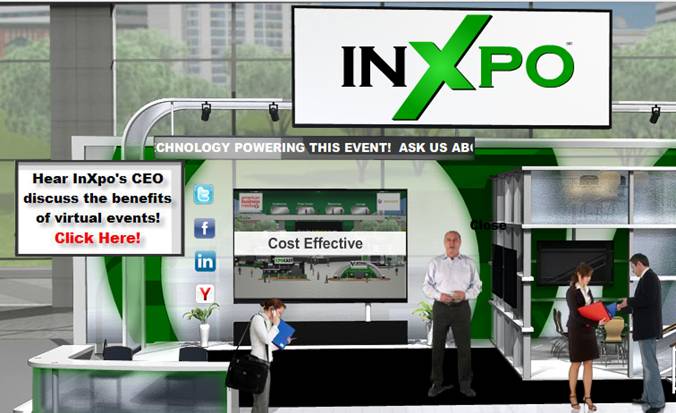
I’m online as an exhibitor at this event – so if you decide to join, come say hi – I’ll be in the InXpo booth:

Source: InXpo's booth at MarketingProfs' virtual event

Source: InXpo's booth at MarketingProfs' virtual event


Newspapers: With Print Declining, Go Virtual

March 24, 2009

Source: GlobalPost

Source: GlobalPost

In a previous blog posting, I wrote that newspapers could leverage virtual event platforms to transform the reader experience from one of unidirectional consumption to an interactive community of participation and engagement.  In an article titled “A Web Site’s For-Profit Approach to World News “, the New York Times highlights Boston-based GlobalPost.  The good folks at GlobalPost are clearly thinking outside the “print box”, with an approach that mirrors (somewhat) some of the points I made in my original blog posting.

For one, GlobalPost has deployed a freemium model, built upon a wealth of freely available, advertising supported content.  The premium service comes into play with a service called Passport, which, as eloquently stated by GlobalPost, “offers an entrée into GlobalPost’s inner circle”.  According to the New York Times article:

Passport subscribers, who pay as much as $199 a year, can suggest article ideas. “If you are a member, you have a voice at the editorial meeting,” although the site will decide which stories to pursue, said Charles Sennott, a GlobalPost founder and its executive editor. He said Passport is meant to “create a feeling of community” for subscribers who might otherwise see newsrooms as “impenetrable and fortresslike.”

On the GlobalPost Passport web page titled “Benefits of Membership“, one can discover further detalis about the access afforded to Passport subscribers:

Passport also gives you a significant voice in the news. We invite you to join us in reinventing the media equation, empowering members for the Web 2.0 era. Instead of the old top-down model where editors decide what you need to read, as a Passport member you play an unprecedented role in shaping the stories that get covered, via ForeignDesk, Correspondent Calls and Newsmaker Interviews. Simply put, it’s access that gives you an edge.

While GlobalPost would need to find a business model to profitably support this – I can envision the use of a virtual event platform to serve as the foundation for their interactive community.  By “profitably support”, I mean that the additional cost (e.g. virtual event platform, higher costs for editorial staff, etc.) would need to be weighed against the additional revenue.

But that being said, the use of a virtual event platform could facilitate:

  1. Direct, interactive access from Passport subscribers to GlobalPost’s Editorial Staff – in the form of text chat (both private and group), webcam chat (both private and group), forums and blogs (in the platform), etc.  What better a way to shape the editorial focus than for the Passport members (the most loyal of readers) to engage directly with the folks responsible for producing the content.
  2. Direct engagement among Passport subsribers – generate and sustain subscriber loyalty and retention by allowing them to connect with one another.  After all, two subscribers who visit the “United Kingdom” section of GlobalPost.com likely have common things to discuss.
  3. Drive incremental revenue by upselling your Passport subscribers – one you have a loyal following of Passport subscribers, upsell them into higher and higher premium services – e.g. scheduled video chat sessions with your Publisher; access to exclusive content; access to all archived content, etc.

Kudos to GlobalPost on their somewhat contrarian model – and best of luck on the new site and success of Passport.


Increase Your Virtual Event ROI: 10 Tips and Tactics

March 22, 2009

Source: Flickr (Ewan McIntosh)

Source: Flickr (Ewan McIntosh)

If you recently exhibited at a lead generation virtual event, then I’ve got some tips for you.  While most exhibitors consider the program “complete” at the conclusion of the live virtual event, your work is just beginning.  Outhustle your competition and you’ll generate more ROI, beating them to the punch on shared sales leads.  There are two primary strategies for generating a higher return on your investment:

  1. Leverage your existing investment to generate net new sales leads
  2. Better convert your existing sales leads

Leverage Existing Investment

  1. Convince the virtual event host to light up the environment – most virtual events remain “on demand” for 3 months after the live show date.  During those 3 months, you’ll see intermittent activity – some attendees return to visit your booth – some new leads sprinkle in, 1 here and 2 more a few days later.  Your event organizer should be incented to produce another “live date”, in which past attendees are invited to return – and, new registrants are invited to participate.  After all, the event organizer has fixed costs as well – and lighting up the show again means more revenue.  The organizer will want brand new content to draw users in (e.g. compelling Live Webcasts, like they used in the original event) – and you’ll want to leverage the same amount of booth reps to interact with attendees.
  2. Convince the virtual event host to support portable booths – you spent a lot of time getting your booth just right – selecting the right logo and Flash movie, finding relevant White Papers and producing some case studies just for the event.  Your booth is a great marketing vehicle and should be leveraged elsewhere – how about placing your booth on its own microsite – or, embedding the booth on your corporate web site?  The eco-friendly practice of re-use applies here as well.
  3. Syndicate booth content – for the White Papers, podcasts, Case Studies, etc. that you placed in your booth, syndicate them with the event organizer and related web and blog sites.  This broadens the reach of your content – and allows you to generate more sales leads.
  4. Syndicate Webcast content – if you had a speaking slot at the virtual event, ask the show host for a copy of the Webcast – then, host it on your corporate web site and syndicate it with the event organizer and related web sites.  Any content generated for the event should be re-used – it can generate new sales leads with minimal overhead or cost.
  5. Syndicate the supplemental Webcast content (in different forms) – convert your Webcast into an MP3 audio podcast and make that available on your web site along with the Webcast.  Syndicate the podcast as well, in case your target audience prefers the convenience of a download over the viewing of a streaming presentation.  Take the Q&A of the Webcast and transcribe that into a PDF or HTML document – and place this on your web site as well.  You get the idea here – spread your wings, without thinning the pocketbook.

Convert Existing Leads

  1. Find those Top 10 leads – whether you have an automated system or need to do this manually, comb through the wealth of engagement data that a virtual event provides and find those Top 10 leads.  These are the folks who Sales must call now.  Perhaps they downloaded 10 of your White Papers – or, perhaps they did a text chat with a booth rep and requested that a sales rep call.  Either way, they need immediate attention.  If you know the sales reps who should handle these leads, don’t be shy about personally walking the leads over to them and providing the details as to why the leads as so hot.
  2. Get the basics right in your follow-ups – if Inside Sales is following up by phone with some leads, make sure the reps have a script that covers the correct name of the virtual event – and arm them with some important details of the event (e.g. date, topics, speakers, etc.).  For email follow-up, be sure to include the virtual event title in the Subject line.  Always be sure to reference the context of the event in all of your touchpoints.
  3. Build customized follow-up paths based on prospect activity – again, whether it’s automated or manual, factor in the prospect’s specific activities within the live event and tailor the follow-up touchpoints based on that activity.  Study the 5 White Papers they downloaded and recommend a 6th that brings it all home.  Study the chat transcript with your booth rep and send an email follow-up that ties up any loose ends.  Believe me, the prospects will appreciate the personal attention and the value you deliver to them.
  4. Use the virtual event platform to faciliate your follow-up – your show host is keeping the environment open for 3 months – so it would be a shame not to leverage it for all its worth.  When you do secure a follow-up appointment – consider complementing your phone call by meeting your prospect back in the virtual event.  There, you can do text or webcam chat in an environment s/he is familiar with.  And perhaps you place some additional content in the booth for your prospect to review.
  5. Send small prizes to highly engaged prospects – not everyone could win a prize during the live event – so, find those top 10 leads – or, top 10 most engaged users (in your booth) and send them a memory stick or webcam.  As discussed, reference the context of the event in your communications.  Perhaps the memory stick contains additional White Papers that may be of interest.  Just make sure the touchpoint is personalized – and don’t send the prize just for the sake of sending something.

So there you have it.  Don’t forget that your campaign doesn’t end at the conclusion of the live virtual event.  That signals the starting point of the important phase – the one in which you’re head to head with the competition.  So make sure you score a higher ROI than they do.


Interview With Nic Sauriol, Venture Lead on Nortel’s web.alive Platform

March 1, 2009

Nic Sauriol, Venture Lead of web.alive

Nic Sauriol, Venture Lead of web.alive

Related Links:

  1. Lenovo eLounge
  2. Project Chainsaw
  3. My review of Lenovo eLounge

Amidst great fanfare in January at CES 2009, Lenovo unveiled the Lenovo eLounge virtual environment. Powered by Nortel’s web.alive platform, eLounge allowed users to enter a 3D virtual world to learn about Lenovo Thinkpad notebook computers (with an option to purchase), interact with other visitors and “meet” with representatives from Lenovo and Nortel.

Nic Sauriol is the Venture Lead for web.alive (also referred to as Project Chainsaw).  Nic co-founded the project a few years ago with Arn Hyndman, the chief architect.  I sat down (virtually) with Nic to get his thoughts on web.alive, eLounge, enterprise virtual worlds and more.  Here’s the interview.

If you met someone on the street, how would you describe (or explain) the web.alive platform to him/her?

Nic: web.alive is a collaboration platform designed to integrate into an existing website much like flash. When a web site has web.alive and people visit that site, they can experience a rich and immersive environment and interact with other users – including the website’s employees/staff who are also on that site . They can interact in an immersive and fluid way thanks to real world positional audio. Fundamentally, web.alive is about bringing live, immersive and interactive communications to connect people in real-time via the web.

It’s designed to be a very engaging and entertaining experience – great for social networking efforts. A social experience of the web where a group of friends could meet up on Facebook or LinkedIn and then go visit a few stores like the Lenovo eLounge, watch some shows in Hulu and then comment on the news at Yahoo is what web.alive is about in this context.

web.alive also offers tremendous potential as a tool to facilitate collaborative learning.  Gone are the days of an instructor broadcasting content in one direction – today’s learning requirements call for more collaborative work between instructors and students.  web.alive provides engaging and collaborative environments to make this mode of learning a reality.

In the enterprise, web.alive offers a new world of opportunities to change in a positive way how people communicate. Moving away from calendar based meetings and formal phone calls, to a much more dynamic means of interaction. A place where employees from all over the world can go, bump into each other, exchange ideas, grab a meeting room to discuss and collaborate etc. Simply embedding the web.alive client into existing intranet web sites, integrating into a UC [unified communications] solution (visit Nortel if you don’t already have one) and suddenly your employees are collaborating as though they were collocated.

Nortel and Lenovo received quite a bit of buzz regarding Lenovo’s eLounge and its use of Nortel’s web.alive platform – what do you view as the successes of the launch – and, what were some of the challenges that you had to address?

Nic: The beta launch at CES of the Lenovo eLounge was a tremendous success from our perspective. We saw a great opportunity to help Lenovo take their customer service to an entirely new level. Significantly more users than we had expected visited the beta launch (articles and blogs like yours were a significant factor) and most importantly we saw the kinds of metrics we could have only hoped for. I personally assisted a number of customers who toured the eLounge to browse Lenovo’s laptops. What is most important is that these  – for the most part  – were purchases that otherwise may not have happened, at least not on a traditional retail web site. In addition, we have seen excellent retention rates. Even when users don’t make purchases, they spend a lot of time surrounded by Lenovo’s brand – over time this will also help conversions.

Obviously there are customers that go to the Lenovo web site that intend to make a purchase, and various tools facilitate that. While we are excited to help in that regard, what we always hoped would happen was that users would visit the site that did not have a specific intention of making a purchase, and would otherwise have bought from a retail store (likely helping a competitor to Lenovo) and instead they make the purchase from the eLounge as a result of an unplanned/informal conversation with a sales person or some other person like myself who just happens to be there.

In terms of challenges, there have been many. While the majority of users have had a smooth experience, some users encountered a variety of different bugs which we are fixing as they arrive (users send us e-mails at support@projectchainsaw.com with their bugs). Most users were able to get in and navigate without any specific help, but here have been some that required assistance, so we are working to make interaction even more intuitive and fluid. One really notable challenge was that Lenovo sales staff had to adjust their mode of operation. Call centers wait for a customer to call to initiate a dialogue, unlike the real world where we can reach out to shoppers.

We had to spend time honing that skill to get the right balance of support (i.e. not jump in someone’s face when they first arrive, but make certain that they know you are there and available to assist if you need help). The biggest challenge of all is that people want more, a lot more.

Have there been any new developments with eLounge since the time of the CES 2009 launch?

Nic: Yes, there have been a number of new developments, some deployed others coming soon. Most importantly, Lenovo has seen the positive metrics we had hoped for and have committed to coming out of beta and doing a full supported launch (coming soon!). Changes that have been deployed include a large number of bug fixes, a few new features in the client (like notification when new users arrive via a desktop balloon) with many more coming. While there have been a few minor content updates, there will be many more coming when the site launches out of beta.

Tell us about other enterprise use of web.alive?

Nic: There has been a tremendous interest in web.alive from an enterprise perspective. Whether it be as a global water cooler (e.g. as an enterprise, place web.alive on your global internal home page to enable informal/accidental collaboration and discussion between your employees) or as an alternative for internal meetings (in particular those that would require travel). We have been particularly happy with the tremendous support and pull from within Nortel and have slowly been rolling out web.alive for internal use. We have also been building a number of features to better support internal collaboration beyond just positional voice and slides etc.

Our ultimate goal is to find ways that we can make web.alive collaboration more effective than face to face. The seams ambitious, but there are a number of challenges with face to face communication, let alone current telecommunication technologies that we believe we can address. The simplest example is knowing who you are speaking to or who is talking – this is often a challenge even face to face. More exciting examples include detecting and displaying emotion – there are people who don’t communicate very effectively because they are not skilled at detecting emotion (in the extreme, people with forms of autism) – we believe that over time we can augment and provide that kind of information.

Has there been any existing or planned consumer use of web.alive?

Nic: We are actively working on models to support low-end deployments of web.alive. I have always stated as a goal that my mother in-law should be able to embed web.alive in her personal web site. While technically we support a simple embed tag (in theory she could embed the eLounge on her page), we have yet to deploy a single environment built for this purpose. Most challenging of course if establishing the right business model for this, which is something we are actively working on. We will have something this year that will support small businesses.

What are customers telling you they’d like to see in web.alive?

Nic: This is a really difficult question to answer because we have talked to so many people, whether they be casual users in the eLounge or companies that we have talked with. Common themes would include a higher degree of interaction (e.g. shaking hands, more fluid and realistic animation, taking apart laptops etc.); more audio controls like the ‘cone of silence’ for private discussions; means to invite friends and better ways of staying connected.

What’s on the feature roadmap for web.alive?

Nic: We will be working to further optimize the new user experience (from client optimizations in size and speed to usability etc.), enable small businesses, enhance collaboration and make the whole experience much more immersive and interactive. We are also looking to start rolling out our community (user and developer) in 2009 to enable more contribution and an eco-system of value co-creation.

What does the future hold for enterprise focused virtual environments?

Nic: There is no question in my mind that immersive positional audio will fundamentally transform how we communicate. I believe we will start to see the kind of connectionless (from a user perspective) communications that happen in web.alive that enable “accidental collaboration” to permeate how enterprise users interact with each other, their suppliers and their customers. Eventually, calendar based meetings will become significantly less frequent as issues are resolved on the fly. Ultimately, I am convinced that virtual environments will facilitate this way of communicating by enabling rich immersive and dynamic collaboration. Just consider how an enterprise could use web.alive to improve their brand awareness by letting their customers hold virtual events or get-togethers with their network of friends, family and associates.

The best part if that we have a number of surprises (well, if you’re a techie like me they are surprises 🙂 – features that have not been rolled out but that we have built and are playing with. I won’t expand on what they are just yet, but we will roll some of them out over the coming weeks and months, and I assure you they are exciting. These features will really help incentivize enterprises into taking the leap and jumping into this kind of technology by doing things that can only be done with the kind of architecture.


Videos On Virtual Event Best Practices

February 26, 2009

I created an open Facebook group for Virtual Event Strategists – my goal with this group is to foster discussion and collaboration around virtual event strategies and best practices.  I’ve seeded the content on the group page by developing a series of Virtual Event Best Practices videos – short, 2-3 minute clips where I cover one particular best practice each day.

Since Facebook provides a very convenient video recording and upload utility (right there from the Group page – for anyone who has a webcam), my hope is that other group members will start contributing their own thoughts via video.  Or, start posing questions to the group via video (if not text).  A YouTube-like channel for Virtual Events sounds good to me!

I thought I’d post links to some of the videos I’ve produced to date.  Of course, to view subsequent videos, be sure to become a member of the Group – it’s open for anyone to join.

bestpract_2

In this first video (click on the image above), I talk about how to effectively use prize giveaways in your virtual event.

bestpract_3

In this video (above), I discuss the importance of “promotion source” tracking and data analysis.

bestpract_4

And in this final video (where I got all dressed up), I talk about ways to dress up your virtual event.

If you view the videos, be sure to let me know what you liked or disliked – thanks!


Join A Group To Collaborate On Virtual Events

February 23, 2009

Over the past few months, I’ve observed an increasing amount of chatter within Twitter (the popular micro-blogging service) regarding virtual events and virtual tradeshows.  In many cases, Twitter users who are considering their first virtual event will submit a tweet such as, “considering my first virtual event.  Anyone have information on best practices?”.  I chime in when I can, but Twitter and its 140 character limit does not facilitate much in the way of extended dialog.

In fact, when two or more Twitter users need to delve deep on a topic, the next step is usually to “connect offline”.  Similarly, this blog is a useful vehicle for the communication of my thoughts and ideas – but isn’t great for facilitating discussion.  Despite the comment feature of blogs, there hasn’t been much extended discussion here, by way of commenters.

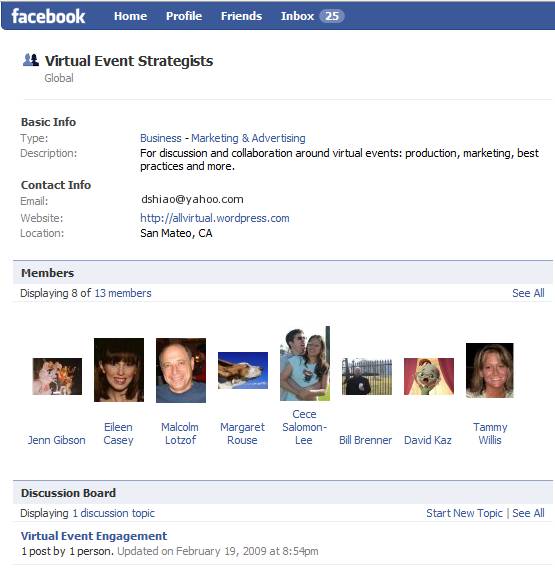
So I decided to create a Facebook Group to address these challenges – it’s called Virtual Event Strategists and is open to anyone interested (you need a Facebook account to join).  Here’s a snapshot of the group page:

Source: Virtual Event Strategists' Group Page

Source: Virtual Event Strategists' Group Page

Why a Facebook Group?  A few reasons:

  1. The 175MM active users (of Facebook) – most readers of this blog are likely on Facebook – if not, let me know why not!
  2. Threaded discussions – are you a first-timer in virtual events?  Well, starting up a threaded discussion may be just the thing to do
  3. The Wall – post miscellaneous thoughts and ideas about virtual events
  4. Post Links – let us know what interesting blogs or articles you’re reading about virtual events
  5. Post Video – Facebook has a convenient video recording and hosting capability – plug in a webcam and start using it

In fact, I’ll be doing brief “Virtual Event Tip of the Day” video clips on the Group page.  Here’s one of my first video clips, where I talk about the use of prizes in virtual events:

fb_video

I’ve seeded the site with some initial content – but, what I’d most like is to hear from all of you.  So, start some discussions, post some videos, post some links.  The group page is:

http://www.new.facebook.com/group.php?gid=52325833170#/home.php?ref=home

Let’s collaborate and learn together – see you there!


Virtual Events In A Wireless World

February 21, 2009

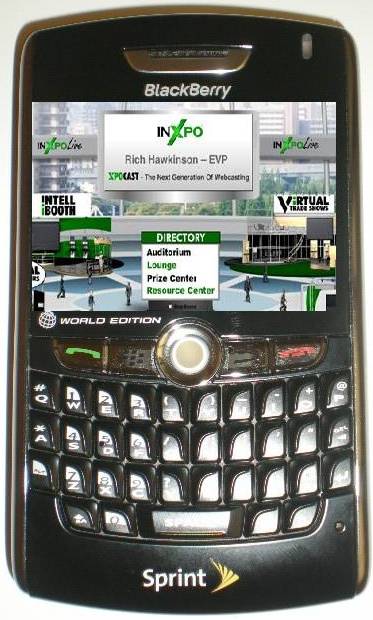
Some day soon: virtual event on PDA?

Some day soon: virtual event on PDA?

Whether it’s business use or personal use, we’ve begun to expect that applications on our PDA’s mirror those available on our PC’s and laptops.  For business, it’s largely corporate email today – the ability to read and respond  (around the clock, I might add!).  For personal use, it’s email (e.g. Yahoo Mail, Gmail, etc.), instant messaging, web browsing and (of course) interacting with our social media sites.

I recently purchased a BlackBerry 8830 – my first step (after verifying that calls to my cellular number were ported over to the BlackBerry) was to set up access to my corporate email.  After that, the series of steps I embarked on were not unlike the set-up of a new PC or laptop – downloading applications that I’ve become accustomed to.  The short list so far is:

  1. AOL Instant Messenger (AIM)
  2. A Twitter client (I selected TwitterBerry)
  3. The Facebook client for BlackBerry

With this collection of apps, I’m able to be on the go, but stay connected with corporate and personal email, stay in touch with friends and colleagues via AIM and keep tabs on my social networks (next up: the BlackBerry client for Netflix).  Virtual events are a combination of business and social networking applications.  Thus, I believe that pretty soon, business users will come to expect virtual events to work on their PDA’s.

Attendees would be able to visit vendor booths and peruse vendor content (while on the go) and exhibitors would be able to interact with booth visitors via a wireless connection.  The “live date” of a virtual event is often planned months in advance – and often times, scheduling conflicts arise for exhibitors – whether it be an important client meeting or attendance at a physical event.  I’m sure that exhibitors would value the convenience of doing basic booth duty from their PDA.

But how do we get there? First, formats like Flash (Adobe), Silverlight (Microsoft) and even JavaFX (Sun) will need stronger support and adoptoin onto PDA devices.  From doing a quick set of Google searches, the adoption (and support) doesn’t seem quite there today.  Here’s hopinng for a better tomorrow – where I’ll be seeing you at a virtual event … from our PDA’s.