5 Virtual Events Postings You May Have Missed

February 23, 2011

5 Virtual Events Postings You May Have Missed

Introduction

In the rush to get caught up with RSS feeds (that I routinely neglect when busy), I unintentionally skip articles and postings that I’d find quite interesting and valuable. With that in mind, I thought I’d round up recent virtual events postings (from this blog) that you may have otherwise missed.  And yes, I do still use an RSS reader.

1) Interactive Emails and Potential Use in Virtual Event Promotions

Virtual Event Email Promotions and Hotmail Active Views

Like banner ads, email marketing and email (in general), response rates tend to decline over time.  The use of interactive elements (within the email) could be a big win – and this certainly applies to virtual event email promotions. Here’s a link to the full posting:

https://allvirtual.wordpress.com/2011/01/14/virtual-event-email-promotions-and-hotmail-active-views/

2) Virtual Event Lead Management

Virtual Event Lead Management

I outline the “drive-by viewing” that you often see at virtual events and note that those visitors are names, not leads.  I also introduce the notion of curating your leads, as if they were fine art.  Here’s a link to the full posting:

https://allvirtual.wordpress.com/2011/01/22/book-supplement-virtual-event-lead-management-leadmanagement/

3) Why I’m There on Pure Virtual Events

I wrote a counterpoint to an article from Velvet Chainsaw’s Dave Lutz on the topic of pure virtual events. While I’m a firm believer in hybrid events, I also believe in the benefits of “pure” virtual events.  Here’s a link to the full posting:

http://inxpo.wordpress.com/2011/01/27/why-im-there-on-pure-virtual-events/

4) Can I Get a Woo Hoo for Virtual Events?

Can I Get a Woo Hoo for Virtual Events

I loved the tactics used by a department store to encourage customers to contribute (to a charity) at the cash register. I loved it so much, in fact, that I decided to draw parallels with the store’s tactics and apply them towards the planning and promotion of virtual events.  Here’s a link to the full posting:

https://allvirtual.wordpress.com/2011/02/07/can-i-get-a-woo-hoo-for-virtual-events/

5) Use Virtual Booths to Complement Your Physical Booths

Use Virtual Booths to Follow Up with Leads from Your Physical Booth

I outline ways in which a virtual booth can allow trade show exhibitors to distribute content, nurture leads and engage with prospects in real-time (after the event).  Here’s a link to the full posting:

https://allvirtual.wordpress.com/2011/01/30/use-virtual-booths-to-follow-up-with-leads-from-your-physical-booth/

Conclusion

If you liked any of these postings, but missed them when they were originally published, subscribe to the It’s All Virtual RSS feed.  If you do subscribe, but “Mark All As Read” in a rush to get caught up, I forgive you (I know the feeling).


Book Review: Viral Loop

February 12, 2011

Image courtesy of Amazon.com

Introduction

Adam L. Penenberg’s “Viral Loop” was published in 2009, but retains a lot of relevance in 2011.  Its subtitle is “From Facebook To Twitter,  How Today’s Smartest Businesses Grow Themselves”.  The book begins by telling the story of the web site “Hot or Not” and how that web site (in 2000) “rode a simple idea to a fortune”, by virtue of “an insanely viral scheme”.

It goes further back in time to the original viral models, Tupperware and Ponzi Schemes and then works its way up through many of the present day (or past-present day) Web 2.0 success stories (e.g. Mosaic, Netscape, Ning, Hotmail, eBay, PayPal and more).

The Viral Coefficient

Early in the book, Penenberg explains the “viral coefficient”, or the “number of additional members each person brings in” (to a web site or service).  The success of a web site, or even a YouTube video, “going viral” hinges on this figure.  Penenberg explains that if the coefficient is equal to 1, the site “will grow, but at a linear rate, eventually topping out”.  Then, “above 1, it achieves exponential growth”.

The early growth of Ning was due to the fact that its viral coefficient was 2.0 – “each person who signs up is worth, on average, two people (compounded daily)”.  And while Ning doesn’t attain the lofty position it once had, its viral coefficient (and how it achieved it) is important in understanding its early success.

Web 2.0 History Lessons

Viral Loop Cover with Social Media icons

Image courtesy of ViralLoop.com

Netscape

In addition to explaining viral coefficients and how viral loops are created, Penenberg provides interesting history lessons (stories) behind some of the web’s most well known creations.  He tells the story of how Marc Andreessen created the Mosaic browser at the University of Illinois in Urbana-Champaign, left Illinois to move west to Silicon Valley, and there co-founded Netscape with Jim Clark.  Version 1.0 of the Netscape browser was released on December 15, 1994, and Netscape engineers “rigged servers so a cannon fired every time a browser was downloaded”.

eBay

In a chapter titled “eBay and the Viral Growth Conundrum”, Penenberg tells the story of Pierre Omidyar, whose inspiration for eBay came from a stock order gone bad – he placed a pre-IPO order for a stock, only to see it jump 50% on the day of its IPO. Omidyar, whose business was called AuctionWeb, hosted the site on eBay.com because his desired domain, Echobay.com, was already taken.

PayPal

The chapter “PayPal: The First Stackable Network”, takes us through the very genesis of PayPal, starting with a lecture at Stanford, given by Peter Thiel. Max Levchin was one of six in the audience. They agreed to meet for breakfast the next week and over breakfast, agreed to launch a start-up around Levchin’s ideas for cryptography software.  The initial company was called Fieldlink and went through a few iterations of cryptography business ideas until they settled on the idea that would become PayPal.

Epilogue

Before reaching the Epilogue, we learn about the beginnings of several other well-known names, including Flickr, MySpace, Bebo and Facebook.  In the Epilogue, Penenberg summarizes the characteristics of viral loop companies and compares the similarities to human population growth – “the human population growth  rate [also] mirrors the curves for companies like Skype, Hotmail, Ning, Facebook”.

Penenberg’s book makes me ponder the coming decade (2011-2020). What new viral loop companies will be created (and how) – and who will be this decade’s Hot or Not, Ning and Netscape?


Can I Get A Woo Hoo For Virtual Events?

February 7, 2011

Introduction

At department stores and supermarkets, I’m often asked to make a small donation to a charity at the cash register.  Truth be told, I often choose not to donate. The other day, however, I encountered a scenario in which 100% of customers donated – and, I went to the checkout counter asking if I could donate.

How They Did It

The store was able to accomplish this with a fairly simple tactic.  After each donation, the cashier would get on the loud speaker and proclaim, “We just got another donation to the American Heart Association! Can I get a woo hoo?”  The request was then followed with a loud “woo hoo!” from a number of people.  While shopping, customers would hear these announcements every few minutes.

How could I possibly relate this to virtual events? Well, like an email promotion for your virtual event, the donation was a call to action, in which potential donors needed to understand the value of taking action. Let’s consider some of the particulars.

Be Different

Announcements over the loudspeaker have been done before, but the use of the “woo hoo” was different.  Every time the “woo hoo” was announced, I got a chuckle out of it and other customers did as well.  While requesting a “woo hoo” for your virtual event may not be effective, consider ways in which your marketing and promotion can stand out from the many emails in everyone’s inbox.

Reward Users

Give value back to your users.  For the donation, the reward was very basic and yet, customers continually opted to receive it.  When I approached the cash register, I told the cashier that their “system” was quite clever.  Her response was, “So, do you want your woo hoo?” The donation, while important, become secondary to the acknowledgement.

Involve Your Team

At the store, managers had party horns – when a “woo hoo” was announced, the managers would yell “woo hoo!” and then blow the party horns.  It felt like a New Year’s Eve party and the horns added to the awareness and fun.  For a virtual event, encourage your team to share and promote the event within their social circles, both offline and online.  With the vast reach of social networks in the online world, your own team can make a big difference.

Make Participation Infectious

This can be challenging to achieve – after all, you just can’t “make a video go viral”.  That being said, I believe that our natural inclination is to “follow the herd”, which is one reason the donation did so well.  People donated because everyone else was.  But, it had to be easy (the donation was simply added to your purchase at the register) and it had to be well promoted and shared (the loudspeaker).  With these elements in place, along with “being different”, the store got every single customer to donate.

Conclusion

Instead of doing the same thing over and over when marketing your virtual event, consider new and creative ways to involve your audience, reward them and keep them coming back.  If you can achieve infectious participation, you won’t need to send out as many email blasts.


Top Blogging Tips From … Influential Bloggers

February 6, 2011

Blogging Tips

Introduction

Blogging Success Summit 2011 (“The Web’s Largest Online Business Blogging Conference”) is in full swing.  We’ve identified recent blog postings on the topic of … Blogging Best Practices and wanted to share them here.

Heidi Cohen: Why Above-the-Fold Matters for Blogs

Heidi provides a great list of “16 Must-Have Elements to Put At Top of Your Blog” (above the fold).  I reviewed this list against this blog … and it seems I have some work to do!  The link to the article:

http://heidicohen.com/blog-above-the-fold/

Lisa Barone: A Quick & Dirty Legal Guide For Bloggers

If I could sum up Lisa’s post in a few words, it would be “blogging: be careful out there”.  Lisa provides a list of five myths and then provides details to dispel those myths.  Many of her points I had not considered.  The link to the article:

http://outspokenmedia.com/blogging/blogging-laws/

Joe Pulizzi: 10 Blogging Tips for Beginners and Experts

Joe shares the 10 tips that were included in his presentation at Blogging Success Summit.  I think I need to focus more on Joe’s #3 – “Less is More”, since I tend to go on and on!  The link to the article:

http://blog.junta42.com/2011/02/blogging-tips-beginners-experts/

Jeff Bullas: Are You Making These 10 Mistakes On Your Blog?

Jeff provides a list of 10 things you ought to have on your blog – the good news is, you can quickly and easily implement the majority of Jeff’s list right from your blogging platform’s dashboard.  I know that in WordPress, I can knock out many of these items quickly. So what are you waiting for? The link to the article:

http://www.jeffbullas.com/2011/02/03/are-you-making-these-10-mistakes-on-your-blog/

Conclusion

Even for those of us who have been blogging for a while, there are new things to learn, each and every day.


A Virtual Events Calendar … Maintained By You

February 4, 2011

Introduction

I put up a Virtual Events Calendar on this blog in 2009.  Back then, it was fairly easy to know (and find) the majority of virtual events that were being produced in the U.S.  But my, how the industry has grown! I kept the calendar fairly up to date in 2009 and 2010, but as we head further into 2011, I’m finding it harder to keep the calendar current.

Community Management

So keeping with the trends we’re seeing across the web today, I decided to move the calendar to a wiki, which allows anyone to add their virtual event(s) to the calendar.

Sure, this can lead to spam and promotion, but as we saw with Wikipedia, a workable wiki requires an active community of “editors” to keep things on track.  As such, I’ll be checking to make sure the calendar doesn’t get spammed – and I hope some of you join me to assist in “checks and balances”.

Without further ado, you can find the wiki style virtual events calendar at:

http://allvirtual.pbworks.com/w/page/35815064/Virtual-Events-Calendar

Click on the “Edit” tab, sign up for a PBworks account (if you don’t already have one) and make your edits!


The Future Will See You Now

February 2, 2011

The following is a guest post by Pooky Amsterdam (@PookyMedia).

Introduction

It was Joannis Kepleri in 1634 that first wrote of weightlessness in his book Somnium, or Dream. About a hundred years later, Jonathan Swift would write of two moons of Mars (which would take another 150 years to discover) and Laputa, an island where residents have geometric modeling and knowledge engines.

Jules Verne wrote of rockets, propulsion, undersea mining and a raft of creations too numerous to list. Science Fiction writers have contributed to future ideas and innovation since the genre was invented. Writers from HG Wells, whose babel machine presaged television, to Gene Rodenberry, whose Star Trek imagined so much, have infused our minds with imaginary and fantastic invention.

The Creative Process

And these ideas are taken further, and form the seeds of reality as it will come to be.  Such is the creative process, it must begin somewhere. Paper and pencil allows for anything to be “made,” after being seen in the mind’s eye. You can use words to create anything, then use paper to draw how it looks in two dimensions. What if you can go right to a 3D world, and build futuristic cities, design outfits for the year 3011, and actually design the people who would wear them?

Today you could make those visions and drawings reality in an expensive CGI kind of way, or you could use a graphic novel kind of approach to tell your story while showing vivid creations.  The mind is not now nor has it ever been limited to contemporary tools for story telling or fantastic creations.  Words have sufficed to ensnare the imagination, and immerse the audience since the first campfire. Now we are living and socializing around a virtual campfire, but it glows just as brightly when we gaze into it.

The Virtual World

As it has been said that we didn’t create the universe, so we can not fully understand it. Yet we have created the virtual world, in which we can create anything imaginable. This is done with what are free building tools, in the 3D world of Second Life. While much is recreated to reflect the outworld reality of the residents’ lives, there are opportunities for fantasy, science fiction and historic role-play which are met.  Enthusiastically talented, the creators of Second Life’s vast and stunning array of virtual goods and content contribute much.

The legacy of science fiction has inspired many people to carve out tracks of the grid for space bases, futuristic cities and to sell everything from starships to transporters. All while wearing the latest 2520 fashion. While books give much for our mind’s eye to describe, it is thought out before us. Being able to immerse in a 3D world with other people provides a level of visual storytelling which is unique to us. And that can be unique every day.

A number of traditional media programs have spawned new virtual worlds like the upcoming BattleStar Gallactica, Star Trek, and Star Wars – Clone Wars. What Second Life provides is a way to create a new vision and interpretation, not just re-create and role-play within it. There is a pool of resources within people’s minds that can and is crafted into being. That they can also be sold as an incentive and this encourages a new way of manifesting the future. There are designers and builders in Second Life creating assets and adventures which reflect the same design traditions of classic sci-fi, yet made out of prims.

A New Episode

They also provide a great backdrop and wealth for films. The Future will See You Now is the title of a new episode in our ongoing webseries, Time Travelers, for iHelpLoan and SLFC. Films can not be made without sets, costumes, props and all that makes for great visual story-telling. I feel lucky to be part of this kind of creative world which inspires.

Related Links

  1. Our web site: http://www.pookymediafilms.com/
  2. Our YouTube video: http://www.youtube.com/watch?v=6RR_xohMrvU


Why I’m There On Pure Virtual Events

January 28, 2011

Introduction

Over on the INXPO blog, I wrote a posting on Why I’m There on Pure Virtual Events.  The posting was a counterpoint to an article written by Dave Lutz (@VelChain) of Velvet Chainsaw Consulting.

Dave’s Points

Dave made the following points on “pure” virtual events:

  1. Attendees value the content not the commerce.
  2. They tend to attract an entry- or mid-level professional that lacks enough buying authority or influence to deliver ROI to exhibitors and sponsors.
  3. Networking feels limited if it occurs at all.
  4. It’s difficult to build trust that leads to purchase through a virtual booth.
  5. When education is offered for free and archived, it’s easy to find something more pressing to do. Archived views are less valuable than live ones.
  6. And finally, most webinars stink. I can count the good ones I’ve experienced on one hand.

Point, Counterpoint

I provided some counterpoints to the points.  Here’s a link to the full posting:

http://inxpo.wordpress.com/2011/01/27/why-im-there-on-pure-virtual-events/

I’d be interested in your thoughts – questions include:

  1. What your thoughts on hybrid events?
  2. What are your thoughts on pure virtual events?
  3. How can webinars be more engaging?

Leave a comment below with your thoughts – thanks!


Book Supplement: Virtual Event Lead Management (#leadmanagement)

January 22, 2011

Introduction

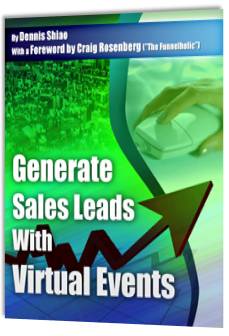
In “Generate Sales Leads With Virtual Events,” Chapter 6 is titled “Score and Follow Up with Leads”.  This really could have been Chapter 7 – and instead, Chapter 6 could have focused on important steps to consider before scoring.  Before you import your virtual event leads into your CRM system, consider these important steps first.

Step #1: Beware of the “Drive-By Viewing”

Someone visited your virtual booth – congratulations! Not so fast.  Make sure the booth visit was not a “drive-by viewing”.  I define a drive-by viewing as:

  1. One (and only one) visit to your booth
  2. “Visit time” of 5 minutes or less
  3. No engagement with others while in the booth (e.g. group chat, private chat)
  4. No interaction with booth content (e.g. booth tabs, documents, links, etc.)

I see plenty of drive-by viewings from booth visitors. Some visitors simply want to see which companies are exhibiting at the virtual event.  And, some virtual platforms have “previous” and “next” buttons in the virtual booths, which means that drive-by visitors may simply be doing a quick tour of all booths.

Drive-by visitors are not leads – they’re NAMES!  My recommendation for drive-by visitors:

  1. Go ahead and import them into your CRM system
  2. Schedule a “thanks for visiting” email
  3. Using simple text links, provide them with a few options (e.g. receive more content, schedule an appointment, etc.)
  4. Respond accordingly – and, if they do not open the email or respond to the offers, cease communications [for now] and nurture them over the long term

Step #2: Beware of Existing Leads and Business Partners

Your virtual event leads can look like a pile of dominoes.  You may not be aware that within that pile of dominoes are existing sales prospects, along with current customers and business partners.  When you exhibit at a virtual event, your sales team is inclined to invite current prospects to come visit – and, your existing customers and partners are inclined to stop in to see what’s new.

Warning: LEAD IMPORT CAN BE DANGEROUS TO YOUR HEALTH.

If you don’t manage your leads well, you may import “hot prospects” (who are already in your CRM system) and trigger a follow-up email to them.  The result is a turning back of the clock with those prospects – imagine finalizing your purchase decision, only to have one of the potential vendors call on you and ask if you’re in the market for their product!

Personal Story: I attended a virtual trade show and did a “drive-by viewing” through an exhibitor’s booth.  I’ve been a long-time subscriber to this exhibitor’s email newsletter and know some of the employees there.  My drive-by viewing was done simply to see who was staffing the booth.

A few days later, I received an email from the exhibitor, asking if I’d like more information.  This exhibitor probably should have known that I was a long-time subscriber – and, routinely click on the links in their newsletter.  Given this, the follow-up should have been more tailored, or skipped entirely.  If I was contemplating a purchase  decision with this exhibitor, that follow-up email could have cost them my business.

Step #3: Build and Import Engagement Profiles

Virtual event platforms have built-in RFID, which means that all interactions from sales prospects (with your content) are tracked and recorded.  The platforms assemble a detailed “engagement profile” for you – the worst thing you can do is throw away that profile when the lead is imported into your CRM system.  My guess is that the majority of marketers today do just that.

Instead, create custom fields in your CRM system to capture this data (e.g. number of visits, documents downloaded, transcripts of chats, etc.).  The more data, the more informed your sales team.  Just like an auto insurer reviews your past driving record and a loan officer reviews your past credit history, your sales team should have the benefit of a prospect’s past engagement data.

Step #4: Curate Leads as You Would Fine Art

You can automate portions of lead management, but you can’t automate the entire process.  It’s easy to automate the de-duping process, which ensures that new records are not created in your CRM system when there’s an existing lead record.

However, it’s not as easy to automate the business intelligence that needs to be applied to your leads (e.g. you can’t do AI on your BI). Examples of business intelligence rules:

  1. Knowing (and spotting) competitors
  2. Knowing (and spotting) existing business partners
  3. Knowing (and spotting) industry experts, analysts, media [who should not be followed up with]
  4. Spotting “creatively submitted” leads, such as “Mick E. Mouse” or “Barack Obama”

Sure, you can automate part of this by filtering on a list of company names, but there are bound to be some leads that slip through the cracks.

For instance, users may have a typo in their company name – or, may list their company differently that what you’ve entered in your filter list.  Your leads are the lifeblood of your business, so you should curate them as if they were fine art.  This means that manual review will always be a part of the lead management process.

Conclusion

Lead Management is not easy.  However, perform these steps before your first virtual event lead hits your CRM system – and you’ll be better off.  Your sales team will receive a far higher percentage of qualified leads – and they’ll thank you for that.


The Virtual Book Tour

January 21, 2011

Introduction

I recently read the excellent book “The On-Demand Brand: 10 Rules for Digital Marketing Success in an Anytime, Everywhere World,” by Rick Mathieson. In addition, I published my own book, “Generate Sales Leads With Virtual Events”.

To uphold the “on-demand brand” of the new book, I’ve decided to forego the traditional book tour. Instead, I’ll embark on a virtual book tour.  I consider the virtual book tour a “virtual event”, which is what my book is about, after all.

Virtual Book Tour

OK, so it’s not even a full blown virtual tour, I admit. That may come, some day.  In the meantime, I will be handing out 5 free copies of the book.  Here’s how you can grab a copy:

  1. Visit the book’s Facebook page.
  2. “Like” the book’s Facebook page. If you’ve previously “Liked” the page, I thank you for that – as a special reward, skip to step #3.
  3. Post a “valid question” about the book to the Facebook page’s Wall.

“Valid questions” must show that you’ve read the description of the book – and, understand the premise. I promise to answer all questions deemed valid.

How to get your copy

The first 5 people to complete the three steps (above) will receive a free copy of the book, which includes free shipping to the address of your choosing.

Unfortunately, I need to restrict the free shipping offer to continental U.S.  only – I’ll contact you to arrange shipping if you’re a winner who resides outside of the U.S.