Your Guide to Social Media and Virtual Events

August 19, 2010

Announcing the next in our eBook series – the latest is:

Your Guide To: Social Media and Virtual Events

This eBook utilizes the following outline:

Chapter 1: Twitter

How to promote your virtual event using Twitter; how to utilize Twitter Lists; how to provide end user support via Twitter

Chapter 2: Facebook

How to incorporate Share on Facebook, Live Stream Box and Facebook Open Graph

Chapter 3: LinkedIn

How to leverage LinkedIn Events and LinkedIn Widgets

Download your free copy and leave a comment below with your feedback!

Tweet this posting:


The Name Of The “Game” Is Engagement

August 9, 2010

Future brand loyalist or virtual goods buyer?

Introduction

Social gaming start-ups are a hot commodity these days.  In the past 12 months, Playfish was acquired by Electronic Arts and Playdom (more recently) was acquired by Disney.  Zynga, which remains independent, has a valuation that’s reported to be as high as $5B.  I expect that CrowdStar, another independent gaming start-up, will be acquired before 2010 closes.

These gaming companies provide “free to play” games on the web and on smartphones.  They then sell virtual goods (within the games) so users can achieve an elevation in status (e.g. a sharper sword, more crop for the farm, designer sunglasses to replace your generic pair, etc.).

Sustainable Growth Can Be Challenging

These gaming start-ups have attractive attributes:

  1. Ability to generate hundreds of millions in revenue (in some cases, more)
  2. High growth rates in users, revenue
  3. High profit margins, since the “cost of goods” (for virtual goods) is virtually zero

While it’s hard to argue with the results that these start-ups are turning in, I wonder if we might be in a mini-gaming-bubble, in terms of current valuations and the potential of sustainable, long term growth.

Social games can be similar to the recording and film industries.  Success depends on the blockbuster hit.  Over time, it becomes more and more challenging to consistently produce the blockbusters, especially in the face of growing competition.  Today, Facebook serves as a great “record label” for the gaming companies.  It provides a marketing vehicle that you can’t find anywhere else – “distribution” to its 500+ MM “listeners” (users).

The gaming companies know, however, that they can’t put all their eggs in the Facebook basket – hence, the plans from Zynga to launch their own Zynga Live platform (as one example).  The gaming companies need their blockbuster hits to turn into self-standing brands (e.g. FarmVille), which then relies on a variety of distribution vehicles.

We know that consumers can be fickle, however.  Recall the progression of “hot social network”, from Friendster to MySpace to Twitter/Facebook.  Games will have a related challenge.  FarmVille is not going to be the #1 game forever, which means that Zynga is already figuring out the “next FarmVille”.

I believe there will be a short list of winners in a market that will be increasingly fierce.  In addition, I wonder if over the long term, the rate of virtual goods purchasing is sustainable – or whether it will continue to grow over the long term.

A New Game in Town?

One of the challenges of the virtual goods model is the funding source. Revenue growth is dependent on fickle consumers, who could love your game one day and move on to another game the next day.  And yes, I realize that part of good game design is to build in the hooks to create user loyalty.

That being said, what about services whose funding source comes from brands that want to reach consumers?  The bills in their “wallet” are of higher denominations than the $1’s and $5’s that consumers use to purchase virtual goods.  In addition, “brands are already brands”, which mean that they have a pre-existing following from consumers.

Foursquare

Consider Foursquare.  Some consider it a “location based service”.  I view Foursquare as an engagement platform that’s built on top of a location based system.  In fact, Foursquare has a loyalty program that generated successful outcomes for Starbucks, Ben & Jerry’s, Whole Foods and many others.

The Foursquare business model is both powerful and scalable: powerful in its use of technology (e.g. location based check-ins) and scalable in leveraging existing brands (e.g. Starbucks) for the consumer following and activity.

Location based technology is great, but the long term success of Foursquare is more about the engagement and loyalty programs it facilitates for brands, based on the applicable and available technology of the day.

Nitro Participation Engine from Bunchball

Keep your eye on the Nitro Participation Engine from Bunchball – a Silicon Valley start-up who counts NBC, Warner Brothers and Victoria’s Secret as clients.  The Nitro engine “drives participation using Gamification”, which means that any brand can easily add gaming elements to their web site(s) – and then leverage the Nitro engine to track user actions, points, status and leaderboard. In addition, brands can use Nitro to deploy and sell virtual goods.

What This Could Mean

I think we could be witnessing a transformation of the advertising industry.  If the 90’s and the 00’s were about banner ads and paid search, this coming decade could be about engagement and loyalty platforms.

Foursquare, Bunchball and others have much to gain – if they can tap into a small percentage of the $100+B spent on advertising annually, they’ll make their investors very happy.

These engagement platforms can move from brand impressions (90’s) to brand engagements – where the engagements are longer lasting and more valuable than a click on a paid search ad.  They’re more participatory and can result in immediate purchases (e.g. the latte that someone just purchased at Starbucks).  In addition and perhaps more importantly, they enhance loyalty between consumers and brands, which is great for the long term.

Of course, sustainable growth is a challenge with any technology. Engagement platforms will face their own challenges as they see adoption grow.  Consumers will only be able to participate in so many engagement or loyalty programs.  That being said, consumers are taking batting practice right now – the first inning has yet to start.  Enjoy the ballgame!

I’ve now managed to speak enough.  Leave a comment below to share your thoughts on this topic.

Related Links

  1. ClickZ article (by Christopher Heine) on brand engagement featuring Booyah, Loopt, Brightkite, Gowalla and Stickybits
  2. Foursquare’s Future Slowly Takes Shape“, by Om Malik of GigaOM
  3. Social-media games: Badges or badgering?“, by Caroline McCarthy of CNET

Top 5 Virtual Event Posts Of 2010

August 5, 2010

Here are the Top 5 posts (on this blog) for calendar year 2010.  The Top 5 List is in descending order and based on the number of page views per blog posting.

#5: Virtual Events 101: Tips For Building Your Virtual Booth

My guess is that many readers built their first virtual booth during 2010.  This posting provided tips planning and objectives, content strategy and booth staffing.  In addition, it provided tips on content presentation, “search optimization” and how to stand out from the crowd.  This posting is part of a broader Virtual Events 101 page that provides tips on virtual events.

#4: Bringing The Physical Event Experience To Virtual Events

This posting did some brainstorming on features that virtual event platforms could provide to bring physical event experiences to virtual events.  Then, it covered tips for virtual events, including how to gauge attendee interest, how to connect with interested attendees and how to create better attendee networking.

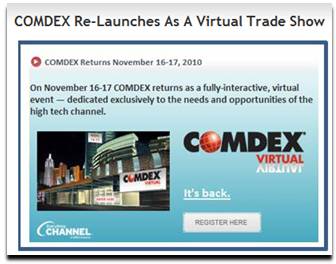
#3: COMDEX Re-Launches As A Virtual Trade Show

This was big news back in March, that the famed COMDEX show would return as a virtual event in November 2010.  I’m looking forward to seeing what’s in store this November at COMDEX Virtual.

#2: How 3D Virtual Worlds Can Be More Like Twitter And Facebook

Twitter and Facebook have taken the world by storm – this post received a lot of traffic by association.  I thought it was logical that 3D virtual world platforms could adopt some of the principles developed by Twitter and Facebook, such as the pervasive “Like” feature from Facebook.  I posited on some new concepts, such as closed circuit TV and on-demand TV for virtual worlds.

Finally, I guess I foreshadowed “Second Life Shared Media”, when I suggested that web content be embedded in-world – Linden Lab announced that feature a few short months after my blog posting.  More recently, I wrote about Second Life being at an important crossroads.

#1: The Future Of Virtual Events

There’s always something about the “future” that generates interest and curiosity.  I’m still a believer in the vision of the future (for virtual events) that I painted here.  While none of it has come to fruition, it’s just a matter of time.  In the future, that is!

Tweet this posting:


What I’ve Been Tweeting (Edition 1.1)

August 2, 2010

Because tweets are temporal, while blog postings are permalinked…

Virtual Events

  1. Virtual Meetings and Exhibits Still Coming of Age: http://bit.ly/aFZF3B #eventprofs #virtualevents
  2. RT @CiscoIBSG: Can Virtual Experts Smooth Expat Transition? How P&G Is Successfully Using Cisco #TelePresence: http://bit.ly/afrmsS
  3. From @CiscoLive & @dveale: embed event video across the web, drive new registrations! http://bit.ly/9CWvxC #eventprofs
  4. Event Planners ‘Check In’ To Location Based Services: http://bit.ly/cFMH9A #eventprofs #wec10
  5. Getting started with #virtualevents? Download my eBook, “Virtual Events: Ready, Set, Go”: http://bit.ly/asJqFs #eventprofs
  6. RT @InXpo: We’re excited: “Latest Cisco Offering: ‘Collaboration for Events’ features INXPO Virtual Platform”: http://bit.ly/apKOH6
  7. Virtual Events ROI Case Study: @virtualedge Hybrid Event: http://bit.ly/cRJt2b #eventprofs #virtualevents #ROI

Social Media

  1. RT @clickz It’s All Fun and Games for Brand Marketers: http://bit.ly/aV8H3r (by @tessawegert)
  2. Twitter time-savers by @markwschaefer: Success in just 20 minutes a day: http://bit.ly/9aHoiu via @addthis
  3. RT @mashable How Twitter in the Classroom is Boosting Student Engagement: http://bit.ly/bmgxpw #classroom #education
  4. From @MarketingSherpa: #Webinar Promotion that Delivers: Use Email, Social, Viral Referrals and Video: http://bit.ly/ddDbhY
  5. 5 tips for lively Twitter chats: http://bit.ly/dqjQlL via @addthis – great article, @leeodden
  6. RT @mashable SCVNGR Launches Sophisticated Rewards Program http://bit.ly/bEQz5l #foursquare #marketing #rewards

Product Ideas

  1. Idea for @LinkedIn: ability to add “Notes” to a Connection (e.g. “Met at SXSW”, “Ask for recommendation”, etc.)
  2. Idea for MLB: for fans’ favorite players, send mobile alerts for “check ins” from home plate, 1B, 2B, 3B
  3. Next move for Facebook: embedding “Like” capability into rich media (e.g. video, audio). Let me “Like” a song from my iPod
  4. Idea for @Facebook: use Facebook Questions (itself) to address users’ questions about the new service
  5. Idea: integrate a brand’s CRM w/their Facebook Fan page – brand mgr sees user’s likes and comments superimposed w/their CRM records
  6. Idea for Google: when search results contain an address, embed Maps functionality, so I can see driving directions right there

General

  1. Good quote from Ask.com: “Google is a verb. But don’t forget that ‘ask’ is a verb too”
  2. Excited to be working for one of Lead411’s hottest companies in the Midwest (@INXPO): http://bit.ly/b2g1Ox – we’re also hot on West Coast!
  3. Physicians confirm we’re alive by checking our pulse. Bloggers, check the ‘pulse’ of your own blog – is there a constant, steady beat?
  4. Event and meeting planners have so many tools at their disposal these days that they’ll need to start wearing Craftsman belts
  5. ESPN and Playdom now under the same parent company (Disney). Wondering (and excited) about possible tie-ups…
  6. Interesting POV from @kimmaicutler: “Why the Facebook/Amazon integration is bigger than you think”: http://bit.ly/bVwz5J

Previously, I posted “What I’ve Been Tweeting” Edition 1.0.

Tweet this posting:


How Vendors Should Evolve Their Virtual Event Platforms

July 10, 2010

The following is a collaborative posting by Miguel Arias, Steve Gogolak and Dennis Shiao.

Content creation and collaboration was facilitated by a PBworks wiki – the wiki page can be found here: http://allvirtual.pbworks.com/How-Vendors-Should-Evolve-Their-Virtual-Event-Platforms

To evolve their platforms for enhanced experiences and broader adoption, virtual event platforms should consider the following:

Make it easier to experience

Most virtual event platforms are easy to use – on a first-time visit, users tend to grasp the overall user experience and can figure out where to go (and how).  That being said, for wide scale adoption, virtual events needs to be as easy as Facebook.  That is, our grandmothers need to be able to access the site and figure things out.  On Facebook, grandmothers can update their profile, read their “friends” posts and write updates to their Walls.  Can a grandmother login to a virtual event, update her profile and participate in a group chat?  We’re not so sure.  Similarly, navigation and interactions need to be easier.  Most virtual events are intuitive to navigate (e.g. Lobby, Auditorium,  Lounge, etc.) – but may not be so intuitive with regard to message boards, chat, blogging, rating, etc.

Along with a simplification of interfaces and the use of usability and navigation conventions, many customers and users seem to be demanding more immersive environments. While presenting a brand and hosting an interactive experience in a convention centre, it seems an interesting field to add some real-time rendered environments using engines like papervision3D or Unity3D. This said, it is unlikely that avatar-based real time rendered environments will make it to a mainstream audience. Key considerations (or obstacles) are plugins or applets downloads, system performance and learning curve barriers.

Make it easier to find

The typical “location” of a virtual event is quickly becoming outdated – microsite with registration page, with no ability to experience the event prior to completing all mandatory registration fields. The registration page serves as a “wall” not only to potential attendees, but to search engines as well.  Virtual event platforms need to move “outside the wall” and expose their technology on Facebook, on blogs and on publisher web sites.  Platforms should widen their distribution via widgets, embed code and application programming interfaces (API’s).  Facebook is not limited to Facebook.com – it has Facebook Connect, Facebook Open Graph and much more.  Virtual events platforms, on the other hand, seem to be restricted to “VirtualEventPlatform.com”

Make it easier to access

The most relevant virtual event platforms will introduce, or already have, Facebook Connect and Twitter API, and they will need to move to even wider standards like OpenID.  For public events, ease of registration is a must.  Using open methods for registering and/or connecting social networks have three-fold benefits:

  1. Registration is faster because basic information can be provided by services like LinkedIn, Facebook, etc.  Shorter registration forms increase completion, period.
  2. Intelligence gathered by the platform about the user’s existing social graph can enhance the experience within the event by automatically creating connections with other attendees based on that user’s connection outside the platform.  This will lead to more networking and awareness of actual people within the environment.
  3. Users opting into connections at the point of registration allows platforms to create publishable actions that can be spit out to twitter and facebook news feeds that can increase viral awareness of the event.  Marketing automation at its best.

On the other hand, desktop or mobile widgets to control your stand usage, statistics and reporting will be a must. Lastly, the platforms will have extensive APIs to manage their integration with various social networks, corporate databases, physical event managing software, etc.

Make the experience available on more devices

Most virtual event platforms support Windows, Mac and Linux.  They need to support more platforms, especially mobile.  On the mobile front, it’s important to consider iPhone/iPad, Android, BlackBerry, Symbian, Windows 7 Phone and WebOS (listed in our order of importance).  To start, we don’t believe the entire virrual event experience needs to be “ported” to mobile devices -rather, vendors should determine the most critical features for attendees and exhibitors – and prioritize based on importance.  For instance, chat is an important element of virtual events, so why not make a mobile app that allows exhibitors to staff their booth via their smartphone.

The entire 3D environment does not need to be supported on a mobile device, but the networking tools (visit card managing, real time conversation, etc) and the reporting tools certainly do. On the other hand, it will be interesting to see what happens with Flash and Apple, and see which vendors will try to develop their platforms using HTML5.

One of the key areas where mobile can play a huge role is the “reminder” needs that come from tons of scheduled activities within virtual events.  If attendees have the ability to build out a personalized agenda before the event and opt-in to either SMS reminders or download some kind of app that will push notifications at them throughout the day, it would be much easier to create a flexible agenda.  Currently we’re cramming so much into the shortest amount of time because we’re afraid of losing people.  If only we had better planning and reminding tools, driven by devices that never leave our pocket!

Make the platform more adaptable and flexible

Related to our point about mobile support, platform vendors have important decisions to make regarding the development platforms.  Virtual event platforms today are based on Flash, Flex, Silverlight, Java and JavaFX.  Are those the “right” platform technologies for the future – or, should platforms move in the direction of HTML5?  Does a combination off HTML5, Javascript and Ajax create a more adaptable and flexible platform?  What do we “lose” by shifting away from Flash, Silverlight, etc.?  And what are the mobile implications with the chosen direction?  All good questions for the platform vendors to consider.

Make the platform more adaptable for different customer needs and different usage

There are so many different kind of virtual events: trade shows, conferences, job fairs, corporate events, webinars, congresses… that vendors should decide in which market niche they are going to play. We will see generic platforms and other vendors delivering a tailored solution for one or many of the previous choices. It will become more and more complex to provide physical event managers with the features they need to handle their hybrid events at the same time as the platform is able to cope with the extensive data handling of the virtual job fair, or the networking tools of a professional tradeshow.

Take a hint from Apple and FaceTime

Video chat will, without a doubt, increase the effectiveness of networking.  It is the one key element that can be introduced that will get critics to come around to the idea that networking in an online environment can be as effective as the cocktail hour of a physical event.

Tweet this posting:


At A Crossroads: Where Does Second Life Go From Here?

July 2, 2010

Crossroads

June 2010 will mark an important month in the history of Linden Lab and Second Life.  On June 9th, the company announced a restructuring that included a 30% reduction of their staff.  On June 24th, the company announced that CEO Mark Kingdon was stepping down and named company founder Philip Rosedale its interim CEO.

Second Life is clearly at a crossroads – it will be crucial for Linden Lab to determine the best path forward.  To do so, they need to identify the right questions to ask and then determine the right answers to those questions.

What is your audience and customer segmentation?

Second Life takes quite a broad approach today – there are a wide assortment of communities [audience] (see their Destination Guide) and an equally wide assortment of land owners [customers].  Having cut 30% of staff, the question at this juncture is whether the company (and the platform) is well suited to cater to “anybody and everybody” or whether it’s better to narrow the focus.

One “focus area” may be in evolving the platform to cater to the hobbyists and loyalists who helped grow the Second Life community from the early days [consumer focus].  Another focus area, while unlikely, may be in catering to corporations for business use (I say “unlikely” because the Enterprise group was let go in the June staff reduction).

Yet another focus area may be in catering to particular categories (e.g. Music, Art, Education).  If Second Life focused their resources around building the #1 immersive music experience, would that have a larger impact than evolving the broader platform to meet everyone’s needs?

So the question really comes down to “narrow vs. broad” – by identifying narrower segments to target their service, can Second Life create a more rewarding and enjoyable experience for both residents and land owners?

What is the revenue model?

Today, the Second Life revenue model is based around a virtual economy, whose currency is the Linden Dollar.  Residents purchase Linden Dollars with real money (e.g. US Dollars) and can then buy land (in-world) or buy virtual goods from in-world merchants.  One of the challenges inherent in this model is its dependence on others to sustain a viable audience (community).

The model works when the audience is growing and the community is thriving; however, when the audience declines and becomes less active, purveyors of virtual land find the ROI less compelling and the audience decline snowballs (since users have fewer residents to interact with each time they login).

Are you a media company or technology platform?

Second Life can go one of two ways here – they can morph into a media company (and have direct influence over the audience) or they can move to a pure-play technology platform provider, which shifts the audience generation “burden” to licensees of the platform.  As a media company, they’d be similar to Facebook, Zynga, IMVU and Slide, with revenue being a mix of advertising, sponsorship and the sale of virtual goods.

Today, I’d say that Second Life is somewhere in between – they’re a technology platform that has no explicit and associated “force” to drive audience (like a media company does).  Resolving this “grey area” will be important.

Where do you take the technology?

To some degree, the technology vision was shared in the June 2010 restructuring announcement – the company will migrate Second Life to a web-based experience, with no software download – and, they’d look to integrate popular social networks to be more accessible and relevant.  Of course, there’s a delicate balance to manage here, since a core component of the Second Life community uses the service for the immersive experience that a downloaded client can deliver.

Here, Second Life can take a page out of OnLive’s book – if OnLive can deliver immersive, action-rich, multi-player video games from the cloud, then one would imagine that a 3D immersive virtual worlds can move to the cloud as well (though, of course, it’s not trivial to achieve).  Second Life needs to think beyond the web as well and determine the viability for apps running on iPad/iPhone, Android and related mobile operating systems.

My Answers (Recommendations)

These are obviously complex questions that require a lot of analysis – in addition, there may be other questions that need to be asked.  The answers to these questions are interrelated and need to be answered together, not individually.  Here are my high level answers / recommendations:

  1. Audience and customer segmentation: Go narrow – you’ll lose segments of your user base, but the core segments you choose to focus on will see solutions and experiences that are more targeted and relevant.  Build upon these small successes and grow outward again.
  2. Revenue model: Move to a SaaS licensing model (priced in US Dollars) – keep the Linden Dollar currency system in place for the purchase of in-world virtual goods.
  3. Media company or technology platform: Become a pure-play technology platform that partners with media companies as a sales channel.  Give media companies incentives and easy-to-use tools that foster growth in virtual real estate – encourage them to be your sales champions and bring their audiences into the community.
  4. Technology evolution: Complete the transition to a 100% web-based offering (no small task!) – and, on the journey there, have plans in place for iPad and Android apps.

Times of turmoil give companies the opportunity to throw convention out the window and reinvent themselves.  Consider another company whose original founder returned to transform them from a “has been” to the most valuable technology company on the planet:

Apple Computer.

Tweet this posting:


Virtual Event Evolution

June 28, 2010

In a prior blog posting, I promoted a wiki that I created that allows us to collaborate on the evolution of virtual event platforms.  The wiki received some very thoughtful contributions.

Miguel Arias (IMASTE) added several insights via the wiki. In the paragraph “Make it easier to experience” he writes:

Along with a simplification of interfaces and the use of usability and navigation conventions, many customers and users seem to be demanding more immersive environments. While presenting a brand and hosting an interactive experience in a convention centre, it seems an interesting field to add some real-time rendered environments using engines like papervision3D or Unity3D. This said, it is unlikely that avatar based real time rendered environments will make it a a mainstream audience. Mainly considering plugin or applets downloads, system performance and learning curve barriers.

In the paragraph “Make it easier to experience” he writes:

The most relevant virtual event platforms will introduce or already have Facebook connect and twitter connect, and they will need to move to even wider standards like OpenID. On the other hand, deskopt or mobile widgets to control your stand usage, statistics and reporting will be a must. Lastly, the platforms will have extense APIs to manage their integration with various social networks, corporate databases, physical event managing software, etc.

Miguel then added a new paragraph:

Make the platform more adaptable for different customer needs and different usage

There are so many different kind of virtual events: trade shows, conferences, job fairs, corporate events, webinars, congresses… that vendors should decide in which market niche they are going to play. We will see generic platforms and other vendors delivering a tailored solution for one or many of the previous choices. It will become more and more complex to provide physical event managers with the features they need to handle their hybrid events at the same time as the platform is able to cope with the extensive data handling of the virtual job fair, or the networking tools of a professional tradeshow.

Steve Gogolak  (Cramer) also added several insights via the wiki. In the paragraph “Make it easier to access” he writes:

For public events, ease of registration is a must. Using open methods for registering and/or connecting social networks have three-fold benefits:

  1. Registration is faster because basic information can be provided by services like LinkedIn, Facebook, etc. Shorter registration forms increase completion, period.
  2. Intelligence gathered by the platform about the user’s existing social graph can enhance the experience within the event by automatically creating connections with other attendees based on that user’s connection outside the platform. This will lead to more networking and awareness of actual people within the environment.
  3. Users opting into connections at the point of registration allows platforms to create publishable actions that can be spit out to twitter and facebook news feeds that can increase viral awareness of the event. Marketing automation at its best.

In the paragraph “Make the experience available on more devices” he writes:

One of the key areas where mobile can play a huge role is the “reminder” needs that come from tons of scheduled activities within virtual events. If attendees have the ability to build out a personalized agenda before the event and opt-in to either SMS reminders or download some kind of app that will push notifications at them throughout the day, it would be much easier to create a flexible agenda. Currently we’re cramming so much into the shortest amount of time because we’re afraid of losing people. If only we had better planning and reminding tools, driven by devices that never leave our pocket!

In the paragraph “Make the platform more adaptable for different customer needs and different usage” that Miguel created, Steve writes:

Take a hint from Apple’s “face time”. Video chat will, without a doubt, increase the effectiveness of networking. It is the one key element that can be introduced that will get critics to come around to the idea that networking in an online environment can be as effective as the cocktail hour of a physical event.

To view the fruits of our collaboration, you can read the wiki page here:

http://allvirtual.pbworks.com/How-Vendors-Should-Evolve-Their-Virtual-Event-Platforms

By default, you’ll be taken to the “VIEW” tab – to contribute, click on the “EDIT” tab. We’d love to hear (read) your thoughts!

Tweet this posting:


What I’ve Been Tweeting (Edition 1.0)

June 25, 2010

Because tweets are temporal, while blog postings are permalinked…

Selected musings and sharings, all done in 140 characters or less – for a full subscription (at absolutely no cost), follow me at @dshiao.

What I’ve Been Tweeting

Virtual Events

  1. #Telepresence In #Virtual Events With @G2Events: http://bit.ly/bcALWq #eventprofs
  2. Lots of #virtual events this month – see calendar: http://bit.ly/6IYdC5 | just added CSCO Summit & Retail Marketing events
  3. @VirtualEdge highlights @CiscoLive 2010, with thoughts from @dveale: http://bit.ly/bSjeJw
  4. Let’s collaborate on the evolution of #virtual events – info: http://bit.ly/brNUGE & wiki: http://bit.ly/9AF7JU #eventprofs
  5. 5 Tips For A Successful Virtual Trade Show by @funnelholic: http://bit.ly/ciApcx
  6. Maximizing the #ROI of #Virtual Trade Shows – Tips from the Trenches: http://bit.ly/9nBATP (by @ellehwoulfe) #eventprofs
  7. A @Focus discussion on #virtual events & what works: http://bit.ly/drin3W (via @funnelholic) #eventprofs
  8. Making Virtual Event Connections”: @dveale on Twitter/Facebook/LinkedIn integration into @CiscoLive Virtual: http://bit.ly/ao0Ibm

Social Media

  1. #socialmedia will shift from specialized machinery in hands of few to Swiss Army knife in hands of many (my take from #ragancisco)
  2. Just noticed: @Yelp now has “Follow This Reviewer”, a “Compliment” button on each review and a type of badge (“Elite ’10”)
  3. Expect @Groupon to ramp up on social: “Most people who use Groupon don’t realize it’s a group purchasing site” (said CEO in @NYTimes)
  4. RT @samueljsmith: Free Report: #SocialMedia in the New Event World http://ow.ly/1YOg4 #eventprofs #mpi RT @ericlukazewski
  5. YouTube Gets a Cloud-Based Video Editor: http://bit.ly/9z3BFS (from @RWW – good stuff, @YouTube)
  6. Fabulous: Inside @Gatorade’s Social Media Command Center from @Mashable: http://bit.ly/9Ma4d8
  7. “8 Interesting Media Offerings on LinkedIn”: http://www.clickz.com/3640716 (by @HarryJGold) – @LinkedIn has a white paper program

Cloudforce 2010

  1. Salesforce doing demo of Chatter app for iPad – planning to release later this year #Cloudforce #Cloud2
  2. Dell is on stage doing demo of Chatter running on the new Dell Streak (Android tablet) – 5 inch form factor #Cloudforce
  3. Neat things from #Cloudforce keynote: #Chatter demo on web, iPad; Jigsaw integration; Service Cloud 2 demo
  4. My learning from #Cloudforce: the cloud can move business “chatter” from a backchannel to an always-on channel
  5. Salesforce using 40-50 percent less email since they enabled #Chatter internally #Cloudforce
  6. #Chatter used to collaborate and share docs within a business – who’s thankful? The Exchange Administrator

Product Ideas

  1. Idea to promote businesses: design floor tiles with embedded QR codes – some patterns I see already look like them 😉
  2. Product idea: Twitter Funnel Server. Why? Because without one, companies would feel like they’re drinking from a firehose

General

  1. How iPhone 4 Could Change Augmented Reality: http://bit.ly/cbgxw8 (via @RWW) #AR
  2. RT @ojchiang: Watch The World Cup Through Your Video Game Console « Velocity – Forbes.com http://bit.ly/diu67X #worldcup
  3. A click is like a first date – it may be your only chance to make a first impression (via @ClickZ article)
  4. New term for startups who do not invest capital wisely: they operate at “broke-even” 😉
  5. Over breakfast, my first grader was talking about bloggers. Asked her to define “blogger” – her answer, “someone who blocks the road”

Let’s Collaborate On: Evolution Of Virtual Event Platforms

June 21, 2010

Let’s collaborate on how virtual event platforms (and their associated experiences) should evolve.  I’ve set up a wiki on PBworks that will allow all of you to chime in with your thoughts.  Here’s the link to the wiki – I invite you all in, to add your thoughts and make edits:

Be part of a collaborative blog posting

http://allvirtual.pbworks.com/How-Vendors-Should-Evolve-Their-Virtual-Event-Platforms

To edit the wiki page, you’ll need to register for a free account with PBworks.  Suggested ways to participate:

  1. Edit any of the existing material
  2. Add new paragraphs or sections
  3. Delete existing material (although I’d rather you re-write existing material than delete it outright)

Below, I’ve posted the current text of the wiki page.  If you have thoughts on this topic, be sure to visit the wiki and chime in! Based on the amount of activity this week, I may choose the publish the final version of this post here on this blog.  All contributors will be acknowledged.  If you do not wish acknolwedgement, simply skip the inclusion of your name in the list (bel0w).

Lastly, if you’d like to contribute, but would rather not use a wiki, leave a comment below and I’ll apply your comment(s) to the wiki (with proper acknowledgement).

Initial Draft – Visit the wiki to add your thoughts

To evolve their platforms for enhanced experiences and broader adoption, virtual event platforms should consider the following:

Make it easier to experience

Most virtual event platforms are easy to use – on a first-time visit, users tend to grasp the overall user experience and can figure out where to go (and how).  That being said, for wide scale adoption, virtual events needs to be as easy as Facebook.  That is, our grandmothers need to be able to access the site and figure things out.  On Facebook, grandmothers can update their profile, read their “friends” posts and write updates to their Walls.  Can a grandmother login to a virtual event, update her profile and participate in a group chat?  We’re not so sure.  Similarly, navigation and interactions need to be easier.  Most virtual events are intuitive to navigate (e.g. Lobby, Auditorium,  Lounge, etc.) – but may not be so intuitive with regard to message boards, chat, blogging, rating, etc.

Make it easier to find

The typical “location” of a virtual event is quickly becomin outdated – microsite with registration page, with no ability to experience the event prior to completing all mandatory registration fields. The registration page serves as a “wall” not only to potential attendees, but to search engines as well.  Virtual event platforms need to move “outside the wall” and expose their technology on Facebook, on blogs and on publisher web sites.  Platforms should widen their distribution via widgets, embed code and application programming interfaces (API’s).  Facebook is not limited to Facebook.com – it has Facebook Connect, Facebook Open Graph and much more.  Virtual events platforms, on the other hand, seem to be restricted to “VirtualEventPlatform.com”

Make the experience available on more devices

Most virtual event platforms support Windows, Mac and Linux.  They need to support more platforms, especially mobile.  On the mobile front, it’s important to consider iPhone/iPad, Android, BlackBerry, Symbian, Windows 7 Phone and WebOS (listed in our order of importance).  To start, we don’t believe the entire virrual event experience needs to be “ported” to mobile devices -rather, vendors should determine the most critical features for attendees and exhibitors – and prioritize based on importance.  For instance, chat is an important element of virtual events, so why not make a mobile app that allows exhibitors to staff their booth via their smartphone.

Make the platform more adaptable and flexible

Related to our point about mobile support, platform vendors have important decisions to make regarding the development platforms.  Virtual event platforms today are based on Flash, Silverlight, Java and JavaFX.  Are those the “right” platform technologies for the future – or, should platforms move in the direction of HTML5?  Does a combination off HTML5, Javascript and Ajax create a more adaptable and flexible platform?  What do we “lose” by shifting away from Flash, Silverlight, etc.?  And what are the mobile implications with the chosen direction?  All good questions for the platform vendors to consider.

This article was developed collaboratively via PBworks.  Contributors to this article include:

  1. Dennis Shiao, Blogger at “It’s All Virtual”
  2. <YOUR NAME HERE>

Tweet this posting:


From Virtual Events To Virtual Business Communities

May 31, 2010

Increasingly, virtual event planners are keeping their virtual events “open” year-round.  The model is evolving from a focus on the annual live event to a focus on the overall business environment, which has live events scheduled throughout the year.

Hence the progression – first, the virtual environment is kept open year-round (“Come in, we’re open”).  From there, virtual event planners become virtual community managers to evolve the environment into an active and engaged community.

Your virtual business community is quite similar to a social network (e.g. Facebook, Twitter, etc.).  Thus, look to those social networks for effective community building and networking tactics.

Content

“Traditional” content forms the foundation of your business community: on-demand webcasts, videos, documents, articles, etc.  That being said “non-traditional” content is what makes a community shine and prosper – it includes other members and their associated user-generated content (e.g. 1:1 and group chat, message boards, blogs and old-fashioned community discussion).

Users may be drawn into your community for the professionally produced content – what makes them stay, however, are the connections with other members and the business conversations that unfold.

Draw them in – with Email

Some community sites (e.g. Facebook) are fortunate enough to have members login as their first stop on the web each day – today, it’s not likely that a virtual business community can achieve the same loyalty.  The key, then, is to provide community members with reasons to return, login and participate.

Email may be considered old fashioned by some, but it still works.  Want proof?   Look no further than Facebook, Twitter and LinkedIn, which all use email effectively to notify members of activity and bring members back into the community.  Examples:

  1. Facebook – I receive email when a Facebook friend has commented on my Wall posting – additionally, when I submit a comment on a friend’s posting, I receive email when subsequent comments are posted.
  2. Twitter – I receive email when new users follow me on Twitter; in addition, when a user sends me a “direct message” (DM), I receive an email with the text of the DM.
  3. LinkedIn – When I comment on a LinkedIn Discussion thread (in a LinkedIn Group), I can opt in to receive email notifications on subsequent comments posted.  This way, I’m instantly notified as other group members comment on my comment, with the email containing the text of the submitted comment.

For your virtual business community, utilize similar email notifications to alert members of new activity and draw them back in to the environment.

Once they’re in, keep them Engaged

Now that you’ve successfully drawn members into the community, keep them active and engaged.  Build tools like the Facebook Status Bar:

The Notification component of the status bar is an area that I check each time I login to Facebook – I want to know who’s “liked” my comment, picture, video or link – and what they wrote about it.

Notifications keeps you engaged once you’re in – and can even serve to draw you there (in the first place).  I occasionally login to Facebook solely to check for new Notifications!

Mobile Integration – Draw them in, from their device

Facebook, LinkedIn, Twitter, Foursquare, etc. provide a variety of mobile apps, developed by the companies themselves and by third party developers.  With mobile apps and mobile clients, members can stay constantly connected to their social networks and communities – they can always stay “in touch”, literally and figuratively.

With a virtual business community, mobile integration does not need to be about 3D spaces, multimedia or immersiveness – things we often associate with virtual events and virtual worlds.  Some day, we may be able to experience full immersiveness on a mobile device.  But in a business community, it’s more about user-to-user connections at a more basic level – e.g. the likes of Twitter @replies and Facebook wall discussions.

Conclusion

Our industry still centers around the occasion-based virtual event – as event planners begin to morph into event-based community managers, they’ll need to map out tools and technologies to keep their communities active, engaged and coming back.  Should be a fun ride.

Tweet this posting: