How To: Generate More Effective Virtual Trade Show Booths

October 19, 2010

My local farmers market had a “Vote 4 Your Favorite Booth” contest.  While the contest was active, I noticed that the fruit vendors were much more engaging and the amount of free samples increased dramatically.  The fruit stands had become more customer-friendly as a result of the competition.  This was a great thing.

I immediately thought – virtual trade shows are a lot like farmers markets – how about creating a similar contest?  Let’s consider a “Vote For Your Favorite Booth Contest” at your next virtual trade show.  The benefits:

Attendees Take Notice

The contest causes attendees to take notice, especially if you offer up prize(s) for voting.  The contest provides attendees a framework (and context) for their booth visits.  Now, when they enter any exhibitor booth, they are paying more attention to what’s there, to judge the current booth to other booths they visit.  Ultimately, they will need to determine their top vote, which requires a certain level of engagement and awareness as they move from one booth to the next.  And that’s a good thing for exhibitors.

Exhibitors Boost and Optimize their Presence

Ever sell a home or condo and host an open house?  I bet your home was de-cluttered and nearly spotless.  And I bet some of you baked cookies for the occasion.  A booth contest is a lot like the open house: the host knows that its visitors will be evaluating the space.  This results in:

  1. More captivating and refined booth imagery
  2. Booth content that aims to please (the visitor)
  3. A higher level of booth staffers
  4. More engagement from booth staffers (just like at the farmers market)

With everyone “raising their game”, this means that exhibitors win and attendees win as well.

SaaS: Sampling as a Service

In the picture above, a fruit stand placed a large assortment of samples in labeled bins, allowing visitors to sample for themselves. I call this Sampling as a (Self) Service!  The idea here is to allow “prospects” to sample your “products” (on their own) and then have a “staffer” come by to see if they have any questions.

The same could be done in a virtual trade show. Place your products in your virtual booth and allow visitors to take them on a test drive.  Let them do their thing, but check in with them from time to time to see if they need assistance.

Logistics

Here’s how the booth contest could be run:

  1. Heavily promote the contest prior to the event
  2. Educate and inform exhibitors on the ground rules
  3. Create meaningful incentives for attendees to vote
  4. Announce the winner two-thirds of the way through the event. This leaves the remaining one-third of the event for the winner to receive the benefits (traffic to their booth)
  5. Create a badge or logo that the winner can place on their web site and share via social networks

Conclusion

The virtual booths at some events can be underwhelming.  A contest can encourage and motivate the exhibitors and create a win/win/win for attendees, exhibitors and you.


Project Planning For Your Virtual Event

September 18, 2010

Planning and executing a virtual event can be a juggling act – moving parts include people, deliverables, technology, content, people, support, sponsorships, exhibitors, presenters, executive sponsors and more.  More than an “event” or a “project”, virtual events are a journey.  When crossing the finish line of a virtual event, some feel like they’ve just completed a marathon.

This leads to an interesting question – what tools do virtual event planners use to manage this journey?  My belief is that most teams use the basic ones.  The most prevalent is probably Microsoft Excel, in which a date and owner-based task list is used.  For a more robust project plan, some teams may use Microsoft Project, which (among other things) allows you to better build in dependencies and critical path items.

In addition to the project planning tools, virtual event teams need to collaborate and coordinate, both within the team and outside their organization (e.g. experts, speakers, technology providers, exhibitors, booth representatives, etc.).  The team may have the benefit of SharePoint or Lotus within their company, but that doesn’t solve the challenge of coordinating with outside parties.

I came across a few articles this week that highlight interesting project management tools.

At Forbes.com, Gene Marks wrote an article titled “Project Management Software That Brings Order To Chaos.”  Tools mentioned by Gene were:

Desktop Software

  1. Microsoft Project 2010
  2. Primavera P6 Project Management (Oracle)
  3. OpenProj (Serena Software)

Hosted Software

  1. Basecamp  (37 Signals)
  2. Zoho Projects
  3. Central Desktop

Basecamp sounds particularly neat – as Gene writes, “Basecamp’s functions include milestone management, collaborative file sharing, time tracking, messaging and integration with the company’s Campfire group-chatting software.”

Group chatting could be useful and efficient compared to numerous phone calls and conference calls.  I’ve surely used a lot of AIM and Skype when coordinating my events – and having a system that all team members can standardize on (for chat) could be a win.

At Entrepreneur.com, Jonathan Blum wrote an article, “The Web-Based Scheduling Tool That’s One Step Ahead of You.”  The article highlights a project planning tool called TheDeadline – a hosted application that integrates with Google Apps.  The neat thing about this tool is that it attempts to predict which tasks you need to work on next.

However, it sounds better suited to an unsequenced task list – so, the current version may not be the best fit for planning a virtual event, where there’s an ordered list of deliverables and tasks that have a pre-deteremined sequence.  I do think it’s something to keep an eye on – imagine entering some tasks into a system and having the tool tell you that speakers’ presentations are due today!

Leave us a comment below – what tools are you using to plan and execute your virtual event?


Using Social Media Marketing To Drive Your Virtual Tradeshow Leads

September 14, 2010

The following is a guest post from Cece Salomon-Lee.

As a marketer, one of my goals is to generate the right leads for my sales force as efficiently and quickly as possible.  This requires constant evaluation of existing tools — emails, banner ads, and events — as well as new ones such as social media and virtual events. While webinars arguably are a standard part of a marketer’s lead gen toolbox, virtual tradeshows are just being considered. Part of the challenge is how to effectively drive qualified sales leads to your booth or virtual event.

Here are recommendations on how to leverage social media to market your next virtual tradeshow (Please note that these recommendations are for organizations who are hosting their own virtual tradeshows and may need to be amended for those exhibiting within a virtual event):

Identify Online Influencers

Each industry has influencers who yield a lot of sway with potential and existing customers. However, popularity – the number of followers or readers -is not necessarily a barometer of one’s online influence– the ability to drive a community of individuals to an action. Identifying the right influencers based on your objectives and audience will require research and time. When done well, these individuals will write or tweet about your upcoming event.

Here are some recommendations:

Twitter Search: Use keywords to find those who tweet the most about your industry.

Twinfluence: Not only does Twinfluence provides a list of the top 50 twitter users based on reach, velocity and social capital, but also can leverage this to determine the influence of those you researched via Twitter search.

AllTop: While you can use Technorati to search for top ranked blogs, I recommend starting with Alltop, which categorizes blogs under separate topics. This will help narrow down the blogs most appropriate for your virtual tradeshow.

Engage in Conversations

Have you been in a middle of a conversation when a stranger suddenly interrupts and adds his two cents? Your initial reaction probably was “who is this guy?”. Well the same applies to online conversations. It’s important to engage in existing conversations BEFORE jumping in to promote your event and disappear. Rather, take time to monitor and participate in ancillary conversations weeks if not months before your event.

For example, research and join relevant groups on Facebook or LinkedIn related to your company, industry and/or solution. If there is a relevant question, avoid the temptation to market only your company or product. Rather, respond with valuable information that contributes to the conversation. This helps to position you and your company positively.

Advertise Socially

Social networks have a wealth of demographic and professional information regarding its members. This is a great opportunity to create ads that target specific age groups or professional titles.  Facebook allows you to select age group, region and professional title when creating ads. Like Google adwords, you’ll want to create variations of your ads, test and refine to determine the best copy and attributes. If you’re targeting more than one professional level, I recommend creating separate ads with only that professional title to better determine who is clicking through. At this time, Facebook doesn’t provide detailed analysis by title.

While LinkedIn Premium Events service is coming soon, you can leverage the social networks’ Direct Ads service to target the network’s 76+ million members. Options include company size, job function, industry, seniority, gender, age and geography.

Share Freely

With the proliferation of information online, the challenge is to demonstrate the value of your virtual tradeshow to motivate people to register and attend. You can entice potential attendees by highlighting the types of information that is available at the tradeshow. For example:

– Blog Posting: Planning a white paper? Consider sharing a graph from the white paper and soliciting feedback to drive interest.

Slideshare.net: Presenting in the virtual tradeshow? Upload the presentation slides to Slideshare and promote via Twitter, your blog, etc. Then invite people to submit questions that will be answered at the conference.

YouTube: Have a product video? Consider posting to YouTube and embedding it on your website, blog, etc

In each instance, include information about your upcoming virtual tradeshow, such as dates, times, and a unique URL to track conversions.

Measurement and Tracking

So you’re tweeting the event, connecting with industry influencers and sharing content online. The next question is how to you track the effectiveness of your social media marketing?  Most virtual event platforms should have a system for tracking and measuring media campaign effectiveness. At minimum, they should be able to provide a formula for tracking those who visit a landing page and register accordingly.

Assuming the above, I recommend:

1) Creating unique landing page URLs for each channel

2) Shorten the URL via a URL shortener service, such as Bitly, that tracks the number of clicks per URL

3) Measure, evaluate and update your marketing mix based on the a) click-through rate and b) conversion to registrations

Conclusions

One word of warning is to first research and evaluate before plunging in with a social media marketing program, especially when contacting individuals and bloggers or participating in online discussions. While social media marketing takes time and effort, when done well, the results can be spectacular!

What strategies or tactics have you used to drive virtual tradeshow attendance?

Bio

As Principal of PR Meets Marketing, Cece Salomon-Lee has over 15 years experience conceptualizing and executing successful strategies for public relations, customer communications, executive visibility, analyst relations, social media and virtual events.  She has worked with start-up and established organizations in enterprise software, SaaS and digital entertainment, such as Blue-ray Disc Association, Cisco Systems, DreamWorks Animation, HP, Yahoo!, and MapQuest. Follow Cece at @csalomonlee or via email cece@prmeetsmarketing.com.


Virtual Events As Sonar Fish Finders

August 13, 2010

Victor Kippes (@vkippes) wrote a guest posting on the Experient blog titled “Fishing for Qualified Leads: Which Strategies Yield the Biggest Catch“.  Victor covers lead capture at events and conferences – he outlines the “fishing pole” strategy (being selective in which leads you engage with) and the “fishing net” strategy (cast the net wide and engage with any and all leads).

I commented to Victor on Twitter that I prefer to use the fishing pole strategy.  I prefer to work with a small set of highly qualified leads, versus a large (and perhaps unmanageable) pile of leads.  The large pile results in more work for me, as I need to then separate the wheat from the chaff.  If I stick to a fishing pole strategy from the start, then I make the best use of my (and my fellow exhibitors) time at the event.

Now, let’s consider the virtual event.

Virtual Events: Get to Know Your Guests

When exhibiting at a virtual event, I like to stick to the fishing pole strategy.  Build your booth well and allow visitors to enter, browse around and engage with your content.  Give them a gentle welcome (as you might in a physical event), but then let them approach you.  Ah, but wait.  In a virtual event, I can review the profile of each visitor!

I can click on the profile image of any booth visitor and see their first name, last name, title, company and other attributes that the virtual event organizer chooses to “expose”.  I’ve just upgraded my fishing pole, as I now know where to cast my line.  I know that I don’t need to spend much time talking to the university student, but I should zone in on the CIO who just entered.

Rather than bombard the CIO with private chat invitations, I’d review his actions (e.g. how many times did he visit and which documents did he view) and let your colleagues know that he visited.  This way, your entire team is on alert should anyone have a subsequent interaction with the CIO.

Virtual Events: Activate your Sonar Fish Finder

Next, activate your sonar fish finder – you know, those “GPS for fishes” devices that tell you where the fish are swimming?  In a virtual event, this is the Search (or Advanced Search) feature – something that’s highly underutilized by exhibitors.  Search for companies on your target list and see whether any attendees (from those companies) appear in the search results.

Next, determine whether those attendees are online (right now!) or offline.  Introduce yourself to a particularly “attractive” lead by sending your vCard.  This may be a more subtle step than immediately inviting leads to a private chat.  Some virtual event platforms provide an Advanced Search, which allows you to search by attendee vs. exhibitor, online vs. offline, attendees vs. booths.  In addition, you may be able to search against certain registration attributes (e.g. seniority, title, country, etc.).

The end result is that you more precisely target the leads at the virtual event, making your team more efficient in the use of their time and energy.  The more time your team spends engaged with your lead “targets”, the more leads you’ll qualify and hand over to Sales.

Conclusion

Exhibiting at events, whether physical or virtual, requires a strategy and plan going into the event.  For virtual events, exhibitors should leverage the information and tools that the virtual platforms provide.  If done right, you’ll be sure to reel in plenty of big catches.

Tweet this posting:


Top 5 Virtual Event Posts Of 2010

August 5, 2010

Here are the Top 5 posts (on this blog) for calendar year 2010.  The Top 5 List is in descending order and based on the number of page views per blog posting.

#5: Virtual Events 101: Tips For Building Your Virtual Booth

My guess is that many readers built their first virtual booth during 2010.  This posting provided tips planning and objectives, content strategy and booth staffing.  In addition, it provided tips on content presentation, “search optimization” and how to stand out from the crowd.  This posting is part of a broader Virtual Events 101 page that provides tips on virtual events.

#4: Bringing The Physical Event Experience To Virtual Events

This posting did some brainstorming on features that virtual event platforms could provide to bring physical event experiences to virtual events.  Then, it covered tips for virtual events, including how to gauge attendee interest, how to connect with interested attendees and how to create better attendee networking.

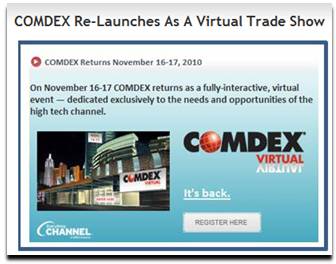
#3: COMDEX Re-Launches As A Virtual Trade Show

This was big news back in March, that the famed COMDEX show would return as a virtual event in November 2010.  I’m looking forward to seeing what’s in store this November at COMDEX Virtual.

#2: How 3D Virtual Worlds Can Be More Like Twitter And Facebook

Twitter and Facebook have taken the world by storm – this post received a lot of traffic by association.  I thought it was logical that 3D virtual world platforms could adopt some of the principles developed by Twitter and Facebook, such as the pervasive “Like” feature from Facebook.  I posited on some new concepts, such as closed circuit TV and on-demand TV for virtual worlds.

Finally, I guess I foreshadowed “Second Life Shared Media”, when I suggested that web content be embedded in-world – Linden Lab announced that feature a few short months after my blog posting.  More recently, I wrote about Second Life being at an important crossroads.

#1: The Future Of Virtual Events

There’s always something about the “future” that generates interest and curiosity.  I’m still a believer in the vision of the future (for virtual events) that I painted here.  While none of it has come to fruition, it’s just a matter of time.  In the future, that is!

Tweet this posting:


Event Planners “Check In” To Location Based Services

July 26, 2010

Introduction

Due to the rising popularity of Foursquare, Gowalla and related apps, location based services (LBS) is quite the buzzword both in consumer and technology circles.  Logically, the ability to “check in” at venues, connect with friends/associates and make new contacts has relevance to events and event planners.

Let’s highlight some of last week’s articles and blog postings on this topic.

Trade Show News Network

Michelle Bruno (@michellebruno) wrote an article in Trade Show News Network (@TSNN_com_US) titled “Checking Out ‘Checking In’ for Events“.  The article references Foursquare and Gowalla and then profiles a technology provider named Double Dutch.  According to its web site, Double Dutch provides “White label geolocation apps for your brand”.

Michelle references a key point regarding hybrid events, in which event planners support both physical and virtual venues.  Michelle writes, “If a virtual event is also taking place, live attendees can check in at the online and offline events for more recognition”.

Tracking and supporting check-ins across physical and virtual locations can build a more cohesive and compelling hybrid event.  In fact, it can serve to bridge the physical and virtual venues.

Virtual event platforms should look into this.  In fact, I blogged about location based services and virtual events previously.

Cisco Live

In Cisco’s Virtual Environments blog, Dannette Veale (@dveale) writes about virtual technologies that Cisco has incorporated into their Cisco Live (@CiscoLive) annual conference.  The 2010 Cisco Live event concluded recently – the physical component was hosted in Las Vegas, while a virtual component ran concurrently.

Disclosure: My employer (@INXPO) provided the virtual platform for Cisco Live

Dannette describes an innovative use  of Foursquare by Cisco Live’s event planners – a type of scavenger hunt, in which conference attendees received a clue (via social media channels) about a check-in location.  The first 75 attendees to check in at that location (and complete an additional task) would receive buttons, which could be used to redeem a daily prize at the Cisco Store.

The contest generated 802 checkins and allowed conference attendees to network and make connections with one another.

SCVNGR (Mashable)

SCVNGR, “a game about doing challenges at places”, this week announced the social check-in.  Two or more users can bump phones (or, wave them at each other in close proximity) and check in at the same time and place.  There are many ways event planners can leverage this technology.

In a trade show, attendees could be encouraged to perform social check-ins with each other – or, with exhibitors.  In a user conference, the social check-in could be used as a back-drop to a game that encouraged attendees to network with one another.  In a corporate setting, social check-ins could be used to encourage team building.

Conclusion

The concepts of “check ins”, location awareness and location tracking have natural uses for events.  While they’re a great fit for physical events, think about tie-ins between physical and virtual for your hybrid event.  And, think about ways in which “location tracking” (in a virtual event) can create connections, engagement and interaction.

Tweet this posting:


How To Leverage LinkedIn For Your Virtual Event

May 26, 2010

With over 65 million registered users worldwide, LinkedIn has become an essential destination where business professionals connect and network.  Make it easy for attendees to connect and engage with their LinkedIn network and virtual event planners have much to gain.

The good news is that LinkedIn provides several convenient integration points – there are LinkedIn Events, LinkedIn Widgets and a full-blown Application Programming Interface (API).  Let’s consider a few possibilities.

LinkedIn Events

To promote your event, create a LinkedIn Event – it’s easy to “Add an Event” once logged in to LinkedIn.  Complete a few input fields and within 5 minutes, your event record is created.  There is a check box for “This is a virtual event” – you’ll obviously want to select that.  Once created, your event will appear at http://events.linkedin.com and be searchable by all LinkedIn members.

Your next step is to generate awareness of your event to LinkedIn members.  On your LinkedIn Event creation confirmation page, you’ll have the option of sharing the Event with selected LinkedIn contacts – and/or advertising the event with LinkedIn’s DirectAds advertising system.  In addition to these options, consider promoting the event to relevant LinkedIn Groups, including those that your company has created – or is active on.

As LinkedIn members find your LinkedIn Event, you’ll begin to generate registrations – members can also denote whether they’re “Attending”, “Interested” or “Not Attending”.  If they’re “Attending”, they can further define their role at the event (e.g. “Attending”, “Presenting” or “Exhibiting”).

Note that a member can denote that they’re “Attending” your virtual event (on LinkedIn), but will still need to complete your event’s registration page, typically hosted on your site or your vendor’s site and separate from LinkedIn.

Once a few members denote that they’re “Attending” your virtual event, LinkedIn’s sharing features kick in – as you see above, I can “Browse Events” and view all upcoming events that a LinkedIn connection (or connections) is attending.  I can click on the LinkedIn Event record to view all attendees – and, I can view which of my connections plans to attend.

This could help in two ways – first, knowing that other like-minded professionals are attending may tip the scales in favor of my own registration and attendance.  Second, I now know (in advance) that one or more of my connections plan to attend, so I’ll be on the look-out for them within the virtual environment.  Or, I may email them on the live event date to ask for their early impressions.

Here’s a useful article: Promote Your Event Using LinkedIn Events Application

LinkedIn as Your Registration Page

Registration page abandonment is a concern for all virtual event hosts – use a form that’s too long and potential registrants may give up and never return.  LinkedIn has a Profile API that can be used to retrieve certain attributes from a LinkedIn member’s profile.

The first step for users, of course, is to authenticate to their LinkedIn account, granting the virtual event platform permission to access their LinkedIn profile.  Once authenticated, the virtual events platform can use the Profile API to obtain some profile attributes.  This should cover 40-50% of a typical event’s registration questions.

By making it convenient for registrants, you’ll see a higher conversion rate and generate more registrations.  You’ll need to balance that by collecting additional information (that exhibitors may need) once registrants login to the event (e.g. email address, which the Profile API does not provide, street address, zip code, qualifying questions, etc.).

LinkedIn Widgets

LinkedIn makes it easy for you to incorporate functionality by way of Javascript-based widgets – LinkedIn provides you with a few lines of Javascript and you embed the code on your web page (or virtual event page).  There are three widgets currently available: Company Insider (see how many connections you have at a particular company), Profile (display a user’s LinkedIn profile) and Share on LinkedIn (share content with your LinkedIn Connections or Groups).

Your virtual event’s registration page is a logical place to embed the “Share on LinkedIn” widget – users registering for your event can share it with their LinkedIn network – or, with particular LinkedIn groups to which they belong.  As shown above, members can share the page via status update (on LinkedIn), via a posting to a selected LinkedIn Group or by emailing selected connections.

The registration page is the one page where sharing makes sense – the rest of the event sits behind the registration page.  Thus, sharing pages from within the event are less useful, since recipients would first need to complete the registration page prior to seeing the “shared content”.

Searching for LinkedIn Connections within the event

I occasionally attend a virtual event where I come across a former colleague in the Networking Lounge or in an exhibitor’s booth.  If not for the random encounter, I would have never known s/he was attending the same event.  The virtual event platform ought to provide me with the ability to search my LinkedIn Connections and then check to see if any of them are registered or online (right now!).

This would be useful for:

  1. Attendees – have the opportunity to connect with a former colleague or business partner, right there in the virtual event.  Additionally, be able to compare notes on exhibitors, sessions, etc. with folks you know.
  2. Exhibitors – invite contacts (connections) to visit you in your virtual booth and get them caught up on your latest product offerings.  Also, be alerted to existing customers and business partners who are attending – whom you may not have known were online in the environment.
  3. Show Hosts – be alerted to business contacts who are attending your event – and be able to check in with them (or connect with them afterwards) to ask about the event experience.

Conclusion

Leveraging LinkedIn can bring many benefits to a virtual event planner – you can generate awareness and additional registrations via LinkedIn Events and the “Share on LinkedIn” widget; you can create an accelerated registration process for your users (and generate additional registrations along the way) and you can create enhanced engagement within the event by allowing attendees to discover their peers and business partners.  Give some of these ideas a try and let me know how they worked out!

Tweet this posting:


Virtual Events And Facebook

May 20, 2010

With 400 million active users worldwide (and counting), Facebook is enormous – in fact, Facebook recently surpassed Google as the #1 web site in the U.S. (as measured by visits).

While recent announcements have stirred up privacy concerns and caused some users to delete their accounts, Facebook continues to generate millions of new sign-ups per day.  All of us know friends, family and colleagues who use the site on a daily (or hourly) basis.

Let’s consider avenues for virtual event planners to tap into the power that Facebook can provide.

Integration 0.1: Share on Facebook

More than half of my Facebook friends (54%) are work-related acquaintances – current colleagues, current business partners, former colleagues and former business partners.  The balance (46%) are friends and family.  I’m by no means the “average” Facebook user.  I believe the typical user tends towards a 65%/35% split between family/friends and work – and, uses Facebook for a family and friend focus rather than work.

That being said, it’s clear to me that Facebook users “friend” their work contacts – and I believe that over time, a growing percentage of your Facebook friends will be work-related contacts, as our personal and work lives blend and mix online.

What does this mean for virtual events?  With a B2B focus (today), this means that a “viable” audience exists (on Facebook) for you to share the virtual events that you’re attending.  Virtual event platforms should make it easy to “share the event” on Facebook, in the same way that users share a web site’s movie review, restaurant listing or product listing.

To make virtual event sharing effective, the “shared items” should include:

  1. A simple and easy to understand title (Facebook grabs the “page title” from the virtual event page you’re sharing)
  2. A suitably sized image (on Facebook, the “sharer” can choose among the images listed on the shared page)
  3. A hyperlink for interested users

If done right, 20 attendees might share your virtual event with their 200 Facebook friends – and you’ve just allowed your audience to promote your event (on your behalf) to 4,000 potential attendees (who otherwise would not have known about your event).

Integration 1.0: Live Stream Box

CBSSports.com used it for live streaming of NCAA March Madness – so did CNN.com for the live stream of President Obama’s inauguration.  As the name implies, Facebook’s Live Stream Box is useful for the “streaming” of “live” events or occasions.  The stream box provides an “Everyone Watching” tab – to submit a comment to that tab, users must authenticate to Facebook.  Even if you don’t have a Facebook account, you’ll still be able to view the running commentary from “Everyone Watching”.

Comments posted to the “Everyone Watching” tab (in the virtual event) also appear on the submitting user’s Facebook Wall.  Thus, participation in a Live Stream Box helps promote the virtual event – users’ comments appear in the News Feed of their Facebook friends, which generates awareness of the virtual event.

Facebook members have the added benefit of a “Friends” tab, which allows users to view their Facebook News Feed, right there from the stream box.  In a virtual event, the Live Stream Box can be placed in the Auditorium (where live sessions are broadcast), the Lounge (where visitors drop by to engage with one another) or Exhibitor Booths (where booth visitors can engage with the Exhibitor – and, one another).

Integration 2.0: Open Graph

“Share on Facebook” goes in one direction (the sharer -> her friends); “Live Stream Box” combines multi-directional interaction with a corresponding one-way share.  Facebook’s Open Graph API, announced in April 2010 at Facebook’s F8 Developer Conference, takes things to the next level.

Now, users can go beyond sharing “the event” and be much more granular in what they “like” (recommend/share) in a virtual event.  I may “like” a session, a virtual booth, a document, or even another user.  And with the Open Graph, I need not share each and every “like”, posting it to my Facebook Wall.  Instead, the “likes” can be aggregated (e.g. by the virtual event platform).

Now, when I login to the virtual event, I may choose to view the activities (and likes) of Facebook friends who opted in to the sharing service.  When I’m making a purchasing decision on a complex product or service, I can poll my Facebook friends to see who’s in the same boat.  If a former colleague attended a virtual trade show in the morning, I may login during the afternoon to view the sessions and exhibitor booths that she “liked”.

Taken at a more granular level, I may choose to see the specific product collateral that she “liked” in the virtual event, or seek out the exhibitor representative that she chatted with and “liked”.  By leaning on those whom I trust, my journey through a virtual trade show just got more productive.

Conclusion

Facebook and its 400+ million users cannot be ignored.  There will be more and more business decisions guided (and made) on Facebook – it can be a great place to “share” your virtual event, both the event as a whole and individual elements within it.

Tweet this posting:


Virtual Events 101: Tips For Planning Your Virtual Event

May 7, 2010

Previously, I provided tips on selecting a virtual event platform.  In that posting, I covered team, technology and customer service considerations for selecting a platform.  Now, I’d like to cover the very important process of planning your virtual event.  A successful virtual event originates with a sound, strategic plan – one that’s researched, developed and documented well before the topic of platform selection is even broached.

Virtual events involve technology – however, as with physical events, it’s about the experience first.  Technology, while important, is there to provide the means to address your experiential goals.  Get the planning done right and technology decisions will fall out naturally from there.

Understand Your Audience

A virtual event planner must act like a product manager – to build the best “product” (i.e. event), you need to first understand your target audience / target customer.

Product managers need to employ “customer empathy”, while virtual event planners need to employ “attendee empathy”.  Product managers develop user personas – profiles of different users of the product.  Similarly, you ought to create attendee personas.

Identify the attendee profiles – and for each profile, document the “average user”.  Questions you ought to ask about your audience:

  1. Are they inclined to experience an event virtually?
  2. What topics/subjects are they most interested in?
  3. What online sites do they frequent the most?
  4. When they’re not online, what are they doing?
  5. How do they prefer to consume content?
  6. How do they prefer to interact with one another?
  7. What would prevent them from interacting, engaging, etc. online?
  8. What motivates them?
  9. What is their preferred form of reward (e.g. recognition, money, etc.)?
  10. How do you hold their attention?

There are many more questions you could ask.  Understanding your audience is one of the most important planning steps, so make sure you invest the right amount of time and energy here.  When done, document your “audience profiles” and share the document with your extended team.  Ensure you’re all on the same page with regard to your target audience.

Identify Your Funding Sources

The virtual event never happens if you’re not able to pay for its costs.  Are you an association that aims to fund the event with association or per-event fees?   Are you a non-profit organization who submitted a bid for a grant?  Or, are you a B2B publisher who aims to fund the event by selling sponsorships at a virtual trade show?

For virtual trade shows, identify possible exhibiting companies and forecast the amount of revenue you can generate from the sponsorships.  Review past events you’ve produced (whether physical or virtual) – and, review competitors’ trade shows to see which companies are exhibiting at them.

Regardless of the scenario, ensure that your funding model is identified – and, that the funds are “firm”.  It does you no good to spend a month profiling your target audience, only to have that work go to waste when you’re not able to obtain funding for the event.  If possible, seek to have your funds secured before you begin the subsequent planning steps.

Define your Format, Venue, Style, Personality

There are many types of virtual events: virtual trade shows, virtual career fairs, virtual product launches, etc.  Chances are, you already have a format in mind and that’s good.  Following that, however, you ought to consider the additional details of the design, style and personality of your virtual event.

The most direct (and cost effective) approach is to select from the pre-existing “event templates” of your virtual event platform provider.  They’ll allow you to select a theme from their template library and you can apply customizations on top of the base image.  While this approach is time and cost efficient, keep in mind that it’s more challenging to distinguish your event, especially if your competitor uses the same platform and selects the same theme.

If you have the budget (and time) to create a unique experience, consider the venue and theme – a virtual experience is not bound by physical space limitations (or, by gravity), so there are endless possibilities.  Do you want an outer space experience?  Perhaps not, but that’s possible if you so choose.

If budget allows, consult with a creative agency or design firm – you’ll first want to “storyboard” the event experience in the same way you’d map out a new web site.  In addition to event components, storyboard the user journey and user experience – map out how you’d like attendees to move through your environment.

Identify the Event’s Content

Most virtual event planners associate “content” with “sessions” (e.g. Webcasts, Videocasts, etc.).  Sessions are indeed important – invest the time and effort to identify hot topics, develop session tracks and recruit speakers and presenters.  Once that’s complete, identify additional content formats to include:

  1. Break-out Sessions
  2. Training Sessions
  3. Scheduled Chats
  4. Quizzes
  5. Games

Virtual events no longer need to be focused around the session schedule – as you can see from the list above, many content formats are available – and some are more effective at engaging and involving the audience.

Identify Potential Dates

Who knew that virtual event planning would be similar to wedding planning?  With regard to date selection, your first step is “conflict avoidance”.  You want to eliminate important dates within your organization (e.g. the date of your annual customer conference) – as well as important dates within your industry.  Then, review competitive events and related events in your industry, as you want to avoid those too.

Finally, consider seasonality dependencies, such as the December religious holidays or the week leading to Labor Day (in the U.S.), during which many families with school kids are out of town.

Once you’ve done the “elimination” of dates, consider events or occasions that would work well for your event – you might want to plan your virtual event around an existing physical event of your’s – or, plan for event around a key product launch you have scheduled two quarters from now.

Identify the Event’s Duration

Single-day events are the most common today.  Your event, however, should have a duration that’s driven by your goals and objectives.  For instance, if you have more content than can be consumed (or scheduled) in a single day, consider the multi-day event.  If your event is based around an ongoing game, with points accrued over days (or weeks), then the game parameters will dictate the event duration.

For multi-day events, be sure you have an audience engagement strategy in place to incent Day 1 attendees to return for Day 2 (and Day 3, etc.).  In addition, keep in mind that multi-day events require staffing and support to be available for each live date, which adds hard and soft costs to the equation.

Conclusion

Hold your horses! Technology is fun and exciting, but before you jump into that step, be sure to spend the necessary time and effort to complete the planning steps outlined here.  In the end, you’ll be rewarded with a successful event.

Related Links

  1. Browse the Virtual Events 101 Index Page
  2. Download the eBook, “Virtual Events: Ready, Set, Go

Note: I invite you to connect with me on .