Stanford Media X Event: IMVU’s Online Community

August 23, 2010

Brett Durrett (@bdurrett), VP Engineering at IMVU, gave an interesting presentation at a Stanford Media X virtual worlds event.  IMVU achieves a $40MM annual run rate, primarily from the sale of virtual goods.  Several virtual worlds entrepreneurs were in attendance at the event, which meant that Durrett’s talk received a lot of attention and interest.

IMVU is NOT a Virtual World

Durrett began the presentation by stating that IMVU is not a virtual world.  Instead, they are an online community “where members use 3D avatars to meet new people, chat, create and have fun with their friends.”  Many members of the early management team came from There.com (including Durrett) and their experience told them that an expansive “world” may not be the best solution.

Instead, the team considered connecting (with one another) the core function of the experience, so they built rooms and spaces where members can meet, connect and chat.  IMVU has achieved large scale usage.  At any time of the day, there’s usually 100,000 (or more) users logged into the system.  And while there’s no single “world” connecting them all, a user can find and connect with any other user who’s online.

User Generated Content as Key Enabler

How has IMVU achieved their current run rate?  User generated content.  IMVU generates very little of the virtual goods for sale in their marketplace.  Instead, it’s the community that creates the virtual goods for sale.  Durrett noted that IMVU could have hired a staff of developers to create the 100,000+ pairs of womens’ shoes available in IMVU.  But at the end of the day, they wouldn’t know if users liked those shoes.

And, that would have covered just shoes.  The way to scale to the wide assortment of goods now available is to open up the creation to the users.  With so many goods available, how do users find the items they want to purchase?  Durrett noted that like any online retailer with a large inventory, intelligent tools need to be built, a la Amazon’s recommendation service.  IMVU can recommend new items to you based on your past purchase patterns.

Competition Drives Engagement

Durrett described how IMVU creates daily contests based on pre-determined themes.  Users dress up their avatars in the particular theme and then submit a snapshot (image) of their avatar.  The community votes and the top avatars are displayed on a leader board.

To appear on the leader board, the reward is “virtual” (i.e. recognition, rather than cash, virtual credits, etc.).  And yet, the contest creates an intense amount of interest and competition from the community – a great thing from IMVU. If members happened to admire a particular user’s outfit, they could purchase all the items in that outfit with a single click.

Expanding the Inventory

Expansion of virtual goods inventory will be a key driver to IMVU’s continued growth.  They already make user generated music available (in MP3 form) and they recently launched games.  For games in particular, it will be interesting to see if IMVU creates inventory items around game status and advancement, as is common in many of today’s social games (e.g. FarmVille).

While IMVU does not support user generated games today, that could  be an interesting avenue of growth.  They’d probably want to review and certify submitted games, to prevent malicious activity from occurring.  In this manner, they could create a sort of iTunes App Store for games.

Related Links

  1. Interesting and related presentations from Brett Durrett (SlideShare)
  2. TechCrunch: IMVU’s Virtual Cash Cow: Doubling Revenues, Focused On Gaming (Video)
  3. Virtual Worlds News: IMVU Hiring, Anticipates $60M Run Rate

Tweet this posting:


Stanford Media X Event: Virtual Worlds Entrepreneurs Show The Way

August 20, 2010

Introduction

Media X at Stanford University hosted a workshop titled “Cashing In on Virtual Worlds: Entrepreneurial Insights for the Healthcare Industry.” The workshop was organized by Parvati Dev and Laura Kusumoto, who combine leading edge research, expertise and hands-on experience with virtual worlds and virtual worlds platforms.

In her introductory remarks, Ms. Kusumoto provided a perspective on the current state of virtual worlds. While the consumer-focused virtual worlds have seen notable platform closures (e.g. Google Lively, Metaplace, There.com, etc.), there has been positive activity on the enterprise side of virtual worlds, including virtual events and virtual trade shows.

Virtual Worlds: On An Upswing?

Kusumoto referenced a recent Gartner Hype Cycle Report that positioned “public virtual worlds” in a phase of “Trough of Disillusionment.”  The good news is that the subsequent phases are called “Slope of Enlightenment” and “Plateau of Productivity.”  Web 2.0, Tablet PCs and Wikis are positioned in this “Slope of Enlightenment” phase in Gartner’s cycle.

In the afternoon, we heard 5-minute pitches from entrepreneurs who were looking to launch virtual worlds businesses related to health care. These entrepreneurs showed me how virtual worlds (and notably, the surviving virtual worlds platforms) can embark on an upward path towards enlightenment.  Here’s my view on how virtual worlds are evolving:

Circling back to the Gartner Hype Cycle, I look back at the following progression:

  1. Technology Trigger: Artists and Hobbyists discover this technology for self-expression
  2. Peak of Inflated Expectations: Fortune 500 brands enter the mix, expecting a transformation of marketing and advertising
  3. Trough of Disillusionment: An assortment of virtual worlds platforms fold
  4. Slope of Enlightenment: Entrepreneurs develop innovative businesses that ride on top of virtual worlds platforms

The entrepreneurs who presented are leading the way towards enlightenment and the virtual worlds platforms (e.g. Second Life, Unity, OLIVE, etc.) stand to benefit.  The new business model is the purchasing of virtual land (or, the licensing of virtual world platform technology) that entrepreneurs leverage to drive monetization and revenue.

In a sense, this is similar to the smartphone app store – the entrepreneur creates intellectual property that rides on top of a “platform”.  The entrepreneur then leverages that platform to drive revenue to a direct sales channel (customers).

Noted Entrepreneurs

I’d like to highlight some of the presenting entrepreneurs (and their businesses).

Club One Island

Lose weight in a virtual world, on Club One IslandCeleste DeVaneaux gave a fascinating overview of how participation in a virtual world program can facilitate habit change.  It’s one thing to urge people to eat slower – it’s another thing to show them how.  And, to have their own avatars practice the habit of doing so.  Club One Island runs on top of the Second Life platform.

Related: How I lost 20 pounds in Second Life (featuring Club One Island – by Hypergrid Business)

CliniSpace


CliniSpace is a collaborative virtual medical environment created by Innovation in Learning, Inc. (the company led by Parvati Dev, one of the event’s organizers).  The goal of CliniSpace is to provide virtual world-based training to physicians, nursing students, etc.  A virtual patient can start out completely healthy, but then be programmed to worsen, such that s/he requires CPR within 15 minutes.  The service runs on top of the Unity platform.

InWorld Solutions


InWorld Solutions “incorporates a wide range of avatars, content and features specifically designed to facilitate clinical and educational applications.”  InWorld can facilitate treatment for substance abuse by having patients in a virtual world, with their doctors observing from the same physical space – or, from within the virtual world.  Patients can experience peer pressure (virtually) and be advised and coached on how to respond.  InWorld runs on top of Forterra’s OLIVE platform.

Conclusion

These were just a few of the innovative business concepts brewing in one particular industry (health care) around virtual worlds.  As more entrepreneurs launch virtual worlds businesses, the platform vendors (e.g. Linden Lab / Second Life, Unity, Forterra / OLIVE) stand to benefit.  And importantly in this vertical, another entity stands to benefit: the human condition.

Tweet this posting:


FountainBlue’s Virtual Worlds Annual Conference (2010)

August 11, 2010

On September 24th 2010, FountainBlue will hold its “Second Annual State of the Virtual Worlds Industry Event” on Cisco’s campus in Milpitas, CA (USA).  The title of the event is:

Virtual Worlds: Where We Were, Where We’re Going, What Does It Mean to YOU?

Register to Attend

The conference will host three panels of virtual worlds experts and thought leaders – one on industry trends facilitate by Jeff Pope (Founding Partner, Spark Sky Ventures), another featuring industry entrepreneurs and facilitated by Nina Gerwin (Founder, The NRG Group) and one that I’m facilitating on corporate use of virtual worlds.

Linda Holroyd, Founder and CEO of FountainBlue answered a few questions about FountainBlue and this virtual worlds event:

Q: Tell us about FountainBlue.

A: FountainBlue stimulates collaborative innovation one conversation, one leader, one organization at a time, through our monthly events, our dynamic communities, and our strategic and business development consulting services for early stage clean energy, high tech and life science entrepreneurs in Silicon Valley and beyond.

Q: Who should attend this conference?

A: This conference is for virtual worlds and other high tech entrepreneurs involved in or interested in this hot space, for intrapreneurs involved with virtual worlds solutions building brand and serving customers, and investors interested in investing in this space.

Q: Why should they attend?

A: FountainBlue events are known both for the quality of the speakers and program, but also for the value of the quality, win-win, long-term connections created. Both are highly valued in creating an entrepreneurial community in this exciting area.

Q: On virtual worlds and “where we’re going”, what is your opinion?

A: The opportunities in virtual worlds brings together the best of enterprise solutions which automate business process to better serve customers at all levels, the best of social media and its capacity to expand audiences virally leveraging technology, and the best of gaming with its fanatical appeal to extremely loyal customers. It is a hot Web 3.0 opportunity, which takes the technology, community, and monetizing potential of Web 2.0 to the next level.

Q: Tell us about other upcoming events from FountainBlue?

A: FountainBlue produces monthly events for clean energy and life science entrepreneurs as well as a Tech2Green series for executives transitioning into the clean energy industry and a When She Speaks Women in Leadership series, supporting women entrepreneurs and leaders. We run annual events for the high tech entrepreneurs in our community, which includes an annual freemium-to-premium event, an annual M&A event, an annual data analytics event, as well as an annual virtual worlds conference – this one, which we are conducting for the second consecutive year. We facilitate the cross-over between communities in support of entrepreneurial ventures.

Q: How do you support early stage entrepreneurs beyond connecting them through regular events?

A: FountainBlue supports entrepreneurs through one-on-one strategic and business development consulting for early stage clean energy, high tech (including virtual worlds) and life science entrepreneurs. We help our founders develop and refine business models and strategies and work with founders to build momentum with initial customers and strategic partnerships.

FountainBlue’s Virtual Worlds Annual Conference

Topic: Virtual Worlds: Where We Were, Where We’re Going, What Does It Mean to YOU?
Date & time: Friday, September 24, 2010, from 8:30 a.m. until 3:00 p.m PT
Location: Cisco, Great Dane Conference Room at MCCARTHY RANCH 3 (SJCMR3), 155 North McCarthy Blvd., Milpitas, CA
Cost: Register by September 22 at noon: $42 members, $52 partners, $62 general
Late and On-Site Registration: $62 for members, $32 for non-members
Registration: http://www.svvirtualworlds.com by 9/22 at noon
Audience: Entrepreneurs, Intrapreneurs and Investors only. No service providers please.

Description
FountainBlue’s Second Annual State of the Virtual Worlds Industry conference updates entrepreneurs, intrapreneurs and investors on the successes, challenges and trends of the industry overall, and showcases corporate and entrepreneurial virtual world demos. Beginning with a panel sharing the growth of the industry from the legal, venture, research and corporate perspectives, the program will next highlight how leading corporations are leveraging virtual worlds solutions to better serve their constituents, and culminating in showcasing early stage, funding-bound virtual worlds entrepreneurs with a range of solutions pushing the technology and business envelope.

Agenda

8:30 Registration and Networking

9:00 Welcomes and Thank Yous

9:15 Trends in the Virtual Worlds Industry: An Update on What’s New and What’s Coming

Facilitator Jeff Pope, Founding Partner, Spark Sky Ventures
Tim Chang, Principal, Norwest Ventures
David Helgason, CEO and Co-Founder, Unity
Chris Platz, Creative Director and Art Lead, Stanford Sirikata Labs
Eilif Trondsen, Research and Program Director of the Virtual Worlds @ Work Consortium at Strategic Business Insights
Mark Wallace, Conversation Manager, Linden Lab

10:20  Morning Break

10:35 Corporate Panel: Serving Customers, Building Communities, Training Users

Facilitator Dennis Shiao, Director of Product Marketing, INXPO
Mic Bowman, Intel
Dannette Veale, Global Virtual Event Strategist, Cisco, Lead, Virtual Component, Cisco Live
Another Corporate Presenter to be confirmed

11:40   Lunch and Networking

12:30   Entrepreneur Panel: The Tools, The Goods, The Immersion Experience

Facilitator Nina Gerwin, The NRG Group
Michael Gold, CEO, Electrotank:
Steve Hoffman, CEO, Rocketon: virtual world for tweeners
Albert Kim, CEO, Zenitum: Augmented reality with 3D displays
Jim Parker, CEO, Digitell: SaaS 3D immersive virtual events and virtual training
Reuben Steiger, Founder and Chairman, Virtual Greats

1:30 Adjourn and Further Networking and Corporate Exhibits and Entrepreneur Showcases open until 2:00

For more information and to register, visit http://www.svvirtualworlds.com.

Thank You to Our Sponsors:
We are grateful to our sponsors at Cisco for their ongoing sponsorship of FountainBlue’s annual virtual world’s conference.

(Technorati code: 2KFW26VPVNTT)

Tweet this posting:


Top 5 Virtual Event Posts Of 2010

August 5, 2010

Here are the Top 5 posts (on this blog) for calendar year 2010.  The Top 5 List is in descending order and based on the number of page views per blog posting.

#5: Virtual Events 101: Tips For Building Your Virtual Booth

My guess is that many readers built their first virtual booth during 2010.  This posting provided tips planning and objectives, content strategy and booth staffing.  In addition, it provided tips on content presentation, “search optimization” and how to stand out from the crowd.  This posting is part of a broader Virtual Events 101 page that provides tips on virtual events.

#4: Bringing The Physical Event Experience To Virtual Events

This posting did some brainstorming on features that virtual event platforms could provide to bring physical event experiences to virtual events.  Then, it covered tips for virtual events, including how to gauge attendee interest, how to connect with interested attendees and how to create better attendee networking.

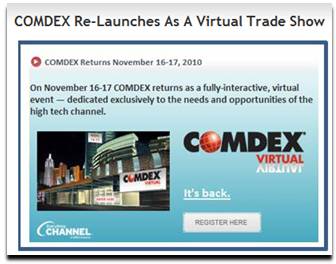
#3: COMDEX Re-Launches As A Virtual Trade Show

This was big news back in March, that the famed COMDEX show would return as a virtual event in November 2010.  I’m looking forward to seeing what’s in store this November at COMDEX Virtual.

#2: How 3D Virtual Worlds Can Be More Like Twitter And Facebook

Twitter and Facebook have taken the world by storm – this post received a lot of traffic by association.  I thought it was logical that 3D virtual world platforms could adopt some of the principles developed by Twitter and Facebook, such as the pervasive “Like” feature from Facebook.  I posited on some new concepts, such as closed circuit TV and on-demand TV for virtual worlds.

Finally, I guess I foreshadowed “Second Life Shared Media”, when I suggested that web content be embedded in-world – Linden Lab announced that feature a few short months after my blog posting.  More recently, I wrote about Second Life being at an important crossroads.

#1: The Future Of Virtual Events

There’s always something about the “future” that generates interest and curiosity.  I’m still a believer in the vision of the future (for virtual events) that I painted here.  While none of it has come to fruition, it’s just a matter of time.  In the future, that is!

Tweet this posting:


How Vendors Should Evolve Their Virtual Event Platforms

July 10, 2010

The following is a collaborative posting by Miguel Arias, Steve Gogolak and Dennis Shiao.

Content creation and collaboration was facilitated by a PBworks wiki – the wiki page can be found here: http://allvirtual.pbworks.com/How-Vendors-Should-Evolve-Their-Virtual-Event-Platforms

To evolve their platforms for enhanced experiences and broader adoption, virtual event platforms should consider the following:

Make it easier to experience

Most virtual event platforms are easy to use – on a first-time visit, users tend to grasp the overall user experience and can figure out where to go (and how).  That being said, for wide scale adoption, virtual events needs to be as easy as Facebook.  That is, our grandmothers need to be able to access the site and figure things out.  On Facebook, grandmothers can update their profile, read their “friends” posts and write updates to their Walls.  Can a grandmother login to a virtual event, update her profile and participate in a group chat?  We’re not so sure.  Similarly, navigation and interactions need to be easier.  Most virtual events are intuitive to navigate (e.g. Lobby, Auditorium,  Lounge, etc.) – but may not be so intuitive with regard to message boards, chat, blogging, rating, etc.

Along with a simplification of interfaces and the use of usability and navigation conventions, many customers and users seem to be demanding more immersive environments. While presenting a brand and hosting an interactive experience in a convention centre, it seems an interesting field to add some real-time rendered environments using engines like papervision3D or Unity3D. This said, it is unlikely that avatar-based real time rendered environments will make it to a mainstream audience. Key considerations (or obstacles) are plugins or applets downloads, system performance and learning curve barriers.

Make it easier to find

The typical “location” of a virtual event is quickly becoming outdated – microsite with registration page, with no ability to experience the event prior to completing all mandatory registration fields. The registration page serves as a “wall” not only to potential attendees, but to search engines as well.  Virtual event platforms need to move “outside the wall” and expose their technology on Facebook, on blogs and on publisher web sites.  Platforms should widen their distribution via widgets, embed code and application programming interfaces (API’s).  Facebook is not limited to Facebook.com – it has Facebook Connect, Facebook Open Graph and much more.  Virtual events platforms, on the other hand, seem to be restricted to “VirtualEventPlatform.com”

Make it easier to access

The most relevant virtual event platforms will introduce, or already have, Facebook Connect and Twitter API, and they will need to move to even wider standards like OpenID.  For public events, ease of registration is a must.  Using open methods for registering and/or connecting social networks have three-fold benefits:

  1. Registration is faster because basic information can be provided by services like LinkedIn, Facebook, etc.  Shorter registration forms increase completion, period.
  2. Intelligence gathered by the platform about the user’s existing social graph can enhance the experience within the event by automatically creating connections with other attendees based on that user’s connection outside the platform.  This will lead to more networking and awareness of actual people within the environment.
  3. Users opting into connections at the point of registration allows platforms to create publishable actions that can be spit out to twitter and facebook news feeds that can increase viral awareness of the event.  Marketing automation at its best.

On the other hand, desktop or mobile widgets to control your stand usage, statistics and reporting will be a must. Lastly, the platforms will have extensive APIs to manage their integration with various social networks, corporate databases, physical event managing software, etc.

Make the experience available on more devices

Most virtual event platforms support Windows, Mac and Linux.  They need to support more platforms, especially mobile.  On the mobile front, it’s important to consider iPhone/iPad, Android, BlackBerry, Symbian, Windows 7 Phone and WebOS (listed in our order of importance).  To start, we don’t believe the entire virrual event experience needs to be “ported” to mobile devices -rather, vendors should determine the most critical features for attendees and exhibitors – and prioritize based on importance.  For instance, chat is an important element of virtual events, so why not make a mobile app that allows exhibitors to staff their booth via their smartphone.

The entire 3D environment does not need to be supported on a mobile device, but the networking tools (visit card managing, real time conversation, etc) and the reporting tools certainly do. On the other hand, it will be interesting to see what happens with Flash and Apple, and see which vendors will try to develop their platforms using HTML5.

One of the key areas where mobile can play a huge role is the “reminder” needs that come from tons of scheduled activities within virtual events.  If attendees have the ability to build out a personalized agenda before the event and opt-in to either SMS reminders or download some kind of app that will push notifications at them throughout the day, it would be much easier to create a flexible agenda.  Currently we’re cramming so much into the shortest amount of time because we’re afraid of losing people.  If only we had better planning and reminding tools, driven by devices that never leave our pocket!

Make the platform more adaptable and flexible

Related to our point about mobile support, platform vendors have important decisions to make regarding the development platforms.  Virtual event platforms today are based on Flash, Flex, Silverlight, Java and JavaFX.  Are those the “right” platform technologies for the future – or, should platforms move in the direction of HTML5?  Does a combination off HTML5, Javascript and Ajax create a more adaptable and flexible platform?  What do we “lose” by shifting away from Flash, Silverlight, etc.?  And what are the mobile implications with the chosen direction?  All good questions for the platform vendors to consider.

Make the platform more adaptable for different customer needs and different usage

There are so many different kind of virtual events: trade shows, conferences, job fairs, corporate events, webinars, congresses… that vendors should decide in which market niche they are going to play. We will see generic platforms and other vendors delivering a tailored solution for one or many of the previous choices. It will become more and more complex to provide physical event managers with the features they need to handle their hybrid events at the same time as the platform is able to cope with the extensive data handling of the virtual job fair, or the networking tools of a professional tradeshow.

Take a hint from Apple and FaceTime

Video chat will, without a doubt, increase the effectiveness of networking.  It is the one key element that can be introduced that will get critics to come around to the idea that networking in an online environment can be as effective as the cocktail hour of a physical event.

Tweet this posting:


At A Crossroads: Where Does Second Life Go From Here?

July 2, 2010

Crossroads

June 2010 will mark an important month in the history of Linden Lab and Second Life.  On June 9th, the company announced a restructuring that included a 30% reduction of their staff.  On June 24th, the company announced that CEO Mark Kingdon was stepping down and named company founder Philip Rosedale its interim CEO.

Second Life is clearly at a crossroads – it will be crucial for Linden Lab to determine the best path forward.  To do so, they need to identify the right questions to ask and then determine the right answers to those questions.

What is your audience and customer segmentation?

Second Life takes quite a broad approach today – there are a wide assortment of communities [audience] (see their Destination Guide) and an equally wide assortment of land owners [customers].  Having cut 30% of staff, the question at this juncture is whether the company (and the platform) is well suited to cater to “anybody and everybody” or whether it’s better to narrow the focus.

One “focus area” may be in evolving the platform to cater to the hobbyists and loyalists who helped grow the Second Life community from the early days [consumer focus].  Another focus area, while unlikely, may be in catering to corporations for business use (I say “unlikely” because the Enterprise group was let go in the June staff reduction).

Yet another focus area may be in catering to particular categories (e.g. Music, Art, Education).  If Second Life focused their resources around building the #1 immersive music experience, would that have a larger impact than evolving the broader platform to meet everyone’s needs?

So the question really comes down to “narrow vs. broad” – by identifying narrower segments to target their service, can Second Life create a more rewarding and enjoyable experience for both residents and land owners?

What is the revenue model?

Today, the Second Life revenue model is based around a virtual economy, whose currency is the Linden Dollar.  Residents purchase Linden Dollars with real money (e.g. US Dollars) and can then buy land (in-world) or buy virtual goods from in-world merchants.  One of the challenges inherent in this model is its dependence on others to sustain a viable audience (community).

The model works when the audience is growing and the community is thriving; however, when the audience declines and becomes less active, purveyors of virtual land find the ROI less compelling and the audience decline snowballs (since users have fewer residents to interact with each time they login).

Are you a media company or technology platform?

Second Life can go one of two ways here – they can morph into a media company (and have direct influence over the audience) or they can move to a pure-play technology platform provider, which shifts the audience generation “burden” to licensees of the platform.  As a media company, they’d be similar to Facebook, Zynga, IMVU and Slide, with revenue being a mix of advertising, sponsorship and the sale of virtual goods.

Today, I’d say that Second Life is somewhere in between – they’re a technology platform that has no explicit and associated “force” to drive audience (like a media company does).  Resolving this “grey area” will be important.

Where do you take the technology?

To some degree, the technology vision was shared in the June 2010 restructuring announcement – the company will migrate Second Life to a web-based experience, with no software download – and, they’d look to integrate popular social networks to be more accessible and relevant.  Of course, there’s a delicate balance to manage here, since a core component of the Second Life community uses the service for the immersive experience that a downloaded client can deliver.

Here, Second Life can take a page out of OnLive’s book – if OnLive can deliver immersive, action-rich, multi-player video games from the cloud, then one would imagine that a 3D immersive virtual worlds can move to the cloud as well (though, of course, it’s not trivial to achieve).  Second Life needs to think beyond the web as well and determine the viability for apps running on iPad/iPhone, Android and related mobile operating systems.

My Answers (Recommendations)

These are obviously complex questions that require a lot of analysis – in addition, there may be other questions that need to be asked.  The answers to these questions are interrelated and need to be answered together, not individually.  Here are my high level answers / recommendations:

  1. Audience and customer segmentation: Go narrow – you’ll lose segments of your user base, but the core segments you choose to focus on will see solutions and experiences that are more targeted and relevant.  Build upon these small successes and grow outward again.
  2. Revenue model: Move to a SaaS licensing model (priced in US Dollars) – keep the Linden Dollar currency system in place for the purchase of in-world virtual goods.
  3. Media company or technology platform: Become a pure-play technology platform that partners with media companies as a sales channel.  Give media companies incentives and easy-to-use tools that foster growth in virtual real estate – encourage them to be your sales champions and bring their audiences into the community.
  4. Technology evolution: Complete the transition to a 100% web-based offering (no small task!) – and, on the journey there, have plans in place for iPad and Android apps.

Times of turmoil give companies the opportunity to throw convention out the window and reinvent themselves.  Consider another company whose original founder returned to transform them from a “has been” to the most valuable technology company on the planet:

Apple Computer.

Tweet this posting:


Mid-Year Report Card: 2010 Virtual Events Predictions

June 9, 2010

At the end of 2009, I posted my 2010 predictions for the virtual events industry.  Now that we’re nearly half done with 2010 (can you believe that), I decided to provide a self-assessment for my predictions.

Overall, I’ve decided on a grade of “B” (I’m an easy grader) – which may improve based on the second half of the year.  Let’s review the individual predictions.

Video Integration (Grade: B)

I wrote:

In 2010, I believe that the virtual event platforms will integrate with third party video conferencing technologies in a big way – stirred largely by client demand for it.

While video conferencing integration has not (yet!) been implemented on a wide scale, we witnessed the first occurrence of telepresence enablement in a virtual event.

The Sustainability Virtual Summit: Smart ICT was produced by G2 Events, “featuring telepresence enablement, allowing roundtable and panel discussions to be broadcast between panelists in remote locations worldwide (first in a virtual event)”.

I attended the event and viewed a number of telepresence-enabled sessions.  While impressive, it should be noted that my prediction was around “incorporation of multi-party, HD video conferencing”, whereas the Sustainability Virtual Summit event enabled telepresence via “simulive” playback of pre-recorded sessions.

Multi-party HD video conferencing over the public Internet is likely a few years away – instead, we’ll likely see multi-party (with virtual event integration) enabled in a corporate setting, with its tighter controls over available bandwidth – and, with the option to distribute the video conferencing streams via IP multicast.

Global Players (Grade: B)

I wrote:

I expect to see another European-based platform emerge in 2010, along with one or more in Asia Pac.

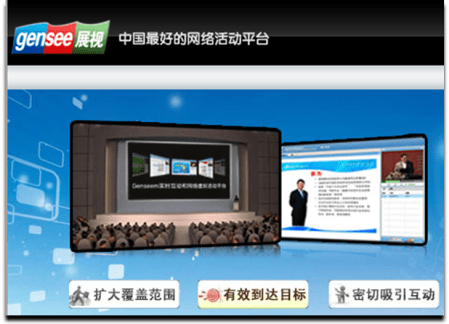
Gensee, based in China, provides a “Web Virtual Events Platform”.  The market for virtual events in China seems to be less developed than in the U.S. and Europe – as such, Gensee may be well positioned to capitalize on any uptick in adoption (in China), as their platform was built to serve a Chinese audience.

“China has more than 400 million internet users, with Flash based virtual games and social network services very popular, although with its own flavors and local providers”, notes Benjamin Chen, CEO of Gensee Technology.

Chen continues, “China has many economic centers and many enterprises have geographically dispersed customers and employees. I already see great demands to complement physical trade shows, expos, events and e-learning with virtual components”.

VisualMente is another European player in the virtual events space – they’re based on Spain and have done virtual event campaigns for BlackBerry, among others.

To be fair, both Gensee and VisualMente were around when my predictions were made, so I didn’t technically predict their emergence.  That being said, I do believe in the trend that more and more players will enter the space, with a growing number of vendors outside of the U.S.  The U.S. is the most developed market to date (relatively speaking) – which means that even larger opportunities lie abroad.

If you’re aware of additional virtual event players (outside of the U.S.), please leave information in the comments section below – thanks.

Source: Cisco Live and Networkers Virtual

Response Rates (Grade: A)

While I can’t provide insight for “relative response rates” on audience generation for virtual events in 2010, I did write the following:

Virtual event show hosts will need to consider the incorporation of gaming, the creation of affinity programs and more.

Cisco Live and Networkers Virtual is incorporating gaming into their upcoming event – Dannette Veale (Cisco) published a post regarding  objectives and considerations behind enabling gaming in that event.  I should disclose that I’m with INXPO, the virtual event platform that’s hosting this event – and we’re big believers in social gaming in virtual events.  So my prediction was a bit self serving.

I do believe in the effectiveness of gaming, especially in a virtual event or virtual business environment (e.g. for learning, retention, sponsor interaction, etc.) – as such, I expect to see an increasing amount of games (especially games with a social component) enabled in virtual events going forward.

Some vendors will integrate them into the core platform, while others will start by creating “one off” games that are loosely coupled with the underlying event platform.

Immersiveness (Grade: A)

In the U.S., the Virtual Edge Summit is the annual face-to-face event in the virtual events industry.  New this year was a “Business 3Di Track”, demonstrating the growing interest in immersiveness [see full program here].  I wrote:

Client interest and demand will drive some platforms to add immersive capabilities in 2010.  I don’t expect a software download, however – it would serve platforms well to support the immersive experience within their existing framework (e.g. Flash, JavaFX, Silverlight).

One of the exhibitors at Virtual Edge was Altadyn, who provides an offering called 3DXplorer – “the first ‘browser-based’ and ‘installation-free’ solution which enables a 3D interactive and fully immersive experience, accessible from any corporate or individual computer”.

In addition to Altadyn, one of the “pure play 2D event platforms” (at Virtual Edge) provided a demo of immersive capabilities they’ve incorporated into their platform.  I expect to see more experimentation and deployment in the second half of this year.

Consolidation (Grade: C)

I wrote:

We’ll see the merging or acquiring of virtual event platform companies.

Since neither of these has yet to come true in 2010, this grade really could be an “F” or an “Incomplete”.  I’m still holding firm on this prediction, however, as I do expect some M&A activity in the second half of the year.

Conclusion

The first half of 2010 sure has flown by – on the predictions front, I’m looking decent so far at the half-way mark.  I’m expecting an eventful second half (pun intended).  What are your expectations for the second half of this year in our industry?  Leave your thoughts below in the comments section.

Tweet this posting:


From Virtual Events To Virtual Business Communities

May 31, 2010

Increasingly, virtual event planners are keeping their virtual events “open” year-round.  The model is evolving from a focus on the annual live event to a focus on the overall business environment, which has live events scheduled throughout the year.

Hence the progression – first, the virtual environment is kept open year-round (“Come in, we’re open”).  From there, virtual event planners become virtual community managers to evolve the environment into an active and engaged community.

Your virtual business community is quite similar to a social network (e.g. Facebook, Twitter, etc.).  Thus, look to those social networks for effective community building and networking tactics.

Content

“Traditional” content forms the foundation of your business community: on-demand webcasts, videos, documents, articles, etc.  That being said “non-traditional” content is what makes a community shine and prosper – it includes other members and their associated user-generated content (e.g. 1:1 and group chat, message boards, blogs and old-fashioned community discussion).

Users may be drawn into your community for the professionally produced content – what makes them stay, however, are the connections with other members and the business conversations that unfold.

Draw them in – with Email

Some community sites (e.g. Facebook) are fortunate enough to have members login as their first stop on the web each day – today, it’s not likely that a virtual business community can achieve the same loyalty.  The key, then, is to provide community members with reasons to return, login and participate.

Email may be considered old fashioned by some, but it still works.  Want proof?   Look no further than Facebook, Twitter and LinkedIn, which all use email effectively to notify members of activity and bring members back into the community.  Examples:

  1. Facebook – I receive email when a Facebook friend has commented on my Wall posting – additionally, when I submit a comment on a friend’s posting, I receive email when subsequent comments are posted.
  2. Twitter – I receive email when new users follow me on Twitter; in addition, when a user sends me a “direct message” (DM), I receive an email with the text of the DM.
  3. LinkedIn – When I comment on a LinkedIn Discussion thread (in a LinkedIn Group), I can opt in to receive email notifications on subsequent comments posted.  This way, I’m instantly notified as other group members comment on my comment, with the email containing the text of the submitted comment.

For your virtual business community, utilize similar email notifications to alert members of new activity and draw them back in to the environment.

Once they’re in, keep them Engaged

Now that you’ve successfully drawn members into the community, keep them active and engaged.  Build tools like the Facebook Status Bar:

The Notification component of the status bar is an area that I check each time I login to Facebook – I want to know who’s “liked” my comment, picture, video or link – and what they wrote about it.

Notifications keeps you engaged once you’re in – and can even serve to draw you there (in the first place).  I occasionally login to Facebook solely to check for new Notifications!

Mobile Integration – Draw them in, from their device

Facebook, LinkedIn, Twitter, Foursquare, etc. provide a variety of mobile apps, developed by the companies themselves and by third party developers.  With mobile apps and mobile clients, members can stay constantly connected to their social networks and communities – they can always stay “in touch”, literally and figuratively.

With a virtual business community, mobile integration does not need to be about 3D spaces, multimedia or immersiveness – things we often associate with virtual events and virtual worlds.  Some day, we may be able to experience full immersiveness on a mobile device.  But in a business community, it’s more about user-to-user connections at a more basic level – e.g. the likes of Twitter @replies and Facebook wall discussions.

Conclusion

Our industry still centers around the occasion-based virtual event – as event planners begin to morph into event-based community managers, they’ll need to map out tools and technologies to keep their communities active, engaged and coming back.  Should be a fun ride.

Tweet this posting:


Virtual Events In Europe: Best Practices, Learnings And Observations

April 19, 2010

The following is a guest post from Miguel Arias of IMASTE.

In the past months we have delivered a virtual career fair in partnership with Monster.com in various European countries. After a number of successful events in France, United Kingdom, Ireland and Italy (and with the imminent launch of the German version and preparations underway for the Polish and Czech versions), it is time to evaluate the project.

With a reach of over 400,000 unique attendees and more than 200 participating exhibitors to date, the Monster European virtual job fairs have become a very relevant case study about the way virtual events and tradeshows are being hold in Europe.

There are a few issues that I would like to point out:

Market differences within Europe

The fact that each of those markets has a different language is a known fact, which demands a certain level of customisation capabilities in the virtual event platform. This affects not only the code language but also all the 3D environments, interfaces size, fonts, etc.

And some of the countries have many official languages; therefore virtual event platforms need to have “real time” Multilanguage capabilities.

But, there are some other subtle differences that may have a big impact for virtual event production and development. For instance, legal differences lead to changes in the résumé data model and in different levels of integration with the partner´s databases.

Different customer expectations

The penetration and market awareness of virtual events is different in the UK, France and Italy. This leads to relevant gaps in terms of pricing, willingness to pay or expected features for the potential customers in each of those countries. Live interaction seems to be more relevant in UK or France, while an immersive user experience ranks higher in the Italian market.

We have also observed that French companies are keener to virtual stand customisations than British companies. It is difficult to generalise, but there seem to be some trends there.

Different marketing approach

In line with the last idea, the effectiveness of some marketing tools is quite diverse. The use of social media to promote the event has proven more successful in our French events than in other countries, while the effect of SEO/SEM strategies have worked better in UK. There is a need of knowing which are the best specific web traffic drivers of each country, to ensure high quality attendees in each event.

Vendor – client relationship

Since virtual events are “live” events, there is a need of a common trust between the event producer and the virtual event vendor. In order to build this relationship, factors like distance, time zone sharing and face-to-face trainings, meetings and follow up are very relevant.

We hired native country managers in Imaste for the French and British market, and will be doing the same with the Italian and German market in the following weeks.

To summarise, I would say that, the Monster Virtual Career fairs, in spite of being delivered for the same company and being the same type of event, implied an important percentage of adaptation and flexibility in each country. And the personal relations that go with a good level of service, involve a cultural understanding of country related particularities.

I believe that Europe can’t be considered a homogeneous market as the US is. American vendors should take this into account when entering the continental Europe market.

About Miguel Arias

Miguel Arias founded IMASTE in 2003 in hopes of building a bridge between companies and university graduates via live career fairs. Over the years, IMASTE has evolved to become one of the major agents in the virtual trade shows and events market, with successful projects in various European and South American countries

IMASTE is a Spanish company, European leading provider of virtual events, 3D online environments and online trade-shows, which connect, inform and engage visitors and exhibitors. IMASTE´s customized solutions reduce travel costs and are environmentally friendly, while our customers are able to generate leads, networking, increase online sales chances and communicate projects or services globally.

IMASTE has delivered more than 100 successful virtual events for global clients across the globe. You may find more info in http://www.imaste-ips.com

Miguel holds a MEng in Civil Engineering from Universidad Politecnica de Madrid and a Professional MBA from the Instituto de Empresa Business School.

Related links:

http://www.monster-edays.fr/2010/printemps/

http://www.monstervirtualjobfair.com/DEMO/

http://www.fieralavoromonster.it/

http://blog.imaste-ips.com

http://www.imaste-ips.com


The Business Benefits Of Second Life

March 23, 2010

Veronica Butler-Borrer

The following is a guest post by Veronica Butler-Borrer, known in-world as Pooky Amsterdam (@PookyMedia).

AVATAR started off being the word of the new decade, and for good reason.  The blockbuster movie, which allows a man to take on a completely new form through a kind of mental transfer, has made hundreds of millions of dollars. It also speaks to the new decade in terms of new possibilities.

While Second Life has been part of the Internet for a while, recent changes and upgrades have made it more compelling as a business and media platform.  Recent economic conditions have also required new strategy to save money on travel costs.  And increased attention to environmental changes has required us to look more closely at green alternatives to business.  Facts and figures plus improved opportunities are now encouraging us as a business community to re-examine Second Life.

Pooky Amsterdam's Second Life avatar

What makes doing business as an avatar in Second Life a good choice?

  1. You can virtually meet people from anywhere in the world easily and inexpensively
  2. Your Avatar can be an extension of yourself and increase personal investment for you and the business community you are addressing
  3. VoIP puts you in the same room with those you need to speak with
  4. You can share any documents you need to
  5. You can work in real time on those shared documents
  6. Any 3D product or place can be re-created cost-effectively and to scale for business decision making
  7. You save on time and travel expense by just logging in from your computer
  8. You can establish a secure environment by restricting access to your location
  9. Training and Education done in virtual worlds returns great results
  10. Video created in Virtual Worlds (known as Machinima) or cinema done on machine will get your message to the public through regular distribution channels (e.g. YouTube).  In addition, it will be available as video content on your web site, plus be something you can include in your video emails

These are the main reasons to think about doing business virtually.  Let’s look into this a bit further.

Analysis: Benefits of Doing Business Virtually

That’s right, once you download the free client which is Second Life, you can enter a 3D world where you can meet by prearrangement, those whom you would like to, from anywhere in the world.  Of course this will take some organization, but that is easy to facilitate.

Your Avatar is an identity that you construct to carry out your work in a virtual world.  Allowing this creation to personify you means you invest yourself in it, and interact as well.  This is also not a bad thing, as in creating an other self which is “better, faster, stronger” will also result in your being able to transfer some of those properties to your real world person.  If you saw a digital image of yourself running on a virtual treadmill, would you feel like going to the gym? Probably so, according to a Stanford study showing that personalized avatars can motivate people to exercise and eat right.

It doesn’t yet beat Skype for number of chat minutes a month, but the VoIP technology in Second Life is excellent, and has served over a billion minutes of voice chat a month.  That means you can speak to people anywhere in the world, in the same virtual room, sharing important documents or any 3D representation for absolutely free.

Second Life Viewer 2

The latest viewer for Second Life (Viewer 2) also allows for shared media within this Virtual World and that means you can view ANY content on the web in real time with people from (or outside of) your organization.

This includes of course, Google Docs and Etherpad.  So you can make decisions together from your office, or home, without having to fly anywhere.  This is a remarkable opportunity that is afforded people who are on this site.  Plus, being able to recreate objects in 3 Dimensions means you can build anything to scale, whether it be a building or an engine, and have your people discuss this matter, again in real time and vocally.

When you have your own location, you can also set permissions to that landing point and area so you are the only ones who have access to it. This will not compromise your security at all, when you are discussing matters of confidentiality.

Second Life Case Study

Consider the case study entitled, “Virtual World Simulation Training Prepares Real Guards on the US-Canadian Border: Loyalist College in Second Life,”

The executive summary reads:

Before September 11, 2001, Customs and Immigration students at Loyalist College spent three weeks closely tailing professional border guards to experience the daily routine of their future job. In a post-911 environment however, this was no longer allowed. Training suffered until the Director of Educational Technology at Loyalist College catalyzed a virtual border crossing simulation in Second Life for Loyalist students.

The amazing results of the training and simulation program have led to significantly improved grades on students’ critical skills tests, taking scores from a 56% success in 2007, to 95% at the end of 2008 after the simulation was instituted.

This is proof positive that training in a Virtual World environment has documented benefits.

I present a video which my company made to show you some of the amazing opportunities that the Virtual World of Second Life can afford.  Video is a hallmark of professionalism, and being able to have content on your website, and/or through video email is an important way to integrate your customer base.

Before embarking on a Second Life journey, you may want to seek expert help; it will save you time and ultimately money if you begin your investment with those who are knowledgeable about the world you are about to enter for business.  Just of course if you wanted to have a meeting in Paris, you would need concierge services there.  Pookymedia can help you get started.

Please feel free to contact Pooky Amsterdam at info@pookymedia.com.

Tweet this posting: