Cisco GSX: Learnings, Best Practices, Looking Forward

December 3, 2009

In 2009, Cisco moved their annual Global Sales Meeting from a physical gathering to a 100% virtual event called Cisco Global Sales Experience (GSX).  I authored a posting on the InXpo blog regarding GSX – with numerous insights from Angie Smith (Manager, Global Sales Experience at Cisco), I covered:

  1. Best Practices – Virtual Sales Meeting
  2. Considerations for a Hybrid (Physical+Virtual) Sales Meeting

Here’s a link to the full blog posting:

http://inxpo.wordpress.com/2009/11/30/the-hybrid-model-comes-to-global-sales-meetings/


Incorporate Gaming In Virtual Events

November 5, 2009


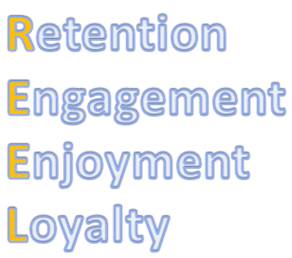
We’ve reached a point in the virtual events industry where users who have attended 1-5 events (or more) are starting to ask, “What’s next”?  If the industry doesn’t effectively answer that question, then users will eventually stop coming back and attendance will suffer.  One concept that makes a lot of sense is to introduce gaming into virtual events.  By doing so, you’ll achieve real results.  Why gaming?  It’s all about REEL:
REEL_img

Retention

Retention is a key objective of any virtual event – whether it’s a lead generation event (virtual tradeshow), partner education event or a virtual sales meeting, you want attendees to leave the event with a level of retention over the content you’ve provided (e.g. exhibitor product information, your own product and technology specifications or the the coming year’s sales priorities and initiatives).  Even in a virtual career fair, “retention” is about job candidates retaining information about your company and why they might want to work there.

With gaming, retention isn’t going to be achieved magically.  Rather, you’ll need to be very strategic in weaving your content message (and objectives) into the games themselves.  So you’re not providing games for 100% fun – but rather, crafting real business value out of participation in the games.  So first determine the messaging you want to convey to your attendees – and itemize the set of desired actions/outcomes you’d like to see them take in the virtual event.  Your tactics will then fall out from there, in terms of how to achieve your objectives within the games.  Sample tactics include:

  1. Place clues in the games that require participants to find and consume content in the show (e.g. view Webcasts, visit booths, etc.)
  2. Award game points based on participant actions
  3. Reward participants who successfully complete quizzes – whereby the questions are associated with content that can be found within the event

In summary, the structure of the game is all about driving business value – with attendees leaving your event with the desired level of retention.  The retention level translates into ROI on behalf of the event exhibitors, executive sponsors and show hosts.

Engagement

All virtual event hosts want to maximize engagement at their event – long session times, high attendee participation, etc.  The way this is achieved via gaming is not just in the sheer interaction with the game elements.  There’s also the factor of competition.  It’s natural for users to exhibit a competitive spirit – competition brings us validation (to know that we’re “better” than the “opponents”), recognition (to achieve a certain status or to see our name atop the leaderboard) and acclaim (to know that we’ve been crowned the champion).

So be sure to make competition a key element of your gaming, as it provides the constant “pulse” (heartbeat) behind the event.  With a leaderboard that’s updated in near-realtime, there will be constant buzz and activity as players jockey with one another for the top billing.

At the platform level, use the familiar video game tactic of “unlocking” certain features or capabilities based on levels you achieve in the game.  Perhaps it’s a special avatar or profile image (to designate your status) or a capability that puts me at an advantage against other gamers.  Lastly, provide compelling prize(s) to participants – otherwise, their incentive to compete may wane.

Enjoyment

When’s the last time you heard someone say they “had fun” at a virtual event?  Not too often, I’d imagine.  Well that’s a goal of gaming – while driving business value, you can simultaneously allow attendees to have some pure, old-fashioned fun.

Perhaps you create a game or two that has no (or very subtle) tie-in to your business objectives.  Or, you create a fun game that has business association, but is very fun to participate in (e.g. Jeopardy, Deal Or No Deal, Who Wants To Be A Millionaire, etc.).  If you’ve generated retention on the part of attendees – and they enjoyed the experience, then you’ve just created a win-win scenario.

Loyalty

An obvious point, but enjoyment lends itself to loyalty.  The more I enjoy an experience, the more I want to do it again.  With gaming, you have a real (or “REEL”) opportunity to create attendee loyalty, so that they come back for your next event.

Furthermore, in hosting an extended event (consider the case of an ongoing event that runs around the clock for a few weeks), the competitive aspect of the event keeps users coming back in to interact with the games, accumulate points and keep (or improve) their standing on the leaderboard.  As a virtual event host, loyalty is your pot of gold – loyal attendees means loyal exhibitors, sponsors, etc.

In summary, incorporating gaming into virtual events is a REEL opportunity that you should consider – if done right, all of your constituents will thank you for it.

Related links

  1. Gaming and Virtual Reality at Cisco’s Annual Sales Meeting (blogs.cisco.com)
  2. Cisco GSX — A Countdown to a Landmark Virtual Event (virtualedge.org)
  3. Marketing Lessons from Foursquare (rocketwatcher.com – observations on the mobile gaming service created by Foursquare)

Virtual Events: Available In Many Flavors

August 25, 2009

Source: flickr (User: rkeohane)

Source: flickr (User: rkeohane)

In my Virtual Events Year In Review: 2009, I summarized key trends that I witnessed in the virtual events industry this year.  The trends for 2009 included global adoption, emergence of new industries (as virtual event show hosts), emergence of hybrid (virtual/physical) events, the shift to ongoing communities and the shift to multi-day events.  There was one trend I neglected to include – and it may be the number one trend for 2009: virtual events in many flavors (aka virtual events take on many shapes and sizes).

Virtual tradeshows still constitute the majority of virtual events in 2009 – however, new flavors emerged (or generated strong growth) in 2009.  Here’s how they’re different from virtual tradeshows:

  1. Virtual Job Fairs – first off, virtual job fairs are quite similar to virtual tradeshows, especially in structure.  There are exhibitor booths, lounges, presentations (live Webcasts or live Video), prize giveaways, a document Resource Center, etc.  Here’s a big difference with the job fair, however – attendees pursue the exhibitors more than the exhibitors pursue the attendees.  The virtual job fair brings a rather engaged attendee, who’s more keen to visit booths and interact with exhibitors (hiring companies) than typical virtual tradeshows.  Hosts of virtual job fairs will want to work with their virtual event platform provider to create unique tools/applications within the show – for instance, a resume wizard (builder), resume submission tools, attendee<->exhibitor match-making (i.e. find the right job for you – find the right candidate for the hiring company), etc.
  2. Virtual Sales Kickoff – that’s right, the annual sales meeting (for some companies) is moving 100% virtual.  Michael Doyle of Virtual Edge published an interesting article on Cisco’s Global Sales Experience.  For most companies, the goal of an annual sales meeting is to bring the entire salesforce together, reflect back on the past year (acknowledging and rewarding sales reps for their efforts) and talk about the year ahead (set priorities and goals).  Similar to a virtual tradeshow, education (e.g. live sessions) is a focus for this type of event.  Unlike a virtual tradeshow, however, there’s less pitching and selling (from exhibitors to attendees) and the need to network (e.g. find new contacts) is lessened.  It’s incumbent on show hosts to make the virtual sales meeting fun and engaging, as attendees are used to going out for dinner, drinks and parties after physical sales meetings.  Virtual cocktails don’t work too well, so be sure to make the virtual experience memorable and fun.
  3. Virtual Partner Summits – a virtual event platform makes perfect sense for a b-to-b vendor’s partner / reseller network – gather the network of partners virtually, give them the training and tools on your products and services and allow them to network with one another.  You improve relations between you and your partners – and, you encourage resellers to partner together to create joint solutions for the market.  Cisco Virtual Partner Summit ran concurrently with a Boston-based physical Partner Summit (June 2009).  Oracle has similar plans for a virtual partner summit.  PartnerPoint has created a 24×7 virtual community “to help connect Microsoft Customers with qualified Microsoft  Partners from around the globe”.  While virtual tradeshows tend to be “lead focused”, virtual partner summits revolve around networking among exhibitors [peers] – they’re unique in that the exhibitors and attendees are one and the same.

My prediction for 2010 – these three flavors will gain further adoption.  Virtual tradeshows will still carry the majority – however, we’ll be seeing more and more off these flavors, in the following order:

  1. Virtual Sales Kick-off
  2. Virtual Partner Summit
  3. Virtual Job Fair

The Convergence Of Physical Events And Virtual Events

July 1, 2009

convergence

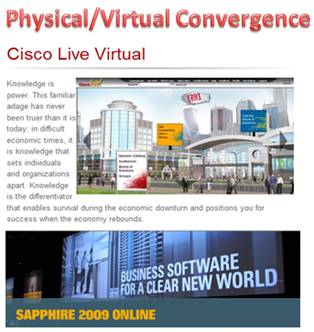
In May, SAP’s annual SAPPHIRE conference (SAPPHIRE 09) floored physically in Orlando, Florida, with a concurrent virtual event online.  This week, Cisco’s annual Cisco Live conference followed suit, with a physical event in San Francisco, California and a concurrent virtual event online.

Full disclosure: My company (InXpo) was the virtual event platform provider for both the SAPPHIRE and Cisco Live virtual events – and, I worked on the Cisco Live virtual event.

During a presentation at the Virtual Edge Summit in May, a presenter from SAP noted that considerations were made concerning the potential of cannibalization – whereby physical attendees may stay at home to attend virtually instead.  However, he noted that in reality, a combination of physical and virtual event extended the overall reach – and the virtual component served to augment the overall attendance count.  When combined (physical+virtual), this year’s attendee count for SAPPHIRE was the largest ever.

This week, I attended Cisco Live on-site, but spent most of my time online to support the virtual event.  However, in experiencing all the touch points of the event, it quickly occurred to me that the entire notion of physical vs. virtual is blurring – they’re coming together to form an aggregate attendee experience.

Some participants are not able to travel to the event’s venue – and as such, their only choice is to participate in a virtual component.  For those on-site, they can choose the attendee path that suits their preferences.  Perhaps that means attending the John Chambers keynote in person, grabbing a cup of coffee, visiting the World of Solutions (exhibit floor) and then returning to the hotel room to login to the virtual event, to follow up with a few exhibitors in their virtual booth.  Later, that same attendee may visit the customer apprecation event in Second Life, and then attend a tweetup at a nightclub (in person).  Here’s an image of my Second Life avatar at the Tuesday evening Second Life dance party:

The author's avatar with right hand raised

The author's avatar with right hand raised

To make this convergence really work, I believe the following should be done:

  1. Create a unique value proposition for each venue – virtual event, virtual world, physical event – do not simply re-purpose one into the other.  Dannette Veale explains it quite well in a Cisco Virtual Worlds blog entry, The Value of Virtual Events.
  2. Tie the venues together in a logical fashion – link the venues together where it makes sense.  Convergence should happen for a good reason – and not for the sake of convergence.
  3. Give the attendees freedom to choose – allow attendees to choose their own attendee path, without forcing them down any one direction.  Leave the hooks in place and each attendee will follow their own path.  Some physical event attendees may opt out of any convergence and focus 100% on the physical event.  Others may actively engage in the virtual event while on-site physically.  Either path is fine.
  4. Integrate social media across the spectrum – whether it’s Visible  Tweets displayed on a physical monitor or Facebook integration with the virtual event – integrating social media increases engagement within the attendee experience and also extends the reach of the event to networks of social networks.  Here’s an interesting example of user generated, social media at the physical event – a physical whiteboard that asked attendees to write about where they were in 1989:

whiteboard

In Cisco Live Virtual, elements of the physical event were streamed into the virtual event.  By doing so, virtual event attendees (who could not travel to San Francisco) were still able to get a taste of the physical event experience.  For instance, webcams were deployed throughout the physical event to stream in live feeds from the show floor – and to host personalized webcam chats with Cisco executives.  One of the webcams was pointed at this Solutions Theater – from which virtual event attendees had a continous live stream of presentations given throughout the day:

solutionstheater

Here are some of the ways I experienced physical/virtual event convergence:

  1. Watching John Chambers’ keynote presentation online, via a Live Webcast streamed into the virtual event (by On24).
  2. Viewing a Cisco Live Second Life session (LIVE!) from a booth in the virtual event – the session was broadcast by treet.tv in Quicktime – so users needed the Quicktime player but not the Second Life client application.
  3. Watching a live (physical) demo of Telepresence, which was broadcast via a Live Video Webcast, which was carried within the virtual event (many layers of convergence there).
  4. Participating in live chat sessions that Cisco executives (Carlos Dominguez and Padmasree Warrior [separately]) attended via webcam.  Attendees typed their questions (via text) and the executives answered via webcam / audio.  The executives answered just about every question posed, so it felt like a personal meet and greet with the executives.
  5. Walking past the NetQoS physical booth – and noticing one of their demo workstations displaying their booth in the virtual event.  Quite a good idea – host visitors to your physical booth and remind them of your presence in the virtual event.  That prospect can’t return to your physical booth next week (when the event is over), but they sure can visit your booth in the virtual event [at any time] to find the needed information.
  6. Reading one user’s in-show blog, where he asked physical attendees to name the “one [physical] booth that should not be missed”.  This particular user was not able to attend physically – but, he may be able to visit the virtual booths of the vendors recommended by his peers.

Moving forward, I expect to see many more events follow this model – whereby physical events will leverage virtual event and virtual worlds technologies to accomplish the following:

  1. Deliver additional value to the physical event
  2. Extend the reach of the event to a global audience
  3. Blend physical and virtual components to create a more compelling experience
  4. Drive stronger event revenue and ROI!

I hope to see you at a future event – I haven’t decided whether I’ll be there physically, virtually or both.


Day 1 Recap: Virtual Edge 2009

May 29, 2009

The ABC's of Virtual Events (Virtual Edge Session)

The ABC's of Virtual Events (with Kenny Lauer, GPJ & Kelly Graham, Cisco)

That’s right, even the Virtual Events industry has a need to meet face-to-face.  Thursday (05/28/09) marked Day 1 of Virtual Edge 2009 – a 2-day face-to-face “summit on virtual events, meetings and communities”, held at the Santa Clara Convention Center.  By my estimation, the event had over 150 attendees and approximately 50 exhibitors.

Most of the presentations and panel discussions had “standing room only” crowds.  Two of the noted presentations of Day 1 were “The ABC’s of Virtual Events, Meetings & Marketing” (featuring Kenny Lauer of GPJ and Kelly Graham of Cisco) and the keynote presentation, featuring Paul Salinger or Oracle and Sandy Carter of IBM.

The sessions were streamed live into the virtual world – a combination of live video (via Stream57) and live video in a 3D immersive world (via VirtualU from Digitell).  A physical event on virtual events, which was then simulcast virtually – neat!  The “concurrent virtual”  allowed global access to event, for folks who were not able to attend in person – and that included some speakers, who (of course!) presented their sessions virtually.

In the afternoon, I participated in a panel discussion titled  “Measurement, Tracking & ROI”.  Two of the main themes we heard from the audience were:

  1. Better measuring event engagement – sure, we know about registration-to-attendance ratio, number of live attendees, average session time, etc. And Stu Schmidt of Unisfair introduced the notion of a “virtual engagement index”.  The calculation of that index (or score), however, may need to get “smarter” – for instance with a chat session.  Dannette Veale of Cisco noted the difference between a “where’s the Auditorium” and a “can you send me pricing information” comment – whereby the latter should carry a higher score from an engagement or “prospect worthiness” point of view.
  2. Aggregate profiles by user type – customers are in the need for published profiles by user type, so that they can better plan targeted virtual events.  For instance, if an enterprise is interested in a virtual event for C-level employees, they need to see a published profile (e.g. what does the C-level do in a virtual event), to determine whether the event is worth pursuing (aka what’s the expected ROI).  The panel responded that there are data privacy issues that need to be worked out – since all data is “owned” by customers – and NOT by the virtual event platform vendors.

While I was able to sneak out to attend a session or two, I spent most of the day in the InXpo booth.  I had the pleasure of meeting (face-to-face!) with many colleagues in the industry and also spoke to countless attendees who are considering their first virtual event.  For attendees from corporations, many had already executed virtual events – and were there to learn best practices and refine their game.  On the other hand, I met several folks from the event marketing industry, who were looking to leverage virtual events to complement their clients’ physical event strategy.

For me, Day 1 marked a momentous occasion for the virtual events industry – the creation of a physical event speaks to the legitimacy of the industry – while the turnout speaks to the timeliness and interest in virtual events.  Today, our industry is like the TV sitcom Cheers (“Where everybody knows your name”).  I imagine that this industry will grow quickly enough that it will be challenging to remember everyone’s name – and in a few years, the venue will have to shift to the Moscone Center in San Francisco! Looking forward to Day 2 today.

Related links

  1. Virtual Edge 2009 program: http://www.virtualedgesummit.com/program.php
  2. Virtual Edge 2009 program – to attend virtually: http://www.virtualedgesummit.com/virtual-event-schedule.php
  3. Dean Takahashi covered Day 1 for VentureBeat: http://venturebeat.com/2009/05/28/virtual-events-draw-a-live-in-person-crowd/

June: A Hot Month For Virtual Events

May 12, 2009

june_cal

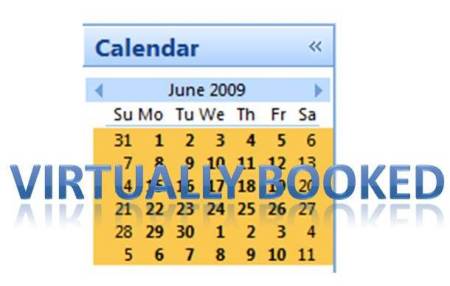
Think up some hot technologies in Enterprise IT – desktop and application virtualization; data center; unified communications; SharePoint.  Next, consider some key disciplines that gain prominence during a down economy – online demand generation and e-commerce.  Then, think about the red hot area of sustainability and clean technology. Finally, consider what a leading technology vendor (Cisco) is producing for their partners and customers.

Put it all together and what do you get?  A jam-packed month of virtual events in the month of June.  You can sell the full slate of virtual events scheduled this year on the Virtual Events Calendar that I maintain on this blog.  Here’s an excerpt from that page, which shows you all the excitement that June has to offer.  Here’s the list of June virtual events in chronological order:

  1. Cisco Virtual Partner Summit: https://www.ciscopartnerspace.com/virtualpartnersummit/ (06/02/2009 through 06/30/2009)
  2. All About eCommerce Virtual Conference & Expo: https://event.on24.com/eventRegistration/EventLobbyServlet?target=registration.jsp&eventid=141444&sessionid=1&key=766F81E957D10012B67D1FC70900312D (06/04/2009)
  3. Desktop and Application Virtualization (SearchVirtualDesktop / TechTarget): http://events.techtarget.com/virtualdesktop/ (06/04/2009)
  4. Transforming the Enterprise with Unified Communications (VoiceCon): http://www.voicecon.com/virtualevents/ (06/10/2009)
  5. SharePoint Virtual Expo 2009 (Quest Software): http://events.unisfair.com/index.jsp?eid=395&seid=30 (06/10/2009)
  6. 2009 State of the Data Center: Storage (Ziff Davis Enterprise): http://presentations.inxpo.com/Shows/ZiffDavisEnterprise/VTS/06-17-09/Website/home.htm (06/17/2009)
  7. BtoB’s Leading Edge: Demand Generation in the Digital Age: https://event.on24.com/eventRegistration/EventLobbyServlet?target=registration.jsp&eventid=137553&sessionid=1&key=1E4584C2A969E4AEFAA97CB93E4BB4C8 (06/23/2009)
  8. Virtual Energy Forum: http://www.virtualenergyforum.com/ (06/24/2009 and 06/25/2009)
  9. Cisco Live Virtual: https://www.ciscolivevirtual.com/portal/login.ww (06/30/2009 and 07/01/2009)

Do you plan to attend or exhibit at a June virtual event that’s not listed here?  If so, leave a comment below to let me know.


Interview with Vizitant Founder James Corbett on Video Communications

January 5, 2009

Vizitant Founder James Corbett (on left)

Vizitant Founder James Corbett (on left)

Q&A with James Corbett, founder of the not-for-profit organization Vizitant.

  1. Tell us a little bit about Vizitant? Sure. Vizitant is a project which aims to bring virtual presence services to socially marginalized groups of people like the elderly, carers, disabled and so on. By virtual presence I mean video-calling and other means of conveying the illusion that one is in the company of others.
  2. How do you facilitate technology use by the elderly or disabled?  We find the most user-friendly devices (e.g. Asus AiGuru SV1 and Eee Top) and configure them to be as simple to use as possible. That can be as basic as setting Skype to auto-answer and auto-start video. Or as complex as making hardware and software modifications.
  3. What would you like to see in video calling technologies that’s not yet available today? I think most of what we need is available today, but in the very high-end or corporate systems like Cisco Telepresence 3000. Which of course is totally beyond the budget of our target community. So what we need to see is the economies of scale in the marketplace that can push this quality of system, or something approaching it, into the consumer space. And of course that’s what Cisco is planning to do within the next couple of years. However, in the meantime, Skype and other low-end solutions are improving the level of experience dramatically for those with high quality webcams and dual core processors. Beyond that we need integrate more of the ‘virtual’ into the ‘presence’. While it’s great to feel like you’re in the same room as a remote relative imagine being able to feel like you’re both at a table together in a Parisian cafe. Or on a Caribbean beach. This is the kind of idea that might remind you of the ‘Holodeck’ on ‘Star Trek’ and that’s where, I believe, this technology can ultimately take us.
  4. Any plans to support multi-party sessions, sort of like a “town hall” meeting? Yes, we are in early discussions with an Irish company called OnlineMeetingRooms.com about using their multi-seat videoconferencing solutions for “town halls”.
  5. Do you envision applications of this technology for medical diagnosis and triage? Absolutely. There are trials ongoing at a hospital in Dublin, Ireland for a ‘robot doctor’, which is something like Skype Video on wheels, used in the early assessment and treatment of stroke victims.  Read more about it here: http://www.vizitant.com/2008/07/remote-presence.html.  And at the high-end there is HealthPresence – a specialized adaptation of Cisco’s high-end Telepresence system outfitted with medical diagnostic equipment and configured in a self-contained pod.  More info can be found here.
  6. Prior to Vizitant, what sorts of projects or technologies did you work on?  I spent a number of years with American multinationals in Ireland, such as Apple, Motorola and Analog Devices. There I worked in Software Test and System Administration roles. So I had varied exposure to a range of operating systems, network systems and so on. Experience which has taught me to look for the correct solution to a problem and not just “what we’ve always used here”.
  7. What’s it like running a business in Ireland?  In general it’s very good. Ireland made No. 2 in Forbes recent list of Best Countries for Business and that’s fairly well borne out in reality. However we are somewhat lacking in terms of Venture Capital and Angel funding options.

More Meetings From Your Desk

December 23, 2008

It’s a growing trend.  In 2009, you’ll be attending more and more meetings.  From your desk and desktop, that is.  In a Travel Procurement article titled “The Next Best Thing To Being There: Virtual Meetings Earn Their Rightful Place In Strategic Meetings Management”, surveyed travel buyers confirm that the trend is real:

Faced with an economic downturn and increased airfares, three-quarters of 230 U.S. travel buyers responding to a recent National Business Travel Association poll reported increased use of teleconferencing and Web-based meetings. Nearly 57 percent cited increased use of videoconferencing. More than 80 percent said the technology replaced actual trips.

Consider the travel policy at P&G:

“Our policy is set up so that virtual media must be considered if business objectives can be achieved,” said Diana Johantgen, service manager for Procter & Gamble’s new meeting, event and convention management team, who helped incorporate a virtual meetings program into that company’s strategic meetings management program.

This shift towards virtual meetings means good things for Cisco (Telepresence and WebEx), Nortel and HP (Telepresence), Citrix (GoToMeeting), Microsoft (Live Meeting) and many others.  While virtual meetings and telepresence may never reproduce 100% of in-person meetings, you can’t beat the cost efficiency and convenience.

Additionally, online meetings provide unique benefits, such as the meeting archive.   Ever need to schedule a series of information sessions or training presentations?  Why not do a virtual meeting (live) and record it – take the archive, edit it down (if needed) and then allow all reamining groups to view the session on-demand, on their schedule.  If the presentation is mandatory, the online meeting can be tracked to ensure that all required users end up viewing it.

OK, gotta go now.  A virtual meeting awaits!