Video: Virtual Events With IMASTE

December 11, 2009

Miguel Arias (@mike_arias), Co-Founder and Director-Partner of IMASTE, visited Silicon Valley (Northern California) this week.  IMASTE, the leading virtual events provider in Europe, was 1 of 10 Spanish technology companies selected to visit Silicon Valley to meet with the likes of Google, Yahoo and venture capitalists.

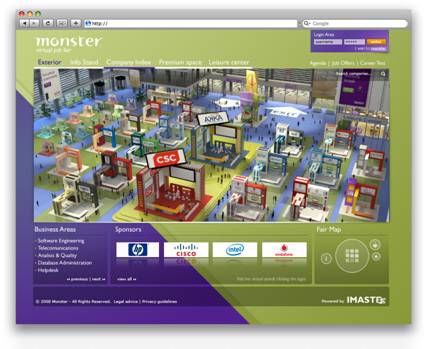
In 2009, IMASTE produced a number of virtual career fairs, including a large scale job fair for Monster Worldwide.  In addition to virtual career fairs, IMASTE produced virtual tradeshows, including hybrid (physical + virtual) events.  IMASTE serviced clients in Europe and Brazil, including a virtual event in Croatian, for a client based in Croatia.

Looking ahead to 2010, Arias sees strong growth in the European market, as awareness of virtual events is growing – in addition, Arias believes hybrid events will be a large growth area in Europe.

View this video for more details about IMASTE – the video includes a brief demo of the Monster virtual career fair that IMASTE powered.


2010 Predictions For Virtual Events

December 3, 2009

Source: flickr (User: sassycrafter)

Back in August, I jumped the gun a bit and wrote a “year in review” posting about virtual events.  Now that we’re in December,  I think it’s high time to peer into the Magic 8 Ball and speculate on what’s in store for the virtual events industry in 2010.  Away we go…

Widescale adoption and integration of video conferencing

Virtual events have incorporated a lot of on-demand and live video – however, to date, the majority of attendee interaction has been via text (e.g. private text chat, group text chat, etc.).  Many platforms have enabled the use of attendee webcams (a la Skype) and that was a nice start.  In 2010, I believe that the virtual event platforms will integrate with third party video conferencing technologies in a big way – stirred largely by client demand for it.

Think about it – multinational corporations have adopted high-end video conferencing to encourage collaboration and save on travel costs.  They have the budget to invest in Cisco Telepresence or HP Halo.  As those same corporations look to adopt virtual events (e.g. for an annual virtual sales meeting), it’s only natural that they incorporate the video conferencing technology that they already have running.

To capture mid-market and small business interest, virtual event platforms will look to integrate with mid-tier video conferencing systems, such as Tandberg (whose acquisition by Cisco is pending) and Polycom.

Another interesting player is LifeSize Communications, an Austin-based provider of “mainstream telepresence” that was acquired by Logitech in November.  LifeSize recently launched an offering called Passport, which they term “a portable telepresence-quality system” that fits in the palm of your hand.

I see continued use of consumer-grade webcam technology in 2010 virtual events  – however, the game changer will be the incorporation of multi-party, HD video conferencing.

Emergence of global players

We’ve already seen the emergence in Europe of virtual event platforms – IMASTE in Spain and Ubivent in Germany.  I expect to see another European-based platform emerge in 2010, along with one or more in Asia Pac.  In addition, we’ll see services companies launch to capitalize on the demand (for virtual events) from publishers, corporations and event marketers.  The companies will provide both strategic and logistical services around virtual events.  You’ll see some start-up companies and you’ll also see physical event marketers spawn service offerings around virtual (or more logically, hybrid) events.

Industry consolidation

We’ll see the merging or acquiring of virtual event platform companies.  Some providers will look to acquire/merge out of platform capability gaps – while stronger players will look to complementary/synergistic technologies offered by the competition.  As the economic environment comes back around, companies (and their investors) will be more apt to combine forces to fuel the next phase of growth.  Lastly, larger and more established players in the “collaboration space” may look to acquire virtual event platform companies, to add a complementary piece to their product portfolio.

Decrease in “relative response rates”

Virtual events had a great run in 2009, but we’re now past the novelty, “wow, this is cool” phase.  In the B2B market, we now have plenty of users who have attended two or more virtual events.  If virtual event show hosts continue to use the same graphical templates, organize the same presentation agenda and re-create an identical experience to their last event, then “relative response rates” will drop – meaning, it will become harder and harder to recruit users to register and attend.

Decreased response rates are natural as any new “content type” grows beyond infancy – and the supply/demand ratio begins to tilt towards having more supply than demand (e.g. lots of virtual events).  Virtual event show hosts will need to consider the incorporation of gaming, the creation of affinity programs and more.  The solution to decreased response rates will be fun to watch – innovators will step to the table to find creative ways to engage and attract virtual event attendees.

Platforms take first step towards immersiveness

While virtual event attendees may not “require” the immersiveness of Second Life and other 3D virtual worlds – immersive capabilities provide real value in a B2B setting.  The most obvious use case is an immersive rendering of a complex product – consider the high-end video conferencing system, the high-end router, the latest luxury car model.  Instead of a 2D PowerPoint slide that highlights the capabilities of the video conferencing system, how about an immersive experience where attendees (aka prospects) get to experience the system and interact with it?

Client interest and demand will drive some platforms to add immersive capabilities in 2010.  I don’t expect a software download, however – it would serve platforms well to support the immersive experience within their existing framework (e.g. Flash, JavaFX, Silverlight).

Those are my 2010 predictions for virtual events.  I’d love to hear your’s!


Cisco GSX: Learnings, Best Practices, Looking Forward

December 3, 2009

In 2009, Cisco moved their annual Global Sales Meeting from a physical gathering to a 100% virtual event called Cisco Global Sales Experience (GSX).  I authored a posting on the InXpo blog regarding GSX – with numerous insights from Angie Smith (Manager, Global Sales Experience at Cisco), I covered:

  1. Best Practices – Virtual Sales Meeting
  2. Considerations for a Hybrid (Physical+Virtual) Sales Meeting

Here’s a link to the full blog posting:

http://inxpo.wordpress.com/2009/11/30/the-hybrid-model-comes-to-global-sales-meetings/


Ubivent Enters The Virtual Events Platform Market

December 2, 2009

Based in Mannheim, Germany, ubivent has entered the virtual events platform market with a recently launched platform.  According to Michael Geisser, Managing Director Market Development, the ubivent co-founders “met at university, working together in an IT research program and pursuing our PhD”.  The co-founders then spent several years working at multinational corporations, where they held numerous roles in IT and IT management.

In fact, Geisser and co-founder Thomas Butter (Managing Director Research and Development) were recently with SAP, where they worked on some of SAP’s first virtual events.  Ubivent is off to a fast start – they received 12 months of funding from EXIST, “a program of the European Union and the German Federal Ministry of Economics and Technology” designed to support innovation.  In addition, in late November, ubivent was selected as the most promising young company in Mannheim.

Target market

Ubivent’s initial target market is to serve large and distributed corporations – large companies have already adopted the basic technologies required for virtual events (including sufficient bandwidth capacity) and distributed companies can immediately leverage the convenience and cost savings of virtual collaboration (versus in-person).

“However, this does not mean that we do not offer our services for small, non-IT organizations”, noted Geisser. “We’ve also done projects with local authorities. Obviously, the entire project size has been not that extensive as for a global event with multiple thousands of participants.”

Since the European market for virtual events has not developed as quickly as the U.S. market, Geisser sees plenty of opportunity in Europe.  Geisser sees opportunity in all sorts of event types, but notes that “the type of the event is not as important as the content and the participants. We see the advantages of virtual events especially for knowledge-intense content (e.g. software, finance, etc.) with globally distributed participants”.

In comparing the U.S. and European markets, Geisser believes that while “US based customers put more emphasis on the look and feel, the European customers are very keen on getting a technically scalable and secure platform. Fortunately we’re combining both.”

Technology platform

Ubivent is a member of Microsoft BizSpark, a program that provides “software, support and visibility” to software start-ups.  While most virtual event platforms are built on top of Adobe Flash, ubivent’s platform is based on JavaFX, a platform for building rich internet applications that runs on top of JRE (Java Runtime Environment).

According to Geisser, the use of JavaFX serves as a competitive advantage for ubivent over competing Flash-based platforms – “JavaFX is one key advantage of our platform. This opens the door for completely new functionalities which are not possible with other technologies (e.g. Flash)”.

Ubivent developed an accessibility framework to assist visually impaired people in using their virtual events platform via a screen reader.  The source code for the accessibility framework has been published as open source.  The framework is built on top of JavaFX, which means that other platforms seeking to incorporate it would need to run JavaFX as well.

Virtual events vs. immersive virtual worlds

Geisser has taken a look at 3D immersive virtual worlds, such as Second Life and Twinity.  He believes, however, that the immersive virtual world is currently more suited to B2C or C2C use cases, whereas his B2B market is more focused on quick and convenient access to selected content.  Notes Geisser, “In a B2B context, the desire for avatars and the ability to walk through a virtual world is less distinct. Here, the focus is more the ability to quickly access information and other participants. The need to ‘walk’ through the virtual world to access this information or participant is considered adverse with regard to this goal.”

In closing

It will be interesting to watch the European market for virtual events in 2010.  Ubivent and IMASTE are two of the leading European-based providers – while they may encounter each other in common client accounts, I’m sure the providers from the U.S. market will be looking towards Europe (and Asia) as well.

Related links

  1. Follow ubivent on Twitter
  2. Ubivent’s Facebook page
  3. Ubivent-developed accessibility framework, fxaccessible
  4. Ubivent’s executive management team
  5. Audio interview – ubivent speaks about their JavaFX-based virtual events platform

To Promote Your Physical Or Virtual Event, Think Outside The Inbox

November 21, 2009

Source: flickr (User: Mzelle Biscotte)

For many, email is a constant stream, an endless loop – we receive too much of it, both “important” emails addressed directly to us and marketing emails that are sent as a result of opting in (or not) to past content, webinars, white papers and marketing lists.  Outbound, push-based email promotions face the following challenges:

  1. Imperfect delivery rates (mail server outages, spam filters, etc.)
  2. Decreasing open rates
  3. Perception of spam – if recipients don’t remember opting in to your list (even though they did), they’ll ignore your email – or, opt out from your list
  4. List fatigue due to overuse of marketing lists
  5. Decreasing click-thru rates (CTR) – once you’ve made it past delivery and open, recipients are clicking less on your embedded offers

Adding to this mix is the fact that many users now interact with brands (and by extension, promotional offers from brands) via their social networks, instead of email.  A user is more inclined to respond to an @reply or direct message (on Twitter) compared to a conventional email blast from a marketer.

Given all this, it surprises me that email is still a primary vehicle for promoting physical and virtual events.  Event marketers have much to gain by thinking outside the inbox.

Social media and social sharing

Your first step outside the inbox should be in the direction of social networks.  Build a presence in social communities and you’ll find that you naturally generate interest and awareness to your event.  Previously, I wrote about leveraging Twitter to promote your virtual event.  As Ian McGonnigal (GPJ) astutely pointed out, those same tactics apply quite well to physical events as well.

In addition to Twitter, consider the following:

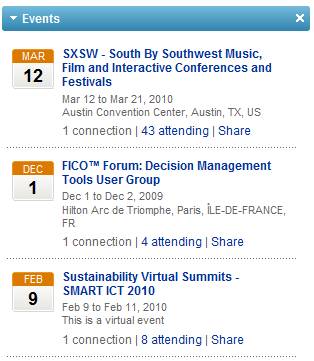
Create a LinkedIn Event entry for your event

  1. Create a LinkedIn Event for your event – a LinkedIn Event page allows you to post relevant information about your event on LinkedIn (e.g. date, event content, etc.) – LinkedIn members can then indicate whether they’ll be attending, not attending or “interested”.  This can be quite useful, as folks often attend events based on knowing whom else will be attending.  By creating a LinkedIn Event, you’ll receive the benefit of having LinkedIn auto-recommend your event to other members, assuming their profile is a “match” with the profile of your event.  Members may also utilize search and find your event.  More info can be found on the LinkedIn blog page announcing the Event feature.
  2. Post videos to YouTube – it’s the #2 search engine after all (behind parent Google), so having event videos posted on the site will generate traffic from the millions of folks who visit YouTube.com each day.  Record videos of your host, keynote speaker, group publisher, etc. talking about your upcoming event – if your keynote speaker has a prominent name, your videos will attract interest from users who search on that name.  When you have a critical mass of videos, create a YouTube channel.  About.com has a neat guide on how to do just that.
  3. Create a Facebook Fan page for your event – with a fan page, you’ll generate interest for your upcoming event – and, you’ll build an ongoing community that you’ll be able to continuously leverage!  The All Facebook blog has a nice guide on how to build a Facebook fan page.
  4. Leverage blogs – author a blog posting on your corporate blog – or, if you don’t have one, ask a relevant industry blog site whether you can author a guest posting.  Alternatively, leave a comment on postings from relevant industry blogs with a pointer (link) to your event.  The key here is not to over-promote your event – your first goal is to provide useful and relevant content/commentary with your event being a secondary (and subtle) mention.

SEO and in-bound links

If you pay attention to search engine optimization (SEO), your event page(s) will receive “organic” traffic – that is, traffic that finds you, rather than you finding the traffic (i.e. the “pull” from users searching, rather than the “push” from your email promotions).  Think about the search keywords that you’d want to associate with your event [e.g. when users are performing searches] and make sure the content on your event page is rich in those keywords.

To increase the page rank of your event page, increase the number of inbound links that point to your page.  A few simple ideas:

  1. For all of your social media efforts (listed above), make sure they provide links to your event page – shazam, you’ve just created a number of inbound links
  2. For event staff (especially those with large followings on Twitter), ask them to temporarily point the “web site” URL in their Twitter profile to the event page
  3. Ask partners, associates, even clients to post a URL from their web site(s) to your event page
  4. Add a “Share on Facebook” capability on your event page – this may result in page rank benefit as search engines begin to index Facebook wall posts – until then, what this really does is generate awareness and outreach of your event to users’ Facebook friends.  If a potential attendee visits your event page and shares the page with her 100 Facebook friends, then you’ve just received 100 free advertising impressions

Advertise

Some affordable options to consider:

  1. Facebook advertising – purchase targeted ads on Facebook.  For a physical event, you can target by geography (e.g. starting with users who are geographically close to your event site).  For a virtual event, geography is less important, so you may want to target based on attributes in the users’ Facebook profiles.  You can pay per view (of the ad) or per click (on the ad), so the terms are flexible.  eHow has a good overview on Facebook advertising.
  2. Content syndication – purchase web syndication with online publishers in your industry – get your event listed in their directories, content sites, etc.  They may charge you per click or per lead (completed registration).  Not only can this generate registrants for your event, but it also improves your page rank by generating more inbound links to your event page.

Hopefully I’ve covered a few “outside the inbox” options for you to consider – certainly continue to promote your event via email – however, use some of these options to lighten the load a bit on your email marketing lists.


Popular Virtual Event Blog Postings

November 19, 2009

This blog's WordPress Dashboard statistics

One of the most enjoyable aspects of virtual events blogging (for me) is the ability to observe which postings “work” and which postings don’t work.  I’ve come to learn that my intuition is often off – postings that I think will generate a lot of traffic don’t, while postings that I thought were marginal become very popular.

For instance, I wrote a posting on the concept of applying Web 2.0 to webinars – it was one of my better pieces of work, but the blogosphere voted with their mouse clicks and (unless we had an issue with counting / undercounting of votes) it didn’t even scratch the Top 10 list of posts [over the past 3 months].

With social media sharing these days, I found that the biggest factor in which posts receive traffic (relative to others) is how and where a given posting is shared.  All it takes is a few retweets from prominent Twitter users (i.e. with 20,000 followers each) to drive a lot of page views to a particular blog posting.  Or, someone posts your blog entry to a sharing site, such as StumbleUpon or digg – you’ll see traffic spike when that occurs.

Another factor is search engine optimization (SEO) – with some of my blog postings, I referenced people, places, certain virtual worlds, etc. – and received search engine traffic from users searching on those terms.

Examples include: Gregory House, My Little Pony (they have a virtual world), Online Dating, Club Penguin.  Some of those blog postings were marginal at best – but they continue to draw traffic to this day – by virtue of having common search engine terms in their content.

Here’s a listing of the Top 5 blog postings (on this blog) over the past 3 months – as measured by the number of page views:

  1. How To Promote Your Virtual Event On Twitter – the key point in this posting – to be able to best leverage Twitter, you need to work hard to build the right “following” first.  This posting received top billing (of traffic) by virtue of tweets/retweets, along with some postings to digg.
  2. Virtual Tradeshow Best Practices: Top 10 Exhibitor Tactics – written back in May, this is always a popular one – it has a fair number of in-bound links and also gets a lot of search engine traffic.
  3. The Advantages Of Virtual Meetings – I provided commentary around a Forbes Insights piece that presented the case for face-to-face meetings.  This gets a lot of its traffic via inbound links.
  4. Virtual Worlds: Where We Were, Where We’re Going, What Does It Mean to YOU? – a guest post by Linda Holroyd, CEO of FountainBlue.  Linda may not have known it at the time, but her posting is an SEO hotbed – it contains lots of relevant terms related to virtual worlds – and, lists the names of many industry executives and entrepreneurs (and their companies).  So this blog posting receives traffic when users search for those individuals’ names or company names.
  5. Hey Kids! I’ve Got a Virtual World For You – it’s like a boomerang (it keeps coming back) – I wrote this back in January and the posting can still make this Top 5 list of the past 3 months.  The reason?  It’s rich in search-friendly terms (Club Penguin, Webkinz, My Little Pony, Cabbage Patch, Beanie Babies, etc.) – I suppose I’ve managed to extend the reach of this blog to parents, who are performing searches on children’s toys!

So there you have it.  I’d love to hear from you – what’s been your favorite blog posting?


Virtual Events, Real Paychecks (InXpo Is Hiring!)

November 16, 2009

I work for InXpo, “a leading provider of business-to-business marketing solutions including virtual events and virtual business environment solutions.”  We’re fortunate to be in a period of rapid growth and we’re looking for talented individuals to join to our team.  Here’s a summary of open positions:

Chicago, IL

  1. Associate Producer (Client Services)
  2. Proposal Development Manager (Business Development)
  3. Solution Engineer (Business Development) –  Chicago is preferred, but the location for this position is flexible

San Francisco Bay Area (CA)

The following are “work from home” positions in the San Francisco Bay Area:

  1. Director of Product Marketing (Marketing)
  2. Online Marketing Manager (Marketing)
  3. Manager of Product Marketing (Marketing)
  4. Global Account Executive (Sales)

New York

The following is a “work from home” position based in New York:

  1. Major Account Executive (Sales)

For the full listing of each of these positions, visit the InXpo Careers Page.

I’m not the hiring manager for any of these positions – however, if you have questions about InXpo, feel free to contact me on Twitter at @dshiao or via email – dshiao (at) inxpo (dot) com.


What Virtual Events Can Learn From The Airline Industry

November 14, 2009

Source: flickr (User: Globalist360)

It’s an industry much-maligned, the airlines – flyer satisfaction has suffered over the years, due to flight delays, lost luggage, unsatisfactory in-flight service – and most recently, extra charges for in-flight meals and checking in baggage.  The virtual event industry, in fact, has been a beneficiary of decreased air travel, as more and more attendees (and meeting planners) opt for virtual events.

That being said, the virtual events industry could stand to benefit in adopting programs pioneered by the airline industry.  Let’s consider a few.

aadvantage_img

Source: American Airlines

Frequent Flyer Programs

According to Wikipedia, “As of January 2005, a total of 14 trillion frequent-flyer miles had been accumulated by people worldwide, which corresponds to a total value of 700 billion US dollars”.  What are frequent flyer programs all about?  Creating active and loyal customers.  You’re naturally incented to build up your miles on a single airline, in order to qualify for a free flight, free upgrade to first class – or, credits that can be used to purchase goods and services.

Virtual events, on the other hand, are all too often “one and done”.  Yes, you may attend a great virtual event, but a week or a month later, you’ve moved on to the “next thing”.  You may return for the same virtual event later in the year (or, next year).  But you probably don’t re-engage with that event until it comes around again.

And, guess what?  When you do come back to next year’s event, you’re asked to enter a blank registration page (from scratch) all over again!  Virtual event platforms – and, virtual event show hosts, need to consider affinity programs for virtual events.  Such programs make a lot of sense for:

  1. Ongoing virtual events that repeat once (or more) per year
  2. Ongoing virtual communities that are open 365 days/year

If a virtual event is truly “one and done”, an affinity program makes no sense.  However, for the ongoing events and communities, affinity programs generate:

  1. Activity and engagement
  2. Loyalty – an attendee enrolled in a virtual event affinity program is more likely to attend the next event [compared to another attendee who did not enroll]

So how might you award “miles” in a virtual event?  Map event activities to “points” and allow attendees to view their real-time point score – activities that might generate points:

  1. Visit a booth
  2. Attend a session
  3. Chat with a booth rep
  4. Submit an in-show blog posting
  5. Submit an online event survey
  6. Rate a booth

Importantly, when you register members to your affinity program, re-use the same profile data for the subsequent events.  This not only provides a convenience to your members (e.g. seamless access into all subsequent virtual events without having to re-register), it generates loyalty and continued attendance (since it’s so convenient to attend each event).

UPDATE: additionally, encourage members of the affinity program to invite their colleagues and friends to join.  Reward them with additional points (or privileges) for each referral that turns into a new member.

For the ongoing community, the points structure serves to reward the more active community members – incenting them to keep logging in and participating.  The key here will be an incentive program that provides real value to those members who have achieved high point scores.  More on that in the next section.

Source: flickr (User: golden_toque)

Tiering of Services

First class, business class, coach.  Which one you travel in depends on how much you’re willing to pay and how loyal a customer you are (i.e. how many frequent flyer miles you’ve banked).  Either way, you know that the airlines create clear differentiation between these tiers of service.  First class travelers can board the plane first, sit in much wider and more comfortable seats and be treated to premium food and beverage (that’s included in their ticket).

In virtual events today, premium services tend to be exclusive content that’s available on a “pay per view” (individual content item) basis – or, by way of a premium attendee package, which costs more than the standard package (which may be free).  Virtual event platforms – and, virtual event show hosts, ought to consider additional tiers of service within an event.  The key will be to create features for which attendees will pay extra – or, for which they’ll perform additional actions to achieve premium status.

As such, virtual event show hosts will need to create the airlines’ first class service tier – e.g. something attendees will actually yearn for.  These premium services would allow the show host to generate additional revenue.  In addition, the premium tier could be bundled into affinity programs, incenting more activity and engagement (from attendees) in order to reach premium status.

So let’s say I’m a frequent contributor to a technical forum – or, I frequently visit the Lounge and help other attendees troubleshoot technical issues.  I’m basically generating a lot of “value” for other community members, on behalf of the show host.  As such, if I’m in the virtual event affinity program, I should be awarded points (for my actions) that build me up to premium status.

At the premium level, I might receive:

  1. Free access to exclusive content (which otherwise would have an associated charge)
  2. Access to an exclusive lounge area with audio/video chat access to experts, executives, thought leaders
  3. The ability to host my own chat room with a video stream of myself (increases my visibility within the community)
  4. A special avatar for premium members only

Reward your loyal and most engaged attendees and you end up encouraging others to join the fray.
skymall_img

Source: SkyMall

Convert a captive audience

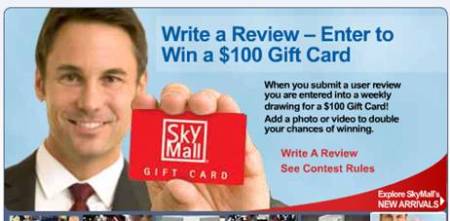
The industry (and, retailers like SkyMall) realized that they had a captive audience for the duration of a 2-hour (or 20-hour) flight.  Sure, there’s reading material, TV, movies (and increasingly, WiFi access), but there’s also a product catalog that’s neatly tucked into your seatback.  And when it’s near time to land and you need to “turn off all electronic devices”, it’s all too easy to grab the SkyMall and peruse through a product catalog.  Before you know it (for some of you), you’ve just charged $50 onto your credit card.

In virtual events, the active audience is a captive audience – attendees are busily viewing sessions, visiting booths, chatting with other attendees and chatting with exhibitors.  Show hosts and exhibitors need to provide this captive audience a valuable and convenient way to “convert” attendees.

Organize your content well – and provide tailored content to individual “personas” (e.g. “Storage Administrator’s Guide to Data Deduplication in the Financial Industry”).  Provide tools (e.g. an RFP requester) that allow attendees to conveniently reach out to multiple exhibitors at once.  Engaged attendees who are not converted from a “visitor” to an “opportunity” are merely lost opportunities.

In conclusion, I think the virtual events industry stands to benefit from adopting tactics used in the airline industry.  Now if only I could convert my virtual event attendances into frequent flyer miles!

The Social Media Landscape

November 9, 2009

I get a lot of enjoyment following trends and developments in social media and social networks – it’s an exciting time, with things moving so quickly.  Keeping up with the pace of change is part of the fun.  I’ve written a blog posting over on the InXpo blog – where I cover some recent developments in social media:

  1. Twitter Lists
  2. Social Search
  3. Inter-connectedness
  4. Mobile

blogposting_img

The blog posting is titled, “Making Sense Of The Ever-Changing Social Media Landscape“.


Leverage Twitter Lists For Your Physical Or Virtual Event

November 7, 2009

twitterList_img

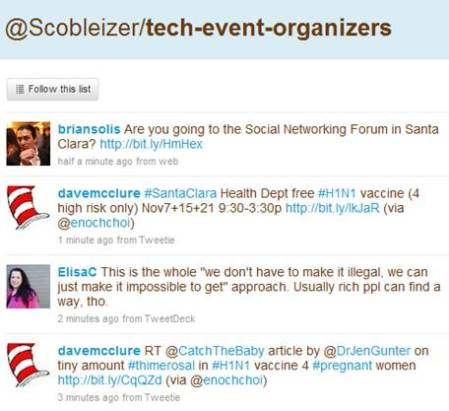
Robert Scoble's tech-event-organizers Twitter List

What’s a very simple yet effective way to integrate the new Twitter Lists feature into your event?  Here’s what you can do:

  1. Define your event hash tag (a “must do” for any event!)
  2. Create a Twitter List for your event
  3. If your company or event already has a Twitter ID (“brand”), connect it to that ID (e.g. twitter.com/<your-brand>/<your-event-list>)
  4. On your registration page, ask registrants to supply their Twitter ID
  5. Manually or automatically populate your Twitter List directly from registration!

As part of the Twitter API, there are methods in place to interact with Twitter Lists (look in the documentation for List Methods, List Members Methods, List Subscribers Methods).  As such, you could automate this process by having your registration page utilize the Twitter List API to auto-populate your list directly from registration.

In addition, you could use the Twitter API to inform registrants which of their Twitter friends or followers are (a) also registered and (b) already a member of the Twitter List.  Here are benefits of leveraging a Twitter List for you event:

Registrants promote the event on your behalf

It’s the crowdsourcing method for generating awareness – allow the participants to spread the word on their own.  After all, the combined reach of your registrants is far greater than your own.  By referencing your Twitter list on your registration page, users who supply their Twitter ID will likely go straight from registration completion to the Twitter list to (a) confirm that they’re now a member of the list and (b) skim through the pre-existing messages.

The concept is similar to a pre-event bulletin board or forum – the beauty of using Twitter, however, is that unlike a forum (which needs a critical mass of initial postings before it really takes off), a Twitter list is “pre-seeded” from the natural activity of the list members’ tweets.  You can be sure that as users register for your event, they’ll first tweet that they “just registered” – and then, continue to tweet about the event (especially as the event date draws near).  You’ll want to encourage all registrants to include your event hash tag when they tweet.

Facilitates pre-event networking among registrants

Whether physical or virtual, a key reason people attend events is the networking aspect – being able to meet, connect and interact with others, to discuss common business challenges – and to extend their social graphs.  Too often, however, one arrives at an event with no idea whom else is attending.  A Twitter List changes the game – you’ll not only know the identity of folks who are attending, but you’ll feel like you know them very well.

Consider friends or family members that you follow on Twitter or Facebook – do you find that you come to learn and understand them more via status updates than interacting with them day-to-day (or over the years)?  It’s remarkable how social network connections can generate a more complete picture of an individual.  With pre-registrants to an event, you may find that you’re really getting to know individuals, based on their intra-day status updates and industry thoughts.

This will lead to events whereby attendees will have pre-arranged meet-ups and appointments (with other attendees) in advance, making their event experience more rewarding.  Perhaps someone will build an integration from Twitter List pages to LinkedIn, so that event registrants can also extend their LinkedIn connections directly from the event’s Twitter List.

Allows exhibitors to get to know registrants/attendees

This will need to be managed/handled properly, as registrants surely wouldn’t welcome unsolicited pitches from exhibitors before they’ve even attended the event – but, imagine the potential for exhibitors.  You get to know the users who are attending the event.  Perhaps you create booth content or special offers that are tailored to what you’ve learned about your upcoming booth visitors.  Did they talk about pricing challenges in your market?  Well, how about an event-exclusive price break on your product, which you announce at the event?

If users commented about technical challenges using your product, bring the right specialists into your booth so that you directly address this pre-event feedback.  Lastly, exhibitors can seed some “must meet” lists based on the registrants who are tweeting within the list – build a profile of interesting users and ask your booth reps to be on alert if those individuals visit your booth.

Can you believe it?  Something as simple as a Twitter List can go a long way to making everyone happy: registrants/attendees, exhibitors and … YOU.

Related links

  1. 10 Ways You Can Use Twitter Lists (Mashable)
  2. Five Essential Twitter Lists For Every Event (CrowdVine)