COMDEX Re-Launches As A Virtual Trade Show

March 4, 2010

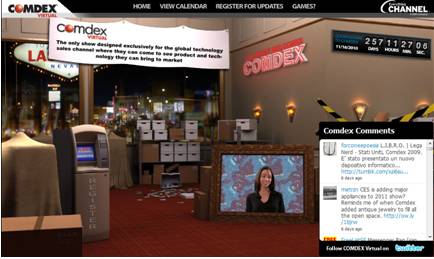
The virtual events industry had a lot of exciting moments over the past two years.  I believe we’ll look back upon today, however, as an one of the most important and historic moments for our industry.  Everything Channel (a UBM company) announced that they’re re-launching COMDEX as a 100% virtual trade show.

Press Release: Introducing the New COMDEX, the Next Generation in Virtual Events

During its heyday, COMDEX was the “go to” trade show in the computer and technology industry, “where all levels of manufacturers and developers of computers, peripherals, software, components and accessories came in direct contact with retailers, consultants and their competitors” (source: Wikipedia)

COMDEX was discontinued in 2004.  In 2006, UBM acquired the event assets of COMDEX via their purchase of MediaLive International Inc.  COMDEX Virtual will fit nicely in UBM’s Everything Channel business, whose objective is “accelerating technology sales” and whose publications include Channelweb and CRN.  This is very exciting news – I gave some thought to what this means to our industry.

Game Changer and Turning Point

Today’s news is nothing short of a game changer and turning point for our industry.  Virtual events have enjoyed growing adoption – initially from B2B publishers and recently from corporations.  Adoption rates have been particularly strong from the same technology vendors who used to exhibit at COMDEX.  Now, however, one of the most widely known event brands has made the move to embrace virtual.

COMDEX Virtual will be watched (and attended) closely by related event brands – its success will incent many more well-known event brands to come on board virtually.  Staying within the technology space, CES and Macworld may be encouraged to consider a hybrid model for their events, adding a virtual component to complement their in-person event.  Discontinued event brands may similarly move to re-launch as a virtual-only experience.

Confirmed: Options and Flexibility with Going Virtual

Virtual event technology afforded Everything Channel with a flexible way to bring back the COMDEX brand.  First, the costs are lower.  Second, the financial commitment around a physical event venue was avoided.  Third, a virtual event affords exhibitors with a convenient and cost-effective means to return to COMDEX.

Re-sellers and systems integrators tend to be small-to-medium sized businesses (SMB) – they operate “lean and mean” without an abundance of marketing budget.  In the past, their entire year’s marketing spend may have been put towards COMDEX.  Now, the same exhibitors can exhibit virtually and avoid the travel costs and “out of office” costs of sending their company representatives to Las Vegas – affording them remaining marketing dollars to use elsewhere.

With the flexibility afforded, COMDEX Virtual allows Everything Channel a convenient and efficient way to bring COMDEX back to life.  If the virtual event exceeds expectations, more options become available, such as a physical component to complement the virtual – creating a hybrid event after first testing the waters virtually.

Virtual Extensions

Industry observers have noted that more focused events (e.g. CES in consumer electronics and Interop in computer networking) began to steal interest away from COMDEX – many believed that it had become too broad.  Subsequent to its November 2010 launch, COMDEX Virtual may want to consider a series of smaller and more focused virtual events – around industry sectors or by specific geographies.

Additionally, virtual affords COMDEX the option of extending its presence globally – both via participation from a global audience, as well as regionalized virtual events that cater to specific regions (e.g. EMEA, Asia Pacific, etc.).  With the localization capabilities provided by virtual event platforms, attendees can choose the language in which they experience the event.
Unique, Branded Experiences

COMDEX had a unique brand – with COMDEX Virtual, there seems to be a clear desire to create a unique experience that carries unique and distinctive branding.  Put another way, COMDEX Virtual should not look like any other virtual event – it needs to stand apart.  As such, UBM Studios, a “creative and strategic marketing agency” will create original and highly engaging event areas for COMDEX Virtual, including the Grand Hall of Masters, Hospitality Suites and the CRN Test Center.

This is part of a continuing trend in our industry – the desire (and capability) of show hosts to create highly engaging and unique experiences that adhere to their branding guidelines – or, create new brand experiences.  As such, clients with the budget (or capabilities) will “in-source” the creative development and look to the virtual event platforms to “carry the payload” – providing the foundation on which the event rides, along with essential platform features and services.

Taking the game to the next level

To support the size and scale of COMDEX (virtually), event platforms will need to bring their “A game”.  If the event will house hundreds of exhibitors interacting with tens of thousands of attendees, the virtual event platform will need to deliver on performance, reliability and scalability.  In addition, useful platform features need to enable exhibitors to demonstrate their products and services.

Match-making tools should enable exhibitors to find the “right” attendees and for attendees to find and make useful business contacts.  Lastly, the platforms need to enable pervasive use of video – both on-demand video and live-streamed video.  After all, a key element of past COMDEX events was the ability to see, hear and engage (visually) with others.

Conclusion

The “countdown to COMDEX” is on – between now and November, I’m sure there’s plenty of work and planning to get done.  In the meantime, with today’s announcement alone, a bit of history has already been made.

Tweet this posting:


Evolving The Virtual Event Group Chat

February 26, 2010

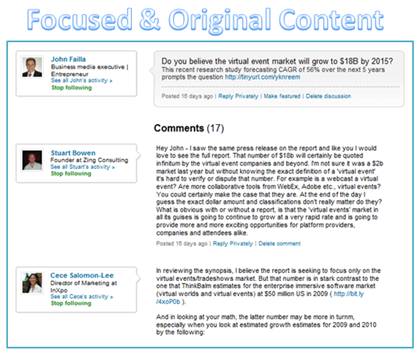
Excerpt of LinkedIn Discussion ("Virtual Events Forum")

For me, the best content in LinkedIn is found in Discussion threads in LinkedIn Groups to which I belong.  Why is the content so good?

  1. It has a precise focus that’s aligned with the charter or focus area of the group
  2. It’s based around timely topics (i.e. what group members are currently interested in discussing)
  3. It’s interactive with a loopback mechanism – there’s a dialog that unfolds – someone making a wild claim will be called on it and will need to return to the discussion to justify the claim (or, lose credibility by remaining silent)
  4. It’s the best form of “user generated content” – from subject matter experts and hands-on practitioners

As such, some content in LinkedIn Discussions can prove to be more useful and valuable than comparable content in related industry publications and web sites.  The LinkedIn Discussion thread is a great example of the “wisdom of the crowds” surpassing the knowledge of a handful of individuals.

Virtual Event Group Chat

While allowing for the fact that a portion of virtual event group chat is logistics-related (e.g. “I don’t hear the audio on the Live Webcast”), chat content related to the event’s theme (topic) comprises some of the most useful and compelling content in the entire event.  Why is that?  It’s for all the same reasons I list (above) for the LinkedIn discussion.

The challenge in leveraging an event’s group chat, however, is this:

If I’m not actively monitoring the group chat, how do I participate?

In my mind, the virtual event group chat needs to evolve to better serve attendees.

Group Chat Threading

Attendees may visit a group chat area (e.g. Networking Lounge), with an interest to discuss numerous topics (see example with LinkedIn Discussion topics, above).  In an unstructured group chat, the introductory chat message (to start the discussion) is likely to be “interrupted” with other, unrelated messages.  The result is some “scattering” of the chat content, with the possibility that a meaningful discussion (on the original topic) never happens.

Today’s “Wild, Wild West” of group chat needs to become threaded – the group chat’s user interface needs to allow participants to denote which message(s) they are commenting on – with the resulting “chat window” nesting (or otherwise grouping) messages within the same thread.  Additionally, the chat system should auto-populate information on which user one is responding to.  This way, participants no longer need to preface their comment with the name of the person they’re responding to.

A wealth of additional features become possible once this sort of threading feature is enabled.

Embraces and extends chat topics

I submit a chat message, asking if folks are interested in “Topic X”.  If no one answers me back within the next 10 minutes, that chat topic is dead.  Threaded chat, however, allows attendees to bring topics back from the dead.  If a visitor enters three hours later and decides to reply to my original message, that section of “threaded chat” can be moved to the “current timeline” in the group chat area – much in the same way a comment on a friend’s Facebook posting moves the original posting “up” in your News Feed.

Real-Time Search!

If I’m not able to dedicate the time to visit and monitor a group chat area, the next best thing would be a virtual event search function that provides real-time (or near-real-time) indexing of the group chat content.  Imagine the following capabilities:

  1. Exhibitor: perform searches on my company name – allows me to determine whether I need to enter the group chat to repsond
  2. Attendee: perform searches on topics that interest me – and be able to see the entire discussion thread on that topic
  3. Attendee: search on other attendees in my Buddy List – show me chat comments posted by my buddies
  4. Attendee: search discussion threads for comments posted subsequent to my own comments

Content Re-Use

For a B2B publisher – and, for some corporations – the content of selected discussion threads could be re-used and posted on the web as original (or, semi-original) content.  B2B sites often publish “how to guides” and best practices articles – discussion thread content (with the “right” mix of contributors) can be re-published on the web – or, used as the basis for a more in-depth article.

Conclusion

With group chat being one of the most valuable components of a virtual event, its features should evolve to better leverage the “wisdom of the crowds”.

Tweet this posting:


2010 Trend Watch: Virtual Events

February 25, 2010

Source: flickr (User: b.frahm)

For the virtual events industry, the premier face-to-face event of the year is Virtual Edge Summit, the “summit on virtual events, marketing & communities”.  Virtual Edge 2010 concluded earlier this week – the face-to-face event floored in Santa Clara, CA, while several vendors provided virtual components, allowing remote (virtual) attendees to participate in the experience.  The event saw record crowds from attendees, exhibitors and presenters.

From my observations at this year’s event, the following are a set of emerging trends in the industry.

Beyond Novelty Phase

Judging by the turn-out alone, the virtual event industry has officially “graduated” beyond the novelty phase.  Awareness of virtual events has broadened – now, when I meet someone at a social gathering and describe what I do for a living, the blank stare of years past has become a “oh yes, I’ve attended one of those”.

The increase of awareness (and, perceived importance) could be seen in the amount of coverage that Virtual Edge 2010 received – an increase in the number of publications (on-site), bloggers (both on-site and virtually) and analysts (both on-site and virtually).  Lastly, the volume of tweets (via hash tag: #ve10) was 5-10 times greater than last year – with more tweets per person and many more people tweeting.

With that being said, there are enormous untapped and unexplored markets, which will provide the industry much of its growth in 2010 and beyond.

More Players Emerge

I noticed a near doubling in the number of exhibitors this year, which means that new/emerging vendors significantly developed (or expanded) their virtual event capabilities – or, from a marketing standpoint, they determined it was the right time to get their products and services in front of this audience.

Last year, the exhibitors were fairly homogeneous – they provide apples-to-apples solutions and directly compete with one another.  This year, the breadth of solutions offerings (from the exhibitors) has expanded – some exhibitors do not necessarily compete directly with one another.

In some cases, a client may use one vendor for a particular type of virtual event and a different vendor in another type of event.  The result?  More “burden” on the attendees (buyers) to understand the solutions offered and determine which solution best fits their needs.  This affords some  industry players (agencies, consultants) a great opportunity to help clients and prospects navigate the waters.

Early Adopters Become Industry Thought Leaders

Practitioners (especially some of the early adopters in our industry) are quickly becoming the thought leaders and “go to source” for ideas, expertise and wisdom.  Many of these thought-leading practitioners were on stage this week – they were very generous with their sharing of experiences.  And, more than ever, they know precisely what they want from their vendors (which is a great thing for those in the vendor space).

In the early days, the practitioner would ask the vendor, “show me what you have” or “show me what you can do’.  Today, the tables have been turned.  Practitioners (clients) are now telling the vendors, “let me tell you what I need” or “make this experiential vision come to life for me”. This is an important aspect of the industry’s evolution – vendors crafting innovation via direct input from practitioners (as opposed to creating “innovation in a vacuum”).

3D Immersiveness

Interest in 3D immersiveness is picking up.  In fact, at Virtual Edge this year, roughly 20% of the session content involved 3D / immersiveness and a formal “Business 3Di” track was created.  The 3Di track featured practitioners, along with vendors such as Linden Lab, Teleplace, Altadyn, Digitell and web.alive (Avaya).  Like last year, Digitell provided a simulcast of the event proceedings into their 3D immersive platform (VirtualU).

Those are the “pure play” immersive environments.  In addition, virtual event platforms are coming on board as well.  In my 2010 predictions on virtual events, I wrote, “(virtual event) platforms take first step towards immersiveness”.  This prediction has come true.

It’s interesting, however – some vendors have a clear vision of what immersiveness enables for exhibitors and attendees of virtual events, while others appear to be adding immersiveness for the sake of adding it (i.e. lacking a clear and compelling use case).  It’s in the best interest of virtual event vendors to explore and enable immersiveness via specific client use cases – this way, the capabilities are added to meet a client need – and, serve as a reference (to the rest of the industry) on the true value delivered via immersiveness.

Social Media Integration

2009 was a monumental year in the evolution of both social media and virtual events.  In 2010, there continues to be a lot of talk about both topics – including discussion around how they integrate with one another.  Social media (and related social networks) were central to the discussion in many workshops and breakout sessions.

And of course, social networking was flourishing in and around the event, with a high volume of tweets, a fair number of Facebook status updates and (I’m sure) lots of LinkedIn connections made.  While I am not aware of any groundbreaking announcements from Virtual Edge on social media integration, I’d expect that platforms enable more and more social networking as 2010 unfolds.  I expect to see the platforms themselves becomes more social (natively) and increase the depth of their integration with third party social networks.  Twitter, Facebook and LinkedIn are commonly mentioned – but expect to see industry-specific, niche networks and communities integrated as well.

Industry Ecosystem Begins to Take Shape

Virtual event platform vendors have established a number of strategic partnerships to extend account/client reach and grow/scale business opportunities.  Most of those partners were present at Virtual Edge – and a number of partners had prominent speaking roles in the sessions.  By this time next year, even more partners will enter the space and appear at the event.

Additionally, smaller businesses (and individuals as well) are seeking to leverage opportunities within virtual events to bring in new business – or sign on for consulting roles.  The list includes video production companies, design agencies, digital signage providers, freelance producers/writers/story-tellers, streaming providers and emerging social network / community sites.  As these “players” look to get a small piece of the industry pie, they serve to grow the overall ecosystem of this industry.

Finally, hands-on practitioners are finding a fluid and welcoming job market, despite the less inviting macro job environment.  Virtual events are still new enough that production staff, developers and strategic consultants have highly specialized knowledge and skills – as such, they’re able to quickly transition from their existing (or past) role to a new vendor, service provider or practitioner (client side).  Most of the vendors in the space are aggressively hiring, which means that savvy job seekers leveraged the conference to generate meaningful employment leads.

Conclusion

It’s an exciting time in our industry – I’m looking forward to seeing how things shape up for Virtual Edge 2011.

Tweet this posting:


What Every Exhibitor Should Know About Virtual Events

February 17, 2010

The following is a guest post from Susan Friedmann.

In a recent webinar I conducted for TSEA (Trade Show Exhibitors Association), “What Every Exhibitor Should Know About Virtual Events,” I highlighted that virtual events can supplement, complement, or replace your physical event. However, I caution exhibitors not to replace their event without totally understanding what you are giving up. Realize that nothing can replace the face-to-face contact that you have at a physical event.

Nielsen Business Media (who organize many virtual tradeshows) have found that the virtual event experience might graphically mimic a tradeshow, but virtual events are currently primarily a social networking environment, especially for the under 50s (sorry to be an ageist).

Virtual events are gaining in popularity, which means as savvy marketers you just can’t ignore them, and hope that if you do, they’ll just go away. It’s just not going to happen.

While they may not replace physical events, the virtual counterparts are becoming more widely used to supplement face-to-face trade shows and conferences, as well as provide ongoing content and follow-up opportunities.

Finally, my all time favorite subject. Don’t have any of your team go on the live or virtual show floor without tradeshow training. It may seem simple to work a virtual show, but winging it will get you winging it results.

The key ingredient to engineer a successful event lies in the simple process of planning and preparation. Easy enough, yet very few exhibitors really take time to truly understand what this means.

Participating in virtual events means not only knowing, and understanding the technology platform, it also means honing the necessary skills for successful results.

Susan A. Friedmann (@TradeshowCoach), CSP (Certified Speaking Professional), is an internationally recognized expert and “how to” coach who has traveled the world helping companies achieve profitable results at tradeshows and events. She offers exhibitor training programs to increase results and focus on building better relationships with customers, prospects and advocates in the marketplace.


Virtual Edge Summit 2010

Susan and I will be presenting at the Virtual Edge Summit on February 23, 2010.

Register for the conference: http://virtualedgesummit.com/

Register for InXpoLive@VirtualEdge: http://bit.ly/InXpoLive_Blog

Tweet this posting:


FountainBlue High Tech Entrepreneur Forum: From Free-mium to Premium

February 12, 2010

Based in Silicon Valley, FountainBlue “supports collaborative innovation, one conversation, one leader, one organization at a time through our monthly events, our dynamic communities, our ongoing discussions on entrepreneurial issues, our invitation-only CEO forums, and through our consulting services.”

FountainBlue Entrepreur Forums launched in 2006 – on average, they attract 50-150 entrepreneurs, intrapreneurs and investors.  I attended an Entrepreneur Forum in 2009 entitled, “Virtual Worlds: The Hype, The Reality, The In-Between” and found the presentations engaging and the post-event networking enjoyable.

The next Entrepreneur Forum takes place on March 8th, “From Free-mium to Premium“:

Overview

Experienced entrepreneurs still standing after the recent tsunami know that you have to prove you can be resourceful and build product and sign on customers despite the economic conditions!

A popular way to bring in customers, gather feedback and build momentum is to adopt a ‘free-mium to premium’ model, letting most users try basic versions of a solution for free and incentivizing some to upgrade to full-featured functionality, paying for the service.

But rare is the company able to successful do this. This panel will feature entrepreneurial companies who have done this and are willing to share their secrets.

The Panel

  1. Facilitator Sergio Monslave, Principal, Norwest Venture Partners
  2. Panelist Will Cheung, Founder, DuffelUp (@WillCheung)
  3. Panelist Daniel Cheng, Graystripe
  4. Panelist Donna Novitsky, CEO, BigTent (@bigtentdonna)
  5. Panelist Entrepreneur – MMO/Virtual World Entrepreneur

Courtesy of Google Maps

Date & Time: Monday, March 8 from 5:30 until 8:00 p.m.
Location: Cooley Godward Kronish, LLP, 3175 Hanover Street in Palo Alto
Audience: Early-Stage, Funding-Bound Clean Energy, High Tech and Life Science Entrepreneurs and Intrapreneurs

Registration

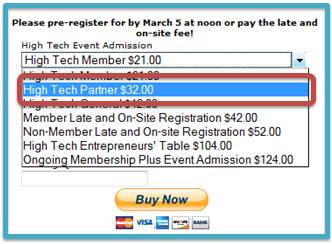
FoutainBlue will plant a tree for everyone who pre-registers by noon on 3/5 using the PayPal link at http://www.sventrepreneurs.com.

Note: Readers of this blog are eligible to receive the “High Tech Partner” rate of US $32 for this event – select the $32 option (above) when processing your payment.

I’ll be attending this event – if you plan to attend as well, send me a message on Twitter (@dshiao) – additionally, feel free to follow FountainBlue (@foutainblue).  Hope to meet / see you there.

Register for the event:

http://www.sventrepreneurs.com


InXpo: Visit Us In-Person Or Virtually at InXpoLive@VirtualEdge

February 10, 2010

Source: flickr (User: santaclaraflickr)

That’s right, even the virtual events industry has a need for an in-person event.  On February 22nd and 23rd, InXpo will be attending Virtual Edge Summit 2010 at the Santa Clara Convention Center in Santa Clara, CA.  There’s an All-Star Roster of Virtual Event strategists, practitioners and visionaries on tap, for an impressive 2-day schedule of keynotes, presentations and break-out sessions.

If you’re unable to join us in Santa Clara, InXpo is holding a hybrid event – we’ll have a virtual event running concurrently with the in-person event.  We’ll provide virtual attendees with a means to view the live video broadcasts of the keynotes, presentations, etc. – and, we’ll be utilizing webcams to bridge the in-person event into the virtual event.

You can pre-register for the virtual event (InXpoLive@VirtualEdge) here:

InXpoLive@VirtualEdge pre-registration

How To Find Me

I’d love to meet up and place faces to names – most of the time, I’ll be stationed in the InXpo booth, so feel free to drop on by.  In addition, InXpo is sponsoring lunch on both days, so perhaps we can grab a sandwich together.

Lastly, I’ll be presenting in a Day 2 session titled “Prevent Virtual Event Nightmares: How Producers Prepare Speakers, Exhibitors and Attendees” – it starts nice and early, at 8AM PT.  I’ll be joined in the presentation by Susan Friedmann, The Tradeshow Coach (@Tradeshowcoach).

Hope to see you there, whether it’s in-person or virtually!

Prevent Virtual Event Nightmares How Producers Prepare Speakers, Exhibitors and Attendees

Tweet this posting:


How 3D Virtual Worlds Can Be More Like Twitter And Facebook

February 8, 2010

3D Virtual Worlds Diagram

Facebook and Twitter have taught us that people of all ages love to utilize the web for self-expression, connecting and staying in touch.  3D virtual worlds have similar characteristics: the ability for self-expression via customized avatars and the creation of your own ‘island’; the ability to connect with friends (or meet people you’d never get a chance to meet in the real world); and the ability to be part of a vibrant community.

In addition, 3D virtual worlds offer a fully immersive environment, that allows you to escape from the real world – and, experience virtual representations of real-world locations. For virtual worlds experiencing declining usage, however, “community” becomes a challenge to maintain (i.e. imagine using Facebook when none of your friends or family are using it).

Mark Kingdon (in-world: “M Linden“), the CEO of Linden Lab, laid out his vision of Second Life’s evolution, tying it in with the recent acquisition of Avatars United.

M. Linden on Community:

“When we talk to the users who sign up but then decide not to stay, they say they left, in part, because they had a hard time finding people to hang out with. Either their friends weren’t there, or they have a hard time meeting new ones inworld, or sometimes both.  We need to fix this.”

M. Linden on Social Sharing:

“Another part of the “social glue” of any community is the concept of sharing.  Inworld, it’s easy to share and we’ll make it even easier.  But sharing between Second Life and the larger social Web is not as easy.  As an avid photographer (well, aspiring to be avid), I’d love to be able to easily share my snapshots from Second Life with my friends on other Web services, and be able to watch a feed of the people I’m interested in.”

Reaction

Kingdon’s blog posting generated a wealth of comments from the Second Life community – I’d characterize the comments as mixed to fairly positive.  My own reaction to the blog posting was very positive – my use of Second Life (and other virtual worlds) would increase based on my knowledge of in-world events/happenings attended by members of my social graph.

Here are my thoughts on how to increase community engagement and social sharing in a 3D virtual world.

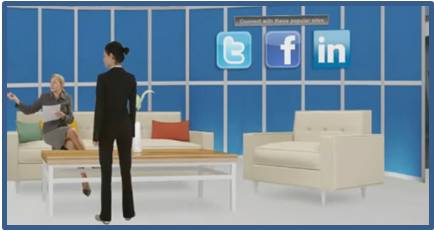
Facebook and Twitter

Direct Integration with Twitter, Facebook

With Avatars United, according to Kingdon, “you’ll start to build an activity feed (similar to Facebook or Twitter) that keeps you in closer touch with the people you’re connected to in Second Life.” While I see value in a single feed that aggregates content from multiple social networks, I see equal (if not more) value in direct integration of Twitter, Facebook, etc., into the virtual world.

The Twitter API and Facebook Connect make doing so fairly straightforward.  A B2B company with an island in Second Life may want to integrate a Twitter stream that displays tweets related to the company.  Similarly, the company could prompt visitors to tweet about their visit and have that message be distributed to all of the visitor’s followers on Twitter.

By enabling this, the owner of the island generates “free” promotion to the social web – and, the underlying platform gains wider reach as well.  A relevant analogy is Ustream’s Social Stream, which allows viewers to “chat with your friends over Twitter” while they’re viewing a live video.

On the Facebook front, imagine if the virtual world platform enabled Facebook Connect, thus allowing residents to sign in to Facebook and find a list of their Facebook friends who are also residents.  Then, imagine showing users a real-time list of their Facebook friends who are in-world right now, with “links” to teleport to the friends’ locations.

Borrowing from another popular service (Foursquare or Gowalla), the virtual world platform could enable residents to “check in” at different locations (islands).  Broadcasting their whereabouts to their social graph may result in more “planned encounters” within the virtual world.  If my friends just checked in to “virtual island”, I may choose to teleport and join them there if I happen to be free.

“I Like It!”

Virtual worlds could create a stronger “shared experience” by allowing visitors to leave a trail of breadcrumbs reflecting their visited locations.  If I “friend” someone in-world – or, if an in-world resident is a Facebook friend of mine, then I might want to follow the path they took during their last session.  Additionally, the platform could support location endorsements, in the same way Facebook allows me to “like” a friend’s wall posting.

As I enter a location in the virtual world, I can see whether members of my social graph previously visited – and, what their comments were.  Alternatively, I could see a list of all past visitors – with a link to view their in-world avatar and profile.  If a past visitor panned a location, but I enjoyed it, allow me to send an offline message to that user, who can read my message the next time she logs in.  This allows me to connect with other users even when they’re not online (a form of virtual world email).

Source: flickr (User: Indiewench)

Virtual World Closed-Circuit TV

Business owners leverage closed-circuit TV technology to perform surveillance of their store front or office.  Wouldn’t a similar service be useful for virtual world residents, especially those who “own” an island?  While we tend to be online during our waking hours, it may not be practical to be in-world all the time.  How about a virtual world thin client – it provides a read-only “view” of a given location, similar to closed-circuit TV.

Since it doesn’t allow you to navigate, teleport, interact with others, etc. – the client is entirely lightweight and can sit in a corner of your desktop with only a portion of the CPU/RAM consumed by the full-blown client.  So if you’re interested in a given location, the closed-circuit TV can alert you to visitors – and with one click, the thin client can launch the full client and teleport you to the location.

Services (like this one) that can instantaneously connect users are a win-win – they generate more logins to the platform and enable more connections, upon which a stronger sense of community develops.  Alternatively, the virtual world platform can provide even more lightweight notification mechanisms: it can generate an email, Twitter direct message or Facebook email whenever a user enters a designated space.  The notification could contain a link that teleports the recipient into that space to connect with the current visitor(s).

Embed Web Content In-World

As Twitter and Facebook have demonstrated, users of social services are inclined to share interesting content, often in the form of web links.  Within a virtual world, “sharing” often results in the launching of a web browser to render the shared page.  Why not provide sharing capabilities that render the shared content on an in-world wall or projection screen?  This keeps users engaged, while retaining their attention in-world.  Building upon this, I may want to look up Facebook friends and be taken to all locations in which they shared content in-world (as I have an interest in what my friends are reading and sharing).

On Demand TV (for Virtual Worlds)

Facebook has a great utility that allows me to record a video on my laptop’s webcam, upload it to Facebook and share it on Facebook.  Virtual world platforms should enable users to press a “record” button and have their current session saved for later playback.  Perhaps I’m attending an in-world concert or watching a keynote presentation – capturing a recording of the session allows me to share it with members of my social graph who weren’t able to attend.  Treet TV provides similar services (with professional quality) – this capability empowers end users to create on-demand programming with the click of a mouse.

Conclusion

3D virtual worlds have a lot to offer already – by adopting useful social sharing services, they can tap into the phenomenon (social media) that’s the force behind many of today’s most popular web sites.

Related Links

  1. Wagner James Au in New World Notes, “How To Make Second Life Truly Mass Market, Part 1: Deep Integration With Facebook

Tweet this posting:


The Future Of Virtual Events

February 1, 2010

There’s no time like the present … to think about the future.  I previously wrote about predictions for the virtual event industry in 2010 – those predictions were based around a short-term outlook and have a reasonable chance of coming true.  Now, I’d like to weigh in on 2011 (and beyond) and discuss where the industry (and the technology behind it) may be heading.

Virtual Event technology moves “closer” to the end user

To spur increased adoption, the virtual event experience will move closer to the end user.  To move closer, the browser-based experience of today will be complemented by numerous apps that live outside of the browser.  A relevant analogy is Twitter, which could not have achieved its place in the world on twitter.com alone – its power is broadened with desktop clients such as TweetDeck and Seesmic.  Possibilities include:

  1. Browser toolbars that encapsulate a subset of virtual event functionality (OK, we’re still within a browser here – so consider this an initial step only).
  2. Desktop applications – initially, these apps may provide a real-time dashboard for attendees, exhibitor or show hosts.  You’ll get to keep tabs on activity within a virtual event without having to be logged into the event (from your browser).  Subsequently, the apps will become more sophisticated and take on more of the virtual event platform’s features.
  3. Asynchronous alerting services – attendees, exhibitors and show hosts will be able to configure alerts that inform them of important activities.  The alerts will have numerous transport mechanisms – email, SMS text message or social media notification (e.g. a direct message on Twitter).

Virtual Events Go Mobile

Related to “getting closer” to the end user, mobile is the “elephant in the room” for virtual events.  The mobile apps will start off quite simple – think again of the dashboard app, which provides a real-time view of what’s going on within the event.

Building onto the dashboard will be basic interactivity (e.g. text chat) – allowing attendees and exhibitors the ability to chat with others.  An exhibitor, for instance, can now staff her booth “on the go” from her iPhone.

As we look to 2011 and beyond, I see a clear shift in the computing landscape, whereby more and more “computing” moves from the desktop and laptop and on to mobile devices.  In this decade, the smartphone becomes the PC of the past decade.

The challenge for virtual event platform providers is to determine where to place their bets (investments) across iPhone, Android, BlackBerry, Symbian, Windows Mobile and Palm.

Tighter Integration Inside The Firewall

Virtual events see major adoption from multinational corporations, who leverage the events for internal-facing communication and collaboration (e.g. sales kick-off meetings, human resources programs, learning programs, executive briefings, team/departmental meetings, etc.).  Corporations will begin to request the following:

  1. Integration with other enterprise applications (which often sit inside the firewall)
  2. Tighter security measures

This drive from corporations will cause virtual event technology to morph a bit, shifting from a 100% software as a service (SaaS) model to a hybrid model that combines SaaS with on-premise software.

At first, integration points to a company’s enterprise apps may reside “on premise” on corporate servers – subsequently, corporations may require the underlying virtual event platform be hosted inside the firewall – a model that mirrors Linden Lab and their Second Life Enterprise.

Augmented Virtuality

Virtual events and in-person events meet augmented reality – resulting in “augmented virtuality”.  I previously wrote that 2010 is The Year of The Hybrid Event.  There will come a day when every in-person event has a virtual component.  With existing smartphone technology and the emergence of augmented reality – we’ll soon hit a sweet spot whereby in-person event attendees will wield enormous power in the palm of their hands.

Physical event attendees will begin to experience an event through the lens of their smartphone – holding up the smartphone at any location and seeing overlays of relevant information.

Augmented virtuality will blend augmented reality with the virtual event platform – elements of the virtual event appear as overlays on the smartphone (e.g. the virtual booth is layered on top of the smartphone’s view of the physical booth – and virtual staffers are displayed as being available [via the smarthphone] if the in-person staffers are busy).

Bye Bye, “Virtual Events”

Based on the trends I’ve outlined, by 2011 (if not sooner), we’ll no longer refer to “virtual events”.  Instead, they’ll have “grown up” and migrated into a broader category of business or collaboration application.  Virtual event technology becomes a toolset in a larger ecosystem – or, they’re integrated into a broader suite of tools (rather than being a standalone solution).

Conclusions

In a few years, these will no longer be your mother’s virtual events!  The industry and technology will change, morph and adapt to suit the needs of the market.  Let’s all be thankful that we’re along for the ride.

Tweet this posting:


InXpo: The Power of The Platform

January 30, 2010

Over at the InXpo blog, I wrote a posting about “The Power of The Platform” – our belief (at InXpo) that the platform serves as the foundation on which our value is delivered.  We deployed Release 8.3.1 of our Virtual Events Platform, complete with lots of exciting features:

  1. Powerful navigation options – pull-down and push-up sub-menus in the event “toolbar”
  2. On-the-fly translation for group chat and one-to-one chat
  3. Multi-language support for the InXpo Webcasting platform (XpoCast) – on both the presenter and viewer interfaces
  4. Full-text document search
  5. Content recommendation engine

And now comes the exciting part – working with clients to apply these features in their upcoming events.

Here’s the full link to the blog posting: Feature Overview: InXpo Virtual Events Platform (Release 8.3.1)

Tweet this posting:


How Virtual Events Can Adopt Location Based Services

January 28, 2010

These days, it seems the social web is like real estate – it’s all about location, location, location.  Foursquare, Gowalla and Loopt are gaining popularity as location based, mobile social services.  Yelp has rolled out Yelp Check-ins, which mirror a popular activity on the aforementioned services.  Twitter added location awareness to its API in 2009.  Facebook, some speculate, may enter the fray with their own location based services.

So how would it be possible to enable Location Based Services in a virtual event?  Well, consider that location tracking is inherent to the virtual event platform – in other words, it has a built-in GPS for all users!  I wrote previously about gaming in virtual events – that gaming can generate  retention, engagement, enjoyment and loyalty.  Location Based Services, in the form of competition and gaming, can achieve all of these benefits.  Let’s take a look at how.

Source: flickr (User: dvxfilmerdoug)

It Starts With The Buddy List

Users first need to build their social graph.  This can be accomplished with a virtual event platform’s “buddy list” feature – all users in your buddy list would receive status notifications from the location system.  The notifications would be sent to users within the virtual event (if you’re logged in).  Once you log out, you can opt to receive status notifications via email.  This way, even if you’re no longer in the event, you can receive updates (via email) on what your buddies are up to.

Build A Reward System

Next, a reward system serves as an incentive for users to participate.  The concept is similar to the becoming “mayor” of a location on Foursquare.  In a virtual event, perhaps you allow privileged users (who have achieved a certain status) to obtain a badge – whereby the badge can superimposed on their avatar image – or, listed on their profile page.  In addition to the badge system, a master leaderboard (and perhaps segmented leaderboards) should be utilized, allowing users to track their performance relative to other users.

The Virtual Trade Show

First, the notion of a social graph in a virtual trade show may be an upfront challenge.  At most trade shows, you may know a handful of colleagues or associates who are also attending – but for the most part, everyone else is a stranger (to start).  Thus, a system may need to be in place first to encourage users to add other users to their buddy list.

Assuming you can achieve decent-sized buddy lists, then the “check-in” becomes quite relevant in a virtual trade show.  Each visit that I make to an event area can be tracked (by the platform) as a check-in – allowing my buddies to know what areas I visited – and, where I am right now.  Secondly, I might leave a review or comment about a particular area – perhaps I enjoyed the content in an exhibitor’s booth – or, I didn’t find a Webcast to be all that useful.  When my buddies enter those same areas, they can then view the comments I left them from my prior check-ins.  Thus, when a buddy enters the same exhibitor booth, she knows that I visited earlier and enjoyed the content there.

Exhibitors could then sponsor areas of the event (besides their own booth) – the Lounge, Auditorium, Resource Center, etc.  Then, attendees can vie to become the “mayor” of a given area.  At the end of the live event, perhaps the mayor of the Lounge receives a prize that’s awarded by the Lounge’s sponsor – and to receive the prize, agrees to have a short conversation with that sponsor.  Already, you can begin to see how this location “app” can generate additional activity and engagement.

Source: flickr (User: Live Solutions)

The Virtual Sales Conference

In a virtual sales conference (and related corporate events), attendees naturally have a large list of potential buddies – the trick is to incent the attendees to populate that list within the virtual event.  Alternatively, management may choose to pre-select the buddy lists by organizing the sales force into teams – whereby your buddy list is pre-seeded with your fellow team members.  The location app is all about checking in (with each other) and sharing information towards gaining points for your team.  In this manner, the location app helps encourage learning and collaboration, making the virtual sales conference more effective.

Social Networks

For certain types of events (e.g. virtual trade shows), integrating the location system with users’ social networks can be powerful.  For instance, a check-in to the keynote presentation can auto-generate a tweet out to the attendee’s Twitter followers – providing a registration link to the event.  Similarly, a check-in at an exhibitor’s booth may prompt the user whether she wants to post an update to her Facebook wall.  In summary, the location service should facilitate sharing not just within the virtual event, but to external social networks as well.

Prevent Gaming (of the System)

The virtual events platform will need to carefully build the measurement and scoring methodologies to ensure that the “game is not gamed”.  In the real world, there is overhead involved in becoming the mayor of a watering hole – in the virtual world, clicking 50 times to enter an exhibitor’s booth is quite easy.  The scoring system ought to consider rate limits, as well as threshold values around selected activities.  Additionally, becoming “mayor” should factor in actions that are not as “game-able” as mouse clicks or visits.

Conclusion

There’s  probably a lot of work to enable the underlying platform to accomplish this – however, such a system can go a long way to achieving retention, engagement, enjoyment and loyalty.

Tweet this posting: