2010 In Review for It’s All Virtual

January 2, 2011

The stats helper monkeys at WordPress.com mulled over how this blog did in 2010, and here’s a high level summary of its overall blog health:

The Blog-Health-o-Meter™ reads Wow.

Crunchy numbers
About 3 million people visit the Taj Mahal every year. This blog was viewed about 33,000 times in 2010. If it were the Taj Mahal, it would take about 4 days for that many people to see it.

In 2010, there were 87 new posts, growing the total archive of this blog to 202 posts. There were 220 pictures uploaded, taking up a total of 8mb. That’s about 4 pictures per week.

The busiest day of the year was September 28th with 213 views. The most popular post that day was Trends In The Virtual Worlds Industry.

Where did they come from?
The top referring sites in 2010 were twitter.com, linkedin.com, facebook.com, en.wikipedia.org, and hootsuite.com.

Some visitors came searching, mostly for virtual calendar, match.com, all virtual worlds, gregory house, and comdex.

Attractions in 2010
These are the posts and pages that got the most views in 2010.

1

Trends In The Virtual Worlds Industry September 2010
6 comments and 1 Like on WordPress.com,

2

Virtual Events Calendar December 2008
14 comments

3

The Business Benefits Of Second Life March 2010
2 comments

4

About December 2008
16 comments

5

COMDEX Re-Launches As A Virtual Trade Show March 2010
1 comment


The Future Of Book Publishing

December 11, 2010

Introduction

I recently published a book, “Generate Sales Leads With Virtual Events“.  I wrote a prior blog posting that described the process of self-publishing the book.

Like other industries (e.g. newspapers, music, entertainment, etc.), the web will have a transformative impact on book publishing.  In fact, my belief is that the coming 2 years will see dramatic shifts – the book publishing industry will never be the same.

Production / Printing

Self-publishing has arrived and it’s here to stay.  Moving the book publishing process into the cloud significantly empowers the author.  Now, authors “prepare the print run” via the web, making tweaks and edits as they see fit.  The cloud has ushered in an era of on-demand printing – or, what I call “agile printing“.  With traditional book publishing, the Second Edition of a book may come out a year later.  With agile printing, it’s possible for the Second Edition to be published the next day.

This does not mean that traditional book publishers will face complete disintermediation.  Instead, I believe savvy publishers will incorporate “cloud technologies” into their publishing process, streamlining the process for editors and authors.  Publishers will rightly conclude that the publishing process could leverage a lot of the same convenience of blog publishing.

Crowd-based Editing

You can put the power of the crowd to work for you and sustain results as good as a single expert. That’s just what Facebook did to enable Facebook.com to be available in 64 languages.  You can add the Facebook Translations application and “join our community of translators and make Facebook available in your language”.

I see a similar opportunity for basic copy editing.  Authors can tap into crowdsourcing providers to have a network of hundreds (or thousands) of “workers” collectively provide copy editing of their manuscript.  To cut costs, traditional book publishers may look to crowdsource copy editing, with a smaller staff of editors in place to “quality check” the resulting work.

Collaborative Writing


What’s better than one author?  Two or more authors.  The beauty of “publishing from the cloud” is that your social graph can be invited directly into the manuscript.  I published my book via FastPencil and it gave me the option of inviting in project managers, co-authors, editors and reviewers to collaborate on my project.

I believe that authors will increasingly bring their social graph into the publishing process.  Survey the suitability of your book to a prior generation by inviting your aunt to review Chapter 2 and then invite past business partners in to write a few chapters.  With self-publishing, we’ll see more “chapter books”, where a collection of experts each write one chapter.

Migration to Digital Readers


While some will insist on sticking to the printed format, we’ll be reading more and more books via digital form.  The combination of digital plus “online” will dramatically change the reading experience in the coming years.  Already, the Amazon Kindle 3 allows readers to copy a selection from the book and share it on Twitter or Facebook.  With digital devices, the reading experience moves from solitary to social.

In the early days of Facebook, I interacted with friends, but it was asynchronous.  I’d post, then an hour later, they’d respond. With Facebook Chat, I’m now noticing that certain friends want to interact in real-time, directly on Facebook.

Book reading will take on similar dynamics. I’ll carry my social graph onto my device (if I choose to) and see which friends are reading the same book as me – right now.  I can start a chat with my friend to discuss Chapter 3.  Or, I can perform a “scan” to see a list of other online users who are reading the same book right now.  The “book of the month club” becomes virtual and global.

Subcription (Rental) Model

On college campuses, Chegg is innovating with a textbook rental business.  With digital books, someone will come along soon (Netflix more likely than Amazon) to disrupt the market with a cloud-based subscription model.  I think the days of “purchasing to own” digital books are numbered.  I think of a digital book like a DVD – I consume it, I enjoy it, I move on.  I don’t need to own it.

With a subscription model, I may get up to 10 digital books per month.  The book content is served up from the cloud, which means I can read it from any device – and I can bookmark the page and move from my laptop to my smartphone.

When I’m done, I “return” the book and can access my next book.  Of course, the challenge will be in the licensing agreements with book publishers – something Netflix has been working through with movie studios for their streaming service.  And, we’ll need an “offline reading mode” for times when users are not connected to the net.

Conclusion

As a new author, I’m excited to see what lies ahead for book publishing.  Based on the web, the cloud and social media, it’s never been a better time to be an author.


Trends from Enterprise 2.0: The Move to Social Business

November 11, 2010

Introduction

I attended Enterprise 2.0 in Santa Clara, CA this week.  I predict that in 2011, “business as usual” will move to social business.  As usual. Meaning, social tools will be enabled across the enterprise and they’ll quickly be ingrained as the “new way to do business”.  Here are specific trends and observations from Enterprise 2.0.

Start-ups on Equal Footing with the Technology Giants

Social business, by way of its “newness”, evens the playing field.  In fact, it actually provides an advantage to the start-ups, who built their business (from the ground up) on a foundation of social features.

The established giants, meanwhile (e.g. IBM, Microsoft, Oracle, etc.), need to retrofit existing offerings – adding social into (or on top of) what already exists.  Or in some cases, the giants are developing new social platforms that live in parallel with their legacy systems.

Commenting on a T-shirt that poked fun at “jive talking”, Christopher Morace (@thinkoutloud) said it well when he tweeted, “How in a space with IBM, MSFT, & SFDC did Jive become ‘the man’? I’m still in my 30’s!”

Social Business UI – New Models Needed

During the event, I tweeted that if imitation is the sincerest form of flattery, then Facebook should be quite flattered.  In other words, everyone’s social business UI looks and feels like Facebook.

Conference attendee Robert Lavigne (@RLavigne42) agreed and tweeted back, “good from a cross training point of view, bad from a breaking that mindset in the sales cycle though. Need innovation not UX copy”.  Robert continued, “Time for something innovative in terms of UX”.

If we do not see UI/UX innovation and differentiation, then the market will face commoditization, where everyone’s platform looks the same.  And that’s not good for the market.  Expect to see fresh, new looks in 2011, especially as some of these platforms evolve to version 2.0.

The Intranet (As We Know It) Is Dead


The Intranet, as a self-standing web site, is now dead.  In its place will be social business platforms.  Do you really use your company’s intranet?  It’s good for routine activities (e.g. look up phone numbers, find the expense report template, etc.), but it doesn’t significantly improve employee productivity.

The typical intranet doesn’t get much activity and it’s hard to find what you need.  Now consider the likes of the Socialtext, Yammer, Salesforce Chatter and others. Common features they provide are:

  1. Follow and be followed – people, documents, sales opportunities, etc.  Need to track an important document?  Follow it, and be alerted to all updates on it.
  2. Crowdsourced answers – need to find a nugget of information or an obscure document?  Ask your followers via a status update and you’ll likely receive an answer within minutes.
  3. Polls – want to know how Marketing is doing with sales collateral?  Create a poll and invite employees to participate.  Publish the results via a status update.
  4. Collaboration via 140 characters – OK, most social platforms don’t impose Twitter-like character limits, but you get the idea: status updates are the new water cooler conversation.
  5. Mobile – access to social business is enabled on your smartphone, via apps provided by the social platforms.  How often did you access your intranet from mobile?

What This Means for Virtual Event Platforms

In my 2011 predictions for virtual events, I wrote about “Market Expansion”.  Guess what? Social business platforms do, in fact, look a lot like virtual event platforms.  Some striking similarities:

  1. A move from point features to a “platform”
  2. Presence
  3. Private and group chat
  4. Collaboration

Some social platforms provide capabilities not found in virtual event platforms today, such as wikis and real-time collaborative document editing.

Virtual event platforms will continue to have the upper hand in supporting live/scheduled (online) events, but will face expanded competition in the area of “virtual communities”.

Conclusion

(A tag cloud generated from the session descriptions at Enterprise 2.0 – using wordle.net)

It’s an interesting time.  2011 could be a year of battles, shifts and migrations.  With the move to social business, along with the larger shift to cloud computing, expect 2011 to be  The Year of the Shakeout.


Virtual Mingle Rooms: Show Them What You’re Talking About

November 1, 2010

The following is a guest post by Daniel Ruscigno of Mingleverse.

Introduction

Mingleverse is a new service offering browser-based virtual rooms where 2 to 50 people can get together to talk using 3D audio while watching various types of media together (pictures, presentations, videos, webcam, screen broadcasting, etc).

Although predominantly a consumer-facing service, Mingleverse is used not only by friends and family in Facebook, but also by teachers and trainers, and small businesses.  However, the most interesting adoption has been with authors and athletes who are using their Mingle Room to mingle live with their fans.

Use Cases

For example, best-selling author Malcolm Gladwell had a live virtual mingle with 25 of his fans, where they were all able to ask him questions about his books and his future writing plans.  Gladwell mingled from the comfort of his New York apartment and came into the room via webcam for all of the fans to see.  He commented afterwards that it really did feel like meeting 25 new people, and the fans were ecstatic that they got to meet their favorite author.

The Vancouver Canucks NHL team have also taken advantage of Mingleverse’s virtual Mingle Rooms by embedding one directly on their website.  After each home game the Canucks invite their fans to join the Mingle Room to talk about the night’s game, watch live post game interviews and press conferences together, and watch highlights streamed directly from YouTube.

There are now several professional sports teams who are looking to be the leaders in live fan interaction and are excited about providing fans the opportunity to mingle live with players and coaches.

Conclusion

As Mingleverse has shown, virtual world technologies allow us to become more interactive with people from all over the world and can afford us new opportunities not regularly available in our daily physical lives.  As we adopt these new technologies, perhaps our celebrity idols will ask you to meet them in their Mingle Room in their next tweet!

You can try Mingleverse for free at http://mingleverse.com or through the Mingleverse Facebook Application.

Related: Mingleverse picks up $1.4M in seed funding for video conferencing with cardboard cutouts (from VentureBeat, Dec 2010)


2011 Predictions For Virtual Events

October 30, 2010

As we head into the final 2 months of 2010, it’s time for another round of predictions.  First, let’s review my 2010 predictions:

  1. The 2010 Predictions for Virtual Events
  2. The Mid-Year Report Card on the 2010 predictions
  3. A posting on the Future of Virtual Events

I assigned myself a mid-year grade of B.  And now, I’m designating a final grade of B-.  I hope to improve in this year’s predictions.  To assist with my predictions, I invited a few experts from the community to chime in, so I’ll be including their predictions with my own.

Market Expansion

To date, “market expansion” has meant a growing number of “pure play” virtual event platform providers.  In the US, we started with a handful of major vendors and we’ve seen new entrants into the market in 2009 and 2010.  We also saw the emergence of platforms outside the US, notably in Europe – and in 2009, in Asia Pacific as well.

For a large Requests For Proposal (RFP) in 2009 and 2010, the virtual event platforms knew whom they were competing against (each other).  Starting in 2011, it gets cloudier (pun intended), as the blending of virtual, social and Enterprise 2.0 means that a wider set of vendors are vying for the same business that virtual platforms got in 2010.

Consider the following vendors, each of whom has offerings that (in part) look, feel and smell like virtual events or virtual business communities:

Jive Software, Yammer, Pathable, Facebook Groups, Socialtext, SharePoint (Microsoft) and Lotus (IBM).

Virtual event platforms can expect to sell against some of these players in 2011 and some platforms may go the partnership route, to build a combined offering as a competitive advantage.

Service Level Agreements (SLA)

The virtual events industry is at a point in its growth where Service Level Agreements (SLA) make a lot of sense.  With a growing number of vendors, SLA’s help separate the contenders from the pretenders – if you’re offering money back (or a credit) if an event fails, then only the strong will survive.

I predict that one vendor will lead the way and proactively hit the market with an SLA – forcing others to follow suit later in 2011.  Expect SLA’s around availability and simultaneous users.

Later in 2011 (or perhaps in 2012), SLA’s will be defined around “quality”, such as response time.  This development helps the market – the assurance provided behind an event allows the market to expand, attracting new customer growth that exceeds 2010’s figures.

Market Upheaval

Market expansion and SLA’s mean the strong get stronger. But lesser platforms have a challenging year ahead. According to Cece Salomon-Lee, Principal at PR Meets Marketing, “some players will be bought by larger organizations, merging to bring together complimentary strengths or even some disappearing from the industry all together. No matter how, we will begin to see some consolidation within the industry.”

Meanwhile, Miguel Arias of IMASTE believes that US platforms will look abroad for acquisitions.  To “gain presence, customers and market knowledge” in Europe, Latin America and Asia, Arias believes US platforms will look to partner or acquire in-country platforms in those same regions.

In my mind, there is an enormous, (largely) untapped market within the US, which means that US-based platforms will continue to focus domestically in 2011.  Global expansion will occur in 2012 or beyond.  In addition, due to the “strong get stronger” phenomenon, I predict that one of the prominent US-based platforms will cease operations in 2011 – or, be sold at a below-market price.

Technology A La Carte


Today, virtual event platforms are “monolithic” – you enter an event and all of the functionality provided by the platform sits within that event.  You can’t experience the platform’s features outside of an “event”.  In my futures column, I predicted that virtual events “move closer to the end user”.

Driven by market demand, platforms will “break out” pieces of their technology platform in a la carte fashion. Customers who do not need a five course meal may opt just for an appetizer and coffee.  This may surface in a number of ways, including:

Thin desktop clients, mobile apps, browser toolbars, virtual booths embedded in banner ads, group chat embedded on a web page, etc.

Hybrid Innovation & The Year of the Hybrid

In 2009, some INXPO colleagues and I predicted that 2010 would be The Year of the Hybrid.  This was partially true – in fact, Cisco received the 2010 Grand Ex Award for their hybrid approach to Cisco Live and Networkers. However, the mass adoption of hybrid events (that we predicted) did not ring true.  But that’s OK, it’s always better to be a year early than a year late.

Event and experience marketing agencies have adopted virtual in varying degrees – 2011 is the year where they demonstrate the most aggressive push to date.  You’ll see strong adoption from the “big brands” in 2011 and it will come by way of these channel partners to the virtual event platforms.  2011 will set the foundation for growth – with “hockey stick growth” coming in 2012.

Another major adopter in 2011 will be associations. They’ve done a number of virtual events to date – in 2011, you’ll see 200%+ growth.  Local chapter meetings will continue to occur at physical locations, while the annual, national chapter meeting of the association will move to a hybrid event, with the virtual component serving those members who were not able to make it to the physical gathering.

More generally, 2011 will see innovative technologies that blend the virtual/online world with the real world.  And these same technologies will be integrated into hybrid event experiences, blurring the lines between physical and virtual.  I’m referring to location based services (LBS), mobile, augmented reality and QR codes.  Expect to see a lot of hybrid events innovation, which benefits everyone.

Miscellaneous Predictions

From Miguel Arias, “After some virtual events vendors, marketers and event organisers have shown in 2010 with successful case studies what are the benefits of virtual events we will see much more events and movements in Europe and South America specially.  I expect a 250-300% growth of the total market size in those regions.”

From Cece Salomon-Lee, “I believe the players that will remain on the landscape will begin building out an ecosystem of services to plug-and-play on the platforms.”

From Miguel on vendor specialization, “With more vendors in the space and more clients asking for more tailored solutions we will probably see a leader in the corporate events environment, a leader in the generic trade show market, other for hybrid events, for virtual career fairs, etc.”

Conclusion

I’ll sum up this piece by using a number of nouns to describe what I expect to see in 2011: innovation, shake-out, growth, change, adaptation, expansion, excitement.  Check back here in 6-8 months for my mid-year report card!


With Lead Generation and Virtual Events, It’s a Journey, Not a Project

October 23, 2010

Introduction

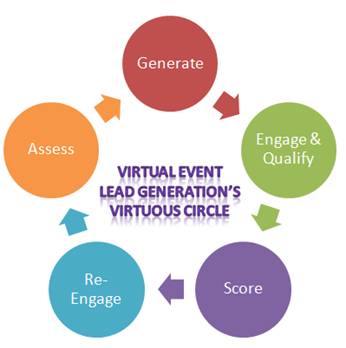
Virtual Events can be highly effective in generating leads to fuel your sales pipeline.  Here’s a 5-step process that I call the “Virtual Event Lead Generation Virtuous Cycle“:

  1. Generate
  2. Engage & Qualify
  3. Score
  4. Re-Engage
  5. Assess

Step #2 (“Engage & Qualify”) is quite unique for virtual events, compared to other online lead generation activities.  Virtual events allow you to generate leads (Step #1) and engage and qualify them on the spot.

With a white paper download or an on-demand webinar, the engagement and qualification occurs after the prospect has requested your content.  Note that I said “requested” – with a white paper download, you don’t even know if the prospect read the paper.

Lather, Rinse, Repeat

As the diagram above illustrates, effective use of virtual events for lead generation is done in a circle (or cycle), where you begin the next event with learnings from your prior event.

By knowing what worked and what didn’t work from your last event, you fine tune and optimize your strategies and tactics and become more effective in generating and engaging leads with each event.  So think of virtual event lead generation as an ongoing journey and not a discrete project.

To help on your journey, here are some useful resources that I’ve come across.

Generating Leads (Step #1)

  1. From BetterCloser.com, “Sales is Personal, Why Isn’t Your Lead Generation?”
  2. An eBook from Brian Carroll, “Eight CRITICAL Success Factors for Lead Generation
  3. From BtoB Online, “2010 Lead Generation Guide
  4. An interview with The Funnelholic, which includes insights on lead generation with virtual events.

Lead Scoring (Step #3)

  1. From Brian Carroll, “Lead scoring thoughts to share

Lead Re-Engagement (Step #4)

More commonly referred to as Lead Follow-Up, also includes Lead Nurturing

  1. From Marketo,  “Perfect Timing – When to Call a Prospect
  2. From LeadSloth, “What Lead Nurturing Content to Send When?”

Lead Assessment (Step #5)

A subset of Lead Management

  1. From The Funnelholic, “Lead Management: 67 tips from the biggest experts in the field

Lead Generation and Virtual Events – A Book

I’ll soon be publishing a book that provides related advice on generating sales leads with virtual events.  For further information on lead generation and virtual events, “Like” the book’s Facebook page.  Updates on the book’s availability will be posted here.  Best of luck on your own journey!

Eight CRITICAL Success Factors for Lead Generation


“It’s All Virtual” On Virtual Worlds

October 3, 2010

Introduction

Given Microsoft’s rumored interest in acquiring Linden Lab (developers of Second Life), I thought I’d assemble some recent virtual worlds content.

Related: “Microsoft Buys Vivaty For New Project, May Be Looking For More,” from Virtual Worlds News

Virtual worlds have taken a hit, as Twitter, Facebook and other services have become media darlings.  And while I love social networks as much as anyone, I do think the market is under-considering (if that’s a word) the potential of virtual worlds technologies.

At A Crossroads: Where Does Second Life Go From Here?

I analyzed different directions that Linden Lab could take Second Life.  Of course, one that I did not cover was an exit – if the rumored exit (Microsoft) were to happen, I’m very curious to see how and where Microsoft folds the Second Life technology into its business.

On a slightly related topic, I wrote about how virtual worlds can be more like Twitter and Facebook – that is, more social and more open to the rest of the web.

Related: Guest Post from Pooky Amsterdam, “The Business Benefits of Second Life.”

Conference Coverage: FountainBlue Virtual Worlds (September 2010)

  1. 3 Virtual Worlds Technologies To Watch
  2. Trends In The Virtual Worlds Industry
  3. Hear From A Panel Of Virtual Worlds Entrepreneurs

Conference Coverage: Stanford Media X Virtual Worlds (August 2010)

  1. Stanford Media X Event: Virtual Worlds Entrepreneurs Show The Way
  2. Stanford Media X Event: IMVU’s Online Community

Trends In The Virtual Worlds Industry

September 28, 2010

How do you keep up with industry trends?  You hear from the people setting the trends.  On September 24th, FountainBlue held its annual virtual worlds conference on Cisco’s campus in Milpitas, CA.  The event featured a session titled “Trends in the Virtual Worlds Industry: An Update on What’s New and What’s Coming.”

The panel:

  1. Facilitator Jeff Pope, Founding Partner, Spark Sky Ventures
  2. David Helgason, CEO and Co-Founder, Unity
  3. Chris Platz, Creative Director and Art Lead, Stanford Sirikata Labs
  4. Eilif Trondsen, Research and Program Director of the Virtual Worlds @ Work Consortium at Strategic Business Insights, SRI International
  5. Mark Wallace, Conversation Manager, Linden Lab

Related News: From Virtual Worlds News, “Unity Launches Unity 3, Wins Innovation Award

Terminology

The panel agreed that the term “virtual worlds” may no longer be applicable.  Eilif Trondsen noted that many technologies (e.g. Teleplace, Protosphere), provide virtual spaces (for corporations), rather than an entire virtual world.  Interestingly, at a Stanford Media X event, IMVU noted that they’re “NOT a virtual world“, either.  Chris Platz noted that he refers to the technology as a “real-time 3D collaborative spaces.”

Adapting to a changing user community

Platz noted that many virtual worlds technologies were designed for an older audience – one that will soon give way to a younger generation (e.g. Gen Y).  The technologies will need to adapt to a user base who grew up in a “virtual world” – they will have a different set of expectations.  An audience member noted that for some kids, their first experience online is in Club Penguin (or a similar “world”) – before they experience the broader web.

Platz encouraged virtual worlds to tear down the “walled garden” (e.g. closed system) in favor of an open system that integrates with Facebook, Twitter and other systems.  Platz developed and experimented with a Flash-based MMORG (massively multi-player online role-playing game) that ran as a Facebook app.  He predicted that some time soon, someone would develop a fully functional 3D virtual world embedded in Facebook – one that users interact with while on Facebook.com.

Avatar or no avatar?

The panel had an interesting debate on the use of avatars.  The debate was spurred from a point made about someone’s notion of an “ideal corporate learning environment”, which listed the following attributes:

  1. Ability to give presentations
  2. Virtual whiteboard
  3. Document collaboration
  4. Desktop sharing
  5. Use of avatars is secondary

What the debate really boiled down to is not “avatar or no avatar”, but “immersion or no immersion?”  Mark Wallace from Linden Lab took the “avatar stance”, noting the deep association between a user and her avatar – and the resulting impact of that connection.  Wallace noted that Second Life residents whose avatars participate in virtual weight loss programs actually lose weight in real life.

Audience member Laura Kusumoto noted that Wallace’s example referred to “Club One Island” on Second Life – I wrote about Club One in a posting about a Stanford Media X event in which they presented.

For me, it’s useful in a group learning environment to receive signals about the other members of the group (e.g. are they paying attention, are they engaged, are they asking questions, etc.).

There are non-immersiveness tools that can be leveraged (e.g. webcams, text chat, message boards, etc.).  However, I do see the value of immersiveness for learning – I’d compare it to an in-person team meeting vs. an audio-only conference call.

Augmented social graph reality

David Helgason made an interesting prediction with regard to augmented reality.  Helgason believes that the future of augmented reality includes your social graph overlaid onto your AR experience.  In the near future, your smartphone may be able to perform facial recognition on a person – and overlay your social graph connections to that person (on your smartphone’s display).

Perhaps the more immediate opportunity is already happening – via location based services as opposed to augmented reality.  For example, I arrive at a restaurant and find reviews from people in my social graph.  Reading my friends’ reviews lets me know whether I should go in to grab a table.

Second Life Enterprise

Linden Lab’s Mark Wallace was asked to comment on future plans for Second Life Enterprise.  Wallace noted that Linden Lab is taking a holistic approach to the entire platform – looking to make improvements to the user experience that apply to all users.  Wallace would not comment specifically on Enterprise, noting that the improvements underway would benefit everyone.

Conclusion

This isn’t your father’s virtual world any more.  From hearing this panel, I’d say that virtual worlds technologies (or, real-time 3D collaborative spaces) will continue to morph and blend immersive experiences with the social graph, social gaming and augmented reality.  As facilitator Jeff Pope noted, it will be interesting to gather again in 12 months to re-assess where the trends have taken us.


3 Virtual Worlds Technologies To Watch

September 26, 2010

On September 24th, FountainBlue held its annual virtual worlds conference.  This year’s event was hosted on Cisco’s campus in Milpitas, CA.

The event was attended by entrepreneurs, intrapreneurs, investors and virtual worlds practitioners.  Several virtual worlds entrepreneurs spoke on the scheduled panel discussions and a few set up stations to demonstrate their technology.

I’d like to highlight 3 virtual worlds technologies that caught my attention.

RocketOn: A virtual world layer on top of the entire web

Presenting executive: Steve Hoffman, CEO

RocketOn takes my “Best in Show Award” for most innovative virtual worlds technology.  While Facebook and Twitter have propelled social networking to mainstream adoption, surfing the web is still a solitary experience.

While many web sites have added community features (e.g. membership, comments, Facebook social graph integration, etc.) – it’s still the case that when I browse my favorite content sites, I have no idea who else is reading the same page at the same time.

RocketOn seeks to change that.  Using a Flash layer placed on top of web pages via an i-frame, RocketOn users can create their own avatar and have them walk atop any web page.  They can then see other RocketOn users who may be visiting the same web page.

Perhaps you’re reading a movie review and happen to bump into a friend, who’s reading the same review.  You decide to visit a site that hosts a trailer for the movie, so you both navigate to the trailer site, watch it there and continue your chat.

A Foursquare for the entire web

One of the captivating features of Foursquare is the ability to see who else is at the same physical location as you.  RocketOn has built a similar feature for the entire web.  While the service is focused on a consumer audience initially, imagine how this technology could be used in a corporate setting.

Browsing your company’s intranet could become much more productive and engaging.  Now, water cooler conversations could occur online, as you bump into colleagues at the employee directory page (rather than the kitchen).

Additional Information

  1. The “About Us” page for RocketOn
  2. More details on the RocketOn platform
  3. Neat 2-minute video about the RocketOn service

Zenitum: Bringing virtual worlds into the real world

Presenting executive: Albert Kim, CEO

I admire technologies that flip conventional models upside down.  While we visit virtual worlds from the real world, Zenitum seeks to have virtual worlds elements visit us in the real world.  CEO Albert Kim receives the “Jetsettter Badge”, having attended the conference from Zenitum’s home base in Seoul, Korea.

When publicly released (later this year), Zenitum’s technology will be supported on iPhone, Android and Symbian.  Zenitum will provide their app and an SDK (software development kit) for free.  They are encouraging widespread adoption of their technology – consumers use their app and device manufacturers develop services using their SDK. Zenitum will monetize their service via advertising (“augmented advertising”, perhaps).

Our reality will forever be augmented

When you run the app, your smartphone scans your surroundings, attempting to recognize images.  If it finds a match, Zenitum overlays a 3D animated object on top (or around) the real world object.  For example, let’s say a comic book publisher is running a campaign and loads an image of a comic strip into the Zenitum platform.

The same image is on a billboard on a city street.  When I walk down that street with the app running (and my smartphone positioned properly), Zenitum detects the comic strip image.  It then inserts animated 3D objects (perhaps other characters from the comic strip) around the real world object.  As I move my phone left, right, up and down, the animated objects adjust their positions accordingly.

Possible use cases

Imagine the use of this technology at a museum – as you walk past a painting, its “virtual artist” could appear on your phone and speak to you about the inspiration behind the work.  At a trade show or conference, walking down an aisle could cause executives (virtually) to spring up and give you a brief pitch about their product.

Neat stuff – I hope we’re able to keep the distinction clear, though, on what’s real and what’s virtual!

Additional Information

  1. Zenitum’s “Company” page on their web site

Digitell: Bringing a global audience to your next meeting

Presenting executive: Jim Parker, President

Digitell uses the ActiveWorlds 3D platform to bring you hybrid meetings, virtual events, virtual communities and webcasts.  Jim Parker, Digitell’s President, notes that a common client of his service is associations, who want to extend the audience for their annual meetings.  Parker notes that the immersive experience of Digitell makes attendees “feel like they’re there” (at the physical event).

Parker’s clients who run these hybrid events often charge the same amount on virtual attendance as they do for the on-site event.  In this way, the common objection of cannibalization goes away, as the virtual component generates additional audience – and additional revenue for the meeting organizer.

Dispelling the notion that virtual worlds are for the younger generation, Parker notes that the average age of a Digitell user is 44 (wow!).  Users are so passionate about the experience that they often comment, “when’s the next event, I want to use my avatar!”.

Parker has created 3D replicas of museums, which allows students (across the globe) to visit and experience the museum’s works, without having to be “bused” to the physical building.  Imagine how easy it would be to have a virtual guide take students on a tour of the museum’s main works, any time of day, with students participating from all over the world.

Additional Information

  1. More info on Hybrid Meetings from Digitell

Conclusion

While the term “virtual worlds” has a negative connotation in the minds of many, it hasn’t stopped innovative entrepreneurs from developing new and exciting services.  It will be interesting to watch each of these technologies to review their adoption, growth and monetization.


How To Effectively Generate Virtual Event Registrations

September 4, 2010

International Freelancers Day is “the biggest ever (FREE) online conference exclusively for solo professionals.”  Want to know how to effectively generate virtual event registrations? Follow this event’s lead.  They make it easy for you to sign up.  And once you do, they provide you with compelling value well before you attend the live event.

Prominently feature of a short video on the event home page

You can’t visit the home page for this event without noticing the prominent video.  It’s short and effectively markets the event (e.g. why should I attend?).  You’ll notice that the home page is not heavy on text that describes this event – instead, the messaging and background is contained within the video.  A well-produced video can describe and promote your event better than any paragraph of text can do.

Make registration easy

Registering for a virtual event typically requires the user to complete a registration page with 10-15 questions (or more!).  Ever wonder why registration counts are down? Could be the complexity of the registration process itself.  With International Freelancers Day, I simply enter my email address.

The event used a “double opt-in”, which means that I received an email, which prompted me to click on a link to confirm my registration.  This is a good protective measure, as a single opt-in would allow anyone to register any other user (email address) for the event, without that user’s knowledge.

In addition to this model, I expect to see virtual events adopt “social registration”, allowing users to register via Facebook, Twitter, LinkedIn, etc. That would also make virtual event registration very easy.

PROVIDE VALUE on your confirmation or welcome page

All too often, a virtual event’s registration confirmation says “thank you” and “see you at the live event.”  That’s it?  Instead, build a page that provides value to the registrant.  These days, attendance rates at virtual events (e.g. free virtual conferences or virtual trade shows) are 50% or lower.  That means that half or your registrants (or more!) never attend.

Your challenge, then, is to demonstrate value to the user as soon as they register.  Consider the confirmation/welcome page a big opportunity.  International Freelancers Day does a great job:

Pre-Event Training Videos

What a great idea – provide content to the registrants, in the form of videos from experts.  Registrants are provided access to 6 training videos.  The first 3 videos had these titles:

  1. A Simple System for Landing More of the Work You Quote
  2. How to Pick the Right Target Niche
  3. Ask Better Questions

Videos #4 through #6 are not yet available, but if you’ve registered for the event, you’ll receive an email when they become available.  Another great tactic – a steady, pre-event flow of content, which keeps you coming back.  That, in turn, keeps the event “top of mind” with registrants.

If users enjoy these videos, they’ll gain confidence in the value of the live conference, which means they’ll be more likely to attend live.  Finally, each video was hosted on a unique URL and allowed comments to be posted.

Video #1 had 17 comments, which means that registrants are viewing the videos – and, they’re already starting a dialog with the event host (and each other) prior to the live event!

Allow registrants to promote the event on your behalf

This event’s welcome page also included the following:

  1. A link to the International Freelancers Day Facebook Page
  2. A “tweet button”, allowing you to share the event with your followers on Twitter – and, a mention of the event’s hash tag (#IFD10)
  3. A snippet of HTML code, so that you can “add the International Freelancers Day badge to your website or blog”
  4. The Twitter ID’s of the event’s co-founders

Conclusion

I’m not a freelancer and yet this event registration process has me sold!  Generating registrations and attendees to your virtual event is a two-tiered process.

You first need to generate registrations.  Then, you need to get those registrants “through the door” (to attend live).  Use effective tactics, like those employed by International Freelancers Day, and you can excel at both.

Tweet this posting: