InXpo: Visit Us In-Person Or Virtually at InXpoLive@VirtualEdge

February 10, 2010

Source: flickr (User: santaclaraflickr)

That’s right, even the virtual events industry has a need for an in-person event.  On February 22nd and 23rd, InXpo will be attending Virtual Edge Summit 2010 at the Santa Clara Convention Center in Santa Clara, CA.  There’s an All-Star Roster of Virtual Event strategists, practitioners and visionaries on tap, for an impressive 2-day schedule of keynotes, presentations and break-out sessions.

If you’re unable to join us in Santa Clara, InXpo is holding a hybrid event – we’ll have a virtual event running concurrently with the in-person event.  We’ll provide virtual attendees with a means to view the live video broadcasts of the keynotes, presentations, etc. – and, we’ll be utilizing webcams to bridge the in-person event into the virtual event.

You can pre-register for the virtual event (InXpoLive@VirtualEdge) here:

InXpoLive@VirtualEdge pre-registration

How To Find Me

I’d love to meet up and place faces to names – most of the time, I’ll be stationed in the InXpo booth, so feel free to drop on by.  In addition, InXpo is sponsoring lunch on both days, so perhaps we can grab a sandwich together.

Lastly, I’ll be presenting in a Day 2 session titled “Prevent Virtual Event Nightmares: How Producers Prepare Speakers, Exhibitors and Attendees” – it starts nice and early, at 8AM PT.  I’ll be joined in the presentation by Susan Friedmann, The Tradeshow Coach (@Tradeshowcoach).

Hope to see you there, whether it’s in-person or virtually!

Prevent Virtual Event Nightmares How Producers Prepare Speakers, Exhibitors and Attendees

Tweet this posting:


The Future Of Virtual Events

February 1, 2010

There’s no time like the present … to think about the future.  I previously wrote about predictions for the virtual event industry in 2010 – those predictions were based around a short-term outlook and have a reasonable chance of coming true.  Now, I’d like to weigh in on 2011 (and beyond) and discuss where the industry (and the technology behind it) may be heading.

Virtual Event technology moves “closer” to the end user

To spur increased adoption, the virtual event experience will move closer to the end user.  To move closer, the browser-based experience of today will be complemented by numerous apps that live outside of the browser.  A relevant analogy is Twitter, which could not have achieved its place in the world on twitter.com alone – its power is broadened with desktop clients such as TweetDeck and Seesmic.  Possibilities include:

  1. Browser toolbars that encapsulate a subset of virtual event functionality (OK, we’re still within a browser here – so consider this an initial step only).
  2. Desktop applications – initially, these apps may provide a real-time dashboard for attendees, exhibitor or show hosts.  You’ll get to keep tabs on activity within a virtual event without having to be logged into the event (from your browser).  Subsequently, the apps will become more sophisticated and take on more of the virtual event platform’s features.
  3. Asynchronous alerting services – attendees, exhibitors and show hosts will be able to configure alerts that inform them of important activities.  The alerts will have numerous transport mechanisms – email, SMS text message or social media notification (e.g. a direct message on Twitter).

Virtual Events Go Mobile

Related to “getting closer” to the end user, mobile is the “elephant in the room” for virtual events.  The mobile apps will start off quite simple – think again of the dashboard app, which provides a real-time view of what’s going on within the event.

Building onto the dashboard will be basic interactivity (e.g. text chat) – allowing attendees and exhibitors the ability to chat with others.  An exhibitor, for instance, can now staff her booth “on the go” from her iPhone.

As we look to 2011 and beyond, I see a clear shift in the computing landscape, whereby more and more “computing” moves from the desktop and laptop and on to mobile devices.  In this decade, the smartphone becomes the PC of the past decade.

The challenge for virtual event platform providers is to determine where to place their bets (investments) across iPhone, Android, BlackBerry, Symbian, Windows Mobile and Palm.

Tighter Integration Inside The Firewall

Virtual events see major adoption from multinational corporations, who leverage the events for internal-facing communication and collaboration (e.g. sales kick-off meetings, human resources programs, learning programs, executive briefings, team/departmental meetings, etc.).  Corporations will begin to request the following:

  1. Integration with other enterprise applications (which often sit inside the firewall)
  2. Tighter security measures

This drive from corporations will cause virtual event technology to morph a bit, shifting from a 100% software as a service (SaaS) model to a hybrid model that combines SaaS with on-premise software.

At first, integration points to a company’s enterprise apps may reside “on premise” on corporate servers – subsequently, corporations may require the underlying virtual event platform be hosted inside the firewall – a model that mirrors Linden Lab and their Second Life Enterprise.

Augmented Virtuality

Virtual events and in-person events meet augmented reality – resulting in “augmented virtuality”.  I previously wrote that 2010 is The Year of The Hybrid Event.  There will come a day when every in-person event has a virtual component.  With existing smartphone technology and the emergence of augmented reality – we’ll soon hit a sweet spot whereby in-person event attendees will wield enormous power in the palm of their hands.

Physical event attendees will begin to experience an event through the lens of their smartphone – holding up the smartphone at any location and seeing overlays of relevant information.

Augmented virtuality will blend augmented reality with the virtual event platform – elements of the virtual event appear as overlays on the smartphone (e.g. the virtual booth is layered on top of the smartphone’s view of the physical booth – and virtual staffers are displayed as being available [via the smarthphone] if the in-person staffers are busy).

Bye Bye, “Virtual Events”

Based on the trends I’ve outlined, by 2011 (if not sooner), we’ll no longer refer to “virtual events”.  Instead, they’ll have “grown up” and migrated into a broader category of business or collaboration application.  Virtual event technology becomes a toolset in a larger ecosystem – or, they’re integrated into a broader suite of tools (rather than being a standalone solution).

Conclusions

In a few years, these will no longer be your mother’s virtual events!  The industry and technology will change, morph and adapt to suit the needs of the market.  Let’s all be thankful that we’re along for the ride.

Tweet this posting:


InXpo: The Power of The Platform

January 30, 2010

Over at the InXpo blog, I wrote a posting about “The Power of The Platform” – our belief (at InXpo) that the platform serves as the foundation on which our value is delivered.  We deployed Release 8.3.1 of our Virtual Events Platform, complete with lots of exciting features:

  1. Powerful navigation options – pull-down and push-up sub-menus in the event “toolbar”
  2. On-the-fly translation for group chat and one-to-one chat
  3. Multi-language support for the InXpo Webcasting platform (XpoCast) – on both the presenter and viewer interfaces
  4. Full-text document search
  5. Content recommendation engine

And now comes the exciting part – working with clients to apply these features in their upcoming events.

Here’s the full link to the blog posting: Feature Overview: InXpo Virtual Events Platform (Release 8.3.1)

Tweet this posting:


How Virtual Events Can Adopt Location Based Services

January 28, 2010

These days, it seems the social web is like real estate – it’s all about location, location, location.  Foursquare, Gowalla and Loopt are gaining popularity as location based, mobile social services.  Yelp has rolled out Yelp Check-ins, which mirror a popular activity on the aforementioned services.  Twitter added location awareness to its API in 2009.  Facebook, some speculate, may enter the fray with their own location based services.

So how would it be possible to enable Location Based Services in a virtual event?  Well, consider that location tracking is inherent to the virtual event platform – in other words, it has a built-in GPS for all users!  I wrote previously about gaming in virtual events – that gaming can generate  retention, engagement, enjoyment and loyalty.  Location Based Services, in the form of competition and gaming, can achieve all of these benefits.  Let’s take a look at how.

Source: flickr (User: dvxfilmerdoug)

It Starts With The Buddy List

Users first need to build their social graph.  This can be accomplished with a virtual event platform’s “buddy list” feature – all users in your buddy list would receive status notifications from the location system.  The notifications would be sent to users within the virtual event (if you’re logged in).  Once you log out, you can opt to receive status notifications via email.  This way, even if you’re no longer in the event, you can receive updates (via email) on what your buddies are up to.

Build A Reward System

Next, a reward system serves as an incentive for users to participate.  The concept is similar to the becoming “mayor” of a location on Foursquare.  In a virtual event, perhaps you allow privileged users (who have achieved a certain status) to obtain a badge – whereby the badge can superimposed on their avatar image – or, listed on their profile page.  In addition to the badge system, a master leaderboard (and perhaps segmented leaderboards) should be utilized, allowing users to track their performance relative to other users.

The Virtual Trade Show

First, the notion of a social graph in a virtual trade show may be an upfront challenge.  At most trade shows, you may know a handful of colleagues or associates who are also attending – but for the most part, everyone else is a stranger (to start).  Thus, a system may need to be in place first to encourage users to add other users to their buddy list.

Assuming you can achieve decent-sized buddy lists, then the “check-in” becomes quite relevant in a virtual trade show.  Each visit that I make to an event area can be tracked (by the platform) as a check-in – allowing my buddies to know what areas I visited – and, where I am right now.  Secondly, I might leave a review or comment about a particular area – perhaps I enjoyed the content in an exhibitor’s booth – or, I didn’t find a Webcast to be all that useful.  When my buddies enter those same areas, they can then view the comments I left them from my prior check-ins.  Thus, when a buddy enters the same exhibitor booth, she knows that I visited earlier and enjoyed the content there.

Exhibitors could then sponsor areas of the event (besides their own booth) – the Lounge, Auditorium, Resource Center, etc.  Then, attendees can vie to become the “mayor” of a given area.  At the end of the live event, perhaps the mayor of the Lounge receives a prize that’s awarded by the Lounge’s sponsor – and to receive the prize, agrees to have a short conversation with that sponsor.  Already, you can begin to see how this location “app” can generate additional activity and engagement.

Source: flickr (User: Live Solutions)

The Virtual Sales Conference

In a virtual sales conference (and related corporate events), attendees naturally have a large list of potential buddies – the trick is to incent the attendees to populate that list within the virtual event.  Alternatively, management may choose to pre-select the buddy lists by organizing the sales force into teams – whereby your buddy list is pre-seeded with your fellow team members.  The location app is all about checking in (with each other) and sharing information towards gaining points for your team.  In this manner, the location app helps encourage learning and collaboration, making the virtual sales conference more effective.

Social Networks

For certain types of events (e.g. virtual trade shows), integrating the location system with users’ social networks can be powerful.  For instance, a check-in to the keynote presentation can auto-generate a tweet out to the attendee’s Twitter followers – providing a registration link to the event.  Similarly, a check-in at an exhibitor’s booth may prompt the user whether she wants to post an update to her Facebook wall.  In summary, the location service should facilitate sharing not just within the virtual event, but to external social networks as well.

Prevent Gaming (of the System)

The virtual events platform will need to carefully build the measurement and scoring methodologies to ensure that the “game is not gamed”.  In the real world, there is overhead involved in becoming the mayor of a watering hole – in the virtual world, clicking 50 times to enter an exhibitor’s booth is quite easy.  The scoring system ought to consider rate limits, as well as threshold values around selected activities.  Additionally, becoming “mayor” should factor in actions that are not as “game-able” as mouse clicks or visits.

Conclusion

There’s  probably a lot of work to enable the underlying platform to accomplish this – however, such a system can go a long way to achieving retention, engagement, enjoyment and loyalty.

Tweet this posting:


The Virtual Unconference

January 25, 2010

Source: flickr (User: Jill)

According to the web site Unconference.net, an unconference is “a facilitated participant-driven face-to-face conference around a theme or purpose”.  The basic concept of an unconference is to throw out all notions of your conventional conference – instead of a central planning figure, a pre-planned agenda and a set of presenters/speakers, the unconference has no meeting planner and no set agenda – and the content of the conference is driven solely by the attendees.

In fact, one of the key moments of the unconference is the setting of the session topics.  Attendees with ideas for session content grab markers and write their ideas on sheets of paper.  The papers are then taped against a large grid, which denotes the location and time of the given session.  For further details, Unconference.net has a great article titled “Facilitating unconference agenda creation Step-by-Step“.

With virtual events increasingly complementing face-to-face events, it’s only natural to ask whether an unconference can occur virtually.  My short answer – virtual event platforms need some tailoring and customization to effectively support the virtual unconference.  Let’s consider the pros and cons of virtual event platforms.

Source: flickr (User: scottamus)

Pro: Self Service Capabilities

Naturally, a virtual unconference requires a virtual event platform with self service capabilities.  The self service tools need to be placed in the hands of the attendees, so that they can set up meeting rooms and presentations.  A self-service webcasting/broadcasting tool is a must, so that an attendee who wants to jump right into a presentation or talk can do so with little to no set-up overhead.

The virtual event platform will need to provide the right tool for the job, however – it should support the broadcast of audio (and video, if desired) and allow two-way participation from the audience – they should be able to ask questions and have the ability to annotate a shared virtual whiteboard.  Since attendees do not arrive at the unconference with prepared PowerPoint presentations, the tool should also support desktop sharing (of the presenter’s desktop), with seamless passing of control to other attendees (and back).

Pro: Efficiency of (Virtual) Collaboration

Previously, I wrote about the advantages of virtual meetings – whereby certain types of collaboration are more efficient online vs. in-person.  For instance, annotating a shared document or diagram is easy to do with 1-2 active participants (in person), but gets trickier with a higher number of participants.  In a virtual whiteboard, many contributors can be collaborating on the space at once, as long as they’re not overwriting each other or stepping on (virtual) toes.

In addition, I’ve found the dynamics of text-based group chat to be interesting, especially during a high volume of chatter, with multiple voices contributing at once.  Imagine the heated conference call where everyone has something to say – if done in a text-based group chat, you often find less chaos and more efficiency.  Text-based group chat could be a nice complement to the session and an important component of the virtual unconference.

Pro: Navigation

Unconferences are all about free movement from one session to another.  If the session you selected is not right for you, get up and leave during the first 5 minutes – neither the attendees nor the speaker mind.  In a virtual unconference, finding the right session becomes even easier, since one can navigate to the next session without walking down the hall.  In this manner, you’re nearly guaranteed to find a session that’s right for you – simply click around until there’s a good fit.

Con: Virtual Agenda Creation

With today’s virtual event platforms, it’s challenging to re-create the agenda creation process, with its scrawling of proposed session topics and placement on the shared grid (wall).  I suppose the agenda creation could be handled via group chat, but that may take a while and is not efficient as the master grid.  Another possibility is the use of Google Wave, although the output of the wave will need to be imported back into the virtual events platform.

In the end, I think that an app would need to be created that specializes in the unique agenda creation process – the sheets of paper would take shape online and be placed onto a virtual grid.  Attendees could then click and drag to move sheets around on the grid or delete sheets altogether.  When final, the grid could then auto-populate the event’s Auditorium listing and allow attendees to conveniently navigate to their sessions of choice.

Con: Spontaneity (structured vs. unstructured)

Today’s virtual event platforms utilize a structured model behind the events they create – unconferences, on the other hand throw structure out the window and breed spontaneity.  For instance, if one particular group decided they wanted to move their session to the local Starbucks, that would be completely fine.  In a virtual event, the same sort of spontaneous decision is harder to fulfill.

Virtual event platforms can reach a similar level of spontaneity via self service tools – however, a balance needs to be reached so that the attendee creating the virtual coffee shop doesn’t take down the entire virtual event.  The virtual unconference may need to grant administrator rights to a small subset of attendees who have responsibility for overall virtual event production.

Conclusion

The notion of a virtual unconference makes a lot of sense to me – virtual event platform providers may have some work to do first.  And, similar to the in-person unconference, a business model will need to be established to subsidize the virtual event platform costs.

Tweet this posting:


Improving The Virtual Event User Experience

January 20, 2010

Source: flickr (User: kamomebird)

The Airport Experience

To get to your flight, one embarks on a journey through the airport.  First, you park your car (or arrive via mass transportation).  Then you take an elevator, walkway or escalator and arrive at your terminal.  From there, you use a self service kiosk to check in to your flight and receive your boarding pass.  Perhaps you check in an item of luggage or two.  Then, you enter the security checkpoint line and have your carry-on items (and yourself) screened.

Once through, you walk towards your assigned gate, while stopping (if needed) to use the restroom, purchase a snack or pick up some reading material for the flight.  Once that’s all done, you may sit at the gate and relax for a bit before your flight takes off.  All in all, quite a complex journey – and, you’re no closer to your destination!  Believe it or not, however, the airport has provided subtle “tools” to make this journey a bit more efficient.

In the midst of one such journey (on a recent business trip), I drew comparisons between the airport experience and the virtual event experience.  Here are some tactics used at the airport that may improve the user experience for virtual events:

Navigation

Bookmarks for frequently visited locations in the virtual event – after I park my car in the airport parking garage, there are a stack of reminder cards by the elevator.  The cards list the garage that I’m in (e.g. Domestic Flights) and allow me to make a small tear mark (on the card itself) to indicate what floor and section I’ve parked in (e.g. 7th Floor, Section F).

Virtual event platforms should support a bookmarking capability to allow me to flag preferred areas of the event – and get me directly there.  Exhibitors could use this capability to find their way back to their booth in one click.  Attendees could leverage this to get them back to the Lounge or Auditorium – or whatever area of the event they frequent the most.

Source: flickr (User: trektheusa)

Auto-generated bookmarks for quicker navigation – at the airport, I use the “moving walkway”.  And I’m not one to stand there for the ride – I like to walk on the moving walkway to double my speed (like most people).  The basic idea is, “get me where I need to go – and fast”.  In a virtual event, the attendee wants to get where they need to go – and they don’t want to “figure it out”, nor are they interested in multiple clicks to get there.

Expanding upon the bookmarking concept, a virtual event platform could use data from the current session and past sessions (for that attendee), to auto-generate a set of recommended bookmarks.  If presented in an unobtrusive manner to the attendee (and, if the recommendations are on the mark), users would perform the one click and be taken directly where they want to go.  And, they’ll be much happier about their experience.

Notifications

When I pass through the security line at the airport, I usually view the monitors to confirm the Gate Number for my flight.  On my recent trip, I noticed prominently placed display monitors in the walk-way that had visual paging notifications (e.g. “John Doe, please meet your party at Gate 4”).  These notifications are typically communicated via audio announcements on the airport loud speakers – but for me, I’ve been trained to tune out those announcements.  The visual cue was much more effective.

At a virtual event, wouldn’t it be neat to have the show host leave notifications for attendees – and, for attendees to leave notifications to others.  If you’re expecting a colleague to attend the live event but don’t see her online, you can leave her a notification – then, when she logs in, she sees notification pop-ups from the show host – along with your’s.

Affinity Programs

Once through the security checkpoint, passengers are free to roam as they wish in the (secure) boarding area.  Passengers who belong to an airline affinity program, however, can show their credentials (e.g. frequent flyer membership card) to gain entrance into a Frequent Flyer Lounge.  I wrote about this previously – the notion of a virtual event affinity program to increase audience, engagement and “event loyalty”.

Source: flickr (User: tombihninc)

Convenience

The airport experience can introduce a lot of inconvenience, which means that any little thing (to create convenience for travelers) helps. Even though I had already packed properly, it was nice to see a pile of clear Ziploc bags available in the security check line – travelers who forgot to place their toiletries in a clear bag could grab one to become compliant.

In a virtual event, there are a number of system requirements (or plug-ins) that are needed for an optimal experience.  For convenience, perhaps the platform performs a check during the registration.  While the registration is being processed, the user is informed that a silent background check is being performed.  Then, upon successful completion of registration, the registration confirmation page provides the outcome of the system check, including links to install required software/plug-ins that were not found.  This way, the registrant has the opportunity to “get what she needs” prior to her arrival on the live event date.

Conclusion

With virtual events now beyond the “infancy” stage, I think a key for 2010 will be improving and enhancing the user experience.

Tweet this posting:


2009 Year In Review: Virtual Events

December 24, 2009

2009 was a landmark year for the virtual events industry – early adopters expanded their virtual event initiatives and leveraged the technology in innovative ways.  Many industries (and associated corporations) entered the mix, producing their first ever virtual event in 2009.  Despite the economy (or perhaps aided by the downturn), virtual event platform providers enjoyed healthy growth in client demand, event volume and revenue.  The platform market expanded beyond the U.S., with the emergence of new platforms in Europe and New Zealand.  We even had the industry’s first ever face-to-face event, the Virtual Edge Summit (U.S. – Santa Clara, CA).

To get a better sense of how 2009 unfolded, I reviewed the past 12 months of postings on this blog and sought to categorize the trends and patterns.

Source: flickr (User: Linzi's Cakes)

Assorted Shapes and Sizes

In the early days, the industry was all about virtual tradeshows.  During 2007-2008, new event types were spawned – and in 2009, we saw many more instances of non-tradeshow events: virtual job fairs, virtual sales meetings, virtual partner summits.  In addition, we saw innovative concepts applied in hybrid events – where event planners staged concurrent physical and virtual events.  I wrote about learnings and observations from Cisco Live and Networkers Virtual, in which virtual and physical blended together.  In 2010, I expect to see many more hybrid events, with event planners leveraging creative ways to tie virtual together with physical.  In fact, I believe 2010 will be The Year of The Hybrid Event.

In addition to the assorted event types – we’re starting to see the use of virtual event technology to support ongoing business communities.  The community concept makes a lot of sense in conjunction with physical or virtual events – instead of “going dark” between live event dates, event planners can leverage the “platform” to keep the community interaction and dialog going – where the events serve as “momentum points” to drive continued activity within the online business community.  I brainstormed about tactics that could be applied to sustain virtual business community loyalty.

Social Media and Twitter

With all due respect to Facebook and other services, I believe 2009 was The Year of Twitter.  There are many ways in which Twitter can be leveraged for virtual events – here are a few ideas that I blogged about:

  1. Leverage Twitter for Virtual Tradeshow Outreach
  2. How to Promote Your Virtual Event on Twitter
  3. Leverage Twitter Lists for your Physical or Virtual Event

Virtual event platforms have integrated with Twitter and other social networks – in 2010, I see the breadth and depth of integration expanding.  The expansion will be fueled both by interest (from the virtual event platforms and from clients) as well as richer interfaces (APIs) from the social network sites.  For instance, LinkedIn recently announced an open API for their platform.

In parallel to virtual events, 2009 was a watershed year for social gaming (e.g. Zynga, Playdom and other sites).  In 2010, we’ll see virtual event platforms leverage gaming for a mix of fun and business use.  I wrote about the reasons that virtual events should incorporate gaming.  Lastly, I believe the tried and true webinar needs to become more social – webinars need to encourage and support more participation from the audience.

The market extends beyond the U.S.

In 2009, virtual events platform vendors emerged globally – in order of appearance in this blog:

  1. ExpoNZ – New Zealand
  2. IMASTE – Spain
  3. Ubivent – Germany

I expect to see a few more virtual event platforms emerge in Europe in 2010 – Asia Pac is sure to see local entrants as well.

Virtual Event Best Practices

I wrote a lot about virtual event best practices in the past 12 months. Here’s a selection of the more popular postings:

  1. Virtual Event Best Practices
  2. How to Market your Virtual Event
  3. Best Practices for Virtual Tradeshow Exhibitors
  4. Lead Follow-Up for Virtual Events
  5. Assemble the Right Team for your Virtual Event
  6. Increase Your Virtual Event ROI
  7. Think Outside the Inbox for Virtual Event Promotion
  8. How to Run a Virtual Event Command Center

Happy Holidays to all.  2009 was a great year for virtual events.  And I have news for you – 2010 will be even better!


Happy New Year 2010: Time To Plan A Hybrid Event

December 18, 2009

I wrote a posting on the InXpo blog about 2010 – I believe the coming year will see lots of hybrid (physical + virtual) events.  I’m excited about watching (and perhaps participating in) the innovation that will occur in the blending of physical and virtual experiences.  In the blog posting, I cover:

  1. Audience Augmentation
  2. Physical <-> Virtual Integration Points
  3. How to Segment Physical/Virtual Features and Options

Here’s the link to the full blog posting:

2010: The Year Of The Hybrid Event

Tweet This on Twitter
Why 2010 is the Year of the Hybrid by @InXpo: http://bit.ly/2010Hybrid_Event #virtual #marketing #eventprofs


Video: Virtual Events With IMASTE

December 11, 2009

Miguel Arias (@mike_arias), Co-Founder and Director-Partner of IMASTE, visited Silicon Valley (Northern California) this week.  IMASTE, the leading virtual events provider in Europe, was 1 of 10 Spanish technology companies selected to visit Silicon Valley to meet with the likes of Google, Yahoo and venture capitalists.

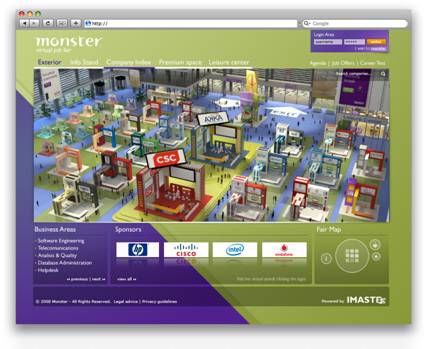
In 2009, IMASTE produced a number of virtual career fairs, including a large scale job fair for Monster Worldwide.  In addition to virtual career fairs, IMASTE produced virtual tradeshows, including hybrid (physical + virtual) events.  IMASTE serviced clients in Europe and Brazil, including a virtual event in Croatian, for a client based in Croatia.

Looking ahead to 2010, Arias sees strong growth in the European market, as awareness of virtual events is growing – in addition, Arias believes hybrid events will be a large growth area in Europe.

View this video for more details about IMASTE – the video includes a brief demo of the Monster virtual career fair that IMASTE powered.


2010 Predictions For Virtual Events

December 3, 2009

Source: flickr (User: sassycrafter)

Back in August, I jumped the gun a bit and wrote a “year in review” posting about virtual events.  Now that we’re in December,  I think it’s high time to peer into the Magic 8 Ball and speculate on what’s in store for the virtual events industry in 2010.  Away we go…

Widescale adoption and integration of video conferencing

Virtual events have incorporated a lot of on-demand and live video – however, to date, the majority of attendee interaction has been via text (e.g. private text chat, group text chat, etc.).  Many platforms have enabled the use of attendee webcams (a la Skype) and that was a nice start.  In 2010, I believe that the virtual event platforms will integrate with third party video conferencing technologies in a big way – stirred largely by client demand for it.

Think about it – multinational corporations have adopted high-end video conferencing to encourage collaboration and save on travel costs.  They have the budget to invest in Cisco Telepresence or HP Halo.  As those same corporations look to adopt virtual events (e.g. for an annual virtual sales meeting), it’s only natural that they incorporate the video conferencing technology that they already have running.

To capture mid-market and small business interest, virtual event platforms will look to integrate with mid-tier video conferencing systems, such as Tandberg (whose acquisition by Cisco is pending) and Polycom.

Another interesting player is LifeSize Communications, an Austin-based provider of “mainstream telepresence” that was acquired by Logitech in November.  LifeSize recently launched an offering called Passport, which they term “a portable telepresence-quality system” that fits in the palm of your hand.

I see continued use of consumer-grade webcam technology in 2010 virtual events  – however, the game changer will be the incorporation of multi-party, HD video conferencing.

Emergence of global players

We’ve already seen the emergence in Europe of virtual event platforms – IMASTE in Spain and Ubivent in Germany.  I expect to see another European-based platform emerge in 2010, along with one or more in Asia Pac.  In addition, we’ll see services companies launch to capitalize on the demand (for virtual events) from publishers, corporations and event marketers.  The companies will provide both strategic and logistical services around virtual events.  You’ll see some start-up companies and you’ll also see physical event marketers spawn service offerings around virtual (or more logically, hybrid) events.

Industry consolidation

We’ll see the merging or acquiring of virtual event platform companies.  Some providers will look to acquire/merge out of platform capability gaps – while stronger players will look to complementary/synergistic technologies offered by the competition.  As the economic environment comes back around, companies (and their investors) will be more apt to combine forces to fuel the next phase of growth.  Lastly, larger and more established players in the “collaboration space” may look to acquire virtual event platform companies, to add a complementary piece to their product portfolio.

Decrease in “relative response rates”

Virtual events had a great run in 2009, but we’re now past the novelty, “wow, this is cool” phase.  In the B2B market, we now have plenty of users who have attended two or more virtual events.  If virtual event show hosts continue to use the same graphical templates, organize the same presentation agenda and re-create an identical experience to their last event, then “relative response rates” will drop – meaning, it will become harder and harder to recruit users to register and attend.

Decreased response rates are natural as any new “content type” grows beyond infancy – and the supply/demand ratio begins to tilt towards having more supply than demand (e.g. lots of virtual events).  Virtual event show hosts will need to consider the incorporation of gaming, the creation of affinity programs and more.  The solution to decreased response rates will be fun to watch – innovators will step to the table to find creative ways to engage and attract virtual event attendees.

Platforms take first step towards immersiveness

While virtual event attendees may not “require” the immersiveness of Second Life and other 3D virtual worlds – immersive capabilities provide real value in a B2B setting.  The most obvious use case is an immersive rendering of a complex product – consider the high-end video conferencing system, the high-end router, the latest luxury car model.  Instead of a 2D PowerPoint slide that highlights the capabilities of the video conferencing system, how about an immersive experience where attendees (aka prospects) get to experience the system and interact with it?

Client interest and demand will drive some platforms to add immersive capabilities in 2010.  I don’t expect a software download, however – it would serve platforms well to support the immersive experience within their existing framework (e.g. Flash, JavaFX, Silverlight).

Those are my 2010 predictions for virtual events.  I’d love to hear your’s!