
With Lead Generation and Virtual Events, It’s a Journey, Not a Project

October 23, 2010

Introduction

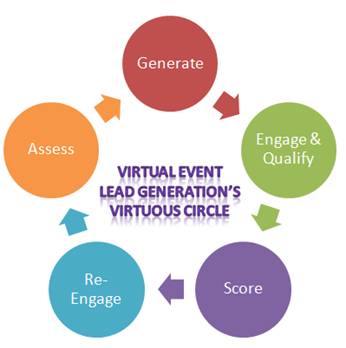
Virtual Events can be highly effective in generating leads to fuel your sales pipeline.  Here’s a 5-step process that I call the “Virtual Event Lead Generation Virtuous Cycle“:

  1. Generate
  2. Engage & Qualify
  3. Score
  4. Re-Engage
  5. Assess

Step #2 (“Engage & Qualify”) is quite unique for virtual events, compared to other online lead generation activities.  Virtual events allow you to generate leads (Step #1) and engage and qualify them on the spot.

With a white paper download or an on-demand webinar, the engagement and qualification occurs after the prospect has requested your content.  Note that I said “requested” – with a white paper download, you don’t even know if the prospect read the paper.

Lather, Rinse, Repeat

As the diagram above illustrates, effective use of virtual events for lead generation is done in a circle (or cycle), where you begin the next event with learnings from your prior event.

By knowing what worked and what didn’t work from your last event, you fine tune and optimize your strategies and tactics and become more effective in generating and engaging leads with each event.  So think of virtual event lead generation as an ongoing journey and not a discrete project.

To help on your journey, here are some useful resources that I’ve come across.

Generating Leads (Step #1)

  1. From BetterCloser.com, “Sales is Personal, Why Isn’t Your Lead Generation?”
  2. An eBook from Brian Carroll, “Eight CRITICAL Success Factors for Lead Generation
  3. From BtoB Online, “2010 Lead Generation Guide
  4. An interview with The Funnelholic, which includes insights on lead generation with virtual events.

Lead Scoring (Step #3)

  1. From Brian Carroll, “Lead scoring thoughts to share

Lead Re-Engagement (Step #4)

More commonly referred to as Lead Follow-Up, also includes Lead Nurturing

  1. From Marketo,  “Perfect Timing – When to Call a Prospect
  2. From LeadSloth, “What Lead Nurturing Content to Send When?”

Lead Assessment (Step #5)

A subset of Lead Management

  1. From The Funnelholic, “Lead Management: 67 tips from the biggest experts in the field

Lead Generation and Virtual Events – A Book

I’ll soon be publishing a book that provides related advice on generating sales leads with virtual events.  For further information on lead generation and virtual events, “Like” the book’s Facebook page.  Updates on the book’s availability will be posted here.  Best of luck on your own journey!

Eight CRITICAL Success Factors for Lead Generation


Virtual Edge Summit 2011

October 20, 2010

Heading into its third year, Virtual Edge Summit, the annual hybrid event covering “digital solutions for events, meetings, learning & community,” is moving up in the world.

Earlier this year, PCMA and Virtual Edge announced that the Virtual Edge Summit would be co-located with PCMA’s 2011 annual meeting in Las Vegas.

As in past years, Virtual Edge Summit will be a hybrid event, featuring both on-site and virtual components.

Make it a 2011 New Year’s Resolution and attend this valuable event.  You’ll hear from the industry’s experts and thought leaders and be able to network with key people in the industry.

Readers of this blog are welcome to a special discount, which is available at this link:

http://virtualedgesummit.com/registration_reader/

By registering from this page, you’ll receive a $120 discount off the $595 registration fee for in-person and $90 off the $195 for virtual.

“Over the past 18 months, virtual events have gained momentum, moving from a nice-to-have to an integral part of an organization’s online strategy,” said Michael Doyle, executive editor of Virtual Edge Institute.

“Virtual Edge Summit is the only conference that will bring together thought leaders from Cisco, IBM, Hilton Hotels and more to discuss business strategies and best practices for taking your business virtual.”

Related Links

  1. ROI Case Study: Virtual Edge Institute’s Hybrid Event
  2. My observations from Virtual Edge Summit: 2010 Trend Watch: Virtual Events

Job Listing: Director of Online Events at Everything Channel

October 19, 2010

Position: Director, Online Events


About Everything Channel

Everything Channel is the premier provider of IT channel-focused events, media, research, consulting, and sales and marketing services. With over 30 years of experience and engagement, Everything Channel has the unmatched channel expertise to execute integrated solutions for technology executives managing partner recruitment, enablement and go-to-market strategy in order to accelerate technology sales. Everything Channel is a UBM company. To learn more about Everything Channel, visit us at http://www.everythingchannel.com.

Job Description

Everything Channel has a fantastic opportunity for a Director Online Events.  This position will interface with senior management, sales, edit and sponsors to create virtual events and webcasts.  This position must be based in one of the following Everything Channel office locations:  Framingham, MA;  Manhasset, NY; San Francisco, CA.

For more info: view the full job listing

Responsibilities

  1. Virtual event marketing and management
  2. Sales tool development
  3. Virtual event management
  4. Evaluate new virtual platforms
  5. Lead virtual platform migration team
  6. Collateral creation
  7. Training new sales reps on virtual event product offerings
  8. Planning and managing budgets for virtual events
  9. Manage virtual event project manager

Qualifications

  1. BA/BS Degree
  2. Minimum of 5 years experience working in a position managing Virtual Events
  3. Strong knowledge of Virtual Event platforms
  4. Must be a strong conceptual thinker, with the ability to understand the ‘big picture’ of a project
  5. Must have flexibility, good judgment and attention to detail
  6. Ability to handle multiple high priority projects in a deadline-driven environment
Required Skills
  1. Strong knowledge of Virtual Event platforms
  2. Must be a strong conceptual thinker, with the ability to understand the ‘big picture’ of a project
  3. Must have flexibility, good judgment and attention to detail
  4. Ability to handle multiple high priority projects in a deadline-driven environment
Required Experience
  1. BA/BS Degree
  2. Minimum of 5 years   experience working in a position managing Virtual Events

For more information or to apply online, visit the full job listing.


How To: Generate More Effective Virtual Trade Show Booths

October 19, 2010

My local farmers market had a “Vote 4 Your Favorite Booth” contest.  While the contest was active, I noticed that the fruit vendors were much more engaging and the amount of free samples increased dramatically.  The fruit stands had become more customer-friendly as a result of the competition.  This was a great thing.

I immediately thought – virtual trade shows are a lot like farmers markets – how about creating a similar contest?  Let’s consider a “Vote For Your Favorite Booth Contest” at your next virtual trade show.  The benefits:

Attendees Take Notice

The contest causes attendees to take notice, especially if you offer up prize(s) for voting.  The contest provides attendees a framework (and context) for their booth visits.  Now, when they enter any exhibitor booth, they are paying more attention to what’s there, to judge the current booth to other booths they visit.  Ultimately, they will need to determine their top vote, which requires a certain level of engagement and awareness as they move from one booth to the next.  And that’s a good thing for exhibitors.

Exhibitors Boost and Optimize their Presence

Ever sell a home or condo and host an open house?  I bet your home was de-cluttered and nearly spotless.  And I bet some of you baked cookies for the occasion.  A booth contest is a lot like the open house: the host knows that its visitors will be evaluating the space.  This results in:

  1. More captivating and refined booth imagery
  2. Booth content that aims to please (the visitor)
  3. A higher level of booth staffers
  4. More engagement from booth staffers (just like at the farmers market)

With everyone “raising their game”, this means that exhibitors win and attendees win as well.

SaaS: Sampling as a Service

In the picture above, a fruit stand placed a large assortment of samples in labeled bins, allowing visitors to sample for themselves. I call this Sampling as a (Self) Service!  The idea here is to allow “prospects” to sample your “products” (on their own) and then have a “staffer” come by to see if they have any questions.

The same could be done in a virtual trade show. Place your products in your virtual booth and allow visitors to take them on a test drive.  Let them do their thing, but check in with them from time to time to see if they need assistance.

Logistics

Here’s how the booth contest could be run:

  1. Heavily promote the contest prior to the event
  2. Educate and inform exhibitors on the ground rules
  3. Create meaningful incentives for attendees to vote
  4. Announce the winner two-thirds of the way through the event. This leaves the remaining one-third of the event for the winner to receive the benefits (traffic to their booth)
  5. Create a badge or logo that the winner can place on their web site and share via social networks

Conclusion

The virtual booths at some events can be underwhelming.  A contest can encourage and motivate the exhibitors and create a win/win/win for attendees, exhibitors and you.


Hybrid Events: Where Virtual Complements And Augments Physical

October 13, 2010

Over at the INXPO blog, we had the privilege of publishing guest postings from two thought leaders in the events industry, Heidi Thorne (@heidithorne) and Traci Browne (@tracibrowne).

Both wrote about their experiences attending a hybrid event, Event Camp Twin Cities 2010.  And both came away concluding that virtual components (e.g. video, Twitter, etc.) can significantly augment audience reach and audience engagement.

Successful Hybrid Event Case Study: Event Camp Twin Cities 2010 (by Heidi Thorne)

Heidi served as the Twitter moderator for Event Camp Twin Cities, so she had her hands (and fingers) full, watching the sessions, while exchanging tweets (and retweeting) with the virtual audience.

Of course, the on-site (physical) audiences in the Twin Cities, Dallas and Switzerland were a subset of the virtual audience, since they (on-site) were actively tweeting as well.

Heidi makes good points about the use of technology and virtual moderator(s) in a hybrid event.  Here’s a link to the full posting:

http://inxpo.wordpress.com/2010/10/07/successful-hybrid-event-case-study-event-camp-twin-cities-2010/

Make Your Events and Expos a Virtual Reality (by Traci Browne)

Traci attended Event Camp Twin Cities from her home office and felt like she was there in the Twin Cities.  She then gives us all some food for thought, by providing hybrid event ideas for Education and Networking.

For Education, I love idea #3, to interview virtual attendees and broadcast the interviews to the on-side audience.  What a great way to bring the virtual into the physical.

For Networking, I love idea #2, to have physical attendees send swag bags to virtual attendee pen pals, with the physical attendee’s name attached to it.  I say we go with T-shirts and pens and hold the coffee and cocktails.  Here’s a link to the full posting:

http://inxpo.wordpress.com/2010/10/11/make-your-events-and-expos-a-virtual-reality/

Thanks, Heidi and Traci, for the insightful postings.


Book Excerpt: Generate Sales Leads With Virtual Events

October 9, 2010

BUY THE BOOK: Generate Sales Leads With Virtual Events (Amazon.com)

I’m finalizing a book, “Generate  Sales Leads With Virtual Events.”  I’m self-publishing the book via a neat service called FastPencil.  The book will be available for sale in a few weeks – it will be listed on Amazon in both traditional (printed) format and for the Kindle.  The book will feature a great foreword written by Craig Rosenberg (@Funnelholic), a lead generation expert.

I’m including Chapter 1 (“Introduction”) to the book below.  In addition, I’ve posted this chapter on a wiki:

http://allvirtual.pbworks.com/w/page/Chapter-1%3A-Generate-Sales-Leads-With-Virtual-Events

Feel free to edit this page, to show us how you would have written this chapter – thanks!

Chapter 1: Introduction

I can vividly recall my first experience exhibiting at a trade show.  It was the early 1990’s and I was fresh out of college.  I worked for a company that sold Internet connections to corporations.  My colleagues and I flew across the country for the conference, where we sought to generate sales leads.  We arrived at our destination a day or two prior to the conference, so that we could set up our booth, network our demo workstations and place our sales collateral in neatly organized stands on the show floor.  Undoubtedly, a colleague or two got stranded in their home airport, forcing a lucky few of us to pick up the slack and handle the booth set-up.

Then, there was the workstation monitor that wasn’t delivered to our booth.  Did our colleague forget to include it in the shipment?  Was it lost in transit?  Or was it on the conference facility’s loading dock?  It was late in the evening, so no one was available to answer these questions.  Hopefully, we’d be able to sort it out in the morning.  The workstation monitor ended up arriving a day late, but everything came together and we had a successful show.  I spent my time giving demonstrations to curious booth visitors, who wanted to know more about the “Internet”.  This was before the Mosaic and Netscape browsers hit the scene, which meant that Internet demos centered largely around character- based “telnet sessions” to services called Archie, WAIS and Gopher.

At the end of the conference, we were tired and weary, but managed to collect some 50 business cards that we’d distribute to our sales team when we returned to the office.  For particularly “hot” leads, we scribbled notes on the back of business cards, sending along important notes to the receiving sales representative.  Fast-forward to our present day era of widespread broadband, Web 2.0 and social marketing.  But now imagine a trade show that has global reach.  A trade show that requires no travel, lodging or “out of office” time.  A trade show with no physical booth set-up.  A trade show with detailed tracking of sales lead activity.  A trade show that remains available after the scheduled activities conclude.  Welcome to the virtual trade show!

Virtual trade shows are a flavor of the broader category of virtual events.  In the coming chapters, I’ll cover how virtual events can be effective in generating sales leads.

The Marketing Landscape: Where Virtual Events Fit

Marketers today face the same challenges that my colleagues and I encountered in the early 1990’s.  From their CEO or CFO, they’re tasked with generating an increasing flow of sales leads, but at lower cost.  From their VP of Sales, they’re tasked with the same flow of sales leads, with the additional condition that the leads be “marketing qualified” and “sales ready.”  Often, the two objectives can counteract one another, as lower-cost sales leads tend to be lower quality, which means that they’re less “sales ready.”

How can marketers satisfy both objectives simultaneously?  With the evolution of the web, many have turned to online lead generation.  With online lead generation, marketers can distribute content across the web – white papers, product collateral, case studies, webinars, videos, podcasts and more.  Prospects “discover” the content via the company’s web site, search engines, publisher web sites or via social networks.

Before a prospect can gain access to the content, they may be required to complete a registration profile.  When the prospect completes the profile, we call this a “generated lead” and the marketer has just gained a “sales inquiry.” Web-based, online lead generation comes with fairly low costs, since the “transactions” occur entirely on the web – the costs for shipping, print, freight, travel, etc. are from days long gone.

Once a lead is generated, marketers must qualify the lead.  Often, Marketing will perform an initial evaluation of a lead via pre-defined criteria, such as country, job level, company type, size of budget, etc.  The marketer will need to gauge the prospect’s interest, along with their position in the sales cycle.  Is the prospect engaged in preliminary research to define the solution space?  Or, has the prospect defined the solution space and is looking to narrow the list of potential products?  Or, perhaps the prospect is at the tail end of the evaluation and is looking to make a final decision on a product.

To determine the prospect’s position in the sales cycle, marketers often use a series of communications (e.g. emails, phone calls, etc.), evaluate the responses (if any) to those communications and then follow up with subsequent communications.  Marketers decipher the clues provided by the prospect and determine whether to forward the prospect to Sales – or, to continue the qualification process.

Common clues in the qualification process include:

  1. Did the prospect answer my phone calls?
  2. Did the prospect answer the questions we asked?
  3. Did the prospect open my emails?
  4. Did the prospect click on any of the links in the emails?
  5. Did the prospect download any of the documents referenced in the emails?
  6. Has the prospect requested more information – or, a meeting with us?

Marketers can develop formulas around the prospect’s interactions, to determine which combination of actions moves the prospect from a sales inquiry to a Marketing Qualified Lead (MQL).  Once prospects have moved into MQL status, they can be distributed to the Sales team for further follow-up. A primary challenge in this process is the amount of qualification that occurs “post-lead.”  At the time the lead is generated, a minimal amount of information is known about the prospect, beyond the information submitted in the registration profile.  With a webinar, a marketer may know how many times it was viewed – or, the total viewing time across all views.  With a white paper or podcast download, however, the marketer only knows that a request for download was made.  The marketer may not even know whether the download completed – or, if the content was consumed!

As a result, marketing qualification depends upon ongoing touchpoints with prospects, with the hope that they continue to respond to marketers’ communications.  Now, let’s consider virtual events.  I define a virtual event as “a web and occasion-based gathering that facilitates information sharing, collaboration and interaction.”  Alternatively, consider a trade show, with its sessions, presentations, exhibitor booths, networking areas, etc. – and have it occur 100% on the web.  We call that a virtual trade show.

Conclusion

Virtual events can be a dream for marketers.  They can generate leads cost effectively and they facilitate real-time interactions with sales prospects that can lead to quicker and more efficient marketing qualification.  The “post-lead” nurturing process has been combined into the same act of generating the lead.  I call this “accelerated lead generation” and for marketers, this means more “sales ready” leads that Sales can then turn into faster bookings.

This book will show you how to create those valuable, real-time interactions – taking you from the planning process, to audience generation and engagement strategies and finally to lead qualification and follow-up.

Webinar Evolution

October 6, 2010

Introduction

Do you attend webinars?  If so, what is your satisfaction level with the experience?

Webinar Q&A

I was attending a highly captivating webinar last week.  The speaker had delivered a great, crisp presentation and was doing a great job answering questions during the Q&A period.  While viewing the webinar, I tweeted the following:

Needed in webinars: tool for producer to dynamically insert Q&A topic on screen – better than seeing static closing-slide image

When presenters complete their presentation and transition to Q&A, the viewer is left with a closing slide.  That slide remains unchanged for the duration of the Q&A session.  Couldn’t the moderator play a role here by generating some updates that appear in the webinar player, adding some context to the presenter’s answer?

That’s one of many ways that the webinar experience can evolve.  About a year ago, in fact, I wrote a posting about applying Web 2.0 features to webinars.  Here’s a link to that posting:

https://allvirtual.wordpress.com/2009/09/28/from-web-2-0-to-webinar-2-0/

Let us know your thoughts – how can webinars evolve?


“It’s All Virtual” On Virtual Worlds

October 3, 2010

Introduction

Given Microsoft’s rumored interest in acquiring Linden Lab (developers of Second Life), I thought I’d assemble some recent virtual worlds content.

Related: “Microsoft Buys Vivaty For New Project, May Be Looking For More,” from Virtual Worlds News

Virtual worlds have taken a hit, as Twitter, Facebook and other services have become media darlings.  And while I love social networks as much as anyone, I do think the market is under-considering (if that’s a word) the potential of virtual worlds technologies.

At A Crossroads: Where Does Second Life Go From Here?

I analyzed different directions that Linden Lab could take Second Life.  Of course, one that I did not cover was an exit – if the rumored exit (Microsoft) were to happen, I’m very curious to see how and where Microsoft folds the Second Life technology into its business.

On a slightly related topic, I wrote about how virtual worlds can be more like Twitter and Facebook – that is, more social and more open to the rest of the web.

Related: Guest Post from Pooky Amsterdam, “The Business Benefits of Second Life.”

Conference Coverage: FountainBlue Virtual Worlds (September 2010)

  1. 3 Virtual Worlds Technologies To Watch
  2. Trends In The Virtual Worlds Industry
  3. Hear From A Panel Of Virtual Worlds Entrepreneurs

Conference Coverage: Stanford Media X Virtual Worlds (August 2010)

  1. Stanford Media X Event: Virtual Worlds Entrepreneurs Show The Way
  2. Stanford Media X Event: IMVU’s Online Community

Hear From A Panel Of Virtual Worlds Entrepreneurs

September 30, 2010

On September 24th, FountainBlue held its annual virtual worlds conference.  This year’s event was hosted on Cisco’s campus in Milpitas, CA.  In the afternoon, a panel of virtual worlds entrepreneurs spoke about new developments in the industry.  The panel was titled “Entrepreneur Panel: The Tools, The Goods, The Immersion Experience”:

  1. Facilitator Nina Gerwin, The NRG Group
  2. Michael Gold, CEO, Electrotank: virtual world & virtual games development platform
  3. Steve Hoffman, CEO, Rocketon: virtual world for tweeners
  4. Albert Kim, CEO, Zenitum: Augmented reality with 3D displays
  5. Jim Parker, President, Digitell: SaaS 3D immersive virtual events and virtual training

I covered some of these entrepreneurs’ businesses in a separate posting about virtual worlds technologies to watch.

Adapting your business

Each panelist was asked to describe the genesis behind their business.  As is customary with web startups today, no one is working against their original business model or vision.

For Digitell’s Jim Parker, business began by assembling content for online libraries.  Then, he was struck by the notion of allowing consumers of the library content to meet and collaborate in real-time.

Zenitum’s Albert Kim experiments with a number of different technologies.  When one set of technologies differs enough from the core set, he looks to spin that out into an independent company.

Online gaming

Online and social gaming may be the hottest trend on the web today.  So of course the topic arose with Electrotank’s Michael Gold and RocketOn’s Steve Hoffman.  Gold and Hoffman highlighted technologies available to game makers today:

  1. Flash
  2. HTML5
  3. Objective C
  4. Unity

Note: Unity’s David Helgason spoke on the Trends Panel at this event.

According to Gold, HTML5 has its benefits, but you can’t yet develop a game using it.

Note: Michael Gold posted the following clarification:

“I just want to make a quick correction on a statement about HTML5 that was attributed to me in this blog post. What I said on the panel was that HTML5 is not yet practical for developing *virtual worlds* but has great potential in a few years.

Virtual worlds and MMOs present unique technical challenges that are distinctly different than those presented by the majority of social and casual online and mobile *games* Thus in my opinion it is completely possible to develop *games* using HTML5 at the present time. There are several developers focusing on these games right now. In fact, Zynga recently purchased one – Dextrose, a German development studio. I actually believe you’ll see a significant number of HTML5 games on the market a year from now. Just not so many virtual worlds or MMOs.”

Virtual worlds and engagement

An audience member asked how virtual worlds can track engagement – so that in a corporate setting, the meeting host can measure whether the content is hitting the mark.  Digitell’s Parker notes his clients often use his system for accreditation.  The system uses an idle timer – it renders a “click to continue” message and if the user does not click within 10 seconds, “you don’t get accreditation.”

Studies have shown that viewers of webinars often lose attention and multitask.  A virtual world forces users to remain engaged.  Parker notes that for some sessions, the instructor leads the “students” on a guided walk.  “If Jim doesn’t follow the rest of the group, then you know he’s not paying attention.”

Conclusion

Believe it or not, it’s not a bad time to be a virtual worlds entrepreneur.  As the panel demonstrated, the key is to be nimble and adapt to a changing marketplace.  Next year, it will be interesting to see how these entrepreneurs evolved – and, to see what new entrepreneurs appear on the scene.