Virtual Events: Ready, Set, Go (eBook)

July 23, 2010

Announcing the availability of a FREE eBook (PDF):

Virtual Events: Ready, Set Go

This eBook was created from a collection of past blog postings that cover virtual event basics, such as planning, selecting a platform and building your virtual booth.  You can see most of the blog postings on this Virtual Events 101 page.

Note, this is in PDF format – it’s not the same type of “eBook” that you read on the Amazon Kindle, iPad or related device.

Here’s the chapter outline:

  1. What is a Virtual Event?
  2. Planning Your Virtual Event
  3. Selecting a Virtual Event Platform
  4. Building Your Virtual Booth
  5. Running a Virtual Event Command Center
  6. Organizing a Virtual Event De-Brief

Here’s the link to download your free copy:

Virtual Events: Ready, Set, Go

Enjoy – and, drop a comment below to let me know your feedback.  Thanks!

Tweet this posting:


Silicon Valley Virtual Worlds Conference: Seeking Expert Panelists

July 21, 2010

On September 24th 2010, FountainBlue will hold its “Second Annual State of the Virtual Worlds Industry Event” in Silicon Valley (California/USA).  The topic of the event is:

Virtual Worlds: Where We Were, Where We’re Going, What Does It Mean to YOU?

Previously, I posted a summary of the 2009 event.

This year, I’ll be moderating a panel discussion on corporate use of virtual worlds – the title of the session is:

Corporate Panel: Serving Customers, Building Communities, Training Users

I’m seeking expert panelists (local to the Bay Area / Silicon Valley) who have used virtual worlds in a corporate setting (e.g. for customer engagement, marketing, community building and learning/training).

If you’re interested in being a panelist, drop a comment below, find me on Twitter (@dshiao) or send email to dshiao (at) yahoo (dot) com.

Here are more details about this event:

FountainBlue’s Virtual Worlds Annual Conference
Topic: Virtual Worlds: Where We Were, Where We’re Going, What Does It Mean to YOU?
Date & time: Friday, September 24, 2010, from 8:30 a.m. until 3:00 p.m.
Location: TBD – Silicon Valley (USA)
Cost: Register by September 23 at noon: $42 members, $52 partners, $62 general
Late and On-Site Registration: $83 for members, $93 for non-members
Registration Link: http://www.fountainblue.biz/virtualworlds.html
Audience: Entrepreneurs, Intrapreneurs and Investors only. No service providers please.

Tweet this posting:


Social Gaming And Virtual Events

July 19, 2010

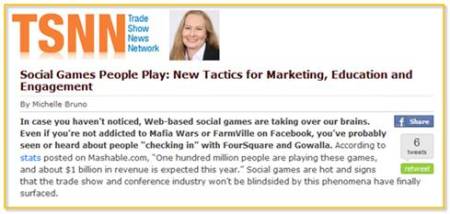
Michelle Bruno (@michellebruno) wrote an excellent article about social gaming in Trade Show News Network (TSNN.com) – I was interviewed by Michelle for the article.  Michelle covers the emergence of social games, including their incorporation into virtual events platform, like INXPO (my employer).

Michelle concludes her article with some compelling thoughts.  First, there’s this:

“As traditional methods of marketing and engagement wane in effectiveness and popularity, social gaming strategies fit nicely into two current trends in the event industry: the ‘social media-ization’ of nearly every technology solution and the blending of the online and offline event worlds.”

These trends play off one another nicely – as social media (and associated tools) are quite effective in blending online and offline event experiences.  I love Michelle’s closing line:

“Social gaming in the event industry could be the spark that ignites a new generation of trade show attendees.”

Love it.

Here’s the full link to the article: http://www.tsnn.com/blog/?p=2692

Tweet this posting:


Let’s Collaborate On: Virtual Events Frequently Asked Questions (FAQ)

July 14, 2010

I’m inviting the community to engage in a PBworks wiki – the idea is to maintain a living FAQ (Frequently Asked Question) document on virtual events.

Ask any question you like – if it’s appropriate and relevant, the virtual events community will answer it.  If the question is not relevant or inappropriate, one of us is likely to delete it.

You can find the wiki here:

http://allvirtual.pbworks.com/Virtual-Events-FAQ-%28Frequently-Asked-Questions%29

How can you participate?  Let me count the ways:

  1. Ask a new question!
  2. Edit existing content
  3. Add new questions to the FAQ
  4. Add new “topical categories” to the FAQ
  5. Answer questions that have not yet been answered

Below, I’ve listed the initial “skeleton” of the FAQ.  Please view the wiki and participate!

General

  1. What is a virtual event?
  2. What are the different types of virtual events?
  3. What are the benefits of virtual events?
  4. Why are virtual events popular?
  5. What’s the difference between a virtual event and a virtual world, such as Second Life?

Technology

  1. What are the technical requirements (prerequisites) for attending a virtual event?
  2. What technology serves as the foundation of virtual event platforms?
  3. Can virtual events incorporate live video streams?
  4. What third party technologies do virtual event platforms integrate with (e.g. CRM, ERP, etc.)?

Technology Providers

  1. What companies provide virtual event platforms?
  2. What companies provide complementary technologies to virtual event platforms?
  3. Are there any independent analyst reports on the virtual event platform providers?
  4. What criteria should I use to evaluate virtual event platforms?
  5. Are there any independent measurement providers (e.g. like a Keynote for virtual event platforms)?

Resources

  1. Where do I go to get more information on virtual events?
  2. Are there any online communities around virtual events?
  3. Are there any good introductory White Papers on virtual events?
  4. How do I experience a sample virtual event?

Tweet this posting:


How Vendors Should Evolve Their Virtual Event Platforms

July 10, 2010

The following is a collaborative posting by Miguel Arias, Steve Gogolak and Dennis Shiao.

Content creation and collaboration was facilitated by a PBworks wiki – the wiki page can be found here: http://allvirtual.pbworks.com/How-Vendors-Should-Evolve-Their-Virtual-Event-Platforms

To evolve their platforms for enhanced experiences and broader adoption, virtual event platforms should consider the following:

Make it easier to experience

Most virtual event platforms are easy to use – on a first-time visit, users tend to grasp the overall user experience and can figure out where to go (and how).  That being said, for wide scale adoption, virtual events needs to be as easy as Facebook.  That is, our grandmothers need to be able to access the site and figure things out.  On Facebook, grandmothers can update their profile, read their “friends” posts and write updates to their Walls.  Can a grandmother login to a virtual event, update her profile and participate in a group chat?  We’re not so sure.  Similarly, navigation and interactions need to be easier.  Most virtual events are intuitive to navigate (e.g. Lobby, Auditorium,  Lounge, etc.) – but may not be so intuitive with regard to message boards, chat, blogging, rating, etc.

Along with a simplification of interfaces and the use of usability and navigation conventions, many customers and users seem to be demanding more immersive environments. While presenting a brand and hosting an interactive experience in a convention centre, it seems an interesting field to add some real-time rendered environments using engines like papervision3D or Unity3D. This said, it is unlikely that avatar-based real time rendered environments will make it to a mainstream audience. Key considerations (or obstacles) are plugins or applets downloads, system performance and learning curve barriers.

Make it easier to find

The typical “location” of a virtual event is quickly becoming outdated – microsite with registration page, with no ability to experience the event prior to completing all mandatory registration fields. The registration page serves as a “wall” not only to potential attendees, but to search engines as well.  Virtual event platforms need to move “outside the wall” and expose their technology on Facebook, on blogs and on publisher web sites.  Platforms should widen their distribution via widgets, embed code and application programming interfaces (API’s).  Facebook is not limited to Facebook.com – it has Facebook Connect, Facebook Open Graph and much more.  Virtual events platforms, on the other hand, seem to be restricted to “VirtualEventPlatform.com”

Make it easier to access

The most relevant virtual event platforms will introduce, or already have, Facebook Connect and Twitter API, and they will need to move to even wider standards like OpenID.  For public events, ease of registration is a must.  Using open methods for registering and/or connecting social networks have three-fold benefits:

  1. Registration is faster because basic information can be provided by services like LinkedIn, Facebook, etc.  Shorter registration forms increase completion, period.
  2. Intelligence gathered by the platform about the user’s existing social graph can enhance the experience within the event by automatically creating connections with other attendees based on that user’s connection outside the platform.  This will lead to more networking and awareness of actual people within the environment.
  3. Users opting into connections at the point of registration allows platforms to create publishable actions that can be spit out to twitter and facebook news feeds that can increase viral awareness of the event.  Marketing automation at its best.

On the other hand, desktop or mobile widgets to control your stand usage, statistics and reporting will be a must. Lastly, the platforms will have extensive APIs to manage their integration with various social networks, corporate databases, physical event managing software, etc.

Make the experience available on more devices

Most virtual event platforms support Windows, Mac and Linux.  They need to support more platforms, especially mobile.  On the mobile front, it’s important to consider iPhone/iPad, Android, BlackBerry, Symbian, Windows 7 Phone and WebOS (listed in our order of importance).  To start, we don’t believe the entire virrual event experience needs to be “ported” to mobile devices -rather, vendors should determine the most critical features for attendees and exhibitors – and prioritize based on importance.  For instance, chat is an important element of virtual events, so why not make a mobile app that allows exhibitors to staff their booth via their smartphone.

The entire 3D environment does not need to be supported on a mobile device, but the networking tools (visit card managing, real time conversation, etc) and the reporting tools certainly do. On the other hand, it will be interesting to see what happens with Flash and Apple, and see which vendors will try to develop their platforms using HTML5.

One of the key areas where mobile can play a huge role is the “reminder” needs that come from tons of scheduled activities within virtual events.  If attendees have the ability to build out a personalized agenda before the event and opt-in to either SMS reminders or download some kind of app that will push notifications at them throughout the day, it would be much easier to create a flexible agenda.  Currently we’re cramming so much into the shortest amount of time because we’re afraid of losing people.  If only we had better planning and reminding tools, driven by devices that never leave our pocket!

Make the platform more adaptable and flexible

Related to our point about mobile support, platform vendors have important decisions to make regarding the development platforms.  Virtual event platforms today are based on Flash, Flex, Silverlight, Java and JavaFX.  Are those the “right” platform technologies for the future – or, should platforms move in the direction of HTML5?  Does a combination off HTML5, Javascript and Ajax create a more adaptable and flexible platform?  What do we “lose” by shifting away from Flash, Silverlight, etc.?  And what are the mobile implications with the chosen direction?  All good questions for the platform vendors to consider.

Make the platform more adaptable for different customer needs and different usage

There are so many different kind of virtual events: trade shows, conferences, job fairs, corporate events, webinars, congresses… that vendors should decide in which market niche they are going to play. We will see generic platforms and other vendors delivering a tailored solution for one or many of the previous choices. It will become more and more complex to provide physical event managers with the features they need to handle their hybrid events at the same time as the platform is able to cope with the extensive data handling of the virtual job fair, or the networking tools of a professional tradeshow.

Take a hint from Apple and FaceTime

Video chat will, without a doubt, increase the effectiveness of networking.  It is the one key element that can be introduced that will get critics to come around to the idea that networking in an online environment can be as effective as the cocktail hour of a physical event.

Tweet this posting:


Virtual Event Evolution

June 28, 2010

In a prior blog posting, I promoted a wiki that I created that allows us to collaborate on the evolution of virtual event platforms.  The wiki received some very thoughtful contributions.

Miguel Arias (IMASTE) added several insights via the wiki. In the paragraph “Make it easier to experience” he writes:

Along with a simplification of interfaces and the use of usability and navigation conventions, many customers and users seem to be demanding more immersive environments. While presenting a brand and hosting an interactive experience in a convention centre, it seems an interesting field to add some real-time rendered environments using engines like papervision3D or Unity3D. This said, it is unlikely that avatar based real time rendered environments will make it a a mainstream audience. Mainly considering plugin or applets downloads, system performance and learning curve barriers.

In the paragraph “Make it easier to experience” he writes:

The most relevant virtual event platforms will introduce or already have Facebook connect and twitter connect, and they will need to move to even wider standards like OpenID. On the other hand, deskopt or mobile widgets to control your stand usage, statistics and reporting will be a must. Lastly, the platforms will have extense APIs to manage their integration with various social networks, corporate databases, physical event managing software, etc.

Miguel then added a new paragraph:

Make the platform more adaptable for different customer needs and different usage

There are so many different kind of virtual events: trade shows, conferences, job fairs, corporate events, webinars, congresses… that vendors should decide in which market niche they are going to play. We will see generic platforms and other vendors delivering a tailored solution for one or many of the previous choices. It will become more and more complex to provide physical event managers with the features they need to handle their hybrid events at the same time as the platform is able to cope with the extensive data handling of the virtual job fair, or the networking tools of a professional tradeshow.

Steve Gogolak  (Cramer) also added several insights via the wiki. In the paragraph “Make it easier to access” he writes:

For public events, ease of registration is a must. Using open methods for registering and/or connecting social networks have three-fold benefits:

  1. Registration is faster because basic information can be provided by services like LinkedIn, Facebook, etc. Shorter registration forms increase completion, period.
  2. Intelligence gathered by the platform about the user’s existing social graph can enhance the experience within the event by automatically creating connections with other attendees based on that user’s connection outside the platform. This will lead to more networking and awareness of actual people within the environment.
  3. Users opting into connections at the point of registration allows platforms to create publishable actions that can be spit out to twitter and facebook news feeds that can increase viral awareness of the event. Marketing automation at its best.

In the paragraph “Make the experience available on more devices” he writes:

One of the key areas where mobile can play a huge role is the “reminder” needs that come from tons of scheduled activities within virtual events. If attendees have the ability to build out a personalized agenda before the event and opt-in to either SMS reminders or download some kind of app that will push notifications at them throughout the day, it would be much easier to create a flexible agenda. Currently we’re cramming so much into the shortest amount of time because we’re afraid of losing people. If only we had better planning and reminding tools, driven by devices that never leave our pocket!

In the paragraph “Make the platform more adaptable for different customer needs and different usage” that Miguel created, Steve writes:

Take a hint from Apple’s “face time”. Video chat will, without a doubt, increase the effectiveness of networking. It is the one key element that can be introduced that will get critics to come around to the idea that networking in an online environment can be as effective as the cocktail hour of a physical event.

To view the fruits of our collaboration, you can read the wiki page here:

http://allvirtual.pbworks.com/How-Vendors-Should-Evolve-Their-Virtual-Event-Platforms

By default, you’ll be taken to the “VIEW” tab – to contribute, click on the “EDIT” tab. We’d love to hear (read) your thoughts!

Tweet this posting:


What I’ve Been Tweeting (Edition 1.0)

June 25, 2010

Because tweets are temporal, while blog postings are permalinked…

Selected musings and sharings, all done in 140 characters or less – for a full subscription (at absolutely no cost), follow me at @dshiao.

What I’ve Been Tweeting

Virtual Events

  1. #Telepresence In #Virtual Events With @G2Events: http://bit.ly/bcALWq #eventprofs
  2. Lots of #virtual events this month – see calendar: http://bit.ly/6IYdC5 | just added CSCO Summit & Retail Marketing events
  3. @VirtualEdge highlights @CiscoLive 2010, with thoughts from @dveale: http://bit.ly/bSjeJw
  4. Let’s collaborate on the evolution of #virtual events – info: http://bit.ly/brNUGE & wiki: http://bit.ly/9AF7JU #eventprofs
  5. 5 Tips For A Successful Virtual Trade Show by @funnelholic: http://bit.ly/ciApcx
  6. Maximizing the #ROI of #Virtual Trade Shows – Tips from the Trenches: http://bit.ly/9nBATP (by @ellehwoulfe) #eventprofs
  7. A @Focus discussion on #virtual events & what works: http://bit.ly/drin3W (via @funnelholic) #eventprofs
  8. Making Virtual Event Connections”: @dveale on Twitter/Facebook/LinkedIn integration into @CiscoLive Virtual: http://bit.ly/ao0Ibm

Social Media

  1. #socialmedia will shift from specialized machinery in hands of few to Swiss Army knife in hands of many (my take from #ragancisco)
  2. Just noticed: @Yelp now has “Follow This Reviewer”, a “Compliment” button on each review and a type of badge (“Elite ’10”)
  3. Expect @Groupon to ramp up on social: “Most people who use Groupon don’t realize it’s a group purchasing site” (said CEO in @NYTimes)
  4. RT @samueljsmith: Free Report: #SocialMedia in the New Event World http://ow.ly/1YOg4 #eventprofs #mpi RT @ericlukazewski
  5. YouTube Gets a Cloud-Based Video Editor: http://bit.ly/9z3BFS (from @RWW – good stuff, @YouTube)
  6. Fabulous: Inside @Gatorade’s Social Media Command Center from @Mashable: http://bit.ly/9Ma4d8
  7. “8 Interesting Media Offerings on LinkedIn”: http://www.clickz.com/3640716 (by @HarryJGold) – @LinkedIn has a white paper program

Cloudforce 2010

  1. Salesforce doing demo of Chatter app for iPad – planning to release later this year #Cloudforce #Cloud2
  2. Dell is on stage doing demo of Chatter running on the new Dell Streak (Android tablet) – 5 inch form factor #Cloudforce
  3. Neat things from #Cloudforce keynote: #Chatter demo on web, iPad; Jigsaw integration; Service Cloud 2 demo
  4. My learning from #Cloudforce: the cloud can move business “chatter” from a backchannel to an always-on channel
  5. Salesforce using 40-50 percent less email since they enabled #Chatter internally #Cloudforce
  6. #Chatter used to collaborate and share docs within a business – who’s thankful? The Exchange Administrator

Product Ideas

  1. Idea to promote businesses: design floor tiles with embedded QR codes – some patterns I see already look like them 😉
  2. Product idea: Twitter Funnel Server. Why? Because without one, companies would feel like they’re drinking from a firehose

General

  1. How iPhone 4 Could Change Augmented Reality: http://bit.ly/cbgxw8 (via @RWW) #AR
  2. RT @ojchiang: Watch The World Cup Through Your Video Game Console « Velocity – Forbes.com http://bit.ly/diu67X #worldcup
  3. A click is like a first date – it may be your only chance to make a first impression (via @ClickZ article)
  4. New term for startups who do not invest capital wisely: they operate at “broke-even” 😉
  5. Over breakfast, my first grader was talking about bloggers. Asked her to define “blogger” – her answer, “someone who blocks the road”

5 Tips For A Successful Virtual Trade Show

June 22, 2010

The following is a guest post from Craig Rosenberg.

On the 29th of June from 8AM to 4PM Pacific, I’ll be running my first virtual trade show: Mastering Lead Management.  At Focus, the company I work for, we’ve been doing webinars for our clients for years. But this virtual event is our first day-long comprehensive show.  To differentiate and make it as successful as possible, there were a few critical decisions we made during the show’s development:

We called it an interactive summit — To us, a virtual trade show or trades hows in general give the impression of a vendor bazaar where everyone’s main goal of the event is to get buyers introduced to vendors. Buyers expect more.

We leveraged all unbiased, third party content (no vendor pitches) — We have sponsors, but our approach to any content we create is all about making it “buyer-helpful,” that is, information that helps buyers do their jobs better or make more informed purchasing decisions.

We gave all sponsors full booth functionality — Instead of worrying about creating different pricing schemes for different features in the booth, we gave everyone everything we could.

    We think these decisions are at least in part the reason why we’ve garnered thousands of registrants to the event so far. Based on what I’ve learned and past experience with all kinds of trade shows, here are my 5 tips for successful virtual trade shows:

    1. It’s all about the content, it’s always about the content – All the blog posts and marketing we find today about virtual events is about minimizing environmental impact, shrinking travel budgets, etc.  While I think these points are interesting, we believe that if the content is compelling, they will come.  Think about it, despite all the marketing we are producing about people avoiding live events, they go and they go because they see value.  White papers, webinars, you name it, they all still work. But it’s about the content. Why would virtual events be different?  The answer is they are not.
    2. It’s all about the variety and volume of content – A virtual summit gives you multiple opportunities to peak a buyers interest with all kinds of content.  In a white paper or a webinar, it’s a one-shot deal.
    3. Content drives the types of leads you get – The biggest factor for the future of the virtual trade show market is ROI.  I can tell you that if you try to be something for everyone, then that’s what you’ll get.  Guess what, that is the problem with the traditional trade show market.  For successful lead generation, I’d suggest creating more targeted content and be prepared for less numbers.
    4. Virtual events are scoring machines – From a lead management perspective, virtual shows provide amazing activity data on attendees.  There is a lot of content available to participants and a lot of opportunities for interactivity. All of this should be collected and sent to whomever cares, such as sponsors.
    5. Understand why trade shows don’t work – This is a bit of a “reset” of the points above, but trade show attendance isn’t only down because of shrinking travel budgets. Trade shows are down because buyers have A LOT of choices for content to do their job better.  15 years ago, trade shows had a pretty solid hold on information. Now with the internet, information is everywhere without the time and resource commitments that make it harder for live trade shows to compete. What can you learn?  Well, people aren’t going to come to your event just because your show is virtual (and you don’t want them to), they are going to come because they see value.

    Craig Rosenberg is Author of The Funnelholic, his very popular B2B sales and marketing blog. He is also Vice President of Products and Services at Focus where he oversees product creation, management, and delivery. Prior to Focus, Craig spent years as a consultant for SalesRamp where he designed, built and managed lead-generation and inside sales strategies and processes for high-tech startups.

    During that time, Craig built lead generation machines at over 25 different companies in a variety of different high-tech verticals ranging from business applications to IT infrastructure. Because of his extensive experience, Craig acts as an advisor to Focus‘s clients, helping them solve a variety of different marketing and demand-generation challenges  You can visit Craig’s B2B Demand Generation Blog at www.funnelholic.com.

    Tweet this posting:


    Let’s Collaborate On: Evolution Of Virtual Event Platforms

    June 21, 2010

    Let’s collaborate on how virtual event platforms (and their associated experiences) should evolve.  I’ve set up a wiki on PBworks that will allow all of you to chime in with your thoughts.  Here’s the link to the wiki – I invite you all in, to add your thoughts and make edits:

    Be part of a collaborative blog posting

    http://allvirtual.pbworks.com/How-Vendors-Should-Evolve-Their-Virtual-Event-Platforms

    To edit the wiki page, you’ll need to register for a free account with PBworks.  Suggested ways to participate:

    1. Edit any of the existing material
    2. Add new paragraphs or sections
    3. Delete existing material (although I’d rather you re-write existing material than delete it outright)

    Below, I’ve posted the current text of the wiki page.  If you have thoughts on this topic, be sure to visit the wiki and chime in! Based on the amount of activity this week, I may choose the publish the final version of this post here on this blog.  All contributors will be acknowledged.  If you do not wish acknolwedgement, simply skip the inclusion of your name in the list (bel0w).

    Lastly, if you’d like to contribute, but would rather not use a wiki, leave a comment below and I’ll apply your comment(s) to the wiki (with proper acknowledgement).

    Initial Draft – Visit the wiki to add your thoughts

    To evolve their platforms for enhanced experiences and broader adoption, virtual event platforms should consider the following:

    Make it easier to experience

    Most virtual event platforms are easy to use – on a first-time visit, users tend to grasp the overall user experience and can figure out where to go (and how).  That being said, for wide scale adoption, virtual events needs to be as easy as Facebook.  That is, our grandmothers need to be able to access the site and figure things out.  On Facebook, grandmothers can update their profile, read their “friends” posts and write updates to their Walls.  Can a grandmother login to a virtual event, update her profile and participate in a group chat?  We’re not so sure.  Similarly, navigation and interactions need to be easier.  Most virtual events are intuitive to navigate (e.g. Lobby, Auditorium,  Lounge, etc.) – but may not be so intuitive with regard to message boards, chat, blogging, rating, etc.

    Make it easier to find

    The typical “location” of a virtual event is quickly becomin outdated – microsite with registration page, with no ability to experience the event prior to completing all mandatory registration fields. The registration page serves as a “wall” not only to potential attendees, but to search engines as well.  Virtual event platforms need to move “outside the wall” and expose their technology on Facebook, on blogs and on publisher web sites.  Platforms should widen their distribution via widgets, embed code and application programming interfaces (API’s).  Facebook is not limited to Facebook.com – it has Facebook Connect, Facebook Open Graph and much more.  Virtual events platforms, on the other hand, seem to be restricted to “VirtualEventPlatform.com”

    Make the experience available on more devices

    Most virtual event platforms support Windows, Mac and Linux.  They need to support more platforms, especially mobile.  On the mobile front, it’s important to consider iPhone/iPad, Android, BlackBerry, Symbian, Windows 7 Phone and WebOS (listed in our order of importance).  To start, we don’t believe the entire virrual event experience needs to be “ported” to mobile devices -rather, vendors should determine the most critical features for attendees and exhibitors – and prioritize based on importance.  For instance, chat is an important element of virtual events, so why not make a mobile app that allows exhibitors to staff their booth via their smartphone.

    Make the platform more adaptable and flexible

    Related to our point about mobile support, platform vendors have important decisions to make regarding the development platforms.  Virtual event platforms today are based on Flash, Silverlight, Java and JavaFX.  Are those the “right” platform technologies for the future – or, should platforms move in the direction of HTML5?  Does a combination off HTML5, Javascript and Ajax create a more adaptable and flexible platform?  What do we “lose” by shifting away from Flash, Silverlight, etc.?  And what are the mobile implications with the chosen direction?  All good questions for the platform vendors to consider.

    This article was developed collaboratively via PBworks.  Contributors to this article include:

    1. Dennis Shiao, Blogger at “It’s All Virtual”
    2. <YOUR NAME HERE>

    Tweet this posting:


    Telepresence In Virtual Events With G2Events

    June 15, 2010

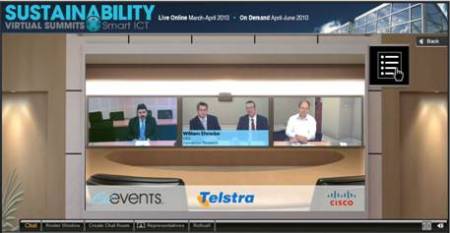
    In the mid-year report card on my 2010 virtual event predictions, I wrote about the first telepresence-enabled virtual event – the “Sustainability Virtual Summit: Smart ICT”, produced by G2Events.  Subsequent to my posting, I heard from Bruno Castejon, Senior Vice President and Co-Founder of G2Events.

    “G2Events is the first Virtual event management services firm to truly integrate Telepresence”, notes Castejon. “We captured the Telepresence feed (high definition video and audio) straight out of the Telepresence racks and rendered the true Telepresence experience over IP in our virtual event platform.  It provided the Virtual Conference attendees a truly immersive experience, as if they were sitting in a Telepresence suite”.

    Sustainability Virtual Summits

    “Sustainability Virtual Summit: Smart ICT” had 8 sessions (out of a total of 35) that included Telepresence enablement.  Five of the eight sessions were round-table discussions with panelists participating from different geographic locations. G2Events is looking at physical events as well, where Telepresence can serve to bridge on-site and remote participants.

    According to G2Events, there is a science behind the technology and process for bringing Telepresence into physical events, especially when one factors in cost and scalability considerations.  “G2events believes Telepresence is one of the most promising technologies to bridge the physical and virtual event worlds and optimize the value of a true hybrid model”, said Castejon.

    TelepresenceWorld 2011

    Hemisphere, the parent company of G2Events, and NAB recently announced a partnership to launch “TelepresenceWorld 2011” at the 2011 NAB Show (April 9-14, 2011).  Telepresence World 2011 will be a hybrid event, combining an on-site conference with a concurrent virtual event, “TelepresenceWorld 2011 Virtual Live!”.

    Notes Castejon, “This will really be a showcase hybrid event demonstrating how Telepresence, in addition of being a very powerful collaboration solution, is also an impactful channel to efficiently reach out to large audiences for marketing purposes”.

    Telepresence and Virtual Events

    At Sustainability Virtual Summits, Telepresence-enabled panels had increased attendee satisfaction – delegates were most engaged with that format.  Castejon notes that the viewing “completion rate” for the Telepresence-enabled panels was by far the highest of all content broadcast during the show.  “They constituted the very reason why the average time at the event was over 2 hours and 50 minutes per attendee”, notes Castejon.

    Bruno contributes two of his own predictions for 2010:

    1. Before 2010 is over, the technology integration will be mature enough to bring Telepresence Live into Virtual Event platforms.
    2. Before 2010 is over, the Virtual event platform leaders will release “full screen” capabilities for video content.  This will take the delegate experience even higher and make Telepresence-enabled panels even more enjoyable.

    Hosted Telepresence

    Think of it as “Telepresence as a Service” – you receive the benefits of Telepresence without the capital investment and hardware support.  “You can now show up at a public Telepresence facility (e.g. Cisco, Marriott, Taj, Starwood) nearby and rent both the room and infrastructure at a cost of $300 or lower”, notes Castejon.  The “Telepresence footprint” (both private and public) is reaching critical mass.  Castejon adds, “The number of rooms is now such that it provides proximity with most, if not all the main business hubs in the world”.

    Telepresence Interoperability Protocol (TIP)

    At the InfoComm conference last week, Cisco announced “interoperability between Cisco and Tandberg TelePresence systems, and with other third-party systems, by integrating the Telepresence Interoperability Protocol (TIP) on Cisco’s newly acquired Tandberg TelePresence Server”. Castejon says this “is a BIG deal”, since it allows one vendor’s system to interoperate with another’s (e.g. in theory, a session betweeen Cisco Telepresence and HP Halo systems).

    While TIP does define interoperability at a protocol level, Castejon notes that telcos will need to follow suit on carrier interoperability.  “Existing private and public Telepresence deployments are on private networks. As of today, I do not believe these carriers have found a way to manage Telepresence roaming. If two parties use different carriers (e.g. one AT&T and the other BT), they still might not be able to communicate”, notes Castejon.

    Conclusion

    Telepresence is a technology to watch – it can facilitate a “virtual meeting” or “virtual event” on its own.  Combined with a virtual event, however, it can significantly expand its audience reach and power.  If you plan to integrate Telepresence into your virtual events, leave a comment below and let us know of your plans.

    Tweet this posting: