Live Webcast: How Smart Marketers Succeed with Virtual Trade Shows

October 26, 2010

“Now, more than ever, B2B marketers are sponsoring virtual trade shows because they are cheaper and can attract larger audiences than live, in-person events.  Next year and beyond, B2B marketers will be able to choose from 100s of virtual trade shows. In other words, what was once considered a gimmick is now a part of the B2B marketing mix.  But just signing up as a sponsor doesn’t guarantee success — a proper plan and execution does.”

That’s the lead-in to a Live Webcast that I’ll be doing with Craig Rosenberg (@funnelholic) and FOCUS  (@FOCUS).  Register to view the Webcast on-demand:

http://www.focus.com/webcasts/marketing/fad-roi-how-smart-marketers-succeed-with-virtual-trade-shows/

View the slides:


With Lead Generation and Virtual Events, It’s a Journey, Not a Project

October 23, 2010

Introduction

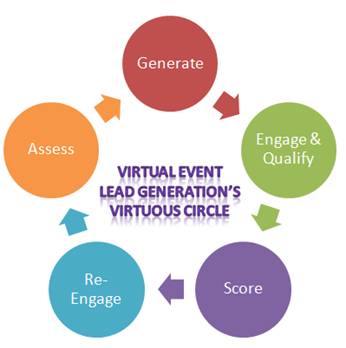
Virtual Events can be highly effective in generating leads to fuel your sales pipeline.  Here’s a 5-step process that I call the “Virtual Event Lead Generation Virtuous Cycle“:

  1. Generate
  2. Engage & Qualify
  3. Score
  4. Re-Engage
  5. Assess

Step #2 (“Engage & Qualify”) is quite unique for virtual events, compared to other online lead generation activities.  Virtual events allow you to generate leads (Step #1) and engage and qualify them on the spot.

With a white paper download or an on-demand webinar, the engagement and qualification occurs after the prospect has requested your content.  Note that I said “requested” – with a white paper download, you don’t even know if the prospect read the paper.

Lather, Rinse, Repeat

As the diagram above illustrates, effective use of virtual events for lead generation is done in a circle (or cycle), where you begin the next event with learnings from your prior event.

By knowing what worked and what didn’t work from your last event, you fine tune and optimize your strategies and tactics and become more effective in generating and engaging leads with each event.  So think of virtual event lead generation as an ongoing journey and not a discrete project.

To help on your journey, here are some useful resources that I’ve come across.

Generating Leads (Step #1)

  1. From BetterCloser.com, “Sales is Personal, Why Isn’t Your Lead Generation?”
  2. An eBook from Brian Carroll, “Eight CRITICAL Success Factors for Lead Generation
  3. From BtoB Online, “2010 Lead Generation Guide
  4. An interview with The Funnelholic, which includes insights on lead generation with virtual events.

Lead Scoring (Step #3)

  1. From Brian Carroll, “Lead scoring thoughts to share

Lead Re-Engagement (Step #4)

More commonly referred to as Lead Follow-Up, also includes Lead Nurturing

  1. From Marketo,  “Perfect Timing – When to Call a Prospect
  2. From LeadSloth, “What Lead Nurturing Content to Send When?”

Lead Assessment (Step #5)

A subset of Lead Management

  1. From The Funnelholic, “Lead Management: 67 tips from the biggest experts in the field

Lead Generation and Virtual Events – A Book

I’ll soon be publishing a book that provides related advice on generating sales leads with virtual events.  For further information on lead generation and virtual events, “Like” the book’s Facebook page.  Updates on the book’s availability will be posted here.  Best of luck on your own journey!

Eight CRITICAL Success Factors for Lead Generation


Virtual Edge Summit 2011

October 20, 2010

Heading into its third year, Virtual Edge Summit, the annual hybrid event covering “digital solutions for events, meetings, learning & community,” is moving up in the world.

Earlier this year, PCMA and Virtual Edge announced that the Virtual Edge Summit would be co-located with PCMA’s 2011 annual meeting in Las Vegas.

As in past years, Virtual Edge Summit will be a hybrid event, featuring both on-site and virtual components.

Make it a 2011 New Year’s Resolution and attend this valuable event.  You’ll hear from the industry’s experts and thought leaders and be able to network with key people in the industry.

Readers of this blog are welcome to a special discount, which is available at this link:

http://virtualedgesummit.com/registration_reader/

By registering from this page, you’ll receive a $120 discount off the $595 registration fee for in-person and $90 off the $195 for virtual.

“Over the past 18 months, virtual events have gained momentum, moving from a nice-to-have to an integral part of an organization’s online strategy,” said Michael Doyle, executive editor of Virtual Edge Institute.

“Virtual Edge Summit is the only conference that will bring together thought leaders from Cisco, IBM, Hilton Hotels and more to discuss business strategies and best practices for taking your business virtual.”

Related Links

  1. ROI Case Study: Virtual Edge Institute’s Hybrid Event
  2. My observations from Virtual Edge Summit: 2010 Trend Watch: Virtual Events

How To: Generate More Effective Virtual Trade Show Booths

October 19, 2010

My local farmers market had a “Vote 4 Your Favorite Booth” contest.  While the contest was active, I noticed that the fruit vendors were much more engaging and the amount of free samples increased dramatically.  The fruit stands had become more customer-friendly as a result of the competition.  This was a great thing.

I immediately thought – virtual trade shows are a lot like farmers markets – how about creating a similar contest?  Let’s consider a “Vote For Your Favorite Booth Contest” at your next virtual trade show.  The benefits:

Attendees Take Notice

The contest causes attendees to take notice, especially if you offer up prize(s) for voting.  The contest provides attendees a framework (and context) for their booth visits.  Now, when they enter any exhibitor booth, they are paying more attention to what’s there, to judge the current booth to other booths they visit.  Ultimately, they will need to determine their top vote, which requires a certain level of engagement and awareness as they move from one booth to the next.  And that’s a good thing for exhibitors.

Exhibitors Boost and Optimize their Presence

Ever sell a home or condo and host an open house?  I bet your home was de-cluttered and nearly spotless.  And I bet some of you baked cookies for the occasion.  A booth contest is a lot like the open house: the host knows that its visitors will be evaluating the space.  This results in:

  1. More captivating and refined booth imagery
  2. Booth content that aims to please (the visitor)
  3. A higher level of booth staffers
  4. More engagement from booth staffers (just like at the farmers market)

With everyone “raising their game”, this means that exhibitors win and attendees win as well.

SaaS: Sampling as a Service

In the picture above, a fruit stand placed a large assortment of samples in labeled bins, allowing visitors to sample for themselves. I call this Sampling as a (Self) Service!  The idea here is to allow “prospects” to sample your “products” (on their own) and then have a “staffer” come by to see if they have any questions.

The same could be done in a virtual trade show. Place your products in your virtual booth and allow visitors to take them on a test drive.  Let them do their thing, but check in with them from time to time to see if they need assistance.

Logistics

Here’s how the booth contest could be run:

  1. Heavily promote the contest prior to the event
  2. Educate and inform exhibitors on the ground rules
  3. Create meaningful incentives for attendees to vote
  4. Announce the winner two-thirds of the way through the event. This leaves the remaining one-third of the event for the winner to receive the benefits (traffic to their booth)
  5. Create a badge or logo that the winner can place on their web site and share via social networks

Conclusion

The virtual booths at some events can be underwhelming.  A contest can encourage and motivate the exhibitors and create a win/win/win for attendees, exhibitors and you.


Hybrid Events: Where Virtual Complements And Augments Physical

October 13, 2010

Over at the INXPO blog, we had the privilege of publishing guest postings from two thought leaders in the events industry, Heidi Thorne (@heidithorne) and Traci Browne (@tracibrowne).

Both wrote about their experiences attending a hybrid event, Event Camp Twin Cities 2010.  And both came away concluding that virtual components (e.g. video, Twitter, etc.) can significantly augment audience reach and audience engagement.

Successful Hybrid Event Case Study: Event Camp Twin Cities 2010 (by Heidi Thorne)

Heidi served as the Twitter moderator for Event Camp Twin Cities, so she had her hands (and fingers) full, watching the sessions, while exchanging tweets (and retweeting) with the virtual audience.

Of course, the on-site (physical) audiences in the Twin Cities, Dallas and Switzerland were a subset of the virtual audience, since they (on-site) were actively tweeting as well.

Heidi makes good points about the use of technology and virtual moderator(s) in a hybrid event.  Here’s a link to the full posting:

http://inxpo.wordpress.com/2010/10/07/successful-hybrid-event-case-study-event-camp-twin-cities-2010/

Make Your Events and Expos a Virtual Reality (by Traci Browne)

Traci attended Event Camp Twin Cities from her home office and felt like she was there in the Twin Cities.  She then gives us all some food for thought, by providing hybrid event ideas for Education and Networking.

For Education, I love idea #3, to interview virtual attendees and broadcast the interviews to the on-side audience.  What a great way to bring the virtual into the physical.

For Networking, I love idea #2, to have physical attendees send swag bags to virtual attendee pen pals, with the physical attendee’s name attached to it.  I say we go with T-shirts and pens and hold the coffee and cocktails.  Here’s a link to the full posting:

http://inxpo.wordpress.com/2010/10/11/make-your-events-and-expos-a-virtual-reality/

Thanks, Heidi and Traci, for the insightful postings.


Book Excerpt: Generate Sales Leads With Virtual Events

October 9, 2010

BUY THE BOOK: Generate Sales Leads With Virtual Events (Amazon.com)

I’m finalizing a book, “Generate  Sales Leads With Virtual Events.”  I’m self-publishing the book via a neat service called FastPencil.  The book will be available for sale in a few weeks – it will be listed on Amazon in both traditional (printed) format and for the Kindle.  The book will feature a great foreword written by Craig Rosenberg (@Funnelholic), a lead generation expert.

I’m including Chapter 1 (“Introduction”) to the book below.  In addition, I’ve posted this chapter on a wiki:

http://allvirtual.pbworks.com/w/page/Chapter-1%3A-Generate-Sales-Leads-With-Virtual-Events

Feel free to edit this page, to show us how you would have written this chapter – thanks!

Chapter 1: Introduction

I can vividly recall my first experience exhibiting at a trade show.  It was the early 1990’s and I was fresh out of college.  I worked for a company that sold Internet connections to corporations.  My colleagues and I flew across the country for the conference, where we sought to generate sales leads.  We arrived at our destination a day or two prior to the conference, so that we could set up our booth, network our demo workstations and place our sales collateral in neatly organized stands on the show floor.  Undoubtedly, a colleague or two got stranded in their home airport, forcing a lucky few of us to pick up the slack and handle the booth set-up.

Then, there was the workstation monitor that wasn’t delivered to our booth.  Did our colleague forget to include it in the shipment?  Was it lost in transit?  Or was it on the conference facility’s loading dock?  It was late in the evening, so no one was available to answer these questions.  Hopefully, we’d be able to sort it out in the morning.  The workstation monitor ended up arriving a day late, but everything came together and we had a successful show.  I spent my time giving demonstrations to curious booth visitors, who wanted to know more about the “Internet”.  This was before the Mosaic and Netscape browsers hit the scene, which meant that Internet demos centered largely around character- based “telnet sessions” to services called Archie, WAIS and Gopher.

At the end of the conference, we were tired and weary, but managed to collect some 50 business cards that we’d distribute to our sales team when we returned to the office.  For particularly “hot” leads, we scribbled notes on the back of business cards, sending along important notes to the receiving sales representative.  Fast-forward to our present day era of widespread broadband, Web 2.0 and social marketing.  But now imagine a trade show that has global reach.  A trade show that requires no travel, lodging or “out of office” time.  A trade show with no physical booth set-up.  A trade show with detailed tracking of sales lead activity.  A trade show that remains available after the scheduled activities conclude.  Welcome to the virtual trade show!

Virtual trade shows are a flavor of the broader category of virtual events.  In the coming chapters, I’ll cover how virtual events can be effective in generating sales leads.

The Marketing Landscape: Where Virtual Events Fit

Marketers today face the same challenges that my colleagues and I encountered in the early 1990’s.  From their CEO or CFO, they’re tasked with generating an increasing flow of sales leads, but at lower cost.  From their VP of Sales, they’re tasked with the same flow of sales leads, with the additional condition that the leads be “marketing qualified” and “sales ready.”  Often, the two objectives can counteract one another, as lower-cost sales leads tend to be lower quality, which means that they’re less “sales ready.”

How can marketers satisfy both objectives simultaneously?  With the evolution of the web, many have turned to online lead generation.  With online lead generation, marketers can distribute content across the web – white papers, product collateral, case studies, webinars, videos, podcasts and more.  Prospects “discover” the content via the company’s web site, search engines, publisher web sites or via social networks.

Before a prospect can gain access to the content, they may be required to complete a registration profile.  When the prospect completes the profile, we call this a “generated lead” and the marketer has just gained a “sales inquiry.” Web-based, online lead generation comes with fairly low costs, since the “transactions” occur entirely on the web – the costs for shipping, print, freight, travel, etc. are from days long gone.

Once a lead is generated, marketers must qualify the lead.  Often, Marketing will perform an initial evaluation of a lead via pre-defined criteria, such as country, job level, company type, size of budget, etc.  The marketer will need to gauge the prospect’s interest, along with their position in the sales cycle.  Is the prospect engaged in preliminary research to define the solution space?  Or, has the prospect defined the solution space and is looking to narrow the list of potential products?  Or, perhaps the prospect is at the tail end of the evaluation and is looking to make a final decision on a product.

To determine the prospect’s position in the sales cycle, marketers often use a series of communications (e.g. emails, phone calls, etc.), evaluate the responses (if any) to those communications and then follow up with subsequent communications.  Marketers decipher the clues provided by the prospect and determine whether to forward the prospect to Sales – or, to continue the qualification process.

Common clues in the qualification process include:

  1. Did the prospect answer my phone calls?
  2. Did the prospect answer the questions we asked?
  3. Did the prospect open my emails?
  4. Did the prospect click on any of the links in the emails?
  5. Did the prospect download any of the documents referenced in the emails?
  6. Has the prospect requested more information – or, a meeting with us?

Marketers can develop formulas around the prospect’s interactions, to determine which combination of actions moves the prospect from a sales inquiry to a Marketing Qualified Lead (MQL).  Once prospects have moved into MQL status, they can be distributed to the Sales team for further follow-up. A primary challenge in this process is the amount of qualification that occurs “post-lead.”  At the time the lead is generated, a minimal amount of information is known about the prospect, beyond the information submitted in the registration profile.  With a webinar, a marketer may know how many times it was viewed – or, the total viewing time across all views.  With a white paper or podcast download, however, the marketer only knows that a request for download was made.  The marketer may not even know whether the download completed – or, if the content was consumed!

As a result, marketing qualification depends upon ongoing touchpoints with prospects, with the hope that they continue to respond to marketers’ communications.  Now, let’s consider virtual events.  I define a virtual event as “a web and occasion-based gathering that facilitates information sharing, collaboration and interaction.”  Alternatively, consider a trade show, with its sessions, presentations, exhibitor booths, networking areas, etc. – and have it occur 100% on the web.  We call that a virtual trade show.

Conclusion

Virtual events can be a dream for marketers.  They can generate leads cost effectively and they facilitate real-time interactions with sales prospects that can lead to quicker and more efficient marketing qualification.  The “post-lead” nurturing process has been combined into the same act of generating the lead.  I call this “accelerated lead generation” and for marketers, this means more “sales ready” leads that Sales can then turn into faster bookings.

This book will show you how to create those valuable, real-time interactions – taking you from the planning process, to audience generation and engagement strategies and finally to lead qualification and follow-up.


Comparing Physical And Virtual Trade Shows

September 16, 2010

At Focus.com, Alex Gonzalez posed a question about the pros and cons of physical and virtual trade shows.

I’d like to share an insightful answer posted by Steve Gogolak, Director of Solutions Innovation at Cramer.

Pros/Cons as an attendee

Travel – the convenience of not having to travel is great for the participant. What’s even better is being able to invite a colleague who may be interested despite not having any intentions to visit the event. It’s the “hey, Jerry would really want to see this” moment realized.

Experience – this is highly dependent on the effort put forth by the booth owner. A lot of booths fall flat in a virtual world, but the same is true in the real world. If an exhibitor understands how to use the features within the booth well, it will make for a good experience. The use of self-directed video is a great example here. The more an attendee browses through video, the more fulfilling the experience. Chat is functional and generally gets the basics across, but will not be comparable to an in-person experience until two-way video is an option.

Privacy – browsing privately is much less intimidating online than in-person. The biggest opportunity an exhibitor has with a visitor is in the attract loop. In a virtual booth, the visitor can be presented with a finite “pitch” regarding what the booth is about. They remain captive for 30-60 seconds as the watch the video, which is effectively qualifying them as a lead (if they bolt, they weren’t interested anyway). It’s hard to stand in a physical trade show booth for a minute and not be bombarded by sales people.

Pros/Cons as an exhibitor

Cost – oh where to begin. A smart exhibitor will shift funds away from travel, employee time and expensive scenery to content production. More content that is suited specifically for a virtual booth is what the best exhibitors will focus on.

Reporting – this has already been mentioned, but near-real-time data about who is in your booth, who has visited and what they did is readily available. Similar results can be achieved in the real world with RFID systems, but the cost is near prohibitive for all but the largest companies. The data that emerges from a virtual booth can keep your sales team busy for weeks worth of follow up.

Commitment – I haven’t seen that many exhibitors really commit the time to understanding what they are doing in side of a virtual booth. They need to see it as a mini-website. An extension of their online presence, targeted for the specific audience that is attending the event in question. The reality is that 95% of the time commitment is spend in content development since the actual tools to “build” the booth are so darned easy to use. In my opinion, the limiting factor is always the content, not the technology.

Re-purpose existing content from other marketing initiatives. As Dennis mentioned, you’re online… so use the assets you already have available and treat the booth as a traffic driver, feeding highly-qualified traffic into your other marketing nets.

View the original Focus.com discussion here:

http://www.focus.com/questions/marketing/live-vsvirtual-trade-shows-pros-and-cons/

About Steve Gogolak

Marketing & Communication is my passion because I love to tell stories. I love to see the look on someone’s face when I’ve hit a chord that resonates with their needs, wants and desires.

Marketing is changing. It is moving further and further away from the “blah blah blah” of a bullhorn in the hands of large companies with big budgets and more toward the targeted messages and subsequent conversations between real people and real buyers. In short, marketing is “getting real” in a big way. What does that mean? It means that companies with remarkable products and services that demonstrate remarkable passion for their buyers’ needs will succeed more quickly – and those who rely on bullhorn-style marketing to force feed their buyers will not.

I’m passionate about marketing because real stories told by real people sell – fast and frequently. I tell stories and I help my clients tell theirs every day.


Using Social Media Marketing To Drive Your Virtual Tradeshow Leads

September 14, 2010

The following is a guest post from Cece Salomon-Lee.

As a marketer, one of my goals is to generate the right leads for my sales force as efficiently and quickly as possible.  This requires constant evaluation of existing tools — emails, banner ads, and events — as well as new ones such as social media and virtual events. While webinars arguably are a standard part of a marketer’s lead gen toolbox, virtual tradeshows are just being considered. Part of the challenge is how to effectively drive qualified sales leads to your booth or virtual event.

Here are recommendations on how to leverage social media to market your next virtual tradeshow (Please note that these recommendations are for organizations who are hosting their own virtual tradeshows and may need to be amended for those exhibiting within a virtual event):

Identify Online Influencers

Each industry has influencers who yield a lot of sway with potential and existing customers. However, popularity – the number of followers or readers -is not necessarily a barometer of one’s online influence– the ability to drive a community of individuals to an action. Identifying the right influencers based on your objectives and audience will require research and time. When done well, these individuals will write or tweet about your upcoming event.

Here are some recommendations:

Twitter Search: Use keywords to find those who tweet the most about your industry.

Twinfluence: Not only does Twinfluence provides a list of the top 50 twitter users based on reach, velocity and social capital, but also can leverage this to determine the influence of those you researched via Twitter search.

AllTop: While you can use Technorati to search for top ranked blogs, I recommend starting with Alltop, which categorizes blogs under separate topics. This will help narrow down the blogs most appropriate for your virtual tradeshow.

Engage in Conversations

Have you been in a middle of a conversation when a stranger suddenly interrupts and adds his two cents? Your initial reaction probably was “who is this guy?”. Well the same applies to online conversations. It’s important to engage in existing conversations BEFORE jumping in to promote your event and disappear. Rather, take time to monitor and participate in ancillary conversations weeks if not months before your event.

For example, research and join relevant groups on Facebook or LinkedIn related to your company, industry and/or solution. If there is a relevant question, avoid the temptation to market only your company or product. Rather, respond with valuable information that contributes to the conversation. This helps to position you and your company positively.

Advertise Socially

Social networks have a wealth of demographic and professional information regarding its members. This is a great opportunity to create ads that target specific age groups or professional titles.  Facebook allows you to select age group, region and professional title when creating ads. Like Google adwords, you’ll want to create variations of your ads, test and refine to determine the best copy and attributes. If you’re targeting more than one professional level, I recommend creating separate ads with only that professional title to better determine who is clicking through. At this time, Facebook doesn’t provide detailed analysis by title.

While LinkedIn Premium Events service is coming soon, you can leverage the social networks’ Direct Ads service to target the network’s 76+ million members. Options include company size, job function, industry, seniority, gender, age and geography.

Share Freely

With the proliferation of information online, the challenge is to demonstrate the value of your virtual tradeshow to motivate people to register and attend. You can entice potential attendees by highlighting the types of information that is available at the tradeshow. For example:

– Blog Posting: Planning a white paper? Consider sharing a graph from the white paper and soliciting feedback to drive interest.

Slideshare.net: Presenting in the virtual tradeshow? Upload the presentation slides to Slideshare and promote via Twitter, your blog, etc. Then invite people to submit questions that will be answered at the conference.

YouTube: Have a product video? Consider posting to YouTube and embedding it on your website, blog, etc

In each instance, include information about your upcoming virtual tradeshow, such as dates, times, and a unique URL to track conversions.

Measurement and Tracking

So you’re tweeting the event, connecting with industry influencers and sharing content online. The next question is how to you track the effectiveness of your social media marketing?  Most virtual event platforms should have a system for tracking and measuring media campaign effectiveness. At minimum, they should be able to provide a formula for tracking those who visit a landing page and register accordingly.

Assuming the above, I recommend:

1) Creating unique landing page URLs for each channel

2) Shorten the URL via a URL shortener service, such as Bitly, that tracks the number of clicks per URL

3) Measure, evaluate and update your marketing mix based on the a) click-through rate and b) conversion to registrations

Conclusions

One word of warning is to first research and evaluate before plunging in with a social media marketing program, especially when contacting individuals and bloggers or participating in online discussions. While social media marketing takes time and effort, when done well, the results can be spectacular!

What strategies or tactics have you used to drive virtual tradeshow attendance?

Bio

As Principal of PR Meets Marketing, Cece Salomon-Lee has over 15 years experience conceptualizing and executing successful strategies for public relations, customer communications, executive visibility, analyst relations, social media and virtual events.  She has worked with start-up and established organizations in enterprise software, SaaS and digital entertainment, such as Blue-ray Disc Association, Cisco Systems, DreamWorks Animation, HP, Yahoo!, and MapQuest. Follow Cece at @csalomonlee or via email cece@prmeetsmarketing.com.


What Virtual Events Really Do

September 9, 2010

In the book “Duct Tape Marketing” by John Jantsch (subtitle: “The World’s Most Practical Small Business Marketing Guide”), there’s a paragraph in Chapter 2 titled “What You Really Sell.”  Here’s an excerpt of that paragraph:

“Here’s the funny thing about business. You don’t sell what it is you claim to offer.  You sell what the eventual buyers think they are going to get from your product. For instance, insurance sales folks don’t sell insurance; they sell peace of mind.  Chiropractors don’t sell neck adjustments; they sell some form of relief.”

Virtual event platforms sell a lot of things.  To some degree, the term “virtual events” is an injustice (or misnomer), based on the wide variety of applications supported by today’s platforms.  In fact, I wrote previously in a “virtual events futures column” that the term “virtual events” would disappear by 2011.

I don’t know whether my 2011 prediction will come true, but I do expect that by later this year, the “virtual” qualifier will start to be dropped, in favor of broader names.  With that being said, and in the spirit of Duct Tape Marketing, here’s my Top 10 List of what virtual “events” really do:

  1. Sales Pipeline Fueler
  2. Learning Platform
  3. Analyst Relations Venue
  4. Product Launch System
  5. HR Recruitment Engine
  6. Partner Community Enabler
  7. Corporate Training System
  8. Content Distribution Platform
  9. Revenue Generator
  10. A Marketer’s Ultimate Dream

Each of these terms better describes “what the eventual buyers think they are going to get from your product” than the term “virtual event.”

Share with us your thoughts – when you “purchase” a virtual event, what is it you’re really getting?