New Book: Generate Sales Leads With Virtual Events

December 1, 2010

Book Cover: Generate Sales Leads With Virtual Events

Disclosure: This post contains affiliate links to sites on which the book is available for purchase.

“Virtual events can be a dream for marketers. They can generate leads cost effectively and they facilitate real-time interactions with sales prospects that can lead to quicker and more efficient marketing qualification.”

That’s the premise behind my new book, “Generate Sales Leads With Virtual Events”.

Previously, I posted the introduction of the book – you can find it here:

Introduction: Generate Sales Leads With Virtual Events

And here’s what I cover in the other chapters:

Chapter Listing

  1. Get Started
  2. Assemble a Plan
  3. Build Your Virtual Booth
  4. Use Social Networks to Generate Interest and Awareness
  5. Engage with Virtual Event Attendees
  6. Score and Follow Up with Leads
  7. Conclude Your Virtual Event Campaign

The book also includes an eloquent Foreword, written by Craig Rosenberg (@Funnelholic), a lead generation expert.

Purchase for Kindle

Purchase for Kindle

“Generate Sales Leads With Virtual Events” (Kindle version) ($9.99)

Purchase for iPad, iPhone & iPod Touch

“Generate Sales Leads With Virtual Events” – via iBooks ($9.99)

Purchase for NOOK (BarnesAndNoble.com)

NOOK Reader

“Generate Sales Leads With Virtual Events” – NOOK ($9.99)

Purchase the Paperback

Purchase from FastPencil, the publisher of the book:

http://www.fastpencil.com/publications/818-Generate-Sales-Leads-With-Virtual-Events ($12.99)

Buy the paperback on Amazon ($11.69)

Buy the paperback at BarnesAndNoble.com ($11.69)

Praise for “Generate Sales Leads With Virtual Events”

“This book should be required reading for any event producer or marketer that plans on using online events to engage with customers and prospects. Done properly, using virtual events for lead generation and lead nurturing as well as sales acceleration can yield impressive ROI and drive customer relationships. Dennis is one of the few experts with real-world experience from having produced lots of virtual events across many markets.”

— Michael Doyle, Executive Director, Virtual Edge Institute (@virtualedge)

“Interacting virtually is now a must-have marketing skill.  In Generate Sales Leads With Virtual Events, Dennis Shiao shows you exactly how to run a successful virtual event from end-to-end. What’s amazing is that the opportunities to engage with leads virtually can be as productive, or more so, than attending events in person.”

— Ardath Albee, author of eMarketing Strategies for the Complex Sale (@Ardath421)

“Dennis is one of the pioneers when it comes to virtual events.  He certainly knows and understands the environment, and his information is right on target!”

— Susan Friedmann, CSP, The Tradeshow Coach (@Tradeshowcoach)

“As interactivity becomes an increasingly important element of marketing campaigns, virtual events offer marketers a cost-efficient solution to engage with prospective buyers. Dennis’ book offers real-world examples and turnkey tactics that marketers can apply to increase their success with virtual events. Whether a marketer is just getting started with virtual events or just looking for tips on improving their metrics, Dennis provides the insight marketers need and want to know to maximize lead flow from virtual events.”

— Amanda Ferrante Batista, Associate Editor, DemandGen Report (@Amanda_Ferrante)


RainToday.com Podcast: Accelerated Lead Generation via Virtual Events

November 30, 2010

Introduction

I was interviewed by Michelle Davidson, Editor at RAIN Group, on RainToday.com’s “Marketing & Selling Professional Services Podcast”.  Michelle and I talked about lead generation via virtual events – a process I call  “accelerated lead generation”.

About RainToday.com

RainToday.com “is the premier online source for insight, advice, and tools for growing professional services businesses. Marketers, rainmakers, and leaders in consulting, accounting, law, AEC, marketing, advertising and PR, training, financial, IT, and other professional services industries, turn to RainToday.com for research, tools, training programs, and recommendations to help them market and sell their services.”

Virtual Events Questions

The questions Michelle asked me:

  1. What is a typical virtual event?
  2. What’s the cost of a virtual trade show compared to a physical trade show?
  3. Do people worry about the lack of face-to-face interaction in a virtual event?
  4. What kind of success have B2B service professionals had with virtual events?
  5. You wrote on your blog that generating leads with virtual events is a process, not a discrete project – tell us about that?
  6. Is the use of virtual events growing?
  7. How does a company get started with virtual events?
  8. If people want to get more educated, do you have any resources to recommend?

You can find the podcast here:

http://www.raintoday.com/pages/6575_podcast_episode_96_accelerated_lead_generation_via_virtual_events.cfm

Additionally, you can directly download the MP3 here:

http://traffic.libsyn.com/raintoday/Shiao_Virtual_Events.mp3


Answers To Your Virtual Events Questions

November 23, 2010

Introduction

Got a question about virtual events, virtual trade shows, virtual career fairs, etc.?  Post it to FOCUS.com and a network of FOCUS Experts is here to help.

Focus “provides millions of professionals with the expertise they need to make better business decisions. At the heart of Focus is a network of world class business and technology experts. These experts power the real time Q&A, world class research, and personalized support that so many businesses now depend on”.

Sample Q&A

Below is a sampling of the questions posted, along with their answers:

Virtual Trade Show Best Practices: Best Practices for Exhibiting at a Virtual Trade Show

Should virtual event teams reside on the IT or Business side?

Virtual trade show booths: What are best practices for creating virtual event booths?

What are your top three tips for planning a successful virtual event?

Virtual Trade Show success: What is the ideal number of exhibitors at an event?

What should your content strategy be for your virtual event booth?

Virtual Events: Best practices for determining the success of your virtual event?

Conclusion

Join the conversation! If you need some help with your virtual event strategy, planning or execution, post it on Focus.  If you have thoughts and experiences to share, “come on down”.  Hope to “see you” there.

Related Links

  1. From the INXPO blog, “Interview with The Funnelholic: Virtual Events, FOCUS Expert Network and More
  2. A webinar I did with FOCUS, “How Smart Marketers Succeed with Virtual Trade Shows

2011 Predictions For Virtual Events

October 30, 2010

As we head into the final 2 months of 2010, it’s time for another round of predictions.  First, let’s review my 2010 predictions:

  1. The 2010 Predictions for Virtual Events
  2. The Mid-Year Report Card on the 2010 predictions
  3. A posting on the Future of Virtual Events

I assigned myself a mid-year grade of B.  And now, I’m designating a final grade of B-.  I hope to improve in this year’s predictions.  To assist with my predictions, I invited a few experts from the community to chime in, so I’ll be including their predictions with my own.

Market Expansion

To date, “market expansion” has meant a growing number of “pure play” virtual event platform providers.  In the US, we started with a handful of major vendors and we’ve seen new entrants into the market in 2009 and 2010.  We also saw the emergence of platforms outside the US, notably in Europe – and in 2009, in Asia Pacific as well.

For a large Requests For Proposal (RFP) in 2009 and 2010, the virtual event platforms knew whom they were competing against (each other).  Starting in 2011, it gets cloudier (pun intended), as the blending of virtual, social and Enterprise 2.0 means that a wider set of vendors are vying for the same business that virtual platforms got in 2010.

Consider the following vendors, each of whom has offerings that (in part) look, feel and smell like virtual events or virtual business communities:

Jive Software, Yammer, Pathable, Facebook Groups, Socialtext, SharePoint (Microsoft) and Lotus (IBM).

Virtual event platforms can expect to sell against some of these players in 2011 and some platforms may go the partnership route, to build a combined offering as a competitive advantage.

Service Level Agreements (SLA)

The virtual events industry is at a point in its growth where Service Level Agreements (SLA) make a lot of sense.  With a growing number of vendors, SLA’s help separate the contenders from the pretenders – if you’re offering money back (or a credit) if an event fails, then only the strong will survive.

I predict that one vendor will lead the way and proactively hit the market with an SLA – forcing others to follow suit later in 2011.  Expect SLA’s around availability and simultaneous users.

Later in 2011 (or perhaps in 2012), SLA’s will be defined around “quality”, such as response time.  This development helps the market – the assurance provided behind an event allows the market to expand, attracting new customer growth that exceeds 2010’s figures.

Market Upheaval

Market expansion and SLA’s mean the strong get stronger. But lesser platforms have a challenging year ahead. According to Cece Salomon-Lee, Principal at PR Meets Marketing, “some players will be bought by larger organizations, merging to bring together complimentary strengths or even some disappearing from the industry all together. No matter how, we will begin to see some consolidation within the industry.”

Meanwhile, Miguel Arias of IMASTE believes that US platforms will look abroad for acquisitions.  To “gain presence, customers and market knowledge” in Europe, Latin America and Asia, Arias believes US platforms will look to partner or acquire in-country platforms in those same regions.

In my mind, there is an enormous, (largely) untapped market within the US, which means that US-based platforms will continue to focus domestically in 2011.  Global expansion will occur in 2012 or beyond.  In addition, due to the “strong get stronger” phenomenon, I predict that one of the prominent US-based platforms will cease operations in 2011 – or, be sold at a below-market price.

Technology A La Carte


Today, virtual event platforms are “monolithic” – you enter an event and all of the functionality provided by the platform sits within that event.  You can’t experience the platform’s features outside of an “event”.  In my futures column, I predicted that virtual events “move closer to the end user”.

Driven by market demand, platforms will “break out” pieces of their technology platform in a la carte fashion. Customers who do not need a five course meal may opt just for an appetizer and coffee.  This may surface in a number of ways, including:

Thin desktop clients, mobile apps, browser toolbars, virtual booths embedded in banner ads, group chat embedded on a web page, etc.

Hybrid Innovation & The Year of the Hybrid

In 2009, some INXPO colleagues and I predicted that 2010 would be The Year of the Hybrid.  This was partially true – in fact, Cisco received the 2010 Grand Ex Award for their hybrid approach to Cisco Live and Networkers. However, the mass adoption of hybrid events (that we predicted) did not ring true.  But that’s OK, it’s always better to be a year early than a year late.

Event and experience marketing agencies have adopted virtual in varying degrees – 2011 is the year where they demonstrate the most aggressive push to date.  You’ll see strong adoption from the “big brands” in 2011 and it will come by way of these channel partners to the virtual event platforms.  2011 will set the foundation for growth – with “hockey stick growth” coming in 2012.

Another major adopter in 2011 will be associations. They’ve done a number of virtual events to date – in 2011, you’ll see 200%+ growth.  Local chapter meetings will continue to occur at physical locations, while the annual, national chapter meeting of the association will move to a hybrid event, with the virtual component serving those members who were not able to make it to the physical gathering.

More generally, 2011 will see innovative technologies that blend the virtual/online world with the real world.  And these same technologies will be integrated into hybrid event experiences, blurring the lines between physical and virtual.  I’m referring to location based services (LBS), mobile, augmented reality and QR codes.  Expect to see a lot of hybrid events innovation, which benefits everyone.

Miscellaneous Predictions

From Miguel Arias, “After some virtual events vendors, marketers and event organisers have shown in 2010 with successful case studies what are the benefits of virtual events we will see much more events and movements in Europe and South America specially.  I expect a 250-300% growth of the total market size in those regions.”

From Cece Salomon-Lee, “I believe the players that will remain on the landscape will begin building out an ecosystem of services to plug-and-play on the platforms.”

From Miguel on vendor specialization, “With more vendors in the space and more clients asking for more tailored solutions we will probably see a leader in the corporate events environment, a leader in the generic trade show market, other for hybrid events, for virtual career fairs, etc.”

Conclusion

I’ll sum up this piece by using a number of nouns to describe what I expect to see in 2011: innovation, shake-out, growth, change, adaptation, expansion, excitement.  Check back here in 6-8 months for my mid-year report card!

With Lead Generation and Virtual Events, It’s a Journey, Not a Project

October 23, 2010

Introduction

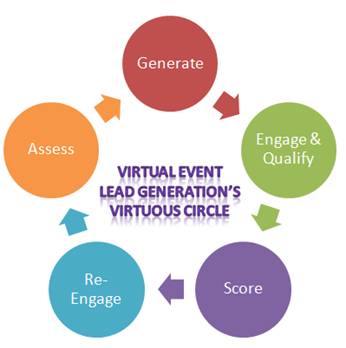
Virtual Events can be highly effective in generating leads to fuel your sales pipeline.  Here’s a 5-step process that I call the “Virtual Event Lead Generation Virtuous Cycle“:

  1. Generate
  2. Engage & Qualify
  3. Score
  4. Re-Engage
  5. Assess

Step #2 (“Engage & Qualify”) is quite unique for virtual events, compared to other online lead generation activities.  Virtual events allow you to generate leads (Step #1) and engage and qualify them on the spot.

With a white paper download or an on-demand webinar, the engagement and qualification occurs after the prospect has requested your content.  Note that I said “requested” – with a white paper download, you don’t even know if the prospect read the paper.

Lather, Rinse, Repeat

As the diagram above illustrates, effective use of virtual events for lead generation is done in a circle (or cycle), where you begin the next event with learnings from your prior event.

By knowing what worked and what didn’t work from your last event, you fine tune and optimize your strategies and tactics and become more effective in generating and engaging leads with each event.  So think of virtual event lead generation as an ongoing journey and not a discrete project.

To help on your journey, here are some useful resources that I’ve come across.

Generating Leads (Step #1)

  1. From BetterCloser.com, “Sales is Personal, Why Isn’t Your Lead Generation?”
  2. An eBook from Brian Carroll, “Eight CRITICAL Success Factors for Lead Generation
  3. From BtoB Online, “2010 Lead Generation Guide
  4. An interview with The Funnelholic, which includes insights on lead generation with virtual events.

Lead Scoring (Step #3)

  1. From Brian Carroll, “Lead scoring thoughts to share

Lead Re-Engagement (Step #4)

More commonly referred to as Lead Follow-Up, also includes Lead Nurturing

  1. From Marketo,  “Perfect Timing – When to Call a Prospect
  2. From LeadSloth, “What Lead Nurturing Content to Send When?”

Lead Assessment (Step #5)

A subset of Lead Management

  1. From The Funnelholic, “Lead Management: 67 tips from the biggest experts in the field

Lead Generation and Virtual Events – A Book

I’ll soon be publishing a book that provides related advice on generating sales leads with virtual events.  For further information on lead generation and virtual events, “Like” the book’s Facebook page.  Updates on the book’s availability will be posted here.  Best of luck on your own journey!

Eight CRITICAL Success Factors for Lead Generation


Virtual Edge Summit 2011

October 20, 2010

Heading into its third year, Virtual Edge Summit, the annual hybrid event covering “digital solutions for events, meetings, learning & community,” is moving up in the world.

Earlier this year, PCMA and Virtual Edge announced that the Virtual Edge Summit would be co-located with PCMA’s 2011 annual meeting in Las Vegas.

As in past years, Virtual Edge Summit will be a hybrid event, featuring both on-site and virtual components.

Make it a 2011 New Year’s Resolution and attend this valuable event.  You’ll hear from the industry’s experts and thought leaders and be able to network with key people in the industry.

Readers of this blog are welcome to a special discount, which is available at this link:

http://virtualedgesummit.com/registration_reader/

By registering from this page, you’ll receive a $120 discount off the $595 registration fee for in-person and $90 off the $195 for virtual.

“Over the past 18 months, virtual events have gained momentum, moving from a nice-to-have to an integral part of an organization’s online strategy,” said Michael Doyle, executive editor of Virtual Edge Institute.

“Virtual Edge Summit is the only conference that will bring together thought leaders from Cisco, IBM, Hilton Hotels and more to discuss business strategies and best practices for taking your business virtual.”

Related Links

  1. ROI Case Study: Virtual Edge Institute’s Hybrid Event
  2. My observations from Virtual Edge Summit: 2010 Trend Watch: Virtual Events


Hybrid Events: Where Virtual Complements And Augments Physical

October 13, 2010

Over at the INXPO blog, we had the privilege of publishing guest postings from two thought leaders in the events industry, Heidi Thorne (@heidithorne) and Traci Browne (@tracibrowne).

Both wrote about their experiences attending a hybrid event, Event Camp Twin Cities 2010.  And both came away concluding that virtual components (e.g. video, Twitter, etc.) can significantly augment audience reach and audience engagement.

Successful Hybrid Event Case Study: Event Camp Twin Cities 2010 (by Heidi Thorne)

Heidi served as the Twitter moderator for Event Camp Twin Cities, so she had her hands (and fingers) full, watching the sessions, while exchanging tweets (and retweeting) with the virtual audience.

Of course, the on-site (physical) audiences in the Twin Cities, Dallas and Switzerland were a subset of the virtual audience, since they (on-site) were actively tweeting as well.

Heidi makes good points about the use of technology and virtual moderator(s) in a hybrid event.  Here’s a link to the full posting:

http://inxpo.wordpress.com/2010/10/07/successful-hybrid-event-case-study-event-camp-twin-cities-2010/

Make Your Events and Expos a Virtual Reality (by Traci Browne)

Traci attended Event Camp Twin Cities from her home office and felt like she was there in the Twin Cities.  She then gives us all some food for thought, by providing hybrid event ideas for Education and Networking.

For Education, I love idea #3, to interview virtual attendees and broadcast the interviews to the on-side audience.  What a great way to bring the virtual into the physical.

For Networking, I love idea #2, to have physical attendees send swag bags to virtual attendee pen pals, with the physical attendee’s name attached to it.  I say we go with T-shirts and pens and hold the coffee and cocktails.  Here’s a link to the full posting:

http://inxpo.wordpress.com/2010/10/11/make-your-events-and-expos-a-virtual-reality/

Thanks, Heidi and Traci, for the insightful postings.


Book Excerpt: Generate Sales Leads With Virtual Events

October 9, 2010

BUY THE BOOK: Generate Sales Leads With Virtual Events (Amazon.com)

I’m finalizing a book, “Generate  Sales Leads With Virtual Events.”  I’m self-publishing the book via a neat service called FastPencil.  The book will be available for sale in a few weeks – it will be listed on Amazon in both traditional (printed) format and for the Kindle.  The book will feature a great foreword written by Craig Rosenberg (@Funnelholic), a lead generation expert.

I’m including Chapter 1 (“Introduction”) to the book below.  In addition, I’ve posted this chapter on a wiki:

http://allvirtual.pbworks.com/w/page/Chapter-1%3A-Generate-Sales-Leads-With-Virtual-Events

Feel free to edit this page, to show us how you would have written this chapter – thanks!

Chapter 1: Introduction

I can vividly recall my first experience exhibiting at a trade show.  It was the early 1990’s and I was fresh out of college.  I worked for a company that sold Internet connections to corporations.  My colleagues and I flew across the country for the conference, where we sought to generate sales leads.  We arrived at our destination a day or two prior to the conference, so that we could set up our booth, network our demo workstations and place our sales collateral in neatly organized stands on the show floor.  Undoubtedly, a colleague or two got stranded in their home airport, forcing a lucky few of us to pick up the slack and handle the booth set-up.

Then, there was the workstation monitor that wasn’t delivered to our booth.  Did our colleague forget to include it in the shipment?  Was it lost in transit?  Or was it on the conference facility’s loading dock?  It was late in the evening, so no one was available to answer these questions.  Hopefully, we’d be able to sort it out in the morning.  The workstation monitor ended up arriving a day late, but everything came together and we had a successful show.  I spent my time giving demonstrations to curious booth visitors, who wanted to know more about the “Internet”.  This was before the Mosaic and Netscape browsers hit the scene, which meant that Internet demos centered largely around character- based “telnet sessions” to services called Archie, WAIS and Gopher.

At the end of the conference, we were tired and weary, but managed to collect some 50 business cards that we’d distribute to our sales team when we returned to the office.  For particularly “hot” leads, we scribbled notes on the back of business cards, sending along important notes to the receiving sales representative.  Fast-forward to our present day era of widespread broadband, Web 2.0 and social marketing.  But now imagine a trade show that has global reach.  A trade show that requires no travel, lodging or “out of office” time.  A trade show with no physical booth set-up.  A trade show with detailed tracking of sales lead activity.  A trade show that remains available after the scheduled activities conclude.  Welcome to the virtual trade show!

Virtual trade shows are a flavor of the broader category of virtual events.  In the coming chapters, I’ll cover how virtual events can be effective in generating sales leads.

The Marketing Landscape: Where Virtual Events Fit

Marketers today face the same challenges that my colleagues and I encountered in the early 1990’s.  From their CEO or CFO, they’re tasked with generating an increasing flow of sales leads, but at lower cost.  From their VP of Sales, they’re tasked with the same flow of sales leads, with the additional condition that the leads be “marketing qualified” and “sales ready.”  Often, the two objectives can counteract one another, as lower-cost sales leads tend to be lower quality, which means that they’re less “sales ready.”

How can marketers satisfy both objectives simultaneously?  With the evolution of the web, many have turned to online lead generation.  With online lead generation, marketers can distribute content across the web – white papers, product collateral, case studies, webinars, videos, podcasts and more.  Prospects “discover” the content via the company’s web site, search engines, publisher web sites or via social networks.

Before a prospect can gain access to the content, they may be required to complete a registration profile.  When the prospect completes the profile, we call this a “generated lead” and the marketer has just gained a “sales inquiry.” Web-based, online lead generation comes with fairly low costs, since the “transactions” occur entirely on the web – the costs for shipping, print, freight, travel, etc. are from days long gone.

Once a lead is generated, marketers must qualify the lead.  Often, Marketing will perform an initial evaluation of a lead via pre-defined criteria, such as country, job level, company type, size of budget, etc.  The marketer will need to gauge the prospect’s interest, along with their position in the sales cycle.  Is the prospect engaged in preliminary research to define the solution space?  Or, has the prospect defined the solution space and is looking to narrow the list of potential products?  Or, perhaps the prospect is at the tail end of the evaluation and is looking to make a final decision on a product.

To determine the prospect’s position in the sales cycle, marketers often use a series of communications (e.g. emails, phone calls, etc.), evaluate the responses (if any) to those communications and then follow up with subsequent communications.  Marketers decipher the clues provided by the prospect and determine whether to forward the prospect to Sales – or, to continue the qualification process.

Common clues in the qualification process include:

  1. Did the prospect answer my phone calls?
  2. Did the prospect answer the questions we asked?
  3. Did the prospect open my emails?
  4. Did the prospect click on any of the links in the emails?
  5. Did the prospect download any of the documents referenced in the emails?
  6. Has the prospect requested more information – or, a meeting with us?

Marketers can develop formulas around the prospect’s interactions, to determine which combination of actions moves the prospect from a sales inquiry to a Marketing Qualified Lead (MQL).  Once prospects have moved into MQL status, they can be distributed to the Sales team for further follow-up. A primary challenge in this process is the amount of qualification that occurs “post-lead.”  At the time the lead is generated, a minimal amount of information is known about the prospect, beyond the information submitted in the registration profile.  With a webinar, a marketer may know how many times it was viewed – or, the total viewing time across all views.  With a white paper or podcast download, however, the marketer only knows that a request for download was made.  The marketer may not even know whether the download completed – or, if the content was consumed!

As a result, marketing qualification depends upon ongoing touchpoints with prospects, with the hope that they continue to respond to marketers’ communications.  Now, let’s consider virtual events.  I define a virtual event as “a web and occasion-based gathering that facilitates information sharing, collaboration and interaction.”  Alternatively, consider a trade show, with its sessions, presentations, exhibitor booths, networking areas, etc. – and have it occur 100% on the web.  We call that a virtual trade show.

Conclusion

Virtual events can be a dream for marketers.  They can generate leads cost effectively and they facilitate real-time interactions with sales prospects that can lead to quicker and more efficient marketing qualification.  The “post-lead” nurturing process has been combined into the same act of generating the lead.  I call this “accelerated lead generation” and for marketers, this means more “sales ready” leads that Sales can then turn into faster bookings.

This book will show you how to create those valuable, real-time interactions – taking you from the planning process, to audience generation and engagement strategies and finally to lead qualification and follow-up.


With Virtual Events, You’ve Got Game

September 20, 2010

On the INXPO blog, we write about virtual events and virtual business environments.  I wrote a posting about gamifying your next virtual event.  The benefits of adding a game element to your event:

  1. Games are Participatory
  2. Games Create Competition & Networking
  3. Games Foster Elevated Retention

I then provided some strategic advice for virtual event gaming:

  1. Content Must Be Contextual
  2. The Game “Layer” Should Be “Thin”
  3. Benefit of Teams

Do you got game? Read the full posting:

INXPO: Gamify Your Next Virtual Event