Introduction to HuzuTech: A Social Media Software Company

January 17, 2011

Note: The following posting was submitted by Graeme Harvey, Managing Director, HuzuTech

Graeme Harvey is MD of HuzuTech, a social media software company. He’s been involved with HuzuTech since 2009, and before that he started up a successful digital publishing division within Harpercollins publishers, concentrating on online, desktop and mobile application development. There, he developed a digital business that underpinned the Collins Language division – the first of its kind within Harpercollins UK (it included the first e-commerce, e-book and mobile app presence).

Introduction

HuzuTech is a British social and virtual technology company. We’ve just launched our white label virtual world platform, HuzuVirtual, which lets brands, publishers and film or TV production houses create their own branded virtual worlds and online environments – at a fraction of the cost of building one from scratch.

We also white label our own social networking platform, HuzuSocial, which lets brands offer secure social networking facilities (including within a virtual world, through full integration with HuzuVirtual) and the ability to link to Facebook.

Branded communities

We announced the launch of HuzuVirtual at AdTech New York recently, and the response was fantastic. We know that virtual worlds are a huge growth area for publishers and media companies, but what was really interesting was the appetite for brands to create their own communities.

As online communities become integral to brands’ marketing campaigns, there is a reluctance to hand over control of customer data and relationships to a third party like Facebook, and requirements for more sophisticated or bespoke technology to manage those relationships effectively.

Customisation

As a result, our technology is completely customisable, with functionality that includes things like the creation of different virtual environments, rooms or ‘levels’ to the world; avatar creation; virtual (or real) goods shop; fully moderated chat functionality; custom-branded avatars; and special events such as online meetings, concerts, and VIP areas. It’s cloud-based, because it is designed to be able to cope with rapid growth, when the community grows exponentially.

Monetisation

There’s also the thorny issue of monetisation. More and more, brands are seeking to monetise their online environments. Sales of branded goods are expected to grow by more than 100 per cent over the next three years. We’ve included virtual shopping features in HuzuVirtual, and the feedback we’ve had so far has been that brands definitely want to control an environment where customers are paying for their goods.

Demonstrating the Technology

We’ve developed a site to show how the technology works, including some really great features like routing technology (which means an avatar will always follow a path – rather than walking ‘through’ obstacles), and ‘motion’ sensors (see how the car alarms going off when the avatar walks past them) here: http://paperworld.huzutech.com/.

Note: this isn’t a virtual world in itself, but shows the kind of technology we can use. We’re constantly tinkering with it to make it better, and we’re always interested to know what other people think of it.

The first full virtual world built on our platform will be out in around June 2011, and is for Scholastic’s Horrible Histories™ – it’s a great one to be working on and shows how the publishing industry is one of the first to adopt these new technologies to market books.

If you’re interested to know more, visit our website: www.huzutech.com.


Virtual Event Email Promotions and Hotmail Active Views

January 14, 2011

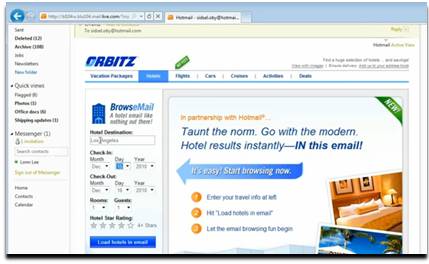
Note: Image sourced from a Hotmail YouTube video.

Introduction

The Hotmail Team has introduced an interactive email technology called Active Views.  The technology allows recipients of Active Views emails (within Hotmail) to interact with the email itself.

Hotmail showed examples of two of their early partners, Orbitz and Monster.  Recipients of the emails could search a flight (in the Orbitz email) or search for jobs (in the Monster email).

Interactive Emails and Virtual Event Promotions

Interactive email technologies present interesting possibilities for virtual event email promotions – and, more broadly, for any email promotion that seeks to elicit a response.  Imagine the following for virtual event email promotions:

  1. Register for the virtual event
  2. Enter your Twitter, Facebook, LinkedIn, etc. identity and see which of your followers, friends, connections, etc. have already registered
  3. Navigate through the session schedule and indicate which sessions you’re interested in attending
  4. Complete your attendee profile – upload your image/photo and add a short bio
  5. Social sharing – let your social networks know that you’re interested in the event – or, that you’ve just registered

The possibilities are endless.

Considerations

  1. Only Hotmail “trusted parties” can utilize Active Views
  2. The technology is platform-specific (it’s limited to Hotmail)
  3. The technology is new and largely untested (at a large scale)
  4. It remains to be seen how well the technology functions across platforms (e.g. email clients, operating systems, tablet devices, etc.)
  5. While security provisions are in place, it may open a window for providers of phishing and malware

Related Links

  1. Active Views introduction on the Inside Windows Live blog
  2. TechCrunch: “Hotmail Active Views Look To Make Email Interactive
  3. ClickZ: “Hotmail Active Views Revives E-mail Innovation in 2011

Lead Generation With Virtual Events (#LeadGen Resources)

January 10, 2011

Introduction

Virtual events can be a highly effective tool for generating sales leads (if done right!).  I’ve assembled a few relevant and timely resources related to virtual event lead generation.

Lead Generation & Virtual Events @ Virtual Edge Summit

I gave a presentation at Virtual Edge Summit 2011 titled “Lead Gen and Nurturing with Virtual Events“.  I was joined by Tom Donoghue (Enterprise Developer News) and Craig Rosenberg (FOCUS).  In the session, we covered:

  1. How to generate leads (promotional tactics)
  2. How to engage with leads during the virtual event
  3. How to qualify and follow up with leads after the virtual event

I’ve included my portion of the presentation – which focused on 5 Tips for engaging with your audience at a virtual event.

Fork In The Road Blog on Virtual Event “Selling”

I spoke to Michelle Bruno (@michellebruno) about my 5-Step Plan for exhibiting at virtual events:

  1. Define your mission statement
  2. Assemble an all-star team
  3. Build and promote your presence
  4. Engage with prospects
  5. Qualify and follow up with prospects

Michelle provides a great summary of our conversation on her blog.

RainToday.com Podcast – Accelerated Lead Generation

I spoke to Michelle Davidson, Editor at RainToday.com, about lead generation and virtual events.  I call it accelerated (online) lead generation, since you can generate leads, while engaging with them in real-time.  You can listen to the recording – or download it – on the RainToday podcast page.

Conclusion

I’d love to hear about the gaps in the market – if you’re interested in generating leads with virtual events, what questions have not yet been answered for you?


2010 In Review for It’s All Virtual

January 2, 2011

The stats helper monkeys at WordPress.com mulled over how this blog did in 2010, and here’s a high level summary of its overall blog health:

The Blog-Health-o-Meter™ reads Wow.

Crunchy numbers
About 3 million people visit the Taj Mahal every year. This blog was viewed about 33,000 times in 2010. If it were the Taj Mahal, it would take about 4 days for that many people to see it.

In 2010, there were 87 new posts, growing the total archive of this blog to 202 posts. There were 220 pictures uploaded, taking up a total of 8mb. That’s about 4 pictures per week.

The busiest day of the year was September 28th with 213 views. The most popular post that day was Trends In The Virtual Worlds Industry.

Where did they come from?
The top referring sites in 2010 were twitter.com, linkedin.com, facebook.com, en.wikipedia.org, and hootsuite.com.

Some visitors came searching, mostly for virtual calendar, match.com, all virtual worlds, gregory house, and comdex.

Attractions in 2010
These are the posts and pages that got the most views in 2010.

1

Trends In The Virtual Worlds Industry September 2010
6 comments and 1 Like on WordPress.com,

2

Virtual Events Calendar December 2008
14 comments

3

The Business Benefits Of Second Life March 2010
2 comments

4

About December 2008
16 comments

5

COMDEX Re-Launches As A Virtual Trade Show March 2010
1 comment


FOCUS Best Practices Report: Exhibiting at Virtual Trade Shows

December 28, 2010

Introduction

FOCUS.com has published a Best Practices Report, “9 Best Practices for Exhibiting at a Virtual Trade Show“.

The report features insights and tips from Roger Courville (1080 Group), Dave Lutz (Velvet Chainsaw Consulting), Shannon Ryan (FOCUS), Cece Salomon-Lee (PR Meets Marketing), Tom Wieser (CGS VirtualEvents365) and myself. We’re all FOCUS Experts and contribute to virtual events (and other) topics on FOCUS.com.

Download The Report

You can download the report here:

http://www.focus.com/research/research-briefings/sales/best-practices-exhibiting-virtual-trade-show/

A Related Webinar

I did a related webinar with FOCUS titled “From Fad to ROI: How Smart Marketers Succeed with Virtual Trade Shows”.  You can view the on-demand webinar (or the associated slides) by following the links here:

https://allvirtual.wordpress.com/2010/10/26/live-webcast-how-smart-marketers-succeed-with-virtual-trade-shows/

Join the Discussion

The report was generated from a question posted to FOCUS.com – feel free to join the discussion by adding your own thoughts about exhibiting at virtual trade shows:

http://www.focus.com/questions/marketing/virtual-trade-show-best-practices-best-practices-exhibiting/


Gamification Predictions for 2011

December 22, 2010

Introduction

At Mashable, Gabe Zichermann (@gzicherm) provided his 5 Predictions for Game Mechanics in 2011.  Gabe’s article inspired me to provide my own predictions.

A New Name in 2011

In the second half of 2010, the term “gamification” became bi-polar: you either loved it or hated it.  People on the “love” side see it as the future of engagement and marketing.  People on the “hate” side see it as a gimmick.

Gabe provides his thoughts in an article at Huffington Post.  While the term is effective in capturing the essence, it’s not perfect.  As a result, “gamification” will be used less and less in 2011.  In its place will be a set of new terms, based on its specific applications (e.g. game-based marketing, game-based social initiatives, etc.).

A Sub-Industry Develops


This is more an observation, rather than a prediction (since it’s already happening): an industry has developed around “gamification”.  When folks convene for a conference or summit, that’s my measuring stick to tell me that an industry is emerging.  In the virtual events space, that happened in 2009 with the Virtual Edge Summit (which, by the way, has its third annual conference, also in January 2011).

If you look at the sponsor and speaker lists for this event, you’ll see a number of start-ups who built their business around gamification.  In 2011, we’ll see some “bubble like” behavior (perhaps we’re already seeing it now), where entrepreneurs look to build the next great gamification companies.  In the second half of 2011, however, the bubble settles and the early winners emerge.

Related: Gamification gets its own conference (VentureBeat)

Game Mechanics for The Greater Good

Jane McGonigal of Palo Alto-based Institute for the Future once said, “Any time I consider a new project, I ask myself, is this pushing the state of gaming toward Nobel Prizes? If it’s not, then it’s not doing anything important enough to spend my time.” (source: Salon.com article from 2007).

In 2011, we’ll see game mechanics applied increasingly to the “greater good” – initiatives that can change the world.

Armchair Revolutionary is a great example – consider one of their slogans, “shape the future by playing a game”.  In 2011, lots of “revolutionaries” emerge to rally those who can, to provide help to those in need.

Game Mechanics Go Mainstream – But Consumers Don’t Know It

Game mechanics are going mainstream, but the typical user won’t know that they’re participating in them.  They simply know that they’re engaging in enjoyable activities (side note: there will be similar growth in Foursquare, Gowalla, etc., but users, of course, won’t know that they’re using “location based services”).

For example, Universal Studios announced successful sales of their “Despicable Me” DVD – their press release attributes some of the success to a “Minions Madness” promotion, “a points-based reward and social media program spotlighting the film’s beloved mischief-makers, the Minions.” This promotion was powered by Bunchball, a game mechanics start-up.

Bunchball (and related companies) has built a nice client list of broadcast networks, cable networks and film studios.  In 2011, additional media outlets come on board.  Game mechanics  go more and more mainstream, even though the typical mainstream user doesn’t know it.  Watch out in 2012, however, as consumer-based game mechanics suffer some fatigue (as consumers then see “much too much” of it).

Established Web Players Incorporate Game Mechanics

2011 sees established players incorporate game mechanics to increase engagement (e.g. “time on site”, clicks, e-commerce sales, etc.).

Google adopts game mechanics as a means for bridging their search business and social services (e.g. adding game mechanics to Google Me). Others who add game mechanics include Netflix, eBay and Groupon.  Of course, it’s natural to expect that more and more virtual event experiences will add game mechanics, too.

Conclusion

2010 has been an interesting year for gamification. 2011 will kick off with an industry event and where we go from there will be exciting to watch.  I’ll check back mid-year with a report card on these predictions. Here’s hoping I attain the “crystal ball badge”.


What Virtual Events Can Learn From Groupon, Quora and FarmVille

December 18, 2010

Introduction

Successful web sites provide a great opportunity: the chance to study what makes them successful and apply those learnings to your own websites or applications.  In 2010, three of the “most talked about” web sites were Groupon, Quora and FarmVille (though FarmVille is more a discrete app, rather than a web site).  Let’s consider how some of their concepts can be applied to virtual event experiences.

Groupon


Groupon is said to be in the local advertising space, but they’re really much more than that.  They’ve hit the mark with a group buying phenomenon (using bulk purchasing to drive down prices) combined with creative and entertaining email copy that keeps subscribers eager to receive the next day’s email.

Groupon, which serves local businesses, segments their offering by geography.  So I might subscribe via San Jose, CA and receive offers from merchants who are near me.  But the Groupon model could certainly apply to national or even global brands.

Group Viewing at Virtual Trade Shows

Now, let’s consider a common dynamic at virtual trade shows.  Exhibitors (sponsors) would like to get their message across to attendees, while attendees are resistant to hearing unsolicited product pitches.

How can you “arbitrate” this situation?  Consider Groupon, where the “daily deal” only registers when a certain number of users agree to purchase the item(s).  Here’s how it might work with sponsor presentations (webinars) at a virtual trade show:

  1. Five sponsors list their webinar title in the trade show Auditorium
  2. Each sponsor is “on alert”, ready to begin broadcasting their live presentation
  3. No presentation begins until it receives 50 (or more) viewers
  4. The presentation continues, only if it can continually sustain 35 simultaneous viewers – if it drops below 35 viewers for more than 5 minutes, the presentation closes

Benefits

  1. Puts portions of the presentation agenda in the hands of attendees
  2. Forces sponsors to present on relevant topics
  3. Forces sponsors to “deliver what they sold” with regard to the presentation
  4. Ups the overall quality of sponsor presentations, as sponsors need to both “sell” the topic and sustain the audience

Quora

Quora is “a continually improving collection of questions and answers created, edited, and organized by everyone who uses it.”  Question and Answer (Q&A) services have been around for some time. Quora has picked up steam in 2010 due to the quality of the members participating (e.g. some of the leading thinkers on the web – and in Silicon Valley).

In virtual events, experts and leading thinkers in a particular industry have gathered online.  They can listen to featured experts (e.g. the presenters), but the event doesn’t fully extract and share the collective knowledge of those assembled. If done right, a Q&A service layered on top of a virtual event can be quite useful.

In fact, let’s consider a related Q&A service, Aardvark, which is now part of Google.  With Aardvark, “you email or instant-message your question to Aardvark, it figures out around half a dozen people you know who might have a good answer, then emails or IMs them for a response and sends what they say back to you.” (source: VentureBeat article).

A virtual event platform could implement a “Quora meets Aardvark” model, whereby questions are distributed to online attendees – and answers are fed back in semi-real-time.  Questions (and their answers) could be shared not only with the requester – but, all attendees, based on their selection of particular topics.

FarmVille

On the surface, FarmVille is about planting your virtual crops and tending to your virtual farm.  But below the surface, its “power” is in the psychological reward of achieving success in something you take pride in.  It’s the same dynamic that fuels entrepreneurs (who take pride in their businesses) and Twitter power users (who take pride in their following).

As virtual events shift from “point in time” live events to “365 day communities”, the challenge becomes how to sustain an ongoing and active community – who will visit the environment on days where absolutely nothing is scheduled.  It’s the same challenge Zynga had – how do you incent farmers to tend to their virtual farm each day?

Virtual Farm Meets Virtual Community

For virtual communities, there needs to be a parallel to that virtual farm – an abstraction that allows members to feel psychological reward when they’ve done something meaningful.  Ideas include:

  1. Elevated  member profiles. Turn the “vanilla” user profile of today into the parallel of the virtual farm
  2. “Pimp my space”. Exhibitors get to build booths – now, allow attendees the freedom to create their own spaces and receive ratings on them
  3. Leverage “status badges” on the profiles – but ensure that demand consistently outstrips supply
  4. “Rate the ratings” – allow members to rate the worthiness of a rating (a la Amazon.com, and “Was this review helpful to you?”) – top rated members receive elevated status in the community
  5. Prominent Leaderboards related to particular activities, games, etc. – these can be a tremendous draw, as users continually return to check on their position on the board

Conclusion

Groupon, Quora and FarmVille have taught us some valuable lessons.  The rising demand for virtual events tells us something as well.  Aardvark may have hit upon the right model – in which they combined social collaboration with a real-time (or semi-real-time) component.  Perhaps Grouopon and the like have something to “learn” from virtual as well.


Just In Time For The Holidays: Generate Sales Leads With Virtual Events

December 16, 2010

Introduction

Virtual events can be a dream for marketers.  In 2011, you can leverage virtual events to generate more leads to fuel your sales pipeline.  And, you can qualify those leads “on the spot”, in what I call “accelerated lead generation”.

With a virtual event, you have the opportunity to engage in real-time with your sales leads and review a rich engagement profile that uncovers their degree of interest in your products – and, their position in the sales cycle.

Got marketers on your holiday list?  The printed version of “Generate Sales Leads With Virtual Event” is now available at a list price of $12.99 (UPDATE: the book is now listed for $11.69).

Amazon

Buy the Paperback: at Amazon.com

Barnes & Noble

Buy the Paperback: at BarnesAndNoble.com

Additional Resources

  1. Find more information about the book, including where to buy it for assorted e-readers.
  2. Read the Introduction of the book online.

Happy Holidays and Happy Reading!


It’s All Virtual Turns Two

December 12, 2010

“Time flies when you’re having fun.”

It all started two years ago today.  The first blog post was made on December 12, 2008.  Since that time, I’ve covered virtual trade shows, hybrid events, virtual worlds, Second Life, social media and many other topics.  It’s been a fun ride to date, but I’m even more excited about what the next 2 or 5 years will bring.  For now, let’s take a look back at five selected posts from the past two years.

What Started It All


My first post, from December 2008, looked ahead to 2009.  It was titled “2009: The Year We Go Virtual“.  I was mostly on target with this post, except for that innocent comment where I noted that face-to-face event producers would struggle to survive.  I should have known that physical events would never go away – and, I hadn’t considered what would follow in 2009/2010, the hybrid event.  Whoops.

Lenovo’s 3D World, Powered by web.alive


This posting, from January 2009, remains today the top grossing piece on this blog.  Lenovo launched a 3D world to promote their Thinkpad notebooks.  It used the web.alive 3D platform from Nortel (and is now part of Avaya, via Avaya’s acquisition of Nortel).  While touring the environment, I met Nic Sauriol, the Venture Lead for the project and he took  me on a personal tour.  Read more: “Review: Lenovo’s eLounge Virtual World“.

Musings on Physical Events & Virtual Events

(Photo courtesy of “ExhibitPeople” on flickr)

Physical events have been around for a long time.  So I decided to write about what we like at physical events and consider how those “features” could work in a virtual event.  I didn’t expect it at the time, but this turned out to be one of the most popular postings this year.  For more: “Bringing The Physical Event Experience To Virtual Events“.

Whose Platform Do I Use?

Once you’ve decided to do a virtual event, one of the key steps is finding the right virtual event platform.  In my Virtual Events 101 series, the most popular posting was this one: “Virtual Events 101: Tips For Selecting A Virtual Event Platform“.  For me, it comes down to the 6 P”s – People, Platform, Production, Price, Process and Partners.

Branching Out A Bit

Branching out from virtual events, I shared some thoughts on the topics of social gaming, location-based services, “gamification” and loyalty programs.  In the coming 1-3 years, gamification, location services and virtual events will come together (via API’s and integration).  On the gamification front, it’s noteworthy that San Francisco will be home to the Gamification Summit in January 2011.  For the full post: “The Name Of The Game Is Engagement“.

Conclusion

It’s been a great two years.  It’s hard to imagine what the (virtual) “world” will look like in another two years.  There’s one thing for sure: I’ll be blogging about it.  Come along for the journey and subscribe to regularly receive my posts.  Until next time!


The Future Of Book Publishing

December 11, 2010

Introduction

I recently published a book, “Generate Sales Leads With Virtual Events“.  I wrote a prior blog posting that described the process of self-publishing the book.

Like other industries (e.g. newspapers, music, entertainment, etc.), the web will have a transformative impact on book publishing.  In fact, my belief is that the coming 2 years will see dramatic shifts – the book publishing industry will never be the same.

Production / Printing

Self-publishing has arrived and it’s here to stay.  Moving the book publishing process into the cloud significantly empowers the author.  Now, authors “prepare the print run” via the web, making tweaks and edits as they see fit.  The cloud has ushered in an era of on-demand printing – or, what I call “agile printing“.  With traditional book publishing, the Second Edition of a book may come out a year later.  With agile printing, it’s possible for the Second Edition to be published the next day.

This does not mean that traditional book publishers will face complete disintermediation.  Instead, I believe savvy publishers will incorporate “cloud technologies” into their publishing process, streamlining the process for editors and authors.  Publishers will rightly conclude that the publishing process could leverage a lot of the same convenience of blog publishing.

Crowd-based Editing

You can put the power of the crowd to work for you and sustain results as good as a single expert. That’s just what Facebook did to enable Facebook.com to be available in 64 languages.  You can add the Facebook Translations application and “join our community of translators and make Facebook available in your language”.

I see a similar opportunity for basic copy editing.  Authors can tap into crowdsourcing providers to have a network of hundreds (or thousands) of “workers” collectively provide copy editing of their manuscript.  To cut costs, traditional book publishers may look to crowdsource copy editing, with a smaller staff of editors in place to “quality check” the resulting work.

Collaborative Writing


What’s better than one author?  Two or more authors.  The beauty of “publishing from the cloud” is that your social graph can be invited directly into the manuscript.  I published my book via FastPencil and it gave me the option of inviting in project managers, co-authors, editors and reviewers to collaborate on my project.

I believe that authors will increasingly bring their social graph into the publishing process.  Survey the suitability of your book to a prior generation by inviting your aunt to review Chapter 2 and then invite past business partners in to write a few chapters.  With self-publishing, we’ll see more “chapter books”, where a collection of experts each write one chapter.

Migration to Digital Readers


While some will insist on sticking to the printed format, we’ll be reading more and more books via digital form.  The combination of digital plus “online” will dramatically change the reading experience in the coming years.  Already, the Amazon Kindle 3 allows readers to copy a selection from the book and share it on Twitter or Facebook.  With digital devices, the reading experience moves from solitary to social.

In the early days of Facebook, I interacted with friends, but it was asynchronous.  I’d post, then an hour later, they’d respond. With Facebook Chat, I’m now noticing that certain friends want to interact in real-time, directly on Facebook.

Book reading will take on similar dynamics. I’ll carry my social graph onto my device (if I choose to) and see which friends are reading the same book as me – right now.  I can start a chat with my friend to discuss Chapter 3.  Or, I can perform a “scan” to see a list of other online users who are reading the same book right now.  The “book of the month club” becomes virtual and global.

Subcription (Rental) Model

On college campuses, Chegg is innovating with a textbook rental business.  With digital books, someone will come along soon (Netflix more likely than Amazon) to disrupt the market with a cloud-based subscription model.  I think the days of “purchasing to own” digital books are numbered.  I think of a digital book like a DVD – I consume it, I enjoy it, I move on.  I don’t need to own it.

With a subscription model, I may get up to 10 digital books per month.  The book content is served up from the cloud, which means I can read it from any device – and I can bookmark the page and move from my laptop to my smartphone.

When I’m done, I “return” the book and can access my next book.  Of course, the challenge will be in the licensing agreements with book publishers – something Netflix has been working through with movie studios for their streaming service.  And, we’ll need an “offline reading mode” for times when users are not connected to the net.

Conclusion

As a new author, I’m excited to see what lies ahead for book publishing.  Based on the web, the cloud and social media, it’s never been a better time to be an author.